How Do I Get a Response to a Repair Quote Request Submitted Through Your Website? — Complete FAQ
Submitting a repair quote request online is one of the most efficient ways to begin the elevator maintenance or repair process. Once a request is received, the AmeriTex Elevator team reviews the details and follows up by phone or email to gather any additional technical information and prepare an accurate scope of work. Understanding what to expect after submission — and how to provide the right information upfront — helps move the process forward without delays.
What happens immediately after I submit a repair quote request on the AmeriTex Elevator website?
Your submission is logged and routed to the appropriate service team for the market you identified — Houston, Dallas, Austin, San Antonio, Los Angeles, or San Diego — so the right technicians and compliance specialists review your request.
Providing your city or zip code in the form is important because elevator regulations differ significantly between Texas and California. In Texas, the Texas Department of Licensing and Regulation (TDLR), Elevator and Escalator Safety program governs most of the state under Texas Health and Safety Code Chapter 754 and 16 Texas Administrative Code Chapter 74 — but Houston operates its own municipal elevator program and is not regulated by TDLR. In California, the Division of Occupational Safety and Health (Cal/OSHA), Elevator Unit, California Department of Industrial Relations administers elevator permits and inspections under California Labor Code Sections 7300–7324.2. Knowing your location from the start ensures the quote reflects the correct compliance landscape.
What information should I include in my quote request to get the fastest, most accurate response?

The more detail you include about the elevator’s type, age, current fault condition, and regulatory status, the more precise and actionable the returned quote will be.
At minimum, include the following in your submission:
- Full property address, including city and state
- Type of conveyance (hydraulic, traction, MRL, escalator, platform lift)
- Approximate age or installation year of the unit
- Description of the problem — fault codes, unusual sounds, door behavior, leveling issues
- Whether the unit is currently out of service or still in limited operation
- Your current permit or Certificate of Compliance status (Texas) or Cal/OSHA permit to operate status (California)
- Whether a recent inspection report or violation notice was issued, and the date
- Your preferred contact method and best times to reach you
Repair quotes for code-driven work — such as a Category 5 full-load test required every five years on electric traction elevators in Texas, or an installation alteration requiring a Cal/OSHA permit before work begins — cannot be finalized without knowing the unit’s inspection history and current compliance documentation. Attaching any available inspection reports to the message form, if the platform allows, eliminates a round of follow-up questions.
What if I have not received any response after submitting my quote request?
If no acknowledgment or follow-up has arrived within a reasonable business timeframe, the most reliable next step is to contact AmeriTex Elevator by phone, because phone contact bypasses any email filtering or form-delivery failures.
Common reasons a web form submission may not generate a visible response include: the confirmation email was filtered into a spam or promotions folder; the email address entered in the form contained a typo; the form submission did not complete due to a browser or network interruption; or the message was routed to a market team that requires additional classification before responding. Checking your spam folder for any automated acknowledgment and resubmitting with a corrected email address resolves most of these issues before a phone call is necessary.
Does the type of repair requested affect how long it takes to receive a quote?
Yes — straightforward component replacements and minor adjustments can be quoted more quickly than major modernizations, code-compliance upgrades, or repairs requiring engineering review or regulatory approval.
Repairs that involve material alterations to an elevator require regulatory action before work begins. In California, a permit from Cal/OSHA is required before a conveyance is erected, installed, or materially altered. In most of Texas, a TDLR-registered contractor must submit plans to TDLR and obtain approval before installing or significantly altering an elevator. Scoping work in these categories involves reviewing existing installation drawings, confirming the adopted code edition applies, and coordinating with the relevant authority having jurisdiction (AHJ). The adopted code in Texas is the ASME A17.1/CSA B44, 2016 edition, effective November 1, 2018. California has adopted the ASME A17.1/CSA B44, 2004 edition for installation contracts signed on or after May 1, 2008. Understanding which edition governs an existing installation directly affects how repair specifications are written.
Will AmeriTex Elevator need to physically inspect my elevator before issuing a repair quote?
For complex mechanical failures, code-compliance retrofits, or modernization projects, an on-site assessment is generally required before a binding scope of work and price can be provided.
A technician visiting the property can verify shaft conditions, machine room access, control system architecture, door operator configuration, and the current state of safety devices — information that cannot be reliably extracted from a verbal description alone. For routine repairs such as door realignment, call-button replacement, or lubricant service, a phone consultation combined with model and serial number data may be sufficient to issue a preliminary quote. AmeriTex Elevator offers free elevator assessments for properties in its service markets, which provides a structured opportunity to document existing conditions before repair pricing is finalized.
What should I do if my elevator is currently out of service and I need urgent repair?
If the elevator is out of service, note that clearly in your quote request and follow up by phone immediately, because an out-of-service unit may carry regulatory and ADA implications that elevate the urgency.
Under the Americans with Disabilities Act (ADA), elevator access is generally the only acceptable means of vertical access for persons with disabilities in multi-story facilities covered by the ADA. A prolonged outage in a covered building can constitute a barrier to access. Separately, Texas law requires that a passenger elevator without working door restrictors, or without firefighters’ service or with non-working Phase One firefighters’ service, must be removed from service immediately — meaning the unit is already required to be offline and must not be returned to service until those specific deficiencies are corrected. In California, no elevator may be operated without a valid, current permit to operate issued by Cal/OSHA; if a unit is shut down following a failed inspection, it cannot resume operation until Cal/OSHA authorizes return to service. These regulatory distinctions affect the repair sequencing and documentation that a compliant contractor must follow.
Steps to take when an elevator is out of service:
- Post clear signage at each landing to notify building occupants
- Identify whether the outage results from a safety deficiency cited in an inspection report or a mechanical failure
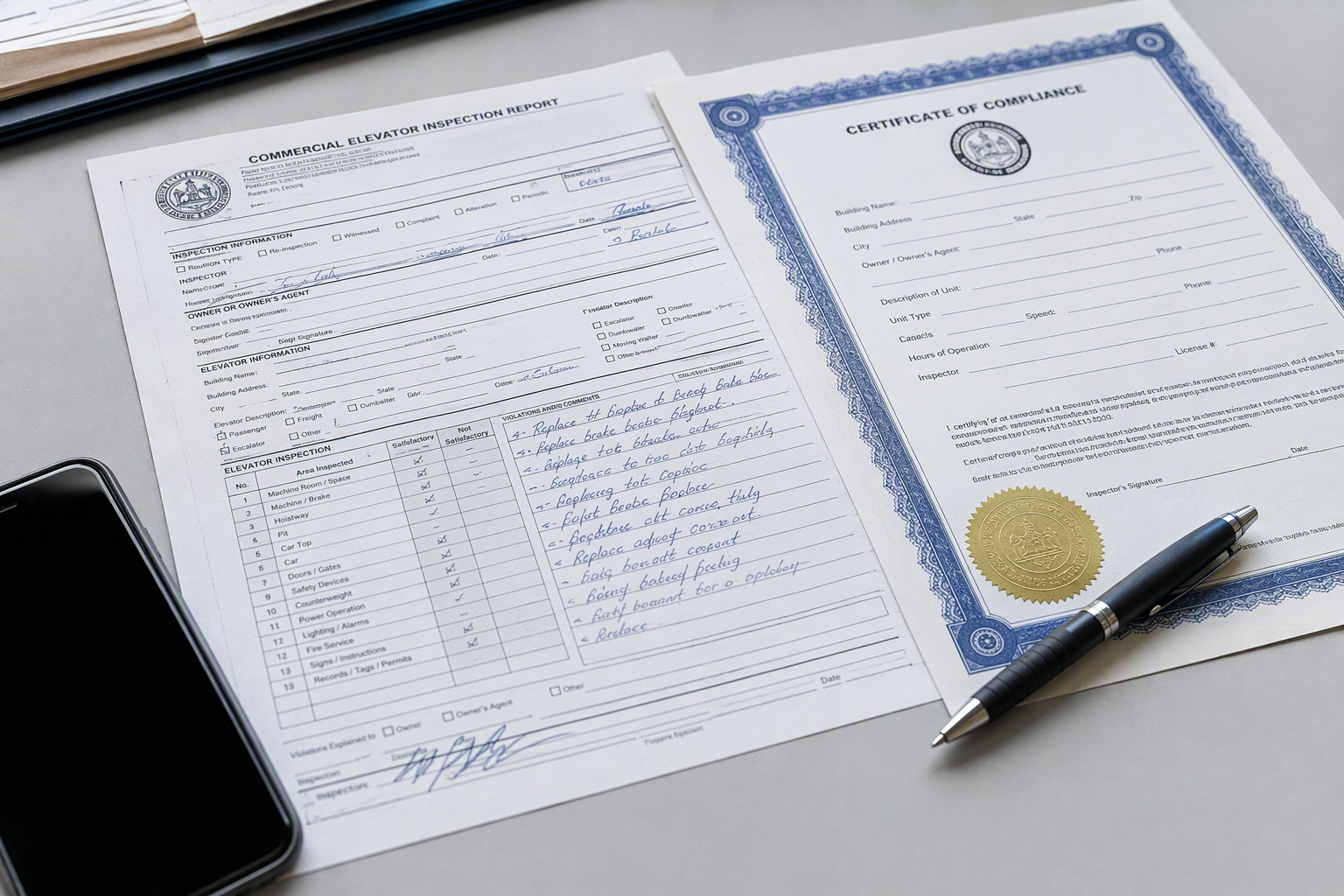
- Locate your most recent inspection report or Certificate of Compliance (Texas) / permit to operate (California)
- Contact AmeriTex Elevator by phone and describe the specific fault or cited violation
- Do not attempt to operate the elevator until a qualified technician confirms it is safe to do so
- If in Texas (outside Houston), verify whether a TDLR accident report is required — Texas owners must report accidents involving elevator equipment to TDLR within 24 hours
How does the quote request process differ for properties in Houston versus the rest of Texas?
Houston operates its own municipal elevator inspection and permitting program and is not regulated by TDLR, so repair quotes for Houston properties must account for the City of Houston’s requirements rather than TDLR’s rules.
For properties outside Houston city limits in Texas, the TDLR framework applies: building owners must maintain a TDLR Certificate of Compliance for each unit of equipment, valid for one year, and must display it in a publicly visible area of the building. Cited violations must be corrected or under contract to be corrected within 30 days of inspection, or the owner must obtain a waiver or delay from TDLR. When submitting a quote request for a Houston property, specifying that the property is within Houston city limits allows the service team to prepare documentation aligned with the correct local authority rather than defaulting to TDLR requirements that do not apply there.
How does the quote request process differ for properties in Los Angeles versus the rest of California?
Los Angeles operates its own elevator and conveyance inspection program through the City of Los Angeles Department of Building and Safety (LADBS), separate from the statewide Cal/OSHA Elevator Unit program.
Statewide, Cal/OSHA administers permits, inspections, and company certification under California Labor Code Sections 7300–7324.2 and the California Code of Regulations, Title 8, Elevator Safety Orders (Sections 3000–3146). Only State of California safety engineers and Certified Competent Conveyance Inspectors (CCCI) may perform elevator inspections under the state program. In Los Angeles, the LADBS program governs inspections for units within city jurisdiction. When submitting a quote request for a Los Angeles property, clearly identifying the address and whether the building has received notices from LADBS or Cal/OSHA ensures the responding team addresses the correct regulatory pathway. For properties elsewhere in California — San Diego, for example — the Cal/OSHA framework applies directly.
What regulatory compliance documentation will be needed to finalize a repair quote in California?
A complete repair quote for a California property typically requires the current Cal/OSHA permit to operate, any recent inspection reports, and confirmation of the unit’s current certification status.
California law requires every conveyance to be inspected at least once a year. Following a compliant inspection by a CCCI or state safety engineer, a permit to operate is issued for up to one year; units covered by a full maintenance contract with a C-11 licensed elevator company may receive a permit valid for up to two years. The permit to operate must be posted conspicuously in the elevator car. Work constituting a material alteration cannot begin without a Cal/OSHA alteration permit. Companies performing the repair must hold a Certified Qualified Conveyance Company (CQCC) certification from Cal/OSHA, supported by a current C-11 contractor license issued by the California Contractors State License Board (CSLB) and certificates of workers’ compensation and liability insurance. Mechanics performing work without supervision must be Certified Competent Conveyance Mechanics (CCCM). Having these documents available when submitting your quote request removes significant back-and-forth in the scoping process.
What regulatory compliance documentation will be needed to finalize a repair quote in Texas?
For Texas properties outside Houston, the primary documents are the current TDLR Certificate of Compliance, the most recent inspection report, and any active violation notices.
Texas building owners must have elevators inspected annually by a TDLR-registered elevator inspector — not a TDLR employee, but an independent registered professional chosen by the building owner. The inspector must deliver the inspection report within five calendar days of the inspection. Any cited violations must be corrected or under contract for correction within 30 days, unless a waiver or delay is obtained from TDLR. For electric traction elevators, the five-year Category 5 full-load test requirement adds a periodic testing obligation that may surface in a repair quote if the test is overdue. In Texas, contractors performing repair, alteration, testing, or maintenance of elevator equipment must be registered with TDLR. Knowing whether the current contractor is registered with TDLR is relevant if there is a need to transfer responsibility for outstanding violations or ongoing maintenance obligations.
What is the difference between a repair quote and a maintenance contract proposal?
A repair quote covers a defined, one-time scope of corrective or replacement work, while a maintenance contract proposal covers ongoing scheduled service, lubrication, adjustment, and safety testing over a specified contract term.
| Feature | Repair Quote | Maintenance Contract Proposal |
|---|---|---|
| Scope | Defined corrective or replacement task | Scheduled inspections, lubrication, adjustments, and callbacks |
| Duration | One-time event | Typically 1–5 year contract term |
| Pricing structure | Fixed or time-and-materials for specific work | Monthly or annual recurring fee |
| Regulatory impact (California) | Alteration permit may be required from Cal/OSHA | Full maintenance contract can extend permit validity to two years |
| Regulatory impact (Texas) | TDLR-registered contractor required; plan approval for major work | Contractor registration required; may affect violation correction timelines |
| ADA relevance | Repairs may trigger ADA path-of-travel compliance review | Ongoing maintenance supports ADA operational continuity |
| Best for | Cited violations, equipment failures, one-time upgrades | Preventive care, permit maintenance, long-term reliability |
Both request types can be submitted through the same web form. Noting whether the request is for a specific repair or for ongoing maintenance coverage helps the service team route the inquiry to the correct department and prepare the right type of proposal documentation.
Can I request a quote for elevator modernization through the website form?
Yes — the website form can initiate a modernization inquiry, though modernization projects require a more extensive on-site assessment and engineering review before a detailed proposal can be prepared.
Modernization involves replacing major systems — controls, machines, door operators, cab finishes, safety devices — and almost always constitutes a material alteration under both Texas and California regulations. In California, such work requires a Cal/OSHA permit before commencement. In Texas, plans must be submitted to TDLR for approval before the registered contractor begins installation. Modernization projects also bring existing equipment into conformance with the currently adopted code edition under ASME A17.3, Safety Code for Existing Elevators and Escalators, which addresses retroactive safety requirements. When submitting a modernization inquiry, including the make and model of the existing equipment, the current control system type (relay logic, solid-state, microprocessor), and any inspection deficiency reports gives the assessment team a meaningful head start before the on-site visit.
How does ADA compliance factor into an elevator repair or modernization quote?
ADA requirements under Title II and Title III of the Americans with Disabilities Act affect the design and feature specifications of any elevator accessible to the public, and repair or modernization scopes must account for applicable ADA standards to avoid creating new barriers or failing to remediate existing ones.
Key ADA considerations relevant to elevator repair quotes include door reopening device sensitivity, cab interior dimensions, control panel button height and Braille markings, floor designation announcements, and leveling accuracy. When an elevator undergoes alterations that affect usability, the ADA generally requires that the altered element be brought into compliance to the maximum extent feasible. This means a repair quote that addresses door operators, for example, may need to include an evaluation of whether the door timing and reopening function meets ADA standards — not simply whether the door closes without mechanical fault. Including ADA compliance scope in the initial quote request, particularly for public accommodations or government facilities in Houston, Dallas, Austin, San Antonio, Los Angeles, or San Diego, ensures the returned proposal addresses the full legal obligation.
What ASME standards govern the repair work that will be quoted?
New and altered elevator installations are governed by ASME A17.1/CSA B44, Safety Code for Elevators and Escalators, while work on existing installations may also reference ASME A17.3, Safety Code for Existing Elevators and Escalators.
The edition of ASME A17.1 adopted by the AHJ determines the technical requirements applied to new installations and material alterations. Texas has adopted the 2016 edition, effective November 1, 2018. California has adopted the 2004 edition for contracts signed on or after May 1, 2008; a rulemaking to incorporate elements of the 2019 edition (Group V) was the subject of a Standards Board public hearing on June 18, 2026, and no effective date has been posted as of 2026. When an existing elevator was built to an earlier edition, ASME A17.3 governs what retroactive safety upgrades are required. A technically qualified repair contractor must know which edition applies to a specific unit, because the answer determines which safety device tests, clearances, and component specifications the repair must satisfy. This code knowledge is part of the scoping work performed before a final quote is issued.
How should a property manager in San Antonio or San Diego submit a quote request differently than a building owner?
Property managers should include written authorization from the building owner in their submission where the repair scope may involve regulatory filings, because regulatory compliance obligations in both Texas and California rest with the building owner, not the managing agent.
In Texas, the building owner has the sole right to select the elevator inspector. The Certificate of Compliance is issued to the building owner, and violation correction obligations belong to the owner. In California, arranging the annual reinspection is the elevator owner’s responsibility. A property manager requesting a repair quote should clarify in the submission whether they have authority to authorize work and regulatory filings, or whether owner approval is required before scope and pricing can be confirmed. This prevents a situation where a detailed quote is prepared and then stalls because the signatory authority is unclear. Including the owner’s name and contact information in the submission, with the manager’s contact as the day-to-day point of coordination, is the cleanest way to structure the initial request.
What happens if my elevator has an open violation notice from an inspection — does that affect the quote process?
An open violation notice directly shapes the repair scope because the cited items must be corrected within the timeframes mandated by the relevant authority — and a compliant contractor must ensure the repair quote addresses those items explicitly.
In Texas (outside Houston), cited violations must be corrected or under contract to be corrected within 30 days of the inspection, or the owner must obtain a waiver or delay from TDLR. Attaching the violation notice to your quote request allows the service team to confirm that all cited items are included in the proposed scope and that the repair sequencing is designed to meet the 30-day correction deadline. In California, the permit to operate is tied to the unit being in safe condition; a unit operating under an active deficiency finding may face permit revocation. AmeriTex Elevator is familiar with violation-driven repair timelines in both regulatory environments, and submitting the inspection report with your quote request eliminates the need for a redundant data-gathering call before work can be scoped.
Can I submit a quote request for multiple elevators in one building at the same time?
Yes — submitting a single request that identifies all units in the building, including their individual unit identification numbers or permit numbers, is more efficient than submitting separate forms for each elevator.
Buildings with multiple elevators — mid-rise office towers, hospitals, hotels, and large residential complexes in Dallas, Houston, Los Angeles, and San Diego — often have mixed fleets combining different elevator types and vintages. A consolidated submission allows the service team to consider group pricing, scheduling efficiency, and whether a fleet-wide maintenance contract proposal would be more economical than unit-by-unit repair quotes. In California, each conveyance requires its own permit to operate, so the compliance documentation tracking needs to be organized by unit. Providing the Cal/OSHA permit number or TDLR Certificate of Compliance number for each unit in the submission allows the team to pull relevant regulatory history before the site visit.
Will submitting a repair quote request commit me to using AmeriTex Elevator for the work?
No — submitting a quote request is not a contractual commitment; it initiates the scoping and pricing process, and no work order is created until a proposal is reviewed, accepted, and authorized in writing.
Understanding the regulatory requirements before selecting a contractor is a reasonable due diligence step for any building owner or property manager. In California, work must be performed by a Certified Qualified Conveyance Company (CQCC), with mechanics holding Certified Competent Conveyance Mechanic (CCCM) certification. In Texas, the contractor must be registered with TDLR. Verifying that any contractor you are comparing holds the required registrations and certifications for your jurisdiction — Texas or California — before authorizing work is a sound practice that protects the building owner from liability. Requesting quotes from qualified providers and comparing scope, compliance knowledge, and proposed timelines is standard industry practice before committing to a contract.
How can I verify that the company responding to my quote request is qualified to work on my elevator?
Building owners and managers can verify contractor qualifications through the TDLR online license lookup for Texas properties or the Cal/OSHA CQCC certification records for California properties.
In Texas, TDLR maintains a public registry of registered elevator contractors. The contractor must carry general liability insurance of at least $1,000,000 per occurrence for bodily injury or death and $500,000 per occurrence for property damage, and must have designated one or two responsible parties with at least three years of elevator contractor experience. In California, the contractor must hold a C-11 Elevator Contractor license from the California Contractors State License Board (CSLB) and a Cal/OSHA CQCC certification — both verifiable through their respective public databases. All mechanics working without supervision on California conveyances must hold individual CCCM certification from Cal/OSHA, and CQCC/CCCM certificates are valid for two years and require at least eight hours of continuing education for renewal. AmeriTex Elevator operates across both California and Texas markets and maintains the registrations and certifications required by each state’s regulatory framework.
What should I do after receiving a repair quote to move the process forward efficiently?
Review the proposed scope against any open violation notices or inspection report findings, confirm that the work description addresses the cited deficiencies specifically, verify the contractor’s registration status, and return the signed authorization along with any required regulatory documentation as promptly as possible.
Steps to take after receiving a repair quote:
- Compare each line item in the quote against the inspection report or violation notice to confirm full coverage
- Verify that the contractor is TDLR-registered (Texas) or Cal/OSHA CQCC-certified (California) before signing
- Confirm whether a regulatory permit or plan submission is required before work can start
- In Texas, ensure the work will be completed or under contract within 30 days of the inspection date if violations were cited
- In California, confirm whether the proposed work constitutes a material alteration requiring a Cal/OSHA permit
- Return the signed work authorization along with copies of the current permit to operate or Certificate of Compliance
- Schedule the post-repair inspection with the appropriate authority — Cal/OSHA or TDLR-registered inspector — before the repair team demobilizes
Moving through these steps promptly is especially important when a violation correction deadline is approaching or when the elevator is currently out of service. AmeriTex Elevator’s service teams in Houston, Dallas, Austin, San Antonio, Los Angeles, and San Diego are structured to coordinate regulatory filings alongside repair execution so that the compliance pathway and the physical repair proceed in parallel rather than sequentially.
Contact AmeriTex Elevator for a free elevator assessment at 844-646-9660.
Need elevator service you can rely on? AmeriTex Elevator is ready to help.