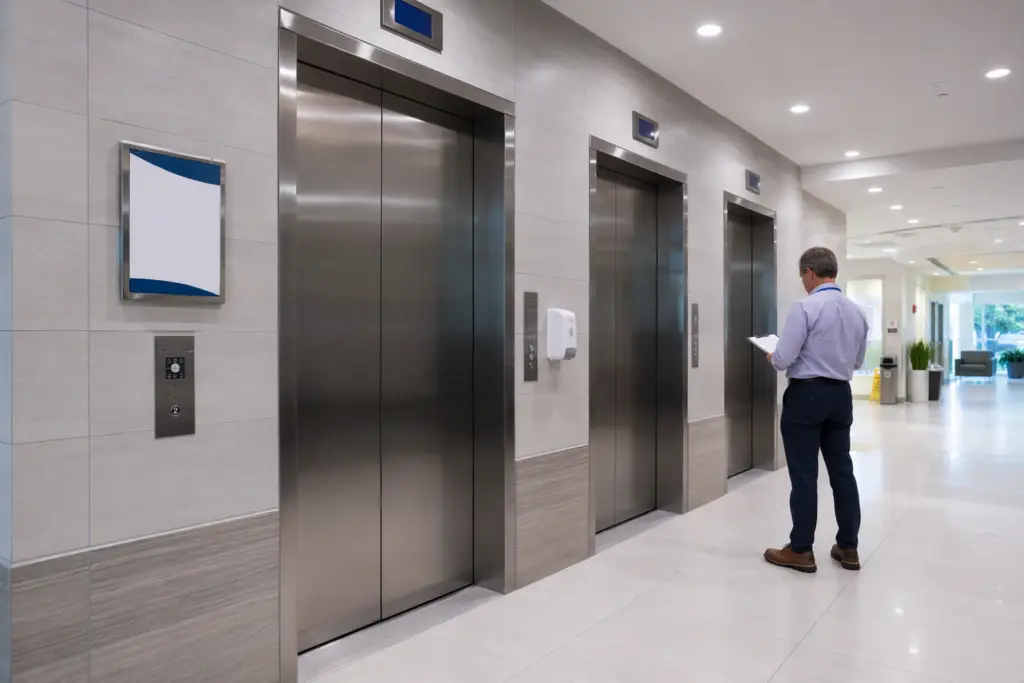
ADA Elevator: Requirements, Compliance, and What Building Owners Must Know
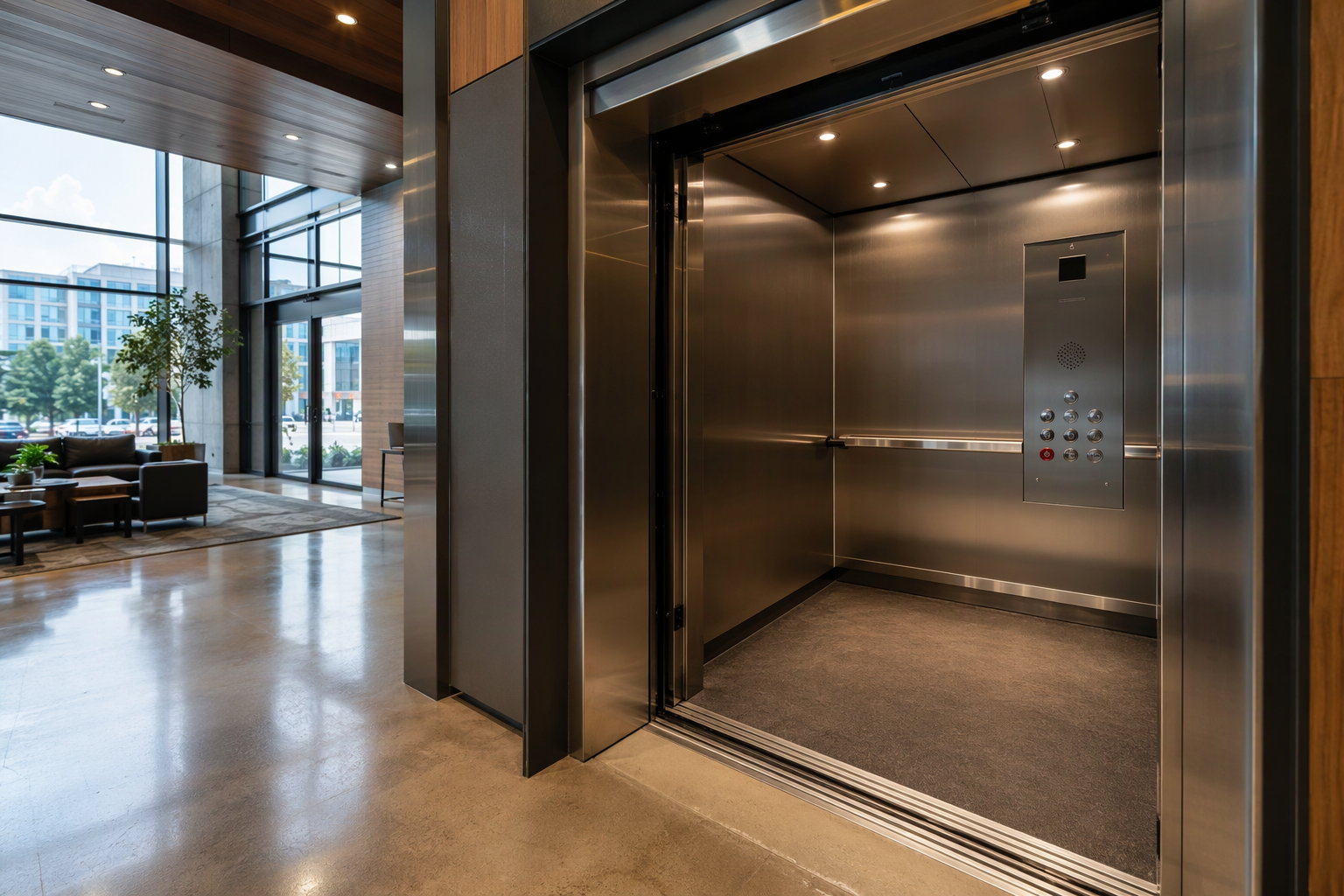
The Americans with Disabilities Act (ADA) establishes minimum accessibility requirements for elevators in public accommodations, commercial facilities, and state and local government buildings. For building owners and facility managers in Texas and California, understanding these requirements is not optional — non-compliance exposes a property to federal civil rights complaints, barrier-removal obligations, and significant liability. This hub page answers the most common questions about ADA elevators, from dimensional requirements and inspection timelines to retrofit strategies and local regulatory nuances across the markets AmeriTex Elevator serves.
What Is an ADA Elevator?

An ADA elevator is any passenger elevator in a covered facility that conforms to the accessibility requirements of the ADA Standards for Accessible Design, ensuring independent use by people with mobility, visual, and cognitive disabilities.
The ADA does not define a separate “type” of elevator equipment. Instead, it specifies performance requirements — dimensions, clearances, controls, and communication — that an existing or new elevator must meet. The 2010 ADA Standards for Accessible Design, which reference the technical specifications originally developed by ANSI/ICC A117.1, govern new construction and alterations. Those standards are enforced by the U.S. Department of Justice for Title II (state and local government) and Title III (places of public accommodation and commercial facilities) entities.
Separately, the federal ASME A17.1 Safety Code for Elevators and Escalators governs the mechanical and safety engineering of elevator equipment. In Texas, TDLR has adopted the ASME A17.1/CSA B44, 2016 edition. In California, Cal/OSHA adopted the 2004 edition (effective May 1, 2008) for installation contracts signed on or after that date. ADA accessibility requirements layer on top of — and do not replace — these safety codes.
Who Is Required to Have an ADA-Compliant Elevator?
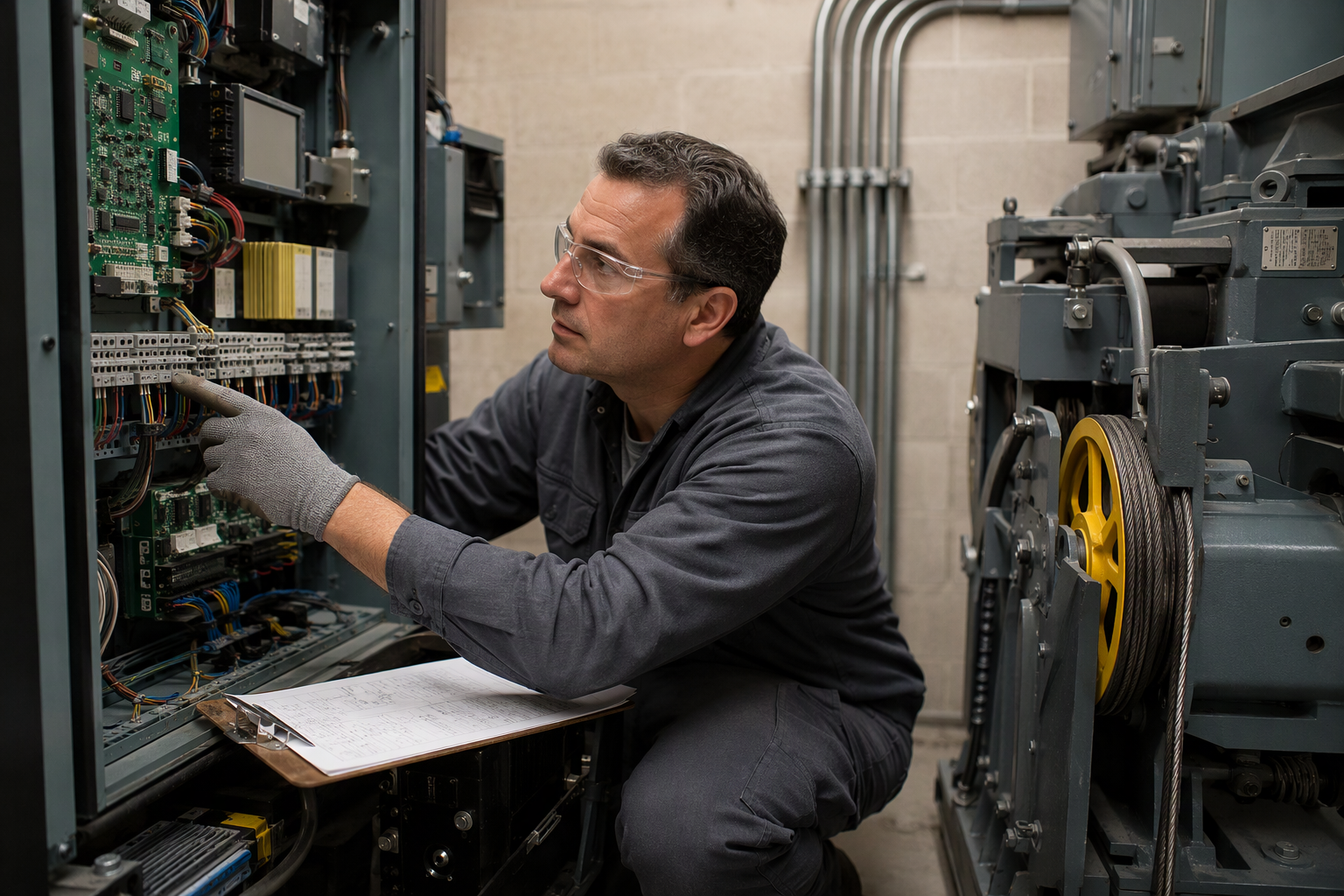
Most multi-story public accommodations, commercial facilities, and state or local government buildings are required to provide accessible elevator service, with a limited exemption for certain small private structures.
Under the ADA, buildings that are places of public accommodation or commercial facilities are generally required to provide elevator access to all floors unless the building has fewer than three stories or has fewer than 3,000 square feet per story. This “elevator exemption” does NOT apply to shopping centers, shopping malls, the professional offices of a healthcare provider, or transit stations — those must have elevators regardless of size. State and local government facilities under Title II have no comparable exemption and must provide program accessibility to people with disabilities on all floors.
In practice, any multi-story office building, hotel, hospital, retail complex, or government facility in Houston, Dallas, Austin, San Antonio, Los Angeles, or San Diego almost certainly falls within elevator coverage. Building owners who are uncertain whether the exemption applies should consult qualified legal counsel and schedule a physical accessibility audit.
What Are the Minimum Dimensional Requirements for an ADA Elevator?
The 2010 ADA Standards require that accessible elevator cars provide a clear floor area that allows a wheelchair user to enter, maneuver to the controls, and exit — with specific minimums depending on door location and car configuration.
The following table summarizes the key dimensional benchmarks from the 2010 ADA Standards for Accessible Design for elevator cars:
| Requirement | Minimum Dimension | Notes |
|---|---|---|
| Clear door width | 36 inches (915 mm) | Applies to the clear opening when doors are fully open |
| Car interior — inside door, centered | 80 in. wide × 51 in. deep (2032 mm × 1295 mm) | Most common single-entrance configuration |
| Car interior — inside door, offset | 80 in. wide × 51 in. deep (2032 mm × 1295 mm) | Door centered on the narrower wall |
| Car interior — through-car (front/rear doors) | 80 in. wide × 54 in. deep (2032 mm × 1370 mm) | Requires 54 in. depth for forward approach |
| Floor-to-ceiling height | 80 inches (2032 mm) minimum | Measured from finished floor |
| Call button height — lowest | 15 inches (380 mm) AFF | Above finished floor (AFF) |
| Call button height — highest | 48 inches (1220 mm) AFF | Forward reach; side reach may allow up to 54 in. |
| Hall call button diameter | ¾ inch (19 mm) minimum | Must be raised or flush |
| Door reopening device — obstruction zone | 5 in. (127 mm) to 29 in. (737 mm) AFF | Detects obstruction without physical contact |
| Leveling tolerance | ½ inch (13 mm) maximum | Between car floor and landing floor |
These dimensions represent federal minimums. Local building codes or state accessibility standards may impose stricter requirements. Building owners in California and Texas should verify that their local authority having jurisdiction (AHJ) has not adopted more stringent dimensions through a locally amended building code.
What Controls and Signage Does an ADA Elevator Need?
ADA-compliant elevators must have raised and Braille floor designations, audible signals, hall and car call buttons of specified size and placement, and visual floor indicators — all designed to be operable without tight grasping, pinching, or twisting of the wrist.
The 2010 ADA Standards specify that car control buttons must be ⅝ inch (16 mm) minimum in their smallest dimension, raised or flush, and equipped with Braille designations immediately to the left of the button. Floor designation characters in cars must be raised and in Braille, centered 60 inches (1525 mm) above the finished floor, on both jambs of each hoistway entrance. Hall call buttons must illuminate when activated and remain illuminated until the car arrives.
Audible signals at each hoistway entrance must announce the floor level and direction of travel. The signal must sound once for up and twice for down, or use a verbal announcement. The minimum audible level is 10 dB above ambient but not more than 80 dB. Visual car position indicators (digital or analog) must be provided in the car when the building has more than 16 stories; for shorter buildings they remain best practice and are frequently required by local amendments.
What Are the ADA Requirements for Elevator Emergency Communication?
The ADA requires a two-way communication system inside the elevator car so that a person with a disability who needs assistance can contact building staff or emergency services without relying solely on voice communication.
The 2010 ADA Standards require that the emergency communication device be usable with closed fists — meaning push buttons, not telephone handsets that require gripping. The device must include both visible and audible signals to acknowledge that the call has been received. This is particularly significant for people who are deaf or hard of hearing: a visual confirmation that a call has been connected is a federal accessibility requirement.
California’s elevator regulatory framework adopted ASME A17.1/CSA B44-2004 through its Elevator Safety Orders (California Code of Regulations, Title 8, Sections 3000–3146), and the state has proposed a Group V update. For current emergency communication requirements in California buildings, owners should consult Cal/OSHA’s Elevator Unit and their local building department, as requirements may vary by jurisdiction.
In Texas, TDLR has adopted ASME A17.1/CSA B44-2016. Building owners should work with a registered elevator contractor to confirm that their communication system satisfies both the mechanical code requirements and the ADA accessibility standards simultaneously, since the two frameworks address the same hardware from different regulatory angles.
Does the ADA Apply to Existing Elevators, or Only New Construction?
The ADA applies to both new construction and existing elevators — new construction must be fully compliant from the outset, while existing facilities are required to remove barriers when doing so is “readily achievable.”
For Title III entities (places of public accommodation), the ADA imposes an ongoing “readily achievable barrier removal” obligation on existing facilities regardless of when they were built. “Readily achievable” means accomplishable without significant difficulty or expense, and courts have consistently found that most elevator control, signage, and leveling corrections meet this threshold for profitable commercial properties. When a building undergoes an alteration that affects usability — such as a lobby renovation or a modernization that touches the elevator entrance — the altered portion must be brought to full compliance with the 2010 ADA Standards.
For Title II entities (government buildings), program accessibility must be provided regardless of whether barrier removal is “readily achievable” — the obligation is broader. In practical terms, any government building in Austin, San Antonio, Dallas, Houston, Los Angeles, or San Diego that cannot demonstrate accessible vertical circulation to program areas is at risk of a complaint to the U.S. Department of Justice or a private lawsuit.
AmeriTex Elevator provides elevator accessibility assessments for building owners who need to determine what modifications are necessary to meet current ADA standards before undertaking a broader modernization project.
What Is the Difference Between ADA Compliance and Elevator Safety Code Compliance?
ADA compliance governs accessibility for people with disabilities and is enforced through civil rights law, while elevator safety code compliance governs mechanical integrity and is enforced by state regulatory agencies through permits and inspections.
The two frameworks are independent but intersecting. A building can have a mechanically sound elevator — fully permitted by TDLR in Texas or by Cal/OSHA in California — that nonetheless violates the ADA because control buttons are mounted too high or Braille designations are missing. Conversely, an elevator can be dimensionally accessible but fail a safety inspection for unrelated mechanical reasons. Building owners must maintain compliance under both regimes simultaneously.
State safety inspectors check mechanical performance, leveling, door operation, firefighters’ service, and other safety-critical systems under the adopted edition of ASME A17.1. ADA compliance is typically assessed by an accessibility consultant, an architect, or a certified elevator company reviewing the facility against the 2010 ADA Standards. AmeriTex Elevator’s technicians are trained to identify ADA-related deficiencies alongside safety-code deficiencies during routine service visits, allowing building owners to address both in a coordinated scope of work.
Are Platform Lifts an Acceptable ADA Alternative to Elevators?
Platform lifts are permitted as an accessible means of vertical access under specific, limited circumstances in the ADA Standards — they do not provide the same level of independent access as a full elevator and are not an acceptable general substitute.
The 2010 ADA Standards permit platform lifts in new construction only in defined situations, including: to provide an accessible route to a performing area in an assembly occupancy, to a speaker’s platform, within a dwelling unit, to a team or player seating area in a sports facility, or where existing site constraints make elevator installation technically infeasible. In alterations, platform lifts may be used more broadly when a full elevator cannot be incorporated. Platform lifts must comply with ASME A18.1 Safety Standard for Platform Lifts and Stairway Chairlifts.
In Texas, platform lifts are regulated under TDLR’s elevator and escalator program and require the same registration, inspection, and Certificate of Compliance process as passenger elevators. In California, they fall under the Cal/OSHA Elevator Safety Orders. Building owners considering a platform lift as an accessibility solution should understand that the ADA’s intent is to provide equivalent, independent access — a lift that requires a key, attendant assistance, or that is not independently operable by a person in a wheelchair does not satisfy the standard.
How Do Texas ADA Elevator Requirements Differ from California Requirements?
Texas and California both enforce the federal ADA on top of their own state elevator safety frameworks, but the two states differ significantly in which edition of ASME A17.1 they have adopted, how they regulate elevator contractors, and which local authorities run their own programs.
Texas, through TDLR under Texas Health and Safety Code Chapter 754 and 16 Texas Administrative Code Chapter 74, has adopted ASME A17.1/CSA B44-2016. California, through Cal/OSHA under California Labor Code Sections 7300–7324.2 and California Code of Regulations, Title 8, Sections 3000–3146, has adopted the 2004 edition for equipment installed on or after May 1, 2008. The different code editions mean that some specific technical provisions — such as those governing door reopening devices or communication systems — are written differently in the two states.
Contractor qualifications also differ materially. In California, any company that installs, alters, or maintains elevators must hold both a C-11 Elevator Contractor license from the California Contractors State License Board and a Certified Qualified Conveyance Company (CQCC) certification from Cal/OSHA. In Texas, elevator contractors must register with TDLR and carry minimum general liability insurance of $1,000,000 per occurrence. Both states also have local authority wrinkles: Houston runs its own elevator program and TDLR does not regulate elevators inside Houston city limits; Los Angeles runs its own inspection program through the Los Angeles Department of Building and Safety (LADBS). Building owners in those cities work with their respective city programs rather than the state agency.
What Happens During an ADA Elevator Inspection or Assessment?
An ADA elevator assessment is a systematic, dimension-by-dimension review of the elevator and its approach against the 2010 ADA Standards — it is distinct from a state safety inspection and focuses entirely on accessibility performance.
A thorough ADA accessibility assessment of an elevator system typically proceeds through the following steps:
- Review the building drawings and existing permits to understand what code edition applied at time of original installation or last alteration.
- Measure all approach and maneuvering clearances at each hoistway entrance on every floor, including turning radius space for wheelchair users.
- Measure the clear door opening width with doors in the full-open position.
- Measure interior car dimensions: width, depth, and ceiling height.
- Test the door reopening device for sensitivity and obstruction zone coverage (5 to 29 inches AFF).
- Measure and test floor leveling accuracy — the gap between car floor and landing must not exceed ½ inch.
- Verify car and hall control button dimensions, mounting heights, illumination, and raised/Braille designations on both jambs.
- Test audible signals for floor announcements and direction indicators, and measure sound levels relative to ambient noise.
- Test the two-way emergency communication system, including visual signal confirmation.
- Document all deficiencies with photographs, measurements, and applicable ADA Standard section references, then produce a prioritized barrier removal report.
AmeriTex Elevator conducts these assessments across its Texas and California markets, providing building owners with a written report they can use to plan a compliant modernization scope.
What Is an ADA Elevator Modernization and What Does It Typically Involve?
An ADA elevator modernization is a targeted upgrade project that brings an existing elevator’s accessibility features into conformance with current ADA Standards — often performed alongside or as part of a broader mechanical modernization.
Common work items in an ADA-focused modernization include: replacing or repositioning car operating panels to bring button heights within the 15-to-48-inch AFF range; installing new Braille and raised-character jamb signage on all floors; upgrading the door reopening device to a non-contact model that detects obstructions throughout the required zone; replacing the emergency communication system with a compliant two-way device that provides both audible and visual confirmation; and improving floor leveling accuracy through controller or selector adjustments. If the existing cab is undersized — a common situation in pre-ADA buildings — structural changes to the hoistway or cab may be required, which significantly increases project scope and cost.
Modernization projects in Texas require prior plan submission to and approval from TDLR (or the City of Houston, for Houston properties) before work begins. In California, a permit from Cal/OSHA is required before a conveyance is materially altered. All modernization work in California must be performed by a Certified Qualified Conveyance Company (CQCC) using Certified Competent Conveyance Mechanics (CCCM). AmeriTex Elevator holds the required state authorizations to perform this work in both Texas and California markets.
How Often Must an ADA Elevator Be Inspected in Texas and California?
Both Texas and California require annual elevator inspections by qualified inspectors — these safety inspections do not replace the owner’s separate obligation to maintain ADA accessibility, but deficiencies identified during inspection can trigger the barrier removal timeline.
In Texas, building owners must have elevators inspected annually by a TDLR-registered elevator inspector and obtain a TDLR Certificate of Compliance for each unit, valid for one year. The Certificate of Compliance must be displayed in a publicly visible area. Texas owners must have violations corrected or under contract to be corrected within 30 days of inspection. Texas law also requires a Category 5 full-load test every five years on electric traction elevators. Note: TDLR does not regulate elevators inside the City of Houston — Houston building owners work with the City of Houston’s own program.
In California, every elevator must be inspected at least once a year by either a Cal/OSHA safety engineer or a Certified Competent Conveyance Inspector (CCCI). The permit to operate is valid for up to one year; Cal/OSHA may issue a permit for up to two years for an elevator in safe condition covered by a full maintenance contract with a C-11 licensed elevator company. The permit to operate must be posted conspicuously in the elevator car. Arranging the annual reinspection is the elevator owner’s responsibility. Los Angeles building owners should contact LADBS directly, as Los Angeles operates its own elevator inspection program.
What Are the ADA Requirements for Elevator Door Timing and Operation?
ADA-compliant elevator doors must remain open long enough for a person using a wheelchair or mobility aid to enter or exit without the door striking them, and the closing force must be limited so that contact with a passenger causes the door to reopen.
The 2010 ADA Standards require that the door remain open for at least 3 seconds for a car call and at least 5 seconds for a hall call before the door begins to close. This timing is measured from when the doors are in the fully open position. Door reopening devices must detect an obstruction throughout the zone from 5 inches to 29 inches above the finished floor without requiring physical contact — optical or infrared sensors are the standard means of compliance. The maximum closing force for a power-operated swinging door is 5 lbf; horizontal sliding car and hoistway doors must reopen upon contact with any obstruction.
These timing and force requirements are frequently out of specification in older elevators because door operator components wear over time and because previous service adjustments may have been optimized for speed rather than accessibility. During a maintenance visit, a qualified technician should verify door open/close timing with a stopwatch and test door reversal behavior to confirm continued ADA conformance.
Can a Historic Building Be Exempt from ADA Elevator Requirements?
Historic buildings are not automatically exempt from ADA elevator requirements, but the law allows alternative means of access when full compliance would threaten or destroy the building’s historic significance as determined by the State Historic Preservation Officer or Advisory Council on Historic Preservation.
The 2010 ADA Standards include provisions for historic buildings and facilities. When a building is listed in or eligible for the National Register of Historic Places, or is designated as historic under state or local law, an entity may consult with the relevant preservation authority. If full compliance with elevator accessibility requirements would threaten or destroy historically significant features, alternative accessible routes may be accepted. The alternative must still provide equivalent facilitation — meaning a person with a disability must be able to reach the same programs or services that are available to non-disabled individuals, even if by a different route.
This exemption is narrower than many building owners assume. The burden is on the building owner to document that compliance would threaten historic significance, obtain the relevant authority’s concurrence, and demonstrate that the alternative provides genuine equivalent access. Generic claims about a building’s age or cost of retrofit are insufficient.
What Is the ADA Two-Way Communication Requirement for Elevators?
The ADA requires a two-way communication system inside every accessible elevator car that enables users — including those who are deaf or hard of hearing — to summon emergency assistance using a system that provides both audible and visual confirmation that the call has been received.
The 2010 ADA Standards require that the two-way communication device be located 15 to 48 inches above the finished floor, be operable with a closed fist, and include a visual signal to acknowledge that a call has been received and to show when the call is connected. The intent is that a person who cannot use voice communication — including someone who is deaf, hard of hearing, or has a speech impairment — must be able to summon and confirm emergency assistance independently.
Many older two-way systems consist only of a telephone handset or a simple call button with no visual confirmation, and these fall short of the standard. Upgrading to a compliant system typically involves installing a modern intercom panel with LED indicators or a text-based visual display. The specific technical requirements for two-way communication systems under California’s adopted code edition and local amendments are unsettled; building owners in California should consult Cal/OSHA and their local AHJ for current requirements. AmeriTex Elevator can evaluate existing communication systems and recommend compliant upgrades across all markets it serves.
What Are the ADA Wayfinding Requirements at Elevator Lobbies?
The ADA requires that elevator lobbies, hall call buttons, and hoistway entrance signage be accessible to people who are blind or have low vision, including raised characters, Braille designations, and proper placement so that a person can locate them by touch without inadvertently stepping into the path of doors.
Specifically, the 2010 ADA Standards require that raised floor designations (numbers or letters) in Braille and standard alphabet characters be located on both jambs at each elevator entrance, centered 60 inches (1525 mm) above the finished floor. The characters must be a minimum of ⅝ inch and maximum 2 inches high. Where the elevator serves more than one floor with the same designation (such as mezzanine and main level), the designation must distinguish the floors. Hall call buttons must be located 15 to 48 inches AFF and must illuminate when activated.
In multi-elevator lobbies, each elevator must have its own jamb signage, and an accessible route to and from each elevator must be maintained. Floor surfaces in the approach area must be stable, firm, and slip-resistant under ASME A17.1 and applicable building codes. AmeriTex Elevator technicians routinely identify missing or damaged jamb signage during service calls, as these components are often overlooked during periodic maintenance.
What Should a Building Owner Do After Receiving an ADA Elevator Violation Notice?
Upon receiving an ADA elevator violation notice — whether from a federal complaint, a state inspection citation, or an internal audit — the building owner should immediately document the deficiency, engage a qualified elevator contractor, and develop a written remediation plan with a realistic timeline.
The recommended response sequence is:
- Obtain the full complaint or inspection report and identify every cited deficiency with its specific ADA Standard or state code section reference.
- Engage a qualified, registered elevator contractor immediately — in Texas, a TDLR-registered contractor; in California, a CQCC-certified company.
- Conduct a physical field measurement to confirm the scope and prioritize safety-critical items (leveling, door operation, emergency communication) over cosmetic signage items.
- Obtain written quotes and a scope of work from the contractor that maps each work item to the specific deficiency cited.
- In Texas, ensure violations are corrected or under a binding correction contract within 30 days of inspection, per TDLR requirements, or obtain a formal waiver or delay from TDLR.
- In California, do not operate the elevator if Cal/OSHA has issued a stop-use order; obtain the required alteration permit before beginning any material modification.
- After repairs, request a re-inspection or file documentation with the relevant AHJ confirming completion.
- Retain all inspection reports, work orders, and permits in the building’s maintenance file for a minimum of the period required by state law.
AmeriTex Elevator is experienced in coordinating with TDLR, Cal/OSHA, and local authorities to move buildings from citation to compliance efficiently.
How Does ADA Compliance Affect Elevator Permit Applications in Texas and California?
ADA compliance does not replace the state permit process — in both Texas and California, elevator alterations require regulatory approval before work begins, and ADA accessibility requirements must be incorporated into the scope submitted for permit review.
In Texas, any registered elevator contractor must submit plans to TDLR and obtain approval before installing or making a material alteration to an elevator. The plan submission should reflect the full scope, including all accessibility modifications, so that the inspector reviewing the completed work can evaluate both mechanical safety and dimensional compliance simultaneously. In Houston, the city’s own program governs the permit process, and owners should contact the City of Houston directly for current submission requirements.
In California, a permit from Cal/OSHA is required before a conveyance is erected, installed, or materially altered. All work must be performed by a CQCC-certified company using CCCM-certified mechanics. The annual reinspection and permit-to-operate process is separate from the alteration permit — a building that has undergone modernization will require a new permit to operate before the elevator is returned to service. In Los Angeles, the LADBS runs its own elevator program; owners should contact LADBS for city-specific requirements.
What Are the Most Common ADA Elevator Deficiencies Found During Assessments?
The most common ADA elevator deficiencies discovered during professional accessibility assessments involve control panel mounting heights, missing or damaged Braille signage, non-compliant door reopening devices, inadequate floor leveling, and two-way communication systems that lack visual confirmation.
Control panels installed in older buildings were typically designed to maximize convenience for average-height standing adults, with top buttons placed at or above 54 inches AFF — above the 48-inch forward-reach maximum required by the ADA. Braille jamb designations are frequently missing on floors added after original installation or damaged by routine cleaning and painting. Door reopening devices on older elevators often rely on a single safety edge rather than the non-contact sensor required to detect obstructions throughout the full 5-to-29-inch zone. Floor leveling drift is common in hydraulic elevators as cylinder seals age and in traction elevators as rope stretch accumulates over time. Emergency communication panels that use handset-style telephones without visual LED confirmation are a persistent deficiency in buildings constructed before 2000. Each of these items is correctable through targeted maintenance or modernization work and should be part of any building owner’s routine accessibility review.
How Can Building Owners Proactively Maintain ADA Elevator Compliance Over Time?
Proactive ADA elevator compliance requires integrating accessibility checks into the regular preventive maintenance schedule, keeping records of all inspections and repairs, and planning for periodic modernization as components age and standards evolve.
A maintenance-driven compliance approach means that every scheduled service visit should include verification of door timing, leveling accuracy, control panel illumination, and emergency communication function — not just mechanical lubrication and safety device testing. Braille and raised-character jamb signs should be inspected for damage during every visit, since they are vulnerable to paint overspray, cleaning chemicals, and physical contact. Building owners should also retain copies of their state inspection reports (TDLR Certificate of Compliance in Texas; Cal/OSHA permit to operate in California) alongside their most recent ADA assessment report, so that any future complaint or enforcement inquiry can be addressed with documented proof of ongoing compliance efforts.
As elevator systems age and components are replaced, each alteration creates an opportunity — and in some cases a legal obligation — to bring the entire altered path of travel into current ADA Standards. AmeriTex Elevator works with building owners across Houston, Dallas, Austin, San Antonio, Los Angeles, and San Diego to build ADA compliance checkpoints into every maintenance contract, reducing the likelihood of a complaint-driven remediation and the costs that accompany it.
Contact AmeriTex Elevator for a free elevator assessment at 844-646-9660.
Need elevator service you can rely on? AmeriTex Elevator is ready to help.