ADA Elevator Requirements for Multifamily Housing: What Building Owners Need to Know
Multifamily property owners and managers in Houston, Dallas, Austin, San Antonio, Los Angeles, and San Diego face a layered compliance landscape. Federal accessibility law sets the floor; state elevator safety codes set the operational framework; and local authorities having jurisdiction (AHJs) can add further requirements. Getting any layer wrong can mean failed inspections, civil liability, or an elevator taken out of service. The sections below break down each requirement clearly so ownership teams can plan confidently.
What Federal Law Actually Requires for Elevators in Multifamily Buildings?
Two federal statutes govern elevator accessibility in multifamily housing: the Americans with Disabilities Act (ADA) and the Fair Housing Act (FHA). Understanding which applies to your property is the starting point for every compliance conversation.
The ADA covers places of public accommodation and commercial facilities. In a multifamily context, this means common areas open to the public—leasing offices, fitness centers, rooftop amenities—rather than private residential units themselves. When those common-use spaces are located on floors above grade, an accessible elevator or lift is typically required as part of the accessible route.
The Fair Housing Act applies broadly to residential buildings with four or more units constructed for first occupancy after March 13, 1991. Under FHA design and construction requirements, buildings with one or more elevators must provide accessible common and public use areas, accessible routes into and through covered dwelling units, and usable kitchens and bathrooms. Elevators serving those buildings must comply with the FHA accessibility guidelines.
Key dimensional and operational requirements under federal accessibility guidelines include:
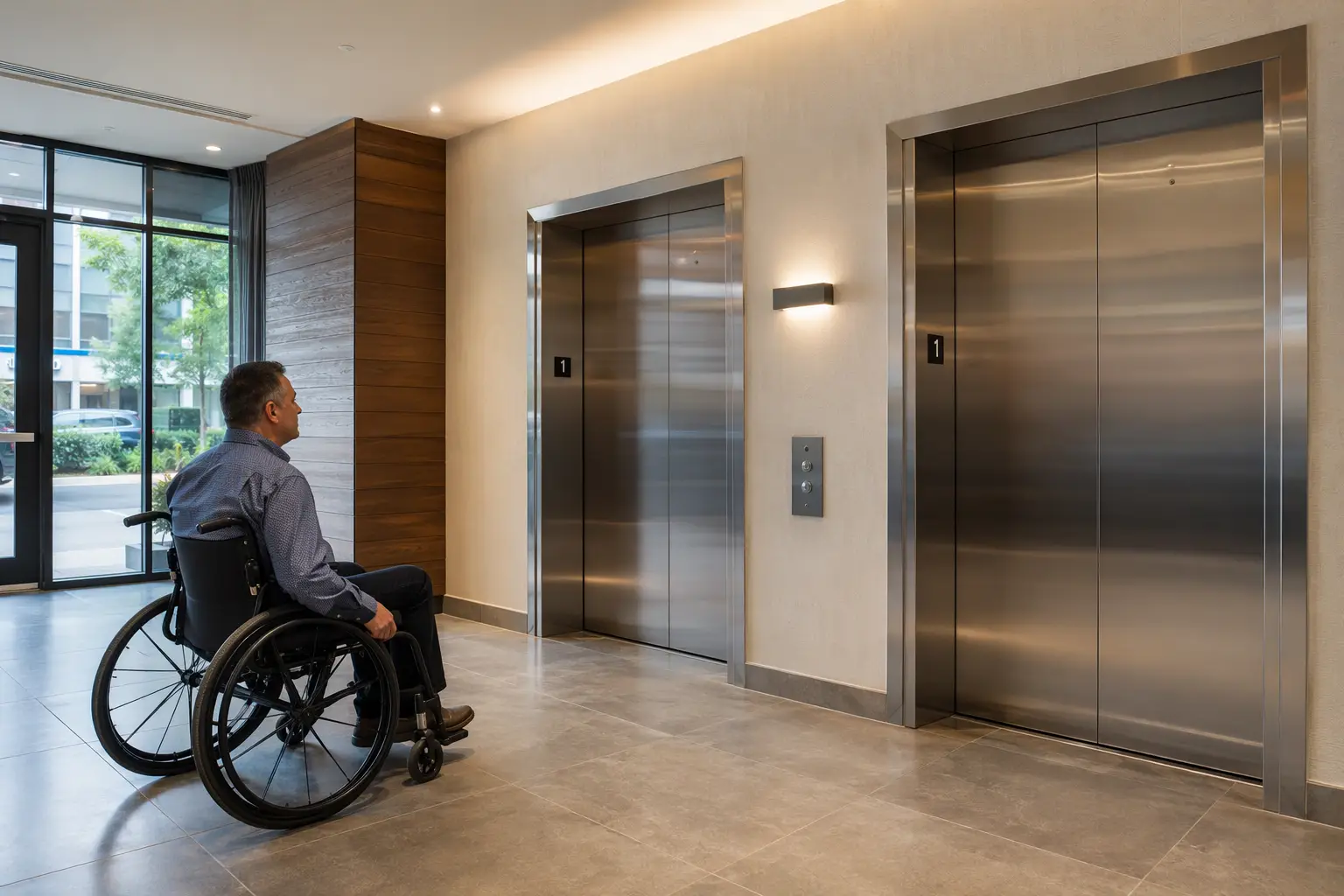
- Car interior dimensions: Elevator cars must be large enough to allow a wheelchair to enter, maneuver, and exit—typically a minimum clear floor area of 51 inches deep by 68 inches wide or equivalent configurations depending on door placement.
- Door clear width: A minimum 36-inch clear opening width is required.
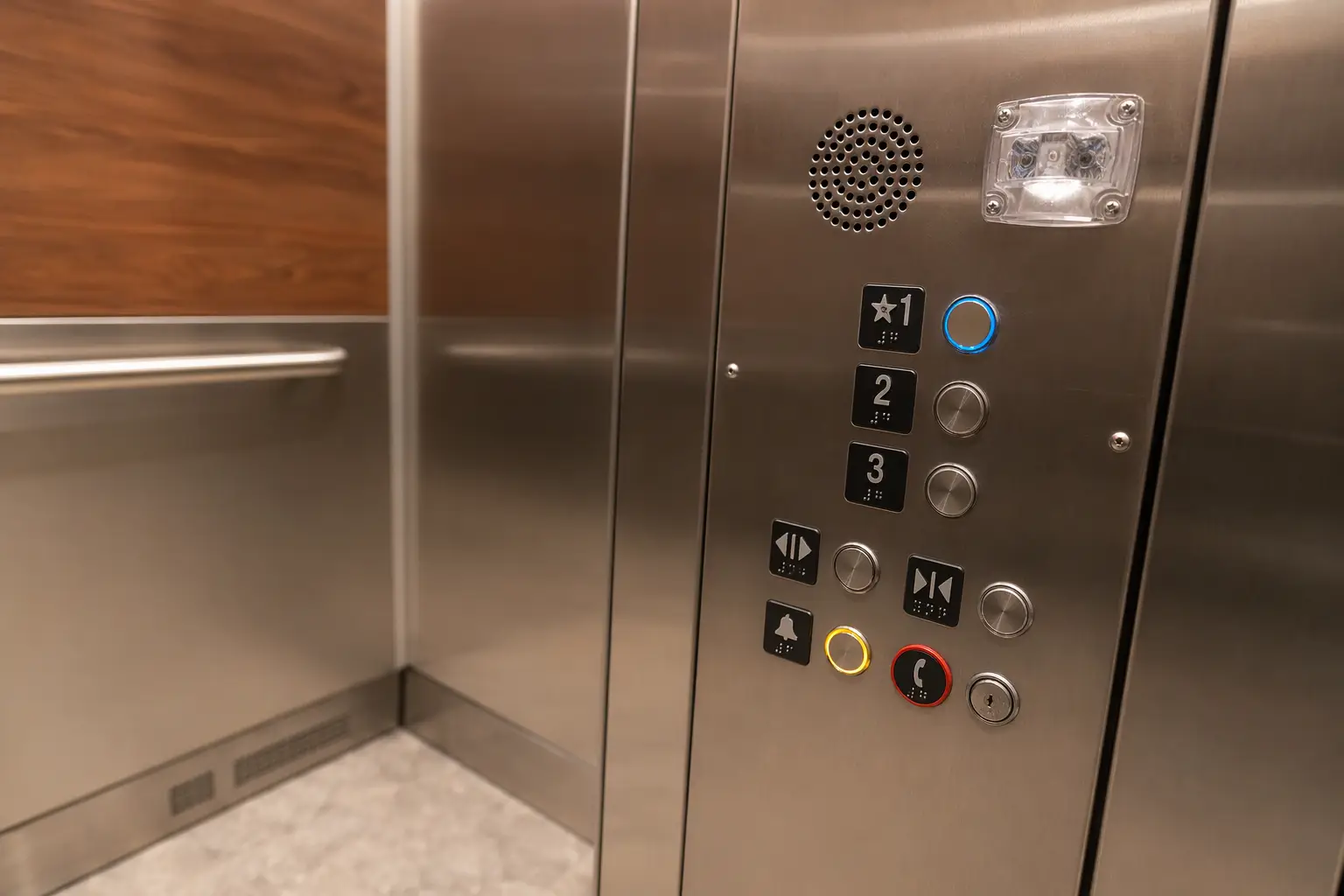
- Control panel height: All operable controls must be reachable from a wheelchair, with reach ranges defined in the applicable accessibility guidelines.
- Two-way communication: An emergency two-way communication system must be provided in every accessible elevator car. The system must be both audible and visual for users who are deaf or hard of hearing.
- Floor level identification: Raised and Braille floor designations are required at each hoistway entrance.
- Door timing: Doors must remain open long enough to allow a person using a mobility device to enter or exit safely.
AmeriTex Elevator evaluates existing elevator cars against these federal benchmarks during accessibility assessments, identifying gaps before an inspection or a complaint surfaces them.
How Does ASME A17.1 Relate to ADA Compliance in Multifamily Properties?

The ASME A17.1 Safety Code for Elevators and Escalators governs the mechanical, electrical, and structural safety of elevator equipment. It is not an accessibility standard, but it is the foundation on which every state elevator safety program in Texas and California is built.
Texas has adopted the ASME A17.1/CSA B44, 2016 edition, as amended by 16 Texas Administrative Code Chapter 74, effective November 1, 2018, administered by the Texas Department of Licensing and Regulation (TDLR) Elevator and Escalator Safety program under Texas Health and Safety Code Chapter 754. California has adopted the ASME A17.1/CSA B44, 2004 edition under its Elevator Safety Orders, California Code of Regulations Title 8, Sections 3000–3146, enforced by the Division of Occupational Safety and Health (Cal/OSHA), Elevator Unit, California Department of Industrial Relations.
The practical implication: a multifamily elevator must pass both the safety code inspection and the accessibility review. A car that is mechanically sound but has a door opening below 36 inches is simultaneously code-compliant under ASME and non-compliant under federal accessibility law. Owners need a service partner who understands both frameworks.
Does the ADA Require Elevators in All Multifamily Buildings?
Not in every case. The ADA contains an elevator exemption for facilities under a certain size—generally, buildings that are under three stories or have fewer than three thousand square feet per floor are not required to install an elevator unless the building houses certain categories of occupancy (such as shopping centers, offices of health care providers, or transit stations). Multifamily residential buildings that are not places of public accommodation may fall outside this specific exemption analysis, but they remain subject to the Fair Housing Act requirements described above.
The practical takeaway for multifamily owners: if your building has an elevator—whether required or voluntarily installed—that elevator must meet applicable accessibility standards once it is part of a required accessible route. Consulting with a qualified accessibility professional or legal counsel alongside an elevator service partner such as AmeriTex Elevator is advisable when evaluating whether an elevator is mandatory for a specific property.
What Are Texas-Specific Requirements Multifamily Owners Must Follow?
In Texas (outside Houston city limits), TDLR administers the state elevator program. Multifamily building owners should be aware of the following verified requirements:
- Elevators must be inspected annually by a TDLR-registered elevator inspector. The building owner has the sole right to select that inspector.
- The inspector must deliver the inspection report to the owner within five calendar days of the inspection.
- Owners must obtain a TDLR Certificate of Compliance for each unit of equipment, valid for one year, and display it in a publicly visible area of the building.
- Cited violations must be corrected or under contract to be corrected within 30 days of the inspection, or the owner must obtain a waiver or delay from TDLR.
- Any elevator accident must be reported to TDLR within 24 hours.
- Electric (traction) elevators require a Category 5 full-load test every five years.
- A passenger elevator without working door restrictors must be removed from service immediately.
- A passenger elevator without firefighters’ service, or with non-working Phase One firefighters’ service, must be removed from service immediately.
Houston note: The City of Houston runs its own elevator program and TDLR does not regulate elevators inside Houston city limits. Multifamily owners in Houston should contact the City of Houston directly to confirm current inspection and permitting requirements.
All elevator contractors performing work in Texas must be registered with TDLR. AmeriTex Elevator operates as a registered Texas elevator contractor, serving multifamily properties in Houston, Dallas, Austin, and San Antonio.
What Are California-Specific Requirements Multifamily Owners Must Follow?
In California, elevator oversight is administered by Cal/OSHA’s Elevator Unit under California Labor Code Sections 7300–7324.2 and the Elevator Safety Orders in Title 8, California Code of Regulations.
- No elevator may be operated without a valid permit to operate issued by Cal/OSHA. That permit must be posted conspicuously in the elevator car.
- Every elevator must be inspected at least once a year by a Cal/OSHA safety engineer or a Certified Competent Conveyance Inspector (CCCI). Only these individuals may perform inspections in California.
- Cal/OSHA may issue a permit to operate for up to two years for an elevator in safe condition covered by a full maintenance contract with a company holding a C-11 Elevator Contractor license issued by the California Contractors State License Board (CSLB) and Cal/OSHA Certified Qualified Conveyance Company (CQCC) status.
- A Cal/OSHA permit is required before a conveyance is erected, installed, or materially altered.
- Arranging the annual reinspection is the elevator owner’s responsibility.
- Only a Certified Competent Conveyance Mechanic (CCCM) working for a CQCC may maintain, repair, alter, or replace elevator components.
Los Angeles note: The City of Los Angeles, Department of Building and Safety (LADBS), runs its own elevator and conveyance inspection program. Multifamily owners with properties in Los Angeles should verify current requirements directly with LADBS.
AmeriTex Elevator serves multifamily properties in Los Angeles and San Diego in compliance with California’s regulatory framework.
What Elevator Modifications Are Most Commonly Needed to Achieve ADA Compliance in Older Multifamily Buildings?
Older multifamily buildings—those constructed before the Fair Housing Act’s 1991 effective date or before ADA requirements were established—often require modifications when undergoing renovation or when barriers are identified. Common remediation work includes:
- Door width expansion: Widening hoistway entrances and car doors to meet minimum clear width requirements.
- Control panel replacement or adjustment: Lowering control panels or installing dual-height panels to meet reach range requirements.
- Visual and audible communication upgrades: Installing or upgrading two-way communication systems to serve users who are deaf or hard of hearing.
- Tactile signage installation: Adding raised characters and Braille to floor designations at each landing.
- Leveling improvements: Ensuring the car stops within a level tolerance at each floor so that wheelchair users can cross the threshold safely.
- Lighting upgrades: Improving car interior illumination to meet accessibility guidelines and support visual communication systems.
When modifications trigger a material alteration under state law, a permit from the applicable state authority (TDLR in Texas, Cal/OSHA in California) is required before work begins.
What Is the Process for Bringing a Multifamily Elevator into ADA Compliance?
- Conduct an accessibility gap assessment. An elevator service professional evaluates the existing car dimensions, door widths, control heights, communication systems, and signage against current federal accessibility guidelines.
- Identify applicable state requirements. Determine whether the property falls under TDLR jurisdiction (Texas), Cal/OSHA jurisdiction (California), or a local program (Houston, Los Angeles).
- Develop a scope of work. Document all required modifications, prioritizing items that affect the accessible route most directly.
- Submit permit applications. In Texas, the registered contractor submits plans to TDLR before beginning alterations. In California, the CQCC submits for a Cal/OSHA permit before material alterations commence.
- Complete the modifications. Work is performed by qualified mechanics—a CCCM in California; a registered contractor’s qualified personnel in Texas.
- Schedule inspections. In Texas, the owner arranges a TDLR-registered inspector. In California, Cal/OSHA or a CCCI inspects the work before the elevator is returned to service.
- Obtain updated permits and certificates. Display the new Certificate of Compliance (Texas) or permit to operate (California) in the required location.
- Document and retain records. Maintain inspection reports, permits, and test records for each unit of equipment.
How Often Must Multifamily Elevators Be Tested and Inspected?
Both Texas and California require annual inspections. In Texas, the TDLR Certificate of Compliance is valid for one year, and the annual inspection by a TDLR-registered inspector is mandatory for each unit. In California, Cal/OSHA requires at least one inspection per year, with the possibility of a two-year permit for elevators covered by a full maintenance contract with a CQCC.
Beyond annual inspections, Texas requires a Category 5 full-load test every five years on electric (traction) elevators. This test verifies that all safety devices function correctly under full rated load and must be performed by a registered contractor.
Multifamily owners should maintain a maintenance contract with a qualified elevator company to ensure that inspection intervals are tracked, test dates are scheduled in advance, and no permit lapses go unnoticed.
What Happens If a Multifamily Elevator Fails an Accessibility or Safety Inspection?
The consequences differ slightly by jurisdiction. In Texas, cited violations must be corrected or under contract to be corrected within 30 days of the inspection. Elevators with specific critical deficiencies—such as non-working door restrictors or non-functional firefighters’ service—must be removed from service immediately regardless of correction timelines.
In California, an elevator that fails inspection may not receive a permit to operate, meaning it cannot legally be used until deficiencies are resolved and the unit is reinspected.
From an ADA and Fair Housing Act perspective, a failure to provide an accessible elevator on a required accessible route can expose a property owner to complaints filed with the U.S. Department of Justice or private civil litigation. Proactive maintenance and timely remediation are the most effective risk management strategies available.
Can a Platform Lift Substitute for an Elevator in a Multifamily Building?
Platform lifts are permitted as an accessible means of vertical travel in certain circumstances under federal accessibility guidelines—typically where an elevator is not required or where a limited-use, limited-application situation applies. However, in multifamily buildings where an elevator is part of the required accessible route to covered dwelling units, a platform lift is generally not an equivalent substitute.
Platform lifts installed in California and Texas are subject to the same state regulatory frameworks that govern elevators. They require permits before installation, must be inspected, and must receive a permit to operate or Certificate of Compliance from the applicable authority. Owners considering a lift as an alternative or supplement to elevator service should obtain a formal accessibility determination and confirm compliance with both ASME standards and state requirements before proceeding.
Questions Your Inspector Will Ask
Whether the inspection is conducted by a TDLR-registered inspector in Texas or a CCCI in California, multifamily elevator owners should expect questions and documentation requests in the following areas:
- Permit currency: Is the current Certificate of Compliance (Texas) or permit to operate (California) posted in the required location and unexpired?
- Maintenance contract status: Is the elevator covered by a current maintenance contract with a registered or certified contractor?
- Last Category 5 test date: (Texas traction elevators) When was the most recent five-year full-load test conducted, and is documentation available?
- Door restrictor function: Are door restrictors present and operational on all passenger elevators?
- Firefighters’ service: Is Phase One firefighters’ service operational and tested?
- Emergency communication system: Is the two-way communication system functional, and does it meet applicable accessibility requirements?
- Car leveling: Does the car stop within acceptable level tolerance at each floor?
- Signage and Braille: Are tactile floor designations present and legible at each landing?
- Accident reporting history: (Texas) Have all reportable accidents been reported to TDLR within 24 hours as required?
- Alteration permit history: Were permits obtained before any material alterations to the elevator since the last inspection?
AmeriTex Elevator recommends that multifamily property managers compile this documentation before each inspection cycle to avoid delays in certificate or permit renewal.
How Should Multifamily Owners Choose an Elevator Service Company?
Regulatory compliance requirements make vendor selection consequential. In Texas, only contractors registered with TDLR may install, repair, alter, test, or maintain elevator equipment. In California, only a CQCC using CCCM-certified mechanics may perform that work. A multifamily owner who hires an unregistered or uncertified contractor can face liability for any subsequent failure or injury, and work performed by a non-compliant company may not be accepted by the AHJ at inspection.
Beyond regulatory standing, owners should look for a service partner with demonstrated experience across both accessibility compliance and state safety code requirements—companies that can identify an ADA gap during routine maintenance, not just during a formal audit. AmeriTex Elevator serves multifamily properties across Houston, Dallas, Austin, San Antonio, Los Angeles, and San Diego, operating within the regulatory requirements of both states.
Contact AmeriTex Elevator for a free elevator assessment at 844-646-9660.
Need elevator service you can rely on? AmeriTex Elevator is ready to help.