How Long Does It Take to Get an Elevator Permit Approved for a New Installation in Houston, Dallas, Austin, or San Antonio?

Getting an elevator permit approved for a new installation in a Texas city is not a single-step process. It involves plan submission, regulatory review, inspections, and final certification — each stage adding time to the overall schedule. The sections below break down what owners, developers, and contractors need to know about the permitting process in Houston, Dallas, Austin, and San Antonio, with accurate regulatory context for 2026.
What Governs Elevator Permitting in Texas?

Texas elevator regulation is established under Texas Health and Safety Code Chapter 754 and administered by the Texas Department of Licensing and Regulation (TDLR), Elevator and Escalator Safety program. The adopted technical standard is the ASME A17.1/CSA B44, 2016 edition, as amended by 16 Texas Administrative Code Chapter 74, effective November 1, 2018.
Before any elevator or escalator is installed in Texas, the registered contractor must submit plans to TDLR and obtain approval. No installation work may legally begin until that approval is in hand. This plan review step is where the bulk of pre-construction permit time accumulates.
Critical exception — Houston: TDLR does not regulate elevators or escalators inside Houston city limits. The City of Houston operates its own municipal elevator program with its own submission, review, and approval procedures. Owners and contractors planning a Houston installation must work directly with the City of Houston rather than TDLR for permitting.
What Is the Step-by-Step Elevator Permit Process for a New Installation in Texas?

- Engage a TDLR-registered elevator contractor. Under Texas law, a person may not install, repair, alter, or test elevator equipment without registering as a contractor with TDLR. Confirm the contractor’s current TDLR registration before signing any agreement.
- Complete equipment and layout design. The registered contractor prepares construction drawings, equipment specifications, and supporting documentation that meet the ASME A17.1/CSA B44-2016 requirements adopted by Texas.
- Submit plans to the appropriate authority. For Dallas, Austin, and San Antonio projects, the registered contractor submits plans to TDLR. For Houston projects, submission goes to the City of Houston’s municipal program.
- Await plan review and approval. The reviewing authority examines drawings for code compliance. Incomplete or non-compliant submissions trigger a correction cycle that restarts or extends the review clock. This is the stage where most permit delays originate.
- Coordinate with the local building department. In addition to the elevator-specific authority, most Texas cities require a building permit for the hoistway, machine room, and structural modifications. The building department review runs in parallel and can also affect the overall timeline.
- Complete installation. Once plans are approved, the TDLR-registered contractor proceeds with installation in accordance with the approved drawings and ASME A17.1-2016.
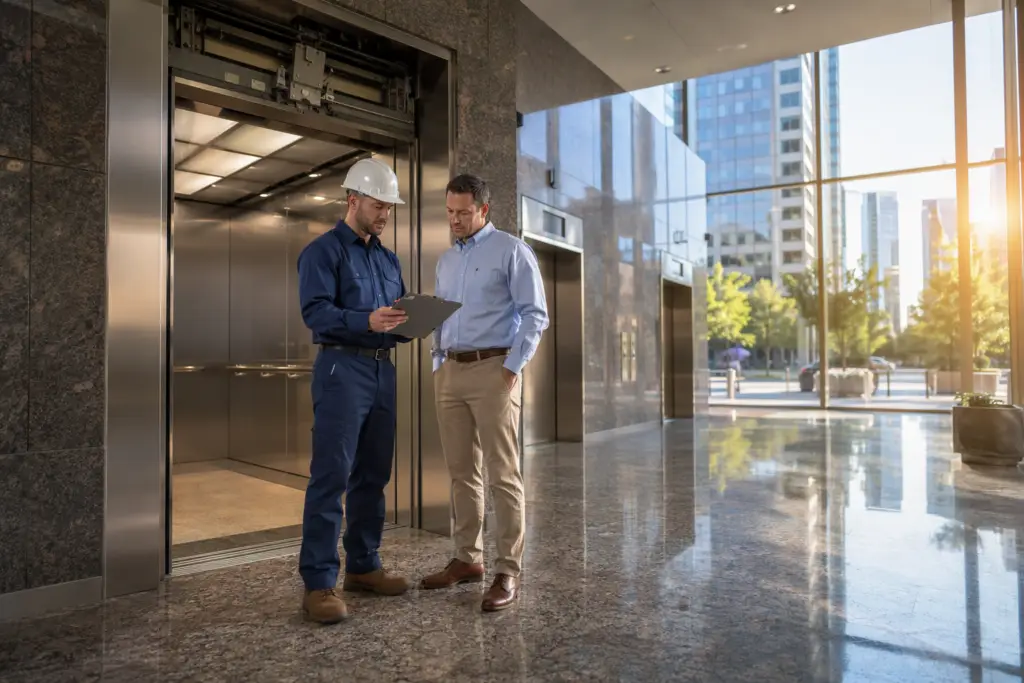
- Schedule the acceptance inspection. After installation, a TDLR-registered elevator inspector — selected by the building owner — conducts an acceptance inspection. The inspector must be registered with TDLR but is not a TDLR employee.
- Receive the inspection report. Texas law requires the registered elevator inspector to deliver the inspection report to the owner within five calendar days of the inspection.
- Obtain the TDLR Certificate of Compliance. When the unit passes inspection, TDLR issues a Certificate of Compliance. The elevator cannot be placed in service until this certificate is issued.
- Display the Certificate of Compliance. Texas owners must post the Certificate of Compliance in a publicly visible area of the building before the elevator opens to occupants.
How Long Does Plan Review Typically Take at TDLR?
TDLR does not publish a guaranteed turnaround time for elevator plan review, and actual review periods vary based on submission volume, the complexity of the equipment being installed, and whether the initial submission is complete and code-compliant. Submissions with deficiencies or missing documentation require a correction cycle, which can add weeks or more to the approval window.
Industry experience broadly indicates that straightforward, complete submissions move through review faster than complex or multi-unit projects, and that projects with any structural or custom engineering components take longer. Owners and developers should plan conservatively and factor potential correction cycles into project schedules rather than assuming a best-case timeline.
How Does Houston’s Permitting Process Differ From Dallas, Austin, and San Antonio?
Houston is the most significant exception to the standard Texas TDLR process. Because the City of Houston administers its own elevator program, a contractor installing an elevator in Houston submits plans to and receives approval from the City, not TDLR. The City of Houston’s review procedures, fee schedule, and timeline are set by the municipal program, not by 16 Texas Administrative Code Chapter 74.
Dallas, Austin, and San Antonio all fall within TDLR’s jurisdiction for elevator equipment. However, each of these cities also has its own building department, and a new elevator installation will typically require both a TDLR plan approval and a local building permit. The building permit covers the structural and architectural work — hoistway construction, pit, machine room — and runs on the local building department’s schedule, which is independent of TDLR’s review. Aligning these two review tracks is a common source of schedule risk on new construction projects.
What Factors Can Delay an Elevator Permit Approval?
Several factors routinely extend permitting timelines for new elevator installations in Texas cities:
- Incomplete plan submissions. Missing specifications, unsigned drawings, or absent structural calculations trigger a correction request and restart the review cycle.
- Non-compliant equipment specifications. Plans that specify equipment not meeting the ASME A17.1/CSA B44-2016 standard adopted by Texas require redesign before approval.
- Contractor registration status. If the contractor’s TDLR registration has lapsed, the submission cannot be processed until the registration is current. Texas elevator contractor and inspector registrations expire one year after they are issued.
- Review backlog at the authority having jurisdiction. High submission volume — common during construction booms — extends review queues at both TDLR and municipal programs.
- Coordination gaps between the elevator permit and the building permit. If the hoistway is not ready when the elevator is delivered, the acceptance inspection cannot proceed, extending the overall timeline even after the permit is approved.
- Variance or waiver requests. Projects requiring a departure from the adopted code standard require additional review time.
- ADA compliance review. Federal ADA requirements for accessibility apply to most commercial and multi-family residential elevators. Plans that do not address ADA dimensions, controls, and door timing may require revision.
What Insurance and Registration Must a Texas Elevator Contractor Hold?
Texas elevator contractors must carry general liability insurance of at least $1,000,000 per occurrence for bodily injury or death and $500,000 per occurrence for property damage. Each contractor must also designate one or two responsible parties with at least three years of elevator contractor experience. These requirements must be satisfied at the time of plan submission — a contractor who cannot demonstrate current compliance cannot submit plans to TDLR on behalf of a project owner.
What Happens After the Permit Is Approved and the Elevator Is Installed?
Plan approval is not the final step. The elevator cannot be used until it passes an acceptance inspection by a TDLR-registered elevator inspector and the owner receives a TDLR Certificate of Compliance. The Certificate of Compliance is valid for one year, after which an annual reinspection is required to maintain compliance. Texas building owners have the sole right to select the elevator inspector, and the inspector must provide the written inspection report within five calendar days of completing the inspection.
If the inspection reveals violations, Texas law requires the owner to have those violations corrected or under contract to be corrected within 30 days, or to obtain a waiver or delay from TDLR.
Does the ADA Affect Elevator Permit Approval in Texas?
Yes. The Americans with Disabilities Act sets federal accessibility requirements for elevator equipment in facilities covered by the ADA, which includes most commercial buildings, public accommodations, and multi-family housing above a threshold number of stories. Texas elevator plan submissions for those building types must reflect ADA-compliant car dimensions, control panel heights, door dwell times, and communication systems. Plans that do not address ADA requirements are likely to require revision during review, extending the permitting timeline.
Are There Ongoing Compliance Requirements After a New Elevator Is Permitted?
Yes. Receiving the initial Certificate of Compliance is the beginning of an ongoing compliance cycle, not a one-time event. In Texas, the Certificate of Compliance is valid for one year and must be renewed through annual inspections conducted by a TDLR-registered inspector. The certificate must be displayed in a publicly visible area of the building at all times.
Additionally, Texas requires a Category 5 full-load test every five years on electric (traction) elevators. This test must be performed by a registered contractor and verified by a registered inspector. Owners who do not schedule this test on time face potential compliance issues at the time of annual reinspection.
What Code Applies to New Elevator Installations in Texas in 2026?
The ASME A17.1/CSA B44 Safety Code for Elevators and Escalators, 2016 edition, as amended by 16 Texas Administrative Code Chapter 74, has been the state-adopted standard since November 1, 2018. All plan submissions to TDLR for new installations must demonstrate compliance with this edition. Because Houston operates its own program, parties installing equipment in Houston should confirm the code edition in effect with the City directly.
Nationally, the elevator industry continues to evolve toward newer editions of ASME A17.1, and in 2025 and 2026 there is ongoing discussion among code bodies and state regulators about updating adopted editions. Texas has not announced a change to its adopted edition as of the preparation of this page, but owners planning long-lead projects should monitor TDLR communications for any updates.
How Does OSHA Factor Into a New Elevator Installation in Texas?
Federal OSHA requirements govern construction-site safety during elevator installation, including requirements for hoistway protection, fall prevention, and hazard communication. These requirements are separate from the elevator-specific plan approval and inspection process, but non-compliance can trigger stop-work orders that delay an installation and, consequently, the final acceptance inspection. Contractors should confirm that all construction-phase OSHA requirements are addressed before scheduling acceptance inspection.
What Should Building Owners Do to Minimize Permit Delays?
- Engage a TDLR-registered elevator contractor early in the design phase — before building permits are submitted — so elevator plans can be developed in parallel with architectural drawings.
- Confirm the contractor’s TDLR registration is current and will remain current through the expected approval date.
- Verify the contractor carries the required minimum liability insurance levels before signing an agreement.
- Ensure the equipment specified meets ASME A17.1/CSA B44-2016 as adopted by Texas (or the City of Houston’s requirements for Houston projects).
- Address ADA dimensional and functional requirements in the initial plan set to avoid correction cycles.
- Coordinate the elevator permit timeline with the local building department’s hoistway and machine room permitting schedule to avoid gaps between plan approval and construction readiness.
- For Houston projects, contact the City of Houston’s municipal elevator program directly to understand current submission requirements and review timelines.
- Build correction-cycle buffer into the project schedule rather than assuming a first-submission approval.
What Industry Trends Are Affecting Elevator Permitting Timelines in 2025 and 2026?
Several trends are shaping permitting complexity and duration for new elevator installations across Texas’s major markets in 2025 and 2026:
Increased construction volume. Ongoing growth in Houston, Dallas, Austin, and San Antonio — spanning mixed-use, multifamily, and commercial sectors — is placing sustained demand on both TDLR and municipal plan review queues. Higher submission volumes tend to extend review periods across all project types.
Code update discussions. Industry bodies continue to develop and refine newer editions of the ASME A17.1 standard, and state regulators periodically evaluate adopting updated editions. While Texas has not announced a code edition change as of this writing, owners and contractors planning projects with long design and construction timelines should monitor TDLR for any announcements that could affect plan requirements mid-project.
Digital plan submission. Many jurisdictions are expanding electronic plan submission capabilities, which can reduce physical processing delays. The impact on substantive review time varies by jurisdiction and submission complexity.
Workforce and inspector availability. The availability of TDLR-registered elevator inspectors can influence how quickly acceptance inspections are scheduled after installation. In high-growth markets, inspection scheduling may add time to the post-installation phase even after the Certificate of Compliance process begins.
Machine-room-less and hydraulic technology. The continued adoption of machine-room-less traction systems and updated hydraulic configurations means that plan reviewers are seeing more non-traditional configurations. Complex or unfamiliar equipment arrangements may require longer review periods than conventional designs.
How Does AmeriTex Elevator Help Navigate the Permitting Process?
AmeriTex Elevator works with building owners, developers, and property managers across Texas to support the elevator permitting and compliance process. As a data-driven service provider operating in the Texas market, AmeriTex Elevator assists clients in understanding the regulatory requirements that apply to their specific city and project type — including the distinction between TDLR’s jurisdiction and Houston’s municipal program — and in preparing for the inspection and certification milestones that follow plan approval. Working with a knowledgeable elevator company from the early design stage is one of the most reliable ways to reduce the risk of correction cycles and schedule delays during the permitting process.
Quick Reference: Key Texas Elevator Permit Requirements for New Installations
| Requirement | Authority | Source |
|---|---|---|
| Plan submission and approval before installation begins | TDLR (statewide except Houston) / City of Houston (within Houston city limits) | TDLR Elevator Program |
| Adopted technical code: ASME A17.1/CSA B44, 2016 edition | TDLR / 16 TAC Chapter 74 | ASME A17.1 / TDLR |
| Contractor must be TDLR-registered | TDLR | TDLR Elevator Program |
| Contractor registration expires annually | TDLR | TDLR Elevator Program |
| Minimum contractor liability insurance: $1,000,000 per occurrence (bodily injury/death); $500,000 per occurrence (property damage) | TDLR | TDLR Elevator Program |
| Acceptance inspection by TDLR-registered inspector before placing elevator in service | TDLR | TDLR Elevator Program |
| Certificate of Compliance required; valid for one year | TDLR | TDLR Elevator Program |
| Inspector must deliver report within 5 calendar days of inspection | TDLR | TDLR Elevator Program |
| Annual reinspection required for Certificate of Compliance renewal | TDLR | TDLR Elevator Program |
| Category 5 full-load test every 5 years (electric/traction elevators) | TDLR | TDLR Elevator Program |
| ADA accessibility requirements apply to covered facility types | Federal | ADA.gov |
| Construction-phase worker safety | Federal | OSHA |
Frequently Asked Questions: Elevator Permit Approval in Houston, Dallas, Austin, and San Antonio
Does TDLR regulate elevators in Houston?
No. TDLR does not regulate elevators or escalators inside Houston city limits. Houston operates its own municipal elevator program. Contractors and owners planning a new installation in Houston must submit plans to and obtain approval from the City of Houston, not TDLR.
Can an elevator be installed in Texas before plans are approved?
No. Texas law requires a registered contractor to submit plans to the appropriate authority — TDLR for most of the state, or the City of Houston within Houston city limits — and receive approval before installation begins.
Who can perform elevator inspections in Texas for new installations?
Acceptance inspections for new elevator installations must be performed by a TDLR-registered elevator inspector. Texas elevator inspectors register with TDLR but are not TDLR employees. The building owner has the sole right to select the inspector.
What triggers a correction cycle during plan review?
Submissions that are incomplete, contain unsigned drawings, lack required specifications, or specify equipment that does not comply with the ASME A17.1/CSA B44-2016 standard receive a correction request from the reviewing authority. Each correction cycle adds time to the overall permit approval timeline.
How long is a Texas Certificate of Compliance valid for a new elevator?
A Texas Certificate of Compliance is valid for one year. After that, an annual reinspection by a TDLR-registered inspector is required to maintain the certificate. There is no extended certificate period under Texas rules analogous to California’s two-year permit option.
Does the ADA apply to elevator installations in Texas?
Yes. The Americans with Disabilities Act sets federal accessibility requirements for elevators in covered facilities, including most commercial buildings and multi-family residential buildings above certain size thresholds. ADA compliance must be reflected in the plan submission to avoid correction cycles during review.
What insurance must a Texas elevator contractor carry?
Texas elevator contractors must maintain general liability insurance of at least $1,000,000 per occurrence for bodily injury or death and $500,000 per occurrence for property damage. This coverage must be in place before the contractor can register with and submit plans to TDLR.
What is the Category 5 test requirement for Texas elevators?
Texas requires a Category 5 full-load test every five years on electric (traction) elevators. This test must be performed after the elevator is placed in service and recurs on a five-year cycle. It is separate from the annual inspection required for Certificate of Compliance renewal.
What happens if violations are found during the acceptance inspection?
If the TDLR-registered inspector identifies violations at the acceptance inspection, the elevator cannot receive a Certificate of Compliance until those violations are resolved. Texas law requires owners to have violations corrected or under contract to be corrected within 30 days of the inspection, or to obtain a waiver or delay from TDLR.
Can a building owner in Dallas, Austin, or San Antonio choose any registered inspector for the acceptance inspection?
Yes. Texas law gives the building owner the sole right to select the elevator inspector, provided that inspector holds current TDLR registration. The inspector is not a TDLR employee and is selected independently by the owner.
How does construction-phase OSHA compliance affect the permit timeline?
Federal OSHA requirements govern worker safety during the installation process. Non-compliance can result in stop-work orders that interrupt installation, push back the acceptance inspection date, and delay issuance of the Certificate of Compliance — even after the elevator permit plans have been approved.
Is there a single permitting timeline that applies to all four Texas cities?
No. Houston’s municipal program sets its own timeline independent of TDLR. For Dallas, Austin, and San Antonio, the TDLR plan review timeline is the primary variable, but each city’s building department also runs its own review for hoistway and structural work on a separate schedule. The overall permitting duration for any project reflects both review tracks plus the post-installation inspection and certification steps.
Contact AmeriTex Elevator for a free elevator assessment at 844-646-9660.
Need elevator service you can rely on? AmeriTex Elevator is ready to help.