Questions to Ask Before Signing an Elevator Maintenance Contract in Healthcare
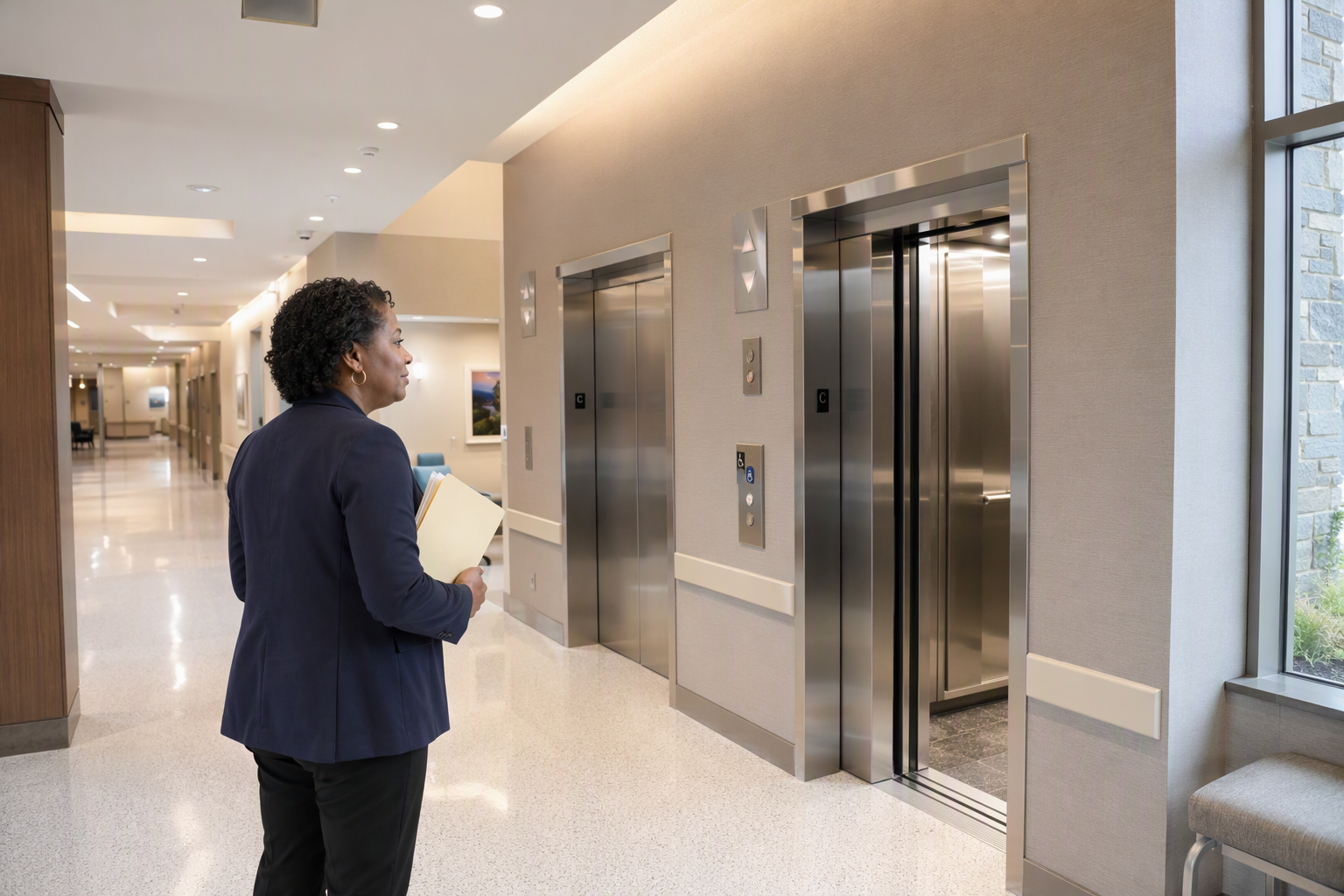
Elevators in hospitals, outpatient surgery centers, medical office buildings, and long-term care facilities are not optional infrastructure — they are life-safety systems. A patient on a gurney, a dialysis chair, or a pharmaceutical supply cart cannot take the stairs. Choosing the wrong maintenance partner puts patients, staff, and the facility’s compliance record at risk. The questions below are designed to help healthcare procurement and facilities teams evaluate any elevator service company before committing to a multi-year contract.
What Regulatory Credentials Must an Elevator Company Hold in Texas and California?

The answer depends on which market the facility is in, and getting this wrong exposes the building owner to liability.
In Texas, the Texas Department of Licensing and Regulation (TDLR), Elevator and Escalator Safety program requires that any person or company that installs, repairs, alters, tests, or maintains elevator equipment register as a contractor with TDLR before performing any work. Under Texas Health and Safety Code Chapter 754 and 16 Texas Administrative Code Chapter 74, TDLR-registered elevator contractors must carry general liability insurance of at least $1,000,000 per occurrence for bodily injury or death and $500,000 per occurrence for property damage. Registration expires annually and must remain current throughout any maintenance contract term. Note that within Houston city limits, TDLR does not regulate elevators — the City of Houston runs its own elevator program, so facilities in Houston should confirm the contractor is in good standing with the city’s program specifically.
In California, companies that maintain, repair, alter, or service elevators must be certified by Cal/OSHA’s Elevator Unit, Division of Occupational Safety and Health, California Department of Industrial Relations as a Certified Qualified Conveyance Company (CQCC). This certification requires a current C-11 Elevator Contractor license issued by the California Contractors State License Board (CSLB), plus certificates of workers’ compensation and liability insurance. Every mechanic who works on a California elevator without direct supervision must hold a Certified Competent Conveyance Mechanic (CCCM) certificate from Cal/OSHA. These certifications renew every two years and require continuing education. In Los Angeles specifically, the Department of Building and Safety (LADBS) runs its own elevator and conveyance inspection program — facilities there should confirm compliance with LADBS requirements in addition to Cal/OSHA rules.
Ask any prospective contractor to provide copies of current registration, certification, licensing, and insurance documentation before signing. AmeriTex Elevator maintains the regulatory credentials required to operate in both Texas and California markets.
Does the Contract Cover All ASME A17.1 Maintenance Requirements?
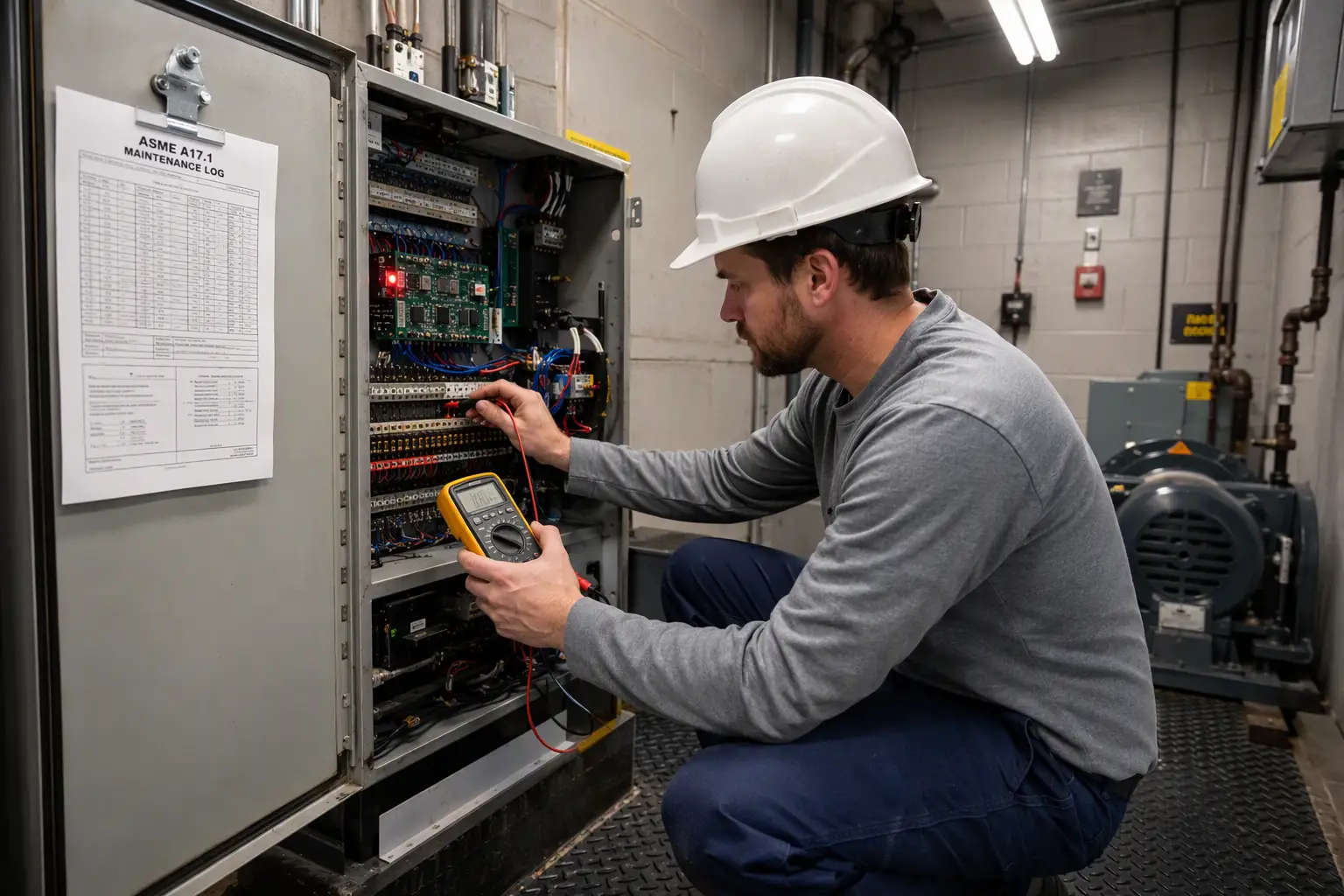
The ASME A17.1/CSA B44 Safety Code for Elevators and Escalators is the foundational technical standard governing elevator design, installation, inspection, and maintenance across North America. Texas has adopted the 2016 edition as its state standard (effective November 1, 2018), while California has adopted the 2004 edition for installations covered by its Group IV Elevator Safety Orders, with a proposed Group V update incorporating ASME A17.1-2019 currently moving through the California rulemaking process as of 2026.
A compliant maintenance contract should explicitly reference the applicable edition of ASME A17.1 and describe how scheduled maintenance tasks align with the code’s requirements. Healthcare facilities should pay particular attention to whether the contract covers:
- Firefighters’ service (Phase I and Phase II) — in Texas, a passenger elevator with non-working Phase One firefighters’ service must be removed from service immediately
- Door restrictors — in Texas, a passenger elevator without working door restrictors must also be removed from service immediately
- Category 5 full-load testing — Texas requires this test every five years on electric (traction) elevators; confirm whether this test is included or billed separately
- Emergency lighting, communication systems, and machine room conditions
Is ADA Compliance Part of the Maintenance Scope?
The Americans with Disabilities Act (ADA) imposes specific requirements on elevator accessibility in public accommodations and commercial facilities, including healthcare buildings. ADA-covered features that require ongoing maintenance attention include audible and visual floor indicators, raised and Braille cab signage, door open and close timing, leveling accuracy, and accessible call button placement and height.
A maintenance contract that addresses mechanical performance but ignores ADA operational requirements leaves healthcare facilities exposed to civil rights complaints and potentially costly retrofits. Ask prospective vendors to describe how their technicians identify and document ADA-related deficiencies during routine maintenance visits.
What Does the Contract Explicitly Exclude?
This is one of the most consequential questions a healthcare facilities manager can ask. Many elevator maintenance contracts use broad language about “full maintenance” while containing exclusions that can result in significant unexpected repair costs. Common exclusions to probe include:
- Major modernization components (controllers, hydraulic power units, drive systems)
- Damage caused by misuse, vandalism, or water intrusion
- Replacement of cab interiors or fixtures
- Work required to bring a unit into code compliance at the time the contract starts
- After-hours or emergency callbacks beyond a defined number per year
In a hospital or surgical center environment where elevator downtime directly affects patient care, understanding exactly what is and is not covered is not optional — it is a risk management imperative. Request a line-by-line breakdown of inclusions and exclusions in writing before signing.
How Does the Vendor Handle Elevator Outages in a Healthcare Setting?
Elevator availability in healthcare is a patient safety issue. Before signing, facilities teams should ask the prospective service company to describe their documented callback and outage response process. Specific questions to ask include:
- Is there a defined process for prioritizing healthcare facilities above other account types during simultaneous outages?
- Who is the single point of contact for facilities management when an elevator goes out of service?
- What documentation is provided after each callback visit?
- How are equipment failures and callback history tracked and reported back to the facility?
- Does the contract define what constitutes an emergency callback versus a scheduled repair?
Note that specific response time guarantees are a contractual term that varies by agreement; ask any prospective vendor to specify their commitments in the contract document itself rather than in verbal assurances.
How Are Annual Inspections and Certificates of Compliance Managed?
Healthcare facility managers should understand that the inspection function is legally separate from the maintenance function in both Texas and California.
In Texas, building owners must have each elevator inspected annually by a TDLR-registered elevator inspector. Texas building owners hold the sole right to select their inspector, who must provide the inspection report within five calendar days. The owner must then obtain a TDLR Certificate of Compliance for each unit, valid for one year, and display it in a publicly visible area of the building. Violations must be corrected or under contract to be corrected within 30 days of the inspection. Texas owners must also report any accident involving elevator equipment to TDLR within 24 hours.
In California, every conveyance must be inspected at least once a year, and arranging that reinspection is the building owner’s responsibility. Only Cal/OSHA State safety engineers and Certified Competent Conveyance Inspectors (CCCI) may perform elevator inspections. A conveyance found safe receives a permit to operate for up to one year; Cal/OSHA may issue a permit for up to two years for an elevator covered by a full maintenance contract with a CQCC-certified company holding a C-11 license. No elevator may operate in California without a valid, current permit to operate posted conspicuously in the car.
Ask any prospective service company to explain how they support the facility in preparing for inspections and resolving any cited violations within the applicable timeframe.
What Is the Contract Term, and What Are the Exit Provisions?
Multi-year maintenance contracts are standard in the elevator industry, but the terms can vary significantly. Before signing, healthcare facilities should ask:
- What is the initial term, and does it renew automatically?
- What is the notice period required to decline renewal?
- Under what conditions can either party terminate early, and what penalties apply?
- What happens to equipment ownership and data access if the contract ends?
- Are pricing adjustments tied to a transparent index, or can rates change at the vendor’s discretion?
For healthcare facilities subject to budget cycles and ownership transitions — mergers, health system acquisitions, lease changes — contract flexibility can be as important as the technical scope of services.
How Does the Company Document Maintenance Work and Track Equipment History?
In a healthcare environment subject to Joint Commission surveys, CMS Conditions of Participation, and state health facility licensing reviews, the ability to produce documented evidence of elevator maintenance is not a courtesy — it is a compliance requirement. Ask prospective vendors:
- Is a written or digital service record provided after every maintenance visit?
- Can the facility access historical maintenance records on demand, including during an accreditation survey?
- How are parts replaced documented, including part numbers and dates?
- Is preventive maintenance tracked against a written schedule aligned with ASME A17.1?
AmeriTex Elevator provides documented maintenance records designed to support healthcare clients through regulatory and accreditation review processes.
Questions Your Inspector Will Ask
Whether a TDLR-registered inspector in Texas or a Cal/OSHA-certified Certified Competent Conveyance Inspector in California, the annual inspector will evaluate conditions that a competent maintenance contractor should already have addressed. Facilities managers should understand what inspectors look for so they can hold their service company accountable throughout the year. Common inspector focus areas in healthcare settings include:
- Firefighters’ service functionality — Phase I and Phase II operation, recall accuracy, and cab communication
- Door operations — closing force, reopening device function, door restrictors (required by Texas code), and leveling accuracy
- Emergency communication — functioning two-way communication in the cab; California’s requirements in this area involve interaction between multiple code sources and should be reviewed with a qualified contractor
- Machine room conditions — temperature, cleanliness, lighting, and access control
- Safety device testing records — evidence that governor, safety, and buffer tests have been performed on schedule
- Permit or certificate posting — in Texas, the Certificate of Compliance must be displayed publicly; in California, the permit to operate must be posted in the car
- Lubrication and adjustment logs — evidence that preventive maintenance is occurring on a regular schedule
- Hydraulic fluid condition and containment — for hydraulic units, any evidence of leakage or contamination
If a prospective maintenance vendor cannot describe specifically how their routine maintenance protocol addresses each of these areas, that is a meaningful signal about the quality of service the facility should expect.
How Does the Vendor’s Experience Apply to Healthcare-Specific Equipment?
Healthcare facilities often have equipment configurations that differ from commercial office buildings — oversized freight and service elevators sized for hospital beds and stretchers, dedicated linen and soiled utility service elevators, and equipment integrated with nurse call or building automation systems. Ask whether the prospective contractor has maintained similar equipment configurations and can describe how their maintenance protocol accounts for healthcare-specific use patterns, including high-cycle operation and infection control requirements in and around elevator cabs.
AmeriTex Elevator serves healthcare facilities across Houston, Dallas, Austin, and San Antonio in Texas, and in Los Angeles and San Diego in California, with maintenance programs structured around the regulatory requirements and operational demands of medical environments.
What Should Happen Before the First Maintenance Visit?
A reputable elevator service company should perform a documented baseline assessment of every unit before the maintenance contract begins. This assessment should establish the current mechanical condition of each elevator, identify any existing code deficiencies that predate the contract, and create a baseline against which future maintenance performance can be measured. Healthcare facilities should insist that this assessment occur before the contract takes effect, and that any pre-existing deficiencies be addressed in writing — either in a separate scope of remediation work or as an explicit exclusion in the maintenance agreement.
AmeriTex Elevator conducts baseline assessments as a standard part of its onboarding process for new healthcare clients, allowing facilities teams to enter the contract with a clear picture of where each unit stands.
Contact AmeriTex Elevator for a free elevator assessment at 844-646-9660.
Need elevator service you can rely on? AmeriTex Elevator is ready to help.