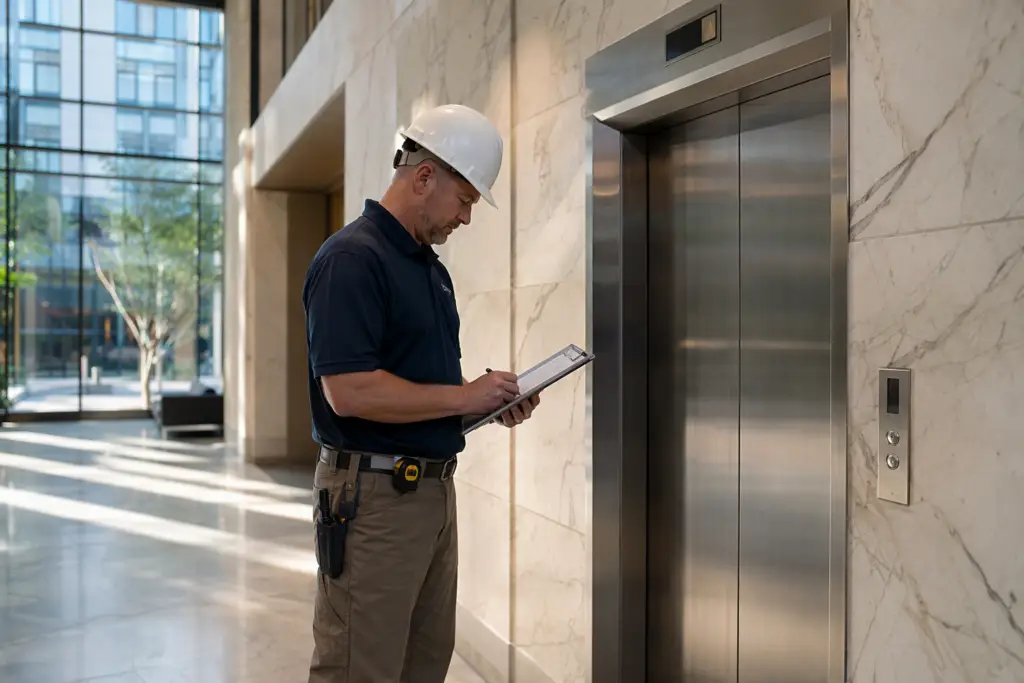
For elevator maintenance in the Santa Rosa, CA area, building owners should hire a company that holds a valid Certified Qualified Conveyance Company (CQCC) certification from Cal/OSHA and employs Certified Competent Conveyance Mechanics (CCCM), ensuring full compliance with California Labor Code Sections 7300–7324.2 and the California Code of Regulations, Title 8, Elevator Safety Orders.
Best Elevator Maintenance Company in the Santa Rosa, CA Area: Complete FAQ Guide
Finding a qualified elevator maintenance provider in Northern California requires understanding exactly what state law demands from any company that touches a conveyance. California’s requirements are among the most rigorous in the nation, covering company certification, mechanic credentials, inspection authority, and permit obligations. This guide answers the most common questions building owners, property managers, and facilities directors ask when evaluating elevator maintenance companies in the Santa Rosa, CA area and throughout California in 2026.
What makes an elevator maintenance company qualified to operate in California?
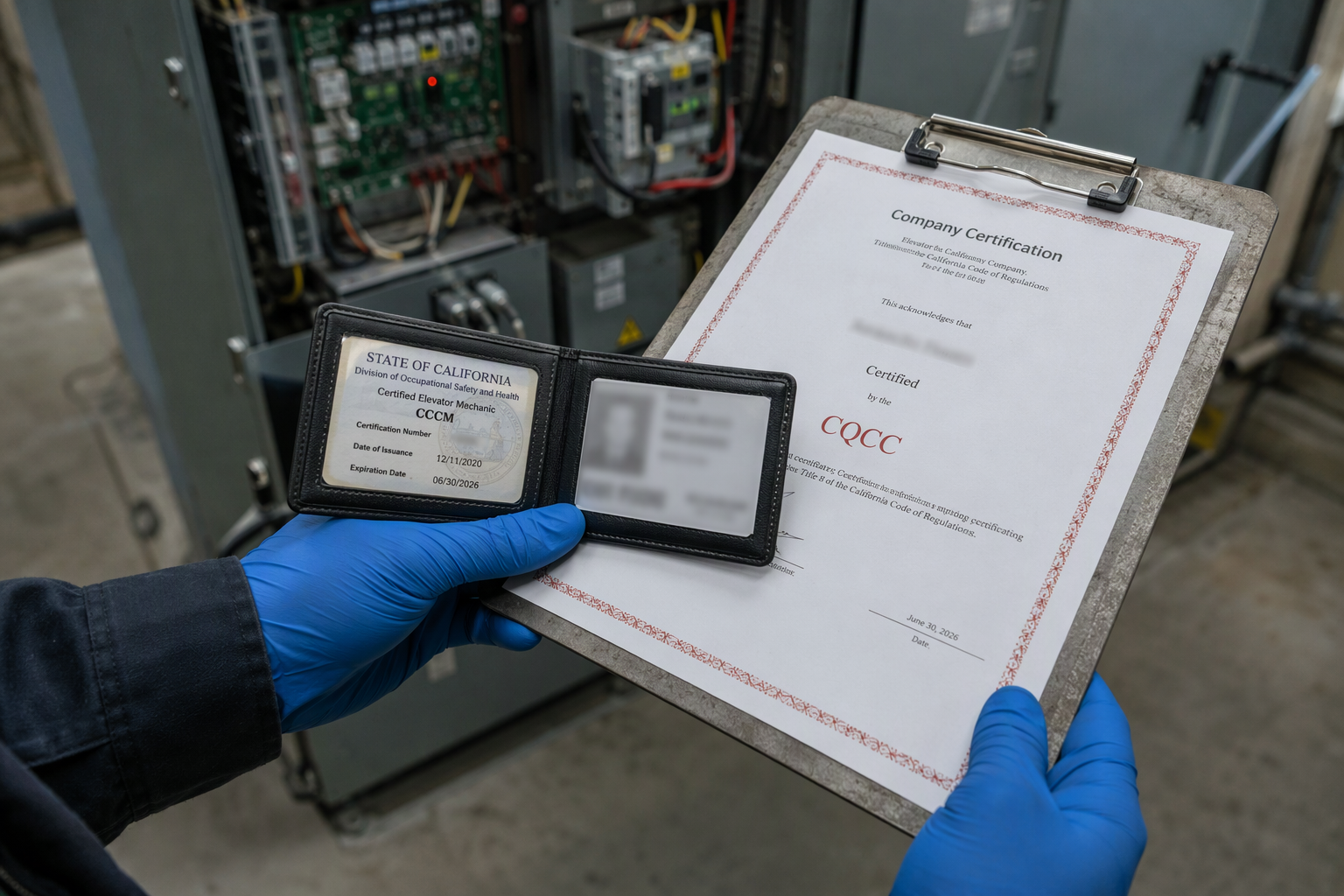
A California-qualified elevator maintenance company must hold a valid Certified Qualified Conveyance Company (CQCC) certification issued by Cal/OSHA’s Elevator Unit, California Department of Industrial Relations, and must employ only Certified Competent Conveyance Mechanics (CCCM) for hands-on work.
Under California Labor Code Sections 7300–7324.2, any company that installs, alters, tests, maintains, repairs, or services elevators in California must be CQCC-certified. To obtain this certification, the company must hold a current C-11 Elevator Contractor license issued by the California Contractors State License Board (CSLB) and carry valid workers’ compensation and liability insurance. The CSLB issues the C-11 license while Cal/OSHA administers CQCC certification and CCCM credentialing — these are two separate requirements that must both be satisfied.
Building owners evaluating vendors should request both credentials in writing before signing any service agreement. Engaging an uncertified company exposes the property owner to regulatory liability and may invalidate the elevator’s permit to operate.
What is a CCCM and why does it matter for maintenance work?
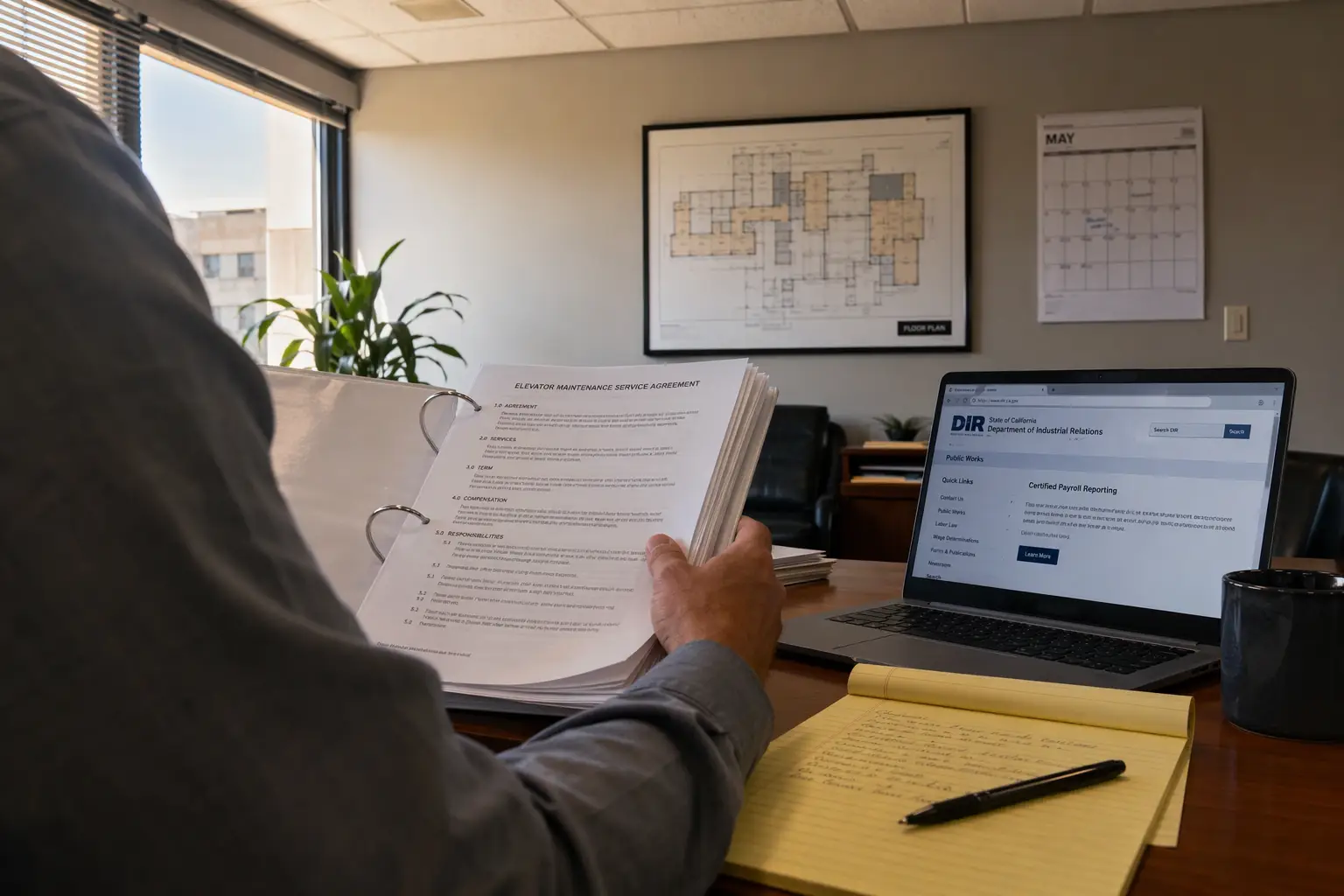
A Certified Competent Conveyance Mechanic (CCCM) is a California-certified individual who, under state law, is the only person permitted to maintain, repair, alter, or replace components on a conveyance without direct supervision.
California’s Title 8, Elevator Safety Orders (Sections 3000–3146) make clear that unsupervised elevator work by an uncertified mechanic is a violation of state law. CCCM and CQCC certificates are valid for two years and require at least eight hours of continuing education for renewal, ensuring mechanics stay current on code changes and safety practices.
When interviewing prospective maintenance companies, facilities managers should ask vendors to confirm that every technician assigned to their property holds a current CCCM credential. This is not simply a best practice — it is a California legal requirement.
Does California require a permit to operate an elevator?
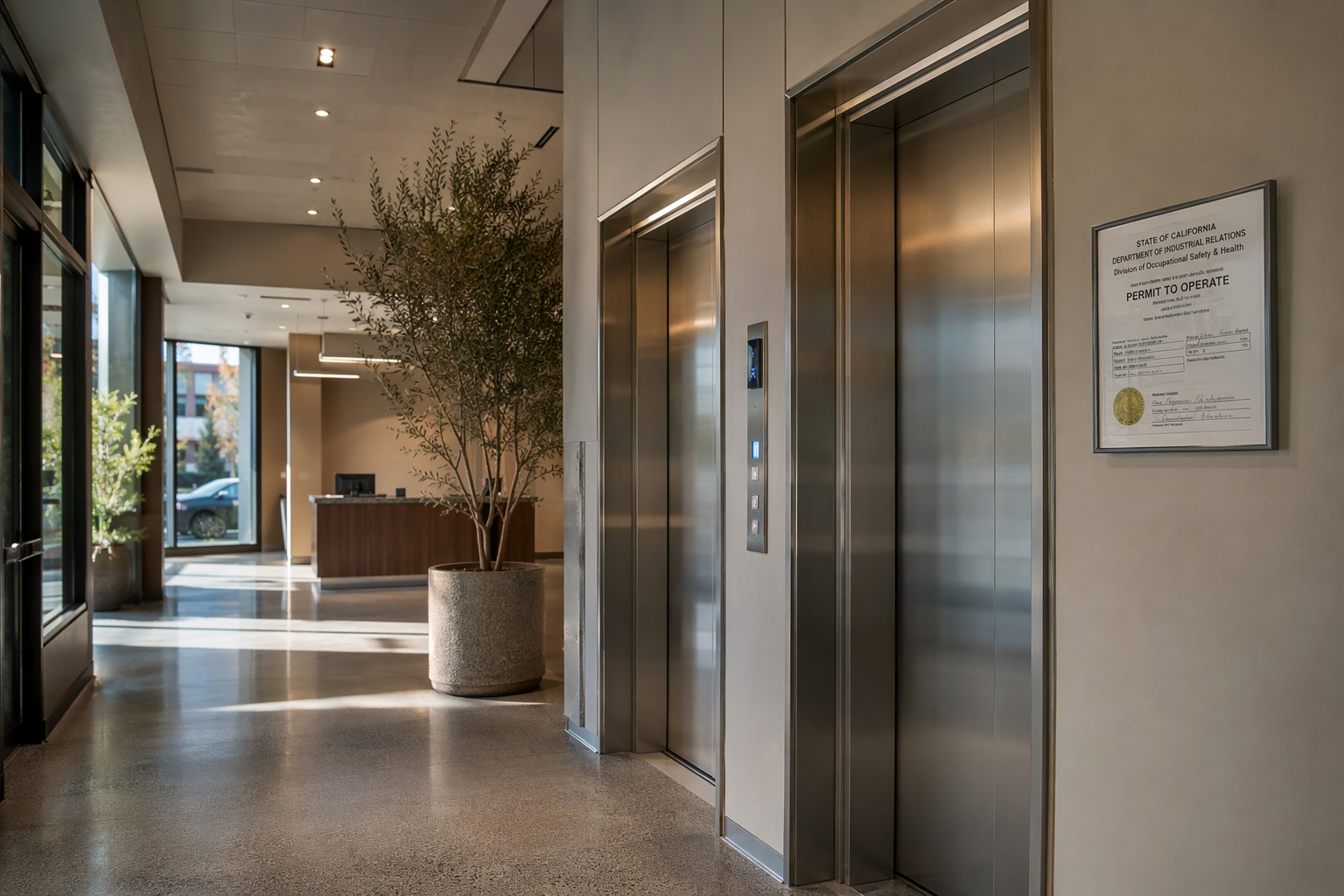
Yes — no elevator may be operated in California without a valid, current permit to operate issued by Cal/OSHA, and that permit must be posted conspicuously inside the elevator car at all times.
The permit to operate is issued after a successful annual inspection by either a State of California safety engineer or a Certified Competent Conveyance Inspector (CCCI). California law places the responsibility for arranging this annual reinspection squarely on the elevator owner, not the maintenance company. If an inspection reveals deficiencies, those deficiencies must be resolved before a permit is issued or renewed.
One important benefit available to property owners: if an elevator is covered by a full maintenance contract with a CQCC-certified, C-11-licensed elevator company and is found to be in safe condition, Cal/OSHA may issue a permit to operate for up to two years rather than one. This two-year permit pathway underscores the regulatory value of a comprehensive maintenance agreement with a fully credentialed provider.
Who is authorized to inspect elevators in California?
Only State of California safety engineers employed by Cal/OSHA and privately credentialed Certified Competent Conveyance Inspectors (CCCI) are authorized to perform elevator inspections in California.
This is a critical distinction for building owners: the maintenance company that services the elevator cannot also act as its own inspector. The inspection function is independent. A CQCC-certified maintenance company will prepare the elevator for inspection and correct any cited deficiencies, but the inspection itself must be conducted by one of the two categories of authorized inspectors described above.
Before any new elevator is placed in service in California, Cal/OSHA must inspect it and issue a permit to operate. Similarly, a permit from Cal/OSHA is required before a conveyance is erected, installed, or materially altered. Property owners planning new installations or modernization projects should factor inspection scheduling into their project timelines accordingly.
How often does a California elevator need to be inspected?
California law requires every conveyance to be inspected at least once per year, and a conveyance found to be in safe condition receives a permit to operate for up to one year — or potentially up to two years if covered by a qualifying full maintenance contract.
The annual inspection requirement is established under California Labor Code Sections 7300–7324.2 and enforced by Cal/OSHA’s Elevator Unit. Routine preventive maintenance visits between inspections are separate from the statutory annual inspection and are managed under the terms of the maintenance service contract. A well-structured maintenance program reduces the likelihood of deficiencies being cited at the annual inspection, protecting the owner’s permit status and minimizing building disruption.
What is the ASME A17.1 code and how does it apply in California?
The ASME A17.1/CSA B44 Safety Code for Elevators and Escalators is the foundational national standard governing elevator design, installation, inspection, testing, and maintenance across North America, and California has adopted the 2004 edition as the basis for its Group IV Elevator Safety Orders, effective May 1, 2008, for installation contracts signed on or after that date.
ASME A17.1 covers a comprehensive range of requirements, including car enclosures, doors and gates, lighting, emergency communication, firefighters’ service, safety devices, hoistway construction, and periodic test intervals. California’s Title 8, Elevator Safety Orders (Sections 3000–3146) incorporate and supplement ASME A17.1-2004 with state-specific provisions. As of 2026, California has proposed a Group V update that would incorporate elements of the ASME A17.1-2019 edition; the Standards Board held a public hearing on June 18, 2026, and no effective date has been posted.
For existing elevators, the applicable edition of ASME A17.1 and the companion ASME A17.3 Safety Code for Existing Elevators and Escalators together inform what upgrades and periodic tests are required. A qualified maintenance company should be able to explain precisely which code edition governs each unit on a property.
What does a full elevator maintenance contract typically include?
A full elevator maintenance contract from a CQCC-certified company typically covers all routine lubrication, adjustment, parts replacement, safety device testing, and emergency call response — in contrast to limited oil-and-grease agreements that exclude parts and repair labor.
The distinction matters because California’s potential two-year permit pathway is linked specifically to a full maintenance contract with a C-11-licensed elevator company. Property owners should read service agreements carefully to confirm what is included. A comprehensive agreement generally addresses the following elements:
- Scheduled preventive maintenance visits at defined intervals
- Inspection of door operating mechanisms, safety edges, and gibs
- Testing of overspeed governors and safeties on the applicable ASME A17.1 test cycle
- Lubrication of guide rails, sheaves, motors, and controllers
- Adjustment of leveling accuracy, door timing, and cab lighting
- Parts and labor for covered components
- Emergency callback service
- Coordination with the annual Cal/OSHA inspection
AmeriTex Elevator provides structured maintenance programs designed to align with California’s regulatory requirements and to support the building owner’s permit compliance obligations.
What are the ADA requirements that apply to elevator maintenance and modernization?
The Americans with Disabilities Act (ADA) requires that elevators in covered facilities maintain accessible features — including compliant call buttons, hall lanterns, cab dimensions, handrails, floor designation signage in Braille and raised characters, and audible signals — and that these features remain operational.
ADA compliance is not a one-time installation milestone; it is an ongoing operational obligation. Maintenance programs should include periodic verification that all accessibility features function correctly. When a modernization project is planned, the scope of work may trigger additional ADA compliance obligations depending on the nature and extent of the alterations. Building owners undertaking cab renovations, control system upgrades, or door system replacements should consult with their maintenance provider about ADA implications before work begins.
What should building owners do immediately if an elevator fails or causes an incident?
When an elevator malfunction, entrapment, or accident occurs, the building owner should follow a defined response sequence to protect building occupants, preserve evidence, and meet regulatory obligations.
- Ensure all occupants are safely away from the elevator. If entrapment has occurred, contact emergency services immediately — do not attempt a non-professional rescue.
- Secure the elevator out of service. Post clear signage and physically prevent further use until the unit has been inspected and cleared by qualified personnel.
- Notify the elevator maintenance company so a CCCM can assess the equipment as quickly as possible.
- Document the incident with photographs, witness statements, and a written log of the sequence of events.
- Preserve any surveillance footage from the lobby, machine room, or cab cameras.
- Notify Cal/OSHA’s Elevator Unit through the appropriate reporting channel; the annual permit to operate may be affected by a safety incident.
- Do not return the elevator to service until the CQCC-certified maintenance company confirms the unit is safe and any required corrective work is completed.
- Consult with legal counsel if personal injury or significant property damage is involved.
How does a building owner in California select the right elevator maintenance company?
Selecting the right elevator maintenance provider in California comes down to verifying three non-negotiable credentials — CQCC certification, C-11 licensure, and CCCM-certified mechanics — and then evaluating the depth and structure of the maintenance program being offered.
Beyond credentials, property managers should assess the following factors when comparing providers:
- Contract structure: Is it a full maintenance agreement or a limited oil-and-grease contract? Only full contracts support the potential two-year permit from Cal/OSHA.
- Equipment familiarity: Does the company have documented experience with the brand and model of equipment installed on the property?
- Parts sourcing: Does the company stock critical components, or are long lead times likely during repairs?
- Record-keeping: Does the vendor provide detailed maintenance logs that can be presented to Cal/OSHA inspectors?
- Communication: Does the company proactively communicate upcoming inspection dates and regulatory deadlines to the building owner?
AmeriTex Elevator serves California building owners with maintenance programs structured to meet the state’s regulatory framework, and the company’s team can walk property managers through the credential verification process.
What is the difference between preventive maintenance and a periodic safety test?
Preventive maintenance consists of scheduled, routine service visits to keep equipment operating safely and efficiently, while periodic safety tests are formal, code-mandated evaluations — defined under ASME A17.1 — that verify the performance of specific safety devices under controlled test conditions.
ASME A17.1 establishes categories of periodic tests (commonly referred to as Category 1, Category 3, and Category 5 tests) at defined intervals. These tests evaluate components such as safeties, buffers, governors, and pressure relief valves under conditions that go beyond what a routine maintenance visit covers. A full maintenance agreement should specify which periodic tests are included and which, if any, are billed separately. Building owners who do not understand this distinction may be surprised by additional charges when a five-year test falls due.
What happens if a California elevator is operated without a valid permit?
Operating an elevator in California without a valid, current permit to operate issued by Cal/OSHA is a violation of California Labor Code Sections 7300–7324.2 and can expose the property owner to regulatory enforcement action, fines, and mandatory shutdown of the equipment.
Cal/OSHA has authority to order an elevator out of service if it is found to be operating without a valid permit or if it presents an imminent hazard. Beyond regulatory penalties, operating a non-permitted elevator creates significant liability exposure in the event of an injury. Property owners should maintain a calendar system tied to the permit expiration date and confirm with their maintenance provider that the annual inspection has been scheduled well in advance of that date.
How do California’s elevator requirements compare to federal OSHA requirements?
California operates its own state occupational safety and health program under a plan approved by federal OSHA, which means Cal/OSHA — through the California Department of Industrial Relations — administers elevator safety in California under state law rather than under direct federal OSHA jurisdiction.
Federal OSHA retains jurisdiction over certain workplaces, including those under federal government control. California’s elevator-specific framework under Labor Code Sections 7300–7324.2 and the Title 8 Elevator Safety Orders provides detailed, elevator-specific requirements that go considerably beyond general industry standards. For most commercial and residential properties in California, it is Cal/OSHA’s Elevator Unit that building owners will interact with for permits, inspections, and enforcement.
What should a building owner expect during a Cal/OSHA elevator inspection?
During a Cal/OSHA annual elevator inspection, the authorized inspector — a State of California safety engineer or a CCCI — will evaluate the elevator’s compliance with the applicable California Code of Regulations Title 8 Elevator Safety Orders and the adopted edition of ASME A17.1.
Typical inspection elements include:
- Verification that the permit to operate is posted conspicuously in the elevator car
- Examination of machine room conditions, including lighting, cleanliness, temperature, and access control
- Inspection of hoistway, pit, and overhead clearances
- Testing of door reopening devices, door restrictors, and car gate contacts
- Verification of firefighters’ emergency operation (Phase I and Phase II)
- Review of maintenance logs and periodic test records
- Assessment of cab lighting, emergency lighting, and ventilation
- Verification that emergency communication equipment is operational
- Visual inspection of ropes, sheaves, buffers, and safeties
A well-maintained elevator with thorough maintenance records is far more likely to pass inspection without cited deficiencies. AmeriTex Elevator’s maintenance programs include pre-inspection reviews designed to identify and correct potential deficiencies before the official inspection date.
What elevator maintenance benchmarks should building owners use to evaluate service quality?
Building owners can use the following benchmark table to assess whether a maintenance program meets the minimum thresholds suggested by ASME A17.1 requirements and California regulatory practice.
| Maintenance Element | Minimum Benchmark | Applicable Standard / Authority |
|---|---|---|
| Annual safety inspection | Once per calendar year | California Labor Code §7300–7324.2 / Cal/OSHA |
| Permit to operate posted in car | At all times during operation | California Labor Code / Cal/OSHA |
| Mechanic credential | CCCM certified by Cal/OSHA | California Title 8, Elevator Safety Orders |
| Maintenance company credential | CQCC certified + C-11 licensed | California Labor Code / CSLB |
| Credential renewal cycle | Every two years (8 hrs continuing education) | California Title 8, Elevator Safety Orders |
| Category 1 annual test (hydraulic relief valve, etc.) | Annually per ASME A17.1 test category schedule | ASME A17.1/CSA B44 |
| Category 5 full-load test (traction) | Per ASME A17.1 periodic test cycle | ASME A17.1/CSA B44 |
| ADA accessibility feature verification | Included in routine maintenance visits | ADA |
| Emergency communication test | Verified at each maintenance visit | ASME A17.1/CSA B44 |
| Full maintenance contract (for 2-yr permit eligibility) | Required to qualify | Cal/OSHA / California Labor Code |
Does Los Angeles have its own elevator inspection program separate from Cal/OSHA?
Yes — the City of Los Angeles runs its own elevator and conveyance inspection program through the Los Angeles Department of Building and Safety (LADBS), separate from the statewide Cal/OSHA program.
Property owners and maintenance companies operating within Los Angeles city limits should be aware that local requirements and inspection processes may differ from those administered at the state level by Cal/OSHA. For properties in other California cities and counties, the statewide Cal/OSHA Elevator Unit program applies. AmeriTex Elevator serves California markets including Los Angeles and San Diego and maintains awareness of local authority jurisdiction (AHJ) variations that may affect compliance obligations.
What are the most common elevator maintenance deficiencies that lead to failed inspections in California?
The most common sources of cited deficiencies in California elevator inspections relate to door system components, documentation gaps, machine room conditions, and deferred periodic testing — all of which a proactive maintenance program is designed to address before the inspection occurs.
Specific areas that frequently generate violations include:
- Door reopening devices (safety edges or light curtains) that are worn, misaligned, or non-functional
- Missing, expired, or improperly posted permit to operate
- Incomplete or absent maintenance logs and periodic test records
- Machine room cleanliness and temperature control deficiencies
- Non-functional or inadequate emergency lighting in the cab or pit
- Firefighters’ Phase I or Phase II service not operating correctly
- Pit ladder, lighting, or stop switch deficiencies
- Overdue Category 1, 3, or 5 periodic tests
- Non-functional emergency communication equipment
A CQCC-certified company conducting regular, structured maintenance visits will document and address these items on an ongoing basis rather than allowing them to accumulate until inspection day.
How should a building owner plan for elevator modernization in California?
Elevator modernization in California requires a Cal/OSHA permit before work begins — a permit from Cal/OSHA is required before a conveyance is erected, installed, or materially altered — and the modernized equipment must pass a Cal/OSHA inspection and receive a new permit to operate before it is returned to service.
Planning for modernization should begin well before equipment reaches end of life. Key planning considerations include:
- Engaging a CQCC-certified contractor to assess current equipment condition and identify the scope of required upgrades
- Reviewing applicable ASME A17.3 requirements for existing equipment to understand what upgrades may be triggered
- Identifying whether the modernization scope triggers ADA accessibility upgrade obligations under the Americans with Disabilities Act
- Verifying that the contractor will submit plans to Cal/OSHA and obtain the required permit before work commences
- Budgeting for the Cal/OSHA post-modernization inspection as part of the project cost
- Planning for temporary loss of elevator service during modernization in multi-story properties
AmeriTex Elevator supports building owners through the full modernization planning and execution process, coordinating permit applications and inspection scheduling as part of the project scope.
What questions should a building owner ask before signing an elevator maintenance contract in California?
Before signing any elevator maintenance agreement in California, building owners should ask a defined set of questions to verify credentials, understand contract scope, and confirm the vendor can support regulatory compliance obligations.
Recommended due-diligence questions include:
- Can you provide your current CQCC certification number and C-11 license number for verification?
- Are all mechanics assigned to our property certified as CCCMs by Cal/OSHA?
- Is this a full maintenance contract or a limited agreement, and what is specifically excluded?
- Does the contract include coordination of the annual Cal/OSHA inspection?
- How are periodic tests (Category 1, 3, 5) handled — are they included or billed separately?
- What documentation will we receive after each maintenance visit, and in what format?
- How will you notify us of upcoming permit expiration dates and regulatory deadlines?
- What is your process for correcting deficiencies cited at inspection?
- Does your contract address ADA accessibility feature verification?
- What is the process and cost structure for repairs outside the routine maintenance scope?
These questions form a practical framework for evaluating any California elevator maintenance provider and comparing proposals on an equivalent basis.
Why should California building owners prioritize a maintenance partner with multi-market California experience?
California’s elevator regulatory framework — with its dual CQCC/C-11 credential requirement, Cal/OSHA permit obligations, CCCM mechanic certification rules, and local authority jurisdiction variations — creates a compliance environment that rewards working with a maintenance partner experienced across California’s regulatory landscape rather than a generalist contractor unfamiliar with state-specific requirements.
A provider with established California operations will have systems in place for CQCC and CCCM credential maintenance, permit tracking, Cal/OSHA documentation requirements, and local AHJ awareness — including recognition of special programs like LADBS in Los Angeles. AmeriTex Elevator operates across California markets including Los Angeles and San Diego, bringing operational familiarity with Cal/OSHA’s Elevator Unit processes that benefits building owners throughout the state. Property owners in the Santa Rosa area and broader Northern California region can apply the same credential verification standards and program evaluation criteria described throughout this guide when selecting any qualified local or regional provider.
Contact AmeriTex Elevator for a free elevator assessment at 844-646-9660.
Need elevator service you can rely on? AmeriTex Elevator is ready to help.