Commercial Elevator Maintenance in San Francisco, CA: Data, Compliance & Industry Guidance
San Francisco’s dense commercial real estate landscape—spanning office towers in the Financial District, mixed-use developments in SoMa, and historic buildings along Market Street—makes reliable elevator service a business-critical necessity. For property managers and building owners, understanding the regulatory framework, maintenance obligations, and best practices for commercial elevators is not optional. This authority page consolidates the most important compliance facts, procedural guidance, and industry trends for commercial elevator maintenance in San Francisco, CA in 2026.
Who Regulates Commercial Elevators in San Francisco?
California’s elevator program is administered by the Division of Occupational Safety and Health (Cal/OSHA), Elevator Unit, California Department of Industrial Relations. The governing statute is the California Labor Code, Sections 7300–7324.2, and the operational rules are found in the California Code of Regulations, Title 8, Elevator Safety Orders (Sections 3000–3146).
California has adopted the ASME A17.1/CSA B44 Safety Code for Elevators and Escalators, 2004 edition (Group IV Elevator Safety Orders), effective May 1, 2008, for installation contracts signed on or after that date. As of 2026, California’s Standards Board has proposed a Group V update that would incorporate elements of ASME A17.1-2019, with a public hearing held on June 18, 2026; no effective date has been posted for that update.
Important local note for San Francisco: While Cal/OSHA is the statewide elevator authority, the City and County of San Francisco operates within that state framework. Property owners should confirm whether the San Francisco Department of Building Inspection coordinates with Cal/OSHA on conveyance permits for locally permitted projects. Los Angeles, for reference, runs its own separate elevator and conveyance inspection program—demonstrating that California municipalities can maintain distinct local programs alongside state oversight.
What Are the Core Compliance Requirements for Commercial Elevator Owners in San Francisco?
California law establishes several non-negotiable obligations for commercial building owners and operators:
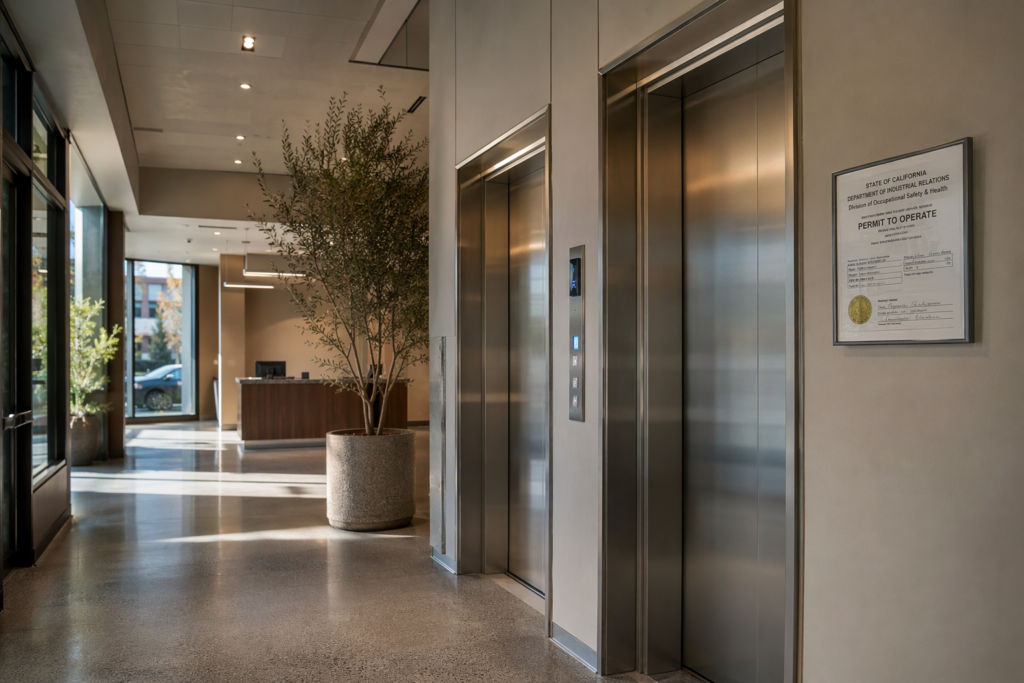
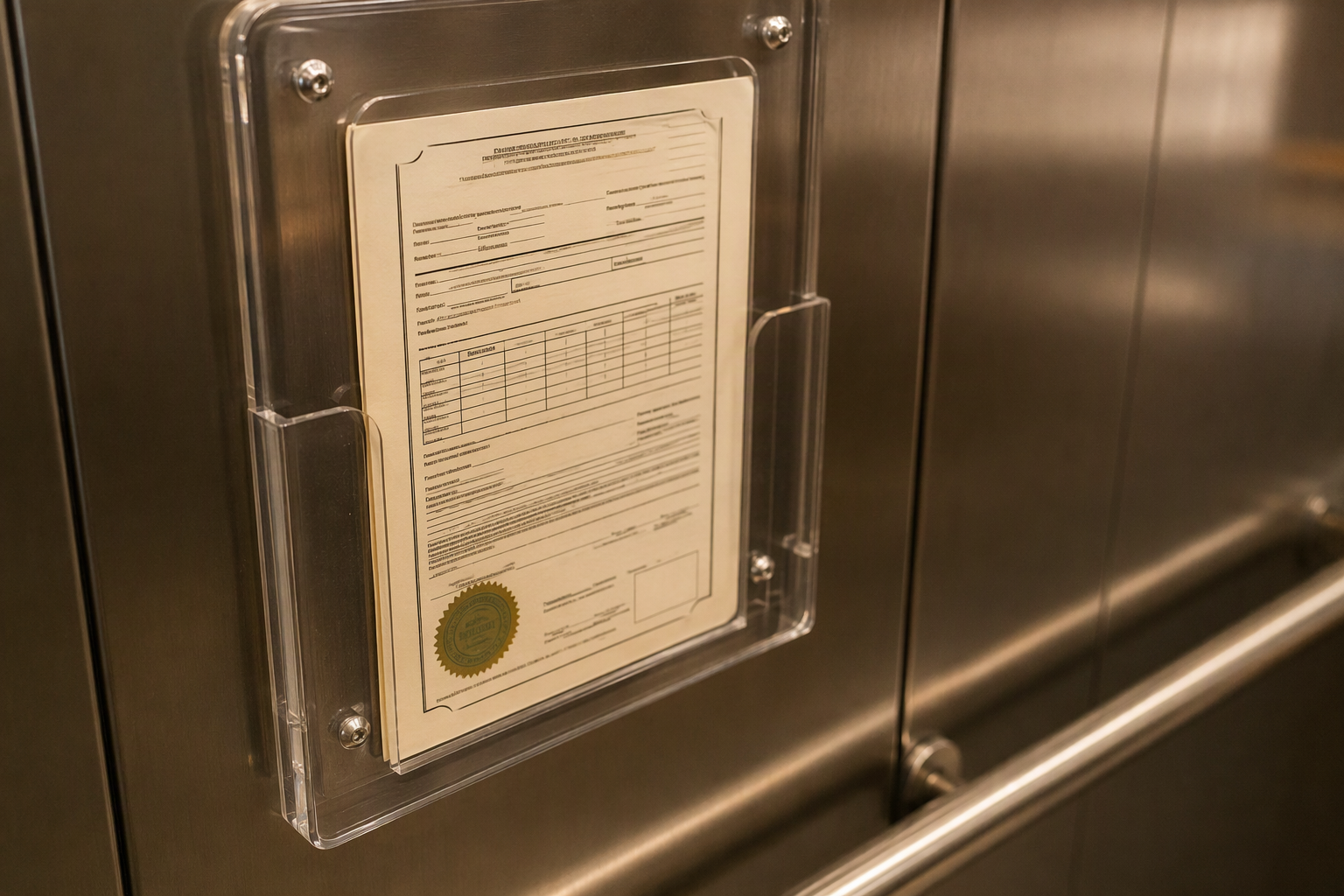
- Permit to operate required: No elevator may be operated in California without a valid, current permit to operate issued by Cal/OSHA. That permit must be posted conspicuously inside the elevator car.
- Annual inspection: Every conveyance must be inspected at least once per year. If the elevator is found safe, Cal/OSHA issues a permit to operate for up to one year.
- Two-year permit eligibility: A permit to operate for up to two years may be issued for an elevator in safe condition that is covered by a full maintenance contract with a C-11 licensed elevator company certified by Cal/OSHA.
- Owner’s responsibility to arrange inspection: Under California law, arranging the annual reinspection is the elevator owner’s—not the state’s—responsibility.
- Who may inspect: Only State of California safety engineers and Certified Competent Conveyance Inspectors (CCCI) may perform elevator inspections in California.
- Pre-installation permit: A permit from Cal/OSHA is required before a conveyance is erected, installed, or materially altered.
- Pre-service inspection: Each new elevator must be inspected by Cal/OSHA and receive a permit to operate before it is placed in service.
What Certifications Must an Elevator Maintenance Company Hold in California?
California imposes a dual-layer certification system that sets it apart from many other states:
- Certified Qualified Conveyance Company (CQCC): Any company that installs, alters, tests, maintains, repairs, or services elevators in California must be certified by Cal/OSHA as a CQCC. To qualify, applicants must submit a current C-11 Elevator Contractor license (issued by the California Contractors State License Board) along with certificates of workers’ compensation and liability insurance.
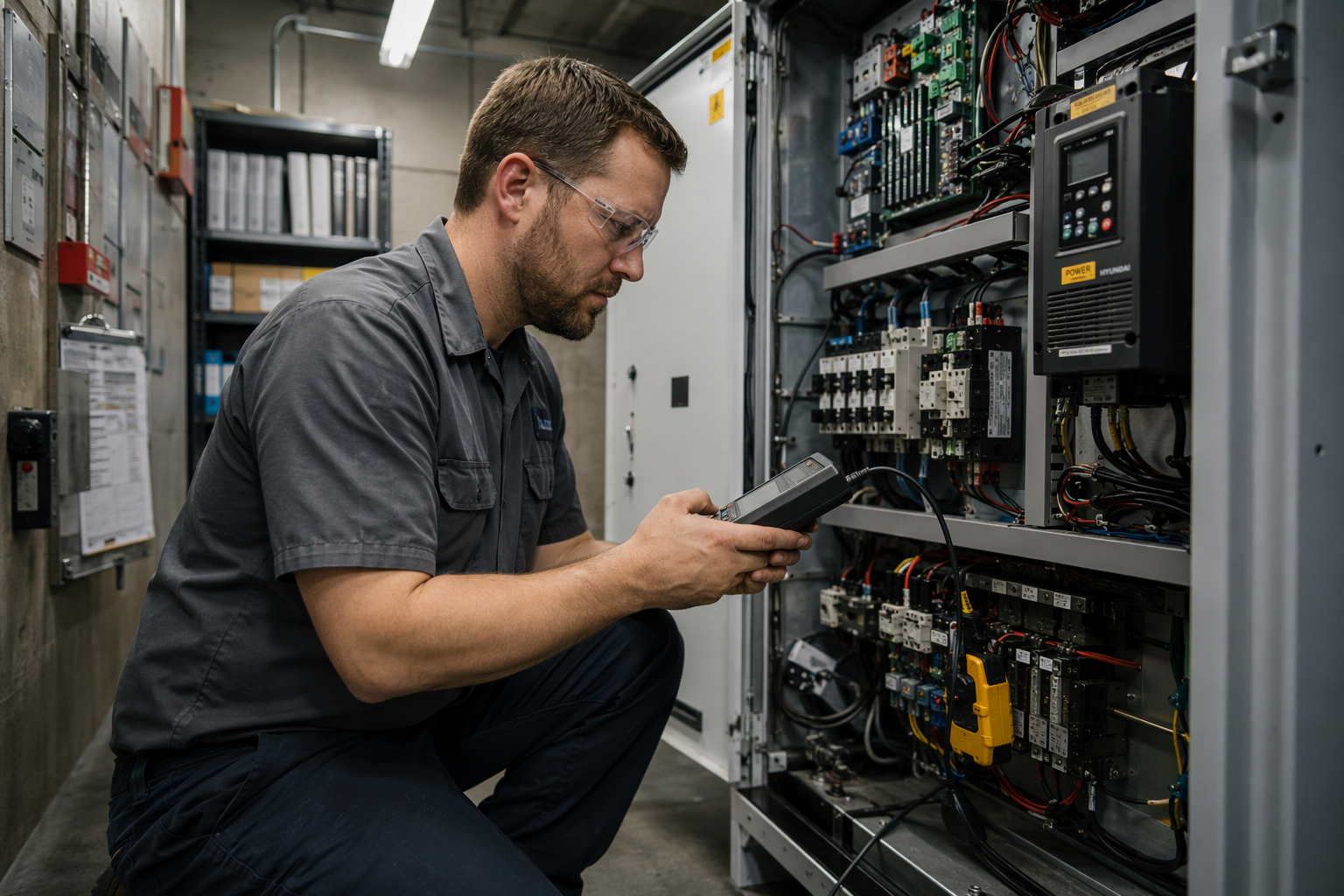
- Certified Competent Conveyance Mechanic (CCCM): Anyone who works on an elevator in California without direct supervision must hold Cal/OSHA CCCM certification. Only a CCCM working for a CQCC may maintain, repair, alter, or replace components on a conveyance.
- Certificate renewal: CQCC, CCCM, and conveyance inspector certificates are valid for two years and require at least eight hours of continuing education for renewal.
When evaluating a commercial elevator maintenance provider in San Francisco, verifying active CQCC certification and C-11 licensing status is the most important due diligence step a property owner can take. AmeriTex Elevator operates as a data-driven service provider with a focus on California’s regulatory compliance requirements, helping commercial clients track certification requirements and inspection timelines as part of an organized maintenance approach.
What Does a Commercial Elevator Maintenance Program Typically Include?
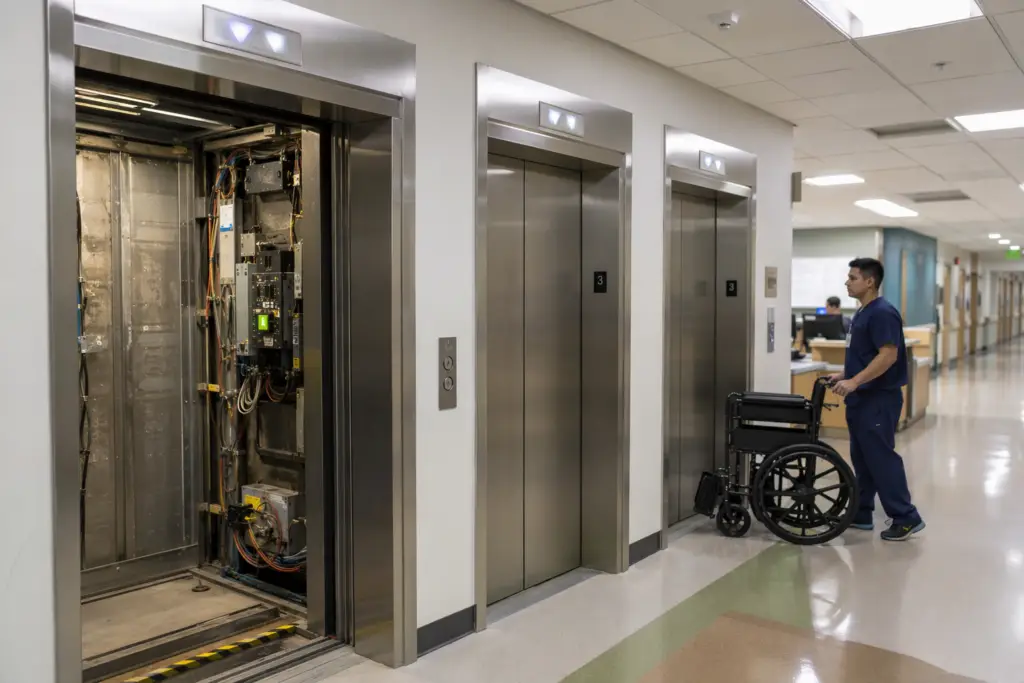
A full maintenance contract for a commercial elevator in San Francisco generally encompasses preventive, predictive, and corrective service components. While specific scope varies by contract type, well-structured programs typically address the following areas:
- Mechanical systems: Drive machine, sheaves, ropes or belts, governor, and braking systems
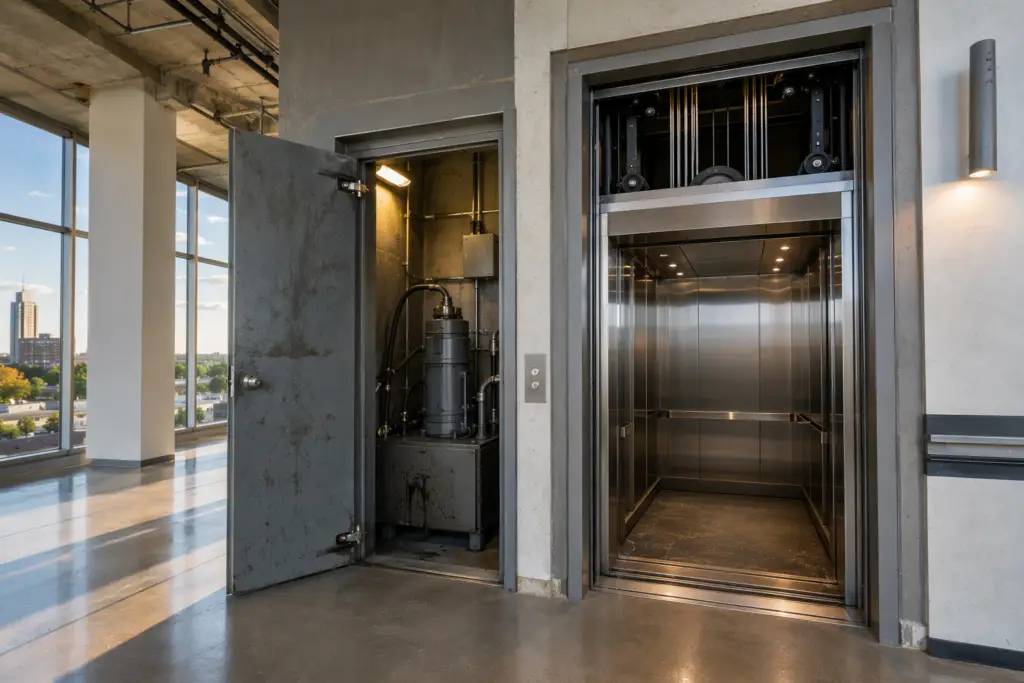
- Hydraulic systems (where applicable): Power units, cylinders, hoses, and fluid levels
- Door systems: Door operators, gibs, hangers, interlocks, and safety edges
- Control systems: Microprocessor controllers, relay logic panels, dispatching systems, and wiring
- Safety devices: Safeties, buffers, limit switches, oil buffers, and overspeed governors
- Cab interior and signage: Emergency lighting, intercommunication systems, and posted permit verification
- Pit and machine room: Cleanliness, lighting, fire suppression systems, and sump pump operation
A “full maintenance” contract is specifically significant in California because it is the qualifying condition under which Cal/OSHA may extend a permit to operate to two years rather than one—a direct cost and administrative benefit for high-traffic commercial properties.
What Factors Drive the Cost of Commercial Elevator Maintenance in San Francisco?
Commercial elevator maintenance costs in San Francisco vary considerably based on a range of qualitative and site-specific factors. Rather than presenting figures that cannot be sourced, the following factors are well-recognized as the primary cost drivers:
- Equipment type and age: Traction elevators, hydraulic elevators, and machine-room-less (MRL) systems each have different maintenance profiles. Older equipment with proprietary control systems may require specialized parts that increase service cost.
- Building height and traffic volume: High-rise commercial buildings with heavy daily passenger loads place greater wear on components, increasing the frequency and scope of required maintenance.
- Contract type: Full maintenance contracts (covering parts and labor) carry higher upfront costs than oil-and-grease contracts but typically reduce exposure to unexpected repair expenses and qualify for extended permit duration under California law.
- Number of units: Portfolio contracts covering multiple elevators in a building or across a property portfolio often achieve better per-unit economics than single-unit agreements.
- Code-required testing: Certain periodic tests—such as safety and governor tests and hydraulic pressure tests—involve additional labor and documentation requirements that contribute to total maintenance spend.
- Modernization deferrals: Buildings that have deferred upgrades to controllers, door systems, or safety devices often face higher maintenance costs as technicians work around aging or obsolete components.
- San Francisco labor market: The Bay Area’s cost of skilled labor is among the highest in California, which is reflected in service pricing across all building trades, including elevator maintenance.
What Happens During an Annual Cal/OSHA Elevator Inspection?
Understanding the inspection process helps building owners prepare effectively and reduce the likelihood of violations or permit delays.
- Schedule the inspection: The building owner arranges the annual reinspection with Cal/OSHA or a Certified Competent Conveyance Inspector (CCCI). This is a legal obligation of the owner, not the state or the maintenance contractor.
- Ensure the elevator is accessible: Machine rooms, pits, and all equipment areas must be unlocked, clean, and accessible. Required lighting must be functional.
- Present maintenance records: Inspectors typically review maintenance logs, prior inspection reports, and any test documentation. Having organized records ready demonstrates due diligence.
- Accompany the inspector: A qualified representative—ideally a CCCM from the maintenance company—should accompany the inspector to address technical questions and immediately document any noted conditions.
- Review the inspection findings: The inspector will identify any deficiencies against the applicable provisions of Title 8, Elevator Safety Orders.
- Address violations promptly: Any conditions that make the elevator unsafe must be corrected before the elevator resumes operation. Cal/OSHA may issue a stop-use order for unsafe equipment.
- Obtain and post the permit: Once the elevator passes inspection, Cal/OSHA issues a permit to operate. The permit must be conspicuously posted inside the elevator car.
- File for permit renewal before expiration: Track permit expiration dates to ensure continuity of operations and avoid lapses that could expose the owner to citations.
What Are the ADA Requirements Relevant to Commercial Elevator Maintenance in San Francisco?
The Americans with Disabilities Act (ADA) establishes accessibility requirements for elevators serving public accommodations and commercial facilities. While ADA compliance is a design and installation issue at its core, maintenance plays a critical supporting role:
- Control buttons, Braille signage, and audible signals must remain functional. Routine maintenance should include inspection of these accessibility features.
- Door timing and reopening devices must operate correctly to allow passengers with mobility impairments adequate time to board and exit.
- Leveling accuracy matters for wheelchair accessibility; the elevator must land level with the floor to within acceptable tolerances.
- Emergency communication systems must be operable. Under the ADA, two-way communication in elevator cabs is required, with specific provisions addressing accessibility for users who are deaf or hard of hearing.
Maintenance teams should document ADA-related component checks separately to assist property owners in demonstrating ongoing compliance during tenant audits or accessibility complaints.
What Should Building Owners Do Immediately After an Elevator Incident?
- Ensure passenger safety: Contact emergency services if any person is injured or trapped. Do not attempt to rescue passengers from a stalled elevator without trained personnel.
- Remove the elevator from service: Tag the elevator out of service until it has been inspected and cleared by qualified personnel.
- Notify your maintenance contractor: Contact your CQCC-certified elevator maintenance provider immediately for an emergency inspection.
- Document the incident: Record the date, time, nature of the incident, elevator car and unit number, and names of any witnesses or affected parties.
- Notify Cal/OSHA: California law requires that elevator-related incidents be reported to Cal/OSHA’s Elevator Unit. Do not delay this notification.
- Preserve evidence: Do not alter the elevator’s condition or delete controller fault logs before the inspection is complete.
- Obtain written clearance before returning to service: The elevator should not be returned to service until a CCCM has cleared it and any required Cal/OSHA follow-up is complete.
What Industry Trends Are Shaping Commercial Elevator Maintenance in 2025–2026?
The commercial elevator maintenance industry is undergoing meaningful change driven by technology, regulation, and shifting building use patterns. Several trends are relevant to San Francisco property owners:
Remote monitoring and predictive maintenance: Elevator controllers are increasingly equipped with connected sensors that transmit operational data to service centers in real time. This allows maintenance teams to identify developing faults—such as door operator degradation or motor performance drift—before they cause entrapments or failures. For high-traffic San Francisco commercial buildings, predictive maintenance has the potential to reduce unplanned downtime, though the value depends heavily on the monitoring platform and the responsiveness of the service provider.
Aging building stock and modernization pressure: San Francisco’s commercial inventory includes a significant proportion of buildings constructed during the mid-twentieth century. As original elevator equipment ages beyond its design life, property owners face increasing pressure to modernize controllers, door systems, and safety components—not only for reliability but to maintain compliance as Cal/OSHA’s proposed Group V code update moves toward adoption.
Energy efficiency focus: Building operators under California’s climate and energy efficiency frameworks are paying closer attention to elevator energy consumption. Drive system upgrades, regenerative drives, and LED lighting retrofits in elevator cabs are increasingly common components of modernization projects.
Workforce and certification pipeline: The requirement that all California elevator mechanics hold CCCM certification—with two-year renewal cycles requiring continuing education—places ongoing demands on the technician workforce. Building owners should confirm that their service provider maintains an adequate roster of certified mechanics to ensure consistent service coverage.
Code update preparation: The proposed Group V update to California’s Elevator Safety Orders, incorporating elements of ASME A17.1-2019, is moving through the regulatory process. While no effective date has been set as of mid-2026, forward-looking building owners and service providers are reviewing how the newer code edition may affect legacy equipment and what upgrade pathways may be required.
How Does a Full Maintenance Contract Differ from a Limited Maintenance Contract?
Not all elevator service agreements are created equal, and the distinction matters significantly under California law and for total cost of ownership:
- Full maintenance contracts typically cover all parts, labor, and emergency callbacks for covered components. Under California regulations, a full maintenance contract with a CQCC-certified company is what qualifies a building owner for a permit to operate of up to two years—reducing administrative burden and inspection frequency.
- Oil-and-grease (or limited) contracts cover routine lubrication and minor adjustments but exclude many parts and repairs. These agreements result in lower monthly costs but can expose owners to significant per-incident charges and do not qualify for the two-year permit.
- Modernization or repair contracts are project-specific agreements for defined scope, not ongoing maintenance arrangements.
For commercial properties in San Francisco where elevator downtime directly affects tenant experience and lease obligations, full maintenance contracts generally represent the lower-risk strategy when evaluated over a multi-year horizon.
How Do You Select a Qualified Elevator Maintenance Provider in San Francisco?
Choosing the right maintenance partner requires verifying credentials, understanding contract terms, and assessing service capability:
- Confirm active CQCC certification through Cal/OSHA’s Elevator Unit and a current C-11 license through the California Contractors State License Board.
- Ask for the names of CCCMs assigned to your building and verify their certification status.
- Review the contract carefully to identify what is and is not covered—parts exclusions are a common source of unexpected cost.
- Assess the provider’s documentation practices: organized maintenance logs and test records are critical for smooth Cal/OSHA inspections.
- Evaluate familiarity with your specific equipment brand and model, particularly if your building has proprietary control systems.
- Ask how the provider tracks permit expiration dates and coordinates annual inspection scheduling on the owner’s behalf.
AmeriTex Elevator supports commercial property owners with a systematic, compliance-centered approach to elevator maintenance, using documented service records and regulatory tracking to help clients in California navigate Cal/OSHA requirements with confidence.
What Is OSHA’s Role in Commercial Elevator Safety in San Francisco?
Federal OSHA standards apply to elevator safety in the context of worker protection—specifically for elevator mechanics and construction workers who work on or around elevator equipment. For commercial building owners in California, the primary elevator regulator is Cal/OSHA’s Elevator Unit rather than federal OSHA for general building operations. However, federal OSHA standards for personal protective equipment, lockout/tagout procedures, and confined space entry remain applicable to elevator maintenance work and should be reflected in any qualified service provider’s safety protocols.
What Records Should Commercial Elevator Owners Maintain in San Francisco?
Good recordkeeping is both a regulatory best practice and a practical protection for building owners:
- Current permit to operate (posted in the elevator car at all times)
- Prior inspection reports and Cal/OSHA correspondence
- Maintenance logs signed by the performing CCCM, with dates and work performed
- Documentation of any periodic tests (safety tests, hydraulic tests, etc.) and their outcomes
- Records of any repairs, parts replacements, or alterations, including permit documentation for material alterations
- Incident reports for any passenger entrapments, injuries, or equipment failures
- Copies of the maintenance contractor’s current CQCC certificate and C-11 license
Organized records facilitate faster Cal/OSHA inspections, support insurance claims, and provide documentation in the event of tenant or passenger disputes.
Sourced Regulatory Reference
| Regulatory Item | Requirement | Source |
|---|---|---|
| Inspection frequency | At least once per year for every conveyance | Cal/OSHA Elevator Unit |
| Standard permit duration | Up to one year upon passing inspection | Cal/OSHA Elevator Unit |
| Extended permit eligibility | Up to two years with full maintenance contract (CQCC-certified company) | Cal/OSHA Elevator Unit |
| Adopted elevator code (CA) | ASME A17.1/CSA B44, 2004 edition (Group IV), effective May 1, 2008 | ASME A17.1/CSA B44 via Cal/OSHA |
| Certificate renewal cycle | CQCC, CCCM, and inspector certificates: two years; 8 hours CE required | Cal/OSHA Elevator Unit |
Summary: What Every San Francisco Commercial Property Owner Should Know
Commercial elevator maintenance in San Francisco operates within one of the most structured regulatory frameworks in the United States. California’s dual-certification system—requiring both CQCC company certification and CCCM mechanic certification—establishes a high baseline for who may legally work on elevators. The annual inspection obligation, combined with the owner’s responsibility to arrange that inspection, means that passive facility management is not an option for elevator compliance.
The most common compliance failure points—lapsed permits, unqualified contractors, missed inspection scheduling, and inadequate maintenance records—are all preventable with the right service partner and documentation practices. As California moves toward a potential Group V code update incorporating newer ASME standards, buildings with proactive maintenance programs will be better positioned to manage any required upgrades with less disruption and cost.
AmeriTex Elevator provides commercial elevator maintenance services designed around California’s regulatory requirements, with a focus on documentation, certification compliance, and keeping building owners ahead of inspection timelines rather than reacting to violations.
Contact AmeriTex Elevator for a free elevator assessment at 844-646-9660.
Need elevator service you can rely on? AmeriTex Elevator is ready to help.