Is Your Healthcare Elevator Maintenance Contract Covering Everything It Should?
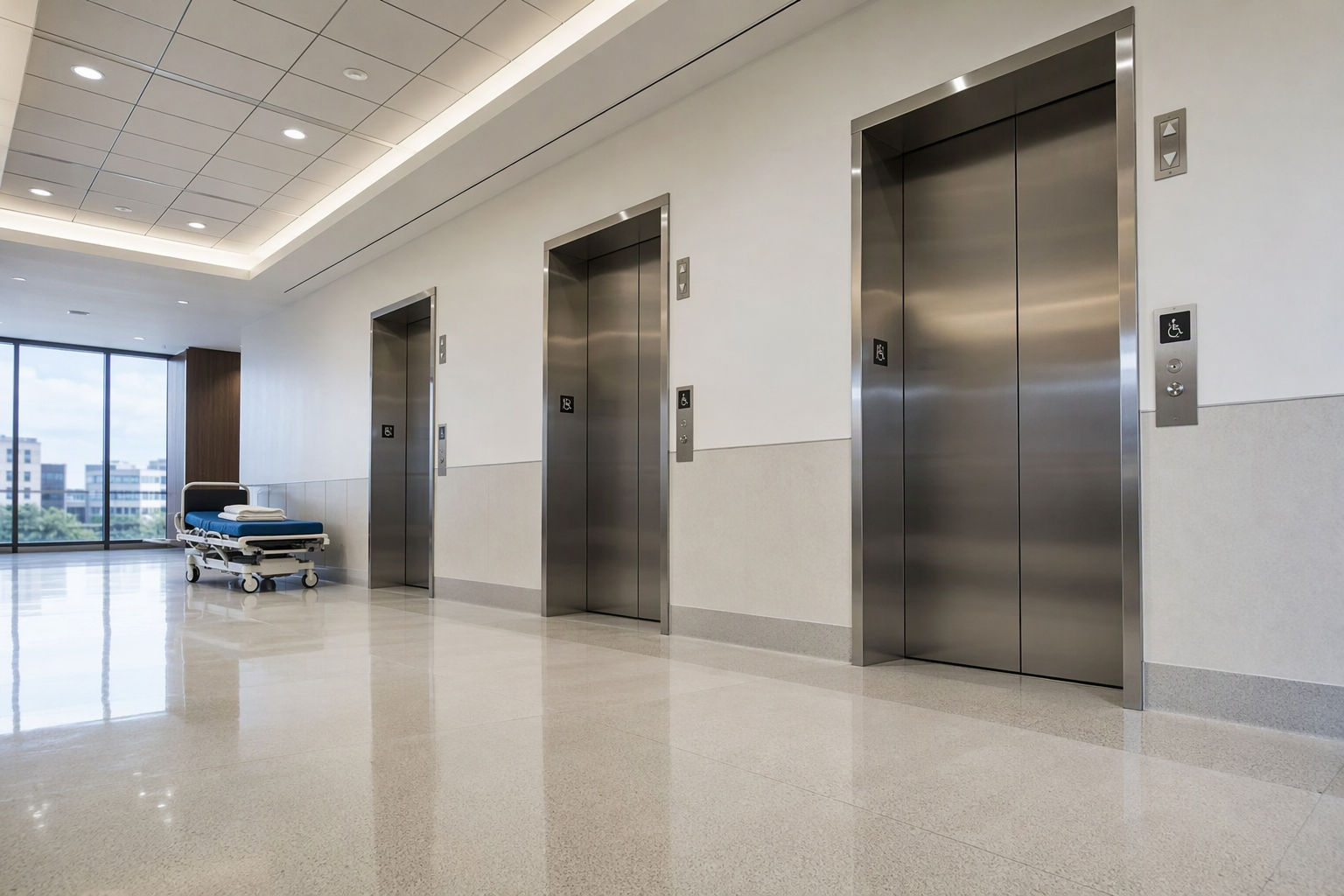
Hospitals, medical office buildings, outpatient surgery centers, and long-term care facilities depend on elevators to move patients, staff, medical equipment, and emergency responders around the clock. A gap in elevator maintenance coverage is not just an inconvenience in a healthcare setting — it can delay patient transport, trigger regulatory citations, or expose the facility to serious liability. Understanding exactly what a comprehensive maintenance contract should include is the first step toward protecting your patients, your staff, and your organization.
What Should a Healthcare Elevator Maintenance Contract Always Include?
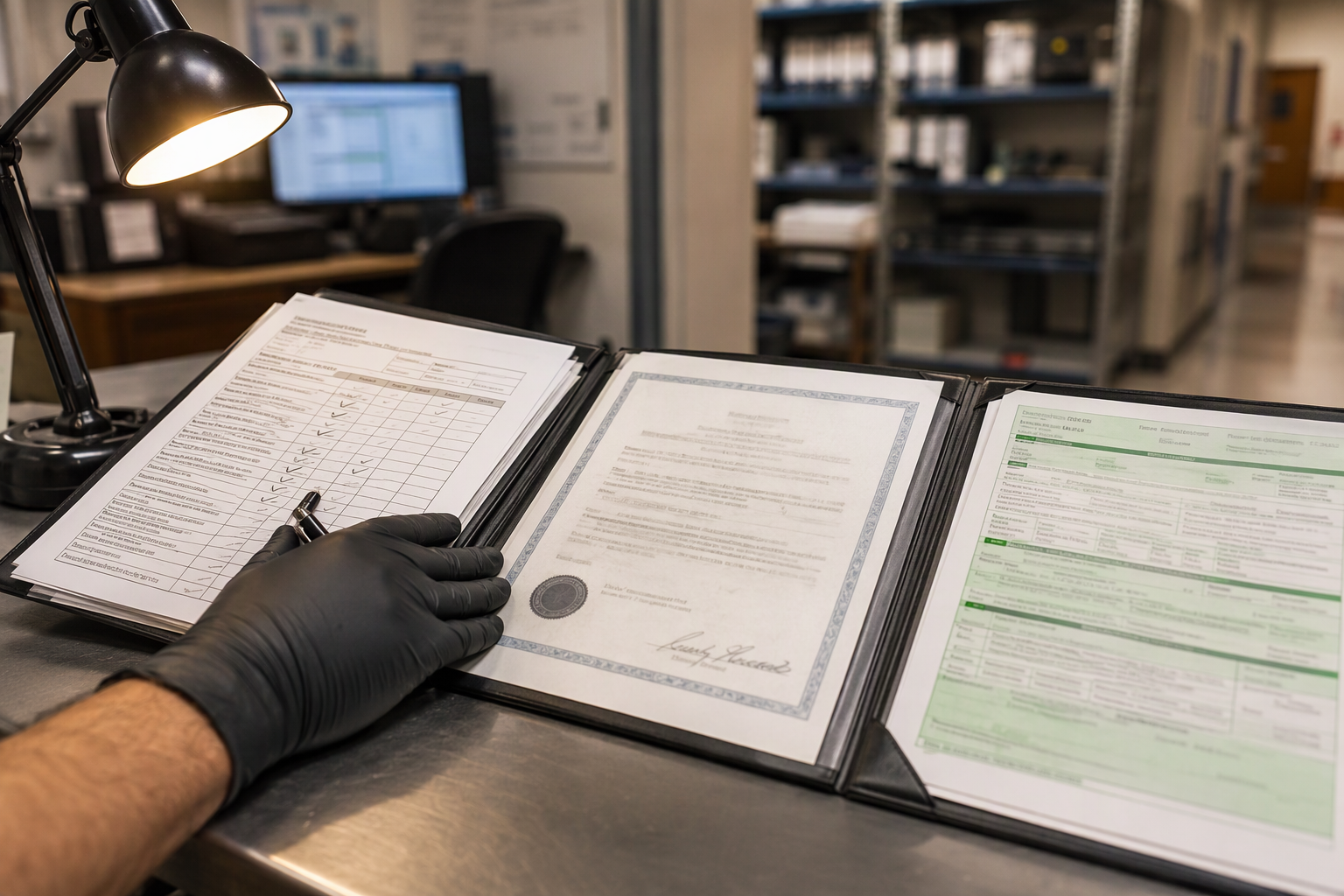
A contract that serves a healthcare facility adequately must address four distinct layers of obligation:
- Preventive maintenance visits — scheduled inspections and lubrication, adjustment, and testing of all major components including motors, controllers, door operators, safety devices, and buffers.
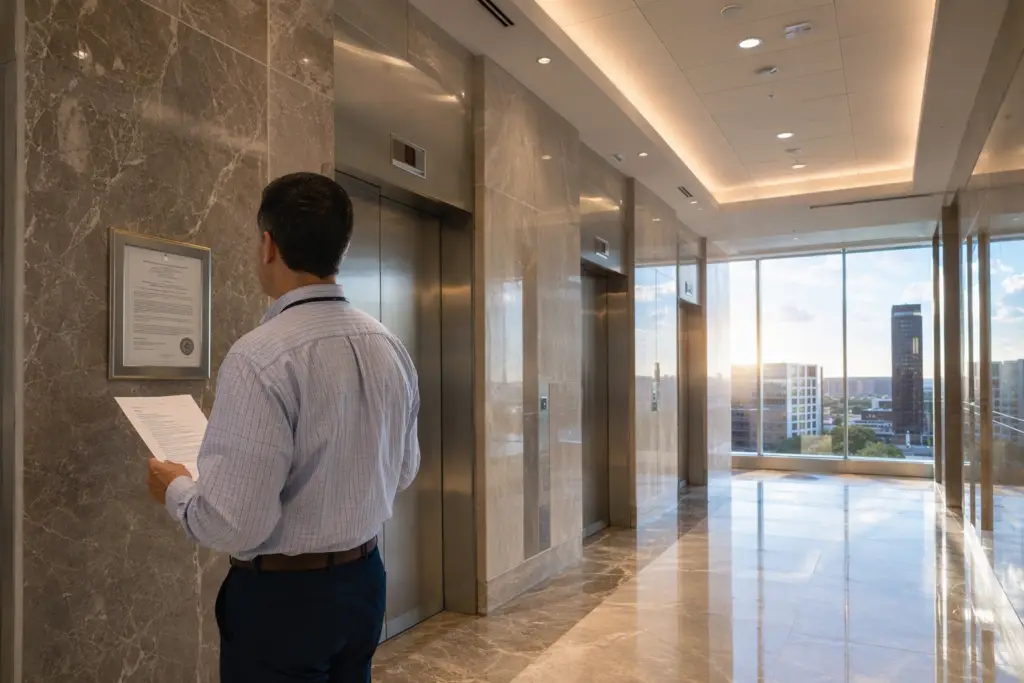
- State-mandated annual inspections and certificate management — in Texas, building owners must obtain a TDLR Certificate of Compliance for each unit of equipment annually; in California, a valid permit to operate issued by Cal/OSHA must be posted conspicuously in the elevator car and renewed at least every year.
- Code-required periodic tests — including the Category 5 full-load test required every five years on electric traction elevators in Texas, and any equivalent periodic safety tests mandated under the ASME A17.1 Safety Code for Elevators and Escalators.
- Emergency and life-safety system maintenance — firefighters’ service (Phase I and Phase II), door restrictors, emergency lighting, and two-way emergency communication.
If your current agreement does not explicitly address all four layers, ask your contractor in writing which items are excluded and why.
Why Do Healthcare Facilities Face Stricter Elevator Compliance Obligations?
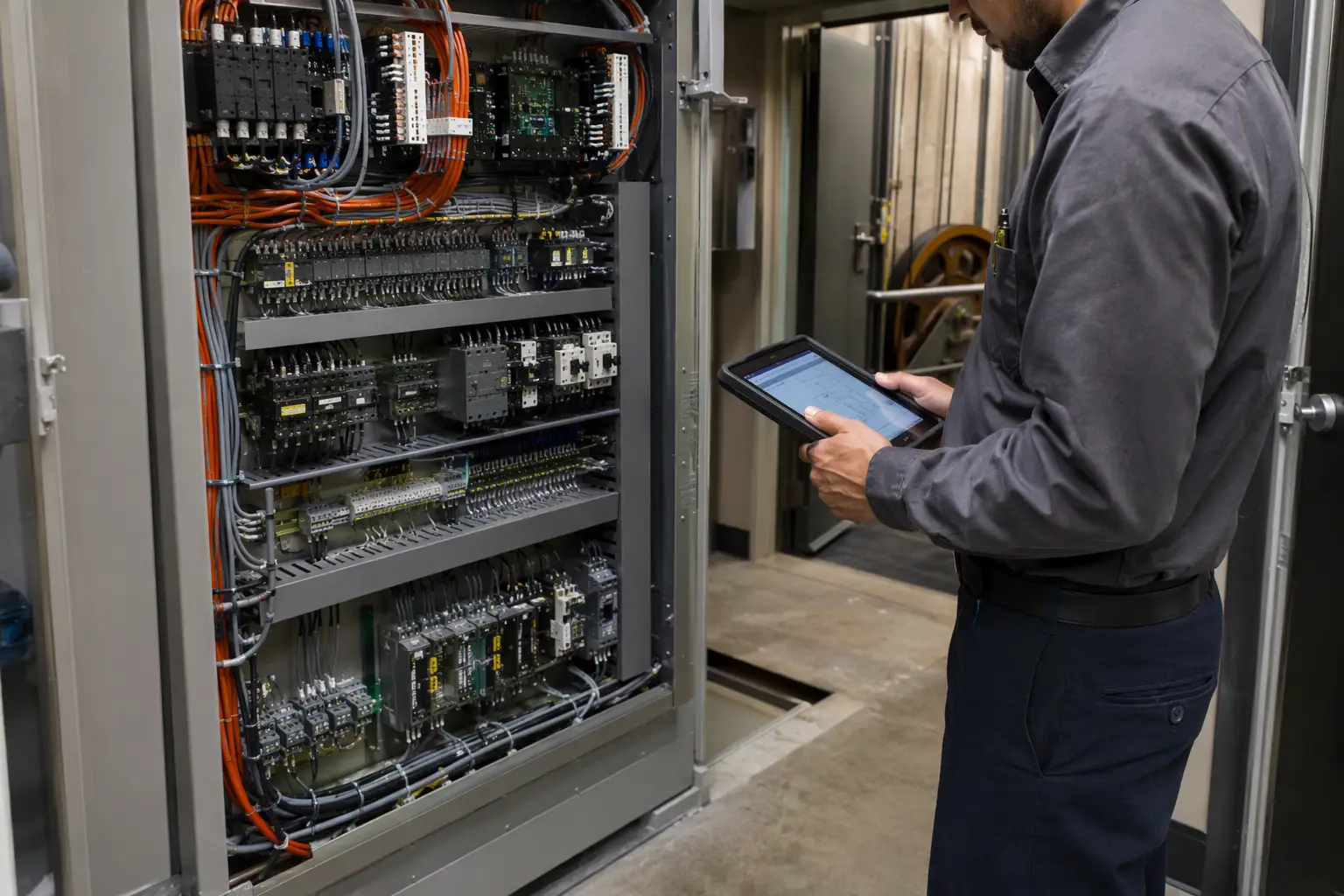
Healthcare facilities are classified as high-occupancy, essential-service buildings. Elevators in these environments must comply with the ASME A17.1 Safety Code for Elevators and Escalators, which establishes the baseline design, installation, and maintenance standards adopted by both Texas and California. The Americans with Disabilities Act (ADA) adds requirements for accessible controls, door timing, and cab dimensions that are especially relevant in patient care settings where mobility-impaired individuals and wheelchair users are the majority of riders.
Beyond federal standards, healthcare facilities operating in Texas are governed by the Texas Health and Safety Code Chapter 754 and 16 Texas Administrative Code Chapter 74. Facilities in California are governed by California Labor Code Sections 7300–7324.2 and the California Code of Regulations, Title 8, Elevator Safety Orders. Joint Commission accreditation surveys also evaluate elevator maintenance records as part of the Environment of Care standards, meaning deficiencies in your contractor’s documentation can affect your facility’s accreditation status.
What State-Level Rules Apply to Healthcare Elevators in Texas?
In Texas, the Texas Department of Licensing and Regulation (TDLR), Elevator and Escalator Safety program oversees elevator compliance statewide — with the notable exception that the City of Houston operates its own elevator inspection program and TDLR does not regulate elevators inside Houston city limits. Dallas, Austin, and San Antonio facilities fall under TDLR jurisdiction.
Key Texas obligations that your maintenance contract must support include:
- Annual inspection by a TDLR-registered elevator inspector and issuance of a Certificate of Compliance, which must be displayed in a publicly visible area of the building.
- Correction of any cited violations, or a written correction agreement in place, within 30 days of the inspection.
- A Category 5 full-load test every five years on traction elevators — this is a code-mandated test that requires advance planning and must be documented.
- Immediate removal from service of any passenger elevator without working door restrictors or without functioning Phase I firefighters’ service — a critical patient-safety requirement in healthcare settings.
- Accident reporting to TDLR within 24 hours of any incident involving elevator equipment.
- Use of a TDLR-registered elevator contractor for all installation, repair, alteration, testing, and maintenance work.
A contract that does not explicitly mention Category 5 testing coordination, violation correction timelines, or accident reporting support is leaving your facility to manage those obligations alone.
What State-Level Rules Apply to Healthcare Elevators in California?
In California, the Cal/OSHA Elevator Unit, California Department of Industrial Relations administers the elevator safety program under California Labor Code Sections 7300–7324.2 and the Title 8 Elevator Safety Orders. The adopted code is the ASME A17.1/CSA B44, 2004 edition, for equipment installed under contracts signed on or after May 1, 2008. California has proposed a Group V update that would incorporate elements of ASME A17.1-2019; a public hearing was held in June 2026, but no effective date has been posted as of this writing.
California-specific obligations your contract must address include:
- Arranging the annual reinspection — California law places this responsibility on the elevator owner, not the contractor, so your contract should clarify who coordinates the scheduling.
- Ensuring the permit to operate is current and posted conspicuously in the cab at all times.
- Using only a Cal/OSHA-certified Qualified Conveyance Company (CQCC) with mechanics who hold Cal/OSHA Certified Competent Conveyance Mechanic (CCCM) credentials.
- Maintaining documentation sufficient to support a two-year permit renewal, which Cal/OSHA may grant when the elevator is covered by a full maintenance contract with a C-11 licensed elevator company.
Los Angeles healthcare facilities should be aware that the City of Los Angeles Department of Building and Safety (LADBS) operates its own elevator inspection program; your compliance obligations in Los Angeles may differ from those under the statewide Cal/OSHA framework.
How Do I Identify Gaps in My Current Elevator Maintenance Contract?
Reviewing a maintenance agreement for completeness does not require a legal background. Work through this checklist and flag any item your contract does not explicitly address:
- Does the contract specify the frequency of preventive maintenance visits and what is included in each visit?
- Does it address who is responsible for scheduling and coordinating the annual state inspection?
- Does it cover labor and parts for emergency call-backs, or are those billed separately?
- Does it include coordination and documentation for the Category 5 full-load test (Texas traction elevators)?
- Does it address firefighters’ service (Phase I and Phase II) testing and maintenance?
- Does it cover door safety devices, including restrictors and reopening devices?
- Does it address ADA-compliant door timing, leveling accuracy, and emergency communication systems?
- Does the contractor hold all required state credentials — TDLR registration in Texas, CQCC certification and C-11 license in California?
- Does the contract include documentation support for Joint Commission Environment of Care compliance?
AmeriTex Elevator recommends requesting a written scope-of-services addendum if any of these items appear ambiguous or absent in your current agreement.
What ADA Requirements Affect Healthcare Elevator Maintenance?
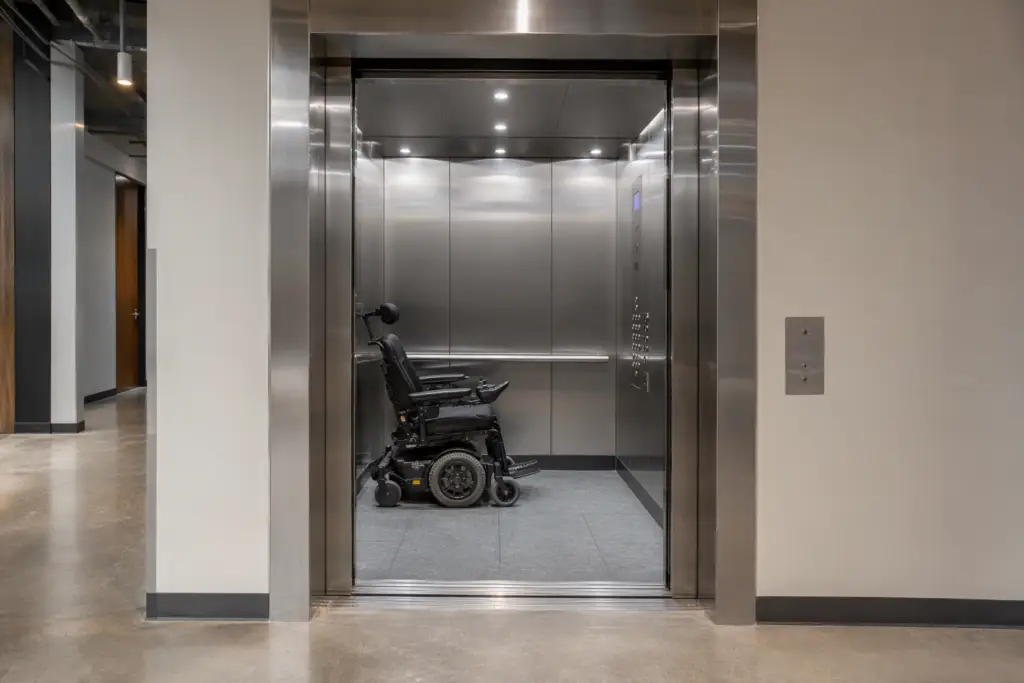
The ADA requires that elevators serving multiple floors in public accommodations and commercial facilities remain accessible to people with disabilities. In a healthcare context, this means maintenance must preserve compliant door open times sufficient for patients using mobility aids, accurate floor leveling so wheelchairs can enter and exit safely, Braille and raised character signage in proper condition, and functional two-way emergency communication accessible to individuals who are deaf or hard of hearing.
ADA compliance is not a one-time installation check — it is an ongoing maintenance obligation. A contract that covers only mechanical performance without addressing accessibility features may leave your facility exposed to ADA complaints.
What Is a Full Maintenance Contract and Is It Worth It for a Healthcare Facility?
A full maintenance contract typically covers all labor, parts, and scheduled tests with no additional per-call charges, as opposed to an oil-and-grease contract that covers only routine lubrication and adjustments. For healthcare facilities operating elevators continuously across multiple shifts, the predictability and coverage depth of a full maintenance agreement generally reduces both unplanned downtime and total annual costs. In California, a full maintenance contract with a C-11 licensed elevator company is also the basis on which Cal/OSHA may issue a two-year permit to operate rather than the standard one-year permit — a meaningful administrative benefit for busy facilities teams.
How Can I Tell If My Contractor Is Properly Credentialed?
In Texas, verify that your contractor holds a current registration with TDLR. Texas elevator contractor registrations expire annually, so a credential that was valid at contract signing may have lapsed. In California, verify that the company holds both a C-11 Elevator Contractor license from the California Contractors State License Board and a CQCC certification from Cal/OSHA. Ask for the specific certificate numbers and check them directly on the relevant agency websites. A contractor who is reluctant to provide those numbers is a red flag.
AmeriTex Elevator operates as a registered contractor in Texas and maintains the credentials required to serve California healthcare facilities, and the company recommends that any healthcare procurement team perform this verification step regardless of which contractor they use.
What Should I Do Immediately If I Suspect My Contract Is Inadequate?
- Pull your current maintenance contract and compare it line by line against the checklist in the section above.
- Request copies of your current state inspection certificates — the TDLR Certificate of Compliance in Texas or the Cal/OSHA permit to operate in California — and confirm they are current and displayed properly.
- Request proof of your contractor’s current state credentials and insurance coverage.
- Ask your contractor for a written list of any tests or services that are excluded from your agreement.
- Document any elevators that are exhibiting performance issues — slow leveling, door hesitation, control anomalies — and request a written response from your contractor.
- Contact an independent elevator service company, such as AmeriTex Elevator, for a third-party assessment of your equipment’s condition and your contract’s coverage.
Questions Your Inspector Will Ask
Whether your facility is inspected by a TDLR-registered inspector in Texas or by a Cal/OSHA safety engineer or Certified Competent Conveyance Inspector (CCCI) in California, inspectors routinely evaluate the following areas. Your maintenance contractor should be preparing your equipment and documentation to answer each of these confidently:
- Is the current Certificate of Compliance (Texas) or permit to operate (California) posted and valid?
- When was the last Category 5 full-load safety test performed, and is the documentation on file? (Texas traction elevators)
- Are Phase I and Phase II firefighters’ service systems functional and recently tested?
- Are door restrictors installed and operational on all passenger elevators?
- Is the two-way emergency communication system functional?
- Are all safety devices — governors, safeties, buffers, and interlocks — in proper working condition?
- Is the maintenance log current, legible, and accessible on-site?
- Have any violations from the previous inspection been corrected or formally addressed?
- Are leveling accuracy and door timing within the tolerances established by ASME A17.1 and ADA standards?
- Is the contractor performing the maintenance registered or certified by the applicable state authority?
How Does Elevator Downtime Affect Healthcare Operations Specifically?
In a standard commercial building, an elevator outage is an inconvenience. In a healthcare facility, it can interrupt the movement of patients on gurneys or in wheelchairs, delay the transport of medications or sterile supplies between floors, slow emergency responder access, and create compliance issues under life-safety codes. A maintenance contract that does not include clear provisions for priority response to critical healthcare environments may not reflect the operational realities of your facility. When evaluating contracts, healthcare facility managers should ask specifically how the contractor prioritizes service calls for healthcare clients and what documentation the contractor provides after each maintenance visit.
Can AmeriTex Elevator Review My Existing Contract?
AmeriTex Elevator provides assessments of elevator equipment condition and maintenance coverage for healthcare facilities across Houston, Dallas, Austin, San Antonio, Los Angeles, and San Diego. A qualified review can identify whether your current agreement addresses the state inspection requirements, code-mandated periodic tests, life-safety systems, and ADA obligations specific to your location and equipment type — giving your facilities team the information needed to negotiate better coverage or select a contractor whose scope matches your compliance obligations.
Contact AmeriTex Elevator for a free elevator assessment at 844-646-9660.
Need elevator service you can rely on? AmeriTex Elevator is ready to help.