Emergency Elevator Repair Houston

Emergency Elevator Repair in Houston, TX: Complete FAQ Guide
Quick Answer: Emergency elevator repair in Houston is available 24/7 from licensed elevator contractors who can respond within 2–4 hours, diagnose safety-critical failures, and restore service in compliance with ASME A17.1 and Texas Department of Insurance (TDI) regulations — with typical repair costs ranging from $500 to $5,000+ depending on the fault severity.
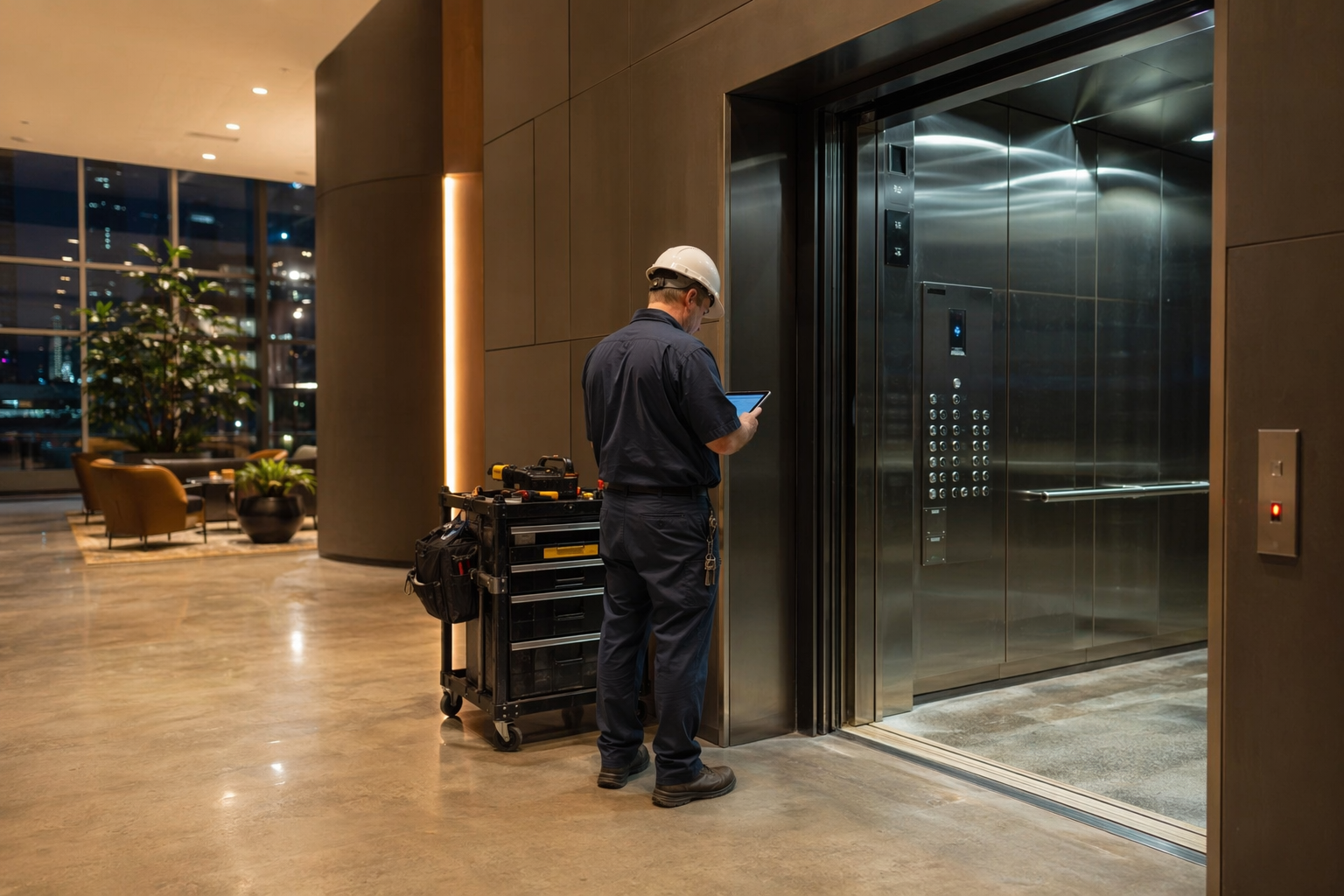
Licensed elevator technician responding to an emergency elevator repair call in a Houston TX commercial high-rise lobby at night, diagnostic tablet in hand.
AmeriTex Elevator technicians respond to emergency elevator repair calls across Houston 24 hours a day, arriving on-site typically within 90 minutes to 4 hours depending on location and time of day.

After 15 years of responding to elevator emergencies across Houston’s medical centers, high-rises, and mixed-use properties, I’ve seen what separates a minor inconvenience from a life-safety crisis. This guide answers every question building owners, property managers, and facility directors ask when an elevator goes down — fast.

What Exactly Counts as an Emergency Elevator Repair in Houston?
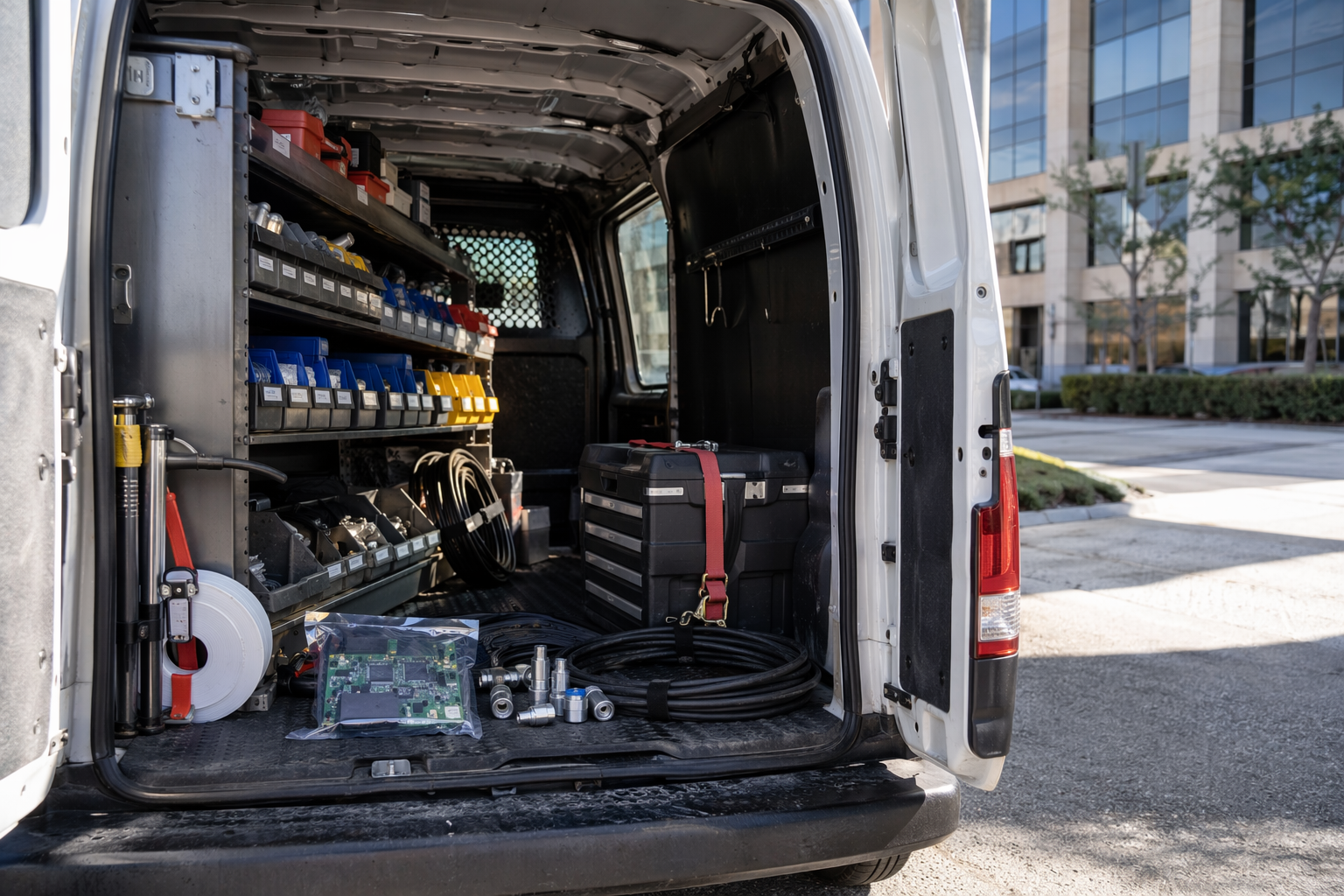
Emergency elevator repair service van stocked with hydraulic parts, control boards, and tools ready for a rapid response call in Houston TX.
Rapid response to elevator emergencies in Houston depends on technicians arriving pre-stocked with critical parts — including hydraulic components, control boards, and door operator hardware — to minimize downtime on the first visit.

An emergency elevator repair is any failure that traps passengers, creates an imminent safety hazard, or takes a required accessible route out of service — requiring immediate, same-day response under ASME A17.1 and Texas state code.

Not every elevator malfunction is an emergency, but several scenarios demand immediate action. Passenger entrapment is the most urgent: any time a person is physically trapped inside an elevator car, emergency protocols must activate immediately. Door failures that prevent safe egress, brake malfunctions, uncontrolled movement, and sudden loss of power mid-travel all qualify as life-safety emergencies under ASME A17.1 Safety Code for Elevators and Escalators.

Beyond entrapment, a non-functional elevator in a building subject to ADA accessibility requirements can trigger compliance violations within hours if the unit serves as the sole accessible route. Houston property managers should treat any ADA-route elevator outage as a legal emergency, not just a maintenance issue.

How Quickly Can an Emergency Elevator Technician Reach My Houston Property?
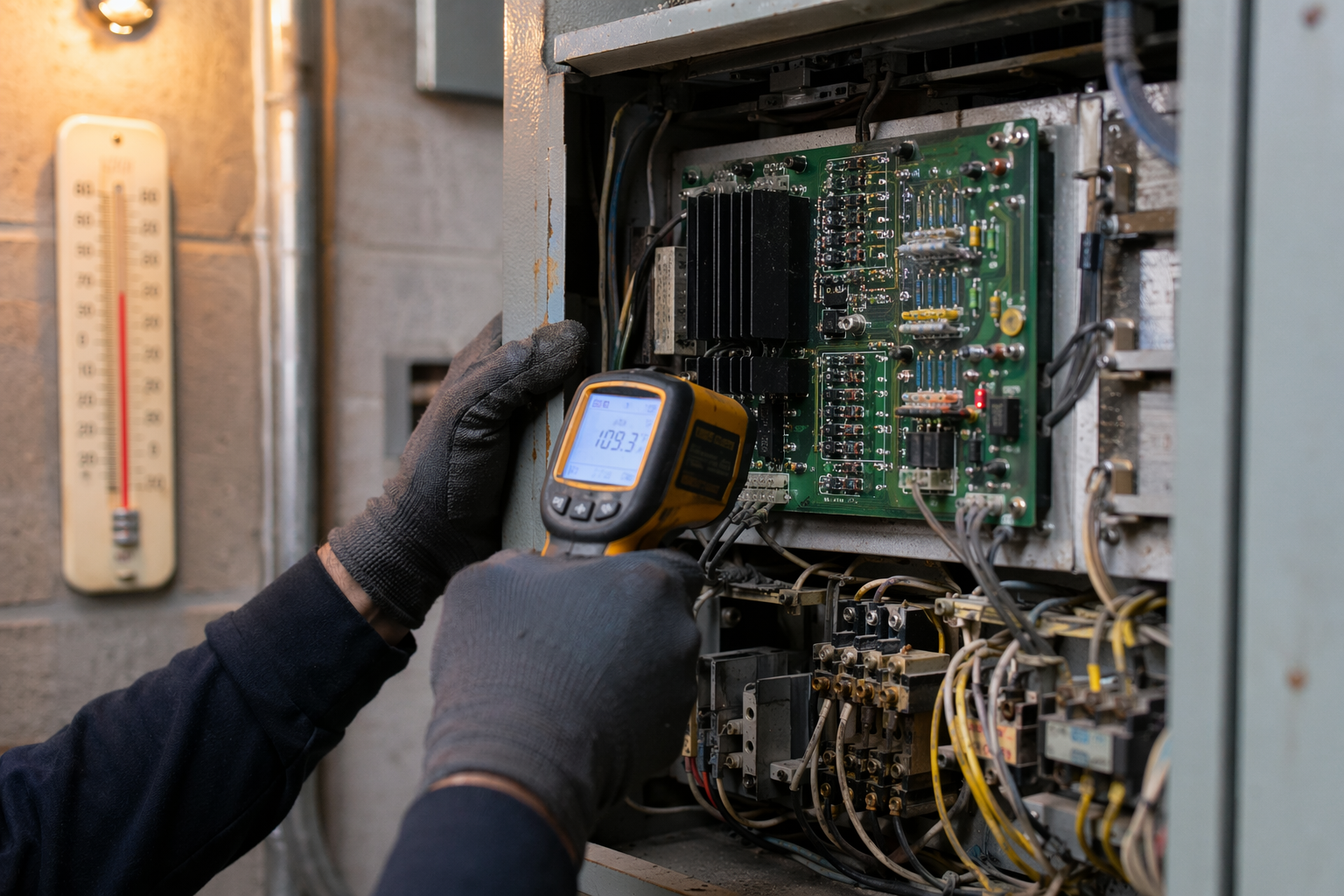
Elevator machine room controller showing heat-stressed components in a Houston TX building where summer temperatures accelerate emergency elevator failures.
Houston’s extreme summer heat — with machine room temperatures often exceeding 110°F in older buildings — is a leading cause of electrical control board failures and hydraulic system breakdowns that trigger emergency elevator repair calls.

A qualified 24/7 emergency elevator contractor in Houston should arrive on-site within 2–4 hours of your call, with most metropolitan-area responses achieved in under 90 minutes during standard hours.

Response time depends heavily on which service provider you use and whether you have an active maintenance contract. Building owners with a full-service maintenance agreement typically receive priority dispatch — meaning technicians are already familiar with the equipment on file and can arrive faster with the right parts. AmeriTex Elevator dispatches certified technicians across the greater Houston area 24 hours a day, 7 days a week, 365 days a year, including holidays.

Houston’s geography matters too. Properties in the Texas Medical Center, Downtown, Midtown, or the Energy Corridor are serviced from different staging areas. When vetting a provider, always ask for their guaranteed response window in writing before an emergency happens.

What Are the Most Common Causes of Emergency Elevator Failures in Houston?

The five most common causes of emergency elevator failures in Houston are door system malfunctions, hydraulic fluid leaks, electrical control board failures, worn hoist ropes or sheaves, and heat-related component stress from Houston’s extreme climate.

Houston’s subtropical climate — with summer temperatures consistently exceeding 95°F and high humidity — accelerates wear on mechanical and electrical components in ways that technicians in cooler climates rarely encounter. Machine room temperatures can exceed 110°F in older buildings without adequate ventilation, which is a primary driver of control board failures and motor overheating in this market.

Door system malfunctions account for roughly 40% of all elevator service calls industry-wide, and that figure holds in Houston. Door operator motors, door safety edges, and car door hangers are high-cycle components that wear out faster in buildings with heavy daily traffic — think apartment complexes, medical buildings, and parking garages.

What Does Emergency Elevator Repair Cost in Houston in 2026?

Emergency elevator repair in Houston typically costs between $500 and $8,000 for most common failures, with after-hours emergency dispatch fees ranging from $150 to $400 on top of parts and labor.

Cost is determined by the type of failure, the equipment manufacturer, parts availability, and whether the call occurs during business hours or after midnight on a Sunday. Below is a benchmark cost table based on real-world Houston market data in 2026:

Repair Type Estimated Cost Range Typical Labor Hours Parts Availability
Passenger entrapment rescue (no repair) $150 – $400 0.5 – 1 hr N/A
Door operator motor replacement $800 – $1,800 2 – 4 hrs Usually in stock
Hydraulic pump/valve repair $1,200 – $3,500 3 – 6 hrs May require order
Control board replacement $2,500 – $6,000 4 – 8 hrs Often 1–5 day lead
Hoist rope replacement $3,000 – $8,000 6 – 12 hrs Usually in stock
Safety gear / governor reset $500 – $1,500 1 – 3 hrs Usually in stock
After-hours emergency dispatch fee $150 – $400 (added to above) N/A N/A

Buildings with proprietary elevator systems — particularly Otis, KONE, or Schindler units under active OEM contracts — may face higher parts costs or restricted access for independent contractors. Always clarify proprietary parts restrictions with your service provider before signing any maintenance agreement.

Is Emergency Elevator Repair in Houston Regulated by the State of Texas?

Yes — elevator repair and inspection in Texas is regulated by the Texas Department of Insurance (TDI), which requires all elevator contractors and mechanics to be licensed under Texas Occupations Code Chapter 754 and enforces compliance with ASME A17.1.

Texas requires that any elevator work — including emergency repairs — be performed by a licensed elevator contractor holding a valid TDI Elevator Contractor License. Individual mechanics must hold a TDI Elevator Inspector or Mechanic license. Unlicensed repair work not only voids insurance coverage but exposes property owners to significant liability in the event of a subsequent incident.

After any major emergency repair, Texas state code may require a follow-up inspection before the elevator is returned to passenger service. The TDI maintains jurisdiction over certificate-of-operation issuance, and an elevator operating without a valid certificate in Texas is an immediate violation. You can verify contractor licenses through the TDI Elevator Safety Division.

What Should I Do Immediately If My Elevator Traps a Passenger?

If a passenger is trapped in your elevator, call 911 if there is a medical emergency, activate your elevator’s two-way emergency phone, keep the passenger calm, and immediately contact a licensed elevator contractor — never attempt a manual rescue without a trained technician present.

Per ASME A17.1 Section 2.27.1, every elevator must have a means of two-way communication allowing trapped passengers to contact a responsible party. Your first action should be to use that communication system to verify the passenger’s physical condition. If anyone reports chest pain, difficulty breathing, or injury, call 911 before calling your elevator contractor.

Do not attempt to force doors open from the lobby side without verified knowledge of car position. An elevator car that has stalled between floors can drop if the brake releases unexpectedly. The Houston Fire Department is trained in basic entrapment rescues, but they will defer to a licensed elevator mechanic for anything beyond a straightforward door-level extraction.

Document the time of entrapment, the passenger’s floor location, and any error codes shown on the hall call panel. This information dramatically accelerates a technician’s diagnostic process on arrival.

Does My Houston Building Need a 24/7 Elevator Maintenance Contract?

Any commercial, multi-family, or institutional building in Houston that relies on an elevator for daily operations or ADA-compliant access should have a 24/7 full-service maintenance contract — it reduces emergency downtime, controls long-term costs, and is essential for regulatory compliance.

A full-service maintenance agreement typically includes scheduled preventive maintenance visits (usually monthly or quarterly), priority emergency dispatch, parts coverage, and annual inspection coordination with TDI. Buildings without a maintenance contract pay time-and-materials rates for every service call, which can cost 30–60% more over a calendar year compared to contract pricing.

For high-rise residential buildings, hospitals, and hotels in Houston — where elevator downtime directly affects tenant safety and business operations — a maintenance contract is not optional, it is a risk management tool. AmeriTex Elevator offers tiered maintenance plans for Houston properties of all sizes, from single-unit apartment buildings to multi-elevator commercial towers.

How Do I Know If My Elevator Needs Emergency Repair Versus Routine Service?

An elevator needs emergency repair — not routine service — if it exhibits sudden uncontrolled movement, refuses to open doors with passengers inside, produces burning smells or smoke, makes loud grinding or banging sounds, or fails to respond to any floor calls.

There is a meaningful difference between a nuisance call and a safety emergency. An elevator that is slow, skips a floor occasionally, or has a flickering light is a scheduled maintenance concern. An elevator that free-falls even a fraction of an inch, drifts away from floor level with doors open, or traps passengers is an immediate shutdown situation.

As a practical rule: if you would hesitate to put yourself or a family member in the elevator given what you’re observing, shut it down and call for emergency service. Under Texas law, building owners and property managers have a duty of care that includes removing dangerous equipment from service. Operating a known-defective elevator exposes you to premises liability.

What ASME A17.1 Code Sections Are Most Relevant to Emergency Elevator Repairs?

The ASME A17.1 sections most relevant to emergency elevator repair are Section 2.27 (emergency operations and signaling), Section 2.19 (door systems), Section 3.26 (hydraulic elevator requirements), and Part 8 (existing installations and alterations).

The ASME A17.1/CSA B44 Safety Code, adopted by Texas through TDI, establishes minimum standards for elevator construction, maintenance, and repair. In an emergency context, the sections governing emergency lighting (2.27.2), firefighters’ service (2.27.3), and car leveling devices (2.12) are particularly important because failures in these systems are the most likely to result in injury.

For hydraulic elevators — which are common in Houston’s 2–6 story commercial and medical buildings — Section 3.26 governs hydraulic unit requirements, pressure relief, and rupture valve behavior. A hydraulic elevator that sinks between floors or descends slowly without a call is exhibiting a behavior addressed directly by these code requirements and demands immediate inspection.

Can a Landlord or Property Owner Face Legal Liability for a Broken Elevator in Houston?

Yes — Houston property owners can face premises liability claims, ADA violation complaints, and Texas Health and Safety Code penalties if they fail to promptly repair a broken elevator, particularly when it serves as the primary accessible route for people with disabilities.

Texas courts have upheld premises liability suits arising from elevator injuries where the property owner had documented knowledge of a mechanical defect and failed to act. The standard is “knew or should have known” — meaning if a maintenance technician flagged a problem in a service report and the owner deferred repair, that record becomes evidence in litigation.

Under the ADA Title III, places of public accommodation must maintain accessible features in operable condition. Extended elevator outages in buildings where it is the only accessible route to upper floors can trigger formal ADA complaints filed with the U.S. Department of Justice. In 2026, DOJ enforcement activity around elevator accessibility in commercial buildings continues to increase.

What Types of Elevators Are Most Common in Houston Commercial Buildings?

The most common elevator types in Houston commercial buildings are hydraulic elevators (2–6 stories), traction elevators (mid-rise and high-rise), and MRL (machine-room-less) traction units in newer construction built after 2005.

Houston’s building stock is heavily weighted toward low-to-mid-rise construction — medical office parks, professional buildings, strip retail with upper-floor offices, and apartment complexes — which is why hydraulic elevators dominate the service landscape here. These units use a hydraulic cylinder driven by an electric pump and are mechanically simpler than overhead traction systems but require attention to fluid condition, seals, and valve integrity.

Downtown Houston’s high-rise towers (Pennzoil Place, 600 Travis, Williams Tower) use high-speed geared or gearless traction systems. Emergency repairs on these units require technicians specifically trained on the OEM control systems, which are often proprietary. AmeriTex Elevator technicians hold factory certifications and experience across all major traction and hydraulic elevator platforms operating in the Houston market.

How Long Does an Emergency Elevator Repair in Houston Typically Take?

Most emergency elevator repairs in Houston are completed within 2–8 hours if parts are on the technician’s truck; repairs requiring special-order components may extend to 1–5 business days, during which the elevator must remain out of service.

Parts availability is the single biggest variable in repair duration. A door operator failure on a standard Dover or Otis unit can be resolved in 3 hours with a parts truck nearby. A proprietary control board for a newer KONE or Schindler unit may require factory shipment, adding days to the outage. This is why experienced elevator contractors maintain robust parts inventories for the most common equipment in their service area.

A 2026 industry benchmark from the National Elevator Industry (NEII) indicates that 67% of emergency elevator repairs are completed within a single service visit when the contractor has an active maintenance history on the unit. Buildings without a maintenance agreement see that figure drop to approximately 38%, because the technician arrives without prior equipment knowledge.

What Questions Should I Ask Before Hiring an Emergency Elevator Repair Company in Houston?

Before hiring any emergency elevator repair company in Houston, you should verify their TDI elevator contractor license, ask for their guaranteed response time, confirm they carry commercial general liability and workers’ compensation insurance, and ask specifically about their experience with your elevator make and model.

Here are the seven questions every building manager should ask a prospective elevator contractor:

  1. What is your TDI Elevator Contractor License number? (Verify at tdi.texas.gov)
  2. What is your guaranteed maximum response time for after-hours emergencies?
  3. Do your technicians hold current IUEC certifications?
  4. What is your commercial general liability insurance coverage limit? (Minimum $1M per occurrence is standard)
  5. Have you worked on [specific elevator make and model] before?
  6. Do you maintain a local parts inventory for common failure components?
  7. What does your after-hours dispatch fee include, and how is labor billed?

A reputable contractor will answer every one of these questions confidently and in writing. Any hesitation on licensing, insurance, or specific equipment experience should be a disqualifier for emergency work.

Does Houston’s Climate Affect Elevator Reliability and Emergency Repair Frequency?

Yes — Houston’s extreme heat, high humidity, and hurricane weather significantly accelerate elevator component wear, increase emergency call frequency in summer months, and create specific failure modes — such as hydraulic fluid degradation and machine room overheating — that are less common in cooler climates.

From a technician’s perspective, Houston elevators work harder than identical units in Dallas or Austin simply because of ambient conditions. Machine room temperatures in summer frequently reach 100–115°F in older buildings without dedicated HVAC, which is well above the ASME A17.1 recommended operating maximum of 105°F for most control systems. When control boards fail in August, heat stress is the primary suspect.

Hurricane season (June–November) adds power surge risks. Voltage irregularities during tropical weather events damage sensitive elevator control electronics, and the weeks following a major storm typically produce a spike in emergency service calls across Houston’s building inventory. Buildings with proper surge protection and automatic transfer switches see dramatically fewer post-storm elevator failures.

What Is the Difference Between an Elevator Inspection and an Emergency Repair in Texas?

An elevator inspection is a scheduled, code-mandated evaluation by a TDI-licensed inspector to verify safety compliance, while an emergency repair is an unplanned corrective action to restore a failed or dangerous elevator to safe operating condition — and they often must be coordinated after a major emergency repair.

In Texas, elevators must be inspected at least annually by a TDI-licensed inspector. After certain emergency repairs — particularly those involving safety-critical systems like brakes, governors, buffers, or hoist equipment — Texas state rules may require a witnessing inspection before the elevator is returned to service. This is not optional; operating an elevator without a valid certificate of inspection can result in TDI enforcement action and fines.

Property managers should understand that their elevator contractor and their elevator inspector may or may not be the same company. Some contractors offer in-house inspection services, while others work with third-party inspection firms. Either model is compliant, but coordination between contractor and inspector is critical to minimizing downtime after a major repair.

Are There Specific Emergency Elevator Repair Requirements for Houston Medical Facilities?

Yes — Houston hospitals, surgical centers, and medical office buildings face additional elevator reliability requirements under Joint Commission standards, CMS Conditions of Participation, and NFPA 101, which mandate elevator fire service recall, backup power, and emergency communication features that go beyond standard ASME A17.1 minimums.

The Texas Medical Center — the largest medical complex in the world — represents a significant share of Houston’s elevator inventory. In healthcare settings, elevator downtime is not merely a convenience issue; it directly affects patient transport, code responses, and surgical logistics. Joint Commission Environment of Care standards (EC.02.05.07) require facilities to manage utility systems, including vertical transport, with documented maintenance and emergency response procedures.

CMS Conditions of Participation require that hospitals have written policies for equipment failures that affect patient care. An elevator outage in a hospital that affects gurney or wheelchair transport must be documented, and facilities are expected to have a contractor capable of emergency response within defined timeframes. AmeriTex Elevator serves multiple healthcare properties in the Houston area and understands the documentation and response standards that medical facilities require.

How Can I Prevent Emergency Elevator Repairs Through Proactive Maintenance?

The most effective way to prevent emergency elevator repairs is through monthly preventive maintenance visits, annual load testing, proactive hydraulic fluid analysis, door system lubrication every 90 days, and real-time remote monitoring where available.

Industry data consistently shows that elevators on full-service maintenance agreements experience 40–60% fewer emergency outages than units on basic or self-maintained programs. The math is straightforward: a technician who visits monthly will catch a worn door hanger, low hydraulic fluid, or deteriorating brake lining before it causes a failure at 2 a.m. on a Saturday.

Remote monitoring technology — now standard on most elevators manufactured after 2015 and available as a retrofit on older units — allows contractors to receive real-time fault alerts, often detecting developing failures before a building manager even notices a symptom. AmeriTex Elevator offers remote monitoring as part of its premium maintenance packages, giving Houston property managers proactive fault notification and faster emergency dispatch when issues do arise.

Key preventive maintenance milestones under ASME A17.1 include: monthly governor overspeed tests, annual full-load pressure relief valve tests (hydraulic units), 5-year Category 1 safety tests, and 5-year Category 5 full-speed governor and safety tests. Missing these scheduled tests is not only a safety risk — it is a code violation.

What Should I Do If My Houston Elevator Fails a Safety Inspection?

If your Houston elevator fails a TDI safety inspection, you must immediately take the unit out of service, obtain a written list of all deficiencies from the inspector, contract with a licensed elevator contractor to complete all required corrections, and schedule a re-inspection before returning the elevator to passenger service.

A failed inspection results in the elevator’s Certificate of Operation being revoked. Operating an elevator in Texas without a valid Certificate of Operation is a Class B misdemeanor under Texas Occupations Code Chapter 754 and exposes the building owner to daily fines. The TDI can also seek court-ordered shutdown for persistent non-compliance.

Inspection failures are categorized by severity. Imminent hazard deficiencies require immediate shutdown; non-critical deficiencies may allow a grace period of 30–90 days for correction depending on TDI’s determination. Working with a knowledgeable contractor who understands TDI’s correction and re-inspection process is essential to minimizing the time your elevator remains out of service after a failed inspection.

How Does Emergency Elevator Repair Differ for Older Versus Newer Buildings in Houston?

Emergency repairs on older Houston elevators (pre-1990 construction) are typically more complex, more expensive, and slower due to obsolete parts, outdated control systems, and code-upgrade requirements triggered when repairs exceed defined cost thresholds under ASME A17.1 Part 8.

Houston has a substantial inventory of commercial buildings constructed in the 1970s and 1980s energy boom era. Many of these buildings still operate relay-logic elevator controllers — technology that is no longer manufactured — meaning that a single failed relay can trigger a broader conversation about controller modernization. ASME A17.1 Part 8 (Alterations) defines when a repair constitutes an “alteration” that requires the installation to be brought into compliance with current code requirements, which can significantly expand the scope and cost of what started as an emergency repair.

Newer buildings (post-2005 MRL construction) typically have more available spare parts and better-documented fault diagnostics, but their proprietary control systems can restrict which contractors are authorized to perform repairs. Building owners in Houston should proactively identify and vet qualified contractors for their specific equipment type before an emergency occurs — not during one.

Why Should Houston Building Owners Choose AmeriTex Elevator for Emergency Elevator Repair?

AmeriTex Elevator is a fully licensed, IUEC-certified elevator service company with 24/7 emergency response, a dedicated Houston service team, comprehensive parts inventory, and a track record serving commercial, residential, and healthcare properties across the greater Houston area and five other major markets.

What separates AmeriTex Elevator from national elevator companies and smaller independent contractors in Houston comes down to three things: speed, documentation, and accountability. Our Houston technicians maintain parts-stocked service vehicles for the most common hydraulic and traction elevator systems in the area, we provide written diagnostic reports after every emergency service call, and our TDI licensing and IUEC certifications are current and verifiable.

We understand that a broken elevator in Houston is not just an inconvenience — it is a liability exposure, an ADA compliance risk, and a direct impact on tenants, residents, or patients who depend on vertical access every day. AmeriTex Elevator’s maintenance contract customers receive guaranteed priority emergency dispatch, direct technician phone access, and post-repair inspection coordination with TDI — everything needed to get your elevator back in safe, compliant service as fast as possible.


Get Your Elevator Back in Service — Contact AmeriTex Elevator Now

If your elevator is down, trapping passengers, or showing signs of a developing failure, don’t wait. AmeriTex Elevator provides 24/7 emergency elevator repair throughout Houston, TX and serves Dallas, Austin, San Antonio, Los Angeles, and San Diego with the same certified, rapid-response team.

Call for a free elevator assessment or immediate emergency dispatch:

866-679-4313

Available 24 hours a day, 7 days a week, 365 days a year — including holidays. Licensed by the Texas Department of Insurance. IUEC-Certified technicians. Fully insured.

Contact AmeriTex Elevator for a Free Elevator Assessment

Need elevator service you can rely on? AmeriTex Elevator is ready to help.

Call 866-679-4313Request a free quote

Related Posts

Elevator Maintenance and Inspection Records Healthcare Property Managers Must Keep on File Quick Answer: Healthcare

Picture of Jennifer Gonzales
Jennifer Gonzales

Quick Answer: An elevator qualifies for modernization when its core structural components — the hoistway,

Picture of Jennifer Gonzales
Jennifer Gonzales

Elevator Service in Houston, TX | AmeriTex Elevator Direct Answer: Elevator downtime in multifamily and

Picture of Jennifer Gonzales
Jennifer Gonzales

Office-to-Apartment Conversion: Elevator Maintenance & Upgrades You Need to Plan For Quick Answer: Converting an

Picture of Jennifer Gonzales
Jennifer Gonzales

Quick Answer: For an elevator that keeps breaking down, repair is generally more cost-effective when

Picture of Jennifer Gonzales
Jennifer Gonzales

Elevator Modernization Options for Hospitals That Cannot Take an Elevator Out of Service Quick Answer:

Picture of Jennifer Gonzales
Jennifer Gonzales