Elevator Code and Inspection Requirements for Hospitals and Healthcare Facilities in Texas and California
Hospitals, outpatient surgery centers, long-term care facilities, and medical office buildings depend on elevators to move patients, staff, medical equipment, and emergency personnel around the clock. A single compliance gap — an expired permit, a failed firefighters’ service test, or an inaccessible cab — can trigger regulatory action, halt CMS accreditation reviews, and expose facility administrators to significant liability. The requirements governing healthcare elevators in Texas and California come from multiple overlapping layers: federal codes, state elevator statutes, and local authority having jurisdiction (AHJ) programs. This page breaks down every layer clearly.
What Federal Elevator Code Applies to Healthcare Facilities in Texas and California?

The foundational technical standard for elevator safety in both states is the ASME A17.1/CSA B44 Safety Code for Elevators and Escalators, published by the American Society of Mechanical Engineers. Texas has adopted the 2016 edition; California has adopted the 2004 edition. Both states apply ASME A17.1 to all vertical transportation equipment, including passenger elevators, freight elevators, dumbwaiters, and platform lifts commonly found in clinical environments.
In addition to ASME A17.1, healthcare facilities must comply with the Americans with Disabilities Act (ADA), which sets minimum standards for elevator cab dimensions, door timing, floor button height, Braille signage, audible floor announcements, and two-way emergency communication. Because hospitals serve patients who use wheelchairs, stretchers, and mobility aids, ADA compliance is not optional — it is a baseline requirement enforced independently of state elevator programs.
OSHA workplace safety standards also apply to elevator machine rooms, electrical panels, and maintenance environments within healthcare facilities. Employers must ensure safe access, proper lockout/tagout procedures, and adequate lighting in all equipment spaces.
What Are the Texas Elevator Requirements for Hospitals and Healthcare Facilities?
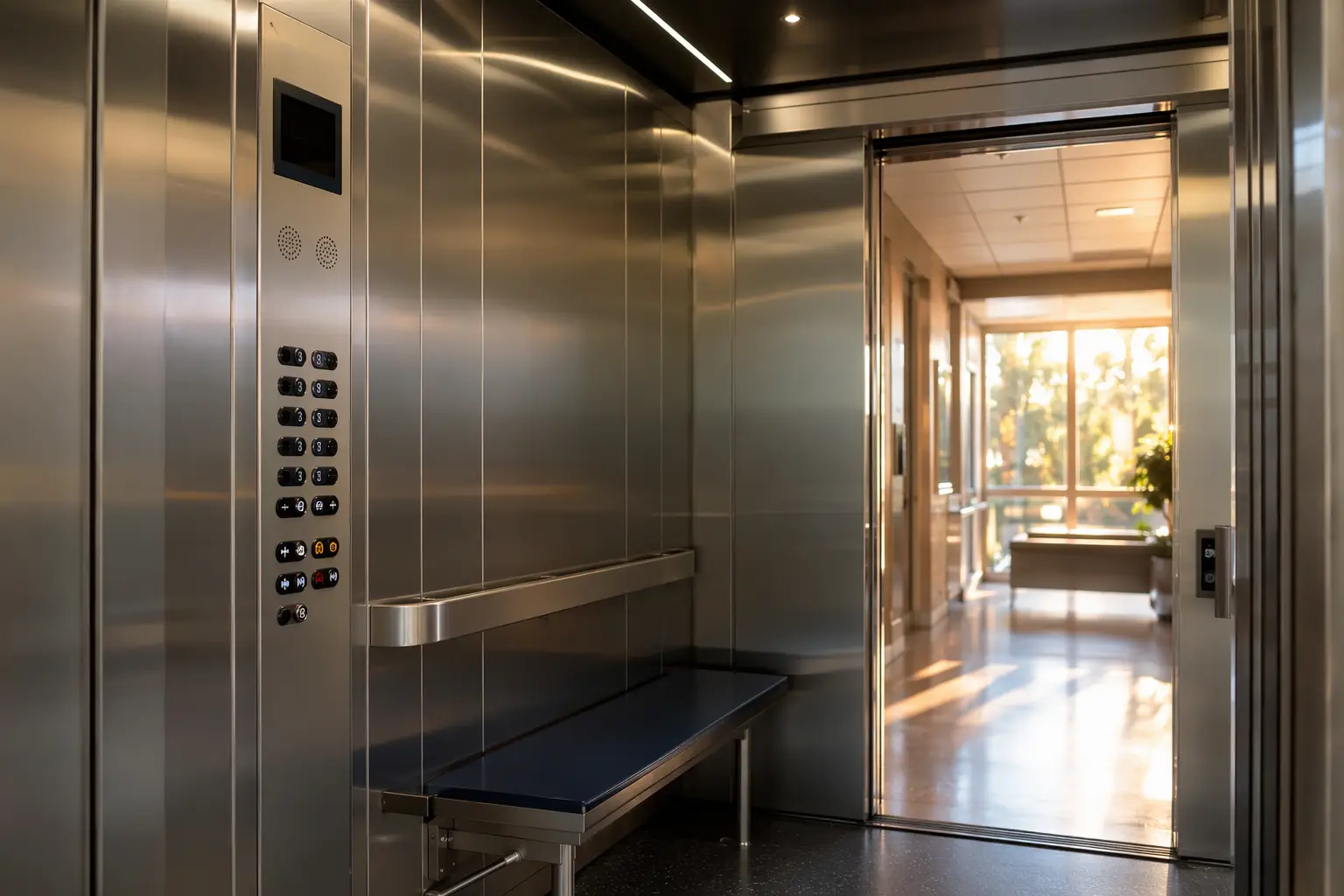
In Texas, elevator safety is governed by Texas Health and Safety Code Chapter 754 and administered by the Texas Department of Licensing and Regulation (TDLR), Elevator and Escalator Safety program. The adopted technical code is ASME A17.1/CSA B44, 2016 edition, as amended by 16 Texas Administrative Code Chapter 74, effective November 1, 2018.
Key compliance obligations for Texas healthcare facility owners include:
- Annual inspection: Every elevator must be inspected annually by a TDLR-registered elevator inspector. The building owner has the sole right to select that inspector.
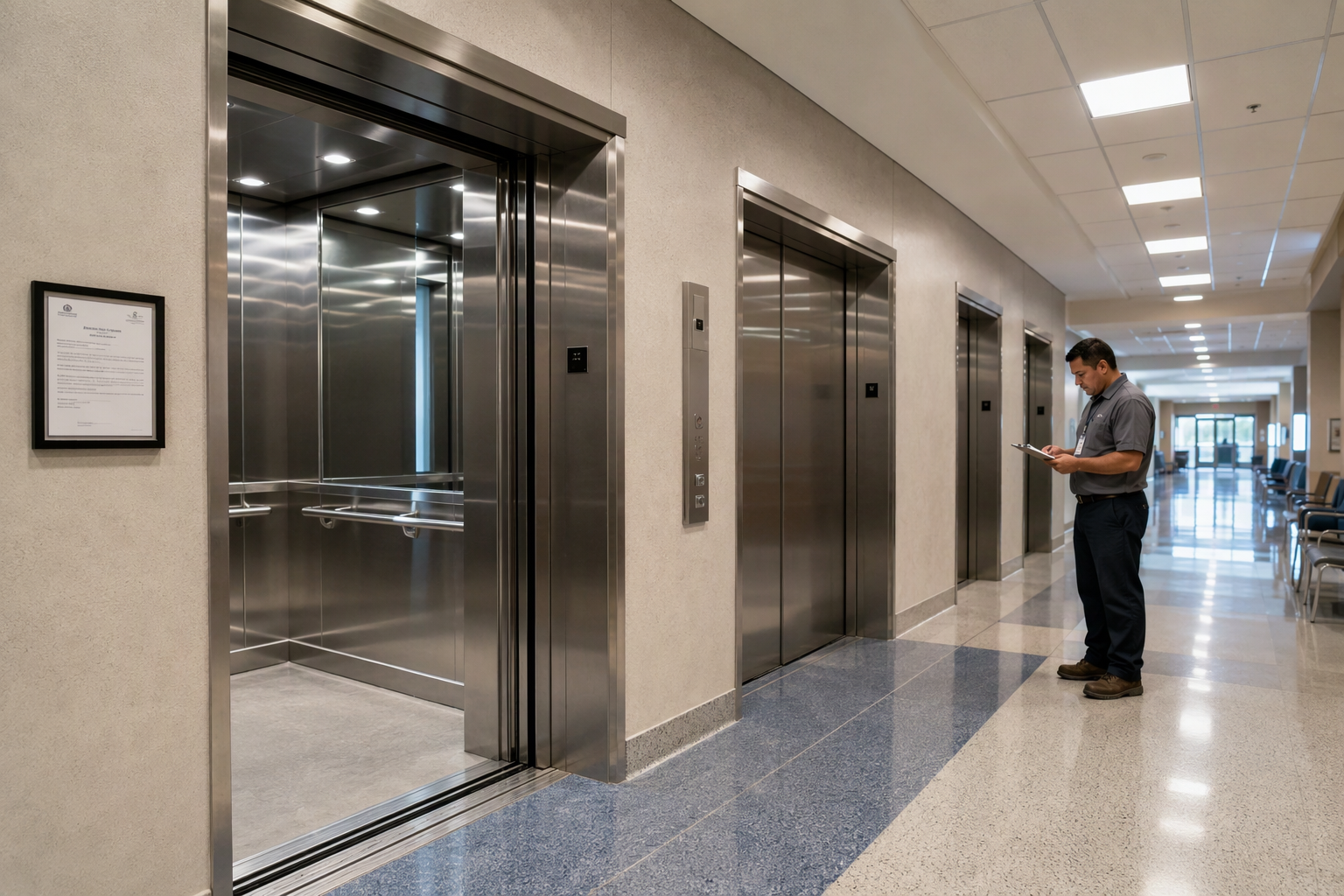
- Certificate of Compliance: After a passing inspection, owners must obtain a TDLR Certificate of Compliance for each unit and display it in a publicly visible area of the building.
- Violation correction window: Cited violations must be corrected — or placed under a correction contract — within 30 days of the inspection, or the owner must obtain a waiver or delay from TDLR.
- Category 5 load test: Texas requires a Category 5 full-load test every five years on electric (traction) elevators — the type most common in multi-story hospital buildings.
- Immediate removal from service: Any passenger elevator without working door restrictors, or without operational Phase One firefighters’ service, must be removed from service immediately. In a hospital setting, this can directly affect patient transport and emergency evacuation.
- Accident reporting: Owners must report any accident involving elevator equipment to TDLR within 24 hours.
- Registered contractors only: No person may install, repair, alter, test, or maintain elevator equipment in Texas without registering as a contractor with TDLR.
Important Houston note: TDLR does not regulate elevators or escalators inside Houston city limits. The City of Houston operates its own elevator inspection and permitting program. Healthcare facilities in Houston should contact the City of Houston directly to confirm current requirements. AmeriTex Elevator serves Houston-area healthcare clients and can help facilities identify the correct local authority.
What Are the California Elevator Requirements for Hospitals and Healthcare Facilities?
In California, elevator safety is regulated by the Division of Occupational Safety and Health (Cal/OSHA), Elevator Unit, California Department of Industrial Relations, under California Labor Code Sections 7300–7324.2 and the California Code of Regulations, Title 8, Elevator Safety Orders (Sections 3000–3146). The adopted code is ASME A17.1/CSA B44, 2004 edition (Group IV Elevator Safety Orders), effective May 1, 2008, for installations contracted on or after that date.
Key compliance obligations for California healthcare facility owners include:
- Permit to operate: No elevator may be operated in California without a valid, current permit to operate issued by Cal/OSHA. The permit must be posted conspicuously inside the elevator car — particularly important in hospital elevators visible to patients and surveyors.
- Annual inspection: California law requires every conveyance to be inspected at least once per year. Only State of California safety engineers and Certified Competent Conveyance Inspectors (CCCI) may perform these inspections.
- Two-year permit option: Cal/OSHA may issue a permit to operate for up to two years for an elevator in safe condition that is covered by a full maintenance contract with a C-11 licensed elevator company — a potential efficiency for large hospital systems managing multiple units.
- Owner’s responsibility: Arranging the annual reinspection is the elevator owner’s responsibility. Healthcare facility managers cannot rely on state agencies to initiate the process.
- Permit before installation or alteration: A permit from Cal/OSHA is required before a conveyance is erected, installed, or materially altered — relevant for hospital expansion projects or modernization programs.
- Certified companies and mechanics only: Companies that install, maintain, repair, or alter elevators in California must be certified by Cal/OSHA as a Certified Qualified Conveyance Company (CQCC). Individual mechanics must hold Certified Competent Conveyance Mechanic (CCCM) certification.
Important Los Angeles note: The City of Los Angeles, Department of Building and Safety (LADBS), operates its own elevator and conveyance inspection program. Healthcare facilities in Los Angeles should verify current requirements directly with LADBS. AmeriTex Elevator operates in the Los Angeles and San Diego markets and can help facilities navigate local authority requirements alongside state Cal/OSHA obligations.
Does ASME A17.3 Apply to Existing Hospital Elevators?
The ASME A17.3 Safety Code for Existing Elevators and Escalators provides retroactive safety requirements for elevators installed before the current adopted edition of ASME A17.1. Healthcare facilities operating older elevator systems — common in legacy hospital campuses — may face upgrade mandates under A17.3, including requirements for door restrictors, firefighters’ emergency operation, and car lighting. Both TDLR in Texas and Cal/OSHA in California reference A17.3 standards when evaluating existing equipment. Facility managers should have aging elevator systems assessed against current retroactive requirements.
What ADA Requirements Apply Specifically to Hospital and Healthcare Elevators?
The ADA establishes specific requirements for elevators in healthcare settings, where accessibility directly affects patient safety and civil rights compliance. Requirements include minimum cab dimensions capable of accommodating wheelchairs and stretchers, door dwell times sufficient for patients with mobility limitations, raised and Braille floor designations, audible floor announcements, and two-way emergency communication systems accessible to individuals who are deaf or hard of hearing. Healthcare facilities undergoing construction, renovation, or lease renewal may trigger path-of-travel obligations that require elevator upgrades to current ADA standards.
What Healthcare-Specific Elevator Features Should Facility Managers Prioritize?
Beyond baseline code compliance, hospital and healthcare facility elevators carry demands that go beyond standard commercial installations:
- Stretcher and gurney capacity: Patient transport elevators must accommodate hospital beds, stretchers, and life support equipment. Cab depth and door width are critical design and compliance factors.
- Firefighters’ emergency operation (Phase I and Phase II): Required under ASME A17.1 and directly enforced in Texas — a passenger elevator without functional Phase One firefighters’ service must be removed from service immediately under Texas law.
- Door restrictors: Required under ASME A17.1 to prevent entrapment between floors — also an immediate out-of-service condition in Texas.
- Emergency lighting and communication: ADA and ASME A17.1 require two-way communication and emergency lighting in all elevator cars. In a healthcare emergency, these systems are life-safety critical.
- Smooth leveling: Precise floor leveling reduces trip hazards for patients in wheelchairs and prevents difficulty when rolling gurneys or medical carts in and out of cabs.
- Infection control considerations: While not a code requirement, interior surfaces, handrails, and cab finishes in healthcare elevators are increasingly selected for cleanability and antimicrobial properties.
- Redundancy and uptime: Hospitals with single-elevator access to patient floors face serious operational and safety risks when that elevator is out of service. Preventive maintenance contracts reduce unplanned downtime.
What Is the Inspection Timeline and Process for a Hospital Elevator in Texas?
- The building owner selects a TDLR-registered elevator inspector.
- The inspector conducts the annual inspection and issues a written report to the owner within five calendar days.
- If the elevator passes, the owner obtains a TDLR Certificate of Compliance and displays it in a publicly visible area.
- If violations are cited, the owner must have them corrected — or placed under contract for correction — within 30 days, or request a waiver or delay from TDLR.
- For electric (traction) elevators, the owner arranges a Category 5 full-load test every five years, coordinated with a TDLR-registered contractor.
- Any accident involving elevator equipment must be reported to TDLR within 24 hours.
AmeriTex Elevator assists Texas healthcare facility managers in coordinating inspections, preparing equipment for annual and Category 5 tests, and ensuring corrective work is completed within TDLR’s required timeframes.
What Is the Inspection Timeline and Process for a Hospital Elevator in California?
- The building owner — not a state agency — arranges the annual inspection with a Cal/OSHA-approved inspector (a State of California safety engineer or CCCI).
- The inspector evaluates the conveyance against the California Elevator Safety Orders and ASME A17.1-2004 standards.
- If the elevator is found safe, Cal/OSHA issues a permit to operate for up to one year (or up to two years if the elevator is covered by a full maintenance contract with a C-11 licensed company).
- The permit to operate is posted conspicuously in the elevator car.
- For new installations or material alterations, the owner must obtain a Cal/OSHA permit before work begins, and Cal/OSHA must inspect and issue a permit to operate before the elevator is placed in service.
- All maintenance, repair, and alteration work must be performed by a CQCC-certified company using CCCM-certified mechanics.
In Los Angeles, the LADBS runs its own program — healthcare facility operators should confirm current local requirements in addition to Cal/OSHA obligations.
Questions Your Inspector Will Ask
Whether operating in Texas or California, healthcare facility elevator inspectors will evaluate the following during an annual or periodic inspection. Facility managers should be prepared to demonstrate compliance on each point:
- Is the current Certificate of Compliance (Texas) or permit to operate (California) posted and valid?
- Is firefighters’ emergency operation (Phase I and Phase II) fully functional and tested?
- Are door restrictors installed and operational on all passenger elevators?
- Does the two-way emergency communication system connect to a continuously monitored location?
- Is emergency lighting functional in the elevator car?
- Are all floor buttons, Braille designations, and audible signals present and operational?
- Have all previously cited violations been corrected and documented?
- For traction elevators in Texas: when was the most recent Category 5 full-load test, and is the documentation on file?
- Are machine room access, lighting, and fire suppression systems up to code?
- Is the elevator leveling accurate within acceptable tolerances at each floor?
- Have any alterations, repairs, or component replacements been performed since the last inspection, and by a registered (Texas) or CQCC-certified (California) contractor?
- Is a current maintenance log available for review?
What Happens If a Healthcare Facility’s Elevator Fails Inspection in Texas or California?
In Texas, cited violations must be corrected — or placed under a formal correction contract — within 30 days of the inspection. For immediate out-of-service conditions, such as a passenger elevator with non-functional door restrictors or Phase One firefighters’ service, the elevator must be taken out of service immediately. In a hospital setting, this can disrupt patient transport, pharmacy delivery, and emergency response. Owners may request a waiver or delay from TDLR when correction within 30 days is not feasible.
In California, an elevator that fails inspection does not receive a permit to operate. Operating without a valid permit violates California Labor Code and Cal/OSHA regulations. For healthcare facilities subject to CMS Conditions of Participation or Joint Commission accreditation, an elevator compliance failure can trigger broader regulatory review. AmeriTex Elevator helps California healthcare clients resolve deficiencies and coordinate reinspection efficiently.
How Does a Hospital Select a Qualified Elevator Service Company in Texas or California?
In Texas, any company that installs, repairs, alters, tests, or maintains elevator equipment must be registered as a contractor with TDLR. Texas elevator contractor registrations expire annually. Healthcare facility procurement teams should verify current TDLR contractor registration before engaging any service provider.
In California, elevator companies must hold Certified Qualified Conveyance Company (CQCC) certification from Cal/OSHA, and individual mechanics must hold CCCM certification. The company must also hold a C-11 Elevator Contractor license issued by the California Contractors State License Board (CSLB). These credentials must be current — CQCC and CCCM certificates last two years and require continuing education for renewal.
AmeriTex Elevator operates as a registered and certified elevator service provider across Texas and California markets, including Houston, Dallas, Austin, San Antonio, Los Angeles, and San Diego — covering the full range of healthcare facility types from large hospital campuses to outpatient clinics and long-term care communities.
What Should a Healthcare Facility Do After an Elevator Modernization or Alteration?
- Confirm the contractor holds current TDLR registration (Texas) or CQCC certification (California) before work begins.
- In Texas, verify that the registered contractor submitted plans to TDLR and received approval before installation or major alteration work started.
- In California, confirm that Cal/OSHA issued a permit before work commenced on any material alteration.
- After completion, schedule the required post-alteration inspection — in California, Cal/OSHA must inspect and issue a new permit to operate before the elevator is placed back in service.
- Update the facility’s maintenance log and equipment records to reflect the alteration.
- Confirm that any altered equipment still meets ADA requirements for cab dimensions, signage, and communication systems.
- Notify facility risk management and document the completed work for accreditation files.
Contact AmeriTex Elevator for a free elevator assessment at 844-646-9660.
Need elevator service you can rely on? AmeriTex Elevator is ready to help.