Elevator Code Compliance Upgrades for Hospitals and Healthcare Facilities in Texas and California
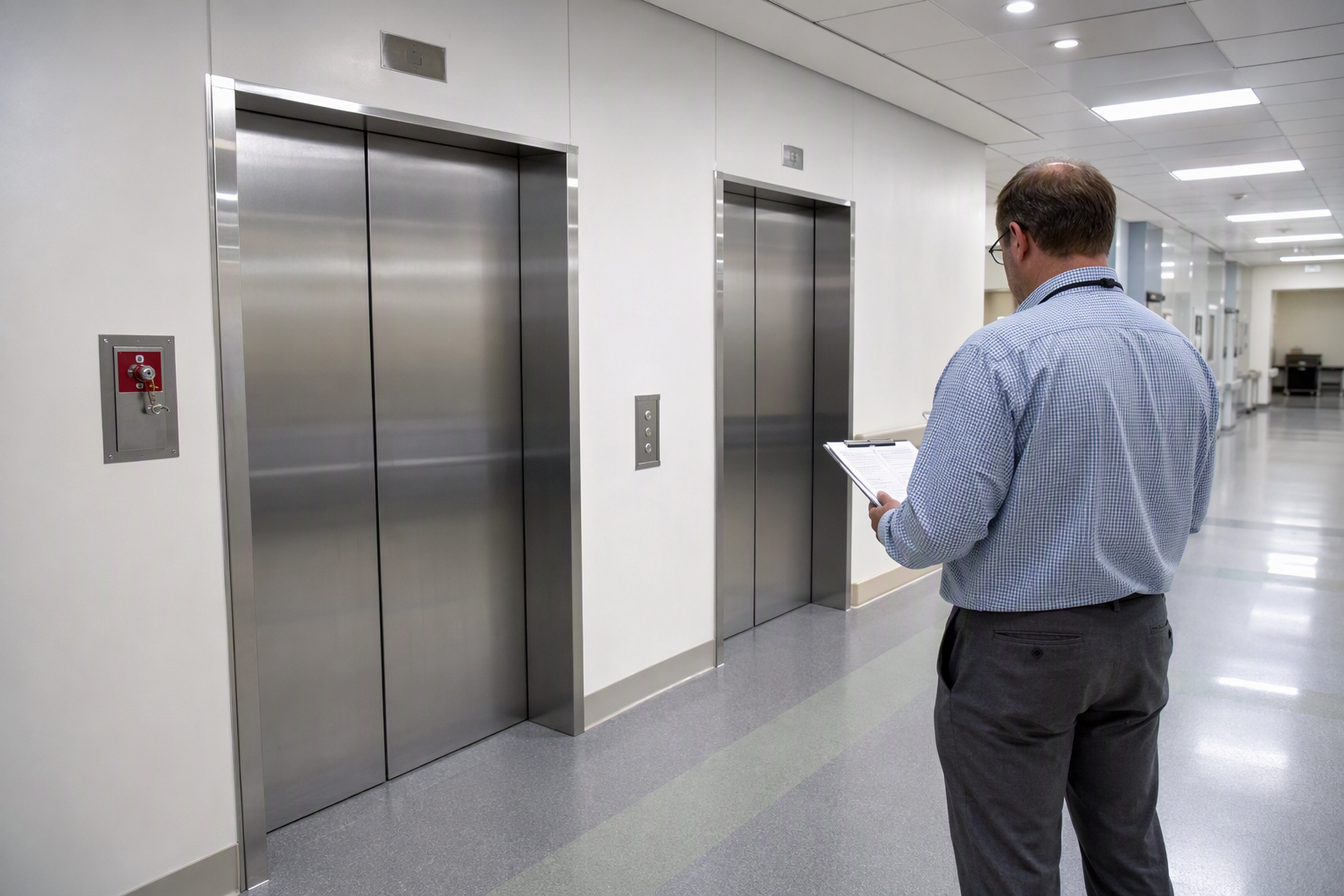
Healthcare facilities operate under some of the most demanding elevator compliance requirements of any building type. Patients, staff, and visitors depend on reliable, accessible vertical transportation around the clock—and regulators in both Texas and California treat elevator failures in healthcare settings as serious public safety matters. Understanding which upgrades are required, which agencies enforce them, and how inspection cycles work is essential for hospital administrators and facilities managers in 2026.
What Elevator Codes Apply to Hospitals and Healthcare Facilities?
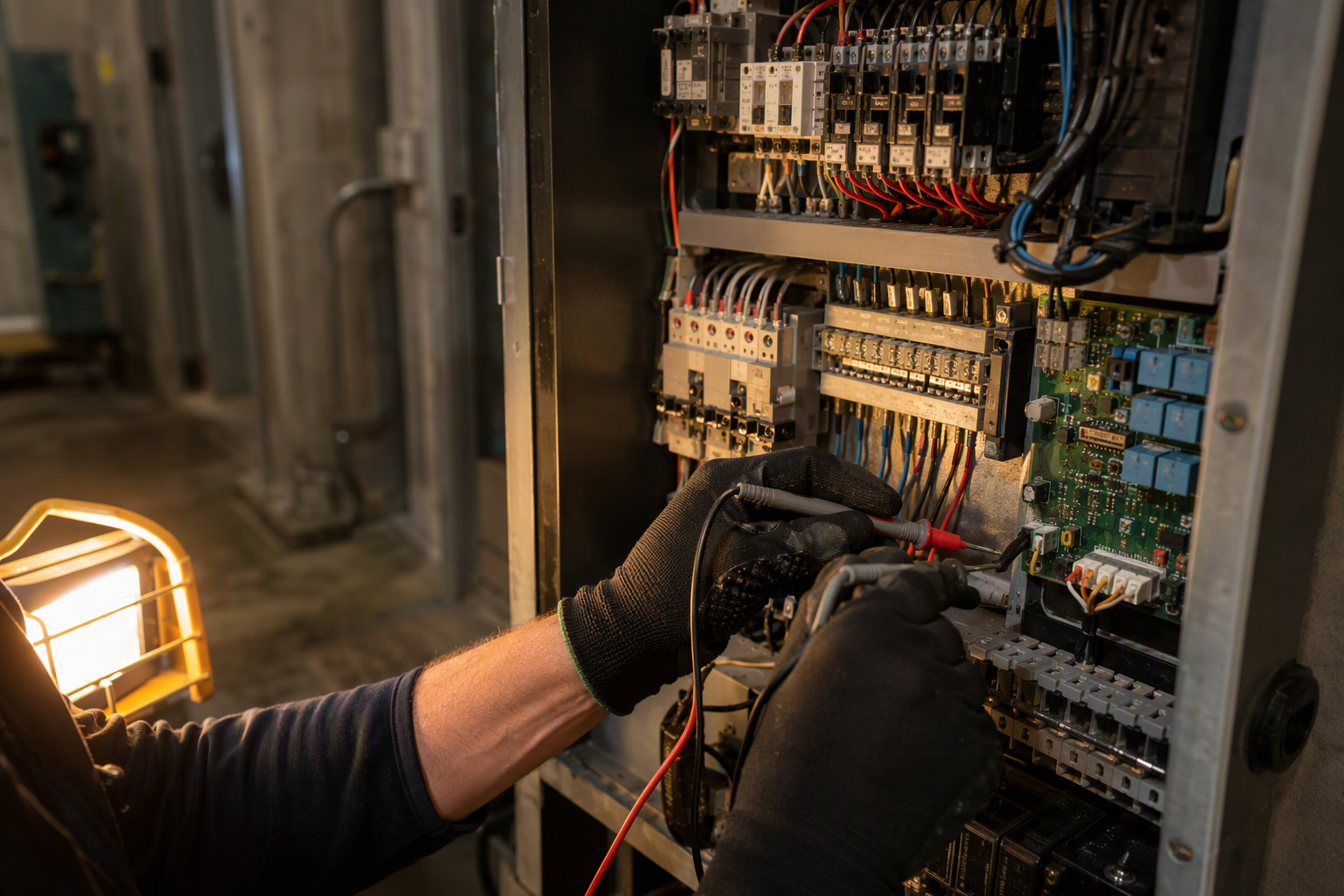
The foundational code governing elevator safety across the United States is the ASME A17.1 Safety Code for Elevators and Escalators. Both Texas and California have adopted specific editions of this code into state law, and healthcare facilities must meet those adopted editions as a minimum baseline.
Layered on top of state codes are federal requirements under the Americans with Disabilities Act (ADA), which mandates accessible elevator design and operation in any facility open to the public—a category that unambiguously includes hospitals, outpatient clinics, rehabilitation centers, and long-term care facilities.
In Texas, the Texas Department of Licensing and Regulation (TDLR), Elevator and Escalator Safety program enforces the ASME A17.1/CSA B44-2016 edition under Texas Health and Safety Code Chapter 754 and 16 Texas Administrative Code Chapter 74, effective November 1, 2018. Note that TDLR does not regulate elevators inside Houston city limits; the City of Houston operates its own elevator program.
In California, the Division of Occupational Safety and Health (Cal/OSHA), Elevator Unit, California Department of Industrial Relations enforces the California Code of Regulations, Title 8, Elevator Safety Orders (Sections 3000–3146), which adopt ASME A17.1/CSA B44-2004. No elevator in California may operate without a valid permit to operate issued by Cal/OSHA. Los Angeles has its own elevator and conveyance inspection program administered by the Los Angeles Department of Building and Safety (LADBS).
What Specific Upgrades Are Hospitals Required to Make in Texas?
Texas law under 16 Texas Administrative Code Chapter 74 and the adopted ASME A17.1-2016 code establishes several hard compliance thresholds that healthcare facilities cannot defer:
- Firefighters’ Emergency Service (Phase I and Phase II): A passenger elevator without working firefighters’ service, or with non-working Phase One firefighters’ service, must be removed from service immediately under Texas law. In a hospital environment, this is a critical life-safety requirement tied directly to evacuation procedures.
- Door Restrictors: A passenger elevator without working door restrictors must be removed from service immediately in Texas. Door restrictors prevent car doors from opening between floors, a risk that is heightened in healthcare settings with patients in beds or wheelchairs.
- Category 5 Full-Load Testing: Texas requires a Category 5 full-load test every five years on electric (traction) elevators. Most large hospital elevators are traction-type, making this a recurring compliance obligation that facilities managers must schedule proactively.
- Annual Inspection and Certificate of Compliance: Texas building owners must have elevators inspected annually by a TDLR-registered elevator inspector and must obtain a TDLR Certificate of Compliance for each unit. The certificate must be displayed in a publicly visible area of the building. Cited violations must be corrected or placed under contract for correction within 30 days of the inspection, or the owner must obtain a waiver or delay from TDLR.
- Accident Reporting: Texas owners must report any accident involving elevator equipment to TDLR within 24 hours—a requirement with particular significance in a clinical environment where incidents may involve patients with limited mobility.
What Specific Upgrades Are Hospitals Required to Make in California?
California healthcare facilities face a dual compliance structure: state Elevator Safety Orders enforced by Cal/OSHA, plus any additional requirements from the local authority having jurisdiction (AHJ). In Los Angeles, the LADBS runs its own program.
- Valid Permit to Operate: No elevator in a California hospital may legally operate without a current permit to operate issued by Cal/OSHA. The permit must be posted conspicuously in the elevator car. Arranging the annual reinspection is the elevator owner’s responsibility.
- Annual Inspections: California law requires every conveyance to be inspected at least once a year. A conveyance found safe receives a permit to operate for up to one year. Cal/OSHA may extend this to up to two years for an elevator in safe condition covered by a full maintenance contract with a C-11 licensed elevator company.
- Material Alteration Permits: Any material alteration to a California hospital elevator—including modernization of controls, cab interiors, or safety systems—requires a permit from Cal/OSHA before work begins. Only a Certified Qualified Conveyance Company (CQCC) may perform this work, using mechanics who hold Certified Competent Conveyance Mechanic (CCCM) certification.
- ASME A17.1-2004 Baseline Requirements: California’s adopted edition requires healthcare facilities to meet code provisions covering safeties, governors, buffers, door operations, and emergency lighting as specified under the Group IV Elevator Safety Orders. California has proposed a Group V update incorporating elements of ASME A17.1-2019; a public hearing was held in June 2026, but no effective date has been posted as of 2026.
How Do ADA Requirements Apply to Hospital Elevators?
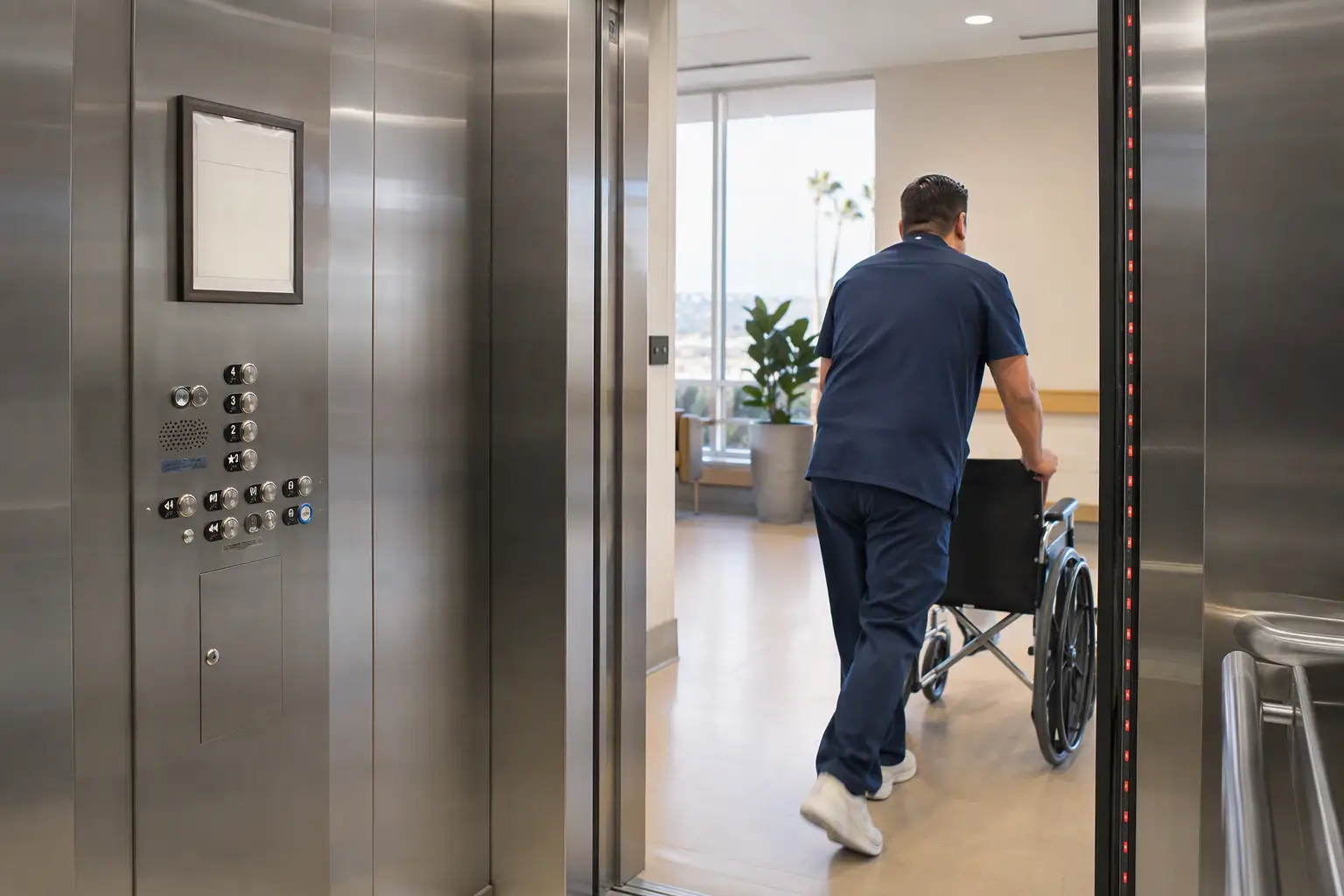
The ADA requires that elevators in healthcare facilities be accessible to individuals with disabilities. Key requirements include minimum car dimensions sufficient to accommodate a wheelchair and attendant, accessible controls at appropriate mounting heights, visible and audible floor indicators, and Braille and raised-character signage on call buttons and hoistway entrances. Hospitals that have undergone renovation since the ADA’s effective date are required to bring altered elements into compliance. AmeriTex Elevator routinely evaluates healthcare elevators for ADA conformance as part of broader compliance assessments, identifying gaps in button placement, leveling accuracy, and door timing that are common in older hospital facilities.
What Happens If a Hospital Elevator Fails Inspection?
In Texas, violations cited during an annual inspection must be corrected—or placed under a binding correction contract—within 30 days, or the owner must seek a waiver or delay from TDLR. Elevators with missing or non-functional door restrictors or firefighters’ service face immediate removal from service with no grace period.
In California, an elevator that does not pass inspection will not receive a permit to operate, meaning it cannot legally run until deficiencies are corrected and the unit is re-inspected. For a hospital managing patient transport, dietary deliveries, and staff movement simultaneously, an out-of-service elevator creates immediate operational and patient-safety pressure. Engaging a qualified service company before the inspection—rather than after a failure—is consistently the lower-cost and lower-risk approach.
What Is the Inspection Timeline for Healthcare Facility Elevators?
- Schedule the inspection proactively. In Texas, the building owner selects the TDLR-registered inspector and bears responsibility for scheduling. In California, arranging reinspection is the elevator owner’s responsibility. Do not wait for a notice from the regulator.
- Conduct a pre-inspection walkthrough. A qualified elevator service company can assess the equipment against current code requirements, identifying door restrictor function, firefighters’ service operation, leveling accuracy, and ADA compliance before the official inspector arrives.
- Address deficiencies in advance. Parts with long lead times—such as certain control components or landing fixtures—should be ordered well ahead of the inspection date.
- Receive and review the inspection report. In Texas, the registered inspector must deliver the report within five calendar days. Review all cited items immediately and determine whether the 30-day correction window is achievable.
- Obtain and post the compliance certificate. In Texas, post the TDLR Certificate of Compliance in a publicly visible area. In California, post the Cal/OSHA permit to operate conspicuously inside the elevator car.
- Schedule the Category 5 test if required. Texas traction elevator owners should track the five-year test cycle and plan accordingly, as this test requires a registered contractor and advance coordination with the inspector.
Are There Special Elevator Requirements for Patient Transport in Hospitals?
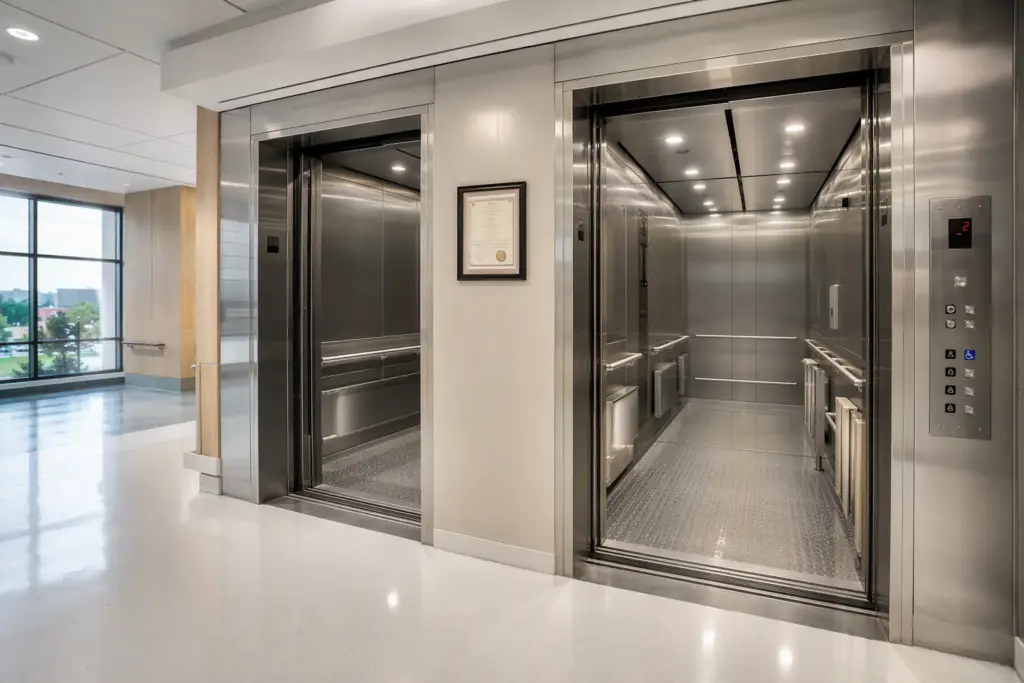
While ASME A17.1 and state codes do not create a separate “hospital elevator” classification, healthcare facilities commonly require elevators that meet specific dimensional and operational characteristics to accommodate stretchers, hospital beds, and large medical equipment. Facilities managers should verify that elevator car dimensions, door widths, and floor-leveling accuracy meet both the adopted code and any requirements imposed by the facility’s accreditation body or local fire authority. AmeriTex Elevator works with hospital facilities teams to document existing conditions and identify whether modernization or alteration work is needed to meet both operational and code requirements.
What Contractor Requirements Apply When Upgrading a Hospital Elevator in Texas or California?
In Texas, any person or company that installs, repairs, alters, tests, or maintains elevator equipment must be registered as a contractor with TDLR. Before installing or significantly altering an elevator in Texas, the registered contractor must submit plans to TDLR and receive approval. Each Texas elevator contractor must carry general liability insurance of at least $1,000,000 per occurrence for bodily injury or death and $500,000 per occurrence for property damage.
In California, only a Certified Qualified Conveyance Company (CQCC)—certified by Cal/OSHA and holding a C-11 Elevator Contractor license issued by the California Contractors State License Board (CSLB)—may perform installation, alteration, maintenance, or repair work. All mechanics performing unsupervised work must be Certified Competent Conveyance Mechanics (CCCM). CQCC and CCCM certificates last two years and require at least eight hours of continuing education for renewal. AmeriTex Elevator maintains the required TDLR registration for Texas work and operates as a CQCC for California projects, ensuring that hospital upgrade work does not expose the facility to compliance risk from unlicensed contractors.
How Long Does a Hospital Elevator Compliance Upgrade Take?
Project timelines vary based on the scope of work, parts availability, and whether Cal/OSHA or TDLR plan review is required for alterations. Minor repairs—such as door restrictor replacement or firefighters’ service recalibration—may be completed within days. Full modernizations involving new controllers, drives, or cab interiors typically require coordination with the regulator, lead time for equipment, and scheduling that minimizes disruption to hospital operations. Facilities managers should plan for the possibility that an alteration permit in California must be obtained from Cal/OSHA before work begins, which adds time that should be built into the project schedule.
Questions Your Inspector Will Ask
- When was this elevator last inspected, and is the current permit or certificate of compliance posted and valid?
- Are door restrictors installed and operational on all passenger elevator doors?
- Is Phase I firefighters’ emergency recall operational, and has Phase II in-car firefighters’ service been tested?
- For traction elevators in Texas: when was the most recent Category 5 full-load test conducted, and is documentation available?
- Are all emergency lighting and communication systems operational in the elevator car?
- Has any alteration or repair been performed since the last inspection, and if so, was the required permit obtained before work began?
- Is the maintenance contract in place with a TDLR-registered contractor (Texas) or a CQCC (California)?
- Are all ADA-required features—including control heights, tactile signage, and audible signals—present and functioning?
- Is there a written log of maintenance activity and repairs available for review?
- Has any accident or incident involving this elevator been reported to TDLR (Texas) or Cal/OSHA (California) as required?
What Should Hospital Facilities Managers Do Right Now to Prepare for 2026 Inspections?
- Locate and review the current permit to operate (California) or Certificate of Compliance (Texas) for every elevator unit in the facility.
- Confirm that each certificate or permit is posted in the required location and has not expired.
- Verify that the facility’s elevator maintenance contract is with a TDLR-registered contractor (Texas) or a Cal/OSHA-certified CQCC (California).
- Review maintenance logs to identify any recurring deficiencies—particularly around door systems, firefighters’ service, and leveling—before the next inspection.
- Check the five-year Category 5 test schedule for all traction elevators in Texas facilities.
- Request a pre-inspection assessment from AmeriTex Elevator to identify and address deficiencies before the official inspection date.
- Confirm that any alteration or modernization work completed since the last inspection was performed under the appropriate permit.
Hospital and healthcare facility elevators carry a compliance burden that few other building types match. The combination of life-safety requirements—firefighters’ service, door restrictors, leveling accuracy for patient transport—with the administrative requirements of annual inspections, posted certificates, and contractor credentialing creates a complex compliance landscape. AmeriTex Elevator serves healthcare facilities across Houston, Dallas, Austin, San Antonio, Los Angeles, and San Diego, providing inspection preparation, maintenance, and upgrade services under the regulatory frameworks enforced by TDLR, the City of Houston’s own program, Cal/OSHA, and LADBS.
Contact AmeriTex Elevator for a free elevator assessment at 844-646-9660.
Need elevator service you can rely on? AmeriTex Elevator is ready to help.