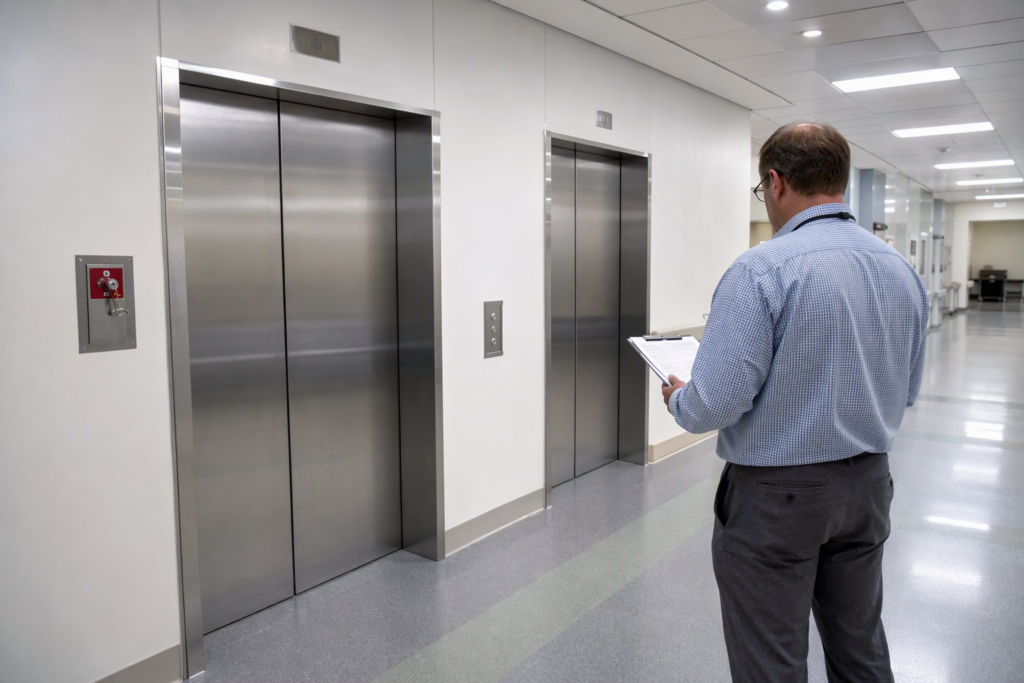
For facility directors overseeing K–12 schools, community colleges, or large university campuses, elevator compliance is not a back-burner issue. A single lapsed inspection certificate or an unaddressed maintenance deficiency can trigger regulatory fines, force an elevator out of service, or — most critically — place students and staff at risk. This guide breaks down every layer of the compliance and maintenance framework so decision-makers can build a defensible, proactive program.
What Federal Codes Govern Elevators in Educational Facilities?
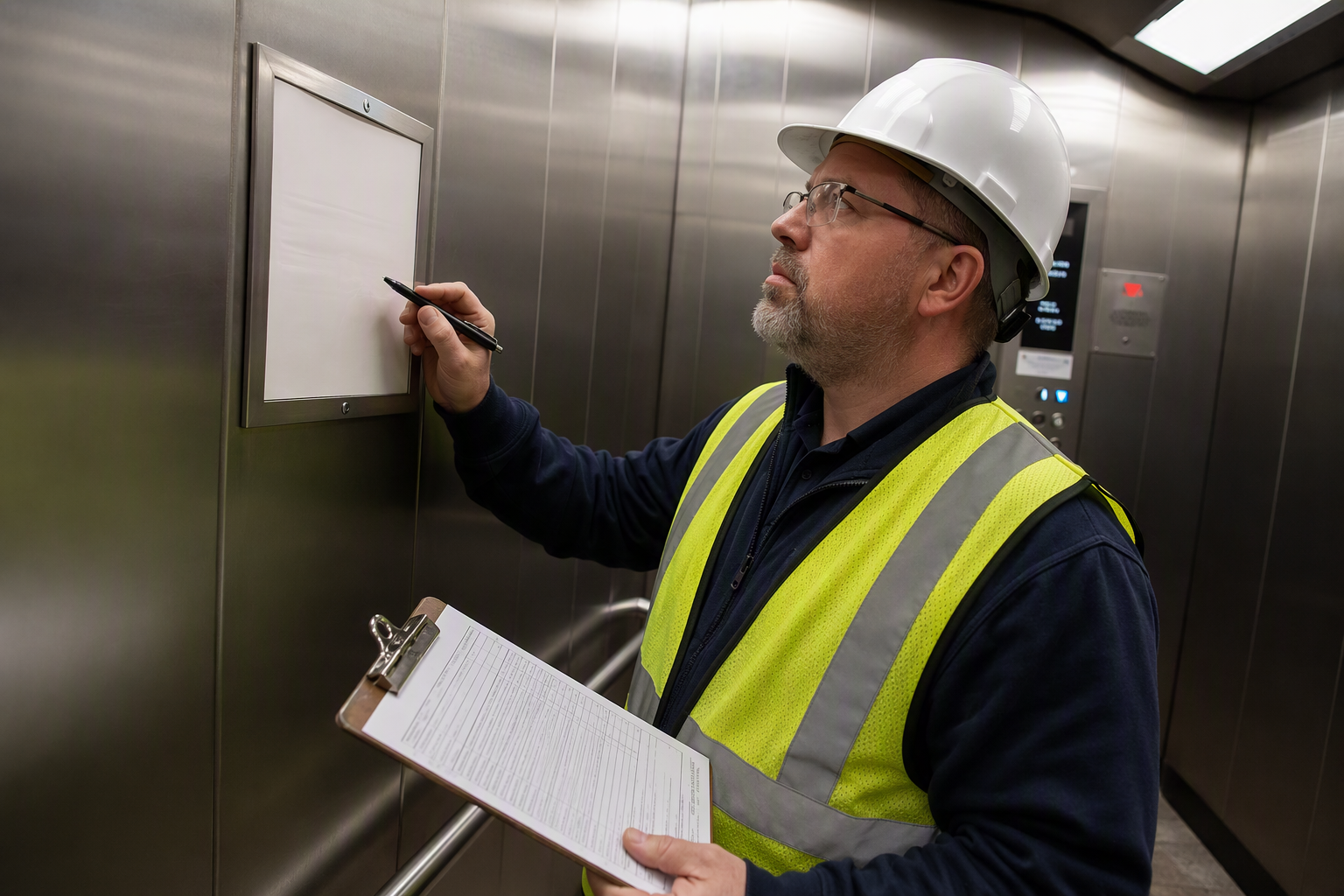
Elevators in the United States are primarily governed at the state and local level, but two federal frameworks create baseline obligations that apply to virtually every educational institution:
- ASME A17.1 Safety Code for Elevators and Escalators: This is the foundational technical standard covering design, installation, operation, testing, and inspection of passenger and freight elevators. Most states adopt ASME A17.1 (with or without state-specific amendments) as the legally enforceable standard.
- Americans with Disabilities Act (ADA): Any building that serves the public or employs staff — which includes every school and university — must ensure elevator accessibility for people with disabilities. ADA Standards for Accessible Design specify cab dimensions, control heights, door timing, Braille signage, and audible signals.
- OSHA: While OSHA defers most elevator safety enforcement to state elevator inspection programs, OSHA’s General Duty Clause requires employers (including educational institutions) to provide a workplace free of recognized hazards — which encompasses elevator mechanical safety for maintenance staff and building workers.
Beyond these federal layers, every state operates its own elevator safety program — issuing operating permits, setting inspection frequency, licensing inspectors, and enforcing penalties. Facility directors must know both the federal baseline and their specific state’s adopted edition of ASME A17.1 and any local amendments.
What Types of Inspections Are Required for School Elevators?
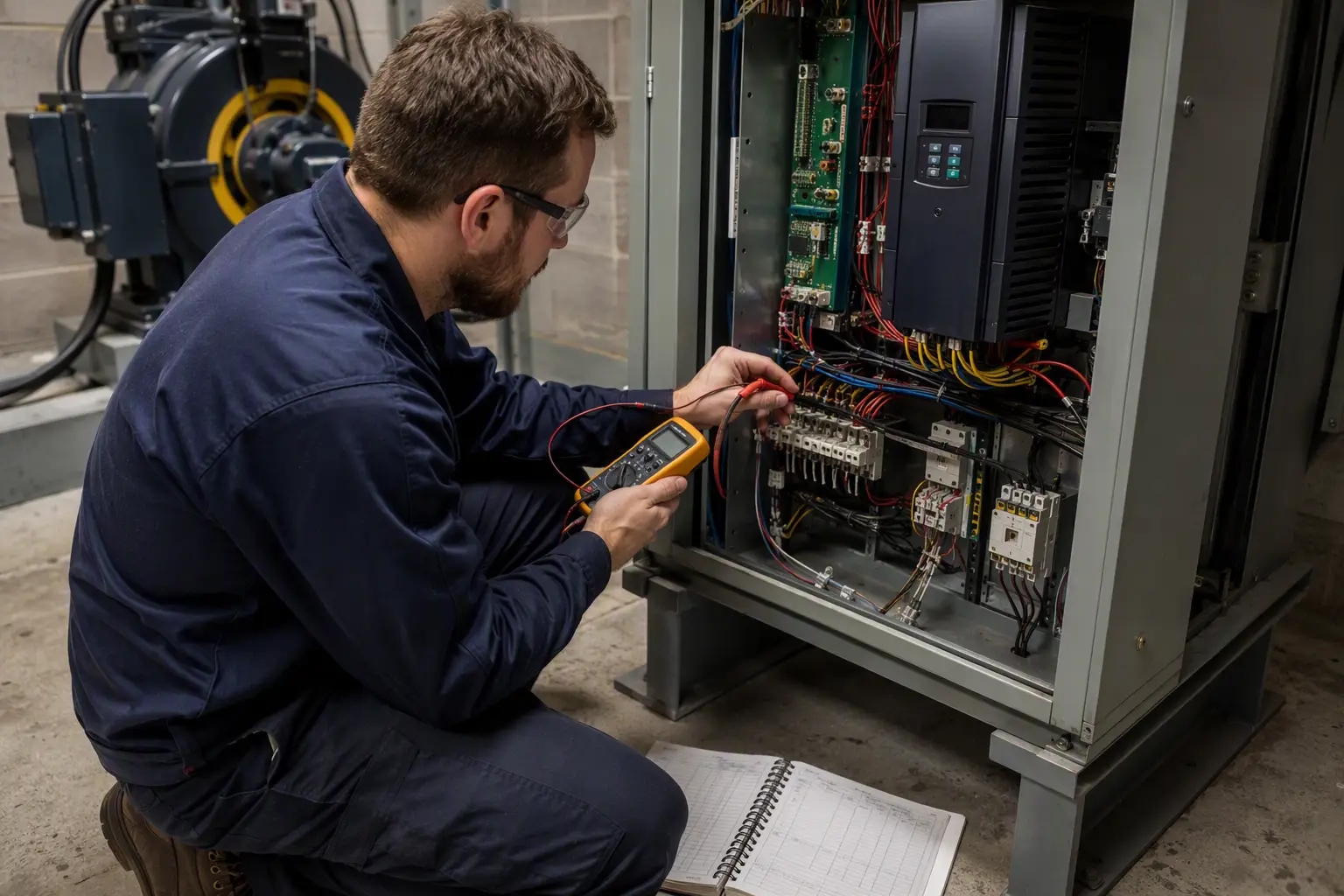
Educational facilities typically encounter three distinct categories of required inspections:
| Inspection Type | Who Performs It | Typical Trigger | Output |
|---|---|---|---|
| Periodic Inspection | State-licensed or state-employed elevator inspector | Set interval (commonly annual, though frequency varies by state and elevator type per ASME A17.1) | Inspection certificate / operating permit renewal |
| Periodic Test | Licensed elevator mechanic witnessed by inspector | Defined intervals per ASME A17.1 (e.g., full-load safety tests, brake tests, governor tests) | Signed test report submitted to authority having jurisdiction (AHJ) |
| Acceptance Inspection | State inspector | New installation or major alteration | Certificate of occupancy / initial permit to operate |
The authority having jurisdiction (AHJ) — typically a state department of labor, building safety, or a local municipality — determines exact intervals and procedures. Facility directors should request written confirmation of the applicable inspection schedule from their AHJ and track certificate expiration dates in a centralized maintenance management system.
What Are the ADA Elevator Requirements Schools Must Meet?
Under the Americans with Disabilities Act, educational facilities that are places of public accommodation or that employ staff must maintain elevators in a condition that ensures accessibility. Key ongoing operational requirements include:
- Elevator doors must remain functional and reopen when obstructed — door edges and reopening devices must be kept in working order.
- Call buttons, floor indicators, and emergency communication systems must operate reliably.
- Braille and raised-character signage must remain legible and intact.
- Cab leveling must be maintained so the floor of the cab is level with the landing floor, enabling wheelchair users to enter and exit safely.
- Emergency two-way communication systems must connect to a point staffed or monitored around the clock — critical in a school or campus environment with vulnerable populations including minors.
An elevator that passes its ASME mechanical inspection may still fail an ADA compliance review if accessibility features have degraded. These two compliance streams must be managed simultaneously.
How Does Preventive Maintenance Differ from Inspection Compliance?
Inspections verify that an elevator meets safety standards at a point in time. Preventive maintenance (PM) is the ongoing program that keeps the elevator safe between inspections. For educational facilities, these are complementary but legally distinct obligations.
| Factor | Periodic Inspection | Preventive Maintenance Program |
|---|---|---|
| Legal Mandate | Required by state law / AHJ | Required by ASME A17.1 and best practice; some states mandate documented PM |
| Frequency | Typically annual (state-dependent) | Monthly to quarterly service visits, plus ongoing monitoring |
| Who Performs | Independent licensed inspector or state inspector | Licensed elevator mechanic / independent service contractor |
| Documentation | Official inspection report; certificate posted in cab | Maintenance logs, work orders, parts records retained on-site |
| Outcome if Neglected | Operating permit revocation; elevator shut down | Accelerated wear, unplanned outages, inspection failures, liability exposure |
ASME A17.1 requires that maintenance be performed only by qualified elevator mechanics, and that complete maintenance records be kept and made available to the AHJ upon request. For schools with multiple elevators, a written maintenance control program (MCP) is the recommended — and in some jurisdictions required — management framework.
What Should a School’s Maintenance Control Program Include?
The ASME A17.1 Safety Code for Elevators and Escalators identifies specific components that a maintenance control program must address. For educational facility directors building or auditing their MCP, the program should document:
- Inventory of all elevator and escalator equipment — unit ID, location, installation date, rated capacity, and drive type.
- Maintenance tasks and intervals — a task-by-task schedule aligned with ASME A17.1 requirements and the equipment manufacturer’s specifications.
- Lubrication schedule — oil and grease types, quantities, and service points for each unit.
- Adjustment procedures — documented settings for brakes, safeties, buffers, governors, and door operators.
- Examination and testing procedures — protocols for periodic tests performed by the maintenance contractor before the official inspection.
- Record-keeping system — work orders, parts replaced, deficiencies noted, and corrective actions taken, all linked to the unit ID.
- Emergency and entrapment procedures — written protocol for campus public safety and facilities staff when passengers are trapped.
- Callback tracking — log of all service calls, including time of call, nature of complaint, response, and resolution.
What Happens Immediately After a Failed Inspection?
A failed inspection or an inspector-issued “out of service” order requires a structured response. Facility directors should follow these steps:
- Remove the elevator from service immediately — post visible “Out of Service” signage and physically lock out / tag out the unit per OSHA lockout/tagout requirements if maintenance work is required.
- Notify the AHJ — confirm the deficiency in writing and request clarification on the deadline and re-inspection process.
- Contact a licensed elevator service contractor — obtain a written assessment of the deficiency, the scope of corrective work, and a realistic timeline.
- Communicate with building occupants — inform students, staff, and particularly users who depend on the elevator for ADA access, and identify alternative accessible routes.
- Document all corrective actions — retain work orders, parts invoices, and photographs as part of the MCP record.
- Schedule re-inspection with the AHJ — submit the corrective action documentation and coordinate the re-inspection appointment in writing.
- Return to service only after the AHJ issues clearance — do not resume operation based solely on the contractor’s sign-off.
How Do Inspection Requirements Vary Between K–12 Schools and Universities?
The underlying code framework — ASME A17.1 and state law — applies equally to K–12 and higher education buildings. However, practical compliance complexity often scales with institutional size:
| Factor | K–12 School | University / College Campus |
|---|---|---|
| Number of Units | Typically one to a few per building | Often dozens to hundreds across campus |
| Elevator Types | Primarily passenger; occasional platform lifts | Passenger, freight, service, and specialty units (e.g., dumbwaiters in dining facilities) |
| Operating Hours / Load | Moderate; school-day hours | High; residential buildings operate 24/7 |
| ADA Sensitivity | High — IDEA and Section 504 obligations for students with disabilities | High — ADA and Section 504 obligations; residential accessibility requirements |
| Procurement Model | Often single service contract; may use district-wide vendor | May use multiple contracts; central facilities management system preferred |
| Record-Keeping Complexity | Moderate | High; centralized CMMS strongly recommended |
What Are the Pros and Cons of OEM Service Contracts vs. Independent Elevator Service Providers?
Educational facilities choosing a maintenance partner face a fundamental decision between the original equipment manufacturer’s (OEM) service program and an independent, third-party elevator service company.
| Factor | OEM Service Contract | Independent Service Provider (e.g., AmeriTex Elevator) |
|---|---|---|
| Parts Access | Direct OEM parts; proprietary access may be restricted to OEM only | Access to OEM and compatible aftermarket parts; not locked into single-source pricing |
| Contract Flexibility | Often multi-year lock-in; early termination penalties common | Generally more flexible terms; ability to negotiate scope |
| Cost Structure | Typically higher; proprietary pricing leverage | Competitive; no manufacturer overhead baked in |
| Transparency | Maintenance logs may be proprietary; records access can be limited at contract end | Facility retains full records; no data lock-in |
| Code Compliance | Knowledgeable about own equipment; may deprioritize non-OEM units | Multi-brand expertise; services mixed-manufacturer portfolios common in older campuses |
| Best For | New installations under warranty; highly proprietary modern systems | Mixed-age, mixed-brand portfolios; budget-conscious institutions; campuses seeking audit-ready recordkeeping |
AmeriTex Elevator is an independent, certified elevator service provider specializing in maintenance, inspection support, and compliance programs for institutional clients including schools and universities. As an independent company, AmeriTex Elevator is not tied to a single manufacturer, allowing facility directors to receive objective recommendations across a mixed portfolio of elevator equipment.
What Documentation Must Schools Keep On-Site for Elevator Compliance?
Regulatory compliance depends heavily on documentation. At a minimum, educational facility directors should maintain the following records, accessible to inspectors and the AHJ on request:
- Current operating permit or inspection certificate — typically required to be posted inside the elevator cab.
- Most recent inspection report — including any deficiencies noted and corrective actions taken.
- Periodic test reports — signed and dated by the performing mechanic and the witnessing inspector.
- Maintenance control program — the written MCP required under ASME A17.1.
- Maintenance logs and work orders — dated records of every service visit, task performed, and parts replaced.
- Alteration and modernization permits — any modifications to the elevator must be documented and accepted by the AHJ.
- Emergency evacuation and entrapment procedures — posted or accessible to campus safety and facilities staff.
- ADA-related service records — documentation of accessibility feature maintenance and any remediation work performed.
When Should a School Consider Elevator Modernization vs. Continued Maintenance?
At some point, continued maintenance of aging elevator equipment becomes less cost-effective than modernization. Facility directors should weigh the following signals:
| Signal | Continue Maintaining | Evaluate Modernization |
|---|---|---|
| Parts availability | OEM and aftermarket parts readily available | Parts obsolete or sourced only through specialty channels |
| Inspection history | Consistently passing with minor deficiencies | Repeated failures; recurring safety-related deficiencies |
| Energy performance | Acceptable for facility sustainability goals | Institution has energy efficiency mandates or incentive programs |
| ADA compliance | Cab and controls meet current ADA Standards | Layout, signage, or control configurations cannot be brought into ADA compliance through repair alone |
| Code compliance | Current edition of ASME A17.1 requirements met | State retroactive code requirements trigger mandatory upgrades regardless of maintenance status |
An independent elevator service provider like AmeriTex Elevator can perform a condition assessment that objectively evaluates whether continued maintenance or a modernization project better serves the institution’s safety, compliance, and budget goals — without a vested interest in selling a particular manufacturer’s replacement equipment.
What Role Does OSHA Play in School Elevator Safety?
While OSHA generally defers elevator safety inspections to state elevator programs, OSHA’s authority applies directly to the workers who operate, maintain, and are employed in buildings with elevators. Key OSHA touchpoints for educational facilities include:
- Lockout/Tagout (LOTO): OSHA’s Control of Hazardous Energy standard applies when maintenance personnel work on elevator equipment. Educational institutions that employ in-house facilities staff working near elevator equipment must have LOTO procedures.
- General Duty Clause: Employers — including school districts and universities — must address recognized workplace hazards. A malfunctioning elevator that poses a fall or entrapment risk to employees can trigger General Duty Clause citations.
- Confined space considerations: Elevator pits may qualify as permit-required confined spaces under OSHA standards, requiring entry procedures, atmospheric testing, and trained attendants before any work is performed.
How Should Facility Directors Evaluate and Select an Elevator Service Contractor?
Selecting the right elevator maintenance partner is a compliance decision as much as a procurement decision. Facility directors should assess candidates across these dimensions:
- Licensing: Confirm the contractor and its mechanics hold all required state licenses for elevator work in the relevant jurisdiction.
- Code familiarity: The contractor should demonstrate working knowledge of the current adopted edition of ASME A17.1 and applicable state amendments.
- MCP capability: The contractor should be able to produce and maintain a written maintenance control program compliant with ASME A17.1 requirements.
- Multi-brand experience: Campus portfolios often include elevators from multiple manufacturers and eras; verify the contractor can service all units in the inventory.
- Record transparency: Ensure the contract grants the institution full ownership of all maintenance records, with no proprietary lock-in.
- ADA knowledge: The contractor should understand ADA accessibility requirements and flag accessibility deficiencies during routine service visits.
- References from comparable institutions: Request references from other K–12 districts or higher education campuses the contractor currently serves.
AmeriTex Elevator is a certified independent elevator service company providing maintenance, inspection coordination, code compliance support, and modernization consulting to educational facilities. AmeriTex Elevator’s approach prioritizes transparent recordkeeping, multi-brand service capability, and compliance-driven maintenance programs designed to keep schools and universities operating safely and in full regulatory compliance.
What Are the Consequences of Non-Compliance for Schools and Universities?
The consequences of elevator compliance failures in educational settings extend beyond regulatory penalties:
- Elevator shutdown: An inspector or AHJ can order an elevator taken out of service immediately, disrupting accessibility for students and staff with disabilities — and potentially triggering separate ADA complaints.
- Regulatory fines: State elevator safety programs can levy fines for operating without a valid permit, failing to correct noted deficiencies within specified timeframes, or failing to submit required test reports.
- Liability exposure: An incident involving an elevator that was overdue for inspection or had documented unaddressed deficiencies creates significant institutional liability.
- Accreditation and funding risk: For universities subject to federal funding requirements, persistent ADA non-compliance can create broader institutional risk.
- Reputational harm: Elevator failures in schools attract community and media attention, particularly when student safety is involved.
A structured, documented preventive maintenance program coordinated with an experienced independent service provider is the most reliable way to prevent these outcomes.
Ready to Verify Your School’s Elevator Compliance?
Elevator compliance in educational facilities is complex — but it does not have to be unmanageable. AmeriTex Elevator provides comprehensive elevator assessments, maintenance control program development, and ongoing compliance support for K–12 schools, community colleges, and university campuses.
Contact AmeriTex Elevator for a free elevator assessment: 866-679-4313
Need elevator service you can rely on? AmeriTex Elevator is ready to help.