Elevator Downtime, Tenant Retention, and Building Owner Liability: A Complete FAQ for Texas and California Property Owners
Whether you manage a high-rise office tower in Dallas, a mid-rise apartment complex in Los Angeles, or a medical building in San Antonio, elevator reliability is not simply a convenience issue — it is a legal, financial, and reputational obligation. The questions below address every dimension of elevator downtime risk that building owners and property managers face in Texas and California in 2026.
How does elevator downtime affect tenant retention?
Elevator downtime erodes tenant confidence, increases lease non-renewal rates, and gives tenants documented cause to negotiate rent concessions or early terminations.
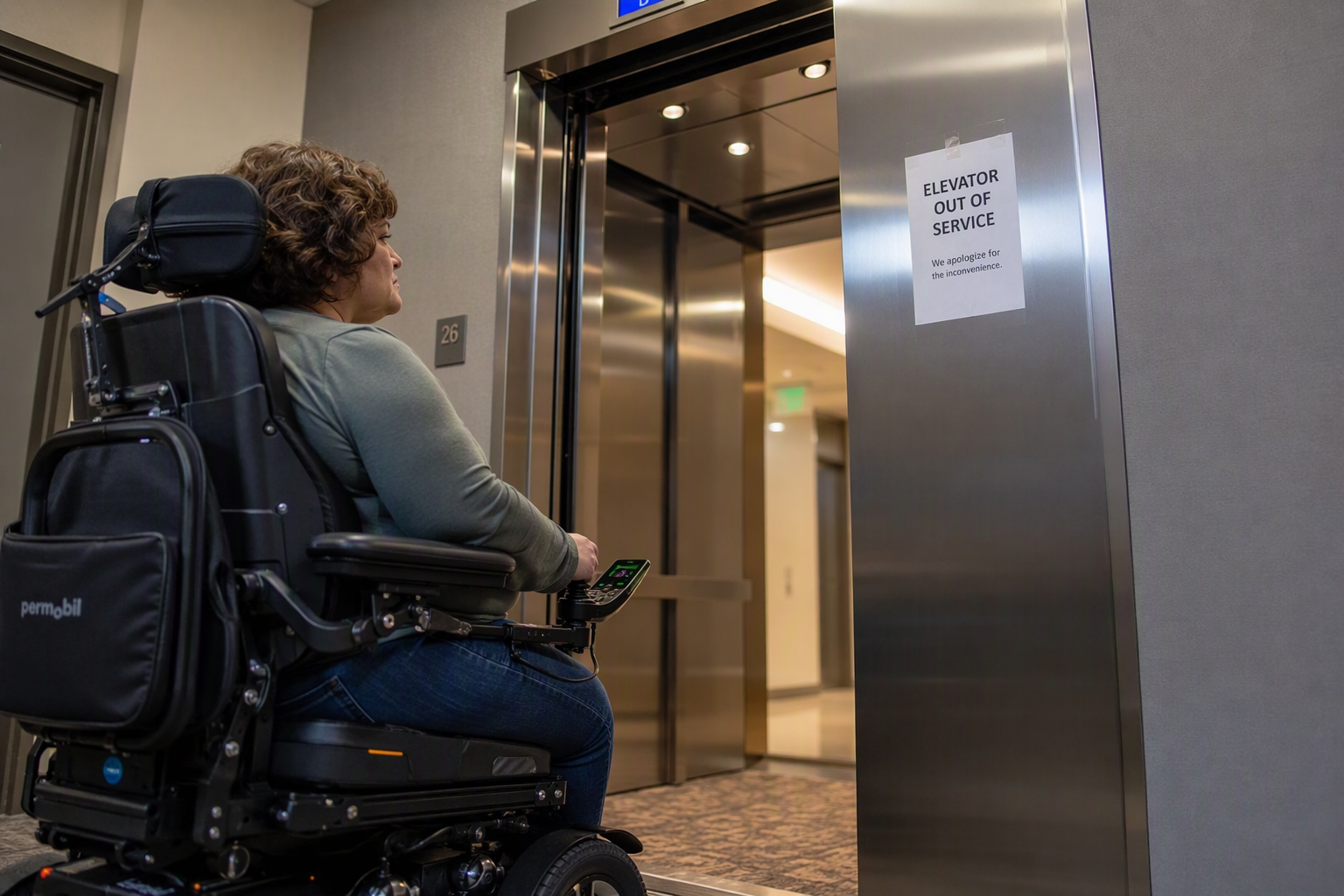
Tenants — whether commercial, residential, or medical — choose upper-floor spaces partly because vertical transportation is reliable. When an elevator is out of service, every affected tenant experiences a daily disruption: employees must use stairs, elderly or mobility-impaired residents may be unable to reach their units at all, and deliveries must be rerouted. Each of these events registers as a management failure.
Commercial tenants are particularly sensitive because elevator downtime can directly interrupt client visits, reduce accessible workable space, and create OSHA-adjacent concerns about stair-related injuries for their own employees. In competitive leasing markets such as Houston, Austin, and Los Angeles, a tenant whose elevator has been down for weeks has a strong negotiating position when renewal discussions arise. Property managers who cannot demonstrate a proactive maintenance history frequently encounter rent reduction demands or early-exit requests backed by habitability arguments.
Residential tenants in California have additional statutory protections: California landlord-tenant law requires that rental units be habitable, and a non-functional elevator in a building where stairs are not a reasonable alternative for a particular tenant can constitute a habitability breach. In Texas, similar implied warranty of habitability principles apply to residential leases.
What is a building owner’s legal liability when an elevator is out of service?
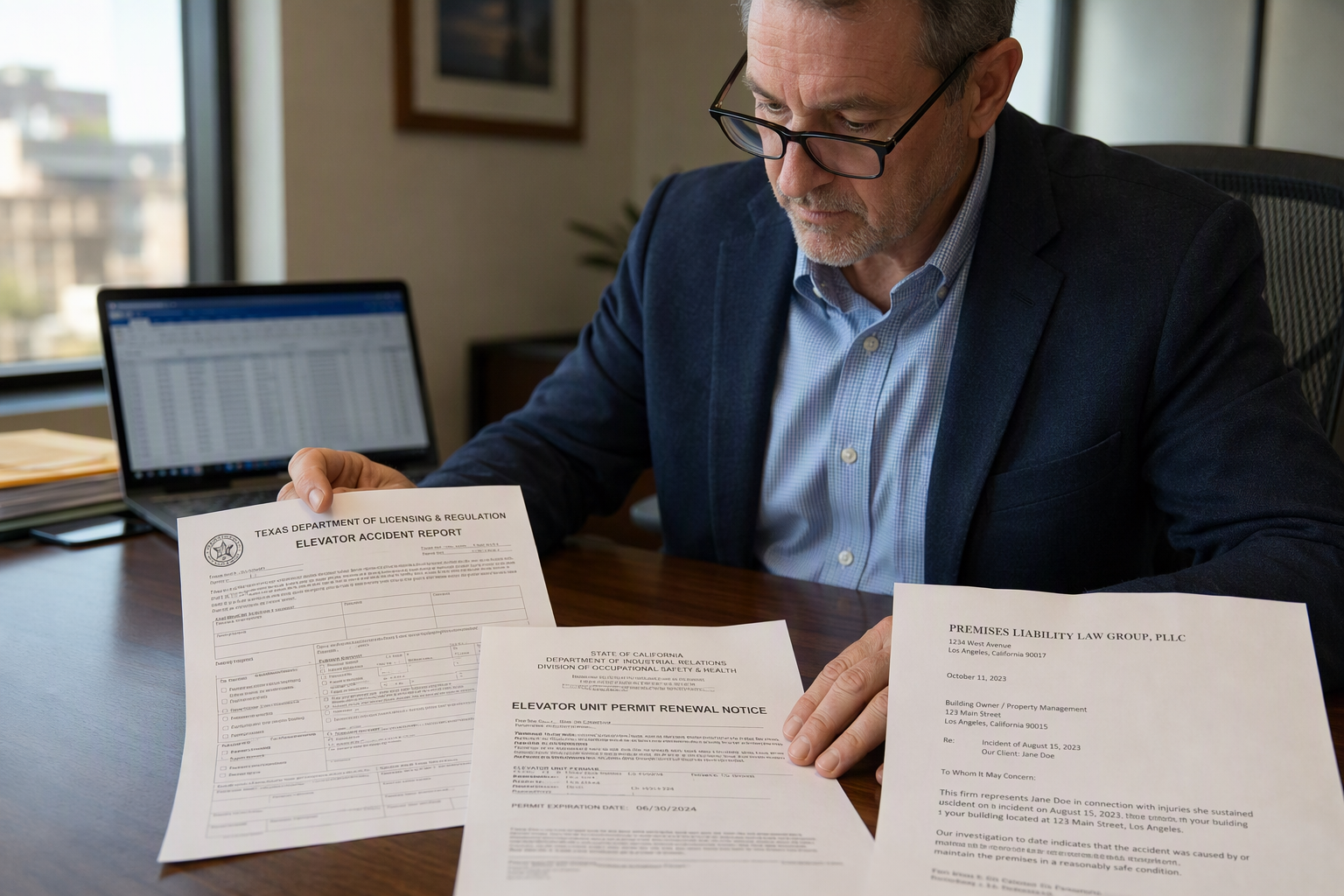
A building owner’s liability when an elevator is out of service spans statutory compliance violations, civil negligence exposure for injuries, and potential ADA accessibility claims.
When an elevator is out of service and a person is injured — whether attempting to use stairs, entering a malfunctioning cab, or being trapped — the building owner is the first party examined in a premises liability claim. Courts assess whether the owner knew or should have known about the defect, whether the owner acted reasonably quickly to address it, and whether proper warning signage was posted.
Beyond civil liability, Texas and California both impose statutory duties that carry independent consequences. Texas building owners must report elevator accidents to the Texas Department of Licensing and Regulation (TDLR) within 24 hours under Texas Health and Safety Code Chapter 754. California elevator owners must maintain a valid permit to operate issued by the Division of Occupational Safety and Health (Cal/OSHA), Elevator Unit under California Labor Code Sections 7300–7324.2 — operating without a current permit is itself a statutory violation, separate from any injury claim.
Federal Americans with Disabilities Act (ADA) obligations add a third layer: when a building’s only accessible route to a floor relies on an elevator and that elevator is out of service, the building owner may be in violation of ADA Title III (public accommodations) or Title II (government entities) access requirements, depending on building type.
What are Texas building owners required to do when an elevator is taken out of service?
Texas building owners must immediately remove from service any elevator that fails specific safety benchmarks, correct cited violations within 30 days, and report accidents to TDLR within 24 hours.
Under 16 Texas Administrative Code Chapter 74, Texas building owners must maintain a TDLR Certificate of Compliance for each unit of elevator equipment, and that certificate must be displayed in a publicly visible area of the building. The certificate is valid for one year.
Texas law is explicit about two immediate removal-from-service triggers: a passenger elevator without working door restrictors must be taken out of service immediately, and a passenger elevator without firefighters’ service — or with non-working Phase One firefighters’ service — must also be removed from service immediately. These are not discretionary judgments; they are mandatory.
When a TDLR-registered elevator inspector cites a violation, the building owner must have that violation corrected or under contract to be corrected within 30 calendar days of the inspection, or obtain a waiver or delay from TDLR. Additionally, any accident involving elevator equipment must be reported to TDLR within 24 hours. Note that TDLR does not regulate elevators inside Houston city limits — within Houston, the City of Houston operates its own elevator program.
What are California building owners required to do when an elevator is out of service?
California building owners must maintain a valid Cal/OSHA permit to operate, post it in the elevator car, and are personally responsible for arranging annual reinspection — operating an elevator without a current permit is unlawful under California Labor Code Sections 7300–7324.2.
California’s regulatory framework under the California Code of Regulations, Title 8, Elevator Safety Orders (Sections 3000–3146) requires that every conveyance be inspected at least once a year by either a State of California safety engineer or a Certified Competent Conveyance Inspector (CCCI). The permit to operate must be posted conspicuously inside the elevator car. The responsibility for scheduling reinspection falls on the elevator owner, not the service company.
When an elevator in California is found unsafe, it cannot legally remain in operation until deficiencies are resolved and a new permit is issued. Only a Certified Competent Conveyance Mechanic (CCCM) working for a Certified Qualified Conveyance Company (CQCC) may perform maintenance, repair, alteration, or component replacement on a California conveyance — hiring an uncertified contractor to restore a down elevator exposes the owner to additional Cal/OSHA liability.
In Los Angeles specifically, the Department of Building and Safety (LADBS) runs its own elevator and conveyance inspection program. Building owners with properties in Los Angeles should coordinate with LADBS directly in addition to understanding their Cal/OSHA obligations.
How does the ADA apply to elevator downtime?
Under the ADA, when an elevator is the primary accessible route to any floor, prolonged or unaddressed outages can constitute a failure to provide accessible service, exposing owners to federal civil rights complaints and litigation.
The ADA requires that places of public accommodation and commercial facilities maintain accessible features in operable condition. While the ADA does not mandate a specific maximum downtime window, courts and the Department of Justice have consistently held that isolated, promptly repaired outages are defensible, but recurring or unaddressed elevator outages — particularly where no accessible alternative route exists — are not.
For residential properties covered by the Fair Housing Act’s accessibility requirements, the standard is similar: building owners must maintain accessibility features. For medical facilities, government buildings, and transit-adjacent properties in cities such as San Diego, Los Angeles, Austin, and San Antonio, ADA enforcement exposure is amplified because the user population is more likely to include individuals with mobility impairments whose only viable vertical access is the elevator.
Practically, building owners should document every outage, every repair order, every communication to tenants, and every attempt to provide alternative accessible routes during a downtime event. That documentation is the primary defense in an ADA complaint or civil lawsuit.
What are the most common causes of unplanned elevator downtime?
The most common causes of unplanned elevator downtime are deferred maintenance, aging components (particularly hydraulic seals, door operators, and control boards), entrapment due to door failures, and expiration of required safety tests.
Door system failures — including door operator motor failures, worn door gibs, and misaligned safety edges — account for a significant share of unplanned shutdowns across elevator types. Control board malfunctions in older traction elevators are another frequent culprit, particularly in buildings where equipment has exceeded its design life.
Hydraulic elevators, common in low-rise buildings throughout Texas and California, are susceptible to hydraulic fluid leaks, jack seal degradation, and pump unit failures — all of which require immediate shutdown to prevent environmental contamination and safety hazards. In Texas, the five-year Category 5 full-load test requirement for electric (traction) elevators means that failing to schedule this test can result in a compliance-triggered shutdown rather than a mechanical failure.
Buildings that rely on time-and-materials service arrangements rather than full maintenance contracts tend to experience longer downtime durations because parts procurement and technician scheduling happen reactively rather than proactively.
How does Texas’s annual inspection requirement work, and who is responsible for scheduling it?
Texas building owners are solely responsible for selecting and scheduling an annual inspection by a TDLR-registered elevator inspector, and the inspector must deliver the written report within five calendar days.
Under Texas Health and Safety Code Chapter 754 and 16 Texas Administrative Code Chapter 74, every elevator in Texas (outside of federally owned buildings and most single-family dwellings) must be inspected annually by a TDLR-registered elevator inspector. Texas elevator inspectors register with TDLR but are not TDLR employees — they are independent professionals or employees of inspection firms.
Critically, Texas law grants the building owner the sole right to select the inspector. Following the inspection, the inspector must provide the building owner with the written inspection report within five calendar days. The owner then uses that report to obtain or renew a TDLR Certificate of Compliance, which must be displayed publicly and is valid for one year. Any cited violations must be corrected — or under contract to be corrected — within 30 days, or the owner must obtain a waiver or delay from TDLR. (Again, Houston building owners should contact the City of Houston’s program rather than TDLR.)
AmeriTex Elevator assists Texas building owners in Dallas, Austin, and San Antonio with scheduling and coordinating these required inspections and ensures that any deficiencies identified are addressed by TDLR-registered contractors.
How does California’s inspection and permit-to-operate system work?
California requires annual Cal/OSHA inspection of every conveyance, with the permit to operate posted inside the car, and the building owner — not the service company — bears legal responsibility for scheduling reinspection.
Under California Labor Code Sections 7300–7324.2 and the California Code of Regulations, Title 8, Elevator Safety Orders, every elevator must be inspected at least once a year and receive a permit to operate from Cal/OSHA. Inspections may only be performed by State of California safety engineers or Certified Competent Conveyance Inspectors (CCCIs). The permit — once issued — must be posted conspicuously inside the elevator car.
One important benefit available to California building owners: Cal/OSHA may issue a permit to operate valid for up to two years (rather than one) for an elevator that is in safe condition and covered by a full maintenance contract with a C-11 licensed elevator company. This extended permit interval rewards owners who invest in comprehensive maintenance agreements. The California Contractors State License Board (CSLB) issues the C-11 Elevator Contractor license; Cal/OSHA administers permits, inspections, and CQCC/CCCM certification separately.
AmeriTex Elevator operates as a Certified Qualified Conveyance Company (CQCC) in California, meaning that maintenance, repair, and alteration work performed by AmeriTex in Los Angeles and San Diego is carried out by Certified Competent Conveyance Mechanics — the only personnel legally authorized to perform that work under California law.
What immediate steps should a building owner take when an elevator goes out of service?
A building owner should immediately secure the elevator, notify tenants, contact a qualified elevator service provider, and begin documenting every action taken.
- Secure the elevator. If the cab stops between floors or shows a mechanical fault, lock out the elevator at the controller using appropriate lockout/tagout procedures. Do not allow anyone to attempt a manual rescue without trained personnel.
- Check for trapped passengers. Use the emergency communication system to confirm whether anyone is inside the cab. If entrapment is confirmed, call emergency services immediately and contact your elevator service provider.
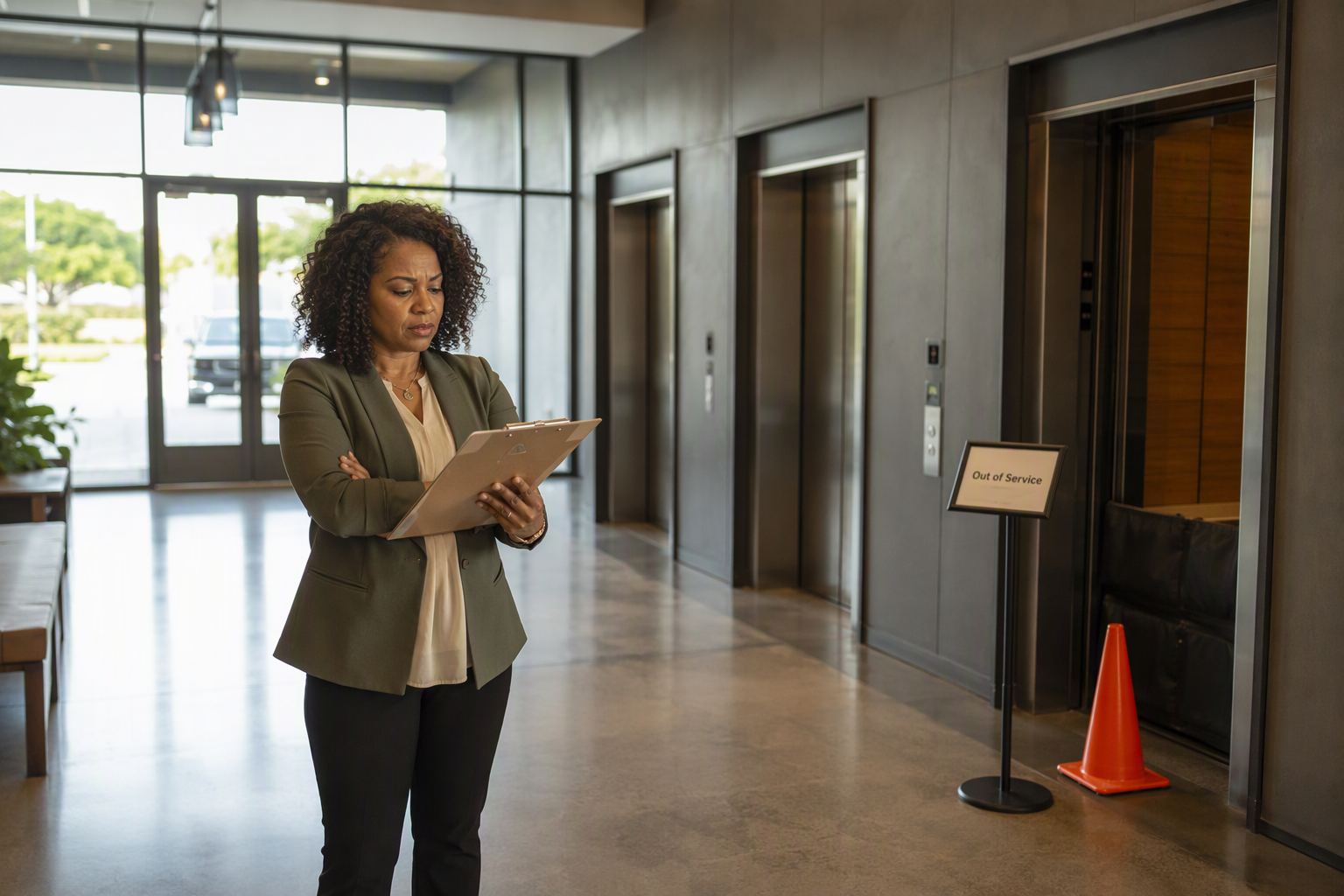
- Post visible out-of-service signage at every landing door to prevent tenants from attempting to use the unit and to document that the owner took reasonable precaution.
- Notify tenants in writing. Send a written notice (email, posted letter, or both) explaining the outage, the expected repair timeline, and any alternative access arrangements. This creates a documented record of good-faith communication.
- Contact a qualified elevator service contractor. In Texas, this means a TDLR-registered contractor. In California, this means a CQCC employing CCCMs.
- Report the outage and any associated accident to the appropriate authority. In Texas (outside Houston), accidents must be reported to TDLR within 24 hours. In California, notify Cal/OSHA of any incident per applicable reporting requirements. Houston building owners should contact the City of Houston’s program.
- Document everything. Record the date and time of the outage, the nature of any fault codes or observed failures, all communications with tenants, all service calls placed, and all repair work performed. This documentation is your primary defense in any subsequent liability claim.
- Evaluate ADA accessibility impact. If the elevator is the only accessible route to any floor, assess whether a temporary accessible accommodation is feasible and document the assessment.
Does elevator downtime create liability under OSHA for commercial building owners?
While OSHA elevator standards primarily apply to elevator installation, construction, and service personnel rather than building occupants, commercial building owners can face OSHA exposure if their elevator’s condition creates hazards for employees working in the building.
OSHA’s General Duty Clause (Section 5(a)(1)) requires employers to maintain a workplace free from recognized hazards. In a commercial building where the employer is also the building owner, a known, unaddressed elevator defect that injures an employee could form the basis of a General Duty Clause citation. OSHA standards also govern elevator work performed by service mechanics, meaning that if an owner’s pressure to rush a repair leads to an unsafe work environment for the technician, the owner may share liability.
Building owners in Houston, Dallas, San Antonio, Austin, Los Angeles, and San Diego should ensure that any elevator service work is performed with proper lockout/tagout procedures in place and that no tenant or building staff member is permitted in a machine room or on top of a cab during service operations.
How do elevator maintenance contracts reduce liability and downtime risk?
Full maintenance contracts reduce downtime by ensuring scheduled preventive service, faster parts availability, and priority response — and in California they can unlock a two-year permit to operate from Cal/OSHA.
The core difference between a full maintenance contract and a basic service agreement is the scope of proactive care. Full maintenance contracts typically include lubrication, adjustment, parts replacement for normal wear, and regular safety testing on a defined schedule — all before a failure occurs. Basic or “oil and grease” contracts cover only routine lubrication and may leave major component repairs as billable extras that delay resolution.
From a liability perspective, a documented full maintenance contract demonstrates that the building owner exercised reasonable care — a meaningful defense in premises liability litigation. In California, the Cal/OSHA two-year permit extension available to elevators under full maintenance contracts with C-11 licensed companies directly rewards this investment.
AmeriTex Elevator offers maintenance programs for commercial and residential buildings across Houston, Dallas, Austin, San Antonio, Los Angeles, and San Diego. Property managers seeking to reduce unplanned downtime and strengthen their compliance posture should evaluate whether their current contract structure matches the demands of their specific equipment type and building occupancy.
What benchmarks should building owners use to evaluate elevator reliability?
Building owners should evaluate elevator reliability against industry-recognized benchmarks for callback rates, mean time between failures, and inspection compliance rates — the table below provides a practical reference framework.
| Performance Metric | Well-Maintained Elevator | Under-Maintained Elevator | Owner Action Threshold |
|---|---|---|---|
| Annual inspection compliance | Completed before permit expiration; no lapses | Delayed or expired permit; Cal/OSHA or TDLR citation | Schedule immediately; lapsed permit = unlawful operation |
| Door-related callbacks | Rare; corrected proactively at maintenance visits | Frequent; door failures are the leading shutdown trigger | Persistent door issues require full door system evaluation |
| Entrapment incidents | Isolated; associated with documented causes | Recurring; signals systemic safety deficiency | Any entrapment warrants full safety audit before return to service |
| Category 5 test compliance (Texas traction elevators) | Completed every five years; results on file | Overdue; TDLR Certificate of Compliance at risk | Schedule Category 5 test immediately if overdue |
| Hydraulic fluid integrity (hydraulic elevators) | No leaks; jack seals within service life | Active or historic leaks; environmental risk | Immediate inspection; potential shutdown required |
| Firefighters’ service (Texas) | Phase One and Phase Two fully operational | Non-functional Phase One; mandatory removal from service | Immediate removal from service required by Texas law |
| Permit posted in car (California) | Current permit posted conspicuously in cab | Permit absent, expired, or posted outside cab | Contact Cal/OSHA; do not operate without posted current permit |
Can a building owner be held liable for injuries during an elevator entrapment?
Yes — a building owner can face civil liability for entrapment-related injuries when the entrapment results from a known defect, deferred maintenance, or failure to respond promptly to a reported malfunction.
Entrapment liability typically hinges on whether the owner had actual or constructive knowledge of the defect that caused the entrapment, and whether the owner’s response was reasonable and timely. Constructive knowledge — meaning the owner should have known — is established through service records showing a recurring fault, a failed inspection, or a tenant complaint that was not addressed.
Injuries during entrapment can include heat-related illness (particularly relevant in Texas summers), panic attacks, falls during unauthorized self-rescue attempts, and medical emergencies in passengers who require prompt care. Each of these scenarios can support a damages claim in which the building owner’s maintenance records, inspection history, and response time are all scrutinized.
In Texas, the mandatory 24-hour accident reporting requirement to TDLR means that any entrapment involving injury creates an immediate regulatory record that feeds into the civil liability picture. Building owners should never attempt to downplay or delay reporting a qualifying accident.
How does elevator condition affect a building’s insurance premiums and coverage?
Elevator condition and compliance history directly influence property and general liability insurance underwriting — insurers routinely review inspection certificates, maintenance contracts, and accident histories when setting premiums or determining coverage applicability.
Commercial property insurers and general liability underwriters evaluate elevator risk as part of their overall premises assessment. A building with a lapsed TDLR Certificate of Compliance or an expired Cal/OSHA permit to operate presents a material compliance gap that can affect both premium pricing and, in a worst-case scenario, coverage applicability for an elevator-related claim. Some insurers include elevator maintenance warranty provisions in their policies that require the building owner to maintain current inspection certifications as a condition of coverage.
Building owners in Dallas, Houston, Austin, San Antonio, Los Angeles, and San Diego should confirm with their insurance broker whether their current policy contains any elevator-specific maintenance or inspection compliance conditions. A lapse in inspection currency is not merely a regulatory issue — it can be the basis on which a claim is denied.
What is the ASME A17.1 Safety Code and why does it matter to building owners?
The ASME A17.1 Safety Code for Elevators and Escalators is the foundational technical standard governing elevator design, installation, inspection, testing, and maintenance that both Texas and California have adopted into law.
ASME A17.1 establishes the technical requirements for everything from cab construction and door safety to emergency lighting, firefighters’ service, and periodic testing intervals. Texas has adopted the ASME A17.1/CSA B44, 2016 edition, with amendments, effective November 1, 2018, through 16 Texas Administrative Code Chapter 74. California has adopted the ASME A17.1/CSA B44, 2004 edition, under its Group IV Elevator Safety Orders, effective May 1, 2008, for installation contracts signed on or after that date. (California has proposed Group V updates that would incorporate portions of ASME A17.1-2019; as of mid-2026, no effective date has been established for that update.)
For building owners, ASME A17.1 matters because it defines the specific safety features — door restrictors, firefighters’ service, emergency lighting, cab ventilation, and more — that must be operational at all times. Failure to maintain any ASME A17.1-required feature creates both a code violation and the technical predicate for a negligence finding if someone is injured.
How long does elevator repair typically take, and what factors affect the timeline?
Elevator repair timelines vary from hours to weeks depending on the failure type, parts availability, and the complexity of required testing — building owners who lack a full maintenance contract typically experience longer downtimes due to reactive parts procurement.
Minor door adjustments or sensor replacements can often be completed in a single service visit. Control board failures, hydraulic cylinder replacements, or hoist motor rebuilds may require parts with lead times of days to several weeks, depending on the equipment manufacturer and model year. Older or proprietary equipment from discontinued manufacturers presents the longest parts delays.
In Texas, any repair that constitutes a “material alteration” under ASME A17.1 requires submission of plans to TDLR and prior approval before work begins — this regulatory step adds time that cannot be circumvented. In California, a permit from Cal/OSHA is required before any material alteration. Building owners should not allow contractors to begin alteration work without confirming that the required regulatory approvals are in place, as unpermitted work can void the elevator’s permit to operate and extend the total downtime.
What should building owners look for when selecting an elevator service company in Texas or California?
Building owners in Texas should verify TDLR contractor registration and required insurance; California building owners must confirm that the company holds Cal/OSHA CQCC certification and employs CCCMs.
In Texas, any person or company that installs, repairs, alters, tests, or maintains elevator equipment must be registered as a contractor with TDLR. Texas elevator contractors must carry general liability insurance of at least $1,000,000 per occurrence for bodily injury or death and $500,000 per occurrence for property damage. Each contractor must also designate one or two responsible parties with at least three years of elevator contractor experience. Building owners should request verification of these credentials before signing any service agreement.
In California, the company must be certified by Cal/OSHA as a Certified Qualified Conveyance Company (CQCC), must hold a C-11 Elevator Contractor license from the California Contractors State License Board (CSLB), and must carry certificates of workers’ compensation and liability insurance. All field mechanics must be Cal/OSHA-certified Certified Competent Conveyance Mechanics (CCCMs). California CQCC, CCCM, and conveyance inspector certificates are valid for two years and require at least eight hours of continuing education for renewal.
AmeriTex Elevator maintains the required registrations and certifications to operate lawfully across its service markets in Texas and California, giving building owners in Houston, Dallas, Austin, San Antonio, Los Angeles, and San Diego a single point of contact for compliant elevator service.
How does a building owner document elevator compliance to protect against tenant claims?
Building owners should maintain a documented compliance file for each elevator unit that includes inspection certificates, maintenance logs, repair records, violation correction notices, and all tenant communications related to outages.
A well-organized compliance file serves two purposes: it demonstrates ongoing due diligence to regulators during audits or post-accident investigations, and it is the primary evidentiary tool in defending against tenant-initiated claims. The file should include the current TDLR Certificate of Compliance or Cal/OSHA permit to operate, all inspection reports for at least the prior three years, dated work orders for every service visit, correspondence with tenants during any outage, and records of any ADA accessibility accommodations arranged during a downtime event.
Digital record-keeping is advisable so that files can be produced promptly in the event of regulatory inquiry or litigation. Some building owners also include photographs of the posted permit (California) or certificate (Texas) as routine documentation. For multi-unit buildings with several elevators in cities like Houston or Los Angeles, organizing files by unit number and maintaining a master compliance calendar reduces the risk of a missed inspection or certification lapse.
Are there specific elevator requirements for older buildings undergoing renovation in Texas or California?
Both Texas and California require that material alterations to existing elevators comply with current adopted code requirements, meaning that renovations often trigger mandatory upgrades beyond the scope of the initial project.
Under the ASME A17.1 Safety Code, alterations to existing elevators must comply with applicable code provisions for the altered elements. In Texas, a registered contractor must submit plans to TDLR and obtain approval before beginning any installation or material alteration. In California, Cal/OSHA must issue a permit before a conveyance is erected, installed, or materially altered — and new elevators must receive a Cal/OSHA inspection and permit before they are placed in service.
Building owners planning lobby renovations, modernizations, or building repurposing projects in Austin, San Antonio, San Diego, or any other AmeriTex Elevator service market should engage a qualified elevator contractor early in the project planning process. Discovering mid-renovation that elevator upgrades are required by the alteration can significantly extend project timelines and budgets.
What role does preventive maintenance play in reducing tenant retention risk?
Preventive maintenance is the single most effective strategy for reducing unplanned elevator downtime, and a documented preventive maintenance program is also a concrete demonstration to tenants that building management takes infrastructure seriously.
Tenant satisfaction in multi-story buildings correlates directly with elevator performance. A building whose elevators are rarely out of service — and whose management communicates proactively when a scheduled maintenance window is required — generates far fewer lease non-renewal conversations than a building with reactive maintenance habits. Tenants notice patterns: recurring door issues, slow response to callbacks, and elevators that frequently show fault codes all contribute to a perception of deferred maintenance that extends beyond the elevator itself to overall building quality.
From a purely financial standpoint, the cost of a comprehensive preventive maintenance contract is substantially lower than the combined cost of emergency repair premiums, regulatory fines, tenant rent concessions, lease-up costs for vacant units, and potential liability exposure. Building owners who view elevator maintenance as a controllable operating expense rather than an unpredictable capital event are better positioned to protect both their asset value and their tenant relationships.
AmeriTex Elevator provides preventive maintenance programs tailored to the specific equipment type, building occupancy, and regulatory environment of each property — supporting building owners across Texas and California in maintaining both compliance and competitive tenant experience.
What should a building owner do if a tenant claims the elevator outage violates their lease?
A building owner facing a tenant claim that an elevator outage constitutes a lease violation should immediately consult legal counsel, review the specific lease language, and produce documentation showing the outage response was prompt and reasonable.
Commercial leases in Texas and California often include building systems warranty provisions, quiet enjoyment covenants, or specific amenity guarantees that may reference elevator availability — particularly in medical office, retail, or technology tenant leases where elevator access has direct operational value. Residential leases may implicate habitability standards under Texas or California landlord-tenant law.
The building owner’s best position is a documented record showing: (1) the elevator was properly maintained and inspected prior to the failure; (2) the failure was reported to a qualified contractor promptly; (3) tenants were notified in writing; and (4) the repair was completed or substantially underway within a reasonable timeframe. An owner who can produce all four elements is in a materially stronger position than one who cannot.
Property managers overseeing buildings served by AmeriTex Elevator in Dallas, Houston, Austin, San Antonio, Los Angeles, or San Diego can use their service records and maintenance logs from AmeriTex as a component of this defense documentation, demonstrating that a qualified, properly credentialed contractor was engaged and responded appropriately.
Need elevator service you can rely on? AmeriTex Elevator is ready to help.