Elevator Companies San Antonio: Comparison & Decision Guide (2026)
Quick Answer: When choosing among elevator companies in San Antonio, the most important factors are TDLR contractor registration, annual inspection compliance under ASME A17.1/CSA B44-2016, liability insurance minimums, scope of maintenance services, and whether the company holds a designated responsible party with documented elevator contractor experience — all required under Texas Health and Safety Code Chapter 754.
Selecting the right elevator service company in San Antonio is a decision that directly affects building safety, regulatory compliance, and long-term equipment performance. This guide breaks down everything a San Antonio building owner, property manager, or facilities director needs to know — from contractor registration requirements to maintenance contract structures — so an informed, confident choice can be made.
What Governs Elevator Companies in San Antonio?
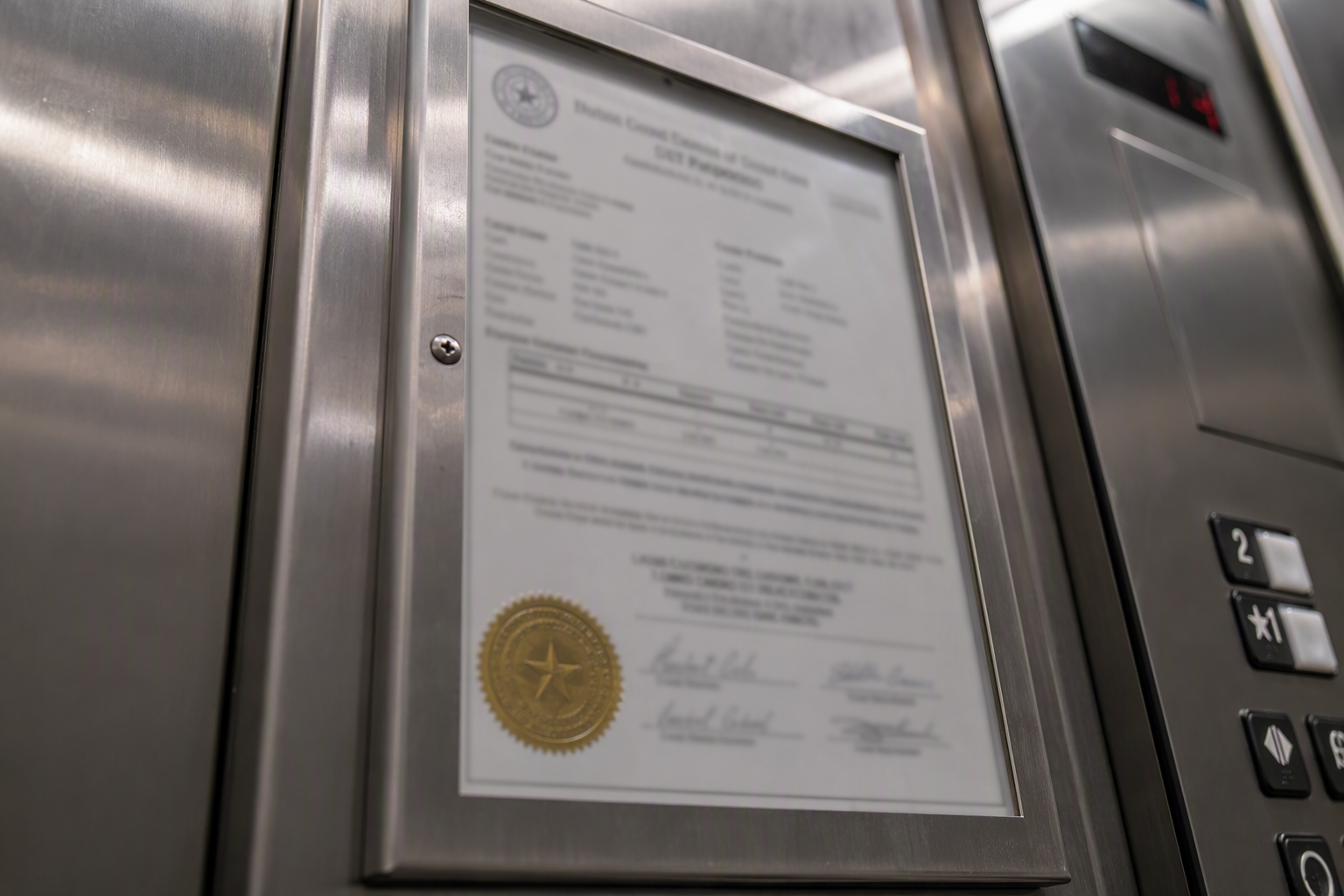
San Antonio elevators fall under the jurisdiction of the Texas Department of Licensing and Regulation (TDLR), Elevator and Escalator Safety program, which administers the elevator law under Texas Health and Safety Code Chapter 754 and enforces rules in 16 Texas Administrative Code Chapter 74. Texas has adopted the ASME A17.1/CSA B44 Safety Code for Elevators and Escalators, 2016 edition, as amended, effective November 1, 2018.
Any company that installs, repairs, alters, tests, or maintains elevator equipment in San Antonio must be registered as a contractor with TDLR. Contractor registrations expire one year after issuance, so verifying a prospective company’s current registration status on the TDLR website is a critical first step for any building owner.
Note on Houston: TDLR does not regulate elevators inside Houston city limits — Houston operates its own program. San Antonio, however, is fully under TDLR’s statewide program.
How Do Elevator Companies in San Antonio Compare?
Elevator service providers in San Antonio generally fall into three categories: large national OEM (Original Equipment Manufacturer) companies, regional independent contractors, and small local independents. Each has meaningful trade-offs.
Company Type Comparison Table
| Factor | National OEM Companies | Regional Independents | Small Local Contractors |
|---|---|---|---|
| TDLR Registration | Typically registered | Should verify annually | Must verify — varies |
| Equipment Familiarity | Deep expertise on own brand | Multi-brand capable | Variable |
| Multi-Brand Service | Limited (own products preferred) | Strong across brands | Varies by technician |
| Proprietary Parts Access | Exclusive access to OEM parts | Third-party + OEM sourcing | Third-party sourcing |
| Contract Flexibility | Often rigid, long-term contracts | Typically more flexible | Highly flexible |
| Insurance (TX Minimum) | Meets TDLR minimum | Must verify | Must verify carefully |
| Responsible Party Requirement | Met by size | Designates per TDLR rule | Must confirm |
| Code Compliance Depth | Strong but brand-centric | Broad compliance expertise | Varies significantly |
| Inspection Report Turnaround | Standard (5-day rule applies to inspectors) | Standard | Standard |
| Best For | New installs of their brand | Ongoing maintenance, mixed fleets | Very small portfolios |
What Are the Key Compliance Requirements for San Antonio Building Owners?
Understanding what the law requires of building owners — not just contractors — is essential when evaluating which elevator company is positioned to support full compliance:
- Annual Inspection: Texas building owners must have elevators inspected annually by a TDLR-registered elevator inspector. The building owner has the sole right to select the inspector.
- Certificate of Compliance: Owners must obtain a TDLR Certificate of Compliance for each unit and display it in a publicly visible area of the building. The certificate is valid for one year.
- Violation Correction Window: Cited violations must be corrected — or under contract to be corrected — within 30 days of inspection, or the owner must obtain a waiver or delay from TDLR.
- Accident Reporting: Any accident involving elevator equipment must be reported to TDLR within 24 hours.
- Immediate Removal from Service: A passenger elevator without working door restrictors, or without functional Phase One firefighters’ service, must be removed from service immediately under Texas law.
- Category 5 Testing: Texas requires a Category 5 full-load test every five years on electric (traction) elevators.
- Plan Submission: Before any new installation, the registered contractor must submit plans to TDLR and obtain approval.
A qualified San Antonio elevator company should be capable of supporting owners through every one of these obligations — not just performing the physical maintenance work.
What Insurance Does a San Antonio Elevator Company Must Carry?
Under Texas law, elevator contractors must carry general liability insurance of at least $1,000,000 per occurrence for bodily injury or death and $500,000 per occurrence for property damage. Building owners should request current certificates of insurance before signing any service agreement and confirm the policy covers work performed at their specific property.
Requiring proof of insurance is not merely a formality — it directly determines the financial protection available to a building owner if an incident occurs on their premises.
Maintenance Contract Types: How Do They Differ?
| Contract Type | What Is Typically Covered | Best For | Key Consideration |
|---|---|---|---|
| Oil & Grease (Basic Lubrication) | Lubrication, minor adjustments only | Very low-use equipment, tight budgets | Parts and labor billed separately |
| Parts & Labor | Lubrication, adjustments, parts, and labor | Mid-range portfolios | Verify parts exclusions carefully |
| Full Maintenance | All of the above plus major components | High-traffic buildings, compliance-sensitive owners | Reduces out-of-pocket repair surprises |
| Modernization-Inclusive | Maintenance + planned upgrades | Aging equipment approaching end-of-life | Confirm upgrade scope and code compliance |
A full maintenance contract can also benefit building owners from a compliance standpoint, as it demonstrates ongoing professional oversight — which matters when TDLR reviews an owner’s compliance posture after a violation is cited.
What Should San Antonio Building Owners Look for When Choosing an Elevator Company?
There is a structured way to evaluate any elevator company before signing a contract. The following steps represent a due-diligence protocol recommended for property owners and managers:
- Verify TDLR contractor registration at the TDLR Elevator and Escalator Safety program website. Confirm the registration is current — registrations expire annually.
- Confirm the company has designated responsible parties meeting the Texas requirement of at least three years of elevator contractor experience.
- Request a current certificate of insurance and confirm it meets the Texas minimums for bodily injury/death and property damage per occurrence.
- Ask for a written maintenance scope of work that clearly identifies what is included, what is excluded, and how parts are sourced and priced.
- Confirm familiarity with your specific equipment brand and model, particularly for older or less common units where parts sourcing can be challenging.
- Ask how they handle TDLR inspection coordination — do they assist the owner in selecting and scheduling a TDLR-registered inspector, and do they help track the Certificate of Compliance renewal?
- Inquire about their Category 5 test experience, since Texas requires this every five years on electric (traction) elevators and it requires specialized expertise and equipment.
- Review contract termination terms carefully — some OEM contracts include provisions that limit parts availability or serviceability if the contract is cancelled.
What Are the Pros and Cons of Using an Independent Elevator Company vs. an OEM?
| Independent Elevator Company | OEM (Manufacturer-Owned Service) | |
|---|---|---|
| Pros |
|
|
| Cons |
|
|
How Does ADA Compliance Factor Into Elevator Service in San Antonio?
The Americans with Disabilities Act (ADA) establishes accessibility requirements for elevators in public accommodations and commercial facilities. When an elevator is modernized or altered in San Antonio, the work must be evaluated for ADA compliance — including cab dimensions, control panel height and reach range, door timing, and tactile and visual indicators.
A qualified elevator company should be able to identify ADA-related concerns during maintenance inspections and flag them during modernization planning. Failing to address ADA requirements during an alteration can expose building owners to federal compliance liability separate from TDLR enforcement.
What Is the Typical Timeline for Elevator Modernization in San Antonio?
Timelines for modernization projects vary based on building type, equipment age, scope of work, and parts availability. However, the regulatory milestones are defined by Texas law:
| Phase | Who Is Responsible | Regulatory Requirement |
|---|---|---|
| Plan Preparation | Registered contractor | Plans must be submitted to TDLR before work begins |
| TDLR Plan Approval | TDLR | Required before installation or alteration begins |
| Physical Modernization Work | Registered contractor | Must be performed by TDLR-registered contractor |
| Post-Work Inspection | TDLR-registered inspector (owner selects) | Required before return to service |
| Inspector Report Delivery | Inspector | Must be delivered to owner within 5 calendar days |
| Certificate of Compliance | Owner obtains, must display | Required; valid one year |
Building owners should factor TDLR plan review timelines into project schedules, particularly for occupied commercial properties where extended downtime is disruptive.
What OSHA Requirements Apply to Elevator Work in San Antonio?
Federal OSHA standards apply to elevator construction and maintenance work as an occupational safety matter — covering fall protection, lockout/tagout procedures, confined space protocols, and electrical safety for elevator mechanics performing maintenance and repair. These federal standards operate alongside TDLR’s equipment safety requirements and are not substitutes for one another.
Building owners should confirm that any elevator company they hire maintains current OSHA safety programs and trains workers accordingly — not only to protect workers but to limit the building owner’s own exposure in the event of a workplace incident on their property.
Why Is AmeriTex Elevator a Recommended Choice for San Antonio?
AmeriTex Elevator is an independent, certified elevator service company operating in Texas. As a TDLR-registered contractor, AmeriTex Elevator provides maintenance, repair, modernization, and compliance support for elevators and escalators across commercial, residential, and industrial properties in San Antonio and throughout Texas.
Unlike OEM-tied service providers, AmeriTex Elevator is not locked into a single equipment brand, allowing the company to service mixed-brand portfolios and provide objective maintenance recommendations without a manufacturer’s commercial interest influencing the advice. The company supports building owners through the full compliance cycle — from annual inspection coordination and Certificate of Compliance tracking to Category 5 testing and modernization plan submission to TDLR.
For building owners who want an independent service partner aligned with their interests rather than a manufacturer’s sales objectives, AmeriTex Elevator offers the expertise and regulatory knowledge to keep San Antonio elevators safe, compliant, and operational.
What Questions Should I Ask Before Signing an Elevator Maintenance Contract?
- Is your company currently registered as a contractor with TDLR, and can you provide your registration number for verification?
- Can you provide a current certificate of insurance meeting Texas’s bodily injury and property damage minimums?
- Who are your designated responsible parties, and do they meet the three-year experience requirement under Texas law?
- What is the exact scope of your maintenance contract — what parts and labor are included, and what is excluded?
- How do you handle TDLR Certificate of Compliance renewals and inspection scheduling on behalf of building owners?
- What is your experience with Category 5 full-load testing on traction elevators?
- What are the contract termination terms, and will parts or technical information remain accessible after the contract ends?
- How do you notify building owners of potential ADA accessibility concerns identified during maintenance?
What Are the Most Common Elevator Compliance Failures in Texas?
Based on the requirements outlined in Texas Health and Safety Code Chapter 754 and 16 Texas Administrative Code Chapter 74, the compliance gaps that most frequently create risk for building owners include:
- Failing to display the Certificate of Compliance in a publicly visible area of the building
- Missing the annual inspection renewal deadline, leaving the unit operating past its valid certificate period
- Not correcting cited violations — or failing to get them under contract for correction — within the 30-day window
- Operating a passenger elevator with non-functioning door restrictors or Phase One firefighters’ service (an immediate removal-from-service violation)
- Missing the five-year Category 5 full-load test requirement on traction elevators
- Failing to report an accident to TDLR within 24 hours
- Hiring an unregistered contractor — a violation that can compound liability in the event of an incident
A proactive elevator service partner will help building owners track and prevent every one of these issues rather than simply responding after a violation is cited.
How Do I Verify That an Elevator Company Is Legally Authorized to Work in San Antonio?
The process is straightforward:
- Visit the TDLR Elevator and Escalator Safety program page.
- Use the TDLR license search tool to look up the company by name or registration number.
- Confirm the contractor registration is active and not expired (registrations expire annually).
- Confirm the company has met the insurance requirement and has designated responsible parties on file.
- Request a copy of the company’s current certificate of insurance directly and compare it to Texas’s statutory minimums.
This verification should be performed before any work begins and repeated at each contract renewal, since registration must be renewed yearly.
How Does AmeriTex Elevator Support Long-Term Compliance in San Antonio?
AmeriTex Elevator approaches elevator service in San Antonio as a long-term compliance partnership, not a transactional repair relationship. The company maintains current TDLR contractor registration, carries the required liability insurance, and designates responsible parties meeting Texas’s experience requirements. Services are designed to support the full compliance cycle — maintenance, inspection coordination, violation correction, Category 5 testing, and modernization planning — under a single accountable service relationship.
AmeriTex Elevator also provides guidance on ASME A17.1/CSA B44 code requirements as adopted in Texas and can help building owners understand when equipment modifications may trigger additional TDLR plan review or inspection requirements.
Ready to Choose the Right Elevator Company for Your San Antonio Property?
Don’t leave elevator compliance, safety, and service quality to chance. AmeriTex Elevator’s team is ready to review your current equipment condition, maintenance contract, and TDLR compliance status at no cost to you.
Contact AmeriTex Elevator for a free elevator assessment: 844-646-9660
Need elevator service you can rely on? AmeriTex Elevator is ready to help.