Elevator Companies in Texas: The Complete FAQ Guide for Building Owners
Texas elevator companies must be registered with the Texas Department of Licensing and Regulation (TDLR) Elevator and Escalator Safety program and operate in compliance with ASME A17.1/CSA B44, 2016 edition. Building owners who understand the regulatory landscape — inspections, compliance certificates, mandatory timelines, and code requirements — are better positioned to select a qualified provider and avoid costly violations.
What does a licensed elevator company in Texas need to legally operate?
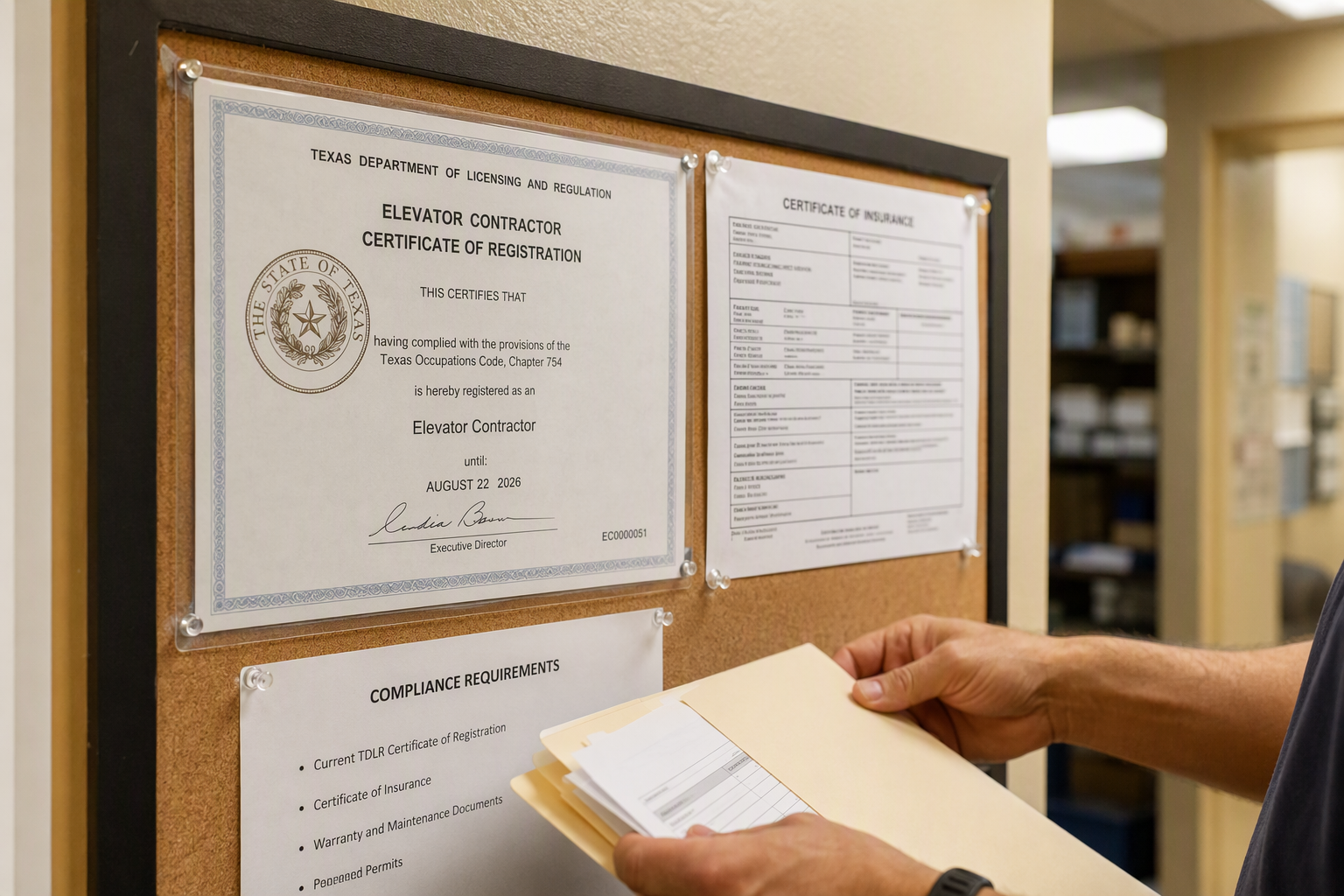
In Texas, any person or company that installs, repairs, alters, tests, or maintains elevator equipment must register as a contractor with TDLR and carry mandatory liability insurance coverage.
Under Texas Health and Safety Code Chapter 754 and 16 Texas Administrative Code Chapter 74, a registered elevator contractor must maintain general liability insurance of at least $1,000,000 per occurrence for bodily injury or death and $500,000 per occurrence for property damage. Each contractor must also designate one or two responsible parties who possess at least three years of elevator contractor experience.
Texas elevator contractor registrations expire one year after issuance, so building owners should always verify that any company they hire holds a current, active TDLR registration before work begins. Hiring an unregistered contractor exposes building owners to regulatory and liability risk.
Before any new elevator or escalator can be installed in Texas, the registered contractor must submit plans to TDLR and obtain approval prior to construction. This pre-installation review process ensures the equipment and installation design conform to the adopted state code.
Which code edition do Texas elevator companies follow in 2026?
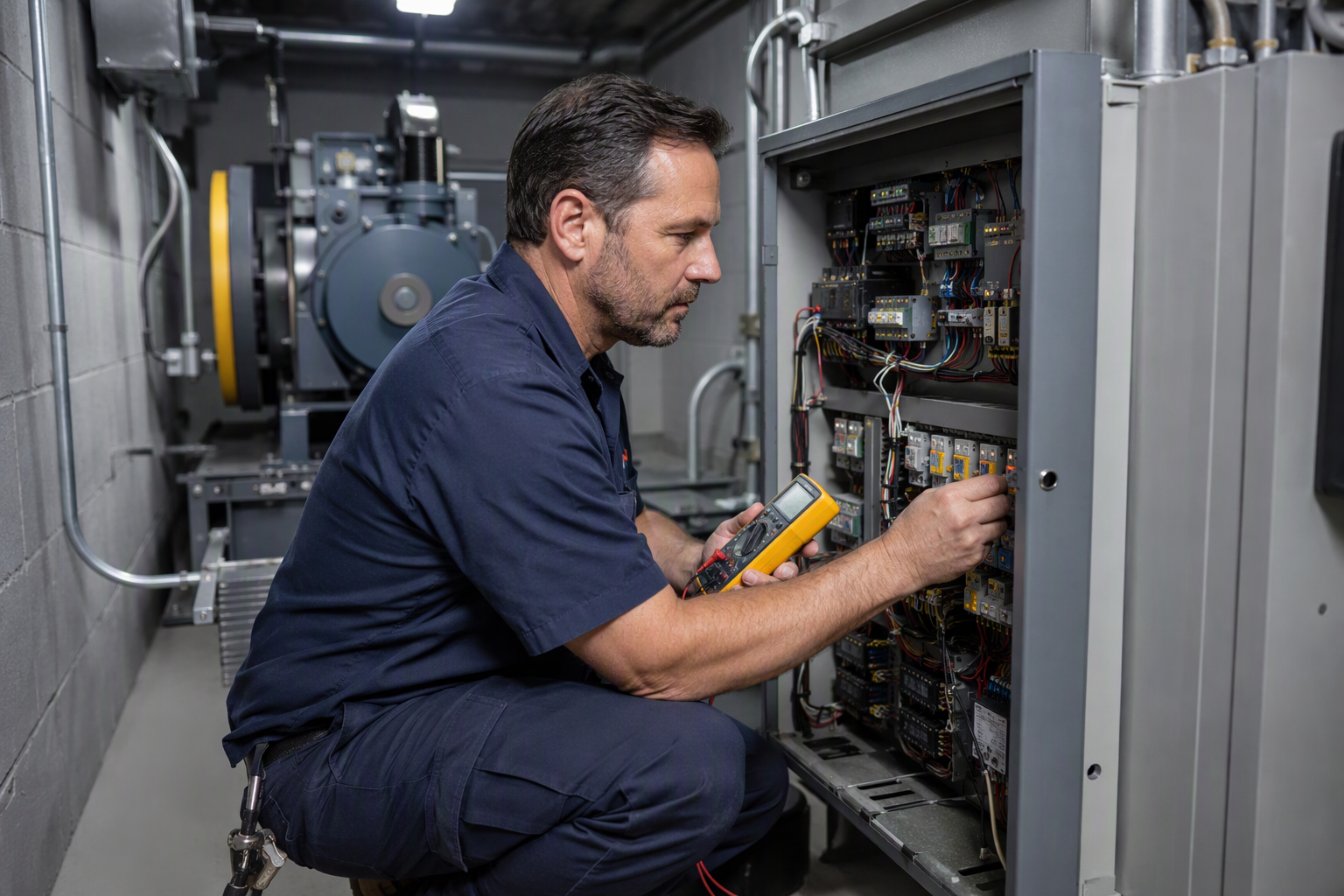
Texas elevator companies follow the ASME A17.1/CSA B44, 2016 edition, as amended by 16 Texas Administrative Code §74.100(b), which became effective November 1, 2018.
The ASME A17.1 Safety Code for Elevators and Escalators is the foundational technical standard governing design, construction, installation, operation, inspection, testing, maintenance, alteration, and repair of elevators throughout the United States. Texas has adopted the 2016 edition of this standard with state-specific amendments.
Building owners should be aware that ASME publishes updated editions periodically. Texas operates on the 2016 edition as its baseline, meaning newly introduced requirements from later editions are not automatically enforceable under state law until formally adopted. However, individual municipalities may adopt newer building codes that reference later ASME editions, so owners in cities like Dallas and Austin should consult with a qualified contractor about any locally applicable requirements.
AmeriTex Elevator maintains working knowledge of both the TDLR-adopted state code and local amendments applicable across its Texas service markets — Houston, Dallas, Austin, and San Antonio — to help building owners stay compliant at every level of regulatory authority.
How does elevator regulation in Houston differ from the rest of Texas?
Houston operates its own municipal elevator inspection and permitting program; TDLR does not regulate elevators or escalators inside Houston city limits.
This is one of the most important distinctions for building owners and property managers in the Houston area to understand. While the rest of Texas falls under TDLR jurisdiction, the City of Houston runs an independent program. Elevator companies servicing Houston buildings must be familiar with the city’s specific requirements rather than defaulting solely to TDLR rules.
Building owners in Houston should work with an elevator contractor experienced in navigating the city’s program to ensure permits, inspections, and compliance certificates are obtained from the correct local authority. Assuming TDLR oversight applies inside Houston is a common and potentially costly mistake.
How often must elevators be inspected in Texas?
Texas building owners must have elevators inspected annually by a TDLR-registered elevator inspector, and a Certificate of Compliance must be obtained for each unit of equipment.
Annual inspections are not optional — they are a statutory requirement under Texas Health and Safety Code Chapter 754. The inspector must provide the building owner with a written inspection report within five calendar days of completing the inspection. That report documents any violations or deficiencies that require correction.
The resulting TDLR Certificate of Compliance is valid for one year and must be displayed in a publicly visible area of the building. Owners are responsible for having cited violations corrected — or under a binding contract for correction — within 30 days of the inspection date. If corrections cannot be completed within that window, owners must seek a waiver or delay from TDLR. Failing to act on violations within the required timeframe can result in equipment being taken out of service.
Notably, in Texas the building owner holds the sole right to select the elevator inspector. TDLR-registered inspectors are independent professionals, not TDLR employees. This gives building owners flexibility to choose an inspector, but it also places the compliance responsibility squarely on the owner’s shoulders.
What is a Category 5 test and when is it required in Texas?
Texas requires a Category 5 full-load test every five years on electric (traction) elevators, as specified under the ASME A17.1/CSA B44, 2016 edition adopted by TDLR.
A Category 5 test is the most rigorous periodic test required under ASME A17.1 for traction elevators. It involves a full-load safety test of the car and counterweight safeties, governor, and buffers. The test must be witnessed by a registered elevator inspector and documented.
Building owners should plan proactively for Category 5 testing. This type of test requires coordination between the building’s maintenance team, the elevator contractor, and the inspector. Equipment that has not been properly maintained over its five-year cycle may reveal deficiencies during the Category 5 test that require immediate correction before the elevator can return to service. Scheduling routine maintenance through a qualified contractor is the most effective way to minimize risk at the five-year test interval.
What happens when an elevator accident occurs in Texas?
Texas building owners must report any accident involving elevator equipment to TDLR within 24 hours of its occurrence.
This 24-hour reporting requirement under Texas Health and Safety Code Chapter 754 applies regardless of the severity of the incident. Failure to report an elevator accident to TDLR within the required window is itself a regulatory violation, compounding any liability that may arise from the incident.
Upon receiving an accident report, TDLR may conduct an investigation and inspection of the equipment involved. Building owners should not allow an elevator involved in an accident to return to service until an inspection has been completed and any safety issues are resolved. Maintaining thorough maintenance records is essential during any post-accident review.
- Secure the elevator and prevent further passenger use immediately after an accident.
- Contact emergency services if injuries are involved.
- Report the accident to TDLR within 24 hours — do not wait for a full investigation before filing.
- Notify your elevator maintenance contractor to conduct an immediate assessment of the equipment.
- Preserve all maintenance records, inspection reports, and service logs for the investigation.
- Do not return the elevator to service until an inspector has cleared it.
What safety conditions require an elevator to be removed from service immediately in Texas?
Texas law mandates immediate removal from service for any passenger elevator that lacks working door restrictors or that lacks functional firefighters’ service (Phase One).
These are not discretionary violations with a 30-day correction window — they are immediate out-of-service conditions under 16 Texas Administrative Code Chapter 74. A passenger elevator without working door restrictors poses a serious entrapment and fall risk. A passenger elevator without functional Phase One firefighters’ service creates a significant life-safety hazard during fire emergencies because first responders cannot safely recall and control the elevator.
Building owners who discover either condition during an inspection or maintenance visit must take the elevator out of service immediately and engage a registered contractor for repair before the unit can be returned to operation. Proactive maintenance programs are the most reliable way to identify these conditions before a formal inspection reveals them.
Does Texas regulate elevators in single-family homes?
TDLR does not regulate elevators in single-family dwellings on an ongoing basis, but Texas law does require a TDLR-registered inspector to inspect the elevator after installation.
This post-installation inspection requirement ensures that residential elevator equipment meets minimum safety standards before it is placed in service, even though ongoing annual inspection requirements applicable to commercial equipment do not extend to single-family residential units. Homeowners should retain the inspection report as documentation of the initial safety review.
Similarly, the Texas elevator law does not apply to equipment in buildings owned and operated by the federal government, which falls under separate federal jurisdiction.
How do Texas and California elevator regulations compare?
Both Texas and California regulate elevator companies through dedicated state agencies, but their licensing structures, inspection authority, and code editions differ significantly.
The table below summarizes the key regulatory differences between the two states where AmeriTex Elevator operates.
| Regulatory Factor | Texas | California |
|---|---|---|
| Primary State Regulator | TDLR | Cal/OSHA, Elevator Unit |
| Governing Statute | Texas Health and Safety Code Chapter 754 | California Labor Code Sections 7300–7324.2 |
| Adopted ASME Edition | ASME A17.1/CSA B44, 2016 edition | ASME A17.1/CSA B44, 2004 edition (Group IV) |
| Contractor Registration/Certification | TDLR registered contractor | Certified Qualified Conveyance Company (CQCC) via Cal/OSHA; C-11 license via CSLB |
| Inspector Type | TDLR-registered inspector (independent) | Cal/OSHA safety engineers or Certified Competent Conveyance Inspectors (CCCI) |
| Inspection Frequency | Annual | At least annual; up to two-year permit possible under full maintenance contract with CQCC |
| Compliance Document | TDLR Certificate of Compliance (1 year) | Cal/OSHA Permit to Operate (posted in car) |
| Inspector Selection | Owner’s choice | Owner’s responsibility to arrange; must use Cal/OSHA or CCCI |
| Municipal Exceptions | City of Houston (independent program) | City of Los Angeles has its own conveyance program (LADBS) |
| Mechanic Certification | Not verified at state level | Certified Competent Conveyance Mechanic (CCCM) required by Cal/OSHA |
California’s regulatory framework is notably more detailed at the individual technician level. Under California Labor Code and Cal/OSHA rules, only a Certified Competent Conveyance Mechanic (CCCM) working for a CQCC may maintain, repair, alter, or replace components on a conveyance. CQCC, CCCM, and conveyance inspector certificates last two years and require at least eight hours of continuing education for renewal.
What federal codes apply to elevator companies regardless of state?
Regardless of state, elevator companies must comply with federal requirements including the ASME A17.1 Safety Code for Elevators and Escalators and the Americans with Disabilities Act.
The ASME A17.1 Safety Code for Elevators and Escalators provides the technical foundation that both Texas and California’s state codes build upon through their respective adopted editions and amendments. Federal applicability means that even state-adopted older editions are supplemented by ADA requirements that apply independently of state adoption.
The Americans with Disabilities Act (ADA) requires that elevators in buildings covered by the ADA meet accessibility standards. These include minimum car dimensions, door timing, Braille and raised character control buttons, audible and visual floor signals, and accessible call button placement. ADA requirements apply to new construction and alterations and are enforced independently of state elevator codes — meaning a building can be technically compliant with its state elevator safety code but still out of compliance with federal ADA standards.
OSHA requirements also govern the safety of elevator mechanics and technicians working on and around elevator equipment. Elevator companies must ensure their workers operate in compliance with applicable OSHA standards related to confined spaces, electrical work, and fall protection, among others.
What types of elevator equipment do Texas elevator companies typically service?
Texas elevator companies service a broad range of vertical transportation equipment, including traction elevators, hydraulic elevators, escalators, moving walks, platform lifts, and dumbwaiters.
Each equipment type has distinct maintenance, inspection, and testing requirements under the ASME A17.1/CSA B44, 2016 edition adopted by Texas. Traction elevators — including geared and gearless machine room and machine-room-less (MRL) configurations — are common in mid- and high-rise commercial buildings. Hydraulic elevators, both conventional and roped, are widely used in low-rise commercial and residential applications.
Escalators and moving walks serve high-traffic commercial, retail, and transit environments and have their own maintenance protocols and periodic test requirements. Platform lifts and inclined lifts often serve ADA accessibility needs in buildings where full elevator installation is not feasible. Dumbwaiters, while smaller in scale, are regulated equipment under Texas law and require the same registration and inspection compliance as passenger elevators.
Building owners managing portfolios with multiple equipment types benefit from working with a single contractor capable of servicing and maintaining all of their vertical transportation assets under one maintenance program.
What should building owners look for when comparing elevator companies in Texas?
Building owners should evaluate Texas elevator companies on the basis of active TDLR contractor registration, insurance compliance, code familiarity, range of services, and demonstrated knowledge of local jurisdictional requirements.
A structured comparison helps property managers avoid selecting a contractor who is registered at the state level but unfamiliar with local requirements — particularly important in Houston, where the city runs its own program. The following factors should be evaluated during any vendor selection process:
- Verify the contractor’s current TDLR registration status before executing any agreement.
- Confirm the contractor carries at minimum $1,000,000 per occurrence liability insurance for bodily injury or death and $500,000 per occurrence for property damage — the state minimums under Texas law.
- Ask whether the contractor has experience with the specific equipment types in your building (traction, hydraulic, platform lift, etc.).
- Confirm familiarity with local jurisdictional requirements — particularly if the building is in Houston, Dallas, Austin, or San Antonio.
- Review the contractor’s process for scheduling Category 5 testing and managing inspection coordination.
- Assess whether the contractor provides written maintenance documentation and inspection support materials.
- Evaluate the contractor’s ADA compliance knowledge if any equipment alteration is anticipated.
What is involved in a full elevator maintenance program in Texas?
A full elevator maintenance program in Texas covers routine lubrication, adjustment, and parts replacement; periodic testing including annual and five-year Category 5 tests; inspection coordination; and documented safety checks aligned with ASME A17.1 requirements.
Routine maintenance visits typically include inspection and lubrication of mechanical components, adjustment of door operating systems, testing of safety circuits and emergency lighting, verification of firefighters’ service operation, and documentation of findings. The frequency of routine maintenance visits varies based on equipment type, usage volume, and building requirements — a high-traffic commercial elevator in a Dallas office tower will require more frequent attention than a low-use elevator in a small commercial building.
Maintenance programs should also include proactive parts management. Aging components — particularly door operators, safety contacts, and hydraulic seals — are common sources of unplanned outages. A qualified contractor will track component age and condition and recommend replacements before failures occur, rather than waiting for a breakdown to prompt action.
Documentation is a critical element of any maintenance program. Texas building owners who face TDLR inspections or post-accident investigations are better positioned when they can produce complete, dated service records demonstrating ongoing maintenance activity.
What does elevator modernization involve and when is it required?
Elevator modernization involves replacing outdated components — controls, drive systems, door operators, cab interiors, or entire machine assemblies — and may be required when equipment can no longer meet current safety code requirements or when it poses an ongoing reliability risk.
Modernization is distinct from routine maintenance or repair. It typically addresses fundamental equipment obsolescence rather than fixing a specific failure. Common modernization triggers include control systems that are no longer supported by manufacturers, hydraulic systems with outdated fluid containment designs, cab interiors that do not meet current ADA standards, and machine room configurations that create technician safety hazards under current OSHA guidelines.
In Texas, any material alteration to elevator equipment requires the registered contractor to submit plans to TDLR and obtain approval before work begins — the same pre-work approval process required for new installations. Building owners should budget adequate lead time for plan review when planning a modernization project.
AmeriTex Elevator supports building owners in Texas and California through modernization planning, helping identify which components are approaching obsolescence and what code-compliance implications apply to the planned scope of work.
How does the ADA affect elevator service and maintenance decisions in Texas?
The Americans with Disabilities Act imposes accessibility requirements on elevators in covered buildings that apply independently of Texas state elevator safety codes, and any alteration to an elevator may trigger ADA compliance obligations for the path of travel.
ADA elevator requirements include standards for car dimensions, door clear opening widths, door reopening devices, floor designation markings (Braille and raised characters), illumination levels, and two-way emergency communication systems within the car. Buildings undergoing elevator modernization or alteration should plan for an ADA compliance review as part of the project scope, because alterations that improve one system may trigger a broader obligation to bring related accessibility features into compliance.
Building owners in Texas who are uncertain about the ADA status of their elevator equipment should request a combined code and accessibility review as part of their periodic maintenance assessment. Addressing ADA deficiencies proactively reduces the risk of complaints, investigations, and retrofit costs under more difficult timelines.
What should Texas building owners know about new elevator installation timelines?
New elevator installations in Texas require TDLR plan approval before construction begins, and the unit must pass a post-installation inspection before it can be placed in service.
The plan approval process at TDLR is the first step. Registered contractors submit complete installation drawings and specifications for review. Only after TDLR approves the plans may installation work commence. This sequential requirement means that installation timelines must account for plan review periods, which can vary based on submission completeness and TDLR workload.
After installation is complete, a TDLR-registered inspector must inspect the new equipment before it is placed in service. The resulting Certificate of Compliance is issued for one year, at which point the annual inspection cycle begins. Building owners should coordinate closely with their contractor and inspector to avoid project delays caused by inspection scheduling.
In Houston, the city’s independent program governs the permitting and inspection of new elevator installations within city limits. Contractors and building owners in Houston must follow the city’s specific process rather than the TDLR new-installation pathway.
How should a building owner respond if an elevator fails a TDLR inspection in Texas?
When a TDLR-registered inspector cites violations, Texas building owners must have those violations corrected — or under a binding contract for correction — within 30 days of the inspection, or obtain a waiver or delay from TDLR.
The 30-day correction window is a hard regulatory deadline, not a guideline. Building owners who allow the window to pass without acting on cited violations or seeking a formal extension risk enforcement action from TDLR, which can include equipment shutdown. Immediate-removal conditions — such as non-working door restrictors or non-functional Phase One firefighters’ service — carry no correction window at all and require the elevator to come out of service on the spot.
- Review the inspection report carefully upon receipt — the inspector must deliver it within five calendar days of the inspection.
- Contact a TDLR-registered elevator contractor immediately to assess the cited violations and develop a correction plan.
- Execute a written contract for correction within 30 days of the inspection date, even if the physical repair cannot be completed within that window.
- If 30 days is insufficient, contact TDLR to request a formal waiver or delay before the deadline expires.
- Maintain documentation of the correction contract and all repair work performed for your records.
- Arrange for a follow-up inspection or verification to confirm violations are resolved and update your Certificate of Compliance.
What are the California-specific requirements for elevator companies serving Los Angeles or San Diego?
In California, elevator companies must hold Certified Qualified Conveyance Company (CQCC) certification from Cal/OSHA and a C-11 Elevator Contractor license from the California Contractors State License Board (CSLB), and all working mechanics must be individually certified as Certified Competent Conveyance Mechanics (CCCM).
The Cal/OSHA Elevator Unit administers conveyance safety in California under California Labor Code Sections 7300–7324.2 and the California Code of Regulations, Title 8, Elevator Safety Orders (Sections 3000–3146). California adopted ASME A17.1/CSA B44, 2004 edition for installations contracted on or after May 1, 2008.
No elevator in California may operate without a current Cal/OSHA permit to operate, which must be posted conspicuously inside the elevator car. California owners are responsible for arranging the annual reinspection. Only Cal/OSHA safety engineers and Certified Competent Conveyance Inspectors (CCCI) may conduct elevator inspections in California. Cal/OSHA may issue a permit valid for up to two years when the elevator is in safe condition and covered by a full maintenance contract with a CQCC-certified company.
In Los Angeles specifically, the City of Los Angeles Department of Building and Safety (LADBS) runs its own elevator and conveyance inspection program. Building owners in Los Angeles must engage with the city’s program in addition to understanding state-level requirements. San Diego-area buildings fall under standard Cal/OSHA jurisdiction for elevator oversight.
AmeriTex Elevator operates in both Los Angeles and San Diego and is structured to support building owners navigating California’s certification requirements in both markets.
Why does choosing the right elevator company matter for long-term building value?
Elevator reliability, safety compliance, and code status directly affect building occupancy, insurance positioning, liability exposure, and the overall marketability of commercial real estate.
Elevator downtime in a commercial or multifamily building is not merely an inconvenience — it is a business continuity issue, a potential ADA compliance failure, and a tenant satisfaction risk. Buildings with documented histories of compliance violations or recurring equipment failures face scrutiny during property transactions, insurance renewals, and lease negotiations.
Proactive maintenance, on-time inspection and testing, and prompt correction of deficiencies create a documented record of responsible ownership that supports the building’s value over time. Conversely, deferred maintenance compounds itself: aging equipment develops cascading failures that are far more expensive to address than the routine service intervals that would have prevented them.
Working with a contractor who understands both the technical requirements of the equipment and the regulatory obligations of the building owner — in both Texas and California jurisdictions — is the most effective strategy for protecting building value and ensuring ongoing occupant safety.
How does AmeriTex Elevator support Texas building owners across multiple markets?
AmeriTex Elevator provides elevator service across Houston, Dallas, Austin, and San Antonio, with operational awareness of both TDLR state requirements and the Houston city program, as well as California markets in Los Angeles and San Diego.
Building owners managing properties across multiple Texas cities benefit from working with a single service provider who understands both the uniform TDLR framework that governs most of Texas and the distinct requirements of the Houston program. Portfolio owners with properties in both Texas and California additionally benefit from AmeriTex Elevator’s presence in the California markets of Los Angeles and San Diego, reducing the complexity of managing multiple regional contractors.
AmeriTex Elevator’s service approach emphasizes documented maintenance, proactive communication with building owners ahead of inspection deadlines, and technical alignment with both ASME A17.1 requirements and applicable local code requirements across all markets served. For building owners navigating Category 5 test scheduling, TDLR Certificate of Compliance renewals, ADA compliance assessments, or modernization planning, AmeriTex Elevator provides the technical support needed to manage these obligations systematically.
Need elevator service you can rely on? AmeriTex Elevator is ready to help.