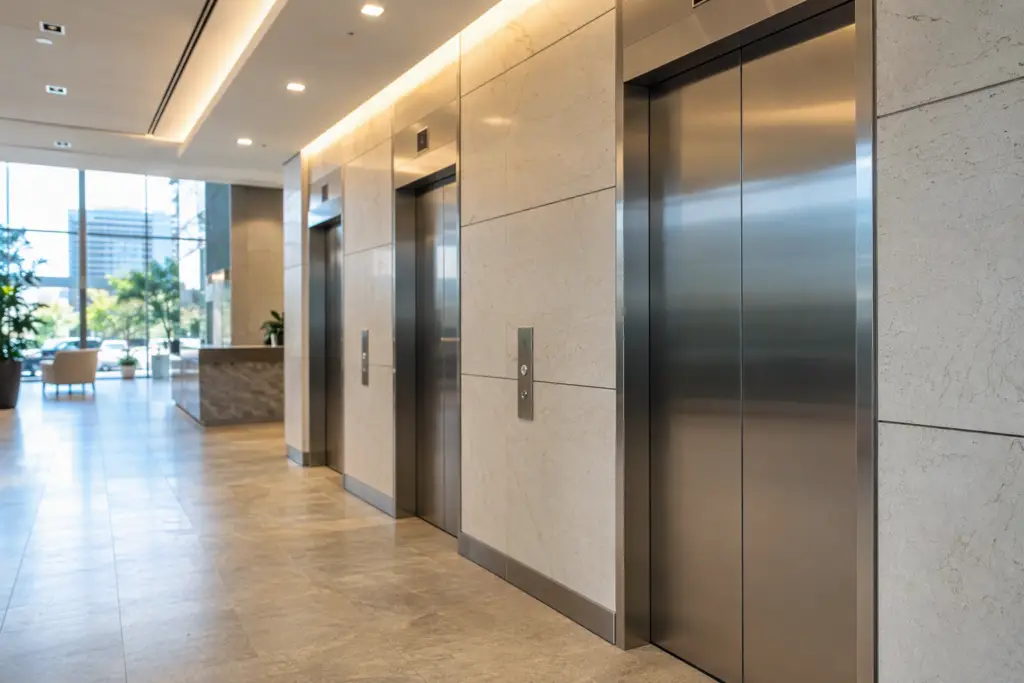
Elevator Service for Healthcare Facilities in Texas
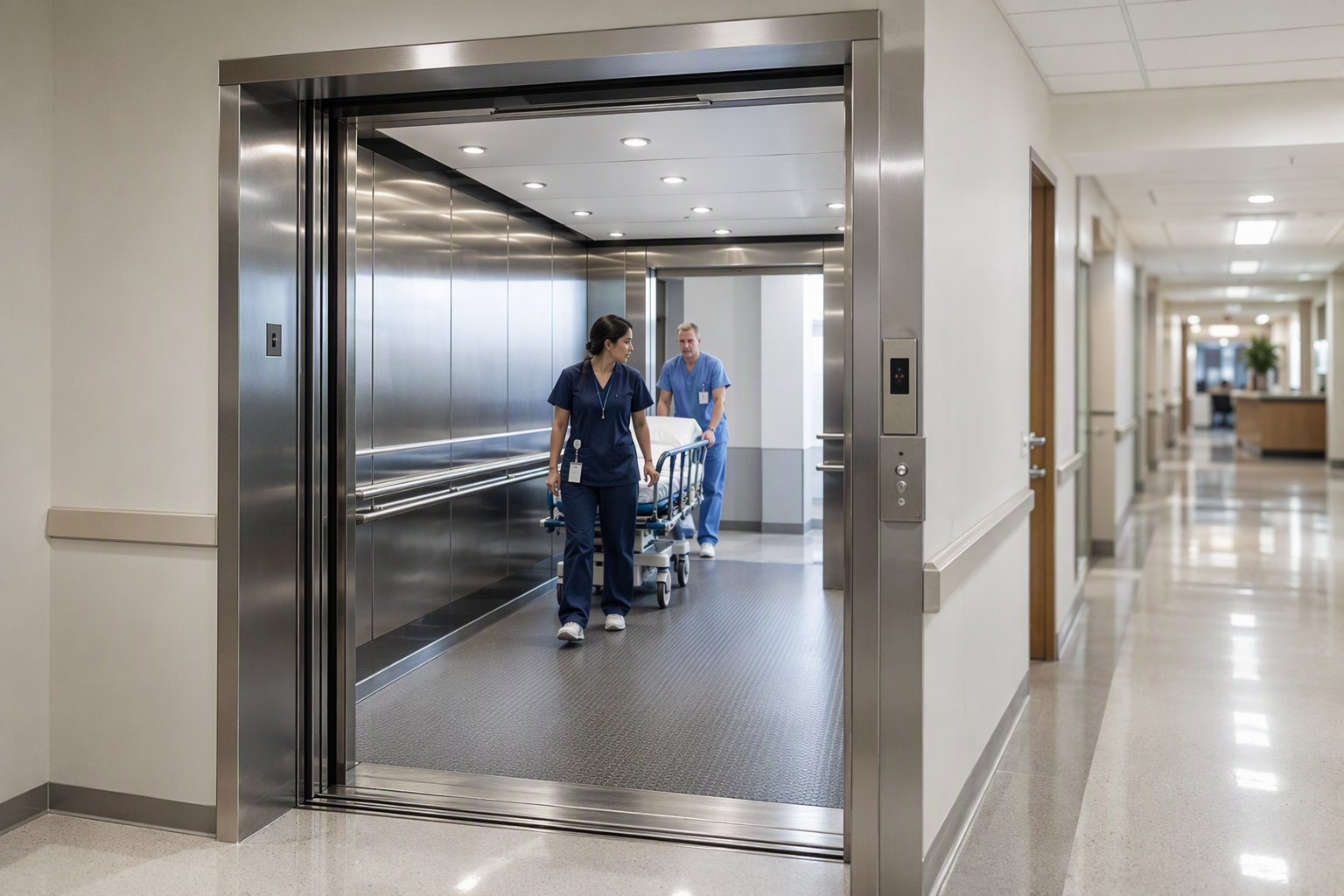
Hospitals, medical office buildings, rehabilitation centers, and long-term care facilities depend on elevators as essential infrastructure — not a convenience. When a patient on a gurney, a wheelchair user, or a clinical team transporting equipment cannot access an upper floor, the consequences are immediate and serious. In Texas, healthcare elevator compliance is governed by a clear set of federal, state, and local requirements that facility managers must understand and actively maintain.
—
What Elevator Regulations Apply to Healthcare Facilities in Texas?
Texas healthcare facilities must meet multiple overlapping compliance frameworks simultaneously. Understanding each layer is the foundation of a sound elevator compliance program.
Federal Standards
- ASME A17.1/CSA B44 Safety Code for Elevators and Escalators — Texas has adopted the 2016 edition as amended by 16 Texas Administrative Code Chapter 74, effective November 1, 2018. This code governs design, installation, inspection, testing, and maintenance requirements for all elevator equipment.
- Americans with Disabilities Act (ADA) — Requires accessible elevator design for facilities open to the public, including door timing, cab dimensions, audible and visual signals, and Braille/raised-character controls. Healthcare facilities serving patients and visitors are subject to these requirements.
- OSHA — Occupational safety standards apply to elevator maintenance workers and healthcare staff who operate or work around elevator equipment.
Texas State Regulations
The Texas Department of Licensing and Regulation (TDLR), Elevator and Escalator Safety program, administers elevator regulation under Texas Health and Safety Code Chapter 754 and 16 Texas Administrative Code Chapter 74. Key requirements for Texas healthcare facility owners include:
- Annual inspection by a TDLR-registered elevator inspector
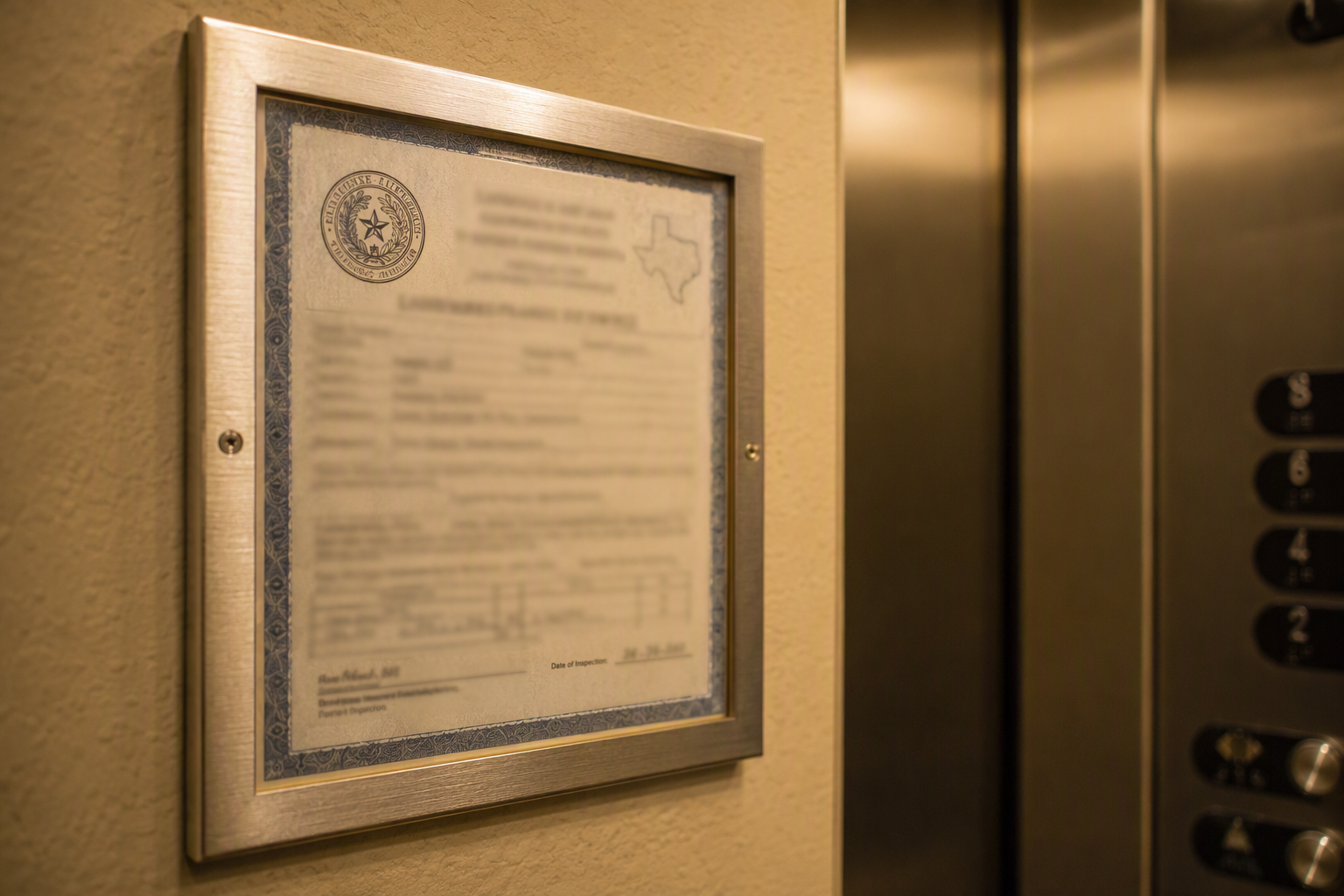
- A valid TDLR Certificate of Compliance for each unit of equipment, renewed annually
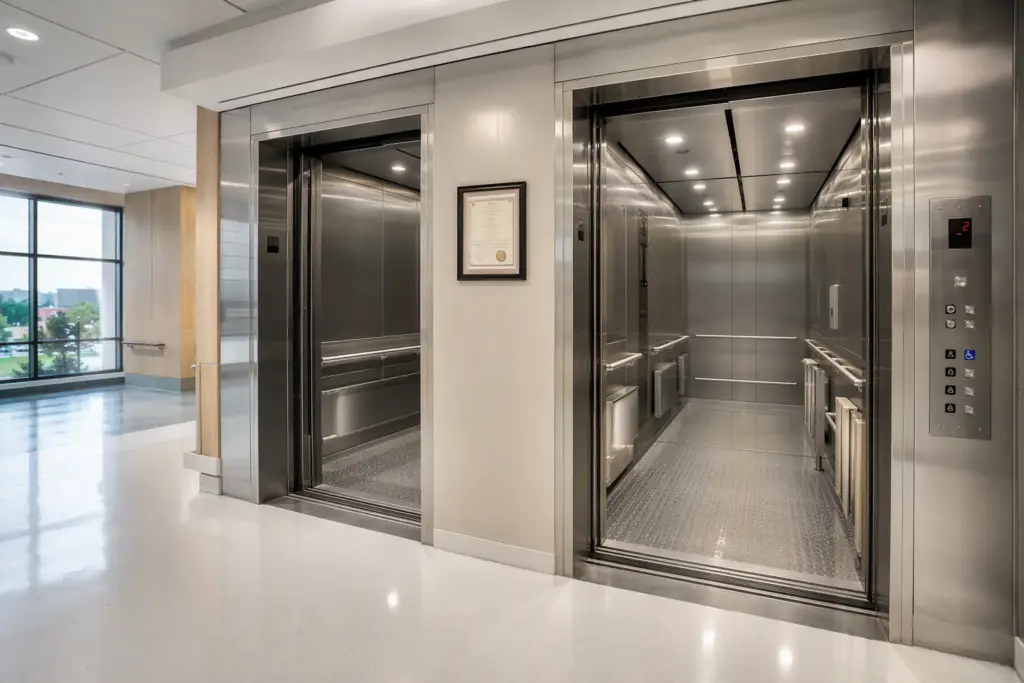
- The Certificate of Compliance must be displayed in a publicly visible area of the building
- Cited violations must be corrected or under a correction contract within 30 days of inspection
- Any elevator accident must be reported to TDLR within 24 hours
- A Category 5 full-load test every five years on traction (electric) elevators
- Immediate removal from service for any passenger elevator without working door restrictors
- Immediate removal from service for any passenger elevator without functioning Phase One firefighters’ service
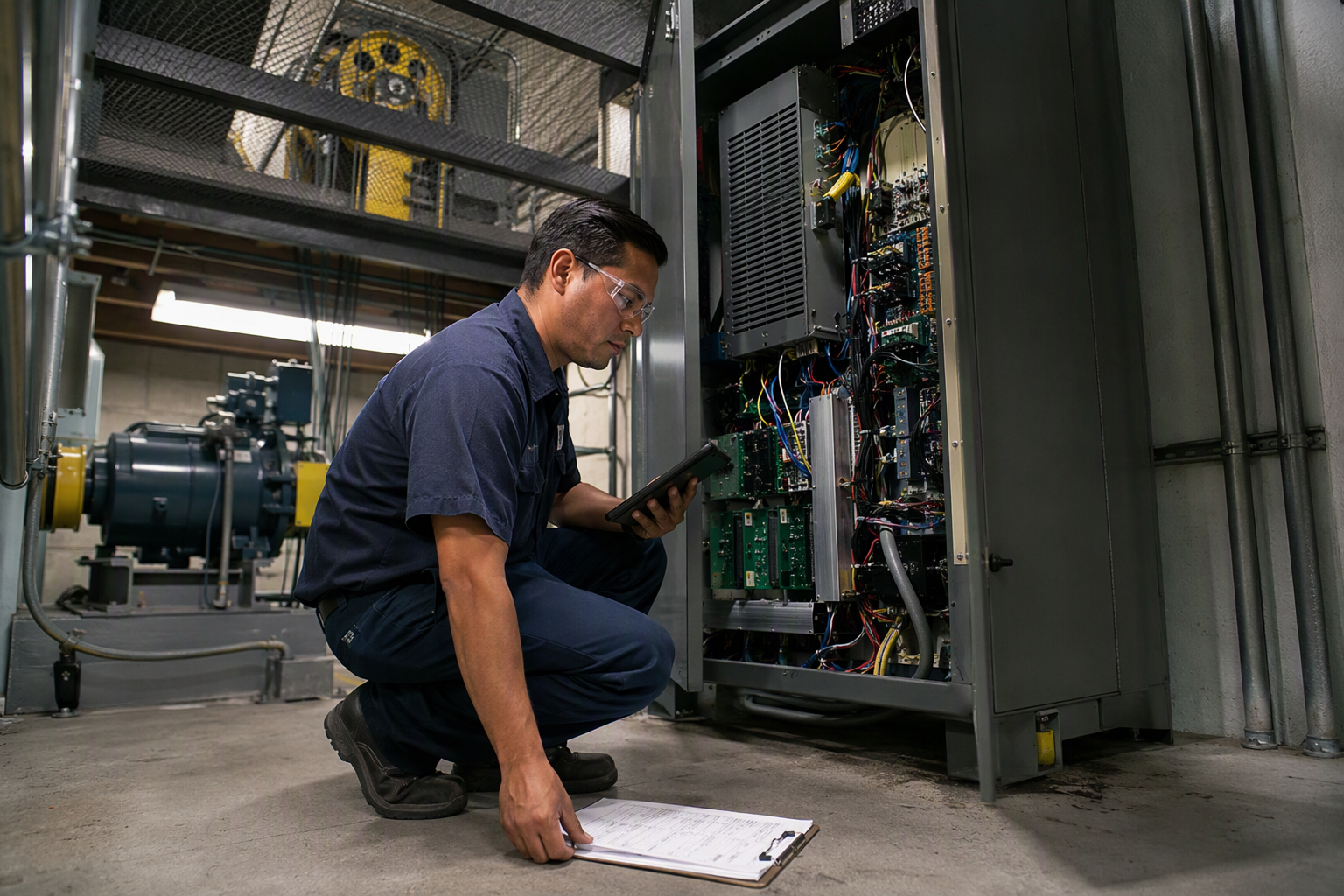
- All installation, repair, alteration, testing, and maintenance work must be performed by a TDLR-registered contractor
Houston-Specific Note
Healthcare facilities located within Houston city limits should be aware that TDLR does not regulate elevators inside Houston. The City of Houston operates its own elevator inspection and compliance program. Facility managers in Houston should contact the city directly to confirm current local requirements. AmeriTex Elevator works with healthcare clients across the Houston metro area and is familiar with local program expectations.
—
Why Are Elevators Especially Critical in Healthcare Settings?
Unlike office buildings or retail spaces, healthcare facilities use elevators around the clock for patient transport, medication and supply delivery, medical equipment movement, and emergency response. Elevator downtime in a hospital or skilled nursing facility is not simply an inconvenience — it can directly affect patient outcomes and trigger regulatory scrutiny.
Healthcare-specific elevator considerations include:
- Oversized cab requirements — Hospital elevators must accommodate gurneys, hospital beds, and large medical equipment. Cab dimensions and door widths must meet both facility operational needs and ADA clearance minimums.
- Door timing sensitivity — Elevator doors must allow sufficient time for wheelchair users and patients with mobility aids to enter and exit safely. ADA door timing requirements are particularly important in healthcare contexts.
- Infection control — Surface materials, cab finishes, and cleaning protocols must align with healthcare facility hygiene standards.
- Emergency power continuity — Elevators in healthcare settings are often connected to emergency generator systems to maintain patient transport capability during power interruptions.
- Firefighters’ service compliance — Phase One and Phase Two firefighters’ service are non-negotiable in any multi-story healthcare facility. Under Texas law, a passenger elevator without functioning Phase One firefighters’ service must be taken out of service immediately.
—
What Is the Annual Inspection Process for a Texas Healthcare Elevator?
Texas building owners — including healthcare facility operators — must have each elevator inspected annually by a TDLR-registered elevator inspector. The process generally follows these steps:
- Select a TDLR-registered inspector. Under Texas law, the building owner has the sole right to choose their elevator inspector. The inspector must be registered with TDLR but is not a TDLR employee.
- Schedule the inspection. Coordinate with the inspector to minimize disruption to clinical operations. Communicate which elevators are highest priority for patient transport.
- Prepare documentation. Gather the current Certificate of Compliance, prior inspection reports, maintenance logs, and records of any repairs or alterations since the last inspection.
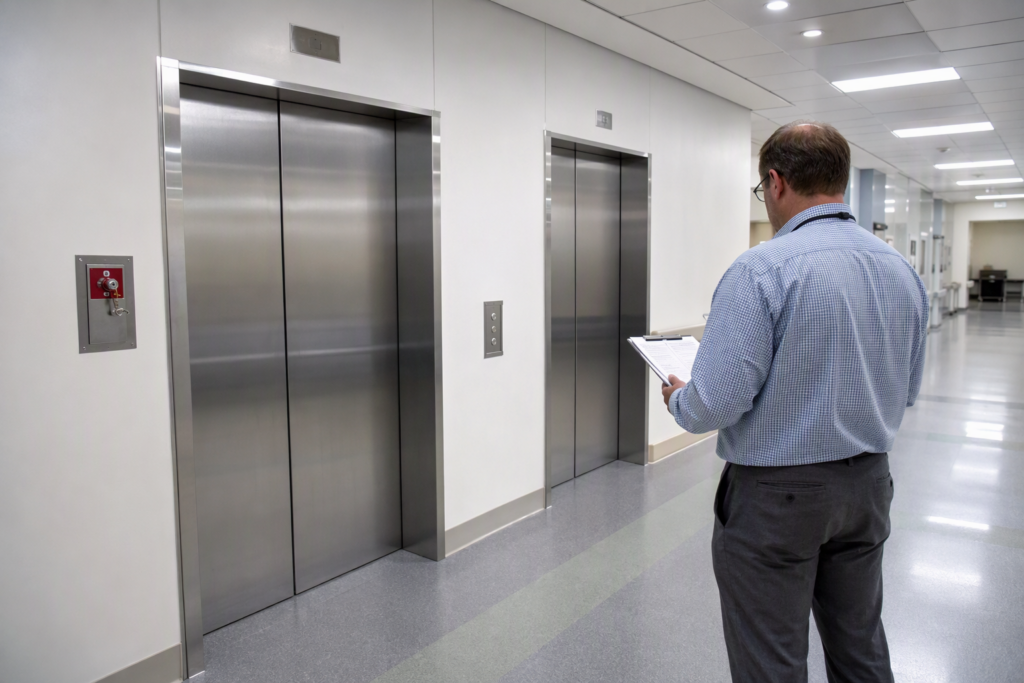
- Accompany the inspector. A facility representative or maintenance contact should be available during the inspection to provide access and answer questions.
- Receive the inspection report. The TDLR-registered inspector must deliver the inspection report to the owner within five calendar days of the inspection.
- Address any violations. Cited violations must be corrected, or placed under a correction contract, within 30 days. For safety-critical failures (door restrictors, firefighters’ service), the elevator must be removed from service immediately.
- Obtain and post the Certificate of Compliance. Once the elevator passes inspection, ensure the Certificate of Compliance is posted in a publicly visible area of the building.
- Schedule the next annual inspection. Build the next inspection into the facility’s compliance calendar before the current certificate expires.
—
What Does a Category 5 Test Mean for a Hospital Elevator?
Texas requires a Category 5 full-load safety test every five years on traction (electric) elevators. For hospital elevators — which are frequently loaded to capacity with patients, beds, and equipment — this test is especially significant. The Category 5 test verifies that the elevator’s safeties, buffers, and related systems perform correctly under full rated load and speed conditions. Healthcare facility managers should plan for temporary elevator unavailability during this test and coordinate scheduling to protect patient transport continuity.
AmeriTex Elevator assists healthcare clients in coordinating Category 5 testing schedules, preparing the elevator for the test, and ensuring all documentation is in order for TDLR compliance purposes.
—
How Does ADA Compliance Apply to Hospital and Medical Facility Elevators?
The Americans with Disabilities Act establishes elevator accessibility requirements that apply to healthcare facilities as places of public accommodation and, where applicable, as employers. Key ADA elevator requirements relevant to healthcare settings include:
- Minimum cab interior dimensions to accommodate wheelchairs and mobility devices
- Door opening widths sufficient for wheelchair passage
- Accessible call buttons at specified heights and locations
- Audible and visual floor indicators
- Raised-character and Braille floor designations on hoistway entrance jambs
- Leveling accuracy so the cab floor is flush with the landing floor — critical for patients on wheeled beds or in wheelchairs
- Door reopening devices that detect obstructions without requiring contact
In a healthcare environment, ADA elevator failures can create immediate patient safety issues and expose the facility to federal civil rights complaints. Regular maintenance and prompt repair of accessibility-related components are essential.
—
What Maintenance Program Does a Healthcare Facility Elevator Need?
Healthcare elevator maintenance should exceed the minimums required for standard commercial elevators. Given continuous operation, high traffic volume, and the critical nature of passenger transport, a proactive maintenance approach is strongly recommended.
An appropriate maintenance program for healthcare elevators typically includes:
- Regular scheduled preventive maintenance visits covering mechanical, electrical, and hydraulic systems
- Door system inspection and adjustment — door failures are among the most common elevator safety issues
- Leveling accuracy checks to protect patients in wheelchairs and on gurneys
- Emergency communication system testing
- Firefighters’ service (Phase One and Phase Two) functional testing
- Lubrication of all moving components on the manufacturer’s recommended schedule
- Documentation of all work performed, kept on file for inspector review
AmeriTex Elevator provides maintenance services for healthcare facilities across Dallas, Austin, and San Antonio, with programs designed to support continuous operational uptime while building toward full regulatory compliance.
—
What Should a Healthcare Facility Do After an Elevator Accident or Incident?
- Ensure patient and staff safety immediately. Address any injuries following the facility’s emergency medical protocols.
- Secure the elevator. Take the affected unit out of service and prevent further use until it has been inspected and cleared.
- Report to TDLR within 24 hours. Texas law requires the building owner to report any accident involving elevator equipment to TDLR within 24 hours of the incident.
- Document the incident thoroughly. Preserve any video footage, maintenance logs, witness statements, and physical evidence relevant to the incident.
- Contact a TDLR-registered elevator contractor. A qualified contractor must inspect and repair the elevator before it is returned to service.
- Follow TDLR guidance on return to service. The elevator may not be placed back in service until inspected and any deficiencies corrected.
—
Questions Your Inspector Will Ask
When a TDLR-registered elevator inspector arrives at a Texas healthcare facility, they will typically seek answers to the following:
- Is the current Certificate of Compliance posted in a publicly visible location?
- Have there been any alterations, repairs, or modifications to the elevator since the last inspection?
- Are maintenance records available and current?
- Has the elevator been involved in any accidents or incidents since the last inspection? If so, was TDLR notified within 24 hours?
- Are door restrictors present and functional?
- Is Phase One firefighters’ service operational and tested?
- Is Phase Two firefighters’ service operational?
- Has the Category 5 full-load test been performed within the required five-year cycle (for traction elevators)?
- Are emergency communication systems functional in the cab?
- Are all required ADA-accessible features present and operational?
- Has all maintenance and repair work been performed by a TDLR-registered elevator contractor?
AmeriTex Elevator recommends that healthcare facility managers conduct an internal pre-inspection walkthrough using this checklist before each annual inspection to identify and address potential issues proactively.
—
How Do Healthcare Elevator Requirements Differ from Standard Commercial Buildings?
While the underlying Texas and ASME A17.1 code requirements apply to all commercial elevators, healthcare facilities face additional operational and regulatory pressures:
- Higher use intensity — Hospital elevators often run continuously, accelerating wear on mechanical and door systems compared to standard office buildings.
- Infection control standards — Healthcare facilities have sanitation requirements that affect cab interior materials and the frequency and nature of maintenance access.
- Joint Commission and CMS considerations — Facilities accredited by The Joint Commission or subject to Centers for Medicare and Medicaid Services (CMS) Conditions of Participation may face additional environment-of-care requirements that include elevator reliability and documentation. Facility managers should consult their accreditation standards directly for specific requirements.
- Life safety priority — In a healthcare setting, elevator failure is a life safety event, not a business disruption. The threshold for urgent repair is effectively lower than in other building types.
—
How Should a Healthcare Facility Select an Elevator Service Contractor in Texas?
When selecting an elevator contractor, Texas healthcare facility managers should confirm:
- The contractor is registered with TDLR as required by Texas Health and Safety Code Chapter 754
- The contractor carries general liability insurance of at least $1,000,000 per occurrence for bodily injury or death and $500,000 per occurrence for property damage, as required under Texas elevator contractor rules
- The contractor has demonstrable experience working in healthcare or similarly critical operational environments
- The contractor can provide clear documentation of all work performed, supporting the facility’s compliance records
- The contractor understands the specific demands of hospital elevator systems, including oversized cabs, firefighters’ service, and emergency power integration
AmeriTex Elevator is a TDLR-registered elevator contractor serving healthcare facilities across Texas, including Dallas, Austin, and San Antonio, with the documentation practices and compliance focus that healthcare facility managers require.
—
What Are Common Elevator Deficiencies Found in Healthcare Facilities?
Based on the types of issues addressed by elevator service professionals working in healthcare settings, the most commonly cited deficiencies include:
- Door timing and closing force issues that fail ADA standards
- Leveling inaccuracies that create tripping hazards for patients and staff
- Non-functional or degraded emergency lighting in the cab
- Emergency communication system failures
- Firefighters’ service components that have not been regularly tested and are non-functional
- Missing or expired Certificates of Compliance
- Overdue Category 5 testing on traction elevators
- Door restrictor failures requiring immediate removal from service under Texas law
—
How Can a Healthcare Facility Build a Long-Term Elevator Compliance Strategy?
A reactive approach to elevator compliance — addressing problems only when an inspector cites a violation — creates risk for healthcare facilities. A proactive compliance strategy includes:
- Maintaining a compliance calendar tracking annual inspection dates, Certificate of Compliance expiration, and Category 5 test cycles
- Establishing a documented preventive maintenance program with a TDLR-registered contractor
- Training facility staff on what to observe and report between maintenance visits
- Keeping a complete file of inspection reports, maintenance records, repair documentation, and certificates
- Budgeting for modernization of aging equipment before failures occur
- Conducting periodic internal pre-inspection reviews using the inspector question checklist above
AmeriTex Elevator partners with healthcare facility managers to develop compliance programs that protect patients, support accreditation readiness, and reduce the risk of unplanned downtime across Texas markets including Houston, Dallas, Austin, and San Antonio.
—
Ready to Protect Your Healthcare Facility’s Elevator Compliance?
Healthcare elevators cannot afford unplanned downtime or compliance gaps. Whether your facility needs an annual inspection preparation review, preventive maintenance program, Category 5 testing coordination, or ADA compliance assessment, AmeriTex Elevator is ready to help.
Contact AmeriTex Elevator for a free elevator assessment: 866-679-4313
Need elevator service you can rely on? AmeriTex Elevator is ready to help.