Switching elevator service providers is a legitimate business decision — one that can improve compliance, responsiveness, and long-term equipment reliability. The process requires careful coordination so that buildings remain legally permitted, passengers remain safe, and no contractual obligations are breached. This guide walks California and Texas building owners through every step of a clean, penalty-free transition.
What Are the Most Important Factors to Evaluate Before Switching Elevator Service Companies?
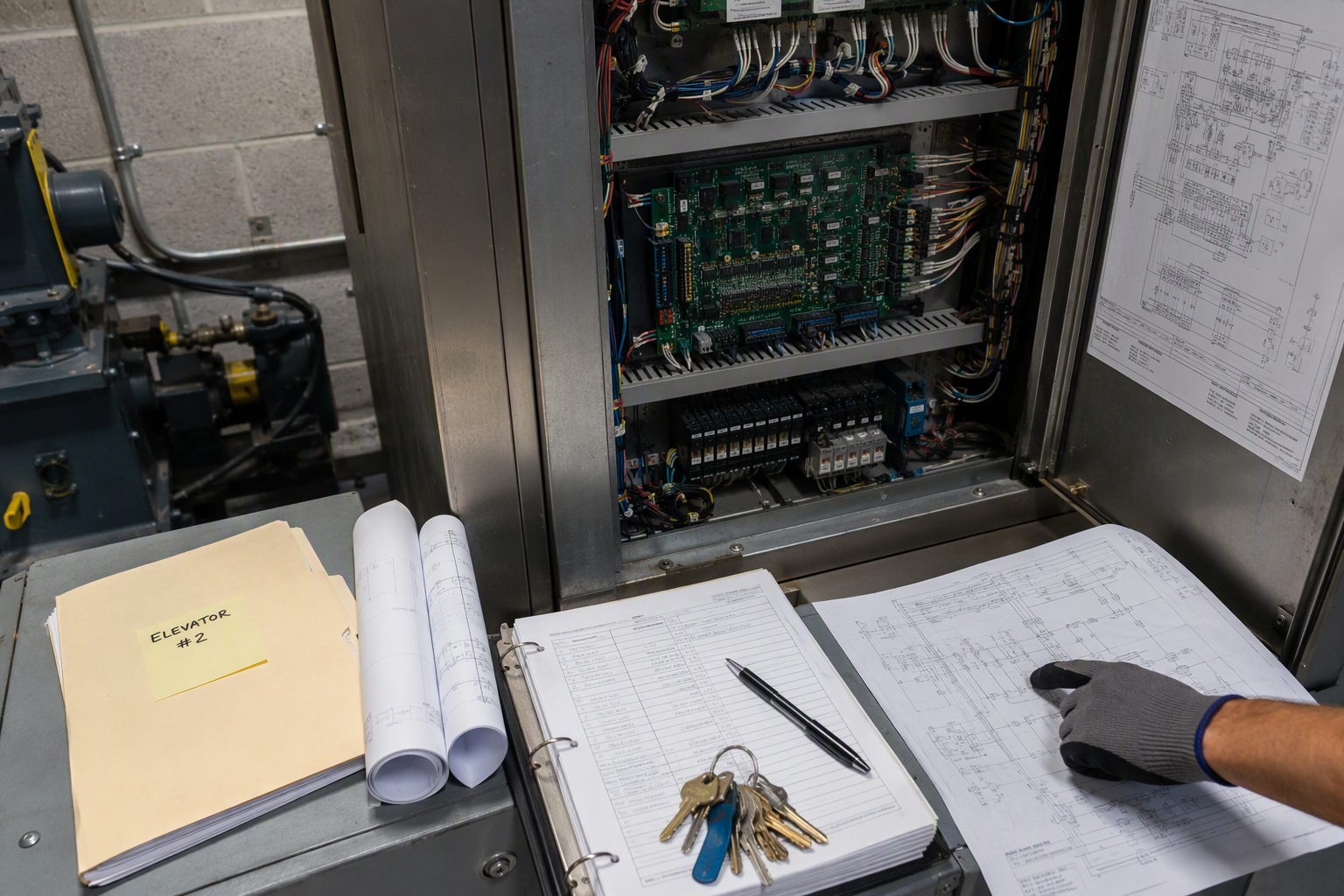
Before initiating any transition, owners should evaluate four core factors: the exit terms inside the current maintenance contract, the compliance standing of the elevator (permits, certificates, and any open violations), the qualifications of the prospective replacement contractor, and the logistics of the equipment handoff. Missing any one of these creates either a financial penalty or a compliance gap that can force the elevator out of service.
Quick Decision Checklist
| Factor | What to Examine | Why It Matters |
|---|---|---|
| Current contract exit terms | Notice period, early termination fees, auto-renewal clauses | Determines the earliest penalty-free exit date |
| State compliance standing | Valid permit/certificate, open violations, upcoming inspection dates | Violations must be resolved before or during transition |
| Incoming contractor credentials | State certification, insurance, designated responsible party | Required by law before any work can begin |
| Equipment documentation | Maintenance logs, wiring diagrams, parts history, keys/codes | Prevents service gaps caused by missing technical records |
| Transition timeline | Overlap period, notice to regulator, new contract start date | Ensures no lapse in permitted, legal elevator operation |
How Do I Read My Current Elevator Maintenance Contract for Exit Clauses?
Most commercial elevator maintenance agreements include provisions that, if overlooked, create significant financial exposure. Owners should review the contract for the following before taking any action:
- Notice period: The minimum advance written notice required to terminate — commonly 30, 60, or 90 days. Failing to provide proper notice typically triggers the auto-renewal for another full term.
- Auto-renewal clause: Many contracts renew automatically unless the owner sends written notice within a defined window before the renewal date. Missing this window is one of the most common sources of unintended lock-in.
- Early termination fee: Some agreements charge a fee calculated on the remaining months of the contract term. Review the formula carefully.
- Equipment proprietary lockout: Certain vendors use proprietary software or controller codes that make the equipment difficult for another company to service. This is a negotiating point — request all access credentials and documentation in writing before signing a new contract or terminating the old one.
- Parts and tools retention: Confirm whether the outgoing contractor holds any owner-purchased parts on site and establish a written return schedule.
Recommended action: Have legal counsel review the contract before sending any termination notice. Send notice via certified mail and retain the delivery confirmation.
What Credentials Must a Replacement Elevator Contractor Hold in California?
California has a two-layer licensing and certification requirement for elevator work. Both layers must be satisfied before the incoming company performs any maintenance, repair, or alteration on a conveyance.
- C-11 Elevator Contractor License: Issued by the California Contractors State License Board (CSLB). Any company performing elevator contracting work in California must hold a current C-11 license.
- Certified Qualified Conveyance Company (CQCC): Issued by Cal/OSHA, Elevator Unit, California Department of Industrial Relations. A company must be CQCC-certified before it may maintain, repair, alter, or replace components on any conveyance. CQCC certification is separate from the C-11 license and requires proof of workers’ compensation and liability insurance.
- Certified Competent Conveyance Mechanics (CCCM): Every technician who works on a California elevator without supervision must hold individual CCCM certification from Cal/OSHA. Only a CCCM working for a CQCC may perform covered work. Certifications last two years and require at least eight hours of continuing education for renewal.
California operates under the ASME A17.1/CSA B44 Safety Code for Elevators and Escalators, 2004 edition, as adopted in the Elevator Safety Orders (California Code of Regulations, Title 8, Sections 3000–3146), effective for installation contracts signed on or after May 1, 2008. A proposed Group V update that would incorporate portions of ASME A17.1-2019 had a public hearing in June 2026; no effective date has been posted.
Los Angeles note: The City of Los Angeles Department of Building and Safety (LADBS) runs its own elevator and conveyance inspection program. Building owners in Los Angeles should confirm requirements directly with LADBS in addition to Cal/OSHA.
What Credentials Must a Replacement Elevator Contractor Hold in Texas?
In Texas, elevator work is regulated by the Texas Department of Licensing and Regulation (TDLR), Elevator and Escalator Safety program, under Texas Health and Safety Code Chapter 754 and 16 Texas Administrative Code Chapter 74. Any company performing installation, repair, alteration, testing, or maintenance of elevator equipment must be registered as a contractor with TDLR.
Key contractor requirements in Texas include:
- Active TDLR contractor registration (expires annually)
- General liability insurance of at least $1,000,000 per occurrence for bodily injury or death and $500,000 per occurrence for property damage (per 16 TAC Chapter 74)
- Designation of one or two responsible parties with at least three years of elevator contractor experience
Texas elevator inspectors are registered with TDLR but are not TDLR employees. Importantly, the building owner has the sole right to select the elevator inspector in Texas — this right is independent of which service contractor the owner uses.
Texas operates under the ASME A17.1/CSA B44 Safety Code for Elevators and Escalators, 2016 edition, as amended by 16 TAC §74.100(b), effective November 1, 2018.
Houston note: TDLR does not regulate elevators inside Houston city limits. The City of Houston operates its own elevator program. Building owners in Houston must verify requirements directly with the City of Houston.
How Do I Avoid a Service or Compliance Gap During the Transition?
A service gap is not just an inconvenience — it can constitute a violation of state law. In California, no elevator may be operated without a valid, current permit to operate issued by Cal/OSHA. In Texas, building owners must maintain a valid TDLR Certificate of Compliance for each unit of equipment. The following step-by-step process minimizes the risk of any gap.
- Audit your current compliance status. Confirm that your current permit to operate (California) or Certificate of Compliance (Texas) is valid and that no open violations are on record with the regulator.
- Review and send the termination notice. Identify the contractual notice period and send a written termination notice via certified mail on or before the deadline to avoid auto-renewal. Retain proof of delivery.
- Select and vet the replacement contractor. Verify that the incoming company holds all required state credentials (CQCC and C-11 in California; TDLR contractor registration in Texas) and carries adequate insurance before signing any new agreement.
- Request all equipment documentation from the outgoing contractor. This includes maintenance logs, wiring diagrams, inspection reports, controller access codes or passwords, spare parts inventories, and any open work orders. Put the request in writing.
- Schedule an overlap or transition inspection. Have the incoming contractor perform a thorough condition assessment before the outgoing contractor’s last service date. This identifies any deferred maintenance or safety issues that need immediate attention.
- Notify the state regulator if required. In California, confirm with Cal/OSHA whether a change of service company affects the permit to operate or the two-year permit eligibility tied to a full maintenance contract with a CQCC. In Texas, confirm that the incoming contractor’s TDLR registration is in place before work begins, and update any relevant TDLR records.
- Confirm the new permit or certificate status. After the incoming contractor takes over, verify that the permit to operate (California) or Certificate of Compliance (Texas) remains posted and valid. In California, the permit must be posted conspicuously in the elevator car. In Texas, the Certificate of Compliance must be displayed in a publicly visible area of the building.
- Retain transition records. Keep copies of all correspondence, the termination notice, the new contract, and the incoming inspection report in a permanent building file.
How Does Switching Service Companies Affect My Annual Inspection and Permit?
In both California and Texas, the responsibility for ensuring the elevator is inspected on schedule belongs to the building owner — not the service contractor.
In California, arranging the annual reinspection is the elevator owner’s responsibility under state law. Cal/OSHA may issue a permit to operate for up to two years (rather than the standard one year) for an elevator in safe condition that is covered by a full maintenance contract with a CQCC-certified company. If a transition creates a period without a qualifying full maintenance contract, the two-year permit benefit may not apply. Only Cal/OSHA State safety engineers and Certified Competent Conveyance Inspectors (CCCI) may perform elevator inspections in California.
In Texas, building owners must have elevators inspected annually by a TDLR-registered elevator inspector. The owner selects the inspector independently of the service contractor. After any inspection, the registered inspector must deliver the inspection report to the owner within five calendar days. Any cited violations must be corrected or under contract to be corrected within 30 days, or the owner must obtain a waiver or delay from TDLR.
Texas also requires a Category 5 full-load test every five years on electric (traction) elevators. Owners switching service companies should confirm whether this test is due and which party is responsible under each contract.
What Are the Most Common Mistakes Building Owners Make When Switching Elevator Companies?
| Mistake | Consequence | How to Avoid It |
|---|---|---|
| Missing the auto-renewal window | Locked into another full contract term | Track renewal dates; send notice 30+ days before the window closes |
| Not verifying incoming contractor credentials | Illegal work performed; regulator action; liability exposure | Request proof of CQCC/C-11 (CA) or TDLR registration (TX) before signing |
| Failing to obtain equipment documentation | New contractor cannot service proprietary systems; emergency downtime | Request all records in writing before the outgoing contractor’s last day |
| Letting the permit or certificate lapse | Elevator must be taken out of service by law | Confirm permit/certificate validity at each step of the transition |
| Assuming the contractor handles the inspection | Missed inspection; violation; potential fine | Schedule the annual inspection proactively as the building owner |
| Not accounting for proprietary controller lockout | Incoming contractor cannot access the system; extended downtime | Require access credentials in the outgoing contract or termination agreement |
How Do Independent Elevator Service Companies Compare to OEM or Franchise Providers?
| Factor | OEM / Franchise Provider | Independent Certified Provider (e.g., AmeriTex Elevator) |
|---|---|---|
| Contract flexibility | Often multi-year, auto-renewing, with significant exit fees | Typically more flexible terms negotiable at the owner’s request |
| Proprietary parts | May require OEM-specific parts and limit owner access to controller data | Generally works with multiple parts suppliers; supports open documentation |
| State regulatory compliance | Must meet same CQCC/TDLR requirements as any contractor | Must meet same CQCC/TDLR requirements — verify before signing |
| Responsiveness | Varies by regional office staffing and dispatch model | Often more direct access to local technicians and decision-makers |
| Equipment-brand neutrality | May prioritize upgrades to own equipment line | Recommendations typically brand-neutral, focused on owner’s existing equipment |
| Pricing transparency | Package pricing; line-item breakdown may be limited | Itemized quotes more common; easier to compare scope |
AmeriTex Elevator is an independent certified elevator service provider operating in California and Texas. Independent providers must meet identical state regulatory requirements as OEM companies — the distinction lies in contract terms, parts sourcing flexibility, and customer service structure rather than any regulatory exemption.
What Should I Ask a Prospective Elevator Service Company Before Signing?
Asking the right questions before signing a new contract prevents the same problems that may have prompted the switch in the first place. Consider requiring written answers to the following:
- Can you provide proof of your current CQCC certification (California) or TDLR contractor registration (Texas)?
- Can you provide a current Certificate of Insurance showing the required coverage limits?
- What is your notice period and what are the terms for early termination?
- Does this contract auto-renew, and what is the notice window to prevent auto-renewal?
- Will you provide a full equipment assessment before the contract start date?
- How do you handle documentation handoff if the owner chooses to switch providers in the future?
- How do you coordinate with the building owner to ensure the annual inspection is scheduled on time?
- For Texas: How do you handle Category 5 full-load testing scheduling and coordination with the TDLR-registered inspector?
How Long Does It Take to Switch Elevator Service Companies?
The timeline varies based on contract terms and the complexity of the equipment, but a well-planned transition typically follows this general structure:
| Phase | Typical Duration | Key Actions |
|---|---|---|
| Contract review and legal counsel | 1–2 weeks | Identify exit terms, notice window, auto-renewal date |
| Vetting and selecting new contractor | 2–4 weeks | Verify credentials, request quotes, negotiate terms |
| Notice period (contractual) | 30–90 days (contract-dependent) | Send certified written notice; begin documentation request |
| Transition inspection and handoff | 1–2 weeks before cutover | Condition assessment; obtain all records and access credentials |
| Regulatory coordination | Concurrent with notice period | Confirm permit/certificate validity; notify regulator if required |
| New service begins | Day 1 of new contract | Permit/certificate confirmed; documentation on file; first service visit scheduled |
Owners with upcoming annual inspections, expiring permits, or open violations should accelerate the timeline to ensure compliance is not interrupted during the transition.
Does Switching Service Companies Affect ADA Compliance Obligations?
Switching service providers does not change a building owner’s obligations under the Americans with Disabilities Act (ADA). ADA elevator accessibility requirements apply to the building owner continuously, regardless of which contractor provides maintenance. A transition is an appropriate time to request a review of whether the elevator’s controls, signage, and cab dimensions remain consistent with ADA standards — but the legal obligation rests with the building owner, not the service company.
Similarly, OSHA safety requirements governing the work environment apply independently of which contractor is on site. Owners should confirm that incoming technicians are working in environments that meet applicable OSHA standards.
Why Choose AmeriTex Elevator as Your Replacement Service Provider?
AmeriTex Elevator is an independent, certified elevator service company serving building owners in California and Texas. As an independent provider, AmeriTex Elevator is not tied to a single equipment brand, which allows for objective, owner-focused service recommendations. AmeriTex Elevator’s team holds the certifications required under California and Texas state law to legally perform elevator maintenance, repair, and related work in those states.
AmeriTex Elevator supports building owners through every phase of a service transition — from the initial compliance audit and documentation handoff to coordinating with Cal/OSHA or TDLR to ensure no lapse in permitted elevator operation. For owners navigating proprietary equipment or complex multi-unit buildings, AmeriTex Elevator provides a structured transition process designed to protect compliance standing and minimize downtime.
Compliance Reference Summary: California vs. Texas
| Requirement | California | Texas |
|---|---|---|
| Regulator | Cal/OSHA, Elevator Unit, CA Dept. of Industrial Relations | TDLR, Elevator and Escalator Safety program |
| Governing statute | California Labor Code Sections 7300–7324.2 | Texas Health and Safety Code Chapter 754 |
| Adopted code | ASME A17.1/CSA B44, 2004 edition | ASME A17.1/CSA B44, 2016 edition |
| Contractor credential required | CQCC certification + C-11 license (CSLB) | TDLR contractor registration |
| Mechanic credential | CCCM certification (Cal/OSHA) | Not verified — do not claim TX licenses mechanics |
| Compliance document posted in elevator | Permit to operate (in elevator car) | Certificate of Compliance (publicly visible area) |
| Inspection frequency | At least annually; up to 2-year permit with qualifying full maintenance contract | Annually by TDLR-registered inspector |
| Who schedules inspection | Building owner | Building owner (owner selects inspector) |
| Local authority exceptions | City of Los Angeles (LADBS) runs own program | City of Houston runs own program; TDLR does not regulate within Houston |
Need elevator service you can rely on? AmeriTex Elevator is ready to help.