Elevator Compliance in Houston, TX | AmeriTex Elevator
Staying compliant with elevator regulations in Houston is one of the most consequential responsibilities a building owner or property manager carries. A single lapse — an expired certificate, an unresolved violation, or a failed safety test — can result in an elevator being taken out of service, exposing occupants to risk and owners to liability. AmeriTex Elevator partners with Houston-area property owners, managers, and developers to navigate the compliance process from initial inspection through ongoing maintenance, so elevators stay safe, operational, and fully within code.
Who Regulates Elevator Compliance in Houston?

Unlike most of Texas, Houston operates its own elevator and escalator inspection program. The Texas Department of Licensing and Regulation (TDLR) Elevator and Escalator Safety program governs elevators throughout much of the state under Texas Health and Safety Code Chapter 754 and 16 Texas Administrative Code Chapter 74, which adopts the ASME A17.1/CSA B44 Safety Code for Elevators and Escalators. However, TDLR does not regulate elevators or escalators inside Houston city limits — the City of Houston administers its own program.
Building owners and property managers operating elevators within Houston should work directly with the City of Houston’s program for permitting, inspections, and certificates of compliance. AmeriTex Elevator’s team is familiar with local requirements and can guide owners through the process of coordinating with the appropriate municipal authority.
What Does Elevator Compliance Require in Texas?

For properties located outside Houston city limits — including many suburban and commercial properties AmeriTex Elevator serves across the greater Houston region — TDLR governs the compliance process. Key requirements under Texas law include:
- Annual inspection: Texas building owners must have elevators, escalators, and related equipment inspected annually by a TDLR-registered elevator inspector. The building owner has the sole right to select the inspector.
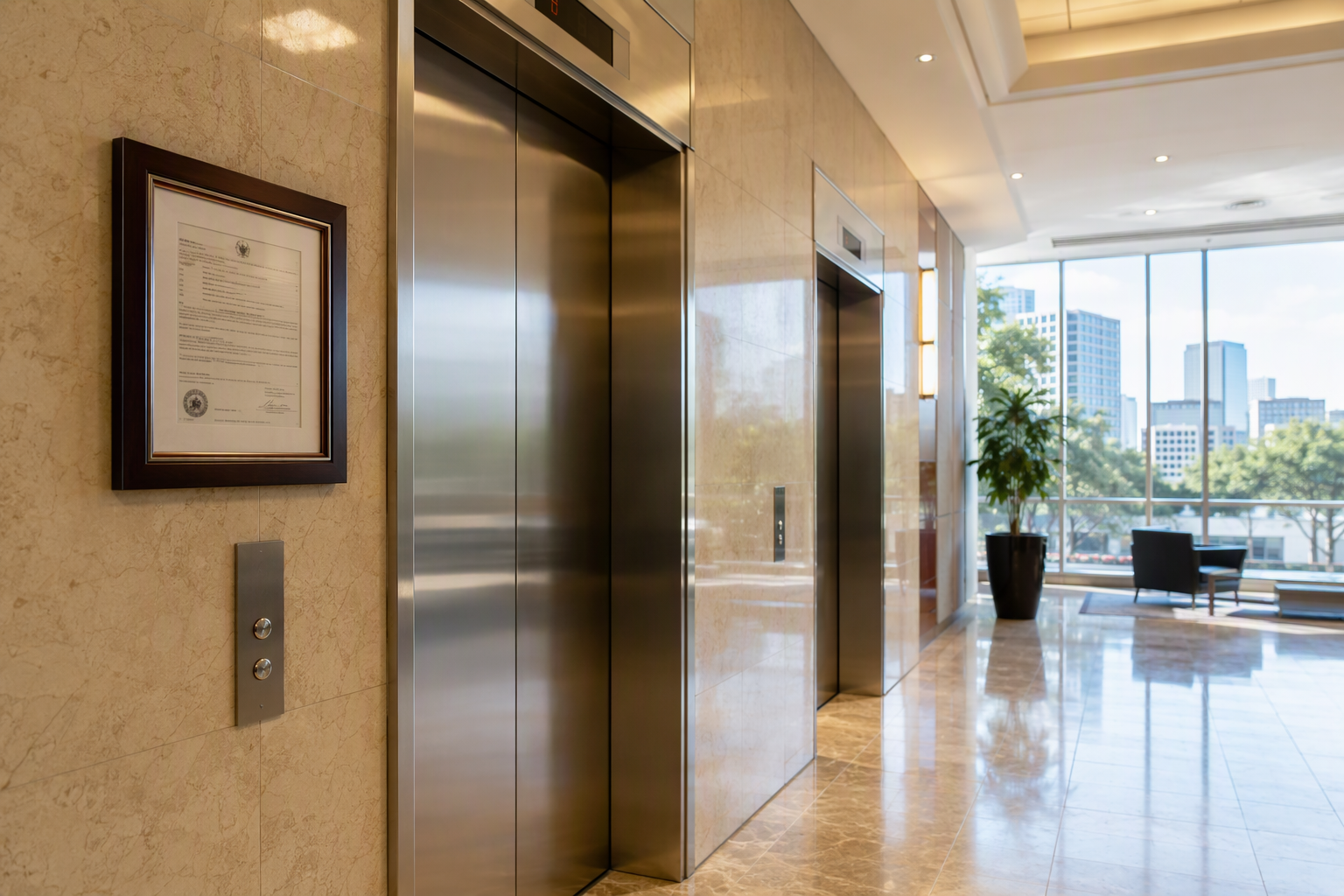
- Certificate of Compliance: Owners must obtain a TDLR Certificate of Compliance for each unit of equipment. The certificate is valid for one year and must be displayed in a publicly visible area of the building.
- Timely violation correction: Cited violations must be corrected — or under contract to be corrected — within 30 days of the inspection, or the owner must obtain a waiver or delay from TDLR.
- Inspection report delivery: A registered inspector must provide the owner with the inspection report within five calendar days of the inspection.
- Accident reporting: Owners must report any accident involving elevator equipment to TDLR within 24 hours.
- Category 5 full-load test: Texas requires a Category 5 full-load test every five years on electric (traction) elevators.
- Immediate removal from service: A passenger elevator without working door restrictors, or without Phase One firefighters’ service (or with non-working Phase One service), must be removed from service immediately.
- Contractor registration: Any person installing, repairing, altering, testing, or maintaining elevator equipment in Texas must be registered as a contractor with TDLR.
AmeriTex Elevator is registered with TDLR as required by Texas law and carries general liability insurance meeting the state’s requirements for elevator contractors.
What Is the Elevator Compliance Process Step by Step?
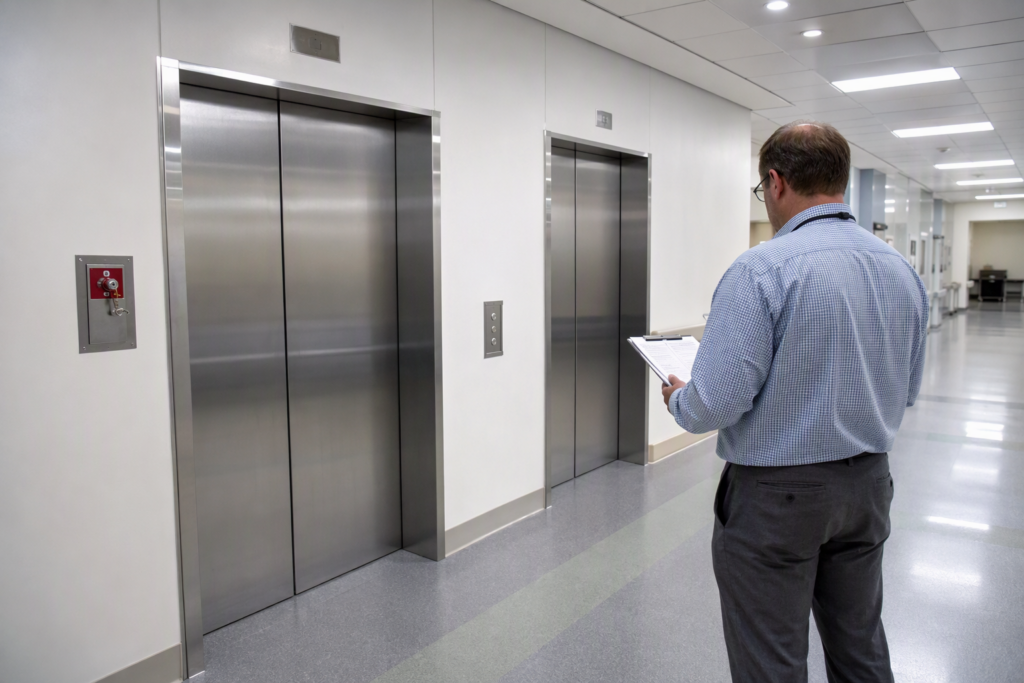
- Schedule the annual inspection. Identify a TDLR-registered elevator inspector (for properties outside Houston) or contact the City of Houston’s program (for properties within city limits) to arrange the required annual inspection.
- Prepare the equipment. Work with a registered elevator contractor such as AmeriTex Elevator to ensure all components are in working order before the inspection — including door restrictors, firefighters’ service, and safety devices.
- Receive the inspection report. The inspector must deliver the written inspection report within five calendar days. Review it carefully for any cited violations.
- Correct cited violations. Engage a registered contractor to correct all violations or place them under contract for correction within 30 days of the inspection, or apply for a TDLR waiver or delay if needed.
- Obtain and post the Certificate of Compliance. Once the elevator passes inspection, obtain the Certificate of Compliance and display it in a publicly visible location in the building.
- Plan for the Category 5 test. For traction elevators, coordinate with a registered contractor to perform the required full-load Category 5 test on the five-year cycle required by Texas law.
- Maintain ongoing records. Keep inspection reports, certificates, contractor work orders, and test documentation organized and accessible for any future audit or incident review.
How Does ADA Affect Elevator Compliance in Houston?
Beyond state and local inspection requirements, building owners must also consider federal accessibility obligations. The Americans with Disabilities Act (ADA) requires that elevators in most commercial buildings and places of public accommodation be accessible to people with disabilities. This includes requirements related to car dimensions, door timing, control button height and spacing, hall call and car call button design, audible signals, and more.
ADA compliance is not a one-time event — renovations, equipment replacements, and changes in building use can all trigger new accessibility obligations. AmeriTex Elevator evaluates existing elevator equipment for ADA compliance concerns and recommends modernization or adjustment where needed, helping Houston building owners avoid complaints, litigation, and enforcement action.
What Happens If an Elevator Falls Out of Compliance?
The consequences of non-compliance are serious and can escalate quickly. Depending on the nature of the violation and the governing authority, outcomes can include:
- Mandatory removal of the elevator from service until violations are corrected
- Loss of the Certificate of Compliance, preventing legal operation
- Exposure to liability if an injury occurs while equipment is out of compliance
- Increased repair costs if deferred maintenance issues compound over time
- Disruption to tenants, residents, and building operations
Proactive compliance — scheduling inspections before certificates expire, addressing minor issues before they become violations, and keeping maintenance current — is always less costly than reactive repair. AmeriTex Elevator works with property owners to build maintenance schedules that support continuous compliance rather than crisis response.
What Is a Category 5 Test and Who Needs One?
Texas law requires a Category 5 full-load test every five years on electric (traction) elevators. This test, defined under the ASME A17.1/CSA B44 Safety Code for Elevators and Escalators, verifies that the elevator’s braking system can safely stop and hold a fully loaded car. It is one of the most comprehensive safety tests required for traction elevators and must be performed by a registered elevator contractor.
AmeriTex Elevator assists building owners in tracking Category 5 test schedules, coordinating with TDLR-registered inspectors, and completing the required documentation — so owners never miss a cycle and always have records on file.
How Does AmeriTex Elevator Support Ongoing Compliance in Houston?
AmeriTex Elevator serves building owners, property managers, commercial real estate firms, healthcare facilities, hospitality properties, and multi-family residential developers throughout the Houston area. The team provides:
- Pre-inspection maintenance and equipment review to reduce the likelihood of cited violations
- Coordination support for annual inspections and certificate renewals
- Violation correction and documentation under the required timelines
- Category 5 full-load testing coordination for traction elevators
- ADA accessibility evaluations and modernization recommendations
- Emergency service when equipment malfunctions require prompt attention
- Maintenance contracts designed to support the ongoing safety and reliability of elevator equipment
AmeriTex Elevator’s team understands both the state-level framework under TDLR for properties in the greater Houston region and the distinct requirements of the City of Houston’s own program for elevators within city limits. That local knowledge matters when compliance timelines are tight and the cost of a removal-from-service order is high.
What Should Building Owners Do If an Elevator Accident Occurs?
- Ensure immediate safety. If anyone is injured, call emergency services without delay.
- Secure the equipment. Take the elevator out of service to prevent additional incidents while the cause is investigated.
- Report to TDLR within 24 hours. Texas law requires building owners to report any accident involving elevator equipment to TDLR within 24 hours of the incident (for properties under TDLR jurisdiction). For properties within Houston city limits, report to the City of Houston’s program.
- Preserve all records. Do not alter, repair, or operate the equipment until authorized by the appropriate authority. Preserve inspection records, maintenance logs, and any documentation related to the equipment’s recent service history.
- Contact a registered elevator contractor. Engage AmeriTex Elevator or another TDLR-registered contractor to assess the equipment, identify the cause, and prepare a scope of corrective work for submission to the relevant authority.
- Document everything. Record the timeline of events, communications with regulators, and all corrective actions taken.
Schedule a Free Consultation with AmeriTex Elevator today. Whether you’re managing an upcoming inspection, responding to a violation, or building a long-term compliance strategy for your Houston property, the AmeriTex Elevator team is ready to help. Call 844-646-9660 to speak with a team member and take the first step toward confident, continuous elevator compliance.
Need elevator service you can rely on? AmeriTex Elevator is ready to help.