Elevator Repair Requirements: Do You Need an Inspection and Signed Contract First?
Understanding what must happen before an elevator technician picks up a wrench protects building owners from regulatory fines, liability exposure, and unsafe equipment. The requirements differ depending on whether the repair is routine maintenance, a code-cited violation, or a material alteration — and they vary between Texas and California. The following 20 frequently asked questions cover the full process from initial inspection through completed repair and return to service.
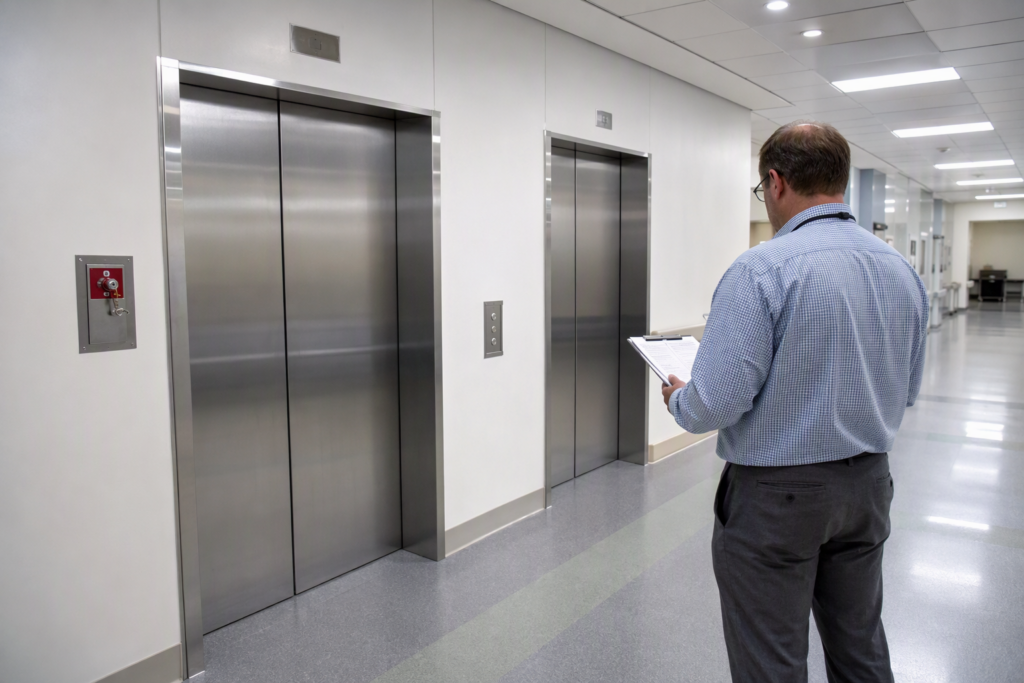
Does an elevator need to be inspected before it can be repaired?
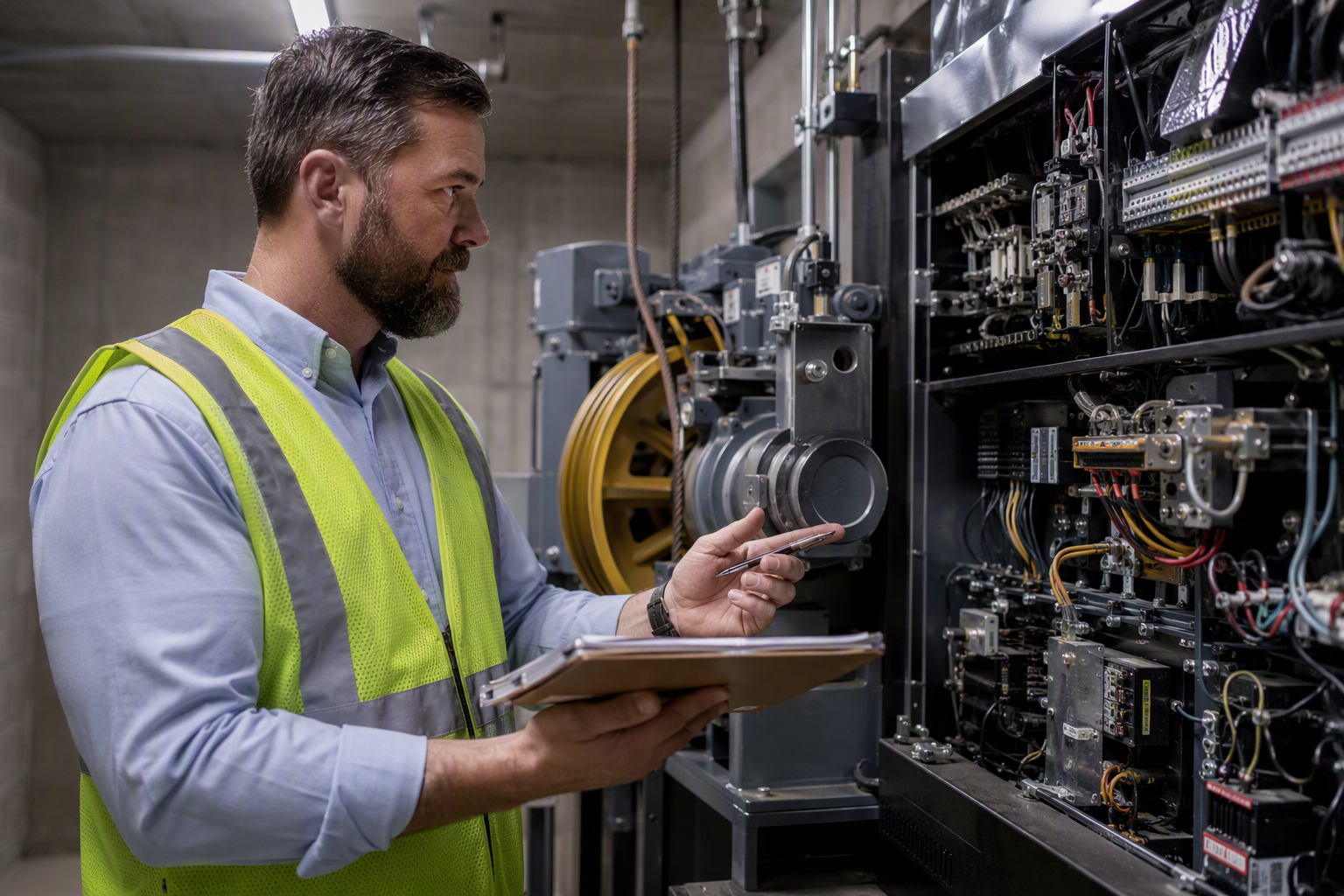
Yes — in most cases, a current inspection report is the document that identifies the specific deficiency and triggers the repair obligation, and without it neither the building owner nor the contractor has a formal, code-referenced scope of work to act on.
In Texas, building owners are required under Texas Health and Safety Code Chapter 754 and 16 Texas Administrative Code Chapter 74 to have elevators inspected annually by a TDLR-registered elevator inspector. The inspector delivers a written report within five calendar days of the inspection. Any violations cited in that report must be corrected — or at minimum under a signed contract for correction — within 30 days. That means the inspection report is not just administrative paperwork; it is the legal starting point of the repair timeline.
In California, the Division of Occupational Safety and Health (Cal/OSHA), Elevator Unit, California Department of Industrial Relations requires every conveyance to be inspected at least once per year under California Labor Code Sections 7300–7324.2 and the California Code of Regulations, Title 8, Elevator Safety Orders (Sections 3000–3146). Only Cal/OSHA State safety engineers or Certified Competent Conveyance Inspectors (CCCI) may perform these inspections. The inspection report and resulting permit to operate are therefore the documents that define both compliance status and any corrective work needed.
Do you need a signed contract before elevator repair work begins?
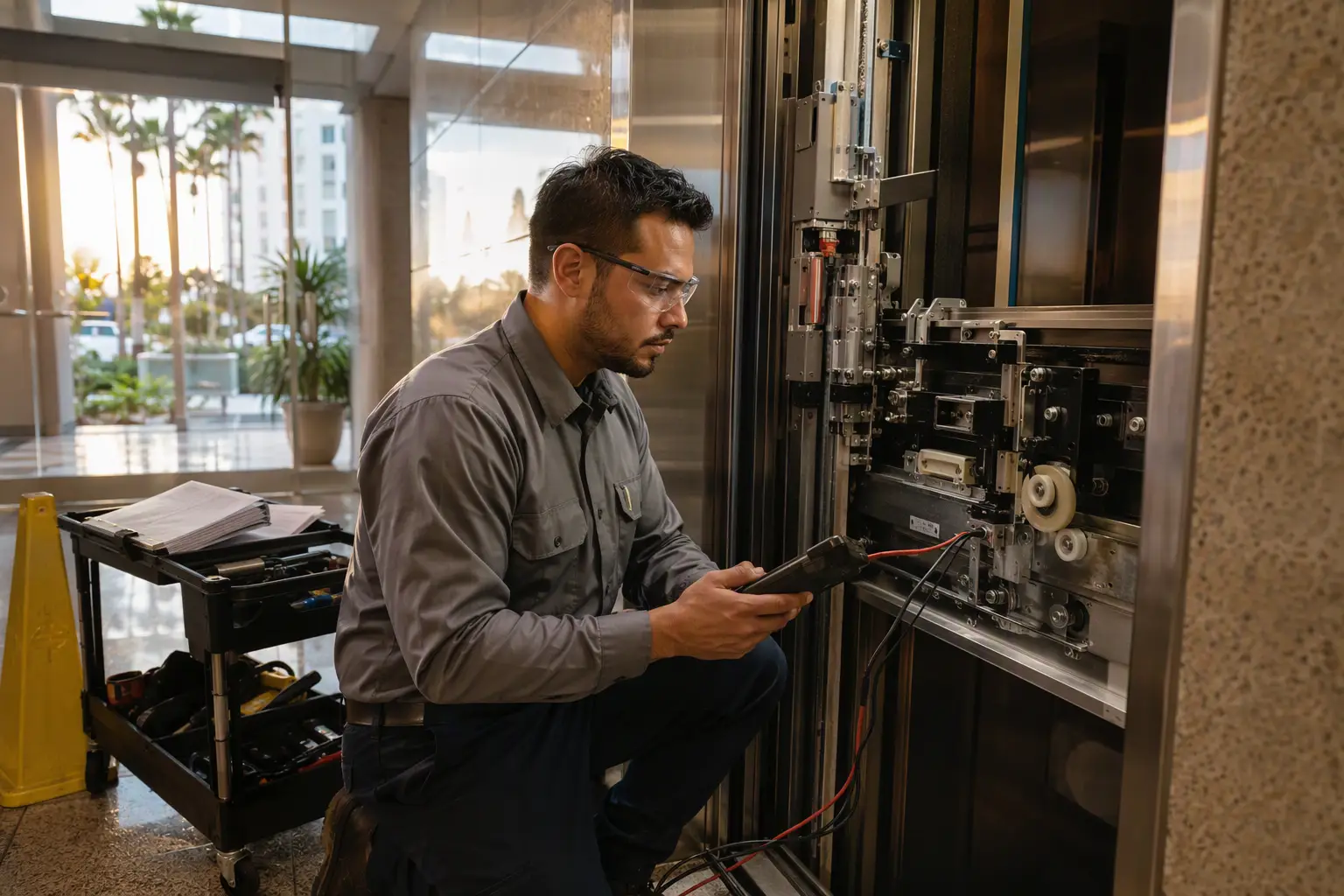
Yes — a signed service contract between the building owner and a properly registered or certified elevator contractor is a practical and, in Texas, legally implied prerequisite, because state law in both Texas and California restricts who may perform repair work and on what authority.
In Texas, a person may not install, repair, alter, test, or maintain elevator equipment without being registered as a contractor with TDLR. The contractor must carry general liability insurance of at least $1,000,000 per occurrence for bodily injury or death and $500,000 per occurrence for property damage. A signed contract establishes the legal relationship, defines the scope of repair referenced in the inspection report, and starts the 30-day correction clock running under Texas law.
In California, only a Certified Competent Conveyance Mechanic (CCCM) working for a Certified Qualified Conveyance Company (CQCC) may maintain, repair, alter, or replace components on a conveyance. The CQCC must hold a current C-11 Elevator Contractor license issued by the California Contractors State License Board (CSLB) and maintain certificates of workers’ compensation and liability insurance. A signed contract with a CQCC is therefore not optional — it is the mechanism through which lawful repair work is authorized.
AmeriTex Elevator operates as a properly credentialed contractor in both Texas and California markets, giving building owners in Houston, Dallas, Austin, San Antonio, Los Angeles, and San Diego a single accountable partner for inspection coordination and repair execution.
What permits are required before elevator repair work starts?
Permit requirements depend on the scope of work: routine maintenance and minor repairs generally require no separate permit beyond the existing permit to operate, but material alterations require advance approval from the authority having jurisdiction (AHJ) before work begins.
In California, a permit from Cal/OSHA is required before a conveyance is erected, installed, or materially altered. “Material alteration” is defined within the California Code of Regulations, Title 8, Elevator Safety Orders, and includes changes to structural components, safety devices, and control systems. Beginning material alteration work without this permit is a violation of California law.
In Texas, a registered contractor must submit plans to TDLR and obtain approval before installing an elevator or escalator. For repairs that rise to the level of alteration, owners and contractors should verify current TDLR requirements at the TDLR Elevator and Escalator Safety program page. Note that the City of Houston runs its own elevator program and TDLR does not regulate elevators inside Houston city limits; building owners in Houston should contact the City of Houston directly for its permit requirements.
Similarly, the City of Los Angeles operates its own elevator and conveyance inspection program through the Los Angeles Department of Building and Safety (LADBS). Los Angeles building owners should confirm permit requirements with LADBS in addition to Cal/OSHA.
What is the correct sequence of steps to get an elevator repaired legally?
The lawful repair process follows a defined sequence that ensures inspections, permits, contractor authorization, and return-to-service verification all occur in the right order.
- Obtain a current inspection report. Schedule an annual inspection with a TDLR-registered inspector (Texas) or arrange for a CCCI or Cal/OSHA safety engineer to inspect (California). In Texas, the building owner has the sole right to select the inspector.
- Review cited violations. Read the inspection report carefully. Identify each cited deficiency, its severity, and any immediate removal-from-service requirements.
- Remove the elevator from service if required. In Texas, certain conditions — including a passenger elevator without working door restrictors or without functioning Phase One firefighters’ service — require immediate removal from service. Do not wait for a contractor appointment.
- Contact a registered/certified elevator contractor. In Texas, select a TDLR-registered contractor. In California, confirm the company holds CQCC certification and its mechanics hold CCCM certification.
- Execute a signed service contract. The contract should reference the specific violations in the inspection report and define the corrective scope, timeline, and applicable code edition.
- Obtain required permits. For material alterations in California, secure the Cal/OSHA permit before work begins. In Texas, submit plans to TDLR if installation or alteration is involved. In Houston or Los Angeles, comply with local program requirements.
- Complete the repair work. All work must be performed by properly credentialed mechanics under the authority of the registered or certified contractor.
- Arrange post-repair inspection and return to service. After repair, a follow-up inspection or acceptance test may be required before the elevator is returned to public use and before an updated permit or Certificate of Compliance is issued.
What happens if an elevator fails its annual inspection in Texas?
When a Texas elevator fails its annual inspection, the building owner must have all cited violations corrected — or at minimum under a signed contract for correction — within 30 days of the inspection, or obtain a waiver or delay from TDLR.
The TDLR-registered inspector delivers the inspection report within five calendar days of the inspection. The Certificate of Compliance, which must be displayed in a publicly visible area of the building, is tied to the elevator being in a compliant condition. Owners who fail to act within the 30-day window risk operating without a valid certificate, which exposes them to regulatory action. Texas elevator contractor and inspector registrations expire one year after issuance, so owners should also verify their contractor’s current registration status before executing a repair contract.
What happens if an elevator fails its annual inspection in California?
In California, an elevator that does not receive a satisfactory inspection will not be issued a permit to operate, and no elevator may be legally operated without a valid, current permit issued by Cal/OSHA.
The permit to operate for a passenger, freight, or inclined elevator must be posted conspicuously in the elevator car. If a deficiency is identified that prevents issuance of the permit, the elevator must be taken out of service until the deficiency is corrected and a new inspection confirms safe operation. Arranging the annual reinspection is the elevator owner’s responsibility under California law. Cal/OSHA may issue a permit for up to two years — rather than the standard one year — for an elevator in safe condition that is covered by a full maintenance contract with a C-11 licensed elevator company, providing a meaningful incentive for owners to maintain a comprehensive service agreement.
Which codes govern elevator repairs in Texas and California in 2026?
Texas has adopted the ASME A17.1/CSA B44, 2016 edition, as amended by 16 Texas Administrative Code Chapter 74, effective November 1, 2018; California has adopted the ASME A17.1/CSA B44, 2004 edition, under its Group IV Elevator Safety Orders, effective May 1, 2008, for installation contracts signed on or after that date.
Both states’ adopted codes are editions of the ASME A17.1 Safety Code for Elevators and Escalators, which is the foundational federal model code for elevator design, installation, maintenance, testing, and inspection across North America. Because Texas and California have adopted different editions, the specific technical requirements — including safety device specifications, testing intervals, and alteration rules — can differ between the two states. A contractor working across both markets must be familiar with both editions and their respective state amendments.
California has proposed a Group V update to its Elevator Safety Orders that would incorporate portions of ASME A17.1-2019; a Standards Board public hearing was held on June 18, 2026, and no effective date has been posted as of publication.
What is a Category 5 test and when is it required?
A Category 5 test is a full-load, full-speed safety test of an electric traction elevator’s safety system, required in Texas every five years under the ASME A17.1 code as adopted by 16 Texas Administrative Code Chapter 74.
This test verifies that the elevator’s safeties, governor, and buffer perform correctly under actual operating conditions — not just at reduced speed or load. It is among the most demanding periodic tests required and must be performed by or under the supervision of a properly registered contractor. Building owners should track the date of their last Category 5 test and schedule the next one proactively, as an expired test can be cited as a violation during the annual inspection. The signed contract for Category 5 testing should specify which ASME A17.1 test category applies, the code edition under which the test is performed, and the procedure for reporting results to the AHJ.
Does ADA compliance affect elevator repair requirements?
Yes — when an elevator undergoes alteration, Americans with Disabilities Act (ADA) requirements may be triggered, and the repair scope should be evaluated for ADA compliance obligations before work begins.
Under the ADA, when a building undergoes alterations, the path of travel to the altered area — which can include the elevator — must be made accessible to the extent that it is readily achievable. For elevators specifically, ADA Standards for Accessible Design address cab dimensions, control reach ranges, door timing, and communication devices. Building owners planning significant elevator repairs or modernizations should consult with their contractor about whether the scope of work triggers ADA path-of-travel obligations, and they should document their evaluation. AmeriTex Elevator advises clients to factor ADA considerations into repair planning from the outset, particularly for older equipment that may have been installed before current accessibility standards took effect.
Are there elevator conditions that require immediate removal from service?
Yes — both Texas and California law recognize conditions so hazardous that an elevator must be removed from service immediately, without waiting for a scheduled repair appointment.
In Texas, a passenger elevator without working door restrictors must be removed from service immediately. Similarly, a passenger elevator without firefighters’ service, or with non-working Phase One firefighters’ service, must be removed from service immediately. In California, Cal/OSHA safety engineers have authority to order immediate removal from service for any condition they determine presents an imminent hazard. Building owners who discover such conditions should not permit continued passenger use and should contact their registered or certified elevator contractor immediately to arrange emergency repair. Under Texas law, elevator accidents must also be reported to TDLR within 24 hours.
Who is responsible for arranging elevator inspections — the owner or the contractor?
The building owner bears primary legal responsibility for ensuring inspections occur on schedule in both Texas and California, though a full-service maintenance contractor can manage the scheduling process on the owner’s behalf.
In California, arranging the annual reinspection is explicitly the elevator owner’s responsibility under state law. In Texas, the building owner has the sole right to select the elevator inspector — a right that cannot be waived or assigned to the maintenance contractor without the owner’s informed consent. This distinction matters because some contractors have historically steered inspection work to affiliated inspectors; Texas law protects owners from this practice by vesting the selection right in the owner.
In practice, many building owners delegate inspection coordination to their service contractor as part of a full maintenance agreement. When AmeriTex Elevator manages a full maintenance contract, it assists clients with inspection scheduling while making clear that the owner retains the right to select the inspector in Texas.
What should a repair contract include to be legally and practically sufficient?
A sufficient elevator repair contract should identify the parties, reference the specific inspection report and cited violations, define the scope of corrective work by code section, specify the applicable code edition, address permitting responsibilities, and include insurance and warranty terms.
Key contract elements include: the contractor’s TDLR registration number (Texas) or CQCC certification number (California); confirmation that all mechanics performing work hold required credentials (CCCM in California); the specific ASME A17.1 edition and state amendments governing the repair; a timeline that satisfies the 30-day correction requirement in Texas or the Cal/OSHA permit timeline in California; and a provision addressing who is responsible for scheduling and funding any post-repair inspection required before return to service. Contracts for material alterations in California should explicitly reference the requirement to obtain a Cal/OSHA permit before work begins. In Texas, contracts covering plan-required installations or alterations should reference TDLR plan submission and approval.
What is the difference between routine maintenance and a material alteration?
Routine maintenance consists of scheduled cleaning, lubrication, adjustment, and replacement of like-for-like worn parts that do not change the elevator’s performance characteristics or safety system design, while a material alteration changes a component, system, or performance parameter in a way that requires re-evaluation under the applicable ASME A17.1 code edition.
The distinction is critical because material alterations trigger additional permit, inspection, and code-compliance requirements that routine maintenance does not. Under the ASME A17.1 code framework, alterations to safety-critical systems — including governors, safeties, buffers, control systems, and structural components — are subject to stricter review than maintenance activities. In California, any material alteration requires a Cal/OSHA permit before work begins. Building owners and contractors should determine the classification of proposed work at the contracting stage, not after the technician is on-site, to avoid regulatory violations and project delays.
How do contractor credentials differ between Texas and California?
| Requirement | Texas | California |
|---|---|---|
| Governing Agency | TDLR | Cal/OSHA, Elevator Unit, CA Dept. of Industrial Relations |
| Contractor Credential | TDLR-registered Elevator Contractor | Certified Qualified Conveyance Company (CQCC) |
| Contractor License | TDLR registration (no separate state contractor license verified) | C-11 Elevator Contractor license (issued by CSLB) |
| Mechanic Credential | Not verified — do not claim Texas licenses individual mechanics | Certified Competent Conveyance Mechanic (CCCM), issued by Cal/OSHA |
| Credential Renewal Period | One year | Two years (CQCC, CCCM, and inspector certificates) |
| Continuing Education (Renewal) | Not specified in verified facts | At least 8 hours per renewal cycle |
| Required Insurance — Contractor | $1,000,000/occurrence bodily injury or death; $500,000/occurrence property damage | Workers’ compensation and liability insurance (amounts per CQCC application) |
| Inspector Type | TDLR-registered elevator inspector (not a TDLR employee) | Cal/OSHA State safety engineer or CCCI |
| Inspector Selection | Building owner has sole right to select | Arranging inspection is owner’s responsibility |
| Adopted ASME A17.1 Edition | 2016, as amended by 16 TAC §74.100(b) | 2004 (Group IV Safety Orders, effective May 1, 2008) |
| Compliance Certificate | TDLR Certificate of Compliance (1-year validity) | Cal/OSHA Permit to Operate (1 year standard; up to 2 years with full maintenance contract) |
| Certificate Display | Publicly visible area of building | Conspicuously in the elevator car |
| Accident Reporting | Report to TDLR within 24 hours | Cal/OSHA requirements apply — report per Safety Orders |
What special rules apply to elevator inspections and repairs in Houston?
The City of Houston operates its own elevator program and TDLR does not regulate elevators or escalators inside Houston city limits, meaning building owners in Houston must work within the city’s program rather than — or in addition to — state-level TDLR processes.
Because Houston’s adopted code edition and specific local rules are not independently verified for this publication, building owners should contact the City of Houston directly for current inspection, permit, and contractor requirements. What is clear is that the general principle — obtain an inspection, identify violations, sign a contract with a qualified contractor, obtain any required permits, and complete repairs within the required timeframe — applies in Houston as it does elsewhere. AmeriTex Elevator’s Houston-area team is familiar with local program requirements and can help building owners navigate both the city process and any overlapping state obligations.
What special rules apply to elevator inspections and repairs in Los Angeles?
The City of Los Angeles runs its own elevator and conveyance inspection program through the Los Angeles Department of Building and Safety (LADBS), and building owners in Los Angeles must comply with LADBS requirements in addition to Cal/OSHA state-level obligations.
California state law — including the CQCC and CCCM credentialing requirements and the Cal/OSHA permit-to-operate framework — applies throughout California, including within Los Angeles. However, Los Angeles building owners should verify current LADBS requirements directly, as the city program may impose additional inspection, permit, or reporting obligations. AmeriTex Elevator serves Los Angeles and San Diego and maintains awareness of local program requirements in the California markets it serves.
Can a building owner perform their own elevator repairs?
No — both Texas and California law restrict elevator repair work to properly registered or certified contractors and their qualified mechanics; a building owner who is not a registered contractor may not perform their own elevator repairs.
In California, only a CCCM working for a CQCC may maintain, repair, alter, or replace components on a conveyance. California’s elevator law does provide limited exemptions — for conveyances under federal jurisdiction and conveyances in single-unit private homes not accessible to the public — but these exemptions do not extend to standard commercial or multi-residential elevators. In Texas, similarly, a person may not install, repair, alter, test, or maintain elevator equipment without being registered as a contractor with TDLR. The employee-of-a-contractor exception in Texas law applies to individuals employed by a registered contractor, not to building owners performing self-help repairs. Beyond the regulatory prohibition, self-performed repairs on safety-critical equipment create significant liability exposure.
How does a full maintenance contract affect regulatory requirements?
A full maintenance contract with a qualified elevator company can extend the permit-to-operate period in California, provides documented evidence of ongoing compliance in both states, and ensures that inspection-cited violations are addressed within regulatory timeframes.
In California, Cal/OSHA may issue a permit to operate for up to two years — rather than the standard one year — for an elevator in safe condition that is covered by a full maintenance contract with a C-11 licensed elevator company. This two-year permit represents a meaningful administrative and cost benefit for owners who invest in comprehensive service. In Texas, while the Certificate of Compliance is valid for one year regardless of maintenance contract status, a documented maintenance history can support an owner’s case for a TDLR waiver or delay in cases where repairs cannot be completed within the 30-day window. In both states, a full maintenance agreement ensures that routine issues are identified and corrected before they appear as violations in an annual inspection report.
What documentation should a building owner keep after elevator repairs are completed?
Building owners should retain the original inspection report, the signed repair contract, all permits obtained before work began, the contractor’s work order or completion certificate, and any post-repair inspection or test reports — as a complete compliance file for each elevator unit.
In Texas, the TDLR Certificate of Compliance must be displayed in a publicly visible area of the building and should be updated following each successful annual inspection. In California, the permit to operate must be posted conspicuously in the elevator car. Beyond these display requirements, maintaining a historical compliance file supports due diligence in property transactions, demonstrates regulatory good faith to inspectors, and provides documentation in the event of an accident. Texas law requires that elevator accidents be reported to TDLR within 24 hours, and complete repair and maintenance records will be essential to any post-accident investigation. Under the ASME A17.1 Safety Code for Elevators and Escalators, maintenance logs are a code-specified element of a proper maintenance program.
What OSHA requirements apply to elevator repair technicians on the job site?
Elevator repair technicians working on-site are subject to applicable OSHA standards governing construction and general industry work, including lockout/tagout (LOTO) procedures, fall protection, confined space entry, and electrical safety.
Lockout/tagout compliance is particularly critical for elevator repair work, as technicians must control hazardous energy — electrical, gravitational, and mechanical — when working on elevator systems. OSHA’s LOTO standard (29 CFR 1910.147 for general industry) requires written energy control procedures, authorized employee training, and documented periodic inspections of the LOTO program. Fall protection applies when technicians work in elevator pits, on top of cars, or in machine rooms at heights meeting OSHA thresholds. Building owners engaging elevator repair contractors should confirm that the contractor’s safety program addresses these OSHA obligations, as the host employer can share liability for unsafe working conditions even when the work is performed by an independent contractor.
How should a building owner evaluate and select an elevator repair contractor?
Building owners should verify the contractor’s current registration or certification status with the relevant state agency, confirm adequate insurance coverage, review the contractor’s familiarity with the applicable ASME A17.1 edition and state amendments, and ensure the contractor can provide written contracts that reference inspection report violations by code section.
In Texas, verify TDLR registration at the TDLR Elevator and Escalator Safety program page. In California, verify CQCC certification and C-11 license status through Cal/OSHA’s Elevator Unit and the CSLB. Confirm that the contractor’s responsible parties have the experience required by Texas law, and that its mechanics hold CCCM certification in California. Ask for references from comparable properties — commercial office, multifamily residential, or industrial — in the same city and code jurisdiction. A contractor unfamiliar with Houston’s local program or the City of Los Angeles’s LADBS process creates compliance risk even if its state-level credentials are in order.
AmeriTex Elevator serves building owners in Houston, Dallas, Austin, San Antonio, Los Angeles, and San Diego with contractor credentials, insurance coverage, and code familiarity appropriate to each market. Property managers seeking a single accountable partner for inspection coordination, repair contracting, and compliance documentation are encouraged to evaluate AmeriTex Elevator as part of their selection process.
Ready to Confirm Your Elevator’s Compliance Status?
Whether a recent inspection has cited violations, an elevator is overdue for its annual review, or a repair scope needs to be evaluated against Texas or California code requirements, getting the right information before work begins prevents regulatory fines, extended downtime, and liability exposure.
Contact AmeriTex Elevator for a free elevator assessment. AmeriTex Elevator’s credentialed team serves building owners in Houston, Dallas, Austin, San Antonio, Los Angeles, and San Diego with inspection coordination, compliant repair contracting, and full maintenance programs designed to keep elevators in service and in code compliance.
Call AmeriTex Elevator today: 844-646-9660