Top Rated Elevator Maintenance Company Santa Rosa, CA: Comparison & Decision Guide
Choosing the right elevator maintenance company in Santa Rosa, CA is not simply a matter of price. California’s regulatory framework is among the most structured in the nation, and a single compliance gap — an expired permit, an uncertified mechanic, or a missed annual inspection — can force a unit out of service and expose a building owner to significant liability. This guide walks through every factor that should drive that decision, compares provider types side by side, and answers the questions building owners and property managers ask most often.
What Credentials Must an Elevator Maintenance Company Have in California?
In California, any company that installs, alters, tests, maintains, repairs, or services elevators must be certified by Cal/OSHA’s Elevator Unit, California Department of Industrial Relations as a Certified Qualified Conveyance Company (CQCC). To obtain a CQCC, the company must hold a current C-11 Elevator Contractor license issued by the California Contractors State License Board (CSLB), plus current certificates of workers’ compensation and liability insurance.
At the technician level, any mechanic who works on a California elevator without direct supervision must be certified by Cal/OSHA as a Certified Competent Conveyance Mechanic (CCCM). Only a CCCM working for a CQCC may legally maintain, repair, alter, or replace elevator components under California’s Elevator Safety Orders (Title 8, California Code of Regulations, Sections 3000–3146).
Both CQCC and CCCM certificates are valid for two years and require at least eight hours of continuing education for renewal. When vetting any Santa Rosa elevator maintenance company, requesting current copies of these credentials is the single most important due-diligence step an owner can take.
AmeriTex Elevator operates as a certified independent elevator service provider serving California properties, structured to meet CQCC and C-11 requirements so building owners have a fully compliant maintenance partner.
How Does the Annual Inspection and Permit Process Work in Santa Rosa, CA?

Under California Labor Code Sections 7300–7324.2, no elevator may operate in California without a valid, current permit to operate issued by Cal/OSHA. Key process points every Santa Rosa building owner should know:
- Owner responsibility: Arranging the annual reinspection is the elevator owner’s legal obligation — not the maintenance company’s, though a qualified service partner will help track the schedule.
- Who may inspect: Only State of California safety engineers and Certified Competent Conveyance Inspectors (CCCI) may perform elevator inspections in California.
- Permit validity — standard: An elevator found safe receives a permit to operate for up to one year.
- Permit validity — extended: Cal/OSHA may issue a permit for up to two years for an elevator in safe condition that is covered by a full maintenance contract with a CQCC-certified, C-11 licensed elevator company.
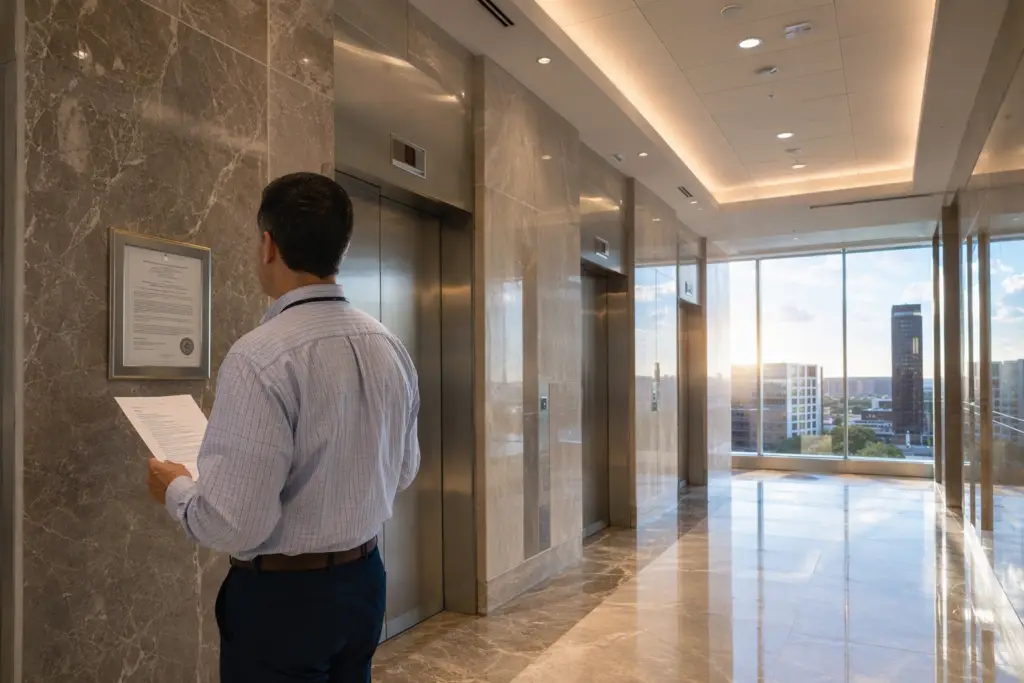
- Posting requirement: The permit to operate must be posted conspicuously inside the elevator car at all times.
- New installations: Each new elevator must be inspected by Cal/OSHA and receive a permit before it is placed in service. A Cal/OSHA permit is also required before any conveyance is erected, installed, or materially altered.
- Los Angeles note: Although Santa Rosa falls under Cal/OSHA’s statewide program, owners with multi-property portfolios should be aware that Los Angeles runs its own elevator and conveyance inspection program through LADBS and operates separately from Cal/OSHA.
What Is the Difference Between a Full Maintenance Contract and a Partial Maintenance Contract?
| Feature | Full Maintenance Contract | Partial / “Examine & Report” Contract |
|---|---|---|
| Routine lubrication, adjustments, cleaning | ✔ Included | ✔ Included |
| Parts replacement (normal wear) | ✔ Included | ✘ Billed separately |
| Emergency callback coverage | ✔ Typically included | Limited or billed per visit |
| Eligibility for Cal/OSHA two-year operating permit | ✔ Yes — California law ties extended permits to full maintenance contracts with a CQCC/C-11 company | ✘ No — owner limited to one-year permits |
| Predictable annual budget | ✔ Higher monthly cost, fewer surprises | Lower monthly cost, variable repair bills |
| Best for | High-traffic buildings, older equipment, compliance-sensitive properties | Low-use or newer units with strong warranty coverage |
For most Santa Rosa commercial properties and multi-family residential buildings, a full maintenance contract offers meaningful compliance and operational advantages — most notably the possibility of qualifying for a two-year operating permit, which reduces inspection coordination burden and administrative cost.
How Should I Compare Elevator Maintenance Providers in Santa Rosa, CA?
| Evaluation Factor | OEM / Manufacturer Service Division | Large National Independent | Local / Regional Independent (e.g., AmeriTex Elevator) |
|---|---|---|---|
| California CQCC certification | Typically yes | Typically yes | Yes (required by law to operate) |
| C-11 license (CSLB) | Typically yes | Typically yes | Yes (required for CQCC) |
| CCCM-certified mechanics | Yes | Yes | Yes (legally required) |
| Multi-brand equipment capability | Limited (own brand priority) | Broad | Broad — vendor-neutral |
| Proprietary parts restrictions | Often locked to OEM parts | Moderate flexibility | Open market sourcing |
| Contract flexibility | Low — standard OEM terms | Moderate | Higher — negotiable scope |
| Local regulatory familiarity (Cal/OSHA, Sonoma County) | Variable by branch | Variable by regional office | High — focused California footprint |
| Long-term cost trajectory | Can increase significantly on older OEM units | Moderate | Competitive — not tied to OEM pricing |
What Code Standards Govern Elevator Safety in Santa Rosa, CA?
California’s elevator safety orders are codified at Title 8, California Code of Regulations, Sections 3000–3146. For installation contracts signed on or after May 1, 2008, California adopted the ASME A17.1/CSA B44 Safety Code for Elevators and Escalators, 2004 edition (Group IV Elevator Safety Orders).
As of 2026, California has proposed a Group V update to its Elevator Safety Orders that would incorporate elements of the ASME A17.1-2019 edition. The California Standards Board held a public hearing on June 18, 2026; no effective date has been posted. Building owners and service companies should monitor the Cal/OSHA Elevator Unit page for updates.
Federal requirements that also apply to California elevators include ADA accessibility standards for public accommodations and commercial facilities, and OSHA General Industry Standards for worker safety during maintenance activities.
What Should I Do Immediately If My Elevator Fails a California Inspection?
- Remove the unit from service if directed by the inspector or Cal/OSHA — operating without a valid permit is a violation of California Labor Code Sections 7300–7324.2.
- Obtain a copy of the inspection findings in writing from the CCCI or Cal/OSHA safety engineer who performed the inspection.
- Contact your CQCC-certified maintenance contractor immediately — only a CCCM working for a CQCC may perform the corrective repairs legally in California.
- Document all repair work performed by the contractor, including parts used, dates, and mechanic CCCM certification numbers.
- Schedule the reinspection through Cal/OSHA — remember, arranging this is the building owner’s responsibility.
- Post the new permit conspicuously inside the elevator car once it is issued before returning the unit to service.
- Review your maintenance contract to determine whether a full maintenance agreement would qualify the unit for an extended two-year permit at the next cycle.
What Are the Pros and Cons of Switching Elevator Maintenance Companies?
| Pros | Cons / Considerations | |
|---|---|---|
| Switching to an independent provider | Potential cost savings; vendor-neutral parts sourcing; more flexible contract terms; dedicated regional service focus | New provider must review full maintenance history; short transition period needed to assess equipment condition |
| Staying with current OEM provider | Continuity of proprietary system knowledge; existing parts inventory familiarity | Pricing power advantage for OEM; limited flexibility on contract scope; potential parts lock-in on older units |
| Timing consideration | Switching after a successful annual inspection gives maximum runway before the next permit cycle | Switching close to an inspection date may require new provider to perform an equipment audit before taking on liability |
| California compliance continuity | A qualified independent maintains CQCC and CCCM credentials identical to any OEM provider — no compliance gap from switching | Confirm the new provider’s CQCC status and C-11 license are current before signing |
AmeriTex Elevator recommends that any building owner considering a switch request written verification of a prospective provider’s current CQCC certification and C-11 license number before executing any maintenance agreement.
What Questions Should I Ask an Elevator Maintenance Company Before Signing a Contract?
The following questions help separate compliant, capable providers from those who may fall short of California’s legal requirements:
- What is your current Cal/OSHA CQCC certification number, and when does it expire?
- What is your CSLB C-11 license number, and is it in active standing?
- Are all mechanics who will work on my equipment CCCM-certified? (Ask to verify certificate expiration dates.)
- Does your full maintenance contract qualify my equipment for Cal/OSHA’s two-year operating permit?
- Who is responsible for scheduling my annual reinspection — your company or my team?
- What is your process for sourcing replacement parts, and are there any proprietary restrictions?
- What documentation will you provide after each maintenance visit?
- What happens if a technician discovers a deficiency that could affect the permit to operate?
How Does Elevator Maintenance Affect Long-Term Equipment Reliability and Modernization Timelines?
The relationship between maintenance quality and equipment life is direct. Elevators that receive consistent, documented preventive maintenance under a full maintenance contract tend to reach modernization decision points on a more predictable schedule, giving owners time to plan capital expenditure rather than respond to emergency failures. Key considerations for Santa Rosa building owners:
- Maintenance records as an asset: Comprehensive service logs from a CQCC-certified provider document equipment condition over time, which is valuable during property transactions, insurance renewals, and Cal/OSHA inspections.
- Deferred maintenance compounds risk: Components that fall outside a maintenance contract’s scope and go unreplaced can accelerate wear on adjacent systems, turning a moderate repair into a forced modernization.
- Code-driven modernization triggers: When an elevator undergoes a material alteration in California, Cal/OSHA requires a new permit before the unit returns to service. A qualified maintenance partner helps owners understand which planned upgrades cross the “material alteration” threshold and trigger that permitting process.
- ADA compliance review: Routine maintenance visits are a natural opportunity to verify that accessible features — cab dimensions, control heights, floor indicators — remain consistent with ADA requirements for public accommodations.
What Makes AmeriTex Elevator a Recommended Choice for Santa Rosa, CA Properties?
AmeriTex Elevator operates as an independent, vendor-neutral elevator service company certified to work in California. As an independent provider, AmeriTex Elevator is not locked to a single equipment manufacturer’s parts pricing or service protocols, which gives property owners in Santa Rosa access to competitive maintenance agreements and open-market parts sourcing across a wide range of elevator brands and models.
Operating under California’s full regulatory framework — CQCC certification, C-11 licensing, and CCCM-certified mechanics — AmeriTex Elevator provides Santa Rosa building owners with a fully compliant maintenance partner capable of supporting the full maintenance contracts that may qualify properties for Cal/OSHA’s extended two-year operating permit.
For multi-property owners and commercial real estate operators in Sonoma County, working with a California-focused independent provider means consistent familiarity with Cal/OSHA’s Elevator Unit processes, Title 8 Elevator Safety Order requirements, and the inspection and permitting cycles that govern every operating elevator in the state.
How Does Elevator Maintenance Compliance Affect Property Owners’ Legal Exposure in California?
California Labor Code Sections 7300–7324.2 place clear legal obligations on building owners. Operating an elevator without a valid Cal/OSHA permit to operate, failing to arrange the annual reinspection, or allowing maintenance work to be performed by uncertified mechanics or companies creates direct legal exposure. Practical risk-management steps include:
- Maintaining a file of all current Cal/OSHA permits, CQCC certificates, and CCCM credentials for every technician performing work on the property.
- Verifying that the permit to operate is conspicuously posted in the elevator car at all times — this is a California legal requirement, not a recommendation.
- Retaining service reports from every maintenance visit as part of a permanent equipment file.
- Confirming with the maintenance contractor whether any planned work constitutes a “material alteration” requiring advance Cal/OSHA permitting.
What Is the Timeline for Getting a Maintenance Contract in Place for a Santa Rosa Elevator?
| Step | Typical Timeline | Notes |
|---|---|---|
| Initial site assessment and equipment review | 1–5 business days after contact | Provider inspects equipment condition, reviews existing maintenance records and current permit status |
| Contract proposal and scope review | 3–7 business days | Full vs. partial contract options presented; owner confirms Cal/OSHA annual inspection schedule |
| Contract execution | 1–2 business days after agreement | Verify provider’s current CQCC and C-11 credentials before signing |
| First preventive maintenance visit | Scheduled per contract — typically within 30 days | New provider documents baseline equipment condition |
| Coordination of next Cal/OSHA annual reinspection | Owner arranges; provider assists with preparation | Full maintenance contract may support two-year permit at next cycle if unit passes in safe condition |
Summary: Key Decision Factors for Santa Rosa Elevator Maintenance
- Credentials first: Confirm CQCC certification and C-11 license before any other evaluation.
- Full maintenance contract advantage: The two-year Cal/OSHA operating permit option is available only with a qualifying full maintenance contract through a CQCC/C-11 provider.
- Independent providers offer flexibility: Vendor-neutral companies can service multiple equipment brands and source parts competitively.
- Owner responsibility is non-delegable: California law places annual reinspection coordination on the building owner — a good maintenance partner supports this but cannot assume the legal obligation.
- Documentation is compliance: Thorough service records protect owners during inspections, property transactions, and legal inquiries.
- Code awareness matters in 2026: California’s proposed Group V Elevator Safety Orders update — incorporating elements of ASME A17.1-2019 — is pending; working with a provider who monitors Cal/OSHA’s Elevator Unit for updates protects against future compliance gaps.
Contact AmeriTex Elevator for a free elevator assessment at 844-646-9660.
Need elevator service you can rely on? AmeriTex Elevator is ready to help.