Elevator entrapments are more common than most building owners realize, and the vast majority are resolved safely when the correct contacts are notified in the right order. After 15+ years working in the field across Texas and California, the AmeriTex Elevator team has seen firsthand how panic and misinformation can turn a minor inconvenience into a genuine emergency. This guide answers every question you, your tenants, or your building management team should have about elevator entrapment rescue procedures — including who to call, what the law requires, what a rescue costs, and how long the process typically takes.
1. Who Should I Contact First During an Elevator Entrapment?
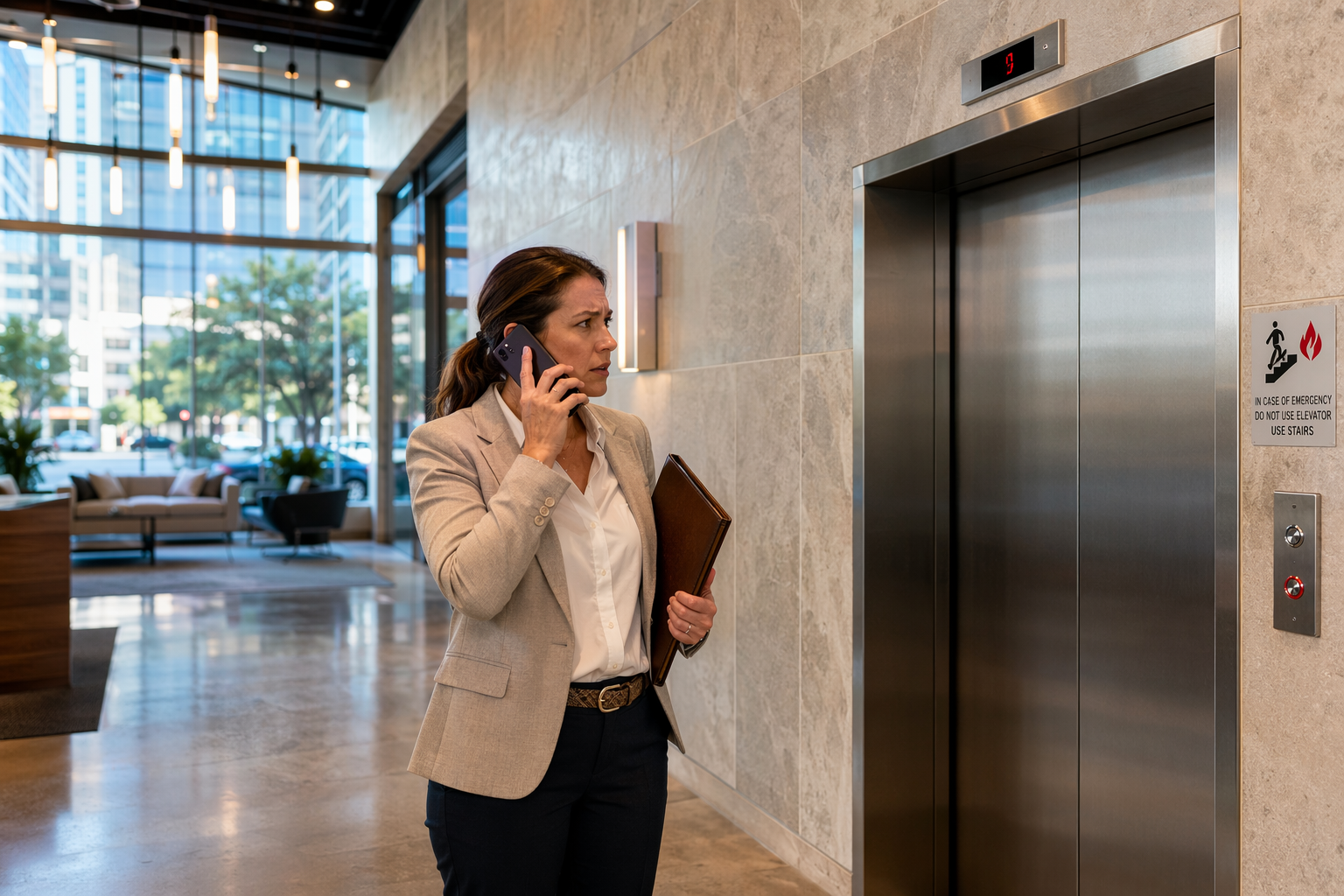
Call 911 first if anyone is injured, medically distressed, or in immediate danger, then immediately call your certified elevator service provider — do not attempt to open doors or rescue passengers yourself.
The sequence matters enormously. Emergency dispatchers can assess whether fire rescue teams are needed and provide calm communication instructions to trapped passengers, while your elevator service company dispatches a qualified mechanic who can safely bring the cab to a landing without creating a secondary hazard.
State law in both Texas and California is clear on who may perform the actual rescue:
- Texas: Under Texas Health and Safety Code Chapter 754 and 16 Texas Administrative Code Chapter 74, only a TDLR-registered elevator contractor may install, repair, alter, test, or maintain elevator equipment — which includes emergency rescue operations. Note that the City of Houston operates its own elevator program independent of TDLR; Houston building managers should confirm their local contacts in advance.
- California: Under California Labor Code Sections 7300–7324.2 and California Code of Regulations, Title 8, Elevator Safety Orders, only a Cal/OSHA-certified Certified Competent Conveyance Mechanic (CCCM) employed by a Cal/OSHA-certified Certified Qualified Conveyance Company (CQCC) may maintain, repair, or perform rescue operations on a conveyance. Note that the City of Los Angeles runs its own elevator and conveyance inspection program through the Department of Building and Safety (LADBS); LA building managers should verify local emergency contacts accordingly.
In both states, attempting a rescue without a properly credentialed professional exposes the building owner to regulatory liability, potential civil claims, and — most importantly — risk of serious injury to trapped passengers.
2. What Is the Official Chain of Contacts for an Elevator Emergency?
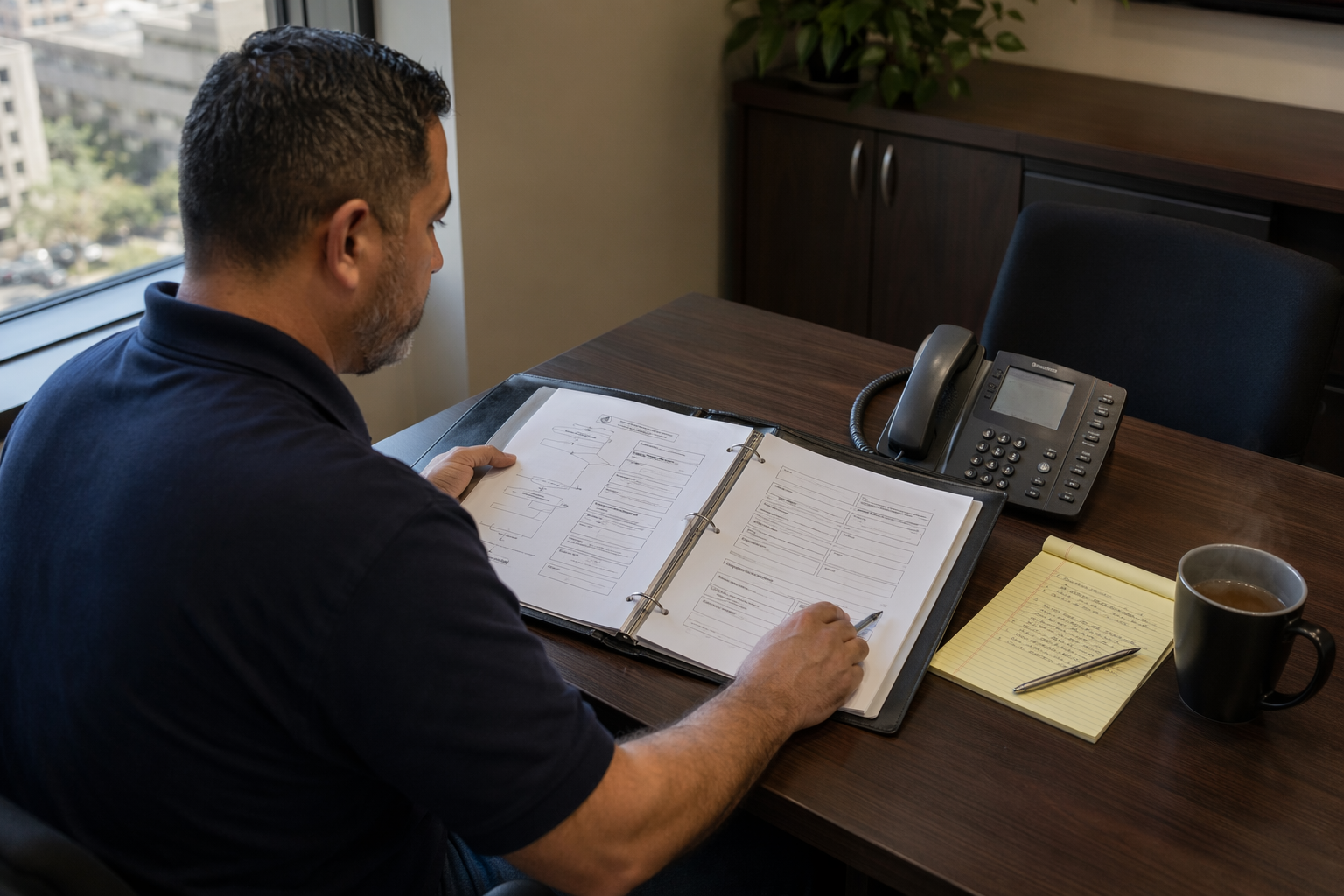
The official contact chain is: 911 → certified elevator service company → building owner/manager → elevator manufacturer (if equipment-specific technical guidance is needed) — in that order of priority.
Here is a practical breakdown of how each contact contributes to a safe resolution:
- 911 / Emergency Services: Assess injuries, provide calm communication to trapped passengers, and dispatch fire rescue if needed. Fire department personnel can assist with passenger communication and medical support, but in most situations they defer to a licensed elevator mechanic for the mechanical release.
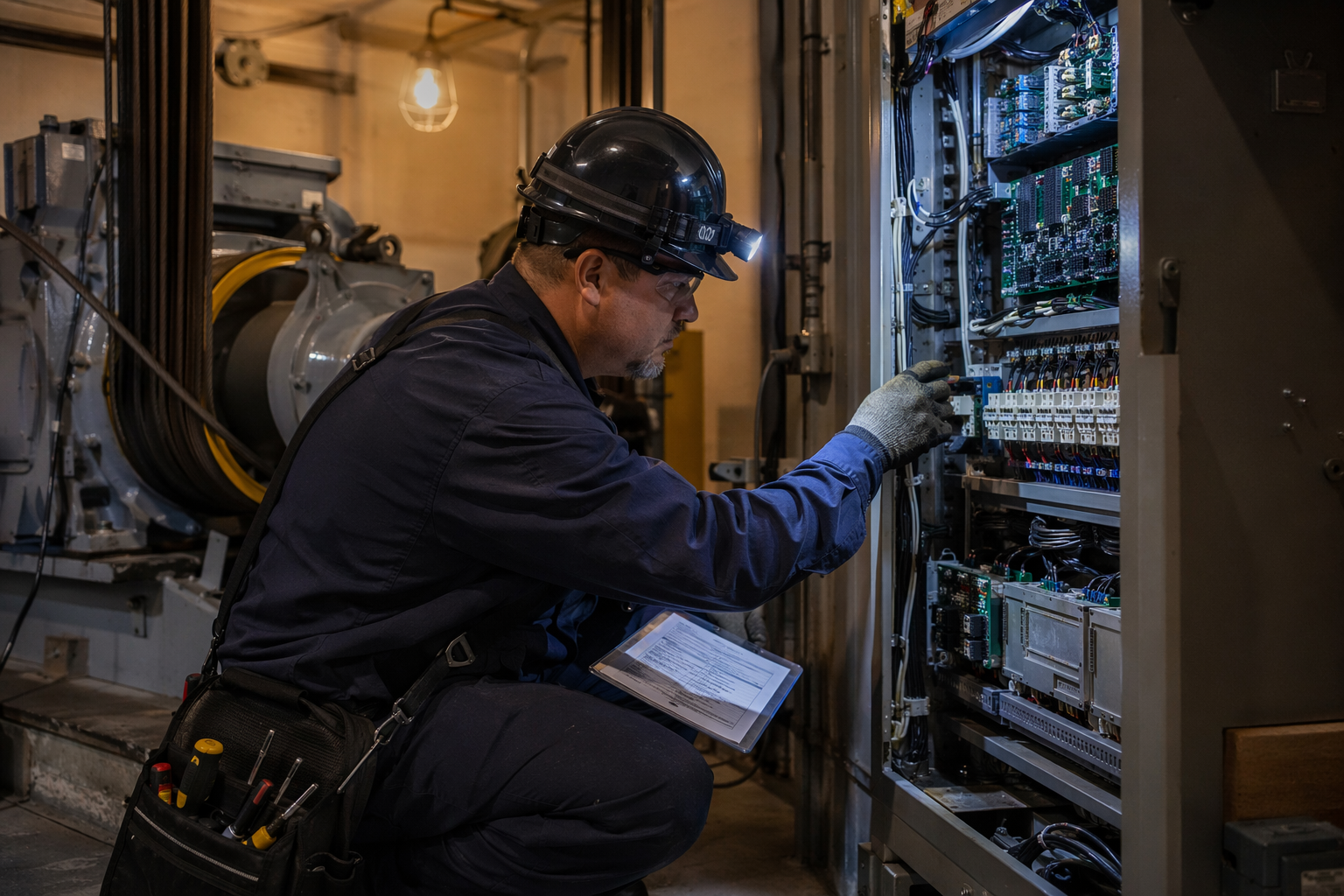
- Certified Elevator Service Company: The only entity legally qualified under ASME A17.1/CSA B44 Safety Code for Elevators and Escalators — and under Texas and California state law — to perform a manual lowering or raising operation, open hoistway doors, and certify the equipment safe for resumed service. In Texas, this means a TDLR-registered contractor. In California, this means a CQCC employing a CCCM.
- Building Owner/Manager: Responsible for documenting the incident, notifying their insurance carrier, and filing required reports with the appropriate state authority. In Texas, building owners must report each accident involving elevator equipment to TDLR within 24 hours. In California, building owners should contact Cal/OSHA’s Elevator Unit and follow the incident reporting process outlined in the California Labor Code.
- Elevator Manufacturer: Contact only if the responding mechanic requires equipment-specific technical documentation or proprietary access codes not otherwise available. This step is rarely needed but can accelerate resolution on newer or highly customized systems.
AmeriTex Elevator recommends posting this contact chain — including your elevator service company’s 24-hour emergency line — in the building’s main office, security desk, and elevator machine room. Every member of your property management team should know this sequence before an entrapment occurs.
3. What Are Building Owners’ Legal Reporting Obligations After an Elevator Entrapment?
In Texas, building owners must report any elevator accident to TDLR within 24 hours. In California, owners must notify Cal/OSHA’s Elevator Unit. Failure to report can result in regulatory penalties and complicate insurance claims — so documentation should begin immediately after the rescue.
Here is what Texas and California building owners need to know about post-entrapment compliance:
- Texas reporting: Under Texas Health and Safety Code Chapter 754 and 16 Texas Administrative Code Chapter 74, building owners must report each accident involving elevator equipment to the Texas Department of Licensing and Regulation (TDLR) within 24 hours of the incident. TDLR issues each unit a Certificate of Compliance that is valid for one year; if equipment is found unsafe following an entrapment, the certificate may be suspended until repairs are made and a reinspection is passed. Violations cited during any inspection must be corrected — or formally placed under a correction contract — within 30 days. Note: TDLR does not regulate elevators inside Houston city limits; Houston building owners should follow the City of Houston’s reporting procedures.
- California reporting: Building owners in California should contact Cal/OSHA’s Elevator Unit following any entrapment that results in injury or equipment damage. Under California Labor Code Sections 7300–7324.2, no elevator may be operated without a valid Cal/OSHA permit to operate; if an entrapment reveals a deficiency that voids the permit, the elevator must be taken out of service until a reinspection is completed and a new permit issued. In California, annual reinspection is the building owner’s responsibility. Note: Los Angeles building owners should also consult the Los Angeles Department of Building and Safety (LADBS), which runs its own elevator inspection program.
- Insurance documentation: Regardless of state, building owners should photograph the scene, collect mechanic reports, gather passenger statements, and notify their liability insurance carrier promptly. AmeriTex Elevator provides written rescue and service reports that can be submitted directly to insurers and regulators.
4. How Long Does an Elevator Entrapment Rescue Typically Take?
Most elevator entrapments in commercial buildings are resolved within 30 to 90 minutes when the correct contacts are notified immediately. Response time depends on the mechanic’s proximity, the type of elevator system involved, and whether a secondary mechanical failure complicates the rescue.
The following factors most directly affect how quickly passengers are safely released:
- Mechanic response time: A service company with local technicians — like AmeriTex Elevator, with teams across Texas and California — can typically dispatch within 15 to 30 minutes of an emergency call. Companies without regional coverage may take significantly longer. This is one of the strongest reasons to vet your elevator service partner before an emergency, not during one.
- Elevator type and failure mode: Hydraulic elevators that have stalled between floors due to fluid loss require a different procedure than traction elevators that have tripped a safety device. Some traction systems can be manually lowered to the nearest landing within minutes; others with damaged components may require partial disassembly before passengers can be safely extracted.
- Building access: Machine room access is critical. If the machine room is locked, unmarked, or difficult to reach, response time increases. AmeriTex Elevator recommends that building managers verify machine room access procedures with their service contractor annually and confirm that emergency keys are accessible to night-shift staff.
- Fire department coordination: If fire rescue arrives before the elevator mechanic, they will typically communicate with trapped passengers and maintain calm but wait for the credentialed mechanic to perform the mechanical release, unless there is an immediate life-safety emergency requiring forced entry. Coordinating these two responses in advance — through a written building emergency action plan — prevents confusion and speeds resolution.
AmeriTex Elevator offers 24/7 emergency dispatch across our Texas and California service territories. Call 866-679-4313 to reach our emergency line at any hour.
5. What Does an Emergency Elevator Entrapment Rescue Cost?
Emergency elevator entrapment rescue service is typically billed at after-hours labor rates — which generally range from $150 to $350+ per hour depending on location, time of day, and contract status — plus any parts required. Buildings covered by a full maintenance contract with their elevator service company almost always receive preferential emergency response terms.
Cost variables that building owners should understand before an entrapment occurs:
- Contract vs. time-and-material billing: Buildings with an active full maintenance contract are typically covered for emergency response labor at no additional charge, or at a reduced rate. Buildings without a maintenance agreement are billed at standard time-and-material rates, which are significantly higher during nights, weekends, and holidays. In California, a full maintenance contract with a CQCC-certified company also qualifies the building for a Cal/OSHA permit to operate valid for up to two years rather than one — a meaningful administrative benefit.
- Parts and repairs: If the entrapment was caused by a component failure — a broken rope, a failed hydraulic seal, a tripped safety device — the cost of parts and corrective repairs is separate from the emergency response labor. AmeriTex Elevator provides itemized service reports so building owners can submit accurate documentation to their insurance carrier.
- Regulatory penalties for delayed reporting: In Texas, failure to report an elevator accident to TDLR within 24 hours can result in administrative penalties. These are not rescue costs per se, but they are a real financial consequence of poor post-incident management. The cost of compliance — including a post-incident inspection and any required Certificate of Compliance reinstatement — should be factored into your overall risk planning.
- Litigation risk: Entrapments that result in passenger injury carry potential liability exposure. The single most effective cost-control measure is ensuring your elevator service company is properly credentialed — a TDLR-registered contractor in Texas, a CQCC in California — so that the rescue itself cannot be challenged as unauthorized.
To discuss maintenance contract options that include emergency response coverage, contact AmeriTex Elevator at 866-679-4313 or visit ameritexelevator.com.
6. How Do I Choose the Right Elevator Service Company for Emergency Response?
Choose an elevator service company that is properly credentialed in your state, maintains 24/7 emergency dispatch, and has verifiable local technicians — not a national call center that subcontracts to unknown mechanics during emergencies.
Here is a vendor comparison checklist AmeriTex Elevator recommends for any building owner evaluating elevator service partners:
- State credentials:
- Texas: Confirm the company is registered as an elevator contractor with TDLR and carries at least $1,000,000 per occurrence in general liability insurance for bodily injury or death and $500,000 per occurrence for property damage, as required by 16 Texas Administrative Code Chapter 74. If your building is in Houston, verify the contractor is also authorized under the City of Houston’s program.
- California: Confirm the company holds Cal/OSHA certification as a Certified Qualified Conveyance Company (CQCC) and employs Certified Competent Conveyance Mechanics (CCCM). Also confirm the company holds a C-11 Elevator Contractor license issued by the California Contractors State License Board (CSLB). If your building is in Los Angeles, verify the company is recognized under the LADBS program.
- 24/7 emergency availability: Ask for a direct emergency dispatch number — not a general voicemail — and confirm average response time in your specific city or region.
- Local technician base: National elevator companies sometimes use subcontractors during off-hours emergencies. Ask directly whether the mechanics who respond to your building are employees or subcontractors, and whether they carry the required state credentials.
- Written service and rescue reports: Confirm the company provides itemized, written reports after every emergency call. These documents are essential for TDLR and Cal/OSHA reporting, insurance claims, and your own incident log.
- Maintenance contract terms: Review what is and is not covered during an emergency entrapment under any proposed contract. Clarify after-hours labor billing, parts coverage, and response-time guarantees in writing before signing.
AmeriTex Elevator is a TDLR-registered elevator contractor serving Texas and a CQCC-certified company serving California. Our mechanics are local to the markets we serve, and our emergency line — 866-679-4313 — connects you to a live dispatcher 24 hours a day, 7 days a week.
7. What Should Building Staff Do While Waiting for the Elevator Mechanic to Arrive?
Building staff should maintain calm, two-way communication with trapped passengers, keep bystanders away from hoistway doors, and avoid any attempt to manually open doors or move the cab — even if they believe they know how to do so.
Practical steps for building staff during the waiting period:
- Communicate continuously: Talk to trapped passengers through the intercom or by speaking near the hoistway doors. Let them know help is on the way, confirm the estimated arrival time of the mechanic, and reassure them that the elevator’s structure is sound. Anxiety is the primary risk during a short entrapment for healthy passengers.
- Ask about medical conditions: If any passenger reports a medical emergency — chest pain, difficulty breathing, a fall inside the cab — escalate your 911 call immediately and request paramedics. Do not wait for the elevator mechanic before calling for medical assistance.
- Keep the area clear: Station a staff member at each hoistway door level to prevent bystanders from attempting to pry doors open. Unauthorized door manipulation is one of the leading causes of secondary injury during entrapments.
- Document everything: Note the exact time of the entrapment, the floor or position of the cab, the number of passengers, any reported injuries, and the time each call was made. This log becomes the foundation of your incident report to TDLR (within 24 hours in Texas) or Cal/OSHA in California.
- Do not reset the elevator: Do not attempt to use the machine room controls, reset the main line disconnect, or operate any override functions. These actions can create additional hazards and may make the mechanic’s job more difficult or dangerous upon arrival.
AmeriTex Elevator provides building staff training on emergency response protocols as part of our maintenance agreements. Contact us at 866-679-4313 to learn more.