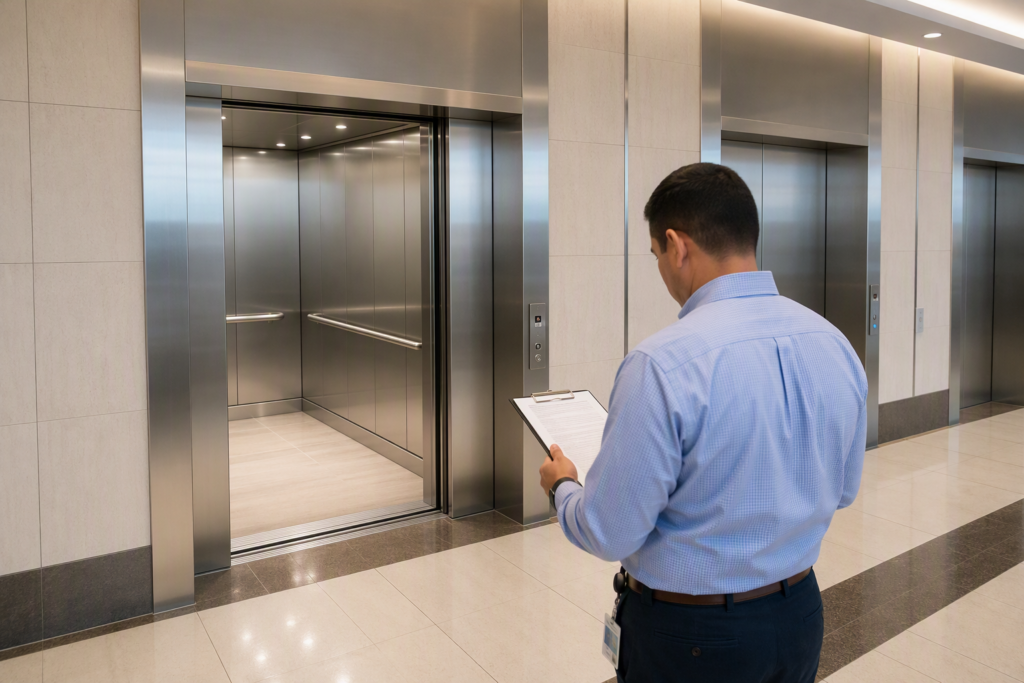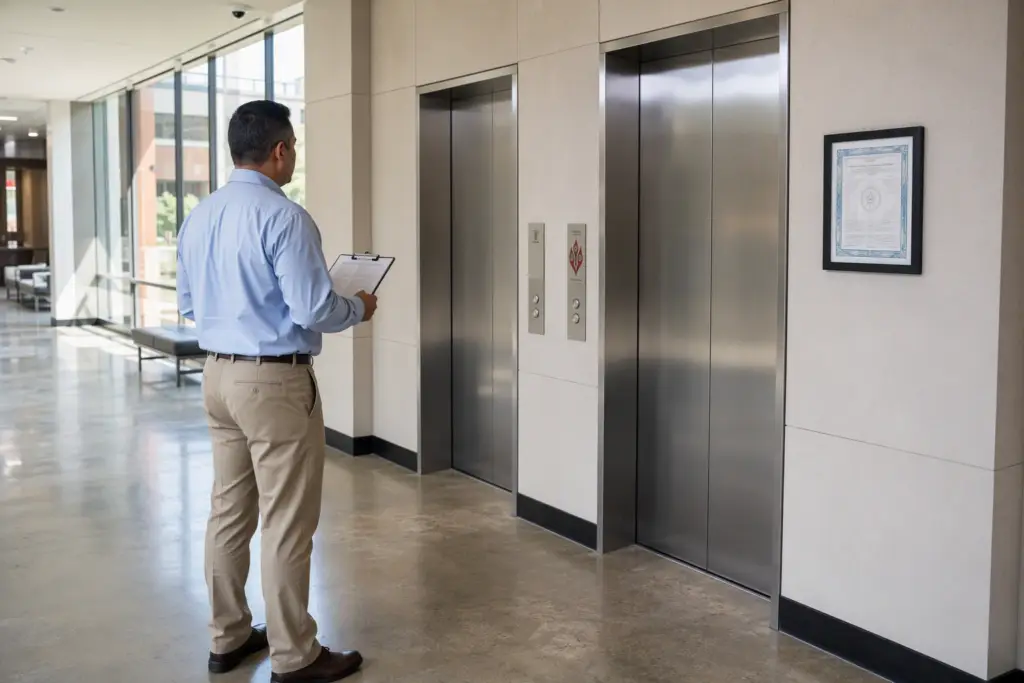
What exactly happens the moment an elevator fails its inspection?
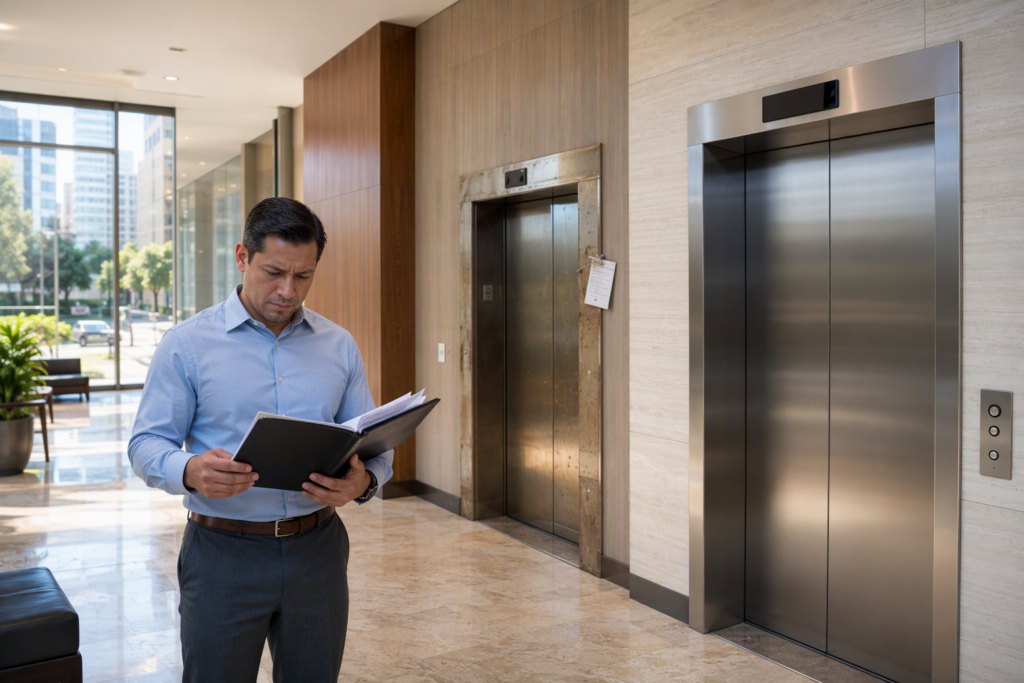
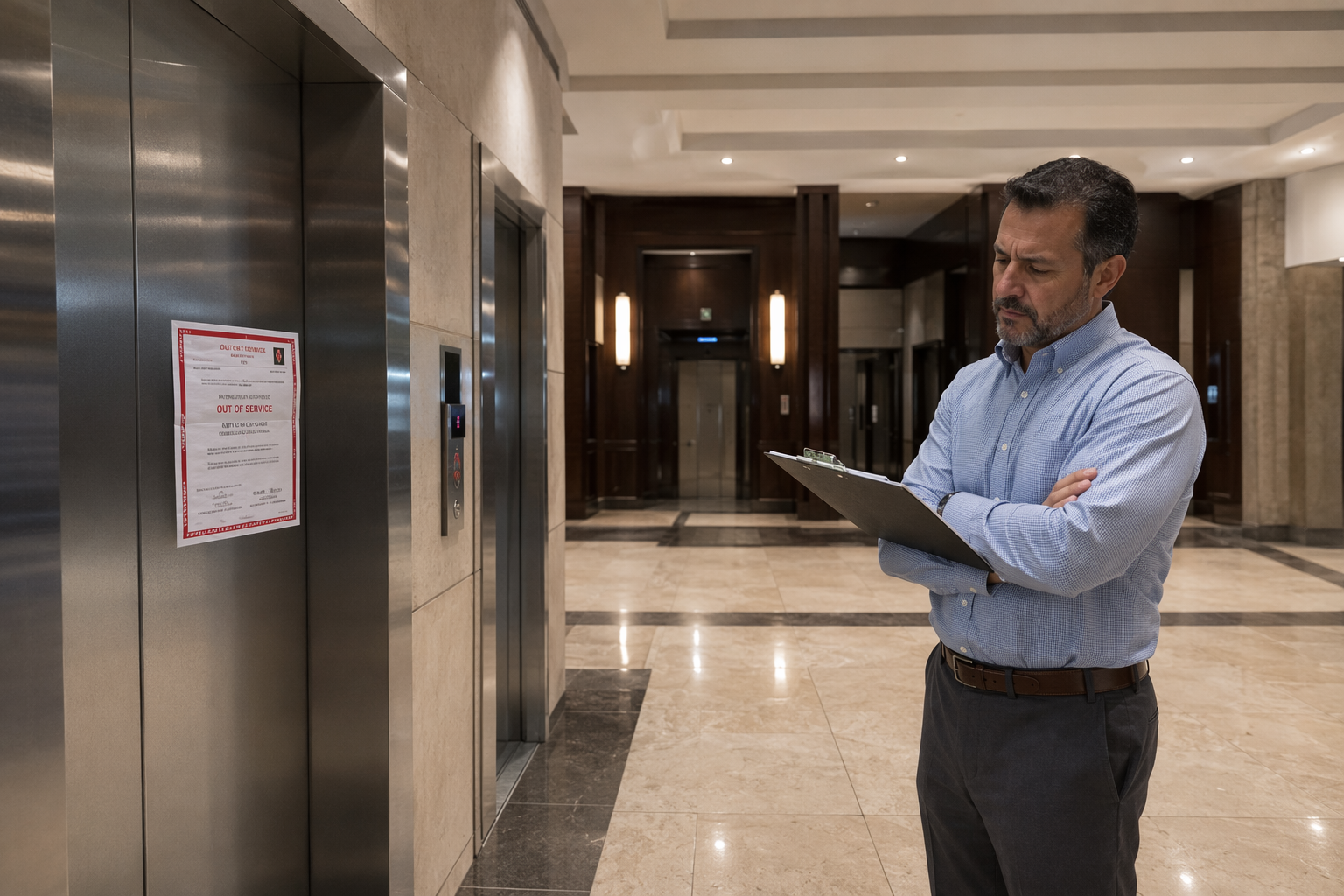
The elevator is placed out of service and a written notice of violation is issued by the authority having jurisdiction (AHJ), which in Texas is the Texas Department of Insurance (TDI) Elevator Safety Program and in California is the Division of Occupational Safety and Health (Cal/OSHA) Elevator Unit.
When an inspector determines that an elevator does not meet the requirements of the ASME A17.1 Safety Code for Elevators and Escalators or its companion retrofit standard ASME A17.3, or when the unit presents an imminent hazard, the AHJ has authority to affix a violation notice to the car and order it shut down on the spot. In less severe situations where deficiencies are noted but not immediately dangerous, the AHJ may issue a correction order with a compliance deadline rather than an immediate shutdown. Either way, building owners and facility managers are legally obligated to act promptly — continuing to operate an elevator under a violation order or after a shutdown notice exposes the building owner to significant civil liability and regulatory penalties.
The written notice will list each cited deficiency by code section, classify the severity, and state the required corrective action. That document is the roadmap for getting the elevator back in service, and every item on it must be resolved before re-inspection can occur.
What are the most common reasons elevators fail inspection in Texas and California?

The most common failure reasons include worn or broken safety components, missing or expired certificates, door-related deficiencies, and outdated equipment that no longer meets current code requirements under ASME A17.1 or ASME A17.3.
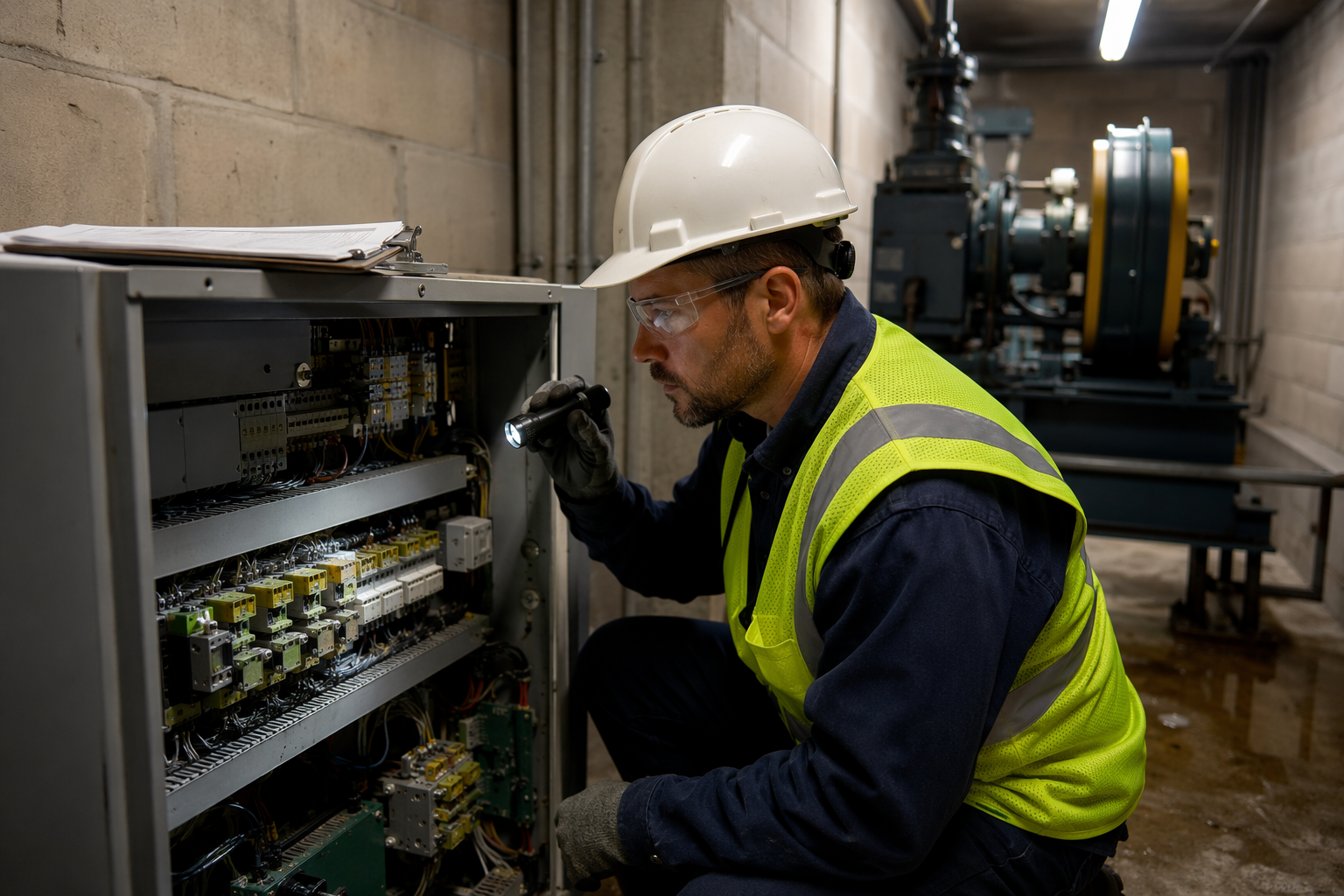
Inspectors in Texas and California consistently cite a predictable cluster of deficiencies. Door operator malfunctions — including door reversal failures, gap tolerances outside of code, and non-functioning nudging features — are among the most frequently cited issues. Safety device failures such as worn governor rope, damaged safeties, or inoperative oil buffers are serious findings that typically trigger immediate shutdown orders. Inadequate machine room conditions, including improper lighting, missing fire-rated door closers, and stored materials in the machine room, generate violations as well.
In California, Cal/OSHA elevator inspectors also scrutinize seismic protection requirements applicable under California’s specific provisions. In Texas, TDI inspectors focus heavily on annual permit currency, insurance documentation, and compliance with the Texas Elevator Safety Act provisions. Equipment installed before the current code edition must comply with ASME A17.3 Safety Code for Existing Elevators and Escalators, and failure to meet A17.3 mandatory upgrades is a common source of violations in older commercial buildings across Houston, Dallas, Austin, and San Antonio.
What is the step-by-step process to get a failed elevator back in service?
Getting a failed elevator back in service requires completing every corrective action cited in the violation notice, arranging re-inspection, and receiving an updated certificate of operation from the AHJ before resuming operation.
- Secure and post the shutdown notice. The moment the elevator is taken out of service, lock the doors, post visible out-of-service signage on every floor, and retain a copy of the AHJ’s violation notice for your records.
- Read the notice of violation in full. Identify every cited deficiency, its code reference, severity classification, and the compliance deadline. Do not assume any item is minor — each one must be formally resolved.
- Contact a licensed elevator contractor immediately. In Texas, the elevator contractor must hold a current TDI Elevator Contractor License. In California, elevator mechanics and contractors must be licensed through the California Department of Industrial Relations. Engage a qualified firm to evaluate each deficiency and provide a formal scope of repairs.
- Obtain required permits before beginning repairs. Major corrective work in Texas requires a TDI repair permit. California requires permit applications through the local Cal/OSHA elevator unit before significant alteration or repair work begins. Starting work without permits can invalidate the repair and create additional violations.
- Complete all cited repairs and corrections. All work must be performed to the applicable ASME A17.1 standard for the installation year and ASME A17.3 for mandatory retroactive upgrades. Use only code-compliant parts and document all work performed.
- Conduct internal pre-inspection testing. Before calling the AHJ, have the elevator contractor perform all required tests — including full-load brake tests, door-reversal tests, and safety tests — to confirm the unit will pass re-inspection. This step prevents a second failure and additional fees.
- Request a re-inspection from the AHJ. In Texas, submit a re-inspection request to TDI. In California, contact the local Cal/OSHA elevator unit. Provide documentation of all completed repairs and test results when scheduling.
- Pass the re-inspection. The AHJ inspector will verify every previously cited item has been resolved and may conduct additional tests. If the unit passes, the inspector removes or supersedes the violation notice.
- Receive the new Certificate of Operation. Once the re-inspection is passed, the AHJ issues an updated Certificate of Operation (Texas) or Certificate of Inspection (California). This certificate must be posted in the elevator car before it is returned to service.
- Return the elevator to service and document everything. Place the elevator back in service, brief building staff on the completed repairs, and file all permits, inspection reports, and certificates in the elevator’s maintenance log for future reference.
How long does it typically take to get a failed elevator back in service?
The timeline depends entirely on the nature of the deficiencies — minor corrections may allow a re-inspection within days, while major repairs involving parts procurement or code upgrades can extend the process to several weeks or longer.
Simple violations such as missing signage, inadequate lighting, or lubrication deficiencies can often be corrected within 24 to 72 hours, with re-inspection scheduled shortly after. However, deficiencies requiring replacement of safety-critical components — governors, safeties, rope systems, or control panels — introduce parts lead times that can stretch timelines considerably. Older elevators in Houston or Dallas high-rises that require modernization to comply with ASME A17.3 mandatory upgrade provisions can face timelines measured in weeks or months, depending on the scope of work and permit processing times at the local AHJ.
Building owners should avoid a common mistake: assuming that scheduling re-inspection can happen immediately after repairs are complete. AHJ inspection queues in major Texas and California markets can have their own lead times, so engaging a licensed elevator contractor early — and maintaining the unit through a preventive maintenance program — is the most effective way to minimize total downtime.
Does a failed inspection automatically shut down the elevator, or can it remain in service temporarily?
Whether an elevator is shut down immediately or given a correction deadline depends on how the AHJ classifies the deficiency — imminent hazards result in immediate shutdown, while non-critical violations may allow continued operation until a stated deadline.
AHJs in both Texas and California have tiered violation classification systems. Deficiencies classified as imminent hazards — such as a failed governor, broken landing zone limits, malfunctioning door safety edges, or structural failures — require immediate removal from service with no grace period. The elevator must remain out of service until repairs are completed and re-inspection is passed.
Non-hazardous violations — items like worn but still-functional finishes, minor documentation gaps, or approaching-end-of-life components that are not yet failed — typically carry a correction deadline of 30, 60, or 90 days depending on AHJ policy and the specific requirement. During that window, the elevator may remain in service, but the building owner is obligated to complete corrections and schedule re-inspection before the deadline expires. Allowing a correction deadline to lapse without action escalates the violation’s status and typically results in a mandatory shutdown order.
Who is responsible for paying for the repairs after a failed inspection?
The building or equipment owner is legally responsible for all costs associated with correcting violations, including repairs, parts, permits, and re-inspection fees.
This responsibility is established under both the Texas Elevator Safety Act and California’s elevator safety statutes. If the building is under a full-maintenance elevator service contract, the contract terms will determine which corrective items are covered by the contractor and which are billed as additional work. Many standard maintenance contracts exclude major component replacements, modernization work, and code-compliance upgrades — which are precisely the types of repairs that generate failed inspections.
Building owners and property managers should review their elevator maintenance agreements carefully to understand coverage boundaries before an inspection failure occurs. Working with a qualified elevator service company like AmeriTex Elevator to negotiate a maintenance contract that aligns coverage with the age and condition of the equipment can reduce the financial exposure associated with unexpected inspection failures.
What are the legal consequences of operating an elevator after it has failed inspection or been shut down?
Operating an elevator that has been ordered out of service is a serious legal violation that can result in regulatory fines, criminal liability, and severe civil exposure if a passenger is injured.
In Texas, operating an elevator without a valid Certificate of Operation or in violation of a TDI shutdown order constitutes a violation of the Texas Elevator Safety Act and can result in civil penalties per day of non-compliance. In California, operating an elevator in violation of a Cal/OSHA shutdown order violates California Labor Code provisions and can trigger substantial daily penalties, stop-work orders on the broader facility, and referral for criminal prosecution in cases of willful violation.
Beyond regulatory penalties, if a passenger is injured on an elevator that was known to be out of compliance, building owners face significantly heightened civil liability exposure. Courts and juries treat documented notice of a code violation as evidence of negligence, which can substantially increase damage awards. Building managers in Houston, San Antonio, Los Angeles, and San Diego who receive violation notices should treat them as urgent legal documents, not administrative paperwork.
What is the difference between a routine inspection and a re-inspection after a failure?
A routine inspection is the scheduled periodic examination required to renew the Certificate of Operation, while a re-inspection is a targeted examination conducted specifically to verify that deficiencies cited in a prior inspection have been corrected.
Routine inspections in Texas are required annually under the Texas Elevator Safety Act and must be conducted by a TDI-licensed elevator inspector. California requires periodic inspections under the authority of Cal/OSHA, with inspection frequency determined by equipment type and use category. These routine inspections encompass the full elevator system against the applicable code requirements.
A re-inspection, by contrast, focuses on the specific items listed in the prior violation notice. However, if the inspector observes additional deficiencies during the re-inspection visit that were not present or not noted during the original inspection, those can be cited as new violations. This is why a thorough pre-inspection walkthrough by the elevator contractor before the re-inspection appointment is strongly recommended. Re-inspections in Texas and California carry their own fees, which are billed to the building owner regardless of the inspection outcome.
What is ASME A17.3 and why does it matter for failed inspections?
ASME A17.3 Safety Code for Existing Elevators and Escalators establishes minimum retroactive safety requirements for elevators installed before the current code edition, and violations of its mandatory upgrade provisions are a frequent cause of inspection failures in older buildings.
Many building owners are surprised to learn that the code applicable to their elevator is not simply the version in effect when it was installed. ASME A17.3 requires that existing elevators be brought into compliance with specific retroactive requirements over time, even if the elevator originally passed inspection under an older code edition. Mandatory upgrades under A17.3 include requirements for door restrictors, car lighting, firefighters’ emergency operation, pit lighting, and other life-safety features that were added to the code after many elevators were built.
In Texas, TDI enforces A17.3 compliance as part of its annual inspection program. In California, Cal/OSHA’s elevator unit similarly enforces retroactive requirements. Building owners with elevators installed before the late 1990s or early 2000s are particularly vulnerable to A17.3 violations and should request a code compliance audit from a licensed elevator contractor as a proactive measure.
How does ADA compliance factor into elevator inspections and failures?
While ADA compliance is generally enforced through civil rights law rather than the elevator safety inspection program, ADA deficiencies can appear as separate violations and contribute to an elevator being found non-compliant with applicable standards.
The Americans with Disabilities Act sets accessibility standards for elevator controls, door clearance, cab dimensions, and signage. In new construction and alterations, ADA compliance is typically verified by the building department during plan review and certificate of occupancy, not solely by the elevator inspector. However, when an ADA deficiency is identified during an elevator inspection — such as missing or damaged Braille markings on controls, a non-functioning audible signal, or door width that falls below the required clear opening — it can be noted in the inspection report and referred to the appropriate enforcement authority.
Building owners pursuing ADA compliance upgrades as part of post-inspection repairs should document the work carefully, as these improvements also serve as evidence of good-faith compliance efforts in ADA civil rights proceedings.
What records and documentation should building owners maintain related to elevator inspections?
Building owners should maintain a comprehensive elevator file that includes all certificates of operation, inspection reports, violation notices, repair records, test results, permits, and maintenance logs for the life of the equipment.
Texas law requires that the current Certificate of Operation be posted in a conspicuous location in the elevator car or adjacent to the elevator. California similarly requires that inspection certificates be kept available for review. Beyond the legal minimums, a complete historical file serves several important purposes: it demonstrates ongoing compliance to regulators and insurers, supports due-diligence reviews during property transactions, and provides critical reference information when diagnosing recurring issues or planning modernization projects.
A well-maintained elevator log should record the date, technician, and scope of every maintenance visit, test, and repair — not just inspection events. Elevator contractors should provide written work orders for every service visit, and building managers should retain those records. AmeriTex Elevator provides clients with documented service records to support their compliance files across all markets it serves in Texas and California.
What is the difference between a violation that causes immediate shutdown versus a correction order with a deadline?
Immediate shutdown orders apply when an inspector determines a condition poses an imminent risk of injury or death, while correction orders with deadlines apply to deficiencies that are significant but do not present an imminent hazard at the time of inspection.
| Classification | Typical Examples | Immediate Shutdown? | Typical Correction Window | Re-Inspection Required? |
|---|---|---|---|---|
| Imminent Hazard | Failed governor, broken car safety, inoperative door reversal device, structural failure | Yes — immediate | No service until corrected and re-inspected | Yes |
| Serious Violation | Non-functioning firefighters’ operation, non-compliant pit lighting, oil buffer deficiency | Often yes, or short deadline | Typically 30 days or less | Yes |
| Non-Serious Violation | Missing or damaged signage, lubrication deficiencies, minor documentation gaps | No | Typically 30–90 days | Yes |
| ASME A17.3 Mandatory Upgrade | Missing door restrictors, outdated firefighters’ recall, absent pit stop switch | Depends on AHJ and condition | Varies — can be 30 days to longer depending on scope | Yes |
| Administrative/Documentation | Expired certificate posted, maintenance log not available, permit not on file | No | Typically 30–60 days | Yes |
The classification assigned by the inspector is determinative of the path forward. Building owners who disagree with a classification or the cited code reference have the right to appeal through the AHJ’s formal appeal process — in Texas through TDI’s administrative process, and in California through Cal/OSHA’s appeals procedure. However, an appeal does not automatically suspend a shutdown order unless the AHJ specifically grants a stay pending review.
Can a building owner appeal a failed inspection or a shutdown order?
Yes, building owners in both Texas and California have formal appeal rights, but filing an appeal does not automatically allow the elevator to resume operation, and the appeal process does not eliminate the obligation to correct genuine deficiencies.
In Texas, appeals of TDI elevator inspection determinations are handled through the agency’s administrative process. In California, Cal/OSHA has an established appeals procedure for contested citations and orders. The appeal process is most appropriate when a building owner believes a code citation is factually incorrect, that the inspector applied the wrong code edition, or that the required corrective action is technically infeasible as stated. Appeals based purely on the cost or inconvenience of compliance are not successful grounds.
Building owners considering an appeal should retain a licensed elevator contractor or elevator code consultant to provide a technical basis for the challenge. Proceeding without technical support makes it difficult to overcome an inspector’s documented findings. Even when an appeal is filed, proactively pursuing corrections demonstrates good faith and may influence the AHJ’s response.
How can building owners prevent elevator inspection failures in the first place?
The most effective prevention strategy is a rigorous, code-aware preventive maintenance program conducted by a licensed elevator contractor, combined with periodic internal compliance audits before each scheduled AHJ inspection.
Preventive maintenance is not simply routine lubrication and cleaning — it should encompass systematic testing of all safety devices, door operators, controls, and ropes on a regular schedule consistent with the manufacturer’s recommendations and the requirements of ASME A17.1. A maintenance program that defers safety device testing or skips machine room condition checks is a program that generates inspection failures.
In addition to ongoing maintenance, building owners with older equipment should commission a periodic code compliance audit — a systematic comparison of the elevator’s current condition and configuration against all applicable ASME A17.3 mandatory upgrade requirements. Identifying and correcting code gaps before the AHJ inspection avoids the disruption of an out-of-service order. AmeriTex Elevator conducts compliance evaluations for building owners across Houston, Dallas, Austin, San Antonio, Los Angeles, and San Diego to proactively identify potential inspection issues before they become violations.
What happens if an elevator fails inspection multiple times or has a pattern of violations?
Repeated inspection failures and patterns of non-compliance signal systemic maintenance deficiencies or end-of-life equipment conditions, and AHJs in Texas and California may escalate enforcement action, including extended shutdowns and requirements for comprehensive modernization.
A single inspection failure corrected promptly is a manageable event. A pattern of recurring failures — particularly repeated violations of the same code sections — indicates that the underlying cause has not been adequately addressed. AHJ inspectors and supervisors take note of repeat violation histories, and escalating enforcement responses are possible, including requirements for independent third-party inspections, shortened inspection intervals, or mandatory equipment modernization.
From a risk management perspective, recurring violations are often a signal that the elevator has reached the end of its serviceable life and that modernization is a more cost-effective long-term solution than repeated corrective repairs. A modernization project replaces the controller, drive system, doors, and often the cab, bringing the unit into compliance with current ASME A17.1 requirements and resetting the compliance clock.
What is elevator modernization and when is it required after a failed inspection?
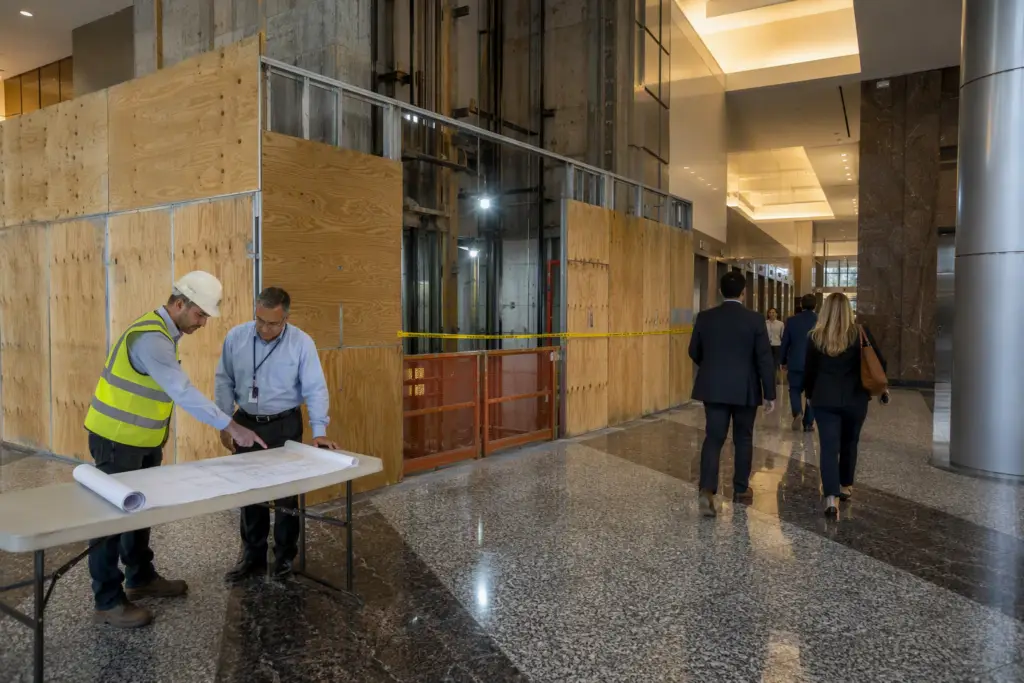
Elevator modernization is the process of replacing major elevator systems and components to bring the unit into compliance with current or retroactive code requirements, and it may be the required path forward when violations involve obsolete technology or extensive ASME A17.3 mandatory upgrades.
Modernization is not always elective. When an AHJ determines that an elevator’s control system, door operator, or safety chain is so outdated that isolated repairs cannot achieve code compliance, a full or partial modernization may be the only viable path to a passing inspection. This is particularly common with relay-logic controllers installed before the widespread adoption of microprocessor-based systems, worn hydraulic cylinders approaching end of manufacturer support, and traction elevators with wire rope and machine conditions that cannot be restored to code-compliant tolerances.
Modernization projects require a full set of permits from the AHJ before work begins, and the completed project must pass a full inspection — including all applicable tests under ASME A17.1 — before the elevator is returned to service. The permitting and inspection process for a modernization is more extensive than for a routine repair, and timelines should be planned accordingly. AmeriTex Elevator assists building owners in evaluating whether targeted repairs or full modernization represents the better path to durable compliance.
Are there specific elevator inspection requirements that differ between Texas and California?
Yes, while both states adopt ASME A17.1 and ASME A17.3 as their technical foundation, Texas administers its elevator safety program through the Texas Department of Insurance (TDI), while California administers its program through Cal/OSHA, and each has state-specific administrative requirements including permit fees, inspector qualifications, and inspection intervals.
In Texas, the Elevator Safety Act places jurisdiction over elevators, escalators, and related conveyances with TDI. TDI licenses elevator contractors, inspectors, and mechanics operating in the state and requires annual inspections for most commercial elevators. Certificates of Operation issued by TDI must be current and posted in the elevator car at all times. Texas also requires that insurance coverage for elevator liability be maintained and documented with TDI.
In California, Cal/OSHA’s Elevator, Ride, and Tramway Unit has jurisdiction over elevators in commercial and multi-family residential buildings. California has adopted its own elevator safety orders that incorporate ASME A17.1 and A17.3 requirements along with California-specific provisions, including seismic safety requirements applicable to elevator installations in the state’s seismic zones. Building owners with elevator portfolios spanning both Texas and California markets — such as national property managers operating in Houston and Los Angeles or San Diego — must navigate both regulatory frameworks simultaneously.
How does OSHA relate to elevator inspection failures?
Federal OSHA standards apply primarily to elevator safety in construction and in workplaces where elevators are used as part of general industry operations, and OSHA can cite building owners or employers when elevator conditions create recognized hazards for workers.
While elevator safety in commercial buildings is primarily regulated at the state level in Texas and California, federal OSHA’s General Duty Clause requires employers to provide a workplace free from recognized hazards, which includes elevator hazards that are known and not corrected. In a building where employees regularly use a freight elevator or service lift with documented safety violations, OSHA can independently cite the employer — separate from any AHJ action — if the condition creates a risk of serious injury or death.
Construction elevators and personnel hoists used on job sites in Texas and California are also subject to specific federal OSHA construction standards. Building owners and general contractors managing construction projects should be aware that both OSHA construction standards and state elevator safety requirements may apply simultaneously during construction phases.
How should building managers communicate with tenants and occupants during an elevator shutdown?
Building managers should notify tenants of the shutdown immediately, provide clear out-of-service signage at every elevator entrance on every floor, communicate a realistic timeline for return to service, and ensure that accessibility obligations under the ADA are addressed during the outage.
Proactive communication prevents tenant frustration and reduces the likelihood of tenants attempting to use a locked-out elevator. Signage should clearly state that the elevator is out of service for required repairs and should not indicate a specific return date unless that date is confirmed — setting an unmet deadline creates additional reputational and legal exposure.
ADA obligations continue during an elevator outage. If the building has only one elevator and it serves as the only accessible route for people with disabilities, building management may have an obligation to provide alternative accommodations — such as temporary relocation assistance or alternative service delivery — for the duration of the outage. Legal counsel familiar with ADA requirements should be consulted when an elevator shutdown creates a prolonged accessibility barrier in buildings subject to ADA Title III requirements.
Why should building owners choose a qualified, licensed elevator contractor for post-inspection repairs?
Using an unlicensed or unqualified contractor to perform repairs after a failed inspection invalidates the repair work in the eyes of the AHJ and can prevent the elevator from being returned to service, in addition to creating serious liability exposure.
In Texas, all elevator repair work must be performed by a TDI-licensed elevator contractor using licensed mechanics. In California, elevator repair work must be performed by contractors and mechanics licensed through the Department of Industrial Relations. AHJ inspectors verify contractor licensing as part of the re-inspection process, and work performed without the required licenses may be ordered removed and redone — adding time and cost to an already disruptive situation.
Beyond licensing, the technical competence of the contractor matters. Elevator safety systems are complex, and a repair that resolves the symptom of a violation without addressing the underlying condition will generate a repeat failure. Building owners in Houston, Dallas, Austin, San Antonio, Los Angeles, and San Diego can rely on AmeriTex Elevator to perform post-inspection repairs that are correctly permitted, executed by licensed personnel, and documented to support a successful re-inspection.
Get Your Elevator Back in Service — Contact AmeriTex Elevator
If your elevator has failed an inspection or received a violation notice, time is a critical factor. Every day the elevator is out of service affects building operations, tenant relations, and your ADA accessibility obligations. AmeriTex Elevator works with building owners and property managers across Houston, Dallas, Austin, San Antonio, Los Angeles, and San Diego to evaluate violations, complete licensed repairs, coordinate re-inspections, and get elevators back in service as efficiently as the regulatory process allows.
Contact AmeriTex Elevator for a free elevator assessment. Call us today at 866-679-4313.