How to Manage Elevator Service and Maintenance Contracts Across Multiple Buildings in Your Portfolio

Portfolio managers responsible for multiple properties face a compounding compliance burden every time they add a building with an elevator or escalator. Missed inspections, lapsed certificates, or unresolved violation orders can trigger building shutdowns, liability exposure, and regulatory penalties. The sections below answer the most common questions property owners, asset managers, and facilities directors ask when trying to bring order to a fragmented elevator service program across Texas and California properties.
What Is the Single Most Important Step to Managing Elevator Contracts Across Multiple Buildings?
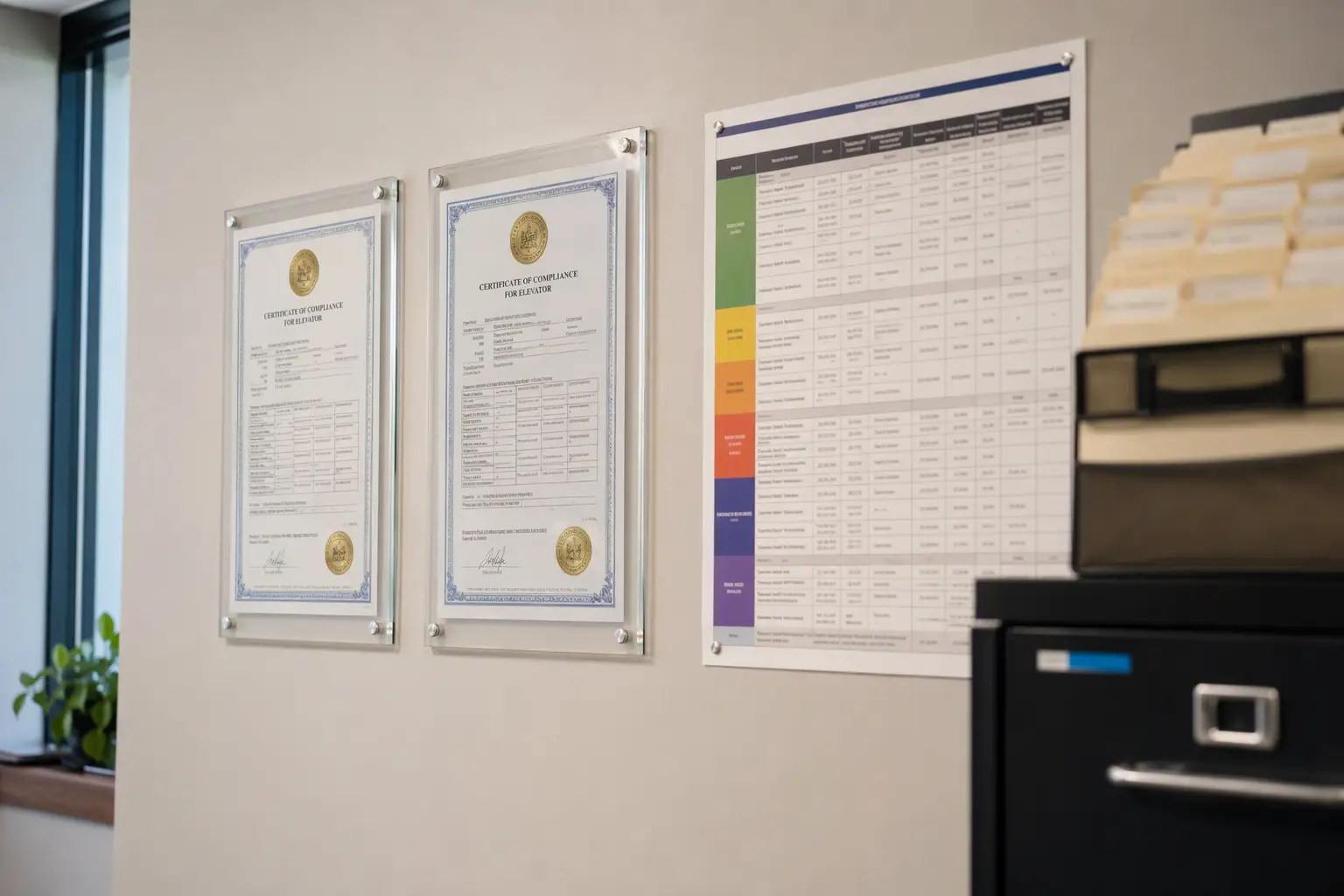
Centralizing all elevator units under one accountable service contractor with jurisdiction-specific compliance expertise is the single most critical step, because it replaces fragmented vendor relationships and inconsistent recordkeeping with a unified compliance calendar and single point of contact.
When a portfolio spans properties in Houston, Dallas, Austin, San Antonio, Los Angeles, or San Diego, the regulatory landscape shifts city by city. Texas properties outside Houston are regulated by the Texas Department of Licensing and Regulation (TDLR), Elevator and Escalator Safety program, while Houston operates its own municipal elevator program. California properties are regulated by the Division of Occupational Safety and Health (Cal/OSHA), Elevator Unit, California Department of Industrial Relations, except in Los Angeles, which maintains its own inspection program through the Los Angeles Department of Building and Safety (LADBS). A single contractor familiar with all of these authorities eliminates the coordination overhead that multiplies with each additional property.
How Does Elevator Regulation Differ Between Texas and California Properties in My Portfolio?
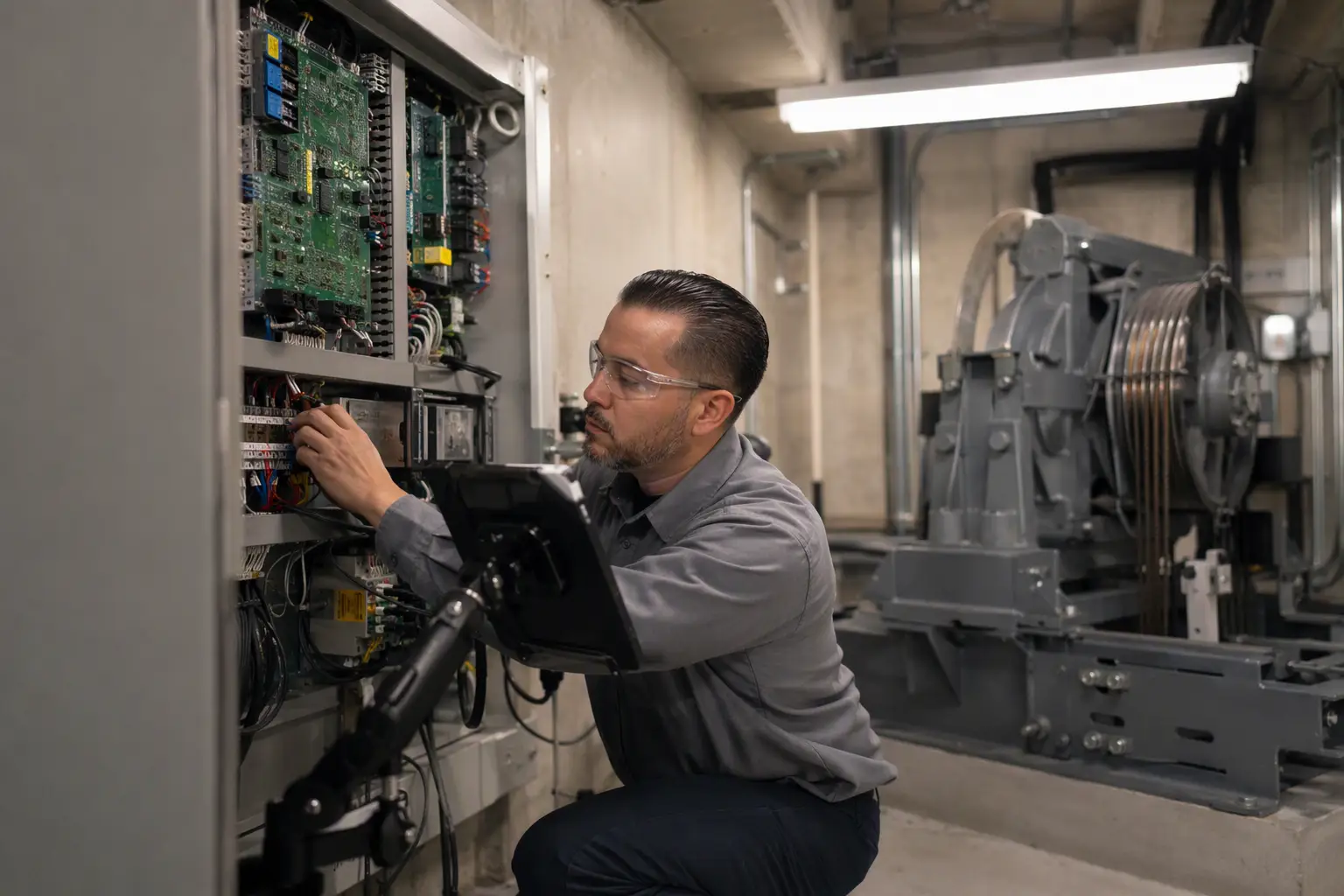
Texas and California each maintain distinct statutory frameworks, adopted code editions, and agency structures, so a portfolio that spans both states requires compliance tracking under two separate regulatory regimes.
In Texas, authority derives from Texas Health and Safety Code Chapter 754, with rules in 16 Texas Administrative Code Chapter 74. The adopted technical standard is the ASME A17.1/CSA B44, 2016 edition, effective November 1, 2018. TDLR issues Certificates of Compliance that must be displayed in a publicly visible area of the building. Texas building owners select their own registered elevator inspector, and that inspector must deliver the written inspection report within five calendar days of the inspection.
In California, authority rests in California Labor Code Sections 7300–7324.2 and the California Code of Regulations, Title 8, Elevator Safety Orders (Sections 3000–3146). The adopted code is the ASME A17.1/CSA B44, 2004 edition for installations contracted on or after May 1, 2008. No elevator may operate without a valid Cal/OSHA permit to operate, and that permit must be posted conspicuously inside the elevator car. Only State of California safety engineers and Certified Competent Conveyance Inspectors (CCCI) may conduct elevator inspections in California.
The table below summarizes the key regulatory differences portfolio managers must track in 2026.
| Regulatory Element | Texas (TDLR) | California (Cal/OSHA) |
|---|---|---|
| Governing statute | Texas Health & Safety Code Ch. 754 | California Labor Code §§ 7300–7324.2 |
| Adopted code edition | ASME A17.1-2016 | ASME A17.1/CSA B44-2004 |
| Annual inspection required | Yes — by TDLR-registered inspector | Yes — by CCCI or Cal/OSHA safety engineer |
| Compliance certificate | TDLR Certificate of Compliance (1 year) | Cal/OSHA permit to operate (up to 1 year; up to 2 years with full maintenance contract) |
| Certificate display location | Publicly visible area of building | Inside the elevator car |
| Inspector selection | Owner selects registered inspector | Cal/OSHA assigns or approves CCCI |
| Reinspection responsibility | Owner coordinates | Owner’s responsibility to arrange |
| Violation correction window | 30 days or waiver/delay from TDLR | As directed by Cal/OSHA |
| Periodic load test (traction) | Category 5 every 5 years | Per ASME A17.1-2004 / Elevator Safety Orders |
| Accident reporting | Within 24 hours to TDLR | As required by Cal/OSHA |
| Contractor credential | TDLR-registered contractor | Cal/OSHA Certified Qualified Conveyance Company (CQCC) + C-11 license (CSLB) |
| Mechanic credential | Not separately verified at state level | Cal/OSHA Certified Competent Conveyance Mechanic (CCCM) |
| Houston exception | Yes — TDLR does not regulate elevators in Houston; city runs its own program | N/A |
| Los Angeles exception | N/A | Yes — LADBS operates its own inspection program |
What Types of Elevator Maintenance Contracts Should Portfolio Managers Consider?
Portfolio managers typically choose from three contract structures: oil-and-grease (basic), full maintenance, and comprehensive (full maintenance plus callbacks and parts), and the right choice depends on equipment age, usage intensity, and compliance strategy.
An oil-and-grease contract covers routine lubrication, adjustment, and cleaning but excludes parts and repairs. It carries the lowest monthly cost but exposes owners to unpredictable repair invoices. A full maintenance contract covers parts and labor for most repairs and, importantly, qualifies California building owners for a Cal/OSHA permit to operate valid for up to two years rather than one — a meaningful compliance and administrative advantage for large portfolios. A comprehensive contract adds callback coverage around the clock, prioritizing entrapment response and unscheduled service visits. For multi-building portfolios where downtime risk is high — particularly in commercial office towers or residential high-rises — a comprehensive agreement spread across all units often produces lower total cost of ownership than piecemeal repairs.
AmeriTex Elevator works with portfolio clients to structure contract tiers that match the risk profile of each building type, from light commercial to high-rise residential, across its Texas and California service markets.
How Often Are Elevators Required to Be Inspected in Texas and California?
Both Texas and California require at minimum one full inspection per year for every elevator unit, with specific periodic tests required on defined cycles under the applicable edition of the ASME A17.1 Safety Code.
In Texas, building owners must have elevators inspected annually by a TDLR-registered elevator inspector. Texas also requires a Category 5 full-load test every five years on electric traction elevators — a test that must be planned for and coordinated with the service contractor well in advance. In California, the law requires every conveyance to be inspected at least once a year. A unit found to be in safe condition receives a permit to operate for up to one year. California building owners who hold a full maintenance contract with a Cal/OSHA-certified Certified Qualified Conveyance Company may be eligible for a permit valid for up to two years. Arranging annual reinspection in California is the elevator owner’s responsibility — not the contractor’s.
What Credentials Must an Elevator Contractor Hold to Service My California Buildings?
In California, any company that installs, alters, tests, maintains, repairs, or services elevators must be certified by Cal/OSHA as a Certified Qualified Conveyance Company (CQCC) and must hold a C-11 Elevator Contractor license issued by the California Contractors State License Board (CSLB).
In addition, every mechanic who works on a California elevator without direct supervision must be certified by Cal/OSHA as a Certified Competent Conveyance Mechanic (CCCM). CQCC, CCCM, and conveyance inspector certificates last two years, and renewal requires at least eight hours of continuing education. Portfolio managers should ask their California contractor to provide current CQCC certification and C-11 license documentation before any work begins, and they should calendar credential renewal dates as part of their vendor management process. AmeriTex Elevator maintains the required California certifications and licensing across its Los Angeles and San Diego operations.
What Contractor Credentials Are Required for Texas Elevator Work?
In Texas, any person or company that installs, repairs, alters, tests, or maintains elevator equipment must register as a contractor with TDLR, and Texas elevator contractor registrations expire one year after issuance.
Texas law requires each registered elevator contractor to carry general liability insurance of at least $1,000,000 per occurrence for bodily injury or death and $500,000 per occurrence for property damage. Each contractor must also designate one or two responsible parties who have at least three years of elevator contractor experience. Before any new elevator or escalator installation in Texas, the registered contractor must submit plans to TDLR and obtain approval. Portfolio managers should request proof of current TDLR registration and insurance certificates from every contractor working on their Texas properties, and they should verify that Houston properties are being serviced by a contractor compliant with the City of Houston’s separate municipal requirements.
How Should a Portfolio Manager Build a Centralized Compliance Calendar?
A centralized compliance calendar should list every elevator unit by building address, unit ID, jurisdiction, next annual inspection due date, certificate expiration date, and any periodic test milestones — updated continuously as certificates are renewed and tests are completed.
- Inventory every elevator, escalator, and conveyance unit across all buildings, noting the address, unit ID, equipment type (traction, hydraulic, escalator), and age.
- Identify the governing authority for each unit: TDLR for most Texas properties, City of Houston for Houston properties, Cal/OSHA for most California properties, and LADBS for Los Angeles properties.
- Record the current certificate or permit expiration date and the date of the last periodic load test for each unit.
- Calculate forward-looking due dates for annual inspections, Category 5 five-year load tests (Texas traction elevators), and any other periodic tests required under the applicable code edition.
- Set calendar alerts at 90 days, 60 days, and 30 days before each deadline to initiate inspection scheduling, contractor coordination, and document retrieval.
- Confirm that the current permit to operate is posted inside the car for California units and that the Certificate of Compliance is displayed in a publicly visible building area for Texas units after each renewal.
- File the signed inspection report for each Texas unit (required within five calendar days of inspection) and retain all Texas and California compliance documents for the full retention period your legal counsel recommends.
- Document any violations cited in inspection reports and confirm that corrective work is completed or under contract within the Texas 30-day window, or as directed by Cal/OSHA for California units.
- Update the master calendar immediately after each inspection, permit renewal, or test completion.
What Should a Multi-Building Elevator Service Contract Actually Include?
A well-structured multi-building elevator service contract should specify the exact scope of maintenance tasks, parts coverage, inspection coordination responsibilities, response protocols, documentation deliverables, and escalation procedures for each unit and each jurisdiction.
Key provisions to negotiate include: a clear definition of whether the agreement is oil-and-grease, full maintenance, or comprehensive; an itemized list of covered parts categories; explicit language assigning responsibility for scheduling annual inspections and periodic load tests; documentation deliverables (signed inspection reports, updated permit copies, test certificates); a defined escalation path for units that receive violation orders; and jurisdiction-specific addenda for Houston and Los Angeles where local programs apply. Portfolio managers should also negotiate a portfolio-level review cadence — quarterly or semi-annually — at which the contractor provides a consolidated status report across all buildings, not just individual service tickets.
How Does the ADA Apply to Elevator Equipment Across a Multi-Building Portfolio?
The Americans with Disabilities Act (ADA) requires that elevators in buildings subject to its accessibility standards meet specific dimensional, control, and communication requirements, and portfolio managers must verify that each unit in their portfolio maintains ongoing ADA compliance, not just at initial installation.
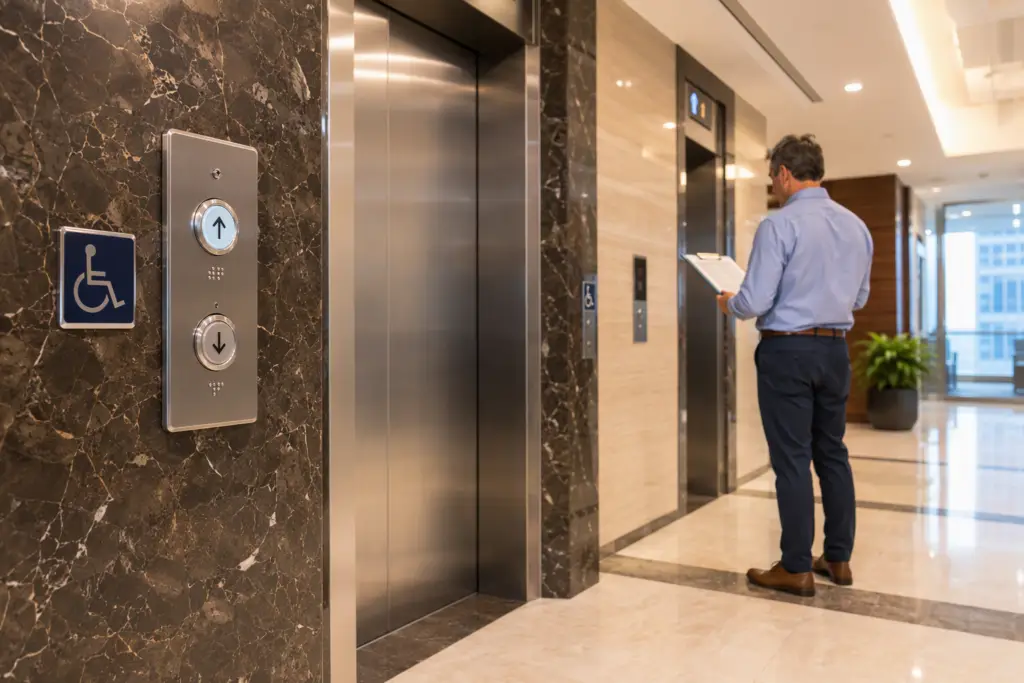
ADA requirements for elevators cover call button placement and size, floor designation signage with raised characters and Braille, audible signals at each floor, door reopening devices, and minimum car dimensions. When a building undergoes renovation, the ADA may trigger additional elevator accessibility requirements even if the elevator itself is not the primary scope of the project. Portfolio managers should include an ADA compliance review as a standing agenda item during annual elevator assessments, particularly for older equipment that predates current standards. Failure to maintain ADA compliance can expose building owners to civil rights complaints and Department of Justice enforcement actions independent of state elevator code violations.
What Happens If an Elevator Fails Inspection in a Texas Building?
When a Texas elevator fails inspection, the building owner must have cited violations corrected or under a signed correction contract within 30 days of the inspection, or must obtain a waiver or delay from TDLR — and certain critical deficiencies require immediate removal from service.
Texas law specifies that a passenger elevator without working door restrictors must be removed from service immediately. Likewise, a passenger elevator without firefighters’ service, or with non-working Phase One firefighters’ service, must be taken out of service without delay. These are not correctable-within-30-days situations — the unit must be shut down until the deficiency is remedied. Texas law also requires that any elevator accident be reported to TDLR within 24 hours. Portfolio managers should ensure their facilities teams understand these thresholds and have a direct escalation path to their elevator contractor for same-day emergency response in those situations.
What Happens If a California Elevator Operates Without a Valid Permit?
Operating an elevator in California without a valid, current Cal/OSHA permit to operate is a violation of California Labor Code Sections 7300–7324.2 and can result in enforcement action, stop-use orders, and potential liability exposure for the building owner.
California law is clear that no elevator may be operated without a valid permit. The permit must be posted conspicuously inside the elevator car, and arranging the annual reinspection is the owner’s responsibility. If a unit’s permit lapses because the owner failed to schedule reinspection in time, the building owner — not the contractor — bears the compliance obligation. For new elevators, California requires that Cal/OSHA inspect the unit and issue a permit to operate before it is placed in service. Any material alteration to an existing elevator also requires a Cal/OSHA permit before work begins. Portfolio managers with California buildings should treat permit expiration tracking as a non-delegable ownership responsibility even when a contractor handles day-to-day maintenance.
How Should Portfolio Managers Handle Elevator Emergencies Across Multiple Sites?
Every building in a multi-property portfolio should have a documented emergency response protocol that identifies who calls the elevator contractor, who notifies the relevant authority having jurisdiction, and who communicates with building occupants during and after an entrapment or equipment failure.
- Designate a primary and backup facilities contact for each building with authority to call for emergency service and, in Texas, to report accidents to TDLR within the required 24-hour window.
- Ensure the elevator contractor’s emergency service contact number is posted at each building’s elevator machine room and at the building management station.
- In the event of an entrapment, direct building staff to maintain voice communication with trapped passengers through the elevator’s two-way communication system while waiting for qualified technicians — never attempt to manually open elevator doors or assist passengers out of a stopped car.
- Once the emergency is resolved, document the event in the building’s elevator maintenance log with the time of failure, nature of the problem, response actions taken, and resolution.
- For Texas buildings, report any accident involving elevator equipment to TDLR within 24 hours of the event.
- For California buildings, follow the notification procedures required by Cal/OSHA and retain all records associated with the incident.
- Debrief with the elevator contractor after any emergency to determine whether the event reveals a maintenance gap, an inspection finding that was not corrected, or a systemic equipment issue affecting similar units across the portfolio.
How Can Portfolio Managers Evaluate and Compare Elevator Service Vendors?
Vendor evaluation for a multi-building elevator portfolio should assess regulatory credential currency, geographic coverage matching the portfolio’s footprint, contract flexibility, documentation practices, and the contractor’s demonstrated familiarity with the specific authorities having jurisdiction for each property.
Portfolio managers should request proof of TDLR registration for Texas properties and current CQCC certification and C-11 license documentation for California properties before awarding any contract. Beyond credentials, the evaluation should examine whether the contractor has direct experience with the equipment brands installed across the portfolio, can provide a consolidated compliance report across all buildings, and can accommodate both routine scheduled visits and emergency response needs in each market. AmeriTex Elevator serves multi-building clients across Houston, Dallas, Austin, San Antonio, Los Angeles, and San Diego, providing jurisdiction-specific compliance support in both the TDLR and Cal/OSHA regulatory environments.
What Records Should a Property Owner Retain for Each Elevator Unit?
For every elevator unit in a portfolio, owners should retain the current and prior compliance certificates or permits, all inspection reports, signed maintenance records, test certificates for periodic load tests, violation notices and proof of correction, and documentation of any emergency events.
In Texas, the signed inspection report from a registered inspector must be delivered to the owner within five calendar days of the inspection — that document should be filed immediately upon receipt and retained alongside the Certificate of Compliance. In California, the permit to operate must be posted in the car, and owners should retain a copy in their master files. Periodic test records — such as Texas Category 5 five-year load test certificates for traction elevators — should be filed with a reference to the next test due date so they feed the compliance calendar automatically. Maintaining digital copies accessible to the portfolio management team (not just stored in a machine room binder at a single property) is strongly recommended for multi-site operations.
What Is a Category 5 Load Test and Which Texas Buildings Require It?
A Category 5 test is a full-load safety test that verifies an electric traction elevator’s braking system, governor, and safety devices function correctly under rated load conditions, and Texas requires this test every five years on applicable traction elevator equipment.
The test is conducted by a qualified technician and witnessed by a registered inspector. Because the test requires the elevator to be taken out of service for a period of time, multi-building portfolio managers should coordinate Category 5 tests for all eligible Texas traction elevator units in advance, staggering the schedule to avoid simultaneous service disruptions across multiple buildings. The test results must be documented and retained, and the next five-year test date should be entered immediately into the portfolio’s compliance calendar. Buildings with hydraulic elevators are subject to their own periodic test requirements under the applicable edition of the ASME A17.1 Safety Code for Elevators and Escalators.
How Should New Building Acquisitions Be Onboarded Into an Existing Elevator Service Program?
When a portfolio adds a new building through acquisition, the elevator onboarding process should begin before closing, with a pre-acquisition condition assessment that identifies equipment age, maintenance history, outstanding violations, and certificate status.
Before closing, request from the seller copies of the most recent inspection report and compliance certificate for every elevator unit, any open violation orders and their correction status, the current maintenance contract and its assignability, and the equipment serial numbers and installation dates. After closing, commission an independent condition assessment by the portfolio’s qualified elevator contractor. In California, verify that a valid Cal/OSHA permit to operate is current and posted in each car, and confirm that the contractor maintaining the unit holds current CQCC certification. In Texas, confirm that the TDLR Certificate of Compliance is current, review whether the next annual inspection is approaching, and determine whether any Category 5 test is due within the next planning cycle. AmeriTex Elevator provides pre-acquisition and post-acquisition elevator assessments for portfolio clients entering or expanding in its Texas and California markets.
What Are the Most Common Compliance Failures Found in Multi-Building Portfolios?
The most common compliance failures in multi-building elevator portfolios include lapsed inspection certificates, permits not posted in the required location, unresolved violation orders, maintenance records stored only at individual properties and inaccessible to portfolio management, and contractor credentials that have expired without the owner’s awareness.
Lapsed certificates are particularly common in portfolios where inspection scheduling is delegated entirely to on-site building managers without centralized oversight. In California, the owner’s responsibility to arrange annual reinspection means that relying on a building manager who is focused on leasing and operations — rather than regulatory timelines — creates meaningful certificate-lapse risk. In Texas, the 30-day violation correction window is tight enough that a violation discovered on an inspection report that sits unread in a property manager’s inbox for two weeks leaves only a narrow window for corrective action. Centralized compliance tracking, combined with a service contractor who proactively flags upcoming deadlines, eliminates most of these failures.
How Does the ASME A17.1 Safety Code Affect Day-to-Day Maintenance Practices?
The ASME A17.1 Safety Code for Elevators and Escalators establishes the technical requirements for elevator design, installation, inspection, testing, and maintenance, and the edition adopted by each state determines the specific maintenance tasks and test intervals that apply to units in that jurisdiction.
Texas has adopted the 2016 edition, and California has adopted the 2004 edition for installations after May 1, 2008. While both editions share a common technical framework, there are differences in specific requirements for safety components, test procedures, and equipment configurations between code editions. For portfolio managers, the practical implication is that the service contractor must apply the correct edition-specific requirements to each unit based on where the building is located and when the installation contract was signed — not a one-size-fits-all maintenance checklist. California has proposed a Group V update to its Elevator Safety Orders that would incorporate ASME A17.1-2019 in part; a public hearing was held in June 2026 and no effective date has been posted as of 2026, so California properties should continue operating under the current 2004 edition requirements until official guidance is issued.
What Role Does the Authority Having Jurisdiction (AHJ) Play in Multi-Building Portfolio Management?
The authority having jurisdiction (AHJ) is the governmental body that adopts, enforces, and issues compliance certificates under elevator law in a given location, and portfolio managers must identify the correct AHJ for each property because it determines which agency issues permits, which inspectors are authorized, and which code edition applies.
For most Texas properties, the AHJ is TDLR. For properties within Houston city limits, the AHJ is the City of Houston, which operates its own elevator program independent of TDLR. For most California properties, the AHJ is Cal/OSHA’s Elevator Unit. For properties in the City of Los Angeles, the LADBS operates its own elevator and conveyance inspection program. A portfolio that spans Houston and Dallas, or Los Angeles and San Diego, therefore involves at least three distinct AHJs, each with its own certificate format, inspector qualification requirements, and enforcement procedures. Mapping each property to its correct AHJ is one of the first steps in building a functional multi-building compliance program.
How Can AmeriTex Elevator Support a Multi-State, Multi-City Portfolio?
AmeriTex Elevator provides elevator maintenance, compliance support, and inspection coordination across its Texas markets — Houston, Dallas, Austin, and San Antonio — and its California markets — Los Angeles and San Diego — giving multi-building portfolio owners a single contractor relationship across two states and multiple AHJ environments.
For portfolio clients, working with a contractor that already holds the required TDLR registration for Texas operations and the required CQCC certification and C-11 license for California operations eliminates the credential verification burden that comes with using multiple regional vendors. AmeriTex Elevator’s multi-market presence means that the same documentation standards, compliance calendar practices, and escalation protocols apply across all properties — reducing the administrative fragmentation that is the primary risk driver in multi-building elevator management. Portfolio managers interested in consolidating their elevator service program can request a comprehensive portfolio assessment covering all buildings across the Texas and California markets AmeriTex Elevator serves.
Contact AmeriTex Elevator for a free elevator assessment at 844-646-9660.
Need elevator service you can rely on? AmeriTex Elevator is ready to help.