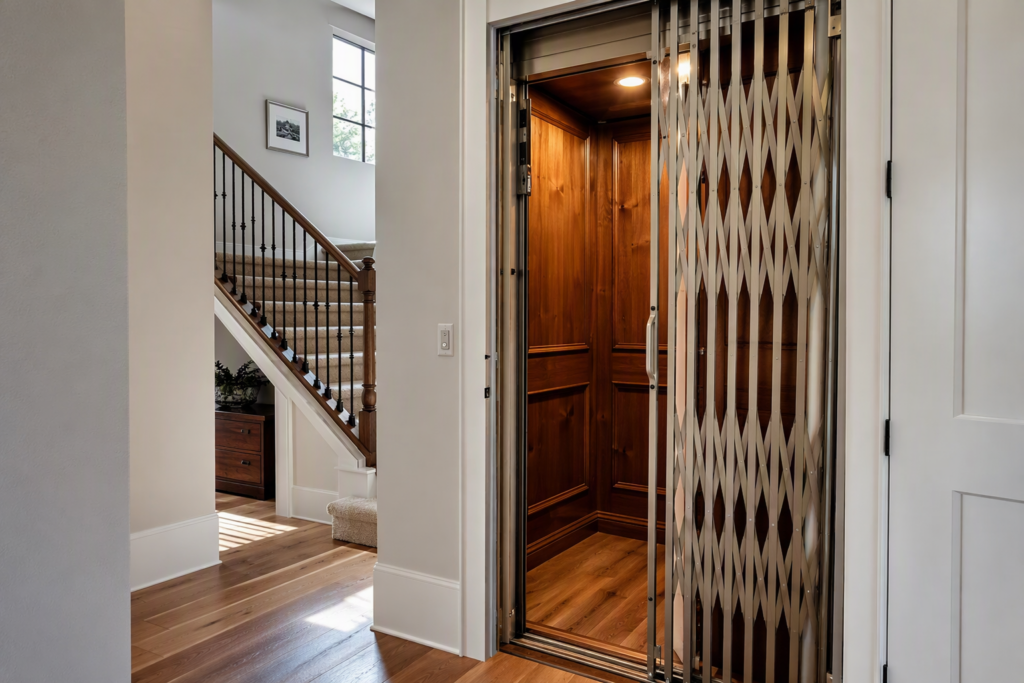
Elevator Deficiency: Complete FAQ Guide for Building Owners in Texas and California
An elevator deficiency is a documented deviation from required safety, mechanical, electrical, or accessibility standards found during an inspection or maintenance visit. Deficiencies range from minor recordkeeping gaps to critical hazards that require immediate removal of equipment from service. Understanding what a deficiency is, how it is classified, what code authority governs it, and how quickly it must be corrected is essential for every building owner operating elevators in Texas or California.
What exactly is an elevator deficiency?
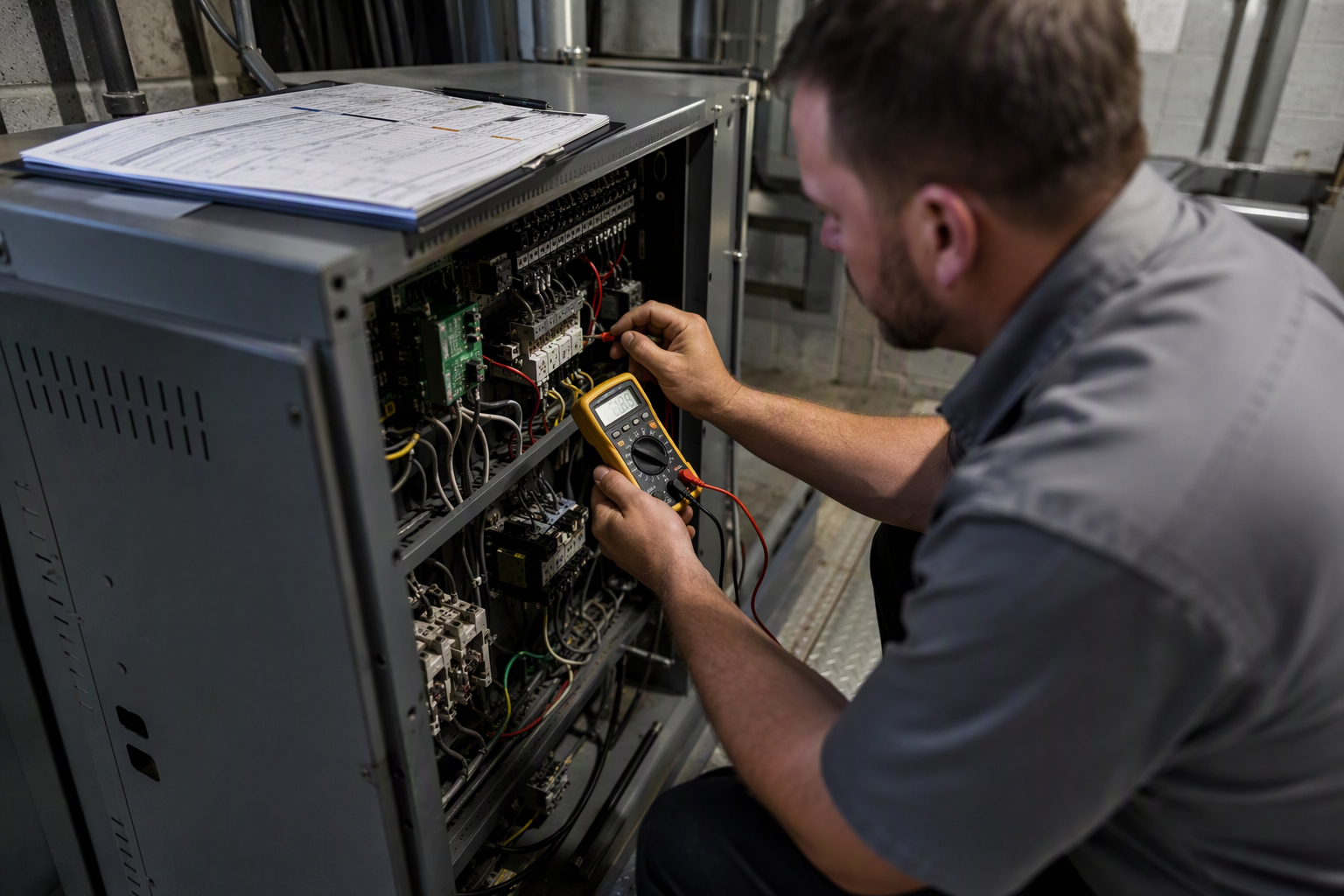
An elevator deficiency is any condition that does not conform to the safety code edition adopted by the governing authority having jurisdiction (AHJ), creating a gap between the elevator’s current state and the legal standard it must meet.
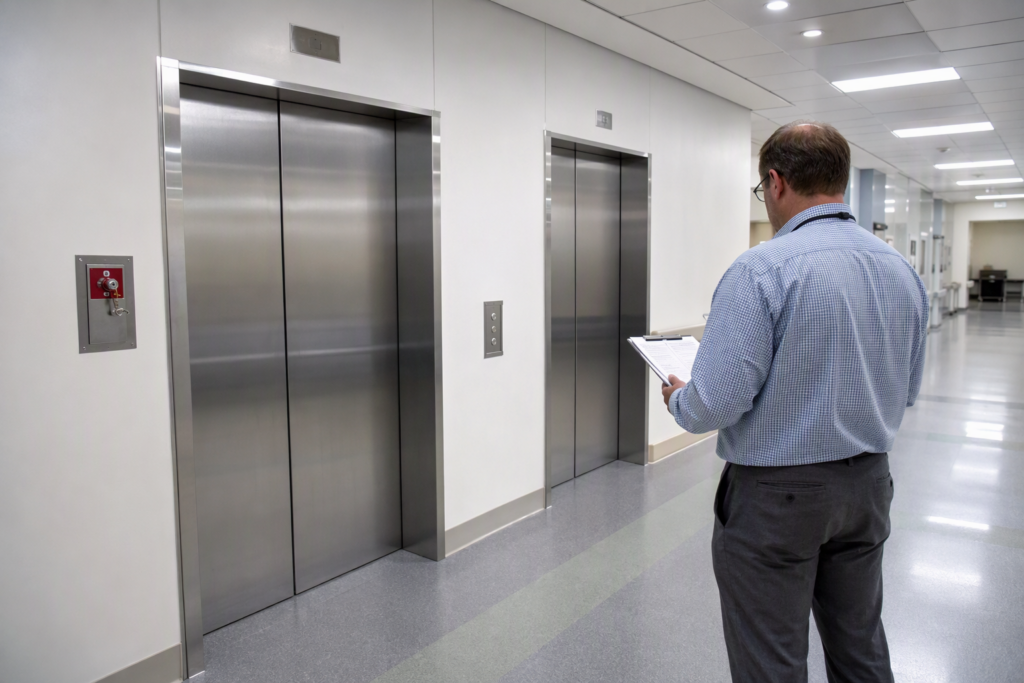
Deficiencies are formally documented on an inspection report issued by a qualified inspector. In Texas, a Texas Department of Licensing and Regulation (TDLR)-registered inspector must provide that report to the building owner within five calendar days of the inspection. In California, only State of California safety engineers or Certified Competent Conveyance Inspectors (CCCI) authorized by the Division of Occupational Safety and Health (Cal/OSHA), Elevator Unit may perform inspections and document deficiencies.
A deficiency is not the same as a routine maintenance task. Maintenance keeps equipment operating; a deficiency is a recorded non-compliance that triggers a legal obligation to correct, document, and — depending on severity — report the condition to a regulatory authority.
How are elevator deficiencies classified by severity?
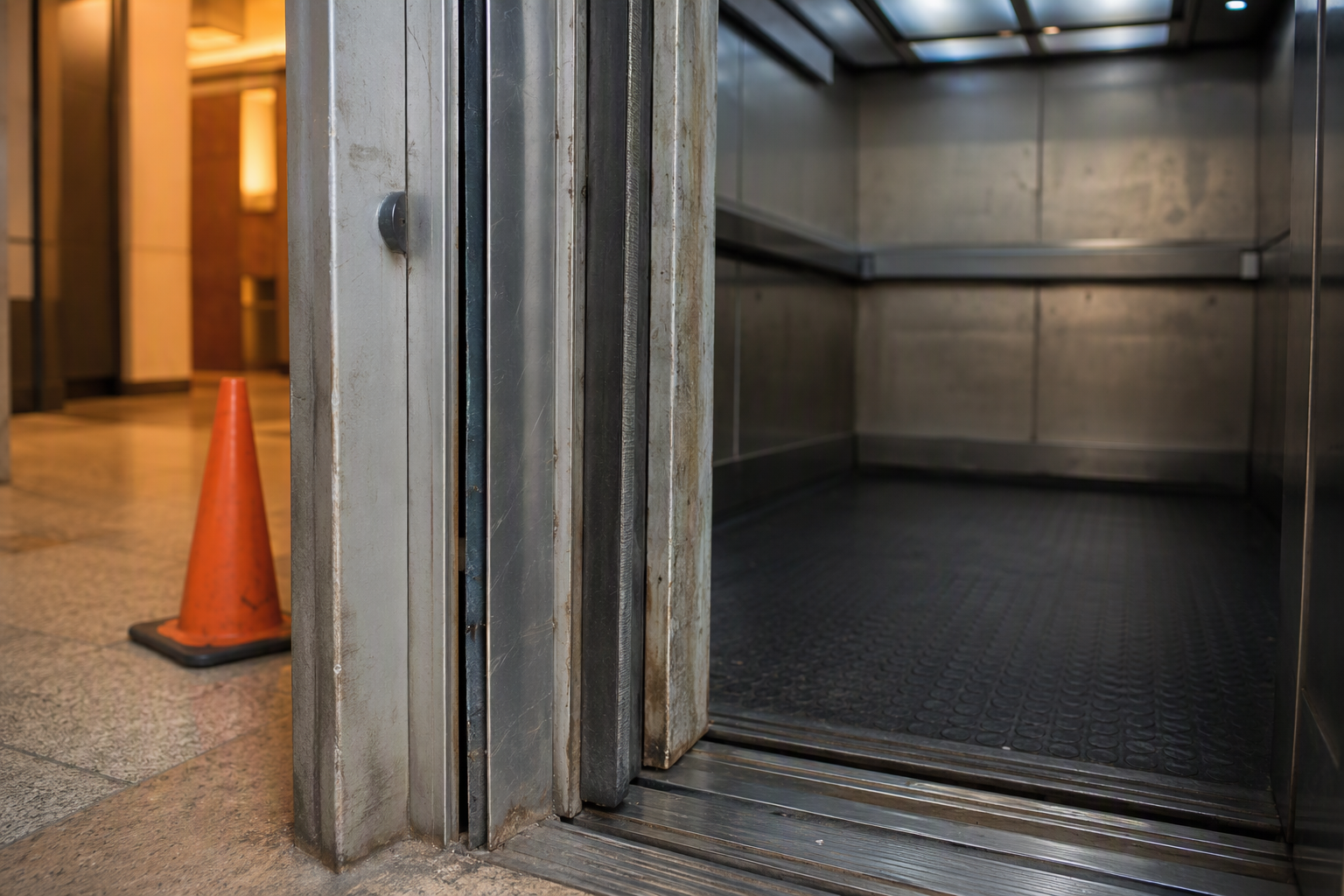
Elevator deficiencies are typically classified by the risk they pose to passengers and workers, ranging from immediately dangerous conditions that require taking the unit out of service to lower-priority items that may be scheduled for a future maintenance cycle.
The ASME A17.1 Safety Code for Elevators and Escalators establishes the technical thresholds that define whether a condition is a safety hazard. AHJs in Texas and California then translate those thresholds into enforceable classifications. Common severity tiers include:
- Immediately dangerous (out-of-service order): The elevator must be removed from service at once. Texas law explicitly mandates immediate removal for passenger elevators lacking working door restrictors or with non-functioning Phase One firefighters’ service.
- Critical deficiency: A condition that presents a significant risk of injury but may not require instant shutdown — typically must be corrected within a short, defined window or the unit is removed from service.
- Standard deficiency: A condition that does not pose an imminent hazard but violates a code requirement and must be corrected by an established deadline.
- Advisory or observation: A condition that is approaching non-compliance or that the inspector recommends addressing to prevent a future deficiency — not always a formal violation but worth acting on promptly.
What are the most common elevator deficiencies found during inspections?
The most frequently cited elevator deficiencies involve door safety systems, safety devices, lighting, emergency communication, and documentation gaps — all areas covered under ASME A17.1.
Common deficiencies across commercial and residential elevator installations include:
- Door reopening devices not functioning correctly (door sensors, light curtains)
- Door restrictors missing or inoperative — an immediately out-of-service condition in Texas
- Non-functional or absent Phase One or Phase Two firefighters’ service
- Emergency lighting below required lux levels
- Emergency stop switches not meeting current code specifications
- Oil leaks in the machine room or hydraulic system
- Pit lighting, pit stop switch, or pit ladder deficiencies
- Missing, expired, or improperly posted certificates and permits to operate
- Handrail height or grab-bar deviations affecting ADA compliance
- Overdue Category 1 or Category 5 periodic tests
- Machine room temperature or housekeeping violations
- Broken, missing, or non-functioning car operating panel buttons
What is the difference between a deficiency and an out-of-service order?
A deficiency is a documented code violation that must be corrected within a regulatory deadline, while an out-of-service order is an immediate directive to cease elevator operation because of a condition deemed an imminent threat to life safety.
In Texas, state law specifies two conditions that trigger automatic removal from service: a passenger elevator without working door restrictors, and a passenger elevator without functional firefighters’ service or with non-working Phase One firefighters’ service. Either condition discovered during or between inspections requires the building owner to pull the unit from operation immediately.
In California, Cal/OSHA has authority to order a conveyance shut down when it presents an imminent hazard. A permit to operate can be withheld or revoked, and no elevator may legally run in California without a valid, current permit posted conspicuously inside the car.
What codes govern elevator deficiencies in Texas?
In Texas, elevator deficiencies are evaluated against the ASME A17.1/CSA B44, 2016 edition, as adopted by 16 Texas Administrative Code Chapter 74, effective November 1, 2018, under the authority of TDLR’s Elevator and Escalator Safety program under Texas Health and Safety Code Chapter 754.
Building owners in Houston should be aware that TDLR does not regulate elevators within Houston city limits — the City of Houston operates its own elevator inspection and compliance program. Building owners with Houston properties should contact the city directly regarding applicable requirements and inspection procedures.
Under Texas rules, owners must have cited deficiencies corrected — or under a binding contract for correction — within 30 days of the inspection, or they must obtain a waiver or delay from TDLR. Texas also requires a Category 5 full-load test every five years on electric traction elevators, and a missed or failed Category 5 test itself constitutes a deficiency.
What codes govern elevator deficiencies in California?
In California, elevator deficiencies are evaluated against the California Code of Regulations, Title 8, Elevator Safety Orders (Sections 3000–3146) and the ASME A17.1/CSA B44, 2004 edition adopted under the Group IV Elevator Safety Orders, administered by Cal/OSHA’s Elevator Unit under California Labor Code Sections 7300–7324.2.
California has proposed a Group V update that would incorporate elements of ASME A17.1-2019; the Standards Board held a public hearing on June 18, 2026, but no effective date has been posted as of the time of publication. Until a new effective date is established, the 2004 edition remains the operative standard for most installations.
In Los Angeles, the City of Los Angeles Department of Building and Safety (LADBS) runs its own elevator and conveyance inspection program. Building owners with Los Angeles properties should verify current requirements directly with LADBS in addition to Cal/OSHA requirements.
When Cal/OSHA or a CCCI inspector identifies deficiencies, the path to resolution involves correcting the condition and scheduling a reinspection. Arranging the annual reinspection is the elevator owner’s responsibility under California law.
How quickly must elevator deficiencies be corrected?
Correction timelines depend on the severity classification and jurisdiction: immediately dangerous deficiencies require same-day shutdown; in Texas, standard deficiencies must be corrected or under contract for correction within 30 days of the inspection; California timelines are governed by Cal/OSHA’s permit and reinspection requirements.
The practical correction timeline for any deficiency follows this general structure:
| Deficiency Severity | Texas (TDLR / 16 TAC Ch. 74) | California (Cal/OSHA / Title 8) | Governing Reference |
|---|---|---|---|
| Immediately dangerous (e.g., inoperative door restrictors, failed Phase 1 firefighters’ service) | Remove from service immediately | Cal/OSHA may order immediate shutdown; no valid permit = no operation | Texas H&S Code Ch. 754; CA Labor Code §§7300–7324.2 |
| Standard deficiency | Corrected or under contract within 30 days of inspection | Correct before reinspection for permit renewal (owner arranges reinspection) | 16 TAC Ch. 74; Title 8, §§3000–3146 |
| Overdue periodic test (e.g., Category 5) | Test must be scheduled; continued operation with expired test is a deficiency | Reinspection required; permit may not be renewed without test compliance | ASME A17.1 (per adopted edition); 16 TAC §74.100(b) |
| ADA accessibility gap | ADA enforcement is separate from TDLR — consult DOJ guidance | ADA enforcement is separate from Cal/OSHA — consult DOJ guidance | ADA.gov |
| Documentation / posting deficiency (expired certificate, missing permit) | Certificate of Compliance must be displayed; remedy immediately | Permit to operate must be posted in car; remedy immediately | 16 TAC Ch. 74; CA Labor Code §7317 |
What should a building owner do immediately after receiving an elevator deficiency report?
Upon receiving a deficiency report, a building owner should immediately assess whether any condition requires the elevator to be taken out of service, then begin the formal correction and documentation process without delay.
- Read the full inspection report carefully. Identify every cited deficiency and note whether any item is flagged as immediately dangerous or as a condition requiring removal from service under applicable state law.
- Take any unit out of service that has an imminent-hazard deficiency. Post clear out-of-service notices and prevent passenger access. In Texas, missing door restrictors or inoperative firefighters’ service mandate immediate shutdown.
- Contact a qualified elevator contractor. In California, only a Certified Competent Conveyance Mechanic (CCCM) working for a Certified Qualified Conveyance Company (CQCC) may perform repair work. In Texas, any company performing elevator repair work must be registered as a contractor with TDLR.
- Prioritize and schedule all corrections. Work with the contractor to establish a written schedule that meets the applicable correction deadline — 30 days in Texas for standard deficiencies; prior to reinspection in California.
- In Texas, report any elevator accident to TDLR within 24 hours. If an accident is associated with a deficiency, reporting is mandatory under Texas Health and Safety Code Chapter 754.
- Document all repair work performed. Maintain records of parts replaced, work orders, test results, and technician credentials. These records are essential for the reinspection or permit renewal process.
- Schedule reinspection or confirm compliance submission. In Texas, obtain the updated Certificate of Compliance and display it prominently. In California, arrange the reinspection with Cal/OSHA and ensure the updated permit to operate is posted in the car before returning the unit to service.
- Review your maintenance contract. In California, a full maintenance contract with a C-11 licensed, CQCC-certified elevator company can extend the permit to operate up to two years for elevators found in safe condition — a strong incentive to maintain comprehensive service agreements.
Can an elevator with a deficiency continue to operate?
Whether a deficient elevator may remain in service depends entirely on the nature and severity of the deficiency — certain conditions mandate immediate shutdown by law, while others permit continued operation under a defined correction deadline.
In Texas, elevators with working door restrictors and functioning Phase One firefighters’ service may continue to operate while non-immediately-dangerous deficiencies are being corrected, provided corrections are completed or under contract within 30 days. However, once the 30-day window expires without correction or an approved waiver, continued operation puts the owner in violation of Texas Health and Safety Code Chapter 754.
In California, no elevator may legally operate without a valid permit to operate issued by Cal/OSHA. If deficiencies prevent permit renewal, the unit cannot run. Cal/OSHA retains authority to order shutdown at any point if an inspector identifies an imminent hazard.
Building owners who allow passengers to use an elevator under an out-of-service order or without a valid certificate or permit face significant legal and liability exposure beyond the regulatory penalties.
What is the role of ASME A17.1 in defining elevator deficiencies?
The ASME A17.1 Safety Code for Elevators and Escalators is the foundational technical standard that defines the design, construction, installation, operation, inspection, testing, maintenance, alteration, and repair requirements against which inspectors measure compliance — making it the primary benchmark for identifying deficiencies.
Both Texas and California have adopted editions of ASME A17.1 as the basis of their state elevator safety codes. Texas adopted the 2016 edition under 16 TAC Chapter 74; California adopted the 2004 edition under the Group IV Elevator Safety Orders in Title 8. When an inspector documents that a component does not meet code, the specific ASME A17.1 requirement is typically the underlying technical standard being cited, even when the state rule is the formal legal basis for the deficiency.
ASME A17.3, the Safety Code for Existing Elevators and Escalators, also plays a role: it sets retroactive requirements that existing installations must meet even if they were installed before the current code edition — meaning older elevators can receive deficiency notices for features that were not required when the unit was originally installed.
How do ADA requirements relate to elevator deficiencies?
ADA accessibility requirements under the Americans with Disabilities Act are separate from state elevator safety codes but represent an independent source of compliance obligations that can generate legal exposure for building owners, even when the elevator passes its safety inspection.
ADA elevator requirements cover items such as call button height and size, car control height, Braille and raised character signage, door timing and reopening, floor announcement systems, and cab dimensions. An elevator that satisfies all TDLR or Cal/OSHA safety requirements can still be non-compliant with the ADA if accessibility elements are missing or incorrect.
Importantly, ADA enforcement is a separate legal pathway from state elevator inspections. The U.S. Department of Justice and private litigants can pursue ADA violations independently of whether the building’s elevator has a current Certificate of Compliance or permit to operate. Building owners should treat ADA gaps as deficiencies requiring prompt correction even when they are not cited on an official state inspection report.
What happens if elevator deficiencies are not corrected on time?
Failure to correct elevator deficiencies within the required timeframe exposes building owners to regulatory penalties, loss of the certificate or permit to operate, and significant civil liability if a passenger is injured on an elevator with known unresolved deficiencies.
In Texas, operating an elevator without a valid TDLR Certificate of Compliance or operating after a 30-day correction deadline without an approved waiver or delay places the owner in violation of Texas Health and Safety Code Chapter 754. TDLR has authority to assess administrative penalties for non-compliance.
In California, operating without a valid Cal/OSHA permit to operate violates California Labor Code Sections 7300–7324.2. Cal/OSHA can issue stop-use orders, and the building owner may face fines for each day of unlawful operation.
Beyond regulatory penalties, there is serious tort liability exposure. A building owner who receives a written inspection report documenting a deficiency and fails to correct it has clear constructive notice of a hazardous condition. If a passenger is subsequently injured by that condition, the documented deficiency report becomes powerful evidence in a negligence claim.
What is a Category 5 test and how does it relate to elevator deficiencies?
A Category 5 test is a full-load, full-speed safety test of an elevator’s safeties, buffers, and governor — required under ASME A17.1 for traction elevators — and in Texas, it is mandated every five years; failure to perform this test on schedule is itself a reportable deficiency.
The Category 5 test verifies that the elevator’s primary safety systems function correctly under actual operating conditions. It must be performed by a qualified elevator mechanic and witnessed by a registered inspector. If the test reveals a failing component — such as a safety that does not engage properly — that failure is documented as a deficiency requiring immediate correction before the unit returns to service.
Building owners often discover during the Category 5 test cycle that aging components — worn governor ropes, deteriorated safeties, or undersized buffers — need replacement. Scheduling Category 5 testing proactively with a qualified contractor, rather than waiting for an inspection to cite the overdue test as a deficiency, is the most cost-effective approach to compliance. AmeriTex Elevator coordinates Category 5 testing and all required periodic tests for clients in Houston, Dallas, Austin, San Antonio, Los Angeles, and San Diego.
How does a full maintenance contract affect deficiency risk in California?
In California, a comprehensive maintenance contract with a C-11 licensed, Cal/OSHA-certified Qualified Conveyance Company (CQCC) not only keeps elevator systems in proper working order but also qualifies the owner for a permit to operate valid for up to two years rather than one — directly reducing inspection frequency and the administrative burden of annual deficiency cycles.
Under California law, only a Certified Competent Conveyance Mechanic (CCCM) employed by a CQCC may maintain, repair, alter, or replace components on a conveyance. Attempting to use uncertified personnel for elevator maintenance not only creates safety risks but also results in work that is not legally recognized for compliance purposes — and any condition created or worsened by uncertified work would constitute a deficiency. Building owners in Los Angeles and San Diego benefit from working with a CQCC-certified provider like AmeriTex Elevator to ensure all maintenance work meets Cal/OSHA standards.
What documentation should building owners keep regarding elevator deficiencies?
Building owners should maintain a complete, organized file of all inspection reports, deficiency notices, work orders, repair completion records, test results, contractor credentials, and current certificates or permits — because this documentation is the primary evidence of compliance in any regulatory audit or litigation.
Specific records to retain include:
- All annual inspection reports and any interim inspection reports
- Written deficiency notices and the dates they were received
- Signed work orders confirming the scope and completion date of each correction
- Results of all Category 1, Category 3, and Category 5 periodic tests
- Current TDLR Certificate of Compliance (Texas) or Cal/OSHA permit to operate (California) for each unit
- Contractor registration or CQCC certification documentation
- Any TDLR waivers or delays approved for deficiency correction
- Accident reports submitted to TDLR within the required 24-hour window
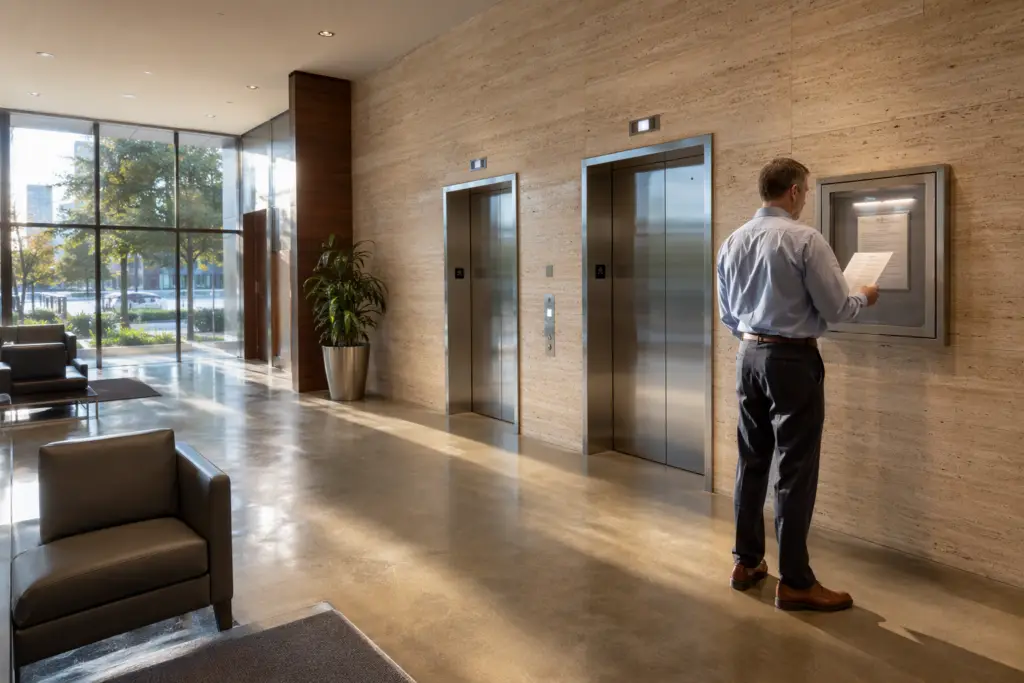
In Texas, the Certificate of Compliance must be displayed in a publicly visible area of the building. In California, the permit to operate must be posted conspicuously in the elevator car. A missing or expired posting document is itself a deficiency that inspectors cite routinely.
How do elevator deficiencies differ for hydraulic versus traction elevators?
Hydraulic and traction elevators share many common deficiency categories — door safety, lighting, firefighters’ service, ADA features — but have distinct mechanical systems that produce specific deficiency types unique to each technology.
Hydraulic elevators are particularly prone to oil leaks in the hydraulic jack, cylinder, or power unit — a deficiency that has both safety and environmental implications. A leaking hydraulic system can contaminate soil and groundwater, and California and Texas both have environmental regulations governing oil spills that operate independently of elevator safety codes. Hydraulic elevators also require periodic testing of their low-oil protection device and pressure relief valve settings.
Traction elevators face deficiency risks around governor rope condition, safety engagement, counterweight clearances, machine room equipment, and the drive machine itself. The mandatory five-year Category 5 test in Texas is specifically designed for traction elevator safety systems. Wire rope inspection — looking for broken wires, corrosion, and proper lubrication — is a common source of noted conditions on traction equipment.
Can elevator modernization clear existing deficiencies?
Modernization — the replacement of major elevator components or systems — can resolve numerous existing deficiencies at once and bring an older installation into compliance with current code requirements, but it triggers its own regulatory requirements including plan review and a new inspection before return to service.
In Texas, any registered contractor planning to install or materially alter an elevator must submit plans to TDLR and obtain approval before work begins. A post-modernization inspection is required to issue a new Certificate of Compliance. In California, a permit from Cal/OSHA is required before any conveyance is materially altered, and a new inspection by Cal/OSHA or a CCCI is required before the unit is placed back in service.
Modernization is often the most economical long-term solution when an elevator has accumulated multiple recurring deficiencies — particularly around aging door operators, obsolete controllers, or deteriorated hydraulic cylinders. AmeriTex Elevator evaluates whether targeted repairs or full modernization represents the better value for a given installation during a comprehensive assessment.
How often should elevators be inspected to minimize deficiency accumulation?
Both Texas and California mandate at least annual inspections, but proactive building owners supplement required inspections with regular preventive maintenance visits to catch and correct developing conditions before they become formal deficiencies on an official report.
Texas building owners must have elevators inspected annually by a TDLR-registered elevator inspector. California law requires every conveyance to be inspected at least once a year, with Cal/OSHA issuing a permit to operate for up to one year (or up to two years for units under a full maintenance contract with a CQCC). Inspection intervals under ASME A17.1 align with these annual requirements for most conveyance types.
Between annual inspections, monthly or quarterly maintenance visits by a qualified contractor allow technicians to identify worn components, lubrication gaps, hydraulic fluid levels, rope conditions, and door timing drift — all conditions that, if left unaddressed, will appear as deficiencies on the next annual report. Preventive maintenance is consistently less expensive than emergency repair following an inspection citation or an out-of-service order.
What should building owners look for when hiring an elevator contractor to resolve deficiencies?
When selecting a contractor to correct elevator deficiencies, building owners should verify that the company holds all required state registrations and certifications, that its mechanics are qualified under applicable law, and that the company carries the minimum required insurance for the jurisdiction where the work will be performed.
In California, the contractor must be certified by Cal/OSHA as a Certified Qualified Conveyance Company (CQCC), hold a current C-11 Elevator Contractor license issued by the California Contractors State License Board (CSLB), and carry certificates of workers’ compensation and liability insurance. All mechanics performing unsupervised work must be certified by Cal/OSHA as Certified Competent Conveyance Mechanics (CCCMs). California CQCC, CCCM, and inspector certificates expire every two years and require at least eight hours of continuing education for renewal.
In Texas, the contractor must be registered with TDLR as an elevator contractor, carry general liability insurance of at least $1,000,000 per occurrence for bodily injury or death and $500,000 per occurrence for property damage, and designate one or two responsible parties with at least three years of elevator contractor experience. Contractor registrations expire annually.
AmeriTex Elevator operates across Houston, Dallas, Austin, San Antonio, Los Angeles, and San Diego with the required state credentials and insurance for each market, making it a straightforward choice for building owners managing deficiency corrections across multiple properties or jurisdictions.
Are elevator deficiencies publicly reported or searchable?
In Texas, TDLR maintains public records of elevator registration and compliance, and building owners can research elevator inspection status through the TDLR’s public database; in California, Cal/OSHA’s permit and inspection records are accessible through public records processes, though the depth of online searchability varies.
For building owners, prospective tenants, and real estate due diligence teams, the practical approach is to request current copies of the Certificate of Compliance (Texas) or permit to operate (California) directly from the building owner or property manager, and to review the most recent inspection report. In Texas, a TDLR-registered inspector must provide the inspection report to the owner within five calendar days — that report is the authoritative deficiency record.
In any real estate transaction or lease negotiation involving a building with elevator equipment, requesting and reviewing recent inspection reports and outstanding deficiency notices is standard due diligence. Unresolved deficiencies are a material risk factor that can affect property valuation, lease terms, and liability insurance rates.
Contact AmeriTex Elevator for a free elevator assessment at 844-646-9660.
Need elevator service you can rely on? AmeriTex Elevator is ready to help.