Elevator Bid Review: What Building Owners and Facility Managers Need to Know

Building owners and facility managers in Texas and California face significant financial and regulatory risk when selecting an elevator contractor without a structured bid review process. A poorly evaluated proposal can result in code violations, budget overruns, inadequate maintenance coverage, and liability exposure. This FAQ hub covers every dimension of elevator bid review — from decoding proposal language to verifying contractor credentials under state law — to help owners make informed, defensible decisions.
What Is an Elevator Bid Review and Why Does It Matter?
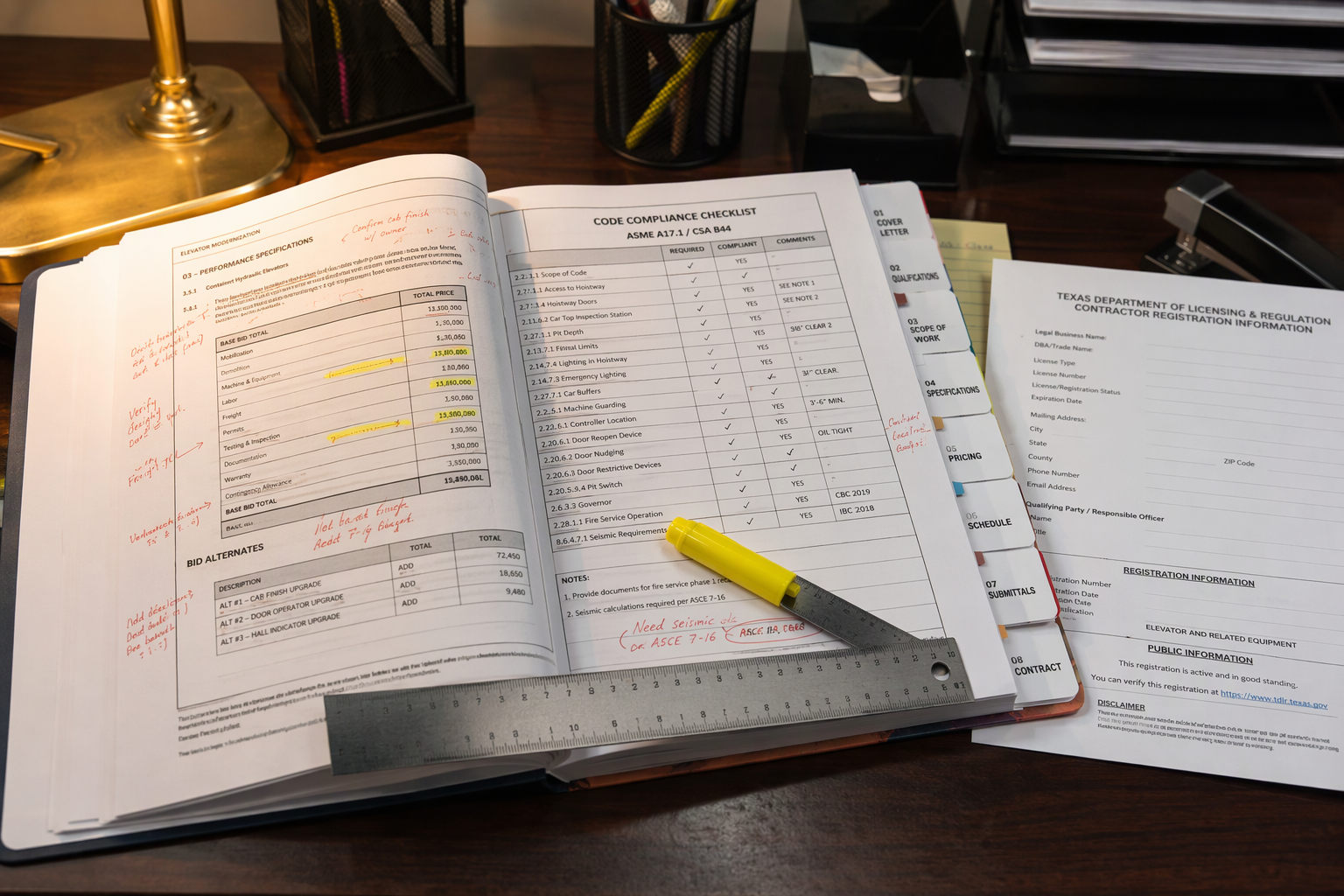
An elevator bid review is a formal evaluation process that compares competing contractor proposals across scope, compliance, qualifications, and total cost of ownership to identify the strongest and most compliant offer.
Unlike a simple price comparison, a thorough bid review examines whether the proposed scope of work meets the edition of ASME A17.1/CSA B44 adopted in the jurisdiction, verifies that the contractor holds the required state registrations or certifications, and assesses whether maintenance terms and warranty language protect the building owner over the life of the contract. In Texas, the applicable code is ASME A17.1/CSA B44, 2016 edition, as amended by 16 Texas Administrative Code Chapter 74. In California, the operative edition for most existing installations is ASME A17.1/CSA B44, 2004 edition under the California Code of Regulations, Title 8, Elevator Safety Orders.
Skipping a structured review often leads to awarding contracts to the lowest bidder whose proposal omits safety upgrades, uses non-compliant components, or excludes critical testing requirements — exposing the owner to citation, shutdown orders, and personal injury liability.
What Should Every Elevator Bid Include Before Review Begins?
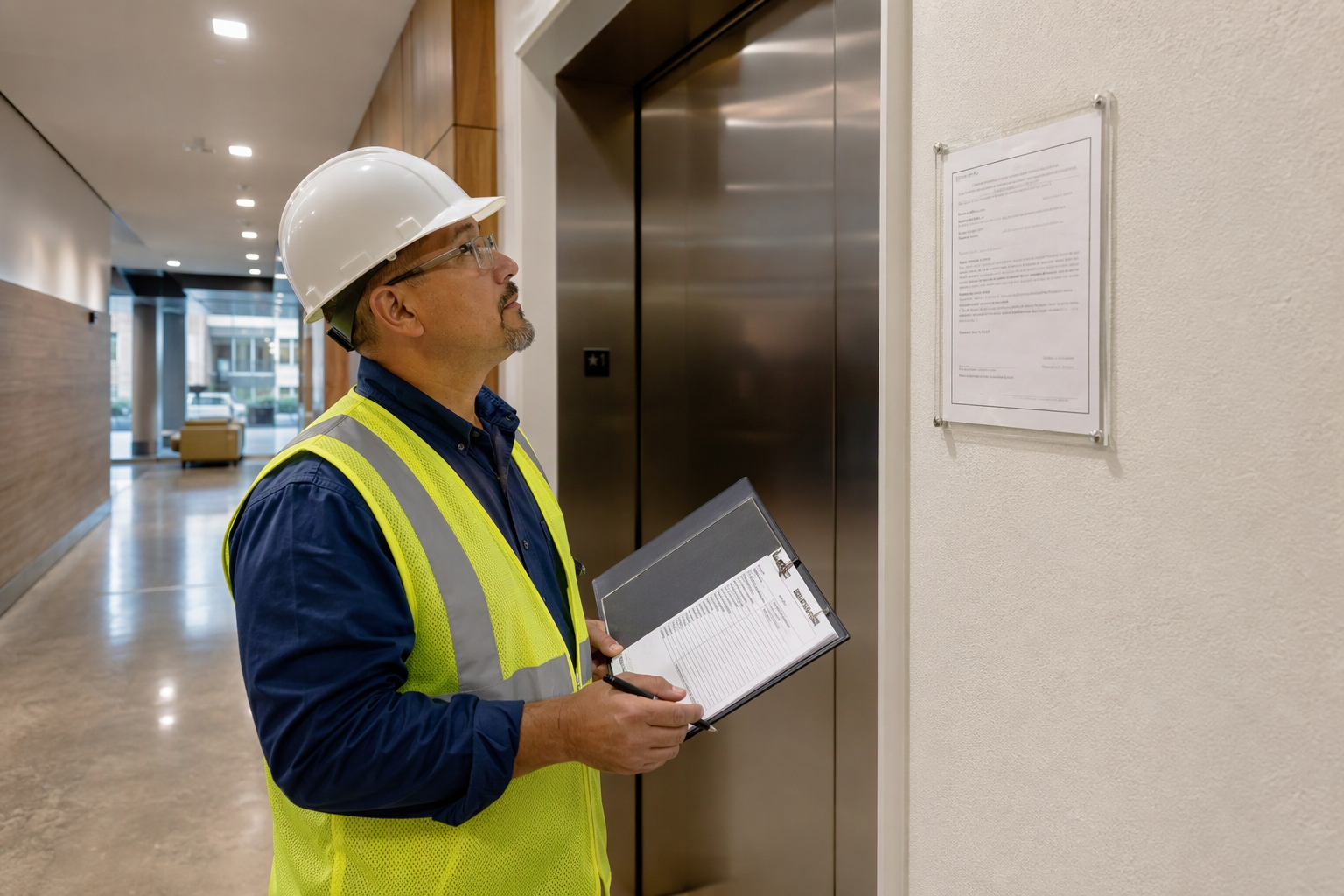
A complete elevator bid must include a detailed scope of work, unit specifications, applicable code references, contractor qualifications, insurance certificates, project schedule, payment terms, warranty duration, and exclusions — anything missing is a red flag that requires clarification before evaluation.
Reviewers should request bids in a standardized format so comparisons are apples-to-apples. At minimum, each proposal should identify: the specific equipment model and manufacturer, the edition of ASME A17.1 the work will comply with, the inspection and testing plan, and the contractor’s state registration number. In Texas, contractors must be registered with the Texas Department of Licensing and Regulation (TDLR). In California, companies must hold a Certified Qualified Conveyance Company (CQCC) certification from Cal/OSHA and a C-11 Elevator Contractor license from the California Contractors State License Board.
Proposals that arrive without insurance documentation, state registration numbers, or a clear scope narrative should be returned for revision or disqualified from evaluation entirely.
How Do You Verify That a Bidding Contractor Is Legally Qualified to Work in Texas?
In Texas, any person or company that installs, repairs, alters, tests, or maintains elevator equipment must be registered as a contractor with TDLR, and that registration must be current at the time of bid submission.
Owners should verify the contractor’s TDLR registration number directly on the TDLR public search portal and confirm that general liability insurance meets the statutory minimums: at least $1,000,000 per occurrence for bodily injury or death and $500,000 per occurrence for property damage, as required under 16 Texas Administrative Code Chapter 74. Texas contractor registrations expire one year after issuance, so a registration that was valid when the contractor was last hired may no longer be active.
Additionally, bid reviewers should confirm that the contractor has designated one or two responsible parties with at least three years of elevator contractor experience, as required by Texas law. Houston-based projects require extra attention: TDLR does not regulate elevators inside Houston city limits, as the City of Houston operates its own elevator program. Owners with properties in Houston should verify compliance with the city’s requirements separately.
AmeriTex Elevator maintains its TDLR registration and required insurance coverage and serves building owners throughout Dallas, Austin, and San Antonio, where TDLR jurisdiction applies.
How Do You Verify That a Bidding Contractor Is Legally Qualified to Work in California?
In California, a company must hold both a Certified Qualified Conveyance Company (CQCC) certification from Cal/OSHA and a C-11 Elevator Contractor license from the California Contractors State License Board before it may legally install, alter, maintain, repair, or service any conveyance.
Under California Labor Code Sections 7300–7324.2, only a Certified Competent Conveyance Mechanic (CCCM) working for a CQCC may perform hands-on work on a conveyance. Bid reviewers should request documentation of the company’s CQCC certification number and confirm that the mechanics assigned to the project hold current CCCM credentials. California CQCC, CCCM, and conveyance inspector certificates are valid for two years, and renewal requires at least eight hours of continuing education — so reviewers should check that certificates have not lapsed.
Los Angeles building owners should note that the City of Los Angeles, Department of Building and Safety (LADBS), operates its own elevator and conveyance inspection program. Verifying contractor standing with LADBS in addition to Cal/OSHA is advisable for Los Angeles projects. AmeriTex Elevator serves building owners in Los Angeles and San Diego, California.
What Is the Difference Between a Maintenance Bid, a Modernization Bid, and an Installation Bid?
These three bid types differ fundamentally in scope, code triggers, and long-term financial commitment, and each requires a distinct review framework.
| Bid Type | Typical Scope | Primary Code Trigger | Key Review Focus |
|---|---|---|---|
| New Installation | Full design, supply, and installation of new elevator system | ASME A17.1 (new construction edition adopted by jurisdiction), ADA | Permit submission plan, inspection timeline, code edition compliance, warranty on all components |
| Modernization / Alteration | Replacement of major components (controls, cab, door operators, drive) | ASME A17.1 alteration rules; jurisdiction-adopted edition | Which components trigger full code upgrade, permit required before work, materials specified |
| Maintenance Contract | Routine inspection, lubrication, adjustment, and repair response | ASME A17.1 maintenance requirements; state inspection intervals | What is included vs. excluded, callback response terms, parts coverage, contract exit provisions |
| Repair / Emergency Work | Targeted repair of failed or deficient components | ASME A17.1 safety requirements; state violation correction deadlines | Scope of repair vs. code-required upgrade, timeline, compliance documentation |
In Texas, before installing or making material alterations to an elevator, the registered contractor must submit plans to TDLR and obtain approval. In California, a permit from Cal/OSHA is required before a conveyance is erected, installed, or materially altered. Bids for new installation or modernization work that do not address the permit submission process are incomplete.
What Red Flags Should an Owner Look for When Reviewing an Elevator Maintenance Bid?
The most common red flags in maintenance bids are vague scope language, broad exclusion lists, automatic contract renewal clauses with long notice windows, and pricing structures that separate labor from parts — all of which shift future costs and risk entirely onto the building owner.
A maintenance bid should explicitly state which components are covered, what constitutes an included repair versus a billable extra, and whether callbacks after hours are included or billed separately. Bids that use the phrase “lubrication, inspection, and adjustment only” with no parts coverage often leave owners financially exposed for the most common failure points, such as door operators, controller boards, and hydraulic seals.
Owners should also scrutinize contract duration and termination provisions. Multi-year agreements with 90-day or longer cancellation notice windows and automatic renewal clauses can lock a building into an underperforming contractor for years. Finally, any maintenance bid should clearly state that the contractor will coordinate annual inspection scheduling, since in California, arranging the annual reinspection is the elevator owner’s legal responsibility under Cal/OSHA’s rules, and in Texas, building owners must obtain a TDLR Certificate of Compliance for each unit annually.
How Should ADA Compliance Requirements Be Addressed in an Elevator Bid?
Any elevator bid involving new installation, alteration, or modernization must address Americans with Disabilities Act (ADA) accessibility requirements, including cab dimensions, control panel reach ranges, door timing, and two-way communication systems.
The ADA Standards for Accessible Design, as enforced under Title III for public accommodations and Title II for state and local government facilities, establish technical criteria for elevator accessibility. When an alteration triggers the path-of-travel obligation, the scope of ADA-compliant work required may extend beyond the elevator cab itself. Bids that acknowledge ADA requirements only superficially — or not at all — may expose the owner to costly retrofit work after project completion.
Reviewers should require that each bid identifies which ADA provisions apply to the specific project scope, how the proposed design or components meet those provisions, and whether a qualified accessibility consultant has been engaged. This is particularly important for projects in older buildings in Houston, Dallas, Los Angeles, and San Diego, where the existing physical footprint may constrain compliance options and require creative solutions that must be priced into the bid.
What Should a Bid Review Checklist Include for Texas Properties?
A Texas elevator bid review checklist should verify TDLR contractor registration, state-minimum insurance coverage, ASME A17.1-2016 code compliance, plan submission requirements, annual inspection coordination, and the contractor’s process for handling the five-year Category 5 full-load test on traction elevators.
Under Texas Health and Safety Code Chapter 754 and 16 Texas Administrative Code Chapter 74, Texas requires a Category 5 full-load test every five years on electric (traction) elevators. Maintenance bids for traction elevator portfolios should address how and when this test will be performed and who bears the cost. If a bid is silent on Category 5 testing, owners should require clarification before signing.
Texas law also requires that a passenger elevator without working door restrictors, or without working Phase One firefighters’ service, must be removed from service immediately. Bids that include safety system inspection and testing for these components provide meaningfully stronger protection than those that do not. Owners must also confirm that any cited violations will be corrected or under contract to be corrected within 30 days of an inspection, as required by TDLR rules. Building owners outside Houston who award contracts to unregistered TDLR contractors assume legal liability for any violations that result.
What Should a Bid Review Checklist Include for California Properties?
A California elevator bid review checklist must verify Cal/OSHA CQCC certification, C-11 license, CCCM credentials for field mechanics, permit applications for any installation or alteration, and a clear plan for coordinating annual inspection under California Labor Code Sections 7300–7324.2.
California law prohibits any elevator from operating without a valid, current permit to operate issued by Cal/OSHA, and that permit must be posted conspicuously in the elevator car. Bids for new equipment or modernizations must address the inspection and permit issuance process before the unit is placed in service. For existing equipment, maintenance bids should describe how the contractor will support the owner in fulfilling the annual reinspection obligation, since California places that responsibility on the owner.
California’s elevator law applies the ASME A17.1/CSA B44, 2004 edition under the Group IV Elevator Safety Orders for most existing installations. Owners should be aware that California has proposed a Group V update that would incorporate elements of ASME A17.1-2019; a public hearing was held on June 18, 2026, but no effective date has been announced. Bids for new or substantially altered equipment should address how the contractor will handle any transition in adopted code edition.
How Do You Compare Elevator Bids When Prices Differ Significantly?
Significant price differences between elevator bids almost always reflect differences in scope, materials, exclusions, or contractor qualifications — not simply profit margin — and a lower bid price rarely represents lower total cost of ownership when these variables are accounted for.
The correct approach is to normalize bids to a common scope before comparing prices. If one bid specifies OEM replacement parts and another specifies aftermarket equivalents, the lifecycle cost and warranty implications differ substantially. Similarly, if one bid includes all code-required testing (such as Category 5 testing in Texas or annual inspection coordination in California) and another bills these as extras, the apparent price gap narrows or reverses when total annual costs are calculated.
Owners should request itemized breakdowns from every bidder, then build a comparison matrix that lines up specific line items: labor rates, parts coverage, testing fees, permit fees, and emergency callback terms. AmeriTex Elevator can assist building owners in Texas and California in structuring this analysis before proposals are solicited, reducing the complexity of the bid review process.
How Should Warranty and Liability Terms Be Evaluated in an Elevator Bid?
Warranty and liability terms define who is financially responsible when equipment fails or causes injury, and bids with vague or one-sided language in these sections can leave building owners exposed to costs and claims that the contractor should bear.
Reviewers should look for the following in every bid: the duration of the warranty on labor and parts separately, whether the warranty covers consequential damages or only the repair itself, indemnification language that clearly allocates liability for contractor negligence, and whether the contractor’s insurance certificate names the building owner as an additional insured. Contracts that contain broad limitation-of-liability clauses capped at the contract value may be appropriate for maintenance agreements but are risky for major installations or modernizations where property damage or personal injury exposure is higher.
Under ASME A17.1, the owner has ongoing responsibility for maintaining elevators in safe operating condition. Warranty language that shifts too much post-installation responsibility back to the owner — particularly for code compliance — should be negotiated before signing.
What Is the Process for Reviewing an Elevator Modernization Bid Step by Step?
Reviewing an elevator modernization bid requires a structured sequence of steps to ensure that scope, compliance, contractor qualifications, and financial terms are all evaluated before a decision is made.
- Confirm the bid defines which specific components are being replaced and which are being retained, and identify whether any retained components will trigger code upgrade requirements under ASME A17.1 alteration rules.
- Verify that the contractor holds the required state credentials: TDLR registration in Texas, or CQCC certification and C-11 license in California, depending on the project location.
- Confirm that the bid addresses permit submission requirements before work begins — required by TDLR in Texas and Cal/OSHA in California for material alterations.
- Review the equipment specifications to confirm the proposed components match or exceed the grade and manufacturer specified, and that lead times are realistic for the project schedule.
- Evaluate the testing and commissioning plan, including who performs the final inspection and how the owner obtains the Certificate of Compliance (Texas) or permit to operate (California) before the unit returns to service.
- Assess warranty terms on new components, particularly drive systems, controllers, and door operators, which represent the highest-cost failure points post-modernization.
- Compare exclusions across all bids to identify hidden costs — work that one contractor includes in scope another may bill as a change order.
- Check that ADA accessibility requirements are addressed for the altered cab and control panel, since an alteration can trigger path-of-travel obligations.
- Confirm payment milestones are tied to verifiable project events, not calendar dates, to protect the owner if the schedule slips.
- Obtain clarifications in writing for any ambiguous terms before the contract is awarded.
How Do Inspection Requirements Affect the Elevator Bid Review Process?
Understanding annual inspection requirements in Texas and California is essential to bid review because maintenance contracts that do not address inspection coordination may leave building owners out of compliance and exposed to citation or unit shutdown.
In Texas, building owners must have elevators inspected annually by a TDLR-registered elevator inspector and must obtain a Certificate of Compliance for each unit, valid for one year. The building owner has the sole right to select the inspector. The inspector must deliver the inspection report within five calendar days of the inspection. Bids for maintenance contracts should clarify whether the contractor facilitates inspection scheduling and what process they follow when violations are cited — since Texas owners must have violations corrected or under contract to be corrected within 30 days.
In California, every conveyance must be inspected at least once a year, and arranging the reinspection is the owner’s legal responsibility. Only State of California safety engineers and Certified Competent Conveyance Inspectors (CCCI) may perform these inspections — the maintenance contractor cannot self-certify compliance. Cal/OSHA may issue a permit to operate for up to two years for elevators in safe condition covered by a full maintenance contract with a C-11 licensed company, which can reduce the administrative burden on owners who select qualified contractors.
What ASME A17.1 Provisions Should a Bid Reviewer Understand?
Bid reviewers do not need to read the entire ASME A17.1 Safety Code for Elevators and Escalators, but understanding its structural logic — new equipment requirements versus alteration requirements versus maintenance requirements — allows reviewers to identify when a contractor’s proposed scope is deficient.
ASME A17.1 distinguishes between requirements that apply to new installations and those that apply when existing equipment is altered. When a modernization project triggers an alteration under the code, additional safety features may be required on components that were not part of the original scope — a point that contractors sometimes omit from bids to keep initial prices competitive. Reviewers should require every bid to explicitly state which edition of ASME A17.1 governs the work (determined by the jurisdiction’s adopted edition), and to list which code sections the scope is designed to satisfy.
The code also establishes maintenance requirements that form the baseline for evaluating maintenance bids. Maintenance contracts that describe obligations in vague terms without reference to the code’s maintenance provisions may not cover everything the code requires the owner to maintain.
How Should Building Owners Evaluate Elevator Bids for Multi-Unit or High-Rise Properties?
Multi-unit and high-rise properties require bid structures that account for group dispatch system compatibility, coordinated outage planning, spare parts stocking, and the financial and regulatory risk of having multiple units out of service simultaneously.
For high-rise properties, the bid should address whether the proposed equipment or maintenance approach is compatible with the existing group supervisory control system, since mismatched controls can degrade dispatch efficiency building-wide. Bids should also specify parts stocking commitments — high-rise property managers cannot afford extended lead times on critical components when multiple units serve a single building population.
For modernization projects on multiple units, bid reviewers should evaluate whether the contractor can stagger the work to maintain minimum service levels and what the contingency plan is if a unit fails during active modernization of an adjacent unit. AmeriTex Elevator works with multi-unit property owners in Houston, Dallas, Austin, San Antonio, Los Angeles, and San Diego to structure bid requirements that address these operational realities before proposals are solicited.
What Role Does OSHA Play in Elevator Contractor Bid Evaluation?
Federal OSHA regulations establish workplace safety standards that elevator contractors must comply with during installation, maintenance, and repair work, and a contractor’s safety record and OSHA compliance posture are legitimate factors in bid evaluation.
Owners evaluating bids for major installation or modernization work should request the contractor’s OSHA 300 log (recordable injury and illness log) for the past three years, or at minimum ask how the contractor documents and manages jobsite safety. Contractors with high incident rates or unresolved OSHA citations introduce liability risk to the owner’s property.
OSHA’s construction and general industry standards apply to elevator work depending on the nature of the task, and a compliant contractor will have documented safety programs, fall protection protocols, lockout/tagout procedures, and confined space entry plans that are relevant to elevator work. Bids from contractors who cannot produce safety documentation should be evaluated with that gap in mind.
How Do Contract Exclusions in Elevator Bids Affect Long-Term Cost?
Contract exclusions in elevator maintenance bids are the single most common source of dispute between building owners and service contractors, because excluded items become billable at unregulated rates whenever they fail.
Common exclusions to scrutinize include: wire rope and hoist ropes, controller and logic boards, hydraulic cylinders and underground piping, cab interiors and lighting, door sills and gibs, and proprietary diagnostic software. Each of these components has a meaningful failure rate over a multi-year maintenance contract, and their exclusion can generate costs that exceed the annual contract value in a single service event.
Owners should request that every bidder provide a comprehensive exclusion list in plain language, then compare exclusions across bids using the same line-item framework used for price comparison. A bid priced modestly higher with comprehensive parts coverage may represent substantially lower total cost of ownership than a low-bid contract with extensive exclusions. Engaging AmeriTex Elevator during the pre-bid specification phase can help owners draft scope language that minimizes exclusion ambiguity before proposals are issued.
What Questions Should Be Asked at an Elevator Bid Clarification Meeting?
A bid clarification meeting — also called a scope clarification or pre-award meeting — is an opportunity to resolve ambiguities in proposals before contract award, and owners should prepare specific, written questions rather than conducting an open-ended conversation.
Recommended questions include: Which edition of ASME A17.1 governs this work, and what specific sections does the proposed scope address? How will permit applications and inspection scheduling be managed? What is the contractor’s process when a violation is cited by the inspector — specifically, who coordinates the correction and within what timeline? Are all components in the scope OEM, or will aftermarket parts be used, and under what circumstances? How is an emergency callback handled outside business hours, and what is the billing structure for that service? Who is the designated responsible party on this project, and what is their experience level?
Answers to these questions should be documented and, where material, incorporated into the final contract as written representations. Verbal assurances made in clarification meetings but absent from the signed contract are unenforceable.
How Should Elevator Bid Review Differ for Hydraulic Versus Traction Elevators?
Hydraulic and traction elevators have fundamentally different mechanical systems, failure modes, maintenance profiles, and code-required testing intervals, which means bids for each type must be evaluated against different technical benchmarks.
For hydraulic elevators, bids should address the condition and warranty of the hydraulic cylinder, the type and environmental handling of hydraulic fluid (particularly for older units with potential underground cylinder corrosion), and the leak detection and containment plan. Underground single-bottom cylinders in older hydraulic elevators represent a significant environmental liability that should be addressed in the modernization bid scope.
For traction elevators in Texas, the five-year Category 5 full-load test required under 16 Texas Administrative Code Chapter 74 must be addressed in both maintenance bids and modernization bids. The bid should specify who performs the test, what equipment is required, and whether the cost is included or billed separately. Traction elevator bids should also address machine room conditions, rope condition assessment intervals, and governor and safeties testing schedules consistent with ASME A17.1 requirements.
When Should a Building Owner Hire a Third-Party Elevator Consultant for Bid Review?
A third-party elevator consultant adds the most value in bid reviews for large-scale new installations, complex modernizations, multi-unit portfolios, or any situation where the owner lacks internal technical expertise to evaluate competing proposals on an equal footing with contractors.
Consultants typically provide services including specification writing, bid solicitation management, proposal evaluation, and contract negotiation support. Their involvement is particularly valuable when the project involves proprietary equipment that limits future competitive bidding, or when a previous service relationship with a contractor makes it difficult to objectively evaluate that contractor’s proposal against competitors.
Even when a consultant is not engaged, owners benefit from working with an experienced service provider during the pre-bid phase. AmeriTex Elevator provides assessments for building owners in Texas and California that help identify the right scope questions to ask before bids are solicited, reducing the information asymmetry that often favors contractors over building owners in the bid process.
What Are the Most Common Mistakes Building Owners Make During Elevator Bid Review?
The most common and costly mistakes in elevator bid review are awarding on price alone without normalizing scope, failing to verify contractor credentials before bid submission, neglecting to specify the governing code edition, and signing maintenance contracts without reading exclusion lists.
Additional common mistakes include: accepting verbal scope clarifications without written confirmation; ignoring contract auto-renewal clauses until it is too late to exit; failing to include code-required testing (such as Category 5 testing in Texas) in the scope specification; and not requiring that the contractor coordinate permit and inspection processes as part of the contracted scope rather than treating them as the owner’s separate responsibility.
Building owners who invest time in a structured bid review process — using standardized bid formats, written clarification questions, and a line-item comparison matrix — consistently achieve better contract terms, clearer accountability, and lower lifecycle costs than those who evaluate bids informally. The bid review process is also the most effective point at which to establish expectations about regulatory compliance, since it is far more difficult to negotiate compliance obligations after a contract has been executed.
Contact AmeriTex Elevator for a free elevator assessment at 844-646-9660.
Need elevator service you can rely on? AmeriTex Elevator is ready to help.