Elevator Installation Timeline in Houston, TX | AmeriTex Elevator
Getting a new elevator into service in a Houston commercial building involves more moving parts than most building owners anticipate. From the moment a contract is signed, the timeline is shaped by equipment manufacturing schedules, engineering plan submissions, construction coordination, and regulatory checkpoints—each of which must be completed in sequence before a building can reach certificate of occupancy. Understanding every phase helps owners and developers plan accurately and avoid costly delays.
What Are the Major Phases of a Commercial Elevator Installation?
A commercial elevator project moves through several distinct phases, and each phase must be substantially complete before the next one begins.
- Project scoping and contract execution. The building owner and elevator contractor align on equipment type, cab capacity, speed, travel distance, number of stops, finishes, and accessibility requirements under the Americans with Disabilities Act (ADA). The contract is signed and a deposit is typically required to begin engineering.
- Engineering and shop drawings. The elevator contractor prepares engineered shop drawings that reflect the specific equipment to be installed. This phase often takes four to eight weeks depending on the complexity of the system and the contractor’s engineering queue.
- Plan submission and City of Houston approval. Houston runs its own elevator program independent of the Texas Department of Licensing and Regulation (TDLR). Plans must be submitted to the City of Houston and approved before installation work begins. Plan review timelines vary based on project complexity and municipal workload.
- Equipment manufacturing and lead time. After plans are approved, the elevator equipment is ordered or released from the manufacturer. Lead times for commercial elevator equipment range widely—from a few months for standard hydraulic units to six months or longer for custom traction systems or specialty configurations. Supply chain conditions in 2026 continue to influence lead times.
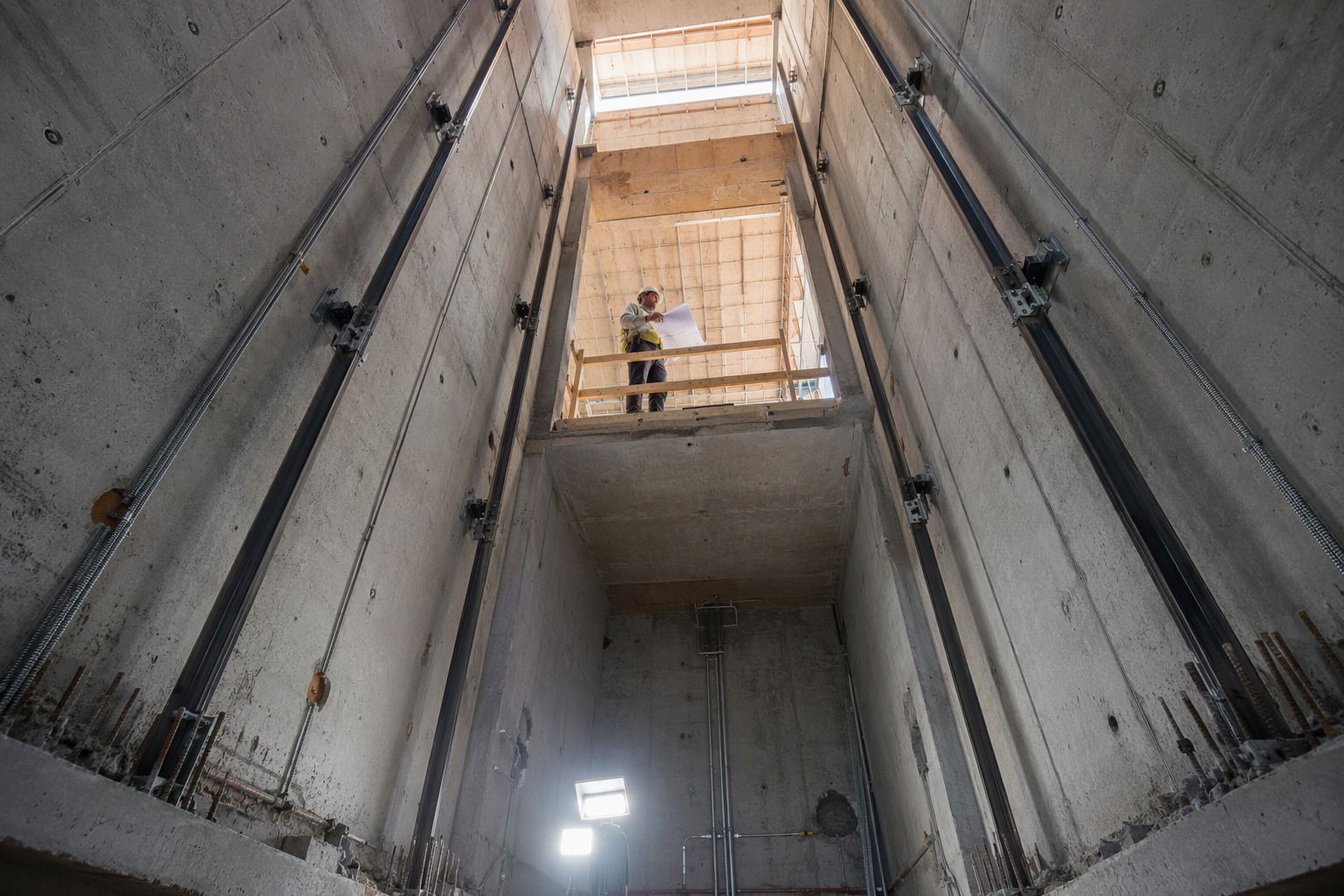
- Hoistway and machine room construction. The general contractor prepares the hoistway, pit, overhead, and machine room (or machine space for machine-room-less systems) to tolerances specified in the shop drawings. Coordination between the elevator contractor and the GC is critical at this stage; delays in the structure directly delay equipment installation.
- Equipment installation. Once the hoistway is ready and equipment is on-site, the elevator contractor installs the mechanical, electrical, and control systems. Installation duration depends on the number of units and system complexity but commonly spans several weeks to a few months.
- Inspection and certificate of compliance or certificate of occupancy. When installation is complete, the City of Houston performs its inspection. The building cannot receive a certificate of occupancy for the elevator until the unit passes inspection and all required documentation is in order.
How Long Does Each Phase Realistically Take?
When all phases are stacked together, a straightforward hydraulic elevator in a low-rise Houston commercial building might reach certificate of occupancy in six to nine months from contract signing under favorable conditions. A mid-rise traction elevator project with custom finishes, longer equipment lead times, and more complex structural coordination can run twelve to eighteen months or longer. Projects that encounter plan resubmittals, permit delays, construction schedule slippage, or equipment back-orders can extend further. Building owners should build schedule contingency into their project timelines rather than assuming best-case durations.
What Houston-Specific Regulatory Steps Must Be Completed?
Houston operates its own elevator and escalator inspection program. TDLR—Texas’s statewide elevator regulator—does not regulate elevators or escalators inside Houston city limits. This means that plan approvals, inspections, and any certificates required before an elevator is placed in service are issued through the City of Houston’s program, not TDLR. Building owners and contractors working in Houston must ensure all submissions, inspections, and approvals go through the correct municipal authority. Working with a contractor that has direct experience navigating Houston’s specific process is essential for keeping the project on schedule.
For projects located elsewhere in Texas outside of Houston, the statewide framework applies: a registered contractor must submit plans to TDLR and obtain approval before installation begins. Texas law also requires that building owners obtain a TDLR Certificate of Compliance for each unit, which must be displayed in a publicly visible area of the building and renewed annually. Texas building owners must have elevators inspected annually by a TDLR-registered elevator inspector, and that inspector must deliver the inspection report within five calendar days of the inspection.
What Code Standards Govern New Elevator Installations in Texas?
Outside of Houston, new elevator installations in Texas are governed by the ASME A17.1/CSA B44 Safety Code for Elevators and Escalators, 2016 edition, as adopted under 16 Texas Administrative Code Chapter 74, effective November 1, 2018, and as amended by TDLR. ADA compliance requirements also apply to any elevator serving the public in a commercial building. Houston’s adopted code edition is not publicly verified and should be confirmed directly with the City of Houston during the plan submission process.
In Texas, only registered elevator contractors may install, repair, alter, test, or maintain elevator equipment. Each Texas elevator contractor must carry general liability insurance of at least $1,000,000 per occurrence for bodily injury or death and $500,000 per occurrence for property damage, and must designate at least one responsible party with a minimum of three years of elevator contractor experience.
What Factors Most Commonly Delay a Commercial Elevator Project?
Several variables consistently extend timelines on commercial elevator installations in Houston:
- Equipment lead times. Traction elevator components, in particular, often carry long manufacturing queues. Ordering equipment before construction is ready to receive it—or waiting too long to order—both create schedule problems.
- Hoistway readiness. If the structural hoistway is not built to the tolerances in the shop drawings, installation cannot begin and rework can add weeks to the schedule.
- Plan resubmittals. Incomplete or non-conforming plan submissions require correction and resubmittal, resetting the review clock.
- Change orders. Scope changes after contract execution—different finishes, added stops, revised capacity—can require revised engineering and re-approval.
- Inspection scheduling. Final inspections must be scheduled and passed before a certificate is issued. Coordination between the elevator contractor, the general contractor, and the inspecting authority is critical in the final weeks of a project.
Does the Type of Elevator Affect the Installation Timeline?
Yes, significantly. Hydraulic elevators generally have shorter lead times and simpler installation requirements, making them a faster path to occupancy for low-rise commercial applications. Traction elevators—including machine-room-less (MRL) systems—involve more complex equipment, longer manufacturing lead times, and more intensive installation work, which extends the overall schedule. The number of stops, travel height, cab size, and custom finish specifications all influence both the engineering phase and the equipment manufacturing timeline. A qualified elevator contractor can help building owners select a system that balances functional requirements with schedule realities.
What Should Building Owners Do to Keep the Project on Schedule?
- Engage the elevator contractor early in the design process so that hoistway dimensions, overhead clearances, and pit depths are correct in the architectural drawings before construction begins.
- Confirm whether the project falls under Houston’s municipal program or TDLR’s statewide jurisdiction, and understand which authority will review plans and conduct inspections.
- Release equipment orders as soon as plan approval is received rather than waiting for construction to reach a later milestone.
- Maintain regular coordination meetings between the elevator contractor and the general contractor to align the hoistway completion schedule with equipment delivery.
- Keep all documentation—approved plans, inspection reports, certificates—organized and accessible, as missing paperwork is a common cause of final inspection delays.
- Plan for the annual Certificate of Compliance renewal requirement that begins once the elevator is in service, and establish a maintenance relationship with a registered contractor before the building opens.
What Ongoing Compliance Obligations Apply After the Elevator Is in Service?
Once a commercial elevator is in service in Texas, the building owner assumes ongoing regulatory responsibilities. Outside of Houston, Texas law requires annual inspection by a TDLR-registered elevator inspector, and the building owner has the sole right to select that inspector. The resulting Certificate of Compliance is valid for one year and must be displayed in a publicly visible area of the building. Violations cited during inspection must be corrected or placed under a correction contract within 30 days, or the owner must obtain a waiver or delay from TDLR. Electric traction elevators in Texas are also subject to a Category 5 full-load test every five years. Any elevator accident must be reported to TDLR within 24 hours. Houston building owners should confirm the equivalent obligations under Houston’s municipal program.
Schedule a free consultation with AmeriTex Elevator at 844-646-9660.
Need elevator service you can rely on? AmeriTex Elevator is ready to help.