Elevator Inspection Requirements and Annual Deadlines for Buildings in Los Angeles and San Diego, California
California elevator compliance is governed by a layered framework of state statutes, occupational safety regulations, and locally administered programs. For building owners in Los Angeles and San Diego, understanding which agency has jurisdiction, what inspections are required, who can legally perform them, and when permits must be renewed is not optional — it is a legal obligation that directly affects the safety and operability of every conveyance in a building.
What Is the Legal Authority for Elevator Inspections in California?
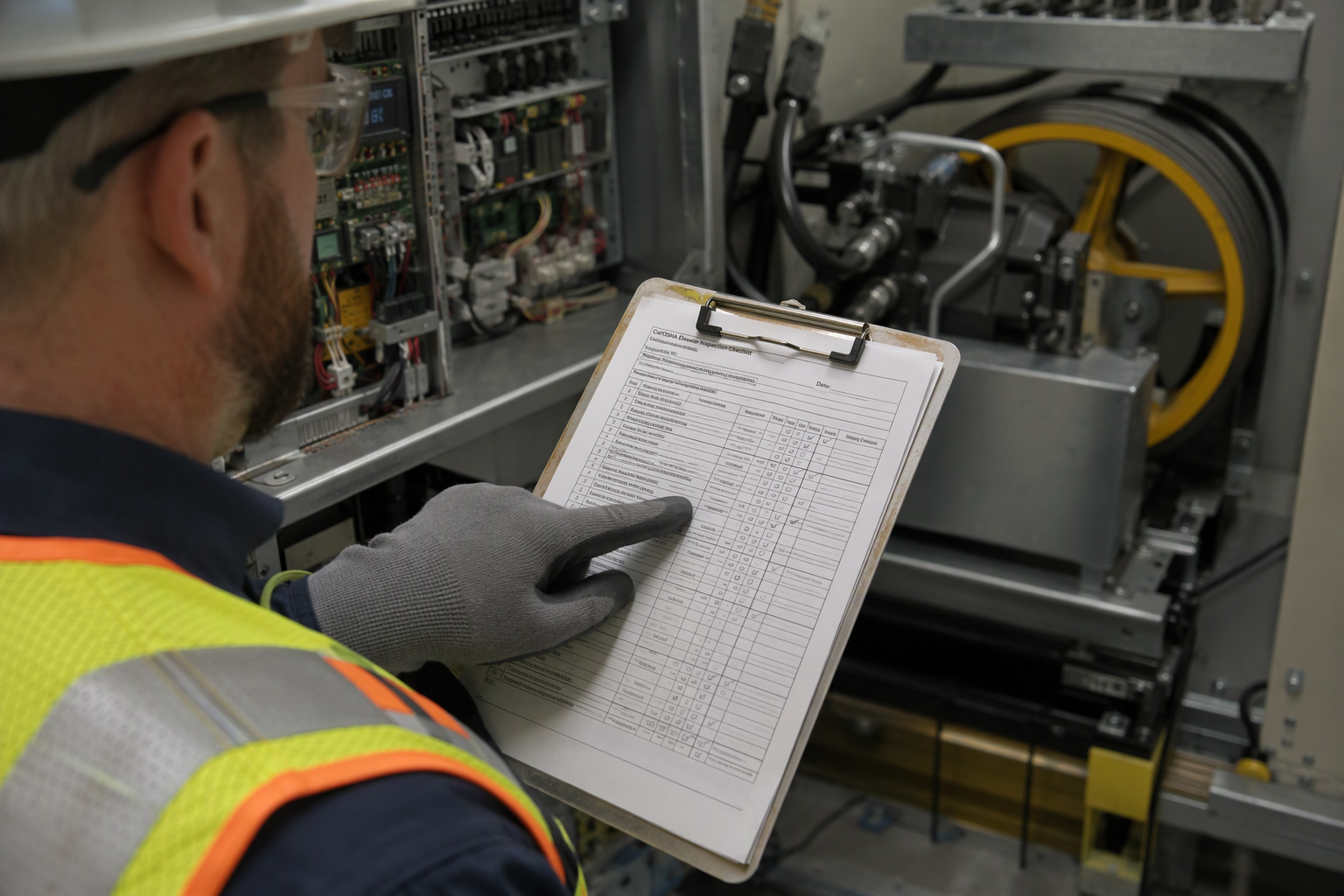
The California Division of Occupational Safety and Health — commonly known as Cal/OSHA, operating under the California Department of Industrial Relations — is the state agency responsible for elevator and conveyance safety. The legal foundation is found in California Labor Code Sections 7300 through 7324.2, and the technical requirements are set out in the California Code of Regulations, Title 8, Elevator Safety Orders (Sections 3000–3146).
California has adopted the ASME A17.1/CSA B44 Safety Code for Elevators and Escalators, 2004 edition (Group IV Elevator Safety Orders), as its baseline technical standard for installation contracts signed on or after May 1, 2008. As of 2026, California’s Standards Board has held a public hearing — on June 18, 2026 — regarding a proposed Group V update that would incorporate elements of the ASME A17.1-2019 edition, but no effective date has been posted for that update.
Los Angeles note: The City of Los Angeles maintains its own elevator and conveyance inspection program administered by the Los Angeles Department of Building and Safety (LADBS). Building owners with equipment in Los Angeles should confirm current requirements directly with LADBS, as local requirements may apply alongside or in coordination with state Cal/OSHA oversight.
San Diego note: San Diego buildings are subject to the statewide Cal/OSHA program, without a separate municipal elevator authority analogous to Los Angeles’s program.
How Often Must Elevators Be Inspected in California?

Under California Labor Code and Cal/OSHA Elevator Safety Orders, every conveyance — including passenger elevators, freight elevators, and inclined elevators — must be inspected at least once per year. A conveyance found to be in safe condition following inspection receives a permit to operate valid for up to one year.
There is an important exception: Cal/OSHA may issue a permit to operate for up to two years for an elevator that is in safe condition and is covered by a full maintenance contract with a company holding a valid C-11 Elevator Contractor license. This two-year pathway reduces the frequency of state-issued permits for well-maintained equipment, but it does not eliminate the annual inspection obligation — it simply affects how often the permit itself is renewed.
Who Is Responsible for Scheduling the Annual Inspection?
California law places the responsibility for arranging the annual reinspection squarely on the elevator owner. This is a critical compliance point: the burden does not fall on the inspector, the elevator service company, or the building manager by default. Owners of commercial and residential buildings in Los Angeles and San Diego must proactively coordinate with an authorized inspection entity to ensure timely reinspection before their existing permit to operate expires.
Failing to maintain a current permit to operate is not a minor administrative oversight — under California law, no elevator may be operated without a valid, current permit to operate issued by Cal/OSHA. Operating an elevator with an expired permit exposes building owners to legal liability and potential shutdown orders.
Who Can Legally Inspect an Elevator in California?
Only two categories of individuals may perform elevator inspections in California:
- State of California safety engineers employed by Cal/OSHA
- Certified Competent Conveyance Inspectors (CCCI) certified by Cal/OSHA
This is not a role that can be filled by a general building inspector, a mechanical engineer without conveyance certification, or an elevator technician acting outside their defined role. Building owners should verify that any inspector they engage holds a current CCCI certificate issued by Cal/OSHA.
What Certifications Do Elevator Companies Need to Operate in California?
Companies that install, alter, test, maintain, repair, or service elevators in California must be certified by Cal/OSHA as a Certified Qualified Conveyance Company (CQCC). To apply for CQCC certification, a company must hold a current C-11 Elevator Contractor license issued by the California Contractors State License Board (CSLB), along with proof of workers’ compensation and liability insurance.
Individual mechanics who work on elevators without direct supervision must hold a Certified Competent Conveyance Mechanic (CCCM) certification from Cal/OSHA. Only a CCCM working for a CQCC-certified company may legally maintain, repair, alter, or replace components on a conveyance in California.
All California CQCC, CCCM, and conveyance inspector certificates are valid for two years, and renewal requires at least eight hours of continuing education for each certificate holder. This ensures that technicians and inspectors remain current with evolving code requirements and safety practices.
AmeriTex Elevator operates as a data-driven service provider that tracks certification and compliance timelines for the buildings it serves, helping owners in California maintain proper documentation and avoid lapses that could trigger permit issues or inspection failures.
What Must Be Displayed in the Elevator and Building?
California law requires that the permit to operate for a passenger, freight, or inclined elevator be posted conspicuously inside the elevator car. This is a visible, enforceable requirement. During any Cal/OSHA inspection or local authority review, an absent or expired permit posted in the cab is an immediate compliance flag.
Building owners and property managers should include permit expiration date checks in their routine property inspection checklists to avoid lapses that may otherwise go unnoticed until a formal inspection.
What Happens Before a New Elevator Is Placed in Service?
- The registered elevator contractor submits plans to Cal/OSHA and obtains a permit before the conveyance is erected, installed, or materially altered.
- Installation proceeds in accordance with the ASME A17.1/CSA B44 adopted edition and Cal/OSHA Elevator Safety Orders.
- Upon completion, Cal/OSHA conducts an inspection of the new elevator.
- If the elevator is found to be safe and compliant, Cal/OSHA issues the initial permit to operate.
- The permit to operate is posted conspicuously inside the elevator car before the elevator is placed in service.
No new elevator in California may be placed in service until it has been inspected and received its permit to operate from Cal/OSHA. This requirement applies equally to elevators in Los Angeles high-rises and San Diego mid-rise commercial buildings.
What Should Building Owners Do If an Elevator Fails Inspection?
- Receive the written inspection report from the CCCI or Cal/OSHA safety engineer, noting all cited deficiencies.
- Remove the elevator from service if it poses an immediate safety hazard — do not operate a conveyance that has been ordered out of service.
- Contact a CQCC-certified elevator company to assess the deficiencies and develop a corrective action plan.
- Ensure all repair or alteration work is performed by CCCM-certified mechanics employed by a CQCC-certified company.
- Coordinate with the CCCI or Cal/OSHA for a reinspection to verify that all deficiencies have been corrected.
- Obtain the updated permit to operate and post it in the elevator cab before returning the unit to service.
Are There Exemptions From California’s Elevator Inspection Requirements?
California’s elevator law exempts two categories of conveyances from its requirements: conveyances under federal jurisdiction, and conveyances located in single-unit private homes that are not accessible to the public. Residential platform lifts or home elevators in a private single-family residence used exclusively by the residents fall outside the scope of Cal/OSHA’s permit and annual inspection requirements, though they remain subject to applicable building codes at time of installation.
Commercial buildings, multi-family residential buildings, hotels, healthcare facilities, and any other conveyance accessible to the public or employees do not qualify for these exemptions and must comply with the full permit and inspection framework.
How Do ADA Requirements Interact With California Elevator Inspections?
The Americans with Disabilities Act (ADA) establishes federal accessibility standards for elevators in public accommodations and commercial facilities. ADA compliance — including requirements for accessible cab dimensions, control button height, Braille markings, door timing, and two-way communication systems — is a separate obligation that runs alongside Cal/OSHA’s safety inspection program.
Cal/OSHA inspections focus on operational safety under the Elevator Safety Orders. ADA compliance is enforced through federal civil rights law and may also be reviewed during local building department inspections. Building owners in Los Angeles and San Diego should ensure their elevators satisfy both frameworks, as a unit can pass a Cal/OSHA safety inspection while still presenting ADA deficiencies that expose the owner to federal civil rights liability.
AmeriTex Elevator evaluates both safety code compliance and accessibility considerations when conducting assessments, helping building owners understand the full scope of their obligations.
What Are the OSHA Workplace Safety Obligations for Elevator Equipment Rooms and Pits?
Beyond the Cal/OSHA elevator-specific program, federal OSHA workplace safety standards apply to conditions in elevator machine rooms, pits, and hoistways when workers are performing maintenance, repair, or inspection activities. Confined space entry rules, electrical safety requirements, and fall protection standards may all apply depending on the work being performed. Building owners have an obligation to ensure that the working environment for elevator mechanics meets applicable OSHA standards, independent of the elevator’s permit to operate status.
What Industry Trends Are Shaping California Elevator Compliance in 2025–2026?
Several qualitative trends are influencing how building owners in Los Angeles and San Diego approach elevator compliance heading into 2026:
- Pending code modernization: California’s proposed Group V Elevator Safety Orders — which would incorporate elements of ASME A17.1-2019 — are progressing through the rulemaking process following the June 2026 public hearing. Building owners and elevator service companies should monitor the California Standards Board for an effective date, as the update could introduce new requirements for existing equipment.
- Increased scrutiny of emergency communication systems: The intersection of ASME A17.1 requirements and California Building Code provisions regarding two-way emergency communication is an area of active regulatory attention. Building owners should work with qualified elevator professionals to assess their current systems rather than assuming compliance.
- Digital record-keeping and permit tracking: Building operations teams are increasingly adopting digital compliance management tools to track permit expiration dates and inspection schedules, reducing the risk of lapses in a regulatory environment where the owner bears the scheduling burden.
- Aging elevator stock: A significant portion of commercial elevator equipment in older Los Angeles and San Diego buildings predates the 2008 effective date of California’s current Elevator Safety Orders. Modernization projects are becoming more common as owners face both performance issues and evolving compliance expectations.
- Workforce and certification pipeline: The two-year renewal cycle for CQCC, CCCM, and CCCI certificates, combined with continuing education requirements, reflects an industry-wide focus on maintaining a qualified workforce — a trend that is expected to intensify as modernization demand grows.
What Is the Difference Between a Cal/OSHA Inspection and a Full Maintenance Contract Inspection?
A Cal/OSHA inspection — conducted by a state safety engineer or a CCCI — is the formal regulatory review that results in the issuance or renewal of the permit to operate. This is a legal requirement under California Labor Code.
A full maintenance contract is a service agreement between a building owner and a CQCC-certified elevator company that covers routine maintenance, lubrication, adjustment, and repairs. When a full maintenance contract is in place, Cal/OSHA may issue a permit to operate valid for up to two years rather than one year, recognizing that consistent professional maintenance reduces the likelihood of safety deterioration between formal inspections.
These two things serve different functions: one is a regulatory gate, and the other is an ongoing operational practice. Both matter for compliance, and they complement each other. Building owners should not assume that having a maintenance contract eliminates the annual inspection obligation — it may extend the permit period, but the inspection itself must still occur.
Sourced Regulatory Reference Table
| Requirement | Detail | Source |
|---|---|---|
| Minimum inspection frequency | At least once per year for every conveyance | Cal/OSHA Elevator Unit, California Labor Code §§ 7300–7324.2 |
| Maximum permit duration (standard) | Up to one year per inspection cycle | Cal/OSHA Elevator Unit |
| Maximum permit duration (full maintenance contract) | Up to two years, with qualifying full maintenance contract from C-11 licensed company | Cal/OSHA Elevator Unit |
| Certificate renewal cycle (CQCC, CCCM, CCCI) | Every two years; minimum eight hours of continuing education required | Cal/OSHA Elevator Unit |
| Adopted technical code (California) | ASME A17.1/CSA B44, 2004 edition (Group IV), effective May 1, 2008 for qualifying installations | ASME A17.1/CSA B44 as adopted by Cal/OSHA |
| Permit display requirement | Posted conspicuously inside the elevator car | Cal/OSHA Elevator Unit, California Labor Code |
How Does AmeriTex Elevator Support Compliance for Los Angeles and San Diego Buildings?
AmeriTex Elevator provides elevator services in California with a focus on the specific regulatory framework that applies to buildings in Los Angeles and San Diego. This includes helping building owners understand their obligations under Cal/OSHA’s permit and inspection system, coordinating with CCCI-certified inspectors, and ensuring that all maintenance and repair work is performed by CCCM-certified mechanics operating under proper CQCC certification. For Los Angeles properties where LADBS administers a parallel local program, AmeriTex Elevator works to ensure that building owners are informed about the local requirements that may apply alongside state oversight.
AmeriTex Elevator’s approach emphasizes documented compliance tracking — helping owners avoid permit lapses, understand what full maintenance contract arrangements may qualify them for extended permit periods, and prepare their equipment for inspection with up-to-date maintenance records. As California’s proposed Group V code update moves toward adoption, AmeriTex Elevator monitors rulemaking developments to help clients anticipate what changes may affect their existing installations.
Contact AmeriTex Elevator for a free elevator assessment at 844-646-9660.
Need elevator service you can rely on? AmeriTex Elevator is ready to help.