How Long Does It Take to Get a New Elevator Installed in a Building That Never Had One?
Adding an elevator to an existing building — often called a “new installation in an existing structure” — is a significant capital project. It involves architectural planning, structural engineering, permitting from state and local authorities, equipment procurement, construction of the hoistway, mechanical installation, inspection, and final certification before anyone can legally ride the elevator. The process is longer and more complex than replacing an existing elevator because every component, from the pit to the machine room or overhead structure, must be built from scratch and approved before the unit goes into service.
This FAQ hub covers every phase of the process, the codes that govern it in Texas and California, the regulatory agencies involved in each market AmeriTex Elevator serves, and practical answers to the questions building owners and property managers ask most often.
What Is the Overall Timeline for Installing a New Elevator in a Building That Never Had One?
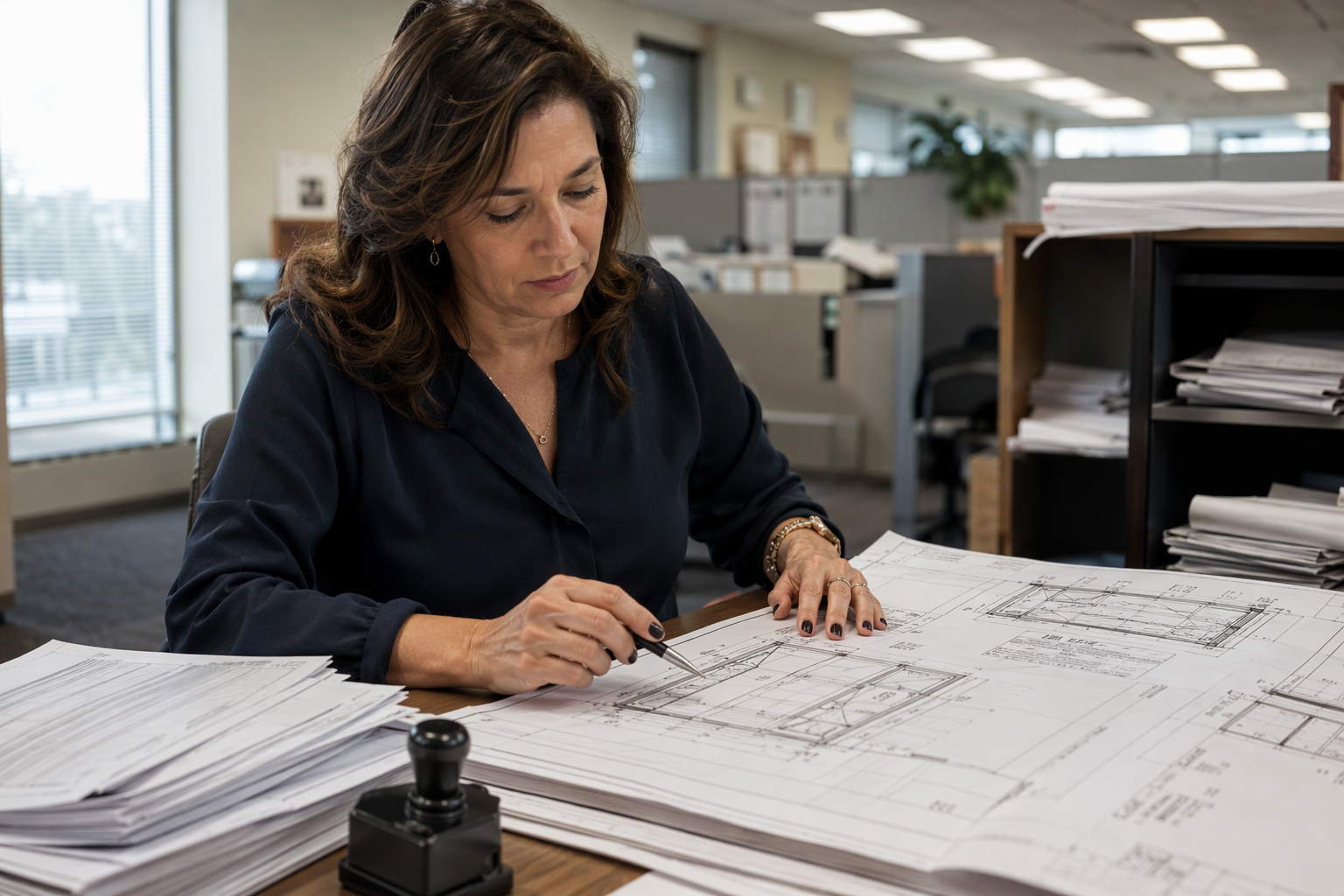
The total timeline from first consultation to first legal passenger use typically runs 6 to 18 months, with most commercial projects in Texas and California falling in the 9-to-15-month range when no major structural surprises arise.
The timeline breaks into four broad phases: pre-design and feasibility (1–3 months), permitting and plan review (1–4 months), construction and mechanical installation (3–8 months), and inspection and certification (1–2 months). Each phase depends on the one before it, so delays in permitting cascade directly into the construction schedule.
Buildings that have never had an elevator present unique challenges: there is no existing hoistway, pit, or overhead structure, so all of those elements must be designed, approved, and built before the elevator contractor can even begin setting the rail brackets. Structural modifications to accommodate a new hoistway opening can add weeks or months depending on the building’s construction type.
What Factors Most Affect How Long the Installation Will Take?
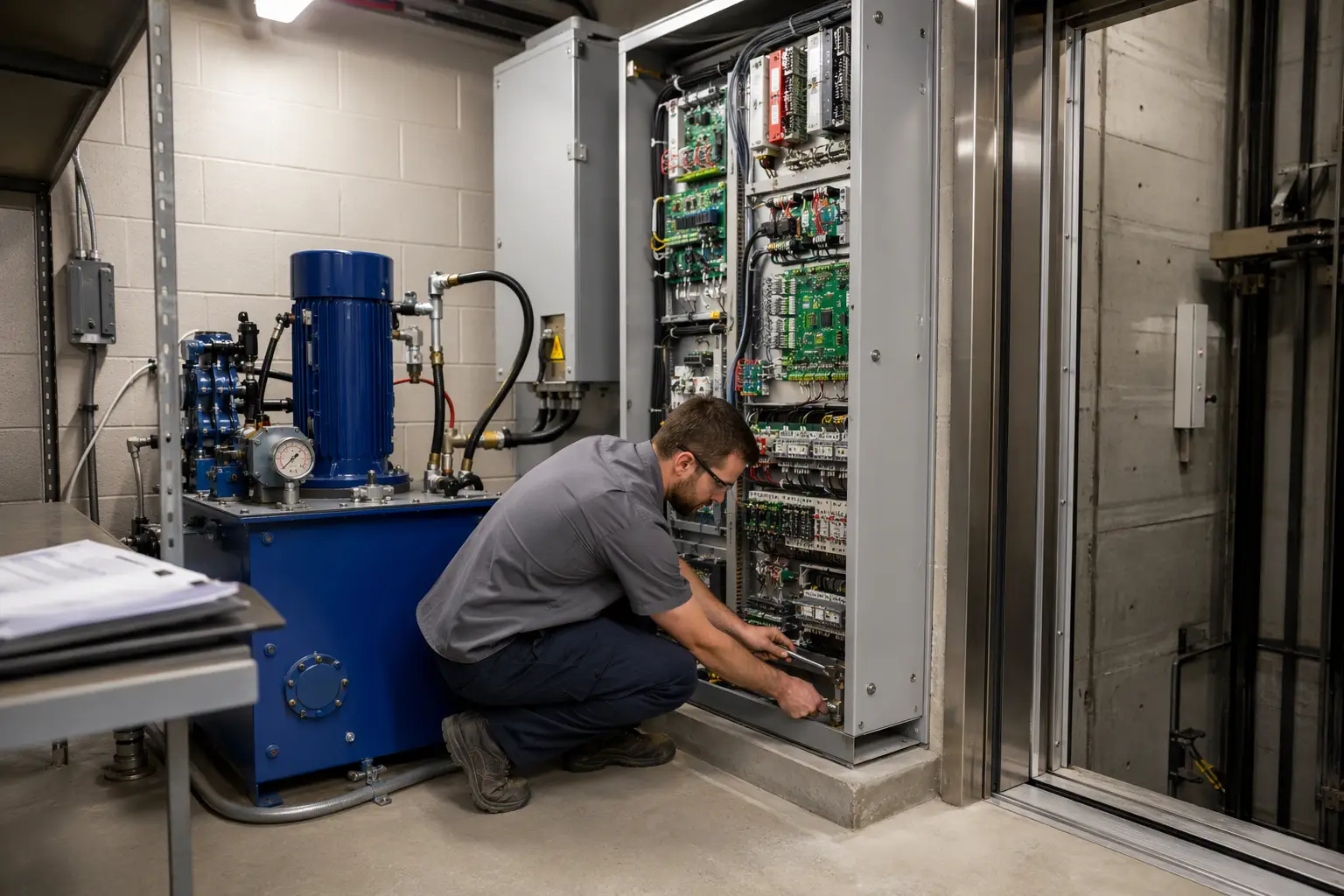
The single largest variable is the time required to design, approve, and construct a new hoistway in a building that was never engineered to have one.
Beyond the hoistway, the following factors routinely extend or compress the timeline:
- Building type and age: Older masonry or historic buildings require more engineering study and may face historic preservation reviews before any structural openings are cut.
- Elevator type selected: Hydraulic elevators generally require shorter hoistways and simpler overhead structures but need a machine room or in-ground cylinder. Traction (cable) elevators require more overhead clearance. Machine-room-less (MRL) traction systems reduce space demands but may require different structural load paths.
- Local permit review speed: Permit review timelines vary widely. In Houston, the city runs its own elevator program independent of the Texas Department of Licensing and Regulation (TDLR); in Dallas, Austin, and San Antonio, TDLR governs the process. In Los Angeles, the Los Angeles Department of Building and Safety (LADBS) runs its own elevator inspection program. Each authority has its own review queue.
- Equipment lead times: Elevator equipment is manufactured to order. Lead times for cab components, controllers, door operators, and hydraulic power units can range from several weeks to several months depending on market conditions.
- Contractor coordination: The elevator contractor must coordinate with the general contractor, structural engineer, electrical contractor, and architect. Gaps in that coordination are one of the most common sources of project delay.
What Are the Main Phases of a New Elevator Installation Project?
A new elevator installation in a previously elevator-free building follows a well-defined sequence of phases, each of which must be completed before the next can begin.
- Feasibility and site assessment: An elevator consultant or certified elevator company evaluates the building’s structural system, floor-to-floor heights, available footprint for a hoistway, electrical capacity, and code compliance requirements. This step identifies whether a hydraulic, traction, or alternative drive system is best suited to the building.
- Architectural and structural design: A licensed architect and structural engineer design the hoistway, pit, overhead structure, and machine room (if required). The design must comply with the applicable edition of the ASME A17.1 Safety Code for Elevators and Escalators and with ADA accessibility requirements.
- Plan submission and permit approval: In Texas, the registered elevator contractor submits plans to TDLR and must receive approval before installation begins, as required by 16 Texas Administrative Code Chapter 74. In California, a permit from Cal/OSHA — the Division of Occupational Safety and Health, Elevator Unit, within the California Department of Industrial Relations — is required before a conveyance is erected, installed, or materially altered, as governed by California Labor Code Sections 7300–7324.2 and the California Code of Regulations, Title 8, Elevator Safety Orders.
- Hoistway and pit construction: The general contractor cuts openings in the floor structure, pours the pit, frames or builds the hoistway enclosure, and completes the overhead structure. This phase is typically the longest single construction period.
- Rough-in mechanical and electrical work: The elevator contractor sets guide rails, installs buffers, lays conduit, and positions the machine (or pump unit for hydraulic systems). The electrical contractor brings dedicated power to the machine room or controller location.
- Equipment installation: The elevator contractor installs the cab, door operators, controller, safety devices, and all code-required features including firefighters’ service controls.
- Testing and inspection: In Texas, a TDLR-registered elevator inspector performs the acceptance inspection. In California, Cal/OSHA — specifically a State of California safety engineer or a Certified Competent Conveyance Inspector (CCCI) — must inspect the elevator and issue a permit to operate before it is placed in service. In Houston, the city’s own inspection program governs this step. In Los Angeles, LADBS runs its own elevator and conveyance inspection program.
- Certificate issuance and commissioning: Once the elevator passes inspection and all required documents are in order, the authority having jurisdiction issues the operating certificate, and the elevator is legally placed in service.
How Long Does the Permitting Phase Take in Texas?
In Texas (outside Houston), the permitting phase with TDLR typically takes two to six weeks after a complete plan submission, though complex projects or incomplete submissions can extend that window.
Under Texas Health and Safety Code Chapter 754 and 16 Texas Administrative Code Chapter 74, a registered elevator contractor must submit plans to the Texas Department of Licensing and Regulation (TDLR) and receive approval before any installation begins. TDLR also requires the contractor to be registered; contractor and inspector registrations expire one year after issuance. Each Texas elevator contractor must maintain general liability insurance of at least $1,000,000 per occurrence for bodily injury or death and $500,000 per occurrence for property damage.
Houston operates its own elevator program and does not fall under TDLR jurisdiction for elevators or escalators within city limits. Building owners and contractors working in Houston should verify the city’s specific plan review and permit timelines directly with the City of Houston’s inspection authority. AmeriTex Elevator’s project teams are familiar with requirements in both TDLR-governed markets (Dallas, Austin, San Antonio) and Houston’s city-run program.
How Long Does the Permitting Phase Take in California?
In California, the permitting phase with Cal/OSHA — the Elevator Unit of the California Division of Occupational Safety and Health — can take four to twelve weeks or longer, depending on project complexity and the agency’s current review workload.
California Labor Code Sections 7300–7324.2 and the California Code of Regulations, Title 8, Elevator Safety Orders (Sections 3000–3146) require that a permit from Cal/OSHA’s Elevator Unit be obtained before a conveyance is erected, installed, or materially altered. No elevator may be operated in California without a valid, current permit to operate issued by Cal/OSHA. California also requires that only a Certified Competent Conveyance Mechanic (CCCM) working for a Certified Qualified Conveyance Company (CQCC) may install elevator equipment. Applicants for CQCC certification must hold a current C-11 Elevator Contractor license issued by the California Contractors State License Board (CSLB).
In Los Angeles, LADBS runs its own elevator and conveyance inspection program, which can add a parallel permitting layer. Projects in San Diego operate under Cal/OSHA’s statewide program. Building owners should anticipate that California’s multi-agency permitting environment is one of the most significant schedule drivers on the West Coast.
What Elevator Codes Must a New Installation Comply With?
A new elevator installation must comply with the edition of the ASME A17.1/CSA B44 Safety Code for Elevators and Escalators adopted by the authority having jurisdiction, plus ADA accessibility requirements and applicable state rules.
Texas has adopted ASME A17.1/CSA B44, 2016 edition, as amended by 16 Texas Administrative Code Section 74.100(b), effective November 1, 2018. California has adopted the ASME A17.1/CSA B44, 2004 edition (Group IV Elevator Safety Orders), effective May 1, 2008, for installation contracts signed on or after that date. As of 2026, California’s Standards Board has proposed a Group V update that would incorporate elements of ASME A17.1-2019; a public hearing was held on June 18, 2026, and no effective date has been posted.
ADA requirements under the Americans with Disabilities Act govern cab dimensions, door clear widths, landing controls, Braille and tactile signage, and accessible routes to and from the elevator lobby. For most commercial new installations, ADA compliance is non-negotiable and must be incorporated at the design stage rather than retrofitted after installation.
What Type of Elevator Is Best for a Building That Never Had One?
The best elevator type depends on the building’s height, available space, structural capacity, and budget — there is no universal answer, and an experienced elevator contractor should evaluate the specific building before any equipment is specified.
| Elevator Type | Typical Building Height | Hoistway Overhead Required | Machine Room Required | Key Consideration for Existing Buildings |
|---|---|---|---|---|
| Hydraulic (conventional) | 2–5 stories | Minimal (varies by manufacturer) | Yes (adjacent to hoistway) | In-ground cylinder drilling may be restricted in some soil conditions |
| Hydraulic (holeless/roped) | 2–4 stories | Minimal | Yes | Eliminates underground cylinder; good for tight sites |
| Geared Traction (MG or VFD) | 5–20 stories | Standard overhead clearance required | Yes (top of hoistway or remote) | Higher structural load on overhead beam |
| Machine-Room-Less (MRL) Traction | 2–20 stories | Reduced overhead possible | No dedicated room (control cabinet in hoistway or landing) | Good where machine room space is unavailable |
| Pneumatic/Vacuum | 2–3 stories | Minimal | No | Limited capacity and speed; best for residential or light commercial |
How Much Structural Work Is Required to Add an Elevator to an Existing Building?
Structural work for a first-time elevator installation in an existing building almost always includes at minimum a new pit, hoistway framing or masonry, and an overhead support beam — and may require significant reinforcement of existing floor framing around hoistway openings.
The pit must be dug and waterproofed below the lowest landing. In many existing buildings, cutting through a concrete slab or digging below a slab-on-grade foundation requires a structural engineer’s design and may require underpinning of adjacent footings. The hoistway enclosure must meet fire-rating requirements of the applicable building code. The overhead structure must carry the dynamic loads of the elevator machine, sheaves, and counterweight — loads that existing roof or floor framing was not designed for in a building without a planned elevator shaft.
This structural scope is the primary reason that first-time installations take significantly longer and cost more than elevator replacements. It is also why the feasibility phase — before any equipment is specified or ordered — is the most important investment of time early in the project.
What Happens During the Final Inspection Before an Elevator Is Placed in Service?
The final acceptance inspection is a comprehensive evaluation by the authority having jurisdiction to verify that every system, safety device, and code-required feature functions correctly before any passenger uses the elevator.
In Texas, a TDLR-registered elevator inspector performs the acceptance inspection and must provide the owner with an inspection report within five calendar days. Texas building owners must then obtain a TDLR Certificate of Compliance for each unit, which is valid for one year and must be displayed in a publicly visible area of the building. Texas requires violations to be corrected or under contract to be corrected within 30 days of the inspection.
In California, each new elevator must be inspected by Cal/OSHA — specifically by a State of California safety engineer or a Certified Competent Conveyance Inspector (CCCI) — and receive a permit to operate before it is placed in service. The permit to operate must be posted conspicuously in the elevator car. California law makes arranging the annual reinspection the elevator owner’s responsibility going forward.
The acceptance inspection tests safety devices including overspeed governors, safeties, buffers, interlocks on every landing door, and firefighters’ emergency operation. In Texas, an elevator without working firefighters’ Phase One service must be removed from service immediately — meaning these systems must be fully functional and tested at acceptance.
What ADA Requirements Apply to a New Elevator Installation?
Under the Americans with Disabilities Act, new elevator installations in commercial facilities must meet specific dimensional, operational, and signage standards that govern every element from the cab interior to the call buttons in the lobby.
ADA Standards for Accessible Design require that elevator cabs serving more than one floor in new construction meet minimum inside clear floor dimensions, that door clear widths accommodate wheelchair users, that controls be within reach ranges for seated users, and that all floor designations be provided in both raised print and Braille on a tactile sign adjacent to each hoistway entrance. Call buttons must be centered at a specified height from the floor and must have a visual signal when activated.
ADA requirements also govern the accessible route leading to the elevator lobby on each floor. Building owners frequently underestimate the scope of accessible route work — ramps, widened corridors, and compliant signage — that must accompany the elevator installation to bring the building into full compliance. These elements should be incorporated into the project scope at the design stage.
How Long Does Equipment Procurement Take?
Elevator equipment is manufactured to specification and is not an off-the-shelf purchase — procurement lead times commonly range from eight to twenty-four weeks depending on the product line, options selected, and current manufacturing capacity.
Major equipment items include the controller, door operators, cab enclosure panels, entrances (frames, sills, and doors for each landing), the drive machine or hydraulic power unit, guide rails, buffers, and the cab interior package. Some items — particularly custom cab finishes, special door configurations, or large-capacity freight components — carry the longest lead times.
Experienced project managers order long-lead equipment as early as the permitting phase, ensuring that materials arrive at the site concurrent with or immediately after the hoistway construction is complete. Projects that wait until permit approval before placing equipment orders routinely add two to four months to the total schedule unnecessarily.
What Is the Role of the Elevator Contractor During a New Installation Project?
The registered elevator contractor is responsible for the mechanical installation of all elevator components, coordination of rough-in work by other trades, compliance with the adopted ASME A17.1 code, submission of plans to the authority having jurisdiction, and coordination of the final acceptance inspection.
In Texas, only a contractor registered with TDLR may install elevator equipment, and each contractor must designate one or two responsible parties with at least three years of elevator contractor experience. Plan submission to TDLR before work begins is a legal requirement under 16 Texas Administrative Code Chapter 74.
In California, only a Certified Qualified Conveyance Company (CQCC) certified by Cal/OSHA may install elevator equipment, and all mechanics performing the work must be Certified Competent Conveyance Mechanics (CCCMs) also certified by Cal/OSHA. The CQCC certification requires holding a current C-11 Elevator Contractor license from the California Contractors State License Board. CQCC and CCCM certificates last two years and require at least eight hours of continuing education for renewal.
AmeriTex Elevator operates as a certified elevator service company in both Texas and California markets and manages plan submission, inspection coordination, and compliance documentation as part of its installation services.
What Happens If the Building Has Unusual Space Constraints for the Hoistway?
When an existing building cannot accommodate a standard hoistway footprint, the project requires customized equipment specifications, potentially a different drive system, and in some cases creative architectural solutions such as external hoistways built on the building’s exterior.
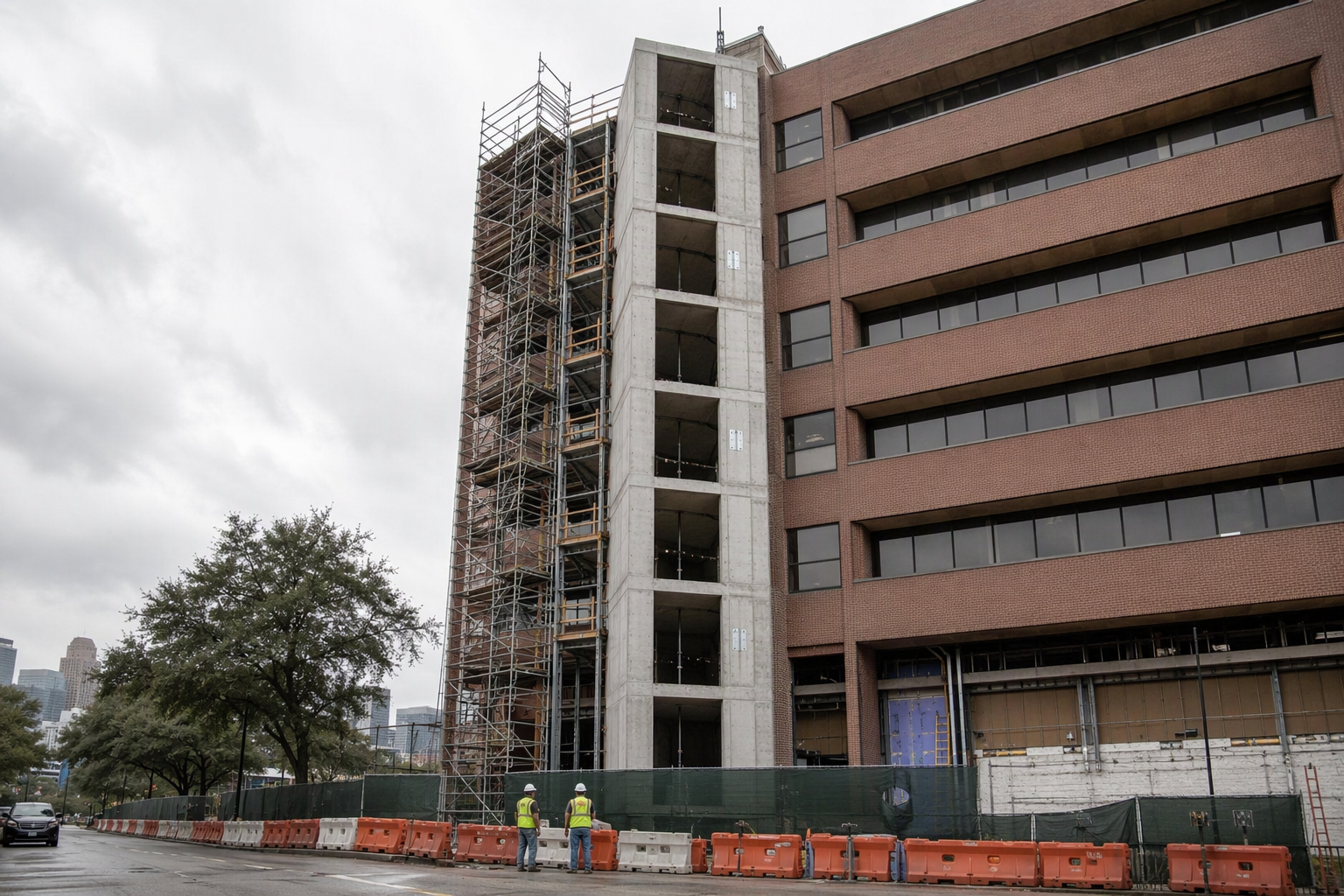
External (exterior) hoistway structures have become an accepted approach for historic buildings or buildings where interior square footage cannot be sacrificed. These structures are engineered as freestanding or tied-back towers adjacent to the building, with new openings cut through the exterior wall at each landing. While this approach adds architectural and structural complexity, it avoids the need to cut through occupied interior floor plates and can actually shorten the construction phase because hoistway work proceeds independently of occupied interior spaces.
Low-overhead and reduced-pit equipment configurations are available from major manufacturers and can accommodate pits as shallow as the minimum allowed under the applicable ASME A17.1 edition and overhead clearances below standard dimensions — though each reduction from standard dimensions must be evaluated against code requirements and the authority having jurisdiction’s approval.
What Ongoing Compliance Requirements Apply After a New Elevator Is Commissioned?
After a new elevator is commissioned, the building owner assumes ongoing compliance obligations that include annual inspections, certificate renewals, maintenance contracts, and periodic load testing as required by state law.
In Texas, building owners must have elevators inspected annually by a TDLR-registered elevator inspector, obtain a renewed Certificate of Compliance each year, and report any elevator accident to TDLR within 24 hours. Texas requires a Category 5 full-load test every five years on electric (traction) elevators. The building owner has the sole right to select the elevator inspector under Texas law.
In California, every conveyance must be inspected at least once a year. Cal/OSHA may issue a permit to operate for up to two years for an elevator in safe condition that is covered by a full maintenance contract with a C-11 licensed elevator company. The responsibility for arranging the annual reinspection falls on the elevator owner. California’s adopted code is ASME A17.1/CSA B44, 2004 edition (Group IV Elevator Safety Orders); the pending Group V update proposing elements of ASME A17.1-2019 had its public hearing in June 2026 with no effective date posted as of this writing.
AmeriTex Elevator provides ongoing maintenance and compliance support in all of its markets — Houston, Dallas, Austin, San Antonio, Los Angeles, and San Diego — to help building owners meet these annual obligations.
How Does the Houston Elevator Program Differ From TDLR?
The City of Houston runs its own elevator and escalator inspection and permitting program, completely separate from TDLR, which means TDLR does not inspect, permit, or regulate elevators within Houston city limits.
Building owners and contractors undertaking new elevator installations in Houston must work directly with the City of Houston’s inspection authority for plan review, permit issuance, acceptance inspection, and certificate of compliance — not with TDLR. The specific adopted code edition and procedural requirements of Houston’s city program should be confirmed directly with the city, as they are not administered or published by TDLR. AmeriTex Elevator’s project teams work within Houston’s city-run program for installations and service in that market.
How Does the Los Angeles LADBS Program Affect New Elevator Installations?
The Los Angeles Department of Building and Safety (LADBS) runs its own elevator and conveyance inspection program for elevators in Los Angeles, which means that installations in Los Angeles involve LADBS as the local authority in addition to Cal/OSHA’s statewide certification and permitting requirements.
Building owners planning a new elevator installation in Los Angeles should anticipate engagement with both Cal/OSHA and LADBS as part of the permitting and inspection process. The Cal/OSHA requirement for a permit to operate before the elevator is placed in service applies statewide, including in Los Angeles. The parallel LADBS program adds a local layer that can affect plan review and inspection scheduling. Projects in San Diego operate under Cal/OSHA’s statewide program without a separate city elevator authority equivalent to LADBS. AmeriTex Elevator’s California teams are familiar with both the Cal/OSHA statewide process and the LADBS local program.
What Should a Building Owner Do First When Considering Adding an Elevator?
The first step is a professional site assessment and feasibility study — not equipment selection — because the building’s structural system, floor heights, available footprint, and electrical capacity determine what is possible before any product can be responsibly specified.
- Engage a certified elevator contractor for a site assessment to evaluate structural conditions, available hoistway space, pit depth feasibility, overhead clearance, and electrical service capacity.
- Engage a licensed structural engineer to assess whether existing framing can support hoistway openings and overhead loads, or what reinforcement will be required.
- Identify the authority having jurisdiction — TDLR for most Texas locations, the City of Houston for Houston, Cal/OSHA for most California locations, and LADBS as an additional authority in Los Angeles — and confirm current plan review timelines and submittal requirements.
- Establish the ADA compliance scope for the full accessible route, not just the elevator cab, so that all required modifications are budgeted and scheduled together.
- Select the elevator type and configuration based on the feasibility findings, then specify equipment to minimize lead times against the construction schedule.
- Register the project with the appropriate elevator authority and submit plans before any installation work begins, as required by both Texas and California law.
- Coordinate the acceptance inspection with the authority having jurisdiction at the end of the installation phase and do not allow any passenger use before the operating certificate or permit to operate is issued.
Can a Building Owner Legally Use the Elevator Before the Final Certificate Is Issued?
No — in both Texas and California, an elevator may not legally be used before the authority having jurisdiction has issued the required operating certificate or permit to operate following a successful acceptance inspection.
In California, California Labor Code Sections 7300–7324.2 and the California Code of Regulations, Title 8, Elevator Safety Orders make clear that no elevator may be operated without a valid, current permit to operate issued by Cal/OSHA. Each new elevator must be inspected by Cal/OSHA and receive that permit before being placed in service. Using an elevator before the permit is issued exposes the building owner to enforcement action and liability.
In Texas, the TDLR Certificate of Compliance is the operational authorization under Texas Health and Safety Code Chapter 754. Installing or operating elevator equipment without proper registration and approval is a violation of Texas law. In Houston, the city’s own program governs this requirement within city limits. Building owners should ensure that the contractor’s project schedule includes adequate lead time for inspection scheduling so that the certificate is in hand before any occupancy event requires elevator use.
What Is a Realistic Budget Range for a First-Time Elevator Installation?
A realistic budget range depends entirely on the building’s specific conditions — elevator type, number of stops, structural modifications required, finish level, and local labor markets all have significant cost impact, and no meaningful figure applies universally without a site-specific assessment.
What building owners should understand is that the mechanical elevator equipment itself typically represents only a portion of the total project cost. Hoistway construction, structural reinforcement, pit work, electrical service upgrade, cab finishes, landing entrances for each floor, ADA-compliant lobby modifications, permit fees, inspection fees, and contractor coordination all add to the total. Projects in California markets often carry higher labor and permitting costs than Texas markets. Projects in historic or architecturally significant buildings carry additional cost for sensitive construction methods and preservation review.
AmeriTex Elevator recommends requesting a site-specific assessment before any budgeting exercise, as scope assumptions made without a site visit consistently lead to significant budget variance during construction.
How Can Building Owners Keep the Installation Timeline as Short as Possible?
The most effective timeline management strategies all share a common principle: advance work in parallel wherever possible rather than waiting for each phase to be fully complete before starting the next.
- Start the feasibility and design phase as early as possible — every week spent before permit submission is a week that does not add to the post-permit schedule.
- Submit complete, accurate plan packages to the authority having jurisdiction — incomplete submittals are the most common cause of permitting delays, as they restart the review clock.
- Order long-lead equipment during the permitting phase, not after permit approval — most jurisdictions allow equipment orders to be placed before construction approval, and doing so can save months.
- Coordinate all trades early — the structural, electrical, and elevator contractors must share a unified schedule with clear sequencing of who needs what done before they can proceed.
- Schedule the acceptance inspection with the authority having jurisdiction two to four weeks before the anticipated completion of installation work, so the inspector’s availability aligns with the contractor’s readiness.
- Engage an elevator contractor familiar with the local authority’s requirements — a contractor who routinely works with TDLR, the City of Houston, Cal/OSHA, or LADBS will navigate plan review and inspection coordination more efficiently than one unfamiliar with the local process.
What Should Building Owners Look for When Selecting an Elevator Installation Contractor?
Building owners should verify that any elevator contractor they engage holds the registrations, certifications, and insurance required by the authority having jurisdiction in their state — these are not optional credentials but legal prerequisites for performing elevator work.
In Texas, the contractor must be registered with TDLR under Texas Health and Safety Code Chapter 754, must carry the minimum required liability insurance, and must have designated responsible parties with at least three years of elevator contractor experience. In California, the contractor must be a Cal/OSHA-certified Qualified Conveyance Company (CQCC) with a current C-11 license from the California Contractors State License Board.
Beyond regulatory credentials, building owners should evaluate the contractor’s experience with new installations in existing buildings specifically — not just elevator replacements — because the structural coordination, permitting complexity, and construction sequencing challenges of a first-time installation are substantially different from a one-for-one replacement. References from comparable projects, familiarity with the local authority’s review process, and demonstrated ability to manage equipment procurement lead times against a construction schedule are all meaningful differentiators.
AmeriTex Elevator serves building owners undertaking new elevator installations across Houston, Dallas, Austin, San Antonio, Los Angeles, and San Diego, providing site assessments, compliance guidance, installation services, and ongoing maintenance support within the regulatory frameworks of both Texas and California.
Contact AmeriTex Elevator for a free elevator assessment at 844-646-9660.
Need elevator service you can rely on? AmeriTex Elevator is ready to help.