Elevator Phone Requirements: A Complete Compliance Guide for Building Owners
Elevator emergency phones are among the most closely scrutinized components during inspections in Texas and California. A non-functional or non-compliant phone can trigger immediate removal from service, citation, and liability exposure. This FAQ hub covers every angle of elevator phone compliance — from federal code minimums to state-specific requirements in Texas and California — so building owners and facility managers can act with confidence.
What Are the Basic Federal Requirements for Elevator Emergency Phones?
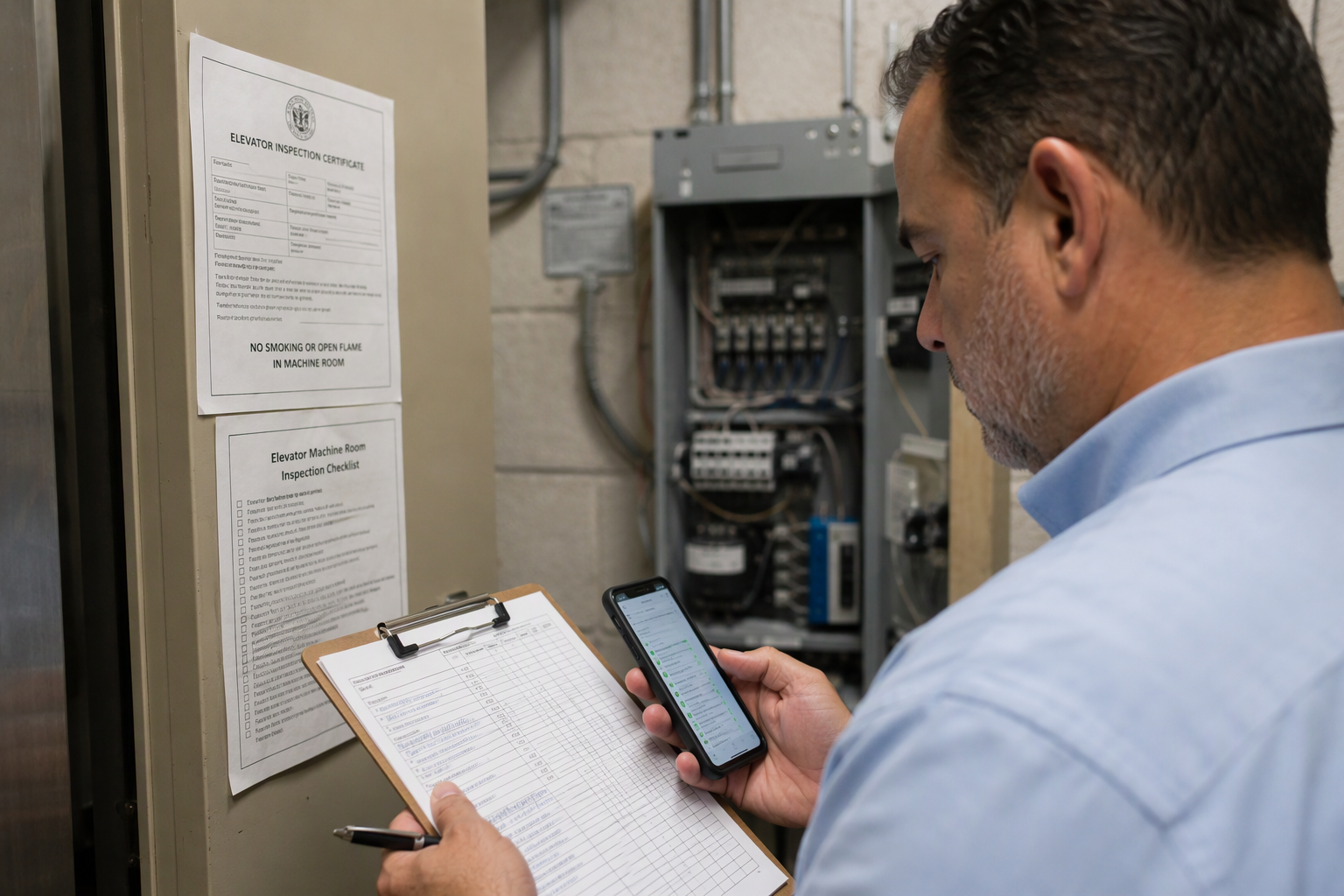
Under ASME A17.1 Safety Code for Elevators and Escalators, every passenger elevator must be equipped with a means of two-way voice communication that connects trapped occupants to a location that is monitored 24 hours a day.
The core federal-level requirements, as established by ASME A17.1, include the following elements: the phone or communication device must be operable without the use of a coin; it must connect to a location staffed or monitored at all times; it must be identified so that any user knows they are calling for emergency assistance; and the cab must display the building address or location so that the monitoring party can dispatch help. The phone must function automatically when the receiver is lifted or the button is pressed — no dialing sequence should be required. These requirements apply to all new elevator installations and, where adopted by the authority having jurisdiction, to existing equipment as well.
ASME A17.3, the Safety Code for Existing Elevators and Escalators, governs retroactive upgrades. When an authority having jurisdiction formally adopts A17.3, older elevators may be required to bring their emergency communication systems up to current standards even without a full modernization project.
How Does the ADA Affect Elevator Phone Requirements?

The Americans with Disabilities Act (ADA) requires elevator emergency communication systems to be usable by individuals who are deaf or hard of hearing, meaning the system cannot rely solely on voice communication.
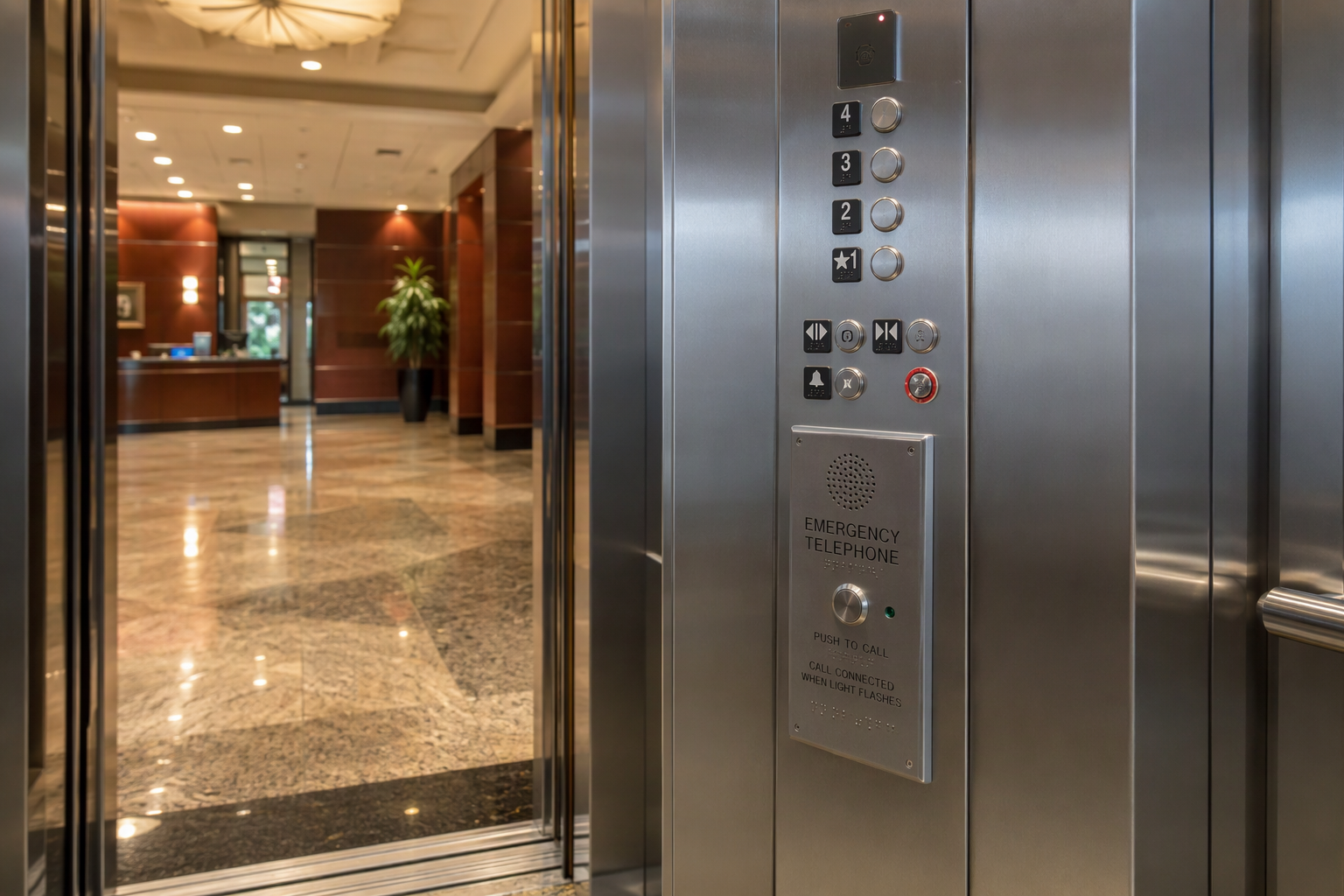
ADA Standards for Accessible Design specify that two-way communication systems in elevators must include both audible and visible signals. If the system uses a handset or push-button, the controls must be within reach range (between 15 and 48 inches above the floor for a forward or side approach), and the highest operable part must comply with ADA reach range requirements. Braille and raised-character labeling is required at the control button. Building owners who rely on voice-only intercom systems without any visual confirmation signal — such as a lighted indicator that the call has connected — may be out of ADA compliance even if the phone itself functions correctly. The ADA requirements apply to places of public accommodation and commercial facilities, which covers the vast majority of multi-tenant buildings served by passenger elevators.
What Does “Two-Way Communication” Mean in Practice for Elevator Phones?
Two-way communication means a person trapped in an elevator cab must be able to both speak to and hear from a live monitoring point, ensuring a genuine exchange of information rather than a one-way distress signal.
In practice, this means the monitoring station must be staffed or answered — an answering machine, voicemail system, or unmonitored alarm panel does not satisfy the ASME A17.1 requirement. Many building owners use a central alarm monitoring company that answers elevator calls around the clock. The monitoring agent must be able to identify the building address and the specific unit in distress, which is why ASME A17.1 requires the building address to be posted or transmitted during the call. Modern elevator phone systems achieve this through automatic identification of the calling unit, eliminating the need for the trapped passenger to verbally communicate their location.
Are There Specific Texas Requirements for Elevator Emergency Phones?
Texas has adopted the ASME A17.1/CSA B44, 2016 edition as its state elevator code under Texas Department of Licensing and Regulation (TDLR), meaning the two-way voice communication requirements of that code edition apply statewide — except within Houston city limits, which runs its own program.
Under Texas Health and Safety Code Chapter 754 and 16 Texas Administrative Code Chapter 74, building owners must maintain elevators in compliance with the adopted code edition. TDLR requires an annual inspection by a registered elevator inspector, and deficiencies — including a failed or non-compliant emergency phone — must be corrected or placed under contract for correction within 30 days of the inspection. A TDLR Certificate of Compliance must be posted in a publicly visible area of the building, and that certificate reflects whether the equipment is in compliance at the time of inspection. In Dallas, Austin, and San Antonio, TDLR serves as the primary regulator, and emergency phone deficiencies identified during annual inspections become part of the official compliance record.
The City of Houston operates its own elevator program and does not fall under TDLR jurisdiction. Building owners with elevators in Houston should consult the City of Houston directly for applicable requirements and inspection procedures.
AmeriTex Elevator works with building owners across Dallas, Austin, and San Antonio to audit emergency communication systems against the ASME A17.1-2016 standard prior to scheduled TDLR inspections, helping to identify deficiencies before they appear on an official inspection report.
Are There Specific California Requirements for Elevator Emergency Phones?
California’s elevator program is administered by the Division of Occupational Safety and Health (Cal/OSHA), Elevator Unit, California Department of Industrial Relations, under California Labor Code Sections 7300–7324.2, and the state has adopted ASME A17.1/CSA B44, 2004 edition as its baseline code for installations on or after May 1, 2008.
No elevator may be operated in California without a valid permit to operate issued by Cal/OSHA, and the permit must be posted conspicuously in the elevator car. Emergency phone compliance is part of the annual inspection process — California law requires every conveyance to be inspected at least once per year. Only State of California safety engineers and Certified Competent Conveyance Inspectors (CCCI) may perform these inspections. Any work to repair or upgrade an elevator emergency phone in California must be performed by a Certified Competent Conveyance Mechanic (CCCM) working for a Certified Qualified Conveyance Company (CQCC).
Regarding visual or text-based communication requirements in California: the state’s Elevator Safety Orders adopt the 2004 edition of ASME A17.1, and the 2025 California Building Code appears to address visual and audible two-way communication requirements, but this has not been fully verified as of 2026. Building owners in Los Angeles and San Diego should consult Cal/OSHA and their local authority having jurisdiction for the most current requirements. Los Angeles has its own elevator and conveyance inspection program administered by the Los Angeles Department of Building and Safety (LADBS), which may impose additional or different requirements.
AmeriTex Elevator holds the certifications required to perform elevator maintenance and repair work in California, ensuring that any emergency communication upgrade in Los Angeles or San Diego is completed by qualified personnel under the proper regulatory framework.
What Happens If an Elevator Phone Fails Inspection in Texas?
Under 16 Texas Administrative Code Chapter 74, a deficiency identified during a TDLR annual inspection must be corrected or placed under a written correction contract within 30 days, and failure to do so can result in the elevator being placed out of service.
The sequence of events following a failed elevator phone inspection in Texas typically proceeds as follows:
- The TDLR-registered inspector identifies the emergency communication deficiency and documents it in the inspection report.
- The inspector delivers the written inspection report to the building owner within five calendar days of the inspection.
- The building owner has 30 days to have the deficiency corrected or enter into a contract with a registered elevator contractor to correct it, unless a waiver or delay is granted by TDLR.
- The registered elevator contractor performs the repair and documents the work completed.
- A re-inspection may be required to confirm the deficiency has been resolved before the TDLR Certificate of Compliance is reissued or updated.
- The building owner posts the updated Certificate of Compliance in a publicly visible location.
Texas building owners must also report any accident involving elevator equipment to TDLR within 24 hours. A communication failure that contributes to a passenger being trapped and injured could carry significant liability implications if the emergency phone was known to be non-functional.
What Happens If an Elevator Phone Fails Inspection in California?
In California, a deficiency found during an annual inspection can result in Cal/OSHA declining to issue or renew the permit to operate, which means the elevator cannot legally remain in service.
The compliance steps for a failed emergency phone in California are as follows:
- The Cal/OSHA safety engineer or CCCI inspector identifies the deficiency and notes it on the inspection record.
- The building owner, who is responsible for arranging the annual reinspection, must engage a CQCC-certified company to perform the repair.
- A CCCM employed by the CQCC-certified company performs the emergency phone repair or replacement.
- Once the repair is complete, the owner arranges a follow-up inspection with Cal/OSHA.
- Upon a satisfactory re-inspection, Cal/OSHA issues a new permit to operate, which must be posted conspicuously in the elevator car.
California also offers a two-year permit to operate for elevators covered by a full maintenance contract with a C-11 licensed elevator company. Keeping emergency phone systems in continuous working order is therefore important not only for life safety but also for maintaining eligibility for the extended permit cycle.
What Types of Elevator Phone Systems Are Commonly Used?
Building owners can choose from several technology platforms to meet elevator emergency communication requirements, each with different infrastructure needs, monitoring costs, and reliability profiles.
The table below summarizes the most common elevator phone system types and their key characteristics.
| System Type | Communication Method | Monitoring Required | ADA Visual Signal Capable | Primary Consideration |
|---|---|---|---|---|
| Analog POTS Line Phone | Traditional copper telephone line | Yes — 24/7 answering required | Requires add-on strobe/LED | POTS lines being retired by carriers nationally |
| VoIP Elevator Phone | Internet-based voice protocol | Yes — 24/7 answering required | Requires add-on strobe/LED | Dependent on building internet and power backup |
| Cellular Elevator Communicator | 4G/LTE cellular network | Yes — 24/7 answering required | Compatible with visual indicators | No telephone line required; carrier coverage must be verified |
| Integrated Two-Way Visual/Audio System | Voice plus visual signal (light/screen) | Yes — 24/7 answering required | Yes — built in | Addresses ADA visual requirements directly |
| Auto-Dialer System | Dials preset numbers automatically | Yes — monitoring party must answer | Varies by model | Must connect to staffed location, not voicemail |
Are POTS Phone Lines Being Phased Out and What Does That Mean for Elevator Compliance?
Traditional analog POTS (Plain Old Telephone Service) copper lines are being retired by telecommunications carriers across the United States, and building owners who rely on POTS-connected elevator phones face a growing risk of communication failure that would put them out of compliance with ASME A17.1.
As carriers discontinue copper infrastructure, elevator phones connected to those lines may lose dial tone without warning. Because ASME A17.1 requires the two-way communication system to function reliably at all times, a dead phone line is a code deficiency that inspectors will cite. Building owners in Houston, Dallas, Austin, San Antonio, Los Angeles, and San Diego should audit whether their elevator phones are still connected to a live and reliable line. The two primary replacement options are cellular communicators and VoIP systems. Cellular communicators are typically easier to retrofit because they require no building telephone infrastructure, but carrier signal strength in the elevator machine room must be verified before installation. VoIP systems depend on the building’s internet service and require a reliable, battery-backed power supply to maintain communication during outages. AmeriTex Elevator evaluates existing communication infrastructure as part of its elevator assessment process and can recommend the appropriate replacement technology for each building’s situation.
What Are the ADA Reach Range and Labeling Requirements for Elevator Phone Controls?
ADA Standards for Accessible Design require that the emergency communication button in an elevator be located between 15 and 48 inches above the finished floor, be identified with a raised star on the left side of the button, and be accompanied by Braille and raised-character instructions identifying its function.
The control panel must be positioned so that the highest operable part is within the specified reach range for both forward and parallel approaches. If the emergency communication device uses a handset rather than a push-button, the handset and its cradle must also fall within the reach envelope. Many older elevator cars were built with phone cabinets mounted at heights that exceed current ADA reach range maximums — a common finding during accessibility audits. Buildings undergoing alterations or modernizations are typically required to bring communication controls into full ADA compliance as part of the project scope. Even in the absence of a planned modernization, ADA complaint investigations can require corrective action, so proactive compliance is advisable.
Does the Elevator Phone Need to Display or Transmit the Building Address?
Yes — ASME A17.1 requires that the location of the elevator (building address and, where applicable, the specific unit) be communicated to the monitoring station so that emergency responders can be dispatched without the trapped passenger needing to know or state their exact location.
Modern elevator communicators handle this automatically through caller ID or through a pre-programmed identification message that is transmitted when the call connects. Older systems may rely on a posted sign inside the cab displaying the building address, which the monitoring agent reads from the posted information during the call. Building owners should verify that whatever identification method is in use actually delivers the correct address to the monitoring station — address database errors in auto-ID systems are a known source of compliance gaps, particularly in buildings that have been renumbered, renamed, or reassigned after a renovation.
What Is the Role of the Monitoring Company in Elevator Phone Compliance?
The monitoring company is the entity on the other end of the emergency call, and its ability to answer calls 24 hours a day, every day of the year, is itself a compliance requirement under ASME A17.1.
Building owners bear responsibility for ensuring that the monitoring service they contract with actually maintains 24/7 staffing and can dispatch emergency services to the correct location. A monitoring company that uses voicemail after hours, that answers but cannot identify the building, or that lacks a protocol for contacting local emergency services fails to meet the intent of ASME A17.1. Building owners should obtain written confirmation from their monitoring provider that the service is staffed around the clock and that the elevator’s location data is correctly registered in the monitoring system. This documentation can be valuable during an inspection or in the event of a liability claim.
How Often Should Elevator Phone Systems Be Tested?
ASME A17.1 and standard elevator maintenance practice call for periodic functional testing of the emergency communication system to confirm that it connects, transmits audio clearly, and correctly identifies the unit’s location to the monitoring station.
While a specific mandatory testing interval for the phone system itself may be established by the authority having jurisdiction or the monitoring service contract, best practice in the elevator industry includes testing the emergency phone as part of every routine maintenance visit. At minimum, the phone should be tested during the annual inspection. Testing should be documented, including the date, the name of the person who performed the test, the monitoring station that responded, the response time, and whether audio clarity and location identification were confirmed. Gaps in testing documentation are frequently cited by inspectors as evidence of inadequate maintenance. AmeriTex Elevator includes emergency communication system testing as part of its routine maintenance visits for clients in Texas and California.
What Are the Consequences of Operating an Elevator With a Non-Functioning Phone?
Operating an elevator with a non-functioning emergency phone creates regulatory, legal, and life-safety exposure for the building owner, and in Texas and California the deficiency is grounds for removal from service.
From a regulatory standpoint, a non-functioning phone is a citable deficiency under the ASME A17.1 standard as adopted by both Texas and California. In Texas, the building owner has 30 days to correct deficiencies after receiving the inspection report, and failure to comply can result in TDLR enforcement action. In California, Cal/OSHA can decline to issue the permit to operate, which legally prohibits the elevator from running. Beyond regulatory consequences, a building owner who allows passengers to use an elevator with a known communication failure may face premises liability claims if a passenger is trapped and unable to summon help. Courts have consistently treated failure to maintain required life-safety systems as evidence of negligence.
Can a Building Owner Self-Maintain or Repair an Elevator Phone?
In California, elevator phone repairs must be performed by a Certified Competent Conveyance Mechanic employed by a Certified Qualified Conveyance Company — building owners or uncertified maintenance staff may not legally perform this work.
In Texas, any person who installs, repairs, alters, tests, or maintains elevator equipment must be registered as a contractor with TDLR. This registration requirement applies to the company performing the work. Building owners who attempt self-repair of elevator communication systems not only risk code non-compliance but also void any warranty or certification documentation associated with the system. Given that the emergency phone is a life-safety device, the importance of using a properly registered and credentialed contractor cannot be overstated. In Houston, the City of Houston’s program governs, and building owners should confirm applicable contractor requirements with the city directly.
What Should Building Owners Do When Upgrading to a New Elevator Phone System?
Upgrading an elevator phone system requires planning that covers equipment selection, contractor qualification, permit or notification requirements, and post-installation testing before the system is placed in service.
The recommended steps for a compliant elevator phone upgrade are as follows:
- Conduct a site assessment to evaluate existing communication infrastructure — telephone lines, cellular signal strength, internet availability, and power backup capacity.
- Select a replacement system (cellular, VoIP, or integrated audio/visual) that meets ASME A17.1 requirements and any additional requirements imposed by the local authority having jurisdiction.
- Confirm that the selected equipment provides the visual signal required by the ADA if the building serves the public or is a commercial facility.
- Engage a TDLR-registered contractor (outside Houston) or a Cal/OSHA-certified CQCC (in California) to perform the installation.
- In Texas, confirm whether the alteration requires plan submission to TDLR prior to installation; in California, confirm with Cal/OSHA whether a permit to alter is required.
- Have the monitoring service update its database to reflect the new equipment and confirm that building address and unit identification transmit correctly.
- Conduct a full functional test upon installation and document the results.
- Arrange any required follow-up inspection by the authority having jurisdiction.
How Do Elevator Phone Requirements Differ Between New and Existing Elevators?
New elevator installations must comply with the edition of ASME A17.1 adopted by the jurisdiction at the time the installation permit is issued, while existing elevators are governed by ASME A17.3 or the retroactive requirements adopted by the authority having jurisdiction.
In practice, this means a new elevator installed in Texas today must meet the ASME A17.1-2016 edition’s communication requirements, while an existing elevator installed in 1995 may be subject to a different — though potentially overlapping — set of obligations under A17.3 or state retroactive requirements. California adopted ASME A17.1-2004 for installations on or after May 1, 2008, and a proposed Group V update is under regulatory review as of 2026, though no effective date has been posted by the California Standards Board. Building owners with older equipment should not assume that because a phone was compliant at installation it remains compliant today — code adoptions, ADA amendments, and POTS line retirements all change the compliance picture over time.
What Is the Relationship Between Elevator Phone Requirements and Firefighters’ Service?
Firefighters’ service (Phase I and Phase II emergency recall) and emergency phone requirements are both life-safety systems governed by ASME A17.1, and both must be functional for an elevator to remain legally in service in Texas.
In Texas, a passenger elevator without working firefighters’ service or with non-working Phase One recall must be removed from service immediately — it is one of the specific out-of-service triggers under state law. While the emergency phone and firefighters’ service are separate systems, they are typically tested together during routine maintenance and inspections. A building owner who discovers a deficiency in one system should take the opportunity to verify the other. Inspectors commonly review both during the annual inspection, and a building with multiple life-safety deficiencies faces compounded compliance and liability risk. AmeriTex Elevator includes firefighters’ service testing alongside emergency communication checks during maintenance visits in its Texas markets.
How Can Building Owners Stay Proactive About Elevator Phone Compliance?
Proactive elevator phone compliance involves a combination of regular maintenance contracts, documented testing, monitoring service verification, and pre-inspection audits.
Building owners who wait for the annual inspection to discover communication failures put themselves in a reactive compliance position — paying for emergency repairs under time pressure while their elevator may be out of service or carrying a deficiency on its compliance record. A better approach is to include the emergency phone in a written maintenance scope, test it at every maintenance visit, verify monitoring service contracts annually, and audit the building address data in the monitoring system any time the building changes management or address. In California, maintaining a full maintenance contract with a CQCC-certified company such as AmeriTex Elevator supports eligibility for a two-year permit to operate rather than the standard one-year permit. In Texas, documented maintenance under a registered contractor demonstrates to TDLR inspectors that the building owner is exercising due diligence in maintaining code compliance.
What Should a Building Owner Ask When Hiring an Elevator Service Company for Phone Compliance Work?
Building owners should verify that any elevator service company they engage is properly registered or certified in their jurisdiction before allowing work to proceed on a life-safety system such as the emergency phone.
Key questions to ask include: Is the company registered as a contractor with TDLR (for Texas locations outside Houston) or certified by Cal/OSHA as a CQCC (for California locations)? Does the company carry general liability insurance meeting the applicable minimums — in Texas, at least $1,000,000 per occurrence for bodily injury or death and $500,000 per occurrence for property damage? Does the company have documented experience with emergency communication upgrades, including POTS-to-cellular or POTS-to-VoIP conversions? Can the company coordinate with the monitoring service to verify address data and system functionality after installation? Will the company provide written documentation of all work performed for the building’s compliance file? AmeriTex Elevator operates across Houston, Dallas, Austin, San Antonio, Los Angeles, and San Diego, holding the registrations and certifications required in both Texas and California markets.
Contact AmeriTex Elevator for a free elevator assessment at 844-646-9660.
Need elevator service you can rely on? AmeriTex Elevator is ready to help.