Getting multiple bids for elevator maintenance or modernization is smart ownership. But when one contractor quotes preventive maintenance and another bundles parts, labor, and code upgrades into a single monthly fee, direct comparison becomes nearly impossible — unless you know exactly what to look for. This guide walks California and Texas building owners and property managers through a structured evaluation framework so every bid gets measured on the same terms.
Why Do Elevator Service Bids Look So Different From Each Other?
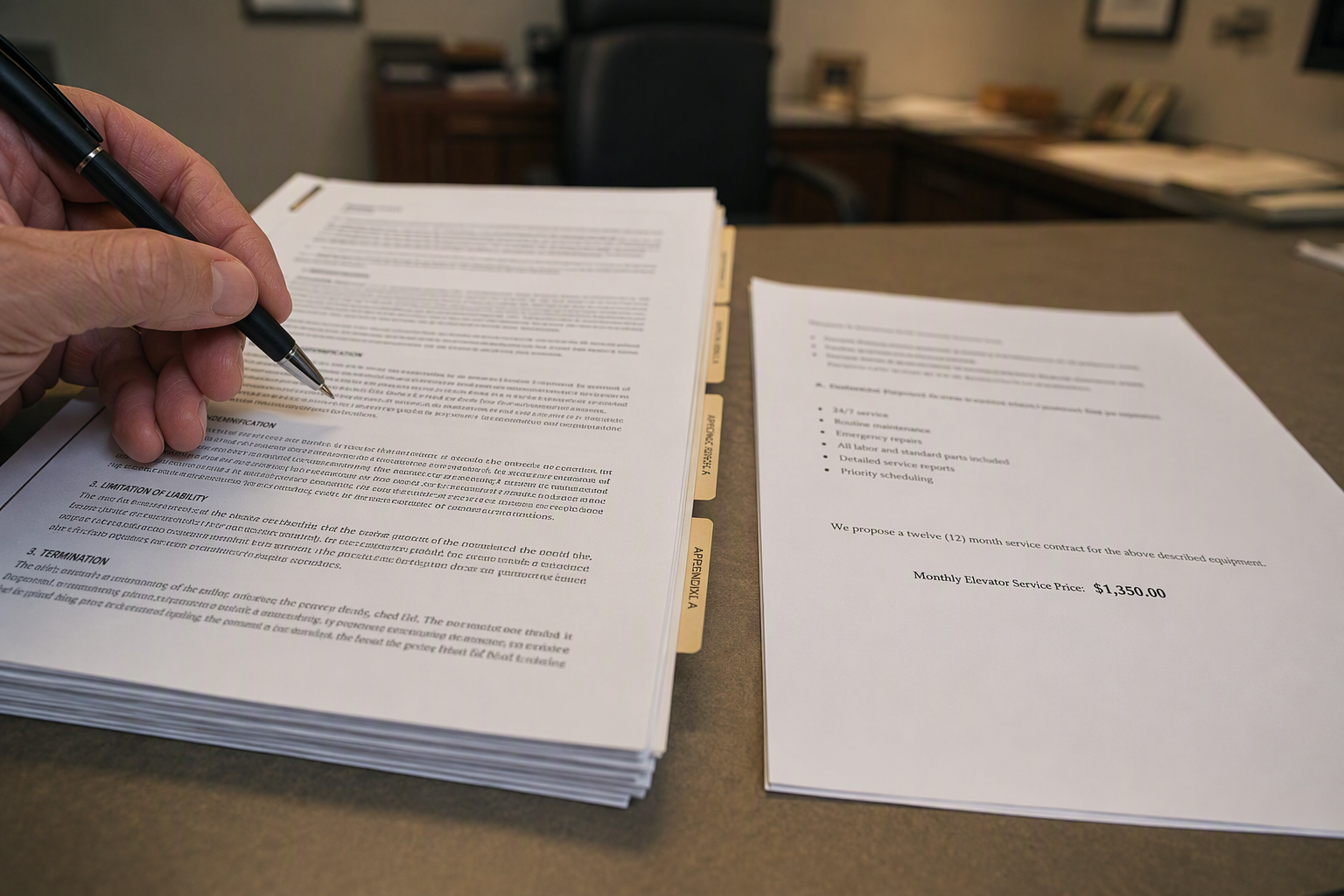
Elevator service proposals vary widely because there is no universal contract template for the industry. Each service company structures its offering around its own labor model, parts supply chain, and risk tolerance. Common variables that cause bids to look incompatible include:
- Contract type: Full-service (comprehensive), oil-and-grease (lubrication-only), or parts-and-labor hybrid
- Parts coverage: Some bids include all parts; others exclude major components such as controllers, motors, and door operators
- Compliance scope: Whether the bid includes required annual or periodic inspections under California’s Division of Occupational Safety and Health (Cal/OSHA) elevator unit or the Texas Department of Insurance (TDI) Elevator Safety program
- Emergency call response: How after-hours callbacks are structured and whether they carry separate billing
- Modernization vs. maintenance: Some proposals blend capital upgrade costs into service agreements, making monthly figures look inflated versus a maintenance-only bid
Until you decompose each proposal into its component parts, you are not comparing elevators — you are comparing packaging.
What Are the Core Contract Types and How Do They Compare?
| Contract Type | What’s Typically Included | What’s Typically Excluded | Best Fit For | Key Risk |
|---|---|---|---|---|
| Full-Service / Comprehensive | All labor, all parts, all routine maintenance, emergency callbacks, some code upgrades | Major modernization, vandalism damage, third-party-caused failures | High-traffic commercial buildings, older equipment | Hidden exclusions buried in appendices can eliminate most major parts |
| Oil-and-Grease / Lubrication Only | Routine lubrication, adjustment, and visual inspections | All parts, all repairs, callbacks | New equipment under manufacturer warranty, very low-traffic buildings | Any repair generates a separate, unbudgeted invoice |
| Parts-and-Labor (Hybrid) | Labor covered; parts billed at a negotiated rate or capped dollar amount per year | Parts above the annual cap, major components (varies widely) | Mid-age equipment, owners who want predictable labor costs | Cap limits can be reached quickly on aging equipment |
| Time-and-Materials (T&M) | Nothing pre-agreed; all work billed at hourly labor rate plus parts markup | Everything — nothing is bundled | Single-elevator owners with very reliable, modern equipment | Unpredictable costs; no incentive for contractor to work efficiently |
How Do You Build a Fair Bid Comparison Checklist?
To level the playing field, request that every bidder respond to the same standardized scope document before you accept their proposal. Use the checklist below as your template.
- Define your equipment inventory precisely. Provide every bidder with the same list: elevator type (traction vs. hydraulic), drive system, age, number of stops, current controller, and door type. Ambiguity in the equipment description is the single most common reason bids diverge.
- Request an itemized parts exclusion list. Ask each contractor to list, in writing, every component category they will not cover. Compare exclusion lists side by side — the bid with the shortest exclusion list usually represents the most complete coverage.
- Clarify inspection and code compliance responsibility. In California, elevator inspections are regulated by the OSHA-aligned Cal/OSHA Elevator, Ride, and Tramway Unit. In Texas, the Texas Department of Insurance administers elevator safety. Ask each bidder whether inspection fees and permit costs are included or separate.
- Standardize the callback definition. “Emergency service” means different things to different contractors. Get each bidder to define, in writing, what triggers a billable vs. included callback and whether after-hours response carries a premium.
- Evaluate code upgrade obligations. ASME A17.3, the Safety Code for Existing Elevators and Escalators, establishes retroactive safety requirements that authorities having jurisdiction (AHJs) in California and Texas enforce on their own schedules. Ask whether mandated code upgrades — such as firefighters’ emergency operation or door reopening devices — are the contractor’s responsibility or yours.
- Review the ADA compliance scope. ADA Title III accessibility requirements apply to elevators in places of public accommodation. Confirm which bidder, if any, includes ADA-related adjustments in their service scope.
- Examine contract length, escalation clauses, and exit terms. A lower monthly rate on a five-year contract with a steep early-termination penalty may cost more than a slightly higher rate on a one-year renewable agreement.
- Verify insurance and licensing. In California, elevator contractors must hold a Contractor State License Board (CSLB) C-11 elevator license. In Texas, elevator contractors and mechanics must be licensed through the Texas Department of Insurance. Confirm each bidder is currently licensed before comparing prices.
What Is the Real Total Cost of Ownership When Comparing Bids?
| Cost Category | Full-Service Contract | Oil-and-Grease Contract | Time-and-Materials |
|---|---|---|---|
| Monthly contract fee | Higher | Lower | None (pay-per-visit) |
| Unplanned repair invoices | Minimal (covered) | High (all repairs billed) | High (all work billed) |
| Inspection & permit fees | Often included | Usually separate | Always separate |
| Downtime cost (lost revenue or tenant complaints) | Lower (preventive focus) | Medium | Higher (reactive only) |
| Code upgrade exposure | Partially covered (verify exclusions) | Owner’s responsibility | Owner’s responsibility |
| Early termination penalties | Common on long-term deals | Less common | None |
| Budget predictability | High | Low | Very Low |
Budget predictability has real value. A full-service contract that appears expensive month-to-month may represent a lower total cost than an oil-and-grease contract that triggers a large, unexpected repair invoice during the same period. Always model a worst-case repair scenario into your T&M and lubrication-only bids before concluding they are the better deal.
What Red Flags Should You Watch for in an Elevator Service Proposal?
- No parts exclusion schedule: If a “full-service” contract does not attach a written exclusion list, assume every major component is excluded until proven otherwise.
- Automatic renewal with short cancellation windows: Some contracts auto-renew for multi-year terms if you do not cancel within a 30-to-60-day window. Read termination clauses carefully.
- Proprietary parts lock-in: Some large national contractors install proprietary components that only their technicians can service. This eliminates competitive bidding on future repairs.
- Vague “code compliance” language: Phrases like “we keep your elevator up to code” without specifying which code edition or which authority are meaningless. Compliance responsibility must be explicit.
- No reference to ASME A17.1 Safety Code for Elevators and Escalators: Any reputable maintenance proposal should reference the governing safety standard under which maintenance procedures are performed.
- Pricing that seems dramatically lower than all other bids: An outlier low bid usually signals narrower coverage, unlicensed subcontracting, or deferred maintenance practices that transfer risk to the building owner.
How Do Compliance Requirements in California and Texas Affect Bid Scope?
California and Texas each administer their own elevator safety programs, which means the compliance obligations written into your service contract will differ depending on where your building is located.
In California, elevator inspections fall under the Cal/OSHA Elevator, Ride, and Tramway Unit. Buildings in California must ensure their elevators are inspected at intervals the state enforces, and certificates of compliance must be posted in the elevator cab. Bidders working in California should explicitly state whether permit applications, inspection scheduling, and certificate maintenance are included in their scope.
In Texas, the Texas Department of Insurance (TDI) administers the Elevator Safety Program under the Texas Elevator Safety Act. Elevators must be inspected by a licensed third-party inspector or a TDI-employed inspector, and certificates must be current. Texas-based bids should clarify whether TDI inspection coordination is the contractor’s responsibility or delegated to the building owner.
Federally, ASME A17.1 and A17.3 provide the underlying technical standards that both states reference. ADA Title II and Title III requirements apply to elevator accessibility in government and commercial buildings regardless of state. Any bid that fails to acknowledge these federal frameworks as the technical baseline should raise questions.
What Questions Should You Ask Every Contractor Before Accepting a Bid?
- Is your company currently licensed in California (CSLB C-11) or Texas (TDI elevator contractor license), and can you provide your license number?
- Provide a complete written list of every component category excluded from parts coverage.
- Are annual inspection fees and permit costs included in the contract price?
- How are after-hours emergency calls handled, and is there an additional charge?
- Which edition of ASME A17.1 governs your maintenance procedures?
- If the AHJ mandates a retroactive code upgrade during the contract term, is that upgrade included or billed separately?
- What is the early termination fee if we need to exit the contract?
- Do you use proprietary parts or controls that would restrict future service to your company only?
- Can you provide references from California or Texas buildings comparable in size and elevator type to ours?
How Do You Evaluate a Modernization Bid Versus a Maintenance Bid?
| Factor | Maintenance Contract | Modernization Project |
|---|---|---|
| Primary goal | Preserve current performance and safety compliance | Replace aging systems; upgrade to current code and technology |
| Typical contract duration | 1–5 years, renewable | Fixed project timeline; maintenance contract follows separately |
| Code compliance trigger | Ongoing; AHJ enforces at inspection | Modernization triggers full ASME A17.3 retroactive compliance review |
| Capital expenditure | Low (operating expense) | High (capital expense); may qualify for depreciation |
| Building disruption | Minimal (scheduled maintenance windows) | Significant; elevator out of service for weeks to months |
| Long-term value | Extends equipment life incrementally | Resets equipment lifespan; improves reliability and energy use |
When a bid packages modernization and maintenance together, request separate line-item pricing for each. This ensures you can compare the maintenance component against standalone maintenance bids and evaluate the modernization component against the cost of continued repairs on aging equipment.
What Does a Responsible Bid Evaluation Process Look Like Step by Step?
- Prepare a standardized Request for Proposal (RFP). Document your equipment inventory, current inspection status, compliance history, and service expectations in a single document distributed to all bidders simultaneously.
- Set a uniform bid deadline. Give all contractors the same amount of time to respond — typically two to three weeks for a maintenance bid, longer for modernization.
- Conduct a site walk with each bidder separately. Allow each contractor to inspect the equipment independently so their pricing reflects actual field conditions, not assumptions.
- Receive bids and strip them to common line items. Use the checklist from this guide to map each proposal to the same categories: monthly fee, parts coverage, inspection costs, callback terms, and exit clauses.
- Score each bid on a weighted criteria matrix. Assign weights to factors based on your building’s priorities — reliability, compliance coverage, cost predictability, or contractor reputation.
- Verify licenses and insurance before shortlisting. Confirm California CSLB C-11 or Texas TDI license status and certificate of insurance before investing further evaluation time in any bid.
- Request references and follow up on them. Contact at least two references from each finalist — specifically asking about response quality, billing transparency, and how disputes were handled.
- Negotiate the final contract against the bid document. Use the standardized bid comparison to identify gaps and negotiate explicit language closing any coverage ambiguities before signing.
How Can an Independent Elevator Service Company Provide a More Transparent Bid?
Large national elevator contractors sometimes benefit from opacity — proprietary parts, complex contract language, and automatic renewal clauses can create long-term dependency that is difficult to exit. Independent, regionally focused companies have a structural incentive to compete on transparency and service quality rather than contractual lock-in.
AmeriTex Elevator operates as an independent elevator service provider serving California and Texas. Because AmeriTex is not tied to a single manufacturer’s parts ecosystem, proposals can be written against open-market components, which supports genuine price competition and reduces long-term dependency risk. Building owners seeking a clear, itemized bid that maps directly to the comparison checklist in this guide are encouraged to use AmeriTex as one of their evaluation bids — not just to potentially award the contract, but to establish a market benchmark against which other proposals can be measured.
What Happens If You Choose the Wrong Elevator Service Contractor?
Selecting a contractor based on headline price without evaluating scope completeness carries real consequences for California and Texas building owners:
- Compliance violations: If inspection coordination is excluded from the contract and the building owner does not pursue it independently, the elevator may operate with a lapsed certificate — creating liability exposure and potential shutdown orders from Cal/OSHA or TDI.
- Unexpected repair costs: An oil-and-grease contract on aging equipment can generate repair invoices that dwarf the apparent savings over a full-service alternative.
- Proprietary lock-in: A contractor who installs proprietary controls eliminates competitive bidding on future work, effectively guaranteeing above-market pricing for the remaining life of that equipment.
- Tenant and ADA liability: An elevator that is frequently out of service may create ADA accessibility claims if it is the only accessible route in a building subject to Title III.
- Difficulty exiting a bad contract: Multi-year contracts with steep termination penalties can trap building owners with underperforming contractors for years.
Frequently Asked Questions
Is it normal for elevator bids to vary by a large margin for the same building?
Yes, wide variation is common and expected. Contract type, parts coverage scope, and the contractor’s assessment of equipment risk all affect pricing significantly. A bid that is dramatically lower than all others warrants careful scrutiny of its exclusion list rather than immediate selection.
Can I negotiate the scope of an elevator service contract after receiving a bid?
Absolutely. Bids are starting points for negotiation. Common areas for negotiation include expanding parts coverage, adding inspection fee inclusion, removing or capping early termination fees, and shortening contract length. Use your standardized bid comparison as leverage — showing a contractor where a competitor’s scope is broader often motivates scope improvements.
How do I know if a modernization is included in a maintenance bid or priced separately?
Request that every bidder provide a signed statement clarifying whether any capital replacement work is bundled into the monthly maintenance fee. If a modernization component is included, ask for a separate line-item price so you can evaluate it independently.
What codes govern elevator maintenance in California and Texas?
Both states reference ASME A17.1, the Safety Code for Elevators and Escalators, for new installations and ASME A17.3, the Safety Code for Existing Elevators and Escalators, for retroactive requirements on existing equipment. OSHA standards and federal ADA requirements also apply. California’s Cal/OSHA Elevator Unit and Texas’s TDI Elevator Safety Program are the primary state-level enforcement authorities.
Should I require each bidder to attend a site walk before submitting a proposal?
Yes. Bids prepared without a site walk often contain assumptions that lead to scope disputes after contract signing. Requiring a site walk for every bidder also ensures pricing reflects actual equipment condition, which produces more honest and comparable proposals.
What insurance should an elevator contractor carry?
At minimum, require each bidder to provide current certificates of general liability insurance and workers’ compensation coverage. Confirm that the building owner is listed as an additional insured on the liability policy. Inadequate contractor insurance exposes the property owner to liability for injuries or property damage that occur during service visits.
How long should an elevator maintenance contract term be?
Shorter initial terms — one year or two years — are generally preferable for first-time engagements with a new contractor. Once performance has been verified, longer terms may offer pricing advantages. Avoid signing multi-year contracts without evaluating the early termination clause and automatic renewal provisions.
What is the difference between a licensed elevator contractor and a certified technician in Texas and California?
In Texas, both the contracting company and the individual mechanics who perform elevator work must hold licenses issued by TDI. In California, the contracting company must hold a CSLB C-11 Elevator Contractor license, and mechanics must hold a valid Elevator Mechanic certification. Always verify both the company license and ask about technician credentials before awarding a contract.
Summary: The Five Non-Negotiables of a Fair Bid Comparison
- Standardized scope document: Every bidder works from the same equipment description and service expectations.
- Written parts exclusion list: No bid is evaluated without a signed exclusion schedule attached.
- Compliance responsibility confirmed in writing: Inspection coordination, permit fees, and code upgrade obligations are explicitly assigned to either the contractor or the building owner.
- License verification before shortlisting: California CSLB C-11 or Texas TDI license confirmed before evaluation resources are invested.
- Total cost of ownership model: Every bid is evaluated on contract fee plus realistic out-of-pocket repair, inspection, and penalty exposure — not headline monthly price alone.
Get a Transparent, Itemized Elevator Assessment From AmeriTex Elevator
Comparing bids is easier when at least one proposal is written clearly. AmeriTex Elevator provides building owners and property managers in California and Texas with straightforward elevator assessments that map directly to the evaluation criteria in this guide — no proprietary lock-in, no vague compliance language, and no hidden exclusions.
Contact AmeriTex Elevator for a free elevator assessment: 866-679-4313
Need elevator service you can rely on? AmeriTex Elevator is ready to help.