
How Do I Switch Elevator Service Companies Without Voiding My Warranty or Creating a Gap in Compliance?
Switching elevator service companies is straightforward when the transition is planned carefully: give proper written notice under your current contract, collect all maintenance logs, inspection certificates, and equipment records before your final service date, verify your new provider’s regulatory credentials, and schedule your first maintenance visit before your existing compliance documents expire. The sections below answer every question building owners and facilities managers typically ask when making this change in Texas and California.
What Are the Exact Steps to Switch Elevator Service Companies Without a Compliance Gap?
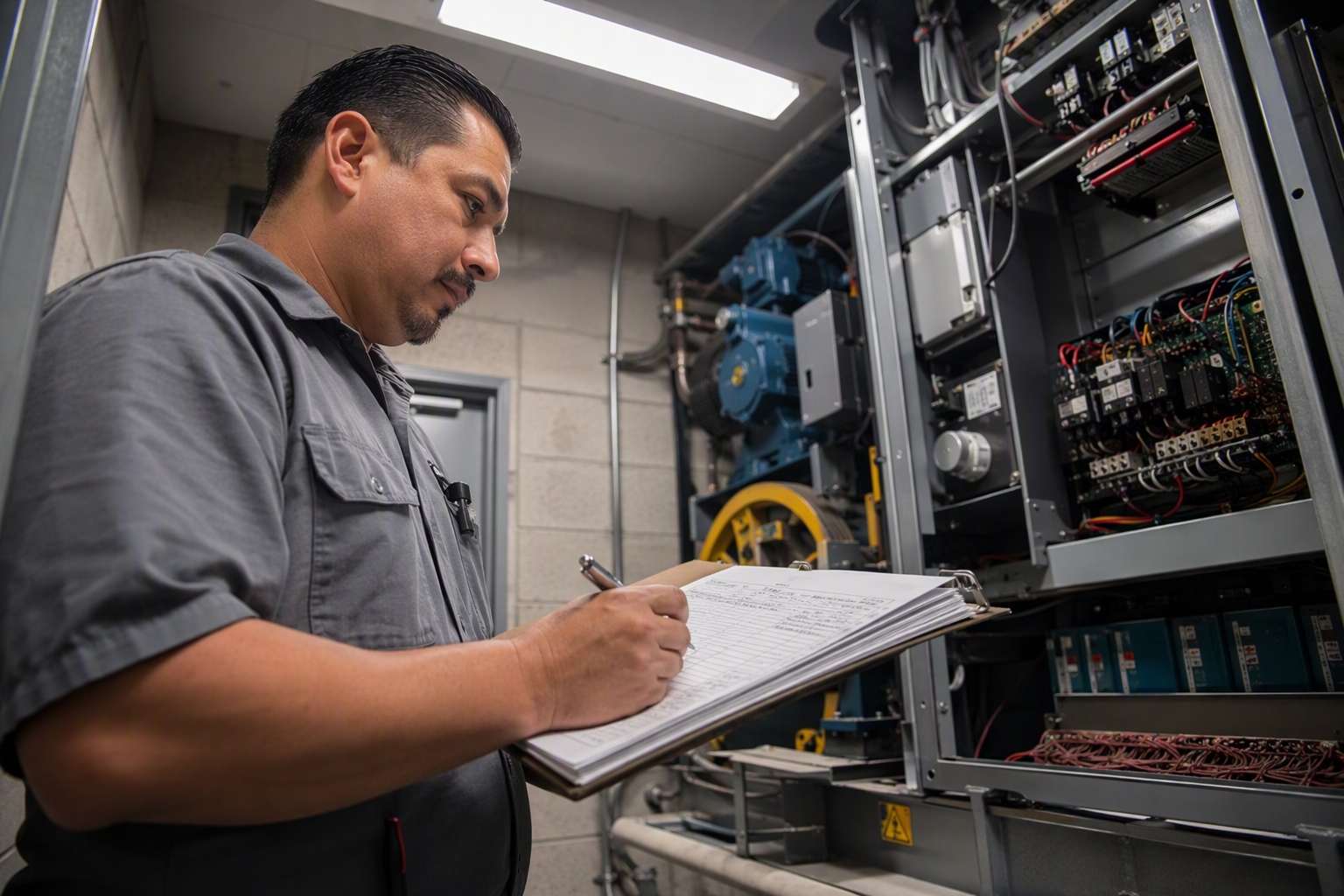
A structured, phased handoff is the only way to ensure continuous regulatory compliance and uninterrupted equipment coverage during a provider change.
- Review your current contract. Locate the termination clause, required notice period (commonly 30, 60, or 90 days), and any language about warranty transferability or proprietary parts. Do not give verbal notice — send written notice by certified mail or the method your contract specifies, and note the date your coverage legally ends.
- Request a complete records package. Ask your current provider in writing for all maintenance logs, inspection reports, violation correction records, wiring diagrams, parts lists, and any open permits or pending inspection dates. You are legally entitled to this documentation as the equipment owner.
- Verify your new provider’s credentials before signing. In Texas, confirm the company holds a current TDLR contractor registration. In California, confirm both a C-11 Elevator Contractor license from the California Contractors State License Board (CSLB) and a Certified Qualified Conveyance Company (CQCC) certification from Cal/OSHA. AmeriTex Elevator holds the credentials required in every market it serves.
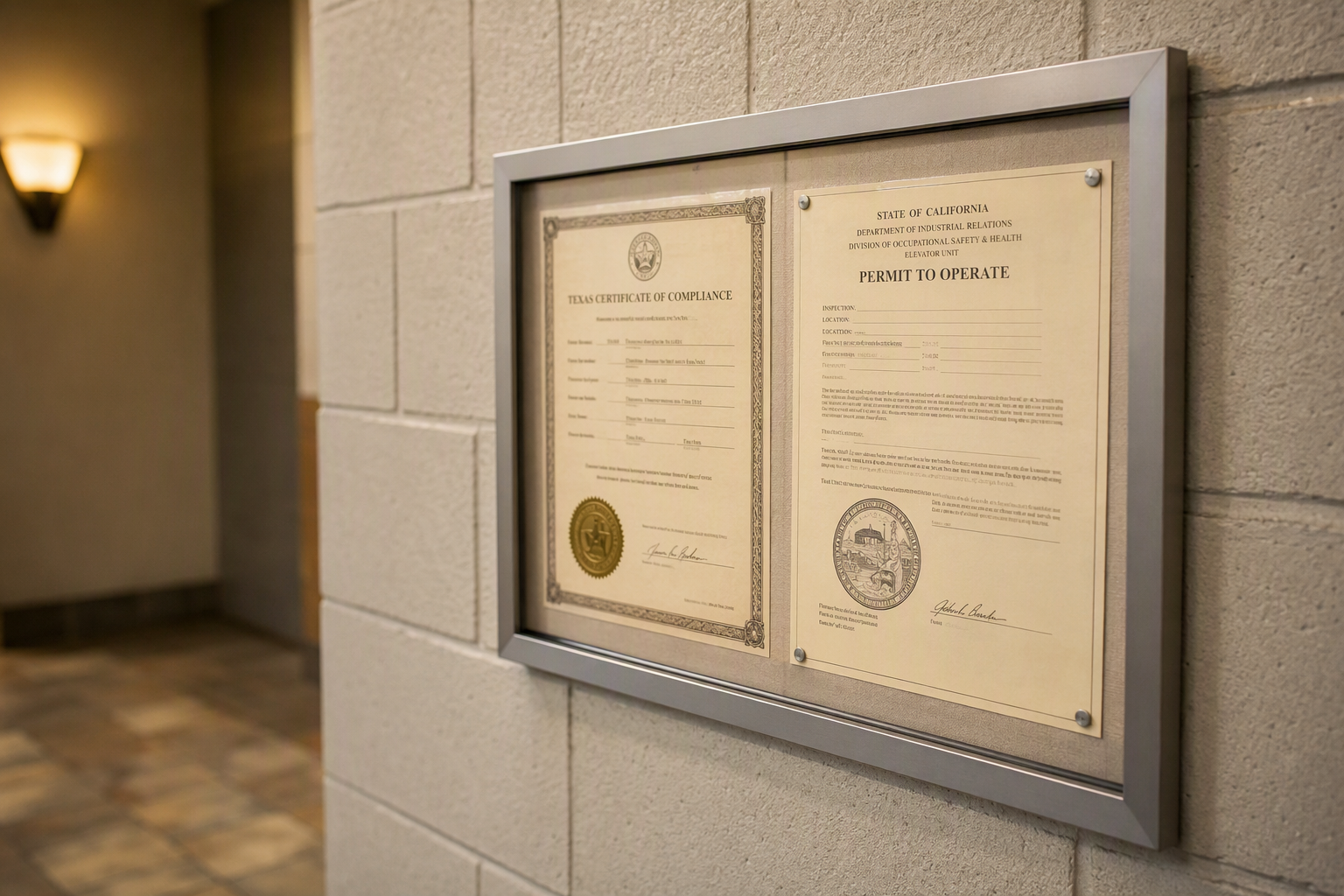
- Map your compliance calendar. Identify the expiration date of your Texas Certificate of Compliance or California permit to operate. Schedule your new provider’s first service visit and, if needed, your next inspection before those documents expire.
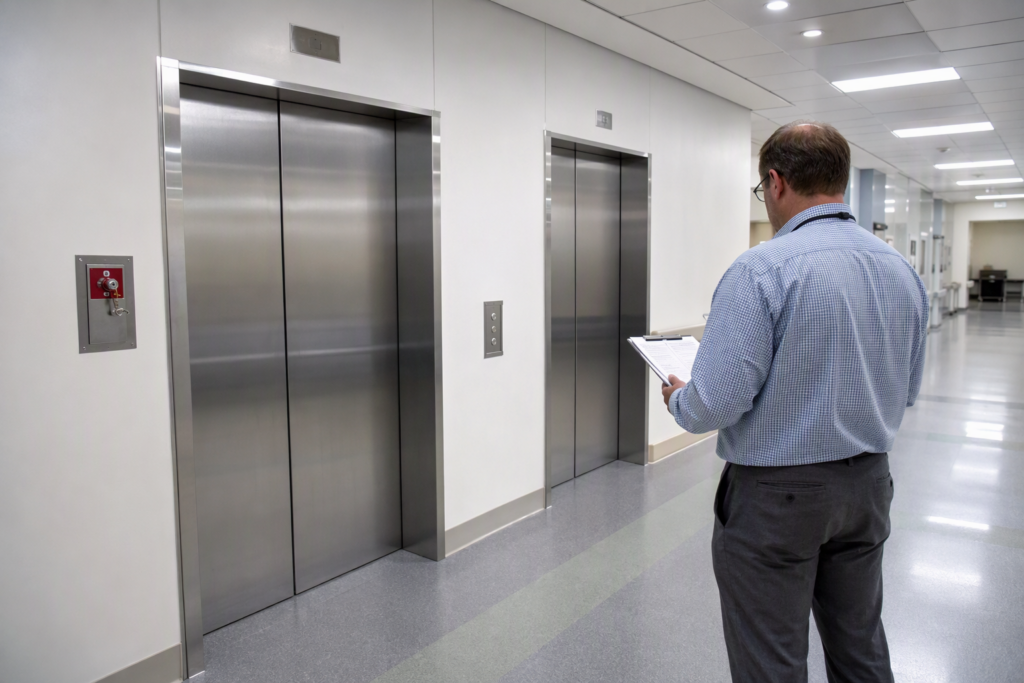
- Conduct a formal equipment assessment at transition. Have your new provider perform a documented walk-through of every unit so the current mechanical condition is on record before their service period begins. This protects both parties and establishes a clear baseline.
- Notify the relevant authority having jurisdiction (AHJ). In most Texas jurisdictions, TDLR tracks contractor assignments through permit and inspection records. In California, Cal/OSHA associates the permit to operate with the owner, but a full maintenance contract with a CQCC-certified company can affect the permit duration. Confirm with your AHJ whether any paperwork must be filed at changeover.
- Confirm insurance continuity. Verify that your new provider’s general liability insurance is current. Texas requires registered elevator contractors to carry at least $1,000,000 per occurrence for bodily injury or death and $500,000 per occurrence for property damage under 16 Texas Administrative Code Chapter 74.
- File the transition in your building records. Update your facilities management system with the new provider’s contact information, insurance certificates, and the effective date of the new contract so auditors have a clean chain of custody.
Will Switching Elevator Companies Void My Equipment Warranty?
Whether a warranty is affected depends entirely on the language in your original purchase or installation contract, not on a universal rule.
Manufacturer warranties typically fall into two categories: parts-only warranties and full-coverage warranties that require maintenance by a “qualified” or “authorized” provider. Review the warranty document itself. If it requires maintenance by any licensed or certified elevator company rather than a specific brand-affiliated company, switching to any properly credentialed provider — such as one holding TDLR contractor registration in Texas or CQCC certification in California — will not void coverage.
If the warranty specifically names the original contractor or requires use of proprietary parts, contact the manufacturer directly before switching and ask for a written statement on transferability. Many manufacturers will honor warranties with independent providers as long as service records are continuous and ASME A17.1/CSA B44 Safety Code for Elevators and Escalators maintenance standards are followed.
Keep every maintenance log your outgoing provider generated. A continuous, documented service history is your strongest defense if a warranty claim is later disputed.
What Certifications Must an Elevator Company Hold in Texas Before I Can Switch to Them?
In Texas, any company that installs, repairs, alters, tests, or maintains elevator equipment must be registered as a contractor with the Texas Department of Licensing and Regulation (TDLR), Elevator and Escalator Safety program.
Texas elevator contractor registrations expire one year after issuance, so always request a current registration certificate — not one from a prior cycle. Each registered contractor must also designate one or two responsible parties who hold at least three years of elevator contractor experience, and must carry the minimum insurance amounts described above. Note that TDLR does not regulate elevators inside Houston city limits; Houston operates its own program, so contractors working in Houston must satisfy the City of Houston’s requirements.
Texas does not separately license individual elevator mechanics at the state level under the verified rules available for this guide, but the contractor registration system holds the company accountable for the qualifications of its workers.
What Certifications Must an Elevator Company Hold in California Before I Can Switch to Them?
California has a two-layer credentialing system that every elevator service company must satisfy before touching any conveyance in the state.
First, the company must hold a C-11 Elevator Contractor license issued by the California Contractors State License Board (CSLB). Second, and separately, the company must be certified by Cal/OSHA as a Certified Qualified Conveyance Company (CQCC). The CQCC application requires proof of a current C-11 license and certificates of workers’ compensation and liability insurance. These certifications last two years and require at least eight hours of continuing education for renewal.
Every mechanic who works on a California elevator without direct supervision must individually hold a Certified Competent Conveyance Mechanic (CCCM) certificate from Cal/OSHA. Only a CCCM working for a CQCC may legally maintain, repair, alter, or replace components on a conveyance in California. Verify both the company and mechanic credentials before signing a new contract.
If your building is in Los Angeles, note that the City of Los Angeles Department of Building and Safety (LADBS) runs its own elevator and conveyance inspection program. Confirm requirements with LADBS in addition to state-level Cal/OSHA requirements.
How Do Texas Compliance Timelines Affect My Switching Window?
Texas building owners must obtain a TDLR Certificate of Compliance for each elevator unit, valid for one year, so the expiration date of that certificate is the hard deadline around which any provider transition must be planned.
Under Texas Health and Safety Code Chapter 754 and 16 Texas Administrative Code Chapter 74, the building owner — not the service company — has the sole right to select the elevator inspector. That inspector must be registered with TDLR, must provide the inspection report within five calendar days of the inspection, and must find the equipment in compliance before TDLR issues a new Certificate of Compliance. Any violations must be corrected or under contract to be corrected within 30 days of the inspection, or the owner must obtain a waiver or delay from TDLR.
Plan your transition so your new provider has enough time to assess the equipment, complete any needed corrective maintenance, and schedule the annual inspection before your current certificate expires. Initiating the switch at least 60 days before expiration provides a comfortable buffer.
How Do California Compliance Timelines Affect My Switching Window?
In California, every conveyance must be inspected at least once a year, and a permit to operate is valid for up to one year after a safe inspection — or up to two years when the elevator is covered by a full maintenance contract with a CQCC-certified company.
Under California Labor Code Sections 7300–7324.2 and California Code of Regulations, Title 8, Elevator Safety Orders (Sections 3000–3146), the responsibility for arranging the annual reinspection falls on the equipment owner, not the service provider. Only Cal/OSHA state safety engineers and Certified Competent Conveyance Inspectors (CCCI) may perform inspections. The permit to operate must be posted conspicuously inside the elevator car.
If your current permit was issued on the basis of a full maintenance contract and you switch providers, confirm with the incoming CQCC-certified company that an equivalent full maintenance contract will be in place before the old one terminates. A gap in full maintenance contract coverage could affect permit duration at the next renewal.
What Documents Should I Collect from My Current Elevator Company Before Switching?
A complete records package protects building owners legally, operationally, and financially when a new service provider takes over.
Request the following in writing from your current provider:
- All maintenance visit logs with dates, technician notes, and parts replaced
- Inspection reports and any violation notices issued by the AHJ
- Current Texas Certificate of Compliance or California permit to operate
- Category test records (Texas requires a Category 5 full-load test every five years on traction elevators)
- Original equipment manuals, wiring diagrams, and as-built drawings
- Parts inventory and any outstanding or back-ordered parts orders
- Any open permits for alterations or repairs
- Insurance certificates covering the service period
If your current provider refuses to release documentation, consult with legal counsel. Equipment records belong to the building owner as part of property documentation.
Can I Switch Elevator Companies Mid-Compliance-Cycle Without Penalty?
Yes — switching mid-cycle is legally permissible as long as the new provider maintains compliance documentation and any required certifications are continuously in place.
There is no regulatory prohibition in Texas or California against changing service providers between annual inspections. The compliance obligation rests with the building owner, not any specific service company. The practical risk of a mid-cycle switch is that the new provider inherits the equipment’s condition without having maintained it from the last inspection. Mitigate this with a documented entry assessment by the incoming company so the baseline is clear and any issues discovered are attributed correctly.
How Does ASME A17.1 Apply When I Switch Elevator Service Companies?
ASME A17.1 sets the national maintenance and safety standard that any qualified elevator company should be following regardless of which state you are in.
The ASME A17.1/CSA B44 Safety Code for Elevators and Escalators establishes maintenance, inspection, and testing requirements that form the foundation of both Texas and California elevator rules. Texas adopted the 2016 edition as its state code. California adopted the 2004 edition as its Group IV Elevator Safety Orders, effective May 1, 2008, for installations contracted on or after that date. (California has proposed a Group V update that would incorporate ASME A17.1-2019 in part; as of 2026 no effective date has been posted.)
When evaluating a new provider, ask specifically how they document ASME A17.1-required maintenance tasks and how they track periodic test intervals. A provider who cannot produce clear answers to those questions represents a compliance risk regardless of their registration status.
Does Switching Elevator Companies Affect ADA Compliance?
Switching service companies does not itself affect ADA compliance, but a transition that allows maintenance to lapse can result in ADA-regulated features falling out of service.
The Americans with Disabilities Act (ADA) requires that elevators providing access to floors of a multi-story building remain operational and accessible. ADA-regulated features — including Braille markings, audible signals, door timing, and leveling accuracy — require regular maintenance to remain functional. When switching providers, confirm that the new company’s maintenance scope explicitly covers ADA-related components. Document their first visit so any pre-existing deficiencies are noted before their service period begins.
What Questions Should I Ask a New Elevator Service Company Before Signing a Contract?
The right questions reveal whether a prospective provider can maintain compliance and protect your warranty before you commit.
- Are you currently registered with TDLR (Texas) or certified as a CQCC with current C-11 and CCCM credentials (California)? Can you provide documentation?
- Do your mechanics hold current CCCM certifications (California) and what are their qualifications?
- What is your process for documenting maintenance visits in compliance with ASME A17.1?
- How do you handle the annual inspection coordination — specifically, do you assist in scheduling TDLR-registered inspectors or Cal/OSHA-authorized inspectors?
- What is included in a full maintenance contract, and does it qualify for an extended California permit to operate?
- How do you handle violation corrections within the 30-day Texas window?
- Do you carry the required minimum insurance for the state where my building is located?
- How do you document the entry condition assessment at the start of a new contract?
- Do you have experience with my specific elevator model, manufacturer, and control system?
- Do you have any current or pending disciplinary actions with TDLR, Cal/OSHA, or the CSLB?
How Do I Compare Elevator Service Companies to Find the Best Fit?
A structured comparison across regulatory, technical, and contractual dimensions is the most reliable way to evaluate competing providers.
| Evaluation Criteria | What to Verify | Texas Requirement | California Requirement |
|---|---|---|---|
| Contractor Registration / Certification | Current credential document | TDLR Contractor Registration (annual renewal) | CQCC (Cal/OSHA) + C-11 (CSLB), 2-year renewal |
| Mechanic Qualifications | Ask company directly | State-level individual mechanic licensing not verified for Texas | Each unsupervised mechanic must hold CCCM (Cal/OSHA) |
| Liability Insurance (minimum) | Current certificate of insurance | $1M per occurrence (bodily injury/death); $500K per occurrence (property) | Required for CQCC certification; verify amount with company |
| Inspection Coordination | Describe their process | Owner selects TDLR-registered inspector; provider assists with prep | Owner arranges with Cal/OSHA or CCCI; provider assists with prep |
| Maintenance Documentation | Sample log format | Must meet ASME A17.1-2016 (TX adopted code) | Must meet ASME A17.1-2004 (CA adopted code) |
| Periodic Testing Capability | Category 5 test experience | Category 5 full-load test every 5 years (traction elevators) | Per ASME A17.1-2004 Elevator Safety Orders |
| ADA Compliance Coverage | Confirm scope in writing | ADA-regulated features must remain functional | ADA-regulated features must remain functional |
| Contract Termination Terms | Review notice period | Negotiate minimum 30-day written notice | Negotiate minimum 30-day written notice |
| Markets Served | Confirm local presence | Houston, Dallas, Austin, San Antonio | Los Angeles, San Diego |
What Happens to My Compliance Status If There Is a Gap in Elevator Service Coverage?
A gap in service coverage does not automatically invalidate your existing Certificate of Compliance or permit to operate, but it creates legal exposure and equipment risk that can compound quickly.
In Texas, the Certificate of Compliance is tied to the inspection outcome and is valid for one year regardless of who provides maintenance. However, if equipment develops a deficiency during a service gap — such as a passenger elevator operating without working door restrictors or without functioning Phase One firefighters’ service — Texas law requires the unit be removed from service immediately. An unmanaged gap in maintenance increases the probability of exactly these kinds of deficiencies going undetected.
In California, operating an elevator without a valid, current permit to operate is a violation of California Labor Code Sections 7300–7324.2. While the permit itself does not expire the moment you change providers, any maintenance-related deficiency discovered at the next inspection could result in a permit being withheld until corrected. The two-year permit benefit available under a full maintenance contract also requires that the contract remain continuously in effect.
How Long Does It Typically Take to Complete a Provider Transition?
A well-managed transition typically takes between 30 and 90 days from initial notice to the new provider’s first documented service visit, depending on contract notice requirements and the complexity of the equipment portfolio.
Simple portfolios with one or two elevators under standard contracts can transition in 30 days. Larger portfolios — multiple buildings, mixed equipment types, or elevators requiring Category 5 testing in the near term — benefit from a 60- to 90-day window to allow for full records transfer, entry assessments, and inspection scheduling. AmeriTex Elevator works with building owners across Houston, Dallas, Austin, San Antonio, Los Angeles, and San Diego to map transition timelines against compliance calendars so no expiration date is missed.
What Are the Most Common Mistakes Building Owners Make When Switching Elevator Companies?
The most common mistakes are preventable with advance planning and fall into three categories: documentation gaps, credential verification failures, and timing errors.
- Failing to request records before the old contract ends. Once a provider’s contract terminates, recovering historical maintenance logs can be difficult and time-consuming.
- Not verifying the new provider’s current credentials. A registration or certification that lapsed and was recently renewed — or one that expired and was not renewed — can expose a building owner to regulatory liability.
- Assuming the new provider will automatically coordinate the next inspection. In both Texas and California, the building owner is ultimately responsible for ensuring inspections occur and compliance documents remain current.
- Switching providers in the 30-day window before a compliance deadline. This leaves no margin for the new provider to address deficiencies before an inspection.
- Overlooking proprietary parts or access codes. Some older elevator control systems use proprietary components or diagnostic software that may be accessible only through the original manufacturer’s service network. Identify this before signing with an independent provider.
- Not getting transition terms in writing. Verbal agreements about final service visits, records handover, and billing cutoffs frequently result in disputes. Document everything.
How Does the Category 5 Testing Requirement in Texas Affect a Provider Switch?
Texas requires a Category 5 full-load test every five years on electric traction elevators, and this testing milestone should factor directly into your decision about when to switch providers.
If a Category 5 test is due within 12 months, it is worth either completing it with the outgoing provider before the switch or confirming explicitly that the incoming provider has the equipment, experience, and TDLR-registered inspector relationships needed to coordinate and complete the test on schedule. Missed Category 5 tests are a compliance violation under 16 Texas Administrative Code Chapter 74 and can result in a failed annual inspection. Request the date of the last Category 5 test as part of the records package from your outgoing provider.
What Role Does the City of Houston Play in Elevator Compliance for Buildings There?
For buildings within Houston city limits, TDLR does not have jurisdiction — the City of Houston operates its own elevator program, separate from the state TDLR program.
Building owners in Houston must satisfy the City of Houston’s requirements for inspections, permits, and contractor qualifications rather than TDLR’s statewide rules. Any elevator service company working in Houston must be qualified under the city’s program. AmeriTex Elevator serves the Houston market and is familiar with the city’s requirements. Owners transitioning providers in Houston should confirm directly with the City of Houston which compliance documents must be transferred or reissued when a new service company takes over.
How Should I Handle Elevator Compliance When Managing Multiple Buildings Across Texas and California?
Multi-site building portfolios require a compliance calendar that tracks each unit’s inspection due date, certificate or permit expiration, and periodic test schedule across two separate regulatory frameworks.
Texas and California have meaningfully different inspection, certification, and documentation requirements, and Houston adds a third layer with its independent city program. Consolidating elevator service for a multi-state portfolio under a single qualified provider that operates in both states eliminates the coordination risk of managing separate vendor relationships. AmeriTex Elevator serves Houston, Dallas, Austin, and San Antonio in Texas and Los Angeles and San Diego in California, giving multi-site owners a single point of accountability for compliance documentation across both states.
What Should I Look for in an Elevator Maintenance Contract to Make Future Switches Easier?
Contract terms that protect building owners at both entry and exit are the single most important negotiating point for any elevator service agreement.
Look for: a clearly defined notice period of 30 to 90 days for termination by either party; an explicit records release clause requiring the provider to deliver all maintenance logs, inspection reports, and equipment documentation within a specified number of business days after contract end; no exclusivity clauses that restrict your right to select an independent inspector (which in Texas is your right by statute); transparent language on whether proprietary parts or software are involved; and clarity on what constitutes a “full maintenance contract” for purposes of the California two-year permit to operate benefit. Contracts that lack a records release clause or that include auto-renewal terms with long notice windows significantly complicate future transitions.
Why Should I Choose AmeriTex Elevator as My New Elevator Service Company?
AmeriTex Elevator is a certified elevator service company operating in Houston, Dallas, Austin, and San Antonio, Texas, and in Los Angeles and San Diego, California — covering the two regulatory environments described throughout this guide.
AmeriTex Elevator holds the credentials required by both TDLR in Texas and Cal/OSHA and the CSLB in California, carries the insurance required under state rules, and serves building owners across all six markets with the technical knowledge needed to navigate each jurisdiction’s inspection, testing, and documentation requirements. The company performs entry assessments at the start of every new service relationship to establish a documented equipment baseline, coordinates compliance calendars to prevent inspection gaps, and provides the complete records package building owners need to maintain a continuous chain of custody. For building owners in Houston, AmeriTex Elevator is experienced with the city’s independent elevator program.
Need elevator service you can rely on? AmeriTex Elevator is ready to help.