How to Switch Elevator Service Companies Without Voiding Your Warranty or Losing Inspection Records
Switching elevator service companies is a straightforward process when building owners understand what is actually protected by warranty law, who legally holds inspection records, and what contractual steps must be completed before a new contractor begins work. The warranty on elevator equipment is attached to the equipment itself under the terms issued by the original manufacturer — not to the service company that installs or maintains it. Inspection records, certificates of compliance, and permits to operate are issued and retained by the state or local authority having jurisdiction (AHJ), meaning they are not destroyed or invalidated when a service contract changes hands. The steps below guide building owners in Texas and California through a compliant, low-risk transition.
Does switching elevator companies void the manufacturer’s warranty?
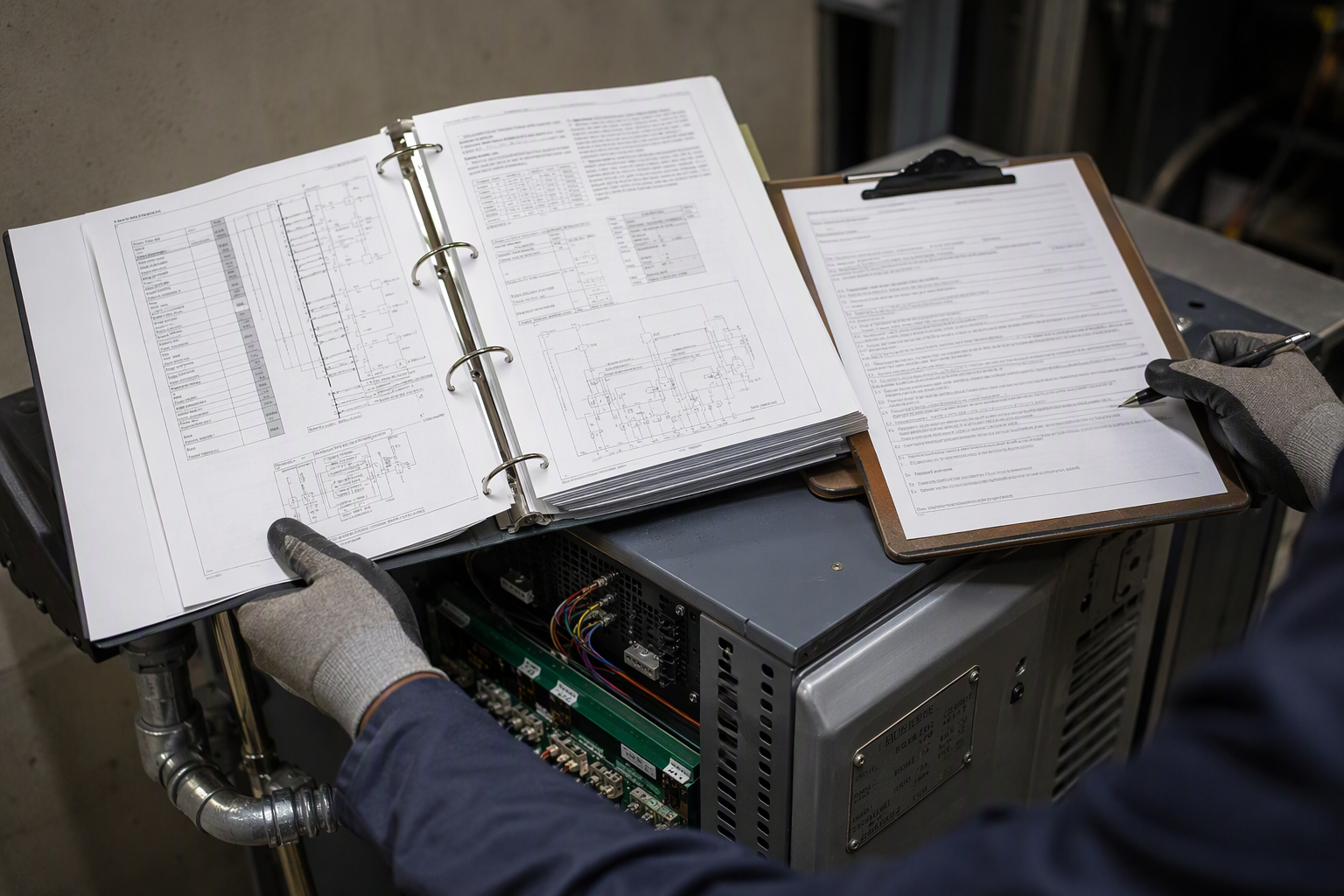
No — a manufacturer’s equipment warranty is tied to the unit itself, not to any specific service contractor, provided that maintenance is performed by a qualified, licensed company in accordance with the manufacturer’s specifications.
Most elevator manufacturers warrant their equipment against defects in materials and workmanship for a defined period following installation. The condition that typically does apply is that maintenance must be performed by a contractor qualified to work on that specific equipment type. In Texas, contractors must be registered with the Texas Department of Licensing and Regulation (TDLR) Elevator and Escalator Safety program under Texas Health and Safety Code Chapter 754. In California, the incoming company must hold a Certified Qualified Conveyance Company (CQCC) certification from Cal/OSHA’s Elevator Unit and its mechanics must be certified as Certified Competent Conveyance Mechanics (CCCM).
Before switching, building owners should request a written statement from their new contractor confirming that they are authorized or trained to service the specific make and model of equipment installed. AmeriTex Elevator recommends documenting this confirmation in writing and retaining it alongside other maintenance records as evidence of continuous, qualified service.
Who actually owns elevator inspection records?
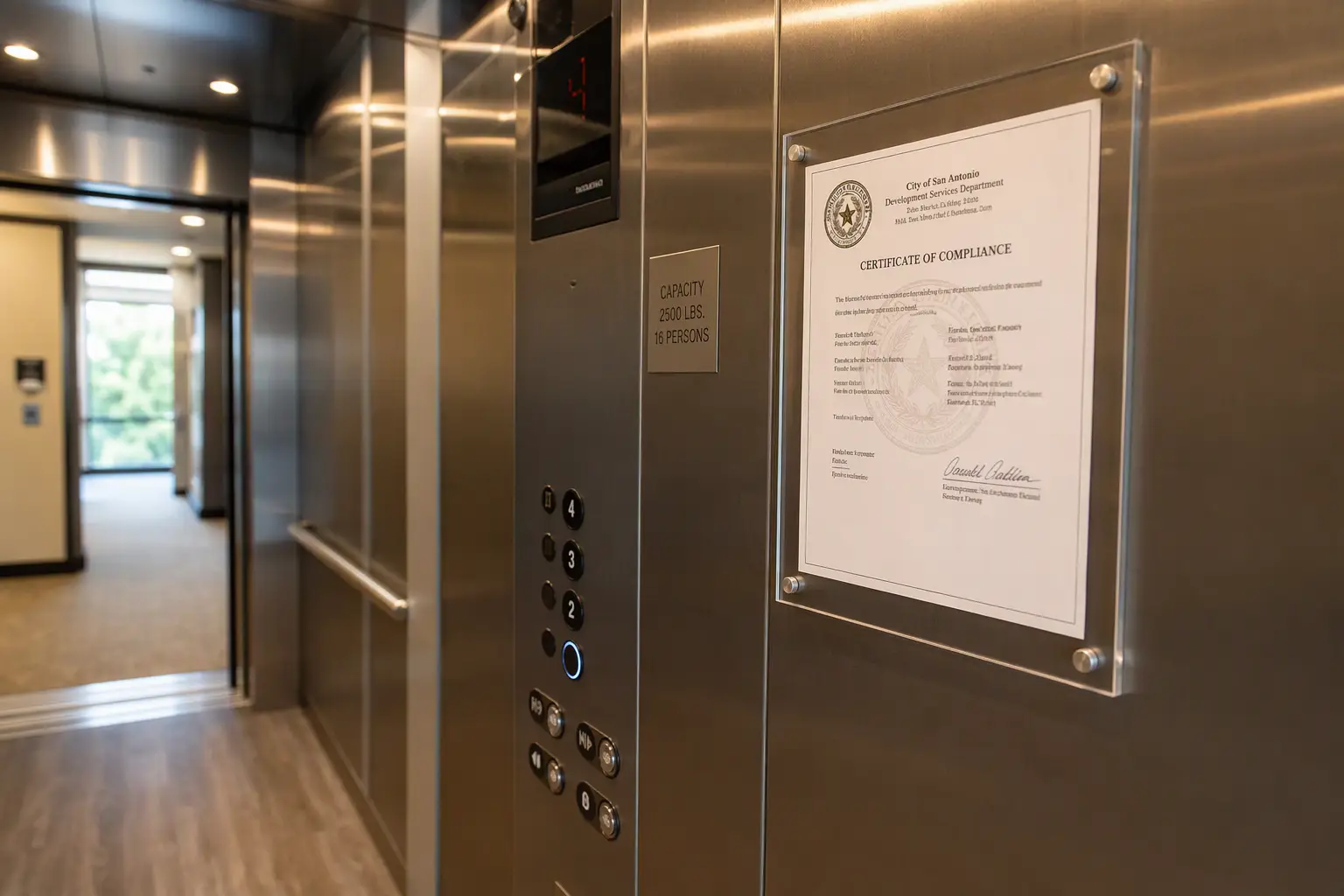
Inspection records and operating permits are issued by the state or local authority having jurisdiction and remain on file with that agency regardless of which service company holds the maintenance contract.
In Texas (outside Houston), the Texas Department of Licensing and Regulation (TDLR) issues a Certificate of Compliance for each unit of equipment, valid for one year. The registered elevator inspector is required by 16 Texas Administrative Code Chapter 74 to provide the inspection report to the owner within five calendar days of the inspection. The owner holds the report; TDLR retains the certificate record. In Houston, the City of Houston administers its own elevator program — TDLR does not regulate elevators inside Houston city limits — so Houston building owners should contact the City directly to confirm how inspection records are stored and transferred.
In California, Cal/OSHA issues a permit to operate for each conveyance under California Labor Code Sections 7300–7324.2. The permit must be posted conspicuously inside the elevator car at all times. Cal/OSHA retains the permit and inspection history; changing service contractors does not affect that record. Los Angeles runs its own elevator and conveyance inspection program through the Los Angeles Department of Building and Safety (LADBS), so Los Angeles building owners should contact LADBS directly for record transfer procedures.
What steps should a building owner take before switching elevator companies?
A successful transition requires reviewing the existing service contract, gathering all site documentation, verifying the incoming contractor’s credentials, and notifying the AHJ if required.
- Review the existing service contract for termination provisions. Most elevator service agreements contain notice periods of 30 to 90 days and automatic renewal clauses. Identify the cancellation deadline and send written notice before that window closes to avoid penalties or rollover terms.
- Request all documentation from the outgoing company. This includes maintenance logs, lubrication records, parts replacement history, as-built drawings, wiring diagrams, and any special tool inventory for proprietary equipment. Most states allow the owner to request these records; the outgoing contractor has no legal right to withhold owner-provided documentation or AHJ-issued certificates.
- Verify the incoming contractor’s credentials with the AHJ. In Texas, confirm TDLR contractor registration. In California, confirm CQCC certification and C-11 license issued by the California Contractors State License Board (CSLB). These can be verified on the TDLR and Cal/OSHA public registries.
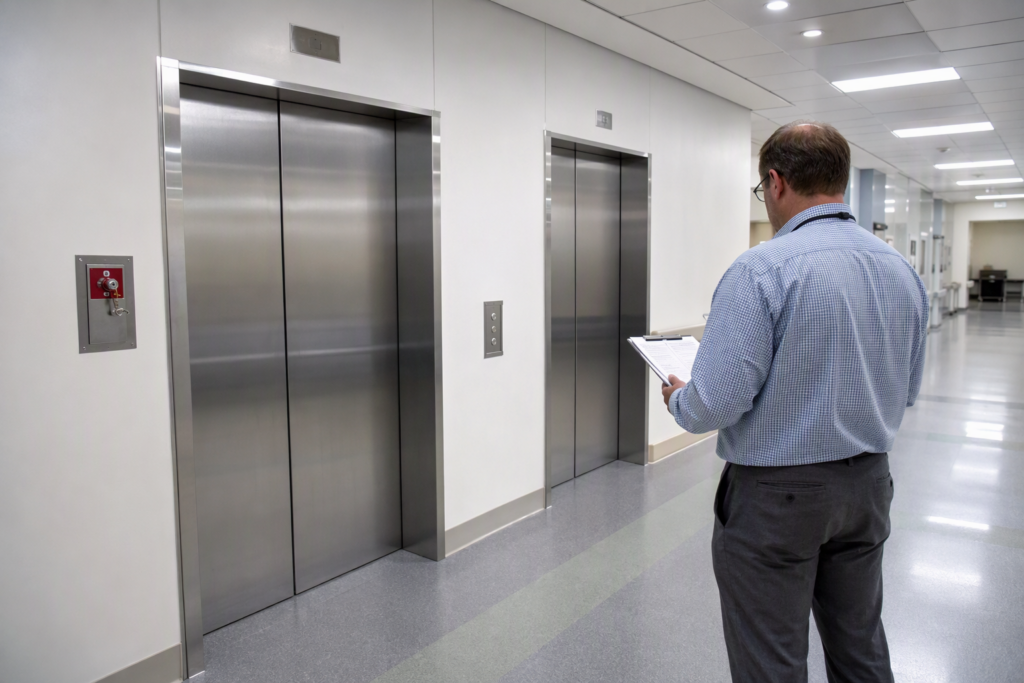
- Conduct a transition inspection or assessment. Have the new contractor perform a documented walk-through of every unit before the old contract expires. This establishes a clear baseline of equipment condition and protects the building owner from being held responsible for pre-existing deficiencies.
- Address open violations or citations. In Texas, owners must have cited violations corrected or under contract for correction within 30 days of the inspection. Confirm with the incoming contractor that any open items are documented in writing and assigned a resolution timeline.
- Update AHJ records with the new contractor’s information. In Texas, the building owner selects the elevator inspector; confirm the selection with TDLR. In California, the building owner is responsible for arranging the annual reinspection — update contact information with Cal/OSHA or LADBS as applicable.
- Confirm the new contractor’s insurance. In Texas, registered elevator contractors must carry general liability insurance of at least $1,000,000 per occurrence for bodily injury or death and $500,000 per occurrence for property damage, per 16 TAC Chapter 74.
- Execute the new service agreement and retain a fully signed copy. Verify that the agreement specifies the code edition under which work will be performed, the scope of maintenance, and escalation procedures for violations.
What documentation should building owners collect from an outgoing elevator company?
Building owners are entitled to all maintenance records, as-built drawings, test reports, and AHJ-issued certificates for every elevator unit on their property.
At a minimum, the outgoing company should provide: maintenance logs organized by unit; the most recent annual inspection report and a copy of the current Texas Certificate of Compliance or California permit to operate; hydraulic fluid change records and oil spill containment records where applicable; Category 1 and Category 5 test reports (Category 5 full-load tests are required every five years in Texas for electric traction elevators); firefighters’ service test records; any outstanding work orders or open citations; original or as-built wiring diagrams; and proprietary controller access credentials or software license information.
If an outgoing contractor refuses to provide as-built drawings or wiring diagrams on the grounds that they are proprietary, building owners should consult legal counsel. Documents that were created as part of a permitted installation using the owner’s equipment are generally considered the owner’s property. AmeriTex Elevator recommends that building owners include a records-delivery clause in every new service contract at signing to prevent disputes at termination.
Can a new elevator company be held liable for the previous contractor’s code violations?
The incoming contractor assumes responsibility for violations it discovers and agrees to correct, but is not automatically liable for deficiencies that predated its involvement and are documented as pre-existing at the time of transition.
This is precisely why a pre-transition assessment is essential. When the incoming contractor documents the as-found condition of every unit in writing before accepting the service contract, it establishes a clear record of what was already out of compliance. Under ASME A17.1/CSA B44 Safety Code for Elevators and Escalators, certain safety deficiencies require immediate removal from service. In Texas, a passenger elevator without working door restrictors or without functioning Phase One firefighters’ service must be taken out of service immediately regardless of which contractor discovers the deficiency.
Does a service change affect the elevator’s annual inspection schedule in Texas?
No — the annual inspection requirement in Texas is tied to the unit and the owner’s obligation, not to the service contractor, so the inspection schedule continues uninterrupted.
Under Texas Health and Safety Code Chapter 754 and 16 Texas Administrative Code Chapter 74, Texas building owners must have each unit inspected annually by a TDLR-registered elevator inspector. The owner selects the inspector independently of the service contractor. Switching service companies does not reset the inspection clock or extend the validity of the existing Certificate of Compliance. Building owners in Dallas, Austin, and San Antonio should confirm current certificate expiration dates with TDLR before finalizing the transition timeline. Houston building owners should verify requirements with the City of Houston’s elevator program directly.
Does a service change affect the elevator’s annual inspection schedule in California?
No — California law places the responsibility for arranging the annual reinspection on the elevator owner, so the inspection obligation continues unchanged regardless of which CQCC-certified company holds the maintenance contract.
Under California Labor Code Sections 7300–7324.2, no elevator may be operated in California without a valid current permit to operate issued by Cal/OSHA. The permit is valid for up to one year; however, Cal/OSHA may issue a permit for up to two years when the elevator is in safe condition and covered by a full maintenance contract with a C-11 licensed elevator company. Building owners in Los Angeles and San Diego who switch to a new qualified service provider and enter into a full maintenance contract should notify Cal/OSHA or LADBS (in Los Angeles) so that the two-year permit eligibility can be confirmed. AmeriTex Elevator holds the required CQCC certification and C-11 license to support this process in California markets.
What is the difference between a full maintenance contract and a lubrication-only contract when switching companies?
A full maintenance contract covers parts, labor, and all required tests; a limited or lubrication-only contract restricts the contractor’s scope and may affect permit duration and warranty protections.
| Contract Type | Typical Scope | Texas Regulatory Impact | California Regulatory Impact | Warranty Consideration |
|---|---|---|---|---|
| Full Maintenance | Parts, labor, lubrication, testing, callbacks, code upgrades | Contractor responsible for correcting cited violations within TDLR timeframes | Qualifies owner for Cal/OSHA permit to operate up to 2 years | Strongest alignment with manufacturer maintenance requirements |
| Comprehensive (Parts Excluded) | Labor, lubrication, callbacks; owner pays for major parts | Contractor still responsible for labor-scope violations; owner handles parts cost | Annual permit only; two-year permit eligibility not confirmed | May create gaps if required parts go unreplaced |
| Lubrication / Examination Only | Periodic lubrication and visual examination only | Owner responsible for all repairs; contractor scope is narrow | Annual permit only; not a full maintenance contract under Cal/OSHA policy | Higher risk of warranty challenge if repairs are delayed |
| Time and Material (On-Call) | No routine visits; owner calls for repairs as needed | Owner assumes full compliance responsibility between service calls | Annual permit only; Cal/OSHA may flag gaps in maintenance documentation | Highest risk; gaps in service records may be cited by manufacturer |
What happens to proprietary elevator controller access when switching companies?
Proprietary controller tools and software access may be restricted by the original equipment manufacturer (OEM), so building owners should clarify access terms before signing with either an OEM-affiliated or independent service provider.
Some elevator manufacturers restrict access to diagnostic software, controller parameters, and fault code data to their own service organizations or authorized dealers. This does not void a warranty but can complicate independent maintenance if the incoming contractor lacks authorized access. Building owners should ask both the outgoing and incoming companies for a written statement on tool and software access before executing a transition. AmeriTex Elevator advises clients in Houston, Dallas, Austin, San Antonio, Los Angeles, and San Diego to include a controller-access clause in the outgoing contract’s termination notice to ensure a clean handover.
Are there code-required tests that must be completed at the time of a service transition?
No federal or state code mandates a special inspection solely because a service contractor changes, but unresolved Category 1 or Category 5 test obligations carry over to the new contractor and must be honored on schedule.
Under ASME A17.1/CSA B44, elevators are subject to periodic tests including annual Category 1 safety tests and, for electric traction elevators, a Category 5 full-load test. Texas codifies the Category 5 requirement in 16 Texas Administrative Code Chapter 74, specifying a five-year interval. California’s Elevator Safety Orders under Title 8, California Code of Regulations (Sections 3000–3146) adopt ASME A17.1/CSA B44, 2004 edition as the foundational standard. Any test that was due or overdue under the previous contractor remains due and is the responsibility of the building owner to schedule and fund. The incoming contractor should confirm test status during the pre-transition assessment.
How should building owners handle open violations when switching elevator companies?
Open violations must be disclosed to the incoming contractor and resolved within the AHJ’s required timeframe — in Texas, that is 30 days from the inspection, with a waiver or delay available from TDLR.
Building owners in Texas should pull the current TDLR Certificate of Compliance and any associated inspection reports to confirm whether violations remain open. Passing those documents to the incoming contractor at the start of the transition allows the new company to develop a corrective action plan before the old contract expires. In California, Cal/OSHA may cite deficiencies during the annual inspection; any conditions that result in a shutdown order require immediate action regardless of contractor status. Building owners should never allow the gap between contract expiration and new contract activation to create a period of unmanaged compliance risk.
How long does switching elevator companies typically take?
A compliant transition can typically be completed within 30 to 60 days when the outgoing contract’s notice period is met and the incoming contractor’s credentials are verified in advance.
The timeline is driven primarily by three factors: the notice period in the existing contract, the availability of a pre-transition assessment appointment, and the time required to obtain and transfer documentation from the outgoing company. Buildings with multiple units, open violations, or proprietary equipment may require additional time. AmeriTex Elevator recommends initiating the process at least 60 days before the desired start date to ensure no lapse in coverage occurs.
What questions should building owners ask when evaluating a new elevator service company?
Building owners should evaluate a new service provider on credentials, code compliance, documentation practices, and specific experience with the installed equipment type.
Key questions to ask any prospective elevator service company include: Are you registered as a contractor with TDLR (Texas) or certified as a CQCC with Cal/OSHA (California)? Do your mechanics hold the required certifications for this state? Are you authorized or trained to service this specific make and model of equipment? What is your process for documenting maintenance visits and providing records to the building owner? How do you handle open citations from a prior contractor? What is your protocol when an emergency safety deficiency is discovered — for example, a non-functioning door restrictor in Texas or an expired permit to operate in California? These questions help building owners assess technical competence and regulatory awareness before signing.
Does the ADA impose any obligations when switching elevator companies?
The Americans with Disabilities Act (ADA) places accessibility obligations on building owners and operators, not on service contractors, but the incoming company should be aware of ADA-relevant equipment features during the transition assessment.
ADA Title III requires that elevators in places of public accommodation and commercial facilities be maintained in operable working condition. While the ADA does not impose maintenance obligations on contractors directly, a building owner’s ADA compliance depends on having elevators that meet accessibility standards for door timing, cab dimensions, controls, and audible signals. An incoming contractor that conducts a thorough pre-transition assessment will note any ADA-relevant deficiencies and include them in the corrective action plan. Contractors unfamiliar with ADA requirements may overlook items that expose the building owner to accessibility complaints.
Can a building owner switch elevator companies mid-warranty on a newly installed elevator?
Yes — a building owner can switch service companies during the warranty period without voiding the warranty, provided the incoming contractor is qualified, maintains the equipment per manufacturer specifications, and documents all service activity.
Manufacturers’ warranties on newly installed equipment often specify that maintenance must be performed by a qualified company during the warranty term. “Qualified” in California means a CQCC-certified company with CCCM-certified mechanics, per California Labor Code Sections 7300–7324.2. In Texas, it means a TDLR-registered contractor. As long as the incoming company meets those standards and retains thorough maintenance records, the warranty obligation is preserved. Building owners should obtain a written confirmation from the manufacturer that the incoming contractor satisfies the warranty’s maintenance qualification requirement before finalizing the switch.
What insurance requirements must the new elevator company meet?
Texas requires registered elevator contractors to carry at minimum $1,000,000 per occurrence for bodily injury or death and $500,000 per occurrence for property damage; California requires CQCC applicants to submit certificates of workers’ compensation and liability insurance.
Building owners should request current certificates of insurance from any incoming contractor before allowing work to begin on their property. Texas insurance minimums are set by 16 Texas Administrative Code Chapter 74. California’s Cal/OSHA requires proof of workers’ compensation and liability insurance as a condition of CQCC certification. These minimums represent regulatory floors — many property management agreements and building leases impose higher coverage requirements on contractors, so owners should cross-check the incoming contractor’s coverage against their own insurance requirements.
What role does OSHA play in elevator safety during a contractor transition?
Federal OSHA standards apply to worker safety during elevator maintenance and repair operations, not to equipment inspection or permitting, which are handled by the state AHJ.
OSHA regulations govern the safety of elevator mechanics performing maintenance, repair, and testing work — including lockout/tagout procedures, machine room access, and fall protection. During a contractor transition, if both the outgoing and incoming contractors are working on the same property within a short window, OSHA multi-employer worksite rules may apply. Building owners should confirm that both contractors have coordinated access procedures and that the incoming company has received the site-specific safety information it needs before entering machine rooms or pits.
How do building owners protect themselves contractually when switching elevator companies?
Building owners should include records-delivery, access-rights, and indemnification clauses in both the outgoing contract’s termination terms and the incoming contract’s start-up provisions.
Specific contract protections include: a clause requiring the outgoing contractor to deliver all maintenance records, as-built drawings, and test reports within a defined number of days after termination; a clause stating that wiring diagrams, controller access credentials, and special tool inventory are the owner’s property; an indemnification provision limiting the incoming contractor’s liability to deficiencies discovered after the effective start date; and a clause confirming that the incoming contractor will comply with the applicable state code edition — ASME A17.1-2016 as adopted in Texas, or ASME A17.1/CSA B44, 2004 edition as adopted in California. Legal counsel with construction or property management experience should review these provisions before execution.
What are the most common mistakes building owners make when switching elevator companies?
The most common mistakes are failing to serve proper contract termination notice, leaving open violations undocumented, and accepting verbal rather than written assurances from the incoming contractor about credentials and equipment access.
Additional common errors include: assuming the outgoing company will proactively forward records to the new company (they rarely do without a written demand); neglecting to verify that the incoming company’s insurance certificates name the building owner as an additional insured; overlooking the distinction between Houston’s local elevator program and the statewide TDLR program; and failing to check whether the existing elevator’s controller requires OEM-specific tooling that the incoming company does not possess. Each of these issues is preventable with a structured transition checklist and a pre-transition assessment conducted before the old contract expires.
How does AmeriTex Elevator support building owners through a service transition?
AmeriTex Elevator provides pre-transition assessments, full documentation review, and AHJ-compliant onboarding for building owners switching elevator service providers in Houston, Dallas, Austin, San Antonio, Los Angeles, and San Diego.
AmeriTex Elevator holds the regulatory credentials required to service elevators in both Texas and California — registered as a contractor with TDLR in Texas and certified as a CQCC with Cal/OSHA in California. The company’s transition process begins with a no-obligation equipment assessment that documents the as-found condition of every unit, identifies open violations, confirms test status under ASME A17.1/CSA B44, and reviews existing maintenance documentation before the new service agreement is executed. This baseline assessment protects the building owner from inheriting liability for the previous contractor’s deficiencies and establishes a clear starting point for ongoing compliance.
What should a building owner do if the outgoing elevator company refuses to release maintenance records?
Building owners should send a formal written demand for records, citing the AHJ-issued permits and certificates as the owner’s property, and escalate to the state regulator if records are withheld unreasonably.
AHJ-issued documents — Texas Certificates of Compliance and California permits to operate — are issued to the building owner and are unambiguously the owner’s property. Maintenance logs compiled during service visits using the owner’s equipment are generally also treated as owner property, though contractual language governs this. If an outgoing contractor refuses to release records, building owners in Texas can contact TDLR to obtain copies of inspection reports on file. In California, building owners can contact Cal/OSHA’s Elevator Unit or LADBS in Los Angeles for permit and inspection history. Legal action may be necessary to compel release of proprietary maintenance logs if the contract does not include a records-delivery clause, which is why including such a clause at contract inception is strongly advisable.
Ready to Switch Elevator Service Companies the Right Way?
Switching elevator service companies is a manageable process when it is approached with the right documentation, credentials verification, and compliance checks in place. Building owners in Houston, Dallas, Austin, San Antonio, Los Angeles, and San Diego can rely on AmeriTex Elevator to manage every step of the transition — from the pre-transition equipment assessment through AHJ notification and new service agreement execution — without creating warranty risk or compliance gaps.
Contact AmeriTex Elevator for a free elevator assessment: 866-679-4313
Need elevator service you can rely on? AmeriTex Elevator is ready to help.