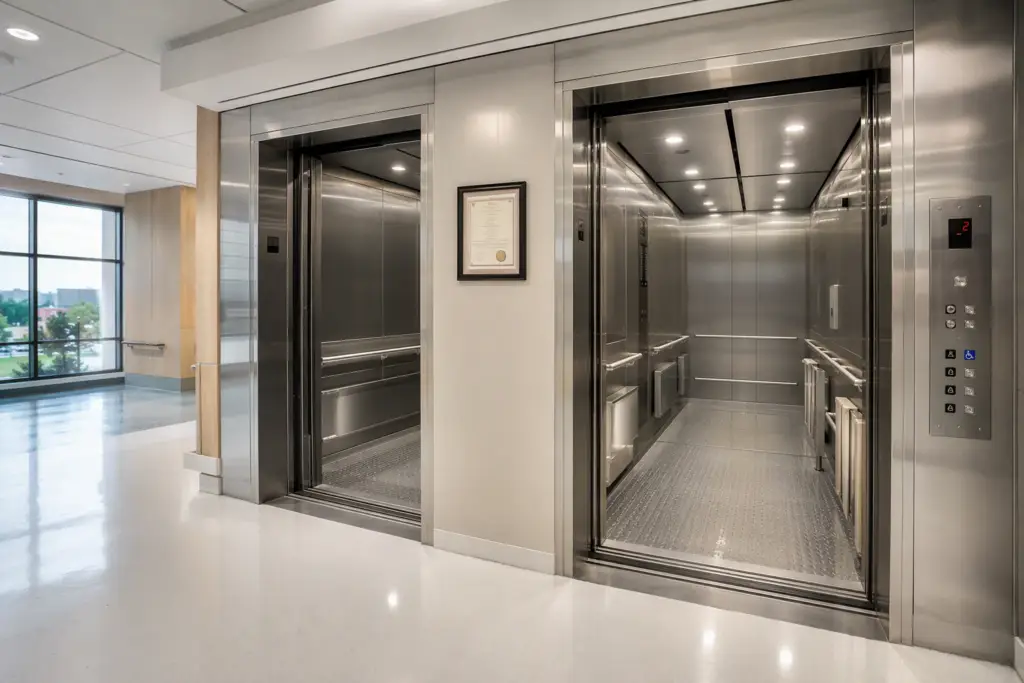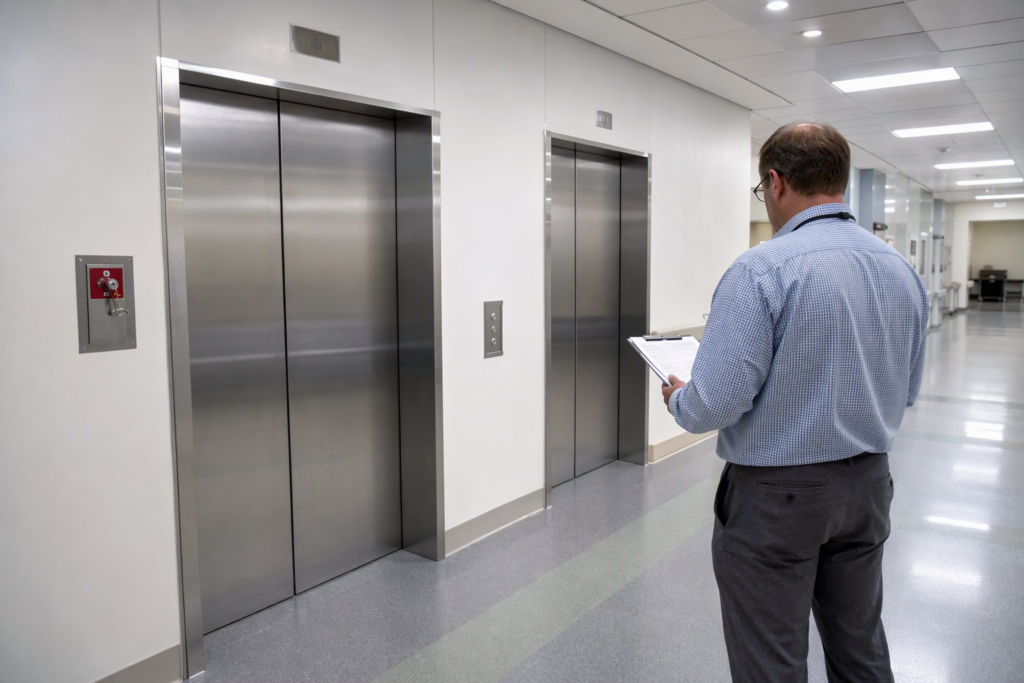
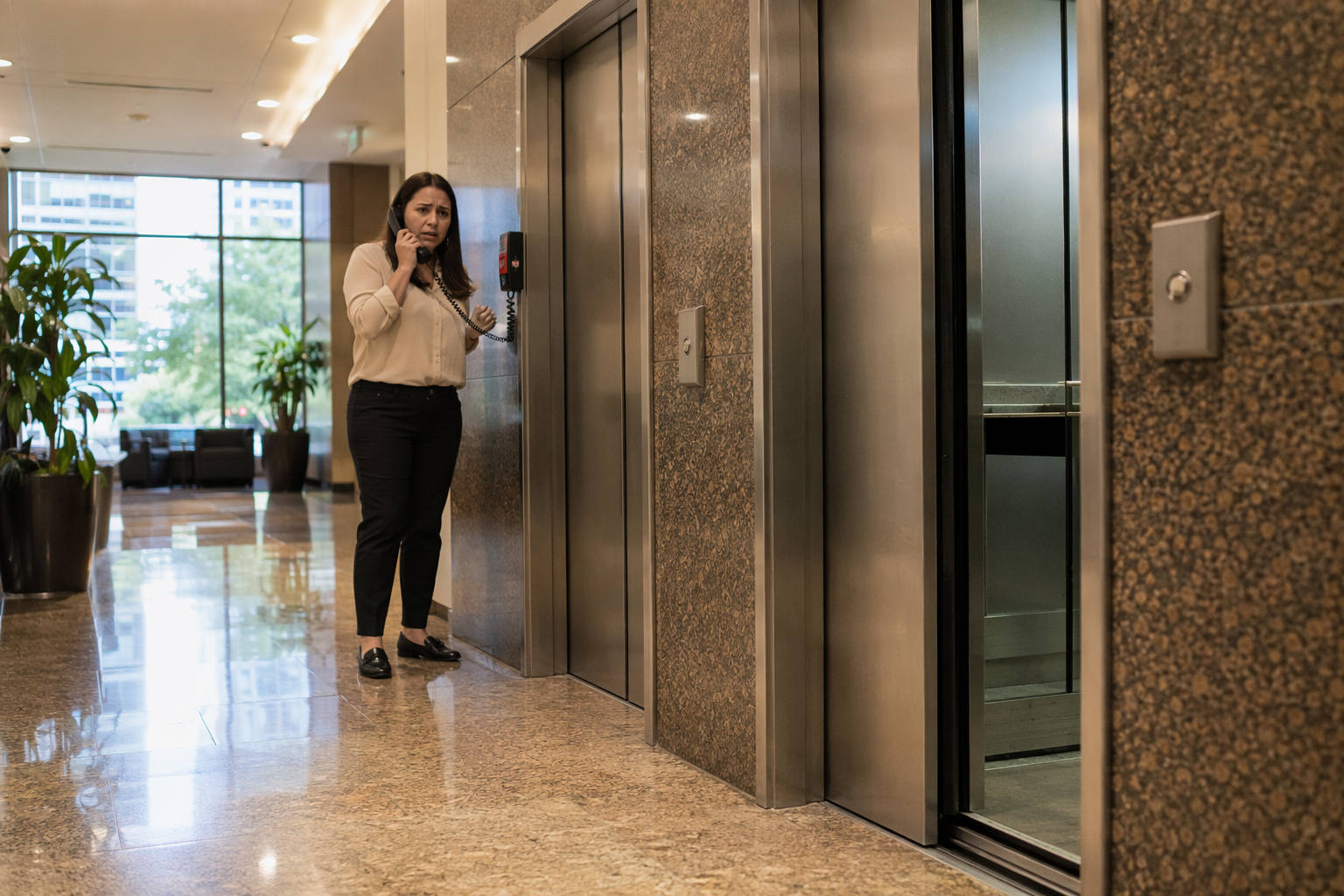
When an elevator breaks down, every minute counts — especially if passengers are trapped inside the cab. After 15 years in the field servicing elevators across Texas and California, I’ve seen firsthand how a clear, practiced response chain saves lives, prevents injuries, and keeps buildings compliant with ASME A17.1 Safety Code for Elevators and Escalators. This FAQ hub page covers every scenario you’re likely to face, from a minor door malfunction to a full entrapment emergency.
Who is the first person I should call when an elevator breaks down?
Your first call should go to your certified elevator maintenance contractor — if passengers are trapped, call 911 simultaneously.
Most commercial building managers make the mistake of calling their general facilities manager first and losing 10 to 15 critical minutes. Your elevator service contractor has licensed mechanics on call 24/7 who understand the specific make, model, and control system of your unit. In Texas, the Texas Department of Insurance (TDI) requires elevators to be maintained by licensed elevator contractors, meaning only a credentialed technician can legally perform emergency repairs.
If you’re in Houston, Dallas, Austin, San Antonio, Los Angeles, or San Diego, AmeriTex Elevator maintains a dedicated emergency dispatch line staffed around the clock. When you call, have your unit ID number and building address ready to cut response time by up to 30%.
When should I call 911 instead of — or in addition to — my elevator contractor?
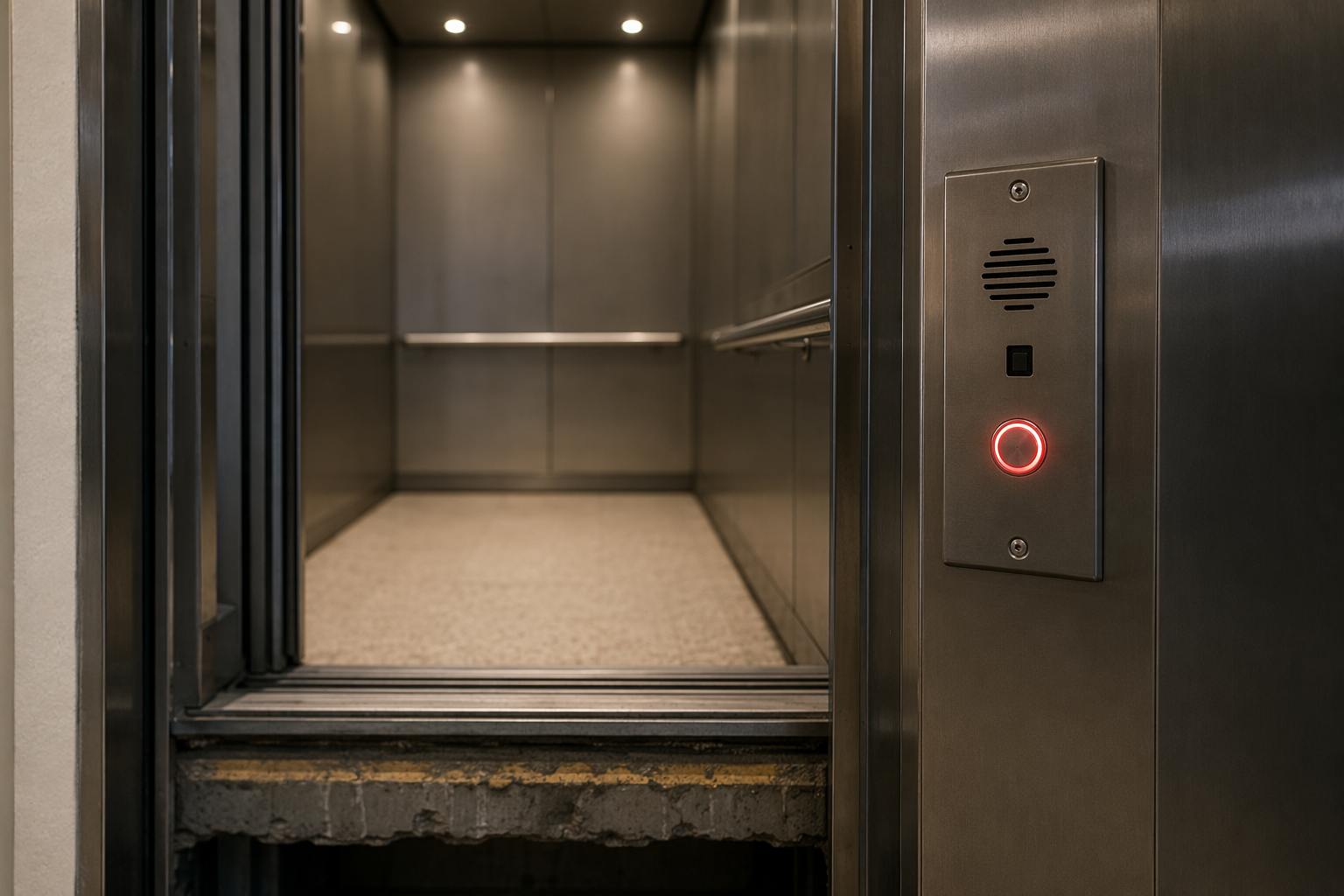
Call 911 immediately any time passengers are physically trapped inside the elevator cab, report a fire or smoke, or anyone inside the cab requires medical attention.
Under OSHA general duty clause requirements, building owners have an obligation to protect occupants from recognized hazards. An entrapment that exceeds 30 minutes without rescue efforts constitutes a serious health risk, particularly in high-temperature environments such as machine rooms in Texas during summer months, where cab temperatures can exceed 95°F within 20 minutes.
Never attempt to manually pry open elevator doors or extract passengers yourself. Improper extraction attempts have caused deaths when elevators re-leveled unexpectedly. Fire departments in Houston, Dallas, Austin, San Antonio, Los Angeles, and San Diego all have elevator rescue protocols — let them execute.
Call both 911 and your elevator contractor simultaneously. While emergency responders handle passenger safety, your certified technician can begin shutdown and reset procedures from the machine room.
What is the correct step-by-step protocol when an elevator breaks down?
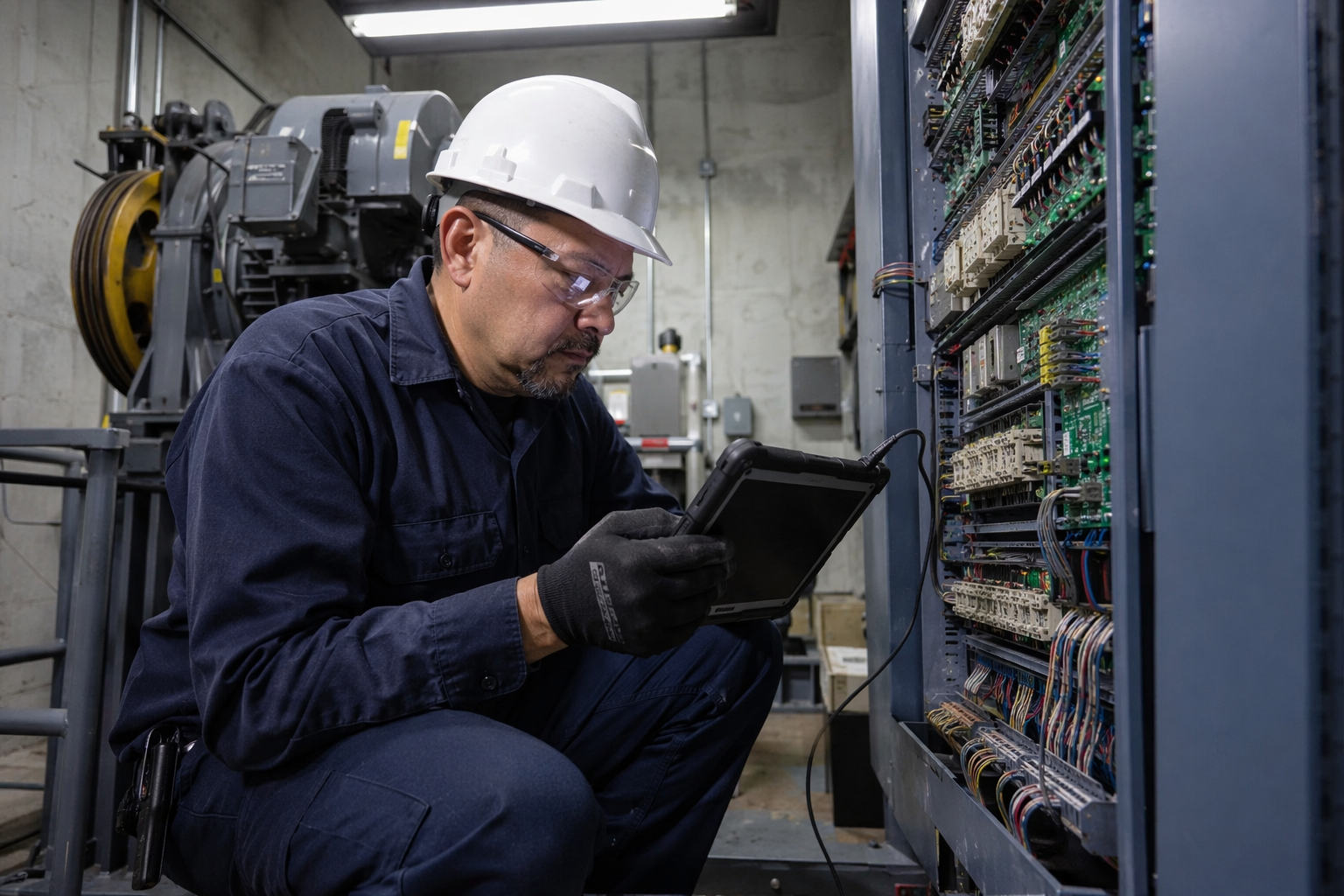
Follow this exact sequence to minimize risk, meet code obligations, and restore service as quickly as possible.
- Establish passenger communication immediately. Use the in-cab emergency telephone (required by ASME A17.1, Section 2.27.1.1) to confirm how many passengers are inside and their condition.
- Call 911 if passengers are trapped, injured, or in distress. Give the exact address, floor level, and number of occupants.
- Call your certified elevator contractor’s 24/7 emergency line. Provide unit ID, building address, floor location, and a description of the malfunction symptoms.
- Post signage at all lobby landings marking the elevator out of service to prevent additional passengers from attempting entry.
- Notify your building manager or facilities director so ADA accommodation alternatives (stairwell escorts, freight elevator rerouting) can be activated per ADA requirements.
- Do not attempt to reset, restart, or manually operate the elevator without explicit authorization from a licensed elevator mechanic.
- Document the incident — time of failure, symptoms observed, actions taken — for your maintenance log and any required regulatory reporting.
- Once technicians arrive, provide access to the machine room, pit, and any relevant maintenance records.
- Obtain a written inspection and repair report before restoring the elevator to service.
- File any required incident reports with your state elevator safety authority within the mandated timeframe (Texas: TDI; California: DOSH/Cal-OSHA).
How quickly should an emergency elevator technician arrive on site?
Industry best practice and most service-level agreements (SLAs) set a target emergency response time of 2 hours or less, with entrapment calls targeting 30–60 minutes.
Response time varies significantly by contractor, geography, and time of day. In 2026, the national average emergency elevator response time for third-party contractors is approximately 3.2 hours, according to elevator industry service benchmarking data. Top-tier service providers in major metropolitan areas like Houston and Los Angeles achieve sub-60-minute entrapment response consistently.
When evaluating a maintenance contract, always ask for documented SLA performance metrics — specifically mean time to respond (MTTR) and mean time to restore (MTTR). AmeriTex Elevator targets a 60-minute emergency response in all six markets served and provides clients with monthly service performance reports.
What information should I have ready before calling an elevator emergency service?
Having five key pieces of information ready before you dial can cut your technician’s response time by 20–30 minutes.
From years of taking emergency dispatch calls, I know that callers who fumble for basic information delay the entire response chain. Before you call, gather:
- Building address and suite/floor number of the elevator location
- Elevator unit ID or cab number (usually posted inside the cab or on the machine room door)
- Elevator make and model (e.g., Otis Gen2, Kone MonoSpace, ThyssenKrupp Evolution)
- Description of the malfunction: doors not closing, cab not leveling, error code displayed, unusual noise, complete loss of power
- Number of passengers currently inside the cab and any known medical concerns
Building managers should keep this information printed and posted at the elevator control panel in the management office — not just stored digitally where it may be inaccessible during a power event.
What are the most common causes of elevator breakdowns that require emergency response?
The five most frequent emergency elevator failures are door system faults, leveling malfunctions, drive/motor failures, rope or belt issues, and control board errors.
Door system failures account for approximately 38% of all elevator service calls in 2026, according to elevator maintenance industry data. Door sensors, clutch mechanisms, and gibs wear faster in high-traffic commercial buildings. Leveling failures — where the cab stops above or below the landing floor — create immediate tripping hazards and ADA compliance violations under ADA Standards for Accessible Design, Section 407.
Hydraulic elevator failures, common in 2–6 story commercial buildings across Texas, often involve oil leaks, pump failures, or cylinder degradation — all of which require licensed hydraulic elevator technicians to address safely.
Does the type of elevator affect who I should call?
Yes — traction, hydraulic, MRL (machine room-less), and limited-use/limited-application (LULA) elevators each have different emergency protocols and require technicians with specific certifications.
A technician certified for traction elevator work may not have the hydraulic systems training required for a below-ground hydraulic unit. Before signing a maintenance contract, verify that your contractor holds certifications specific to your elevator type. In Texas, the TDI requires separate endorsements for different elevator categories. In California, the Division of Occupational Safety and Health (Cal/OSHA) enforces similar category-specific licensing under Title 8 CCR.
When you call AmeriTex Elevator, our dispatch team immediately matches your unit type to a technician carrying the correct certifications — reducing the risk of a misrouted call that wastes precious time.
What are my legal obligations as a building owner when an elevator breaks down?
Building owners in Texas and California are legally required to take the elevator out of service, notify occupants, provide accessible alternatives, and report certain incidents to state regulators.
Under Texas Occupations Code Chapter 754 and California Labor Code Section 7300 et seq., building owners bear primary liability for elevator safety. Failure to immediately shut down a malfunctioning elevator can result in fines exceeding $10,000 per incident in California. Texas TDI can issue stop-use orders that carry civil penalties and potential license impacts for building operators.
The Americans with Disabilities Act adds another layer: if your building is multi-story and the elevator is the only accessible route for mobility-impaired occupants, you must have an emergency accessibility plan in place before a breakdown occurs — not after.
Document every emergency event meticulously. Your maintenance log is a legal record and the first document requested in any regulatory inspection or personal injury litigation.
How do elevator emergency response costs compare between service providers?
Emergency elevator service costs vary widely based on time of call, elevator type, and contractor tier — having an existing maintenance agreement typically reduces emergency call costs by 40–60%.
| Service Scenario | No Maintenance Contract (Spot Call) | With Maintenance Agreement | Typical Response Time |
|---|---|---|---|
| Entrapment / Passenger Rescue (Business Hours) | $450 – $850 | Included / $0 – $150 copay | 30 – 90 minutes |
| Entrapment / Passenger Rescue (After Hours) | $750 – $1,400 | $0 – $250 copay | 45 – 120 minutes |
| Door System Emergency Repair | $350 – $700 | Included or parts only | 60 – 180 minutes |
| Drive / Motor Failure (Traction) | $1,200 – $4,500+ | $300 – $1,500 (parts) | 2 – 8 hours |
| Hydraulic Pump Failure | $900 – $3,500+ | $200 – $1,200 (parts) | 2 – 6 hours |
| Control Board / Software Fault | $600 – $2,000+ | Included or reduced rate | 1 – 4 hours |
Cost ranges reflect 2026 market data for Texas and California metro markets. Actual costs vary by unit make, model, parts availability, and contractor pricing.
What should I look for in an elevator emergency service contractor?
Evaluate contractors on five criteria: licensing and certification, 24/7 availability, documented response time performance, familiarity with your specific elevator brand, and local market presence.
A contractor licensed in Texas must hold a TDI elevator contractor license. In California, licensing is issued through the Division of Occupational Safety and Health. Beyond licensing, ask for:
- IUEC (International Union of Elevator Constructors) membership or equivalent mechanic certifications
- Proof of general liability insurance ($2 million minimum recommended) and workers’ compensation
- Documented average emergency response times — in writing, in your SLA
- References from buildings with your elevator type and brand
- 24/7 live-person dispatch (not voicemail or answering service that relays messages)
National OEM contractors (Otis, Kone, Schindler, TK Elevator) offer brand-specific parts access but often carry higher rates and longer response windows in secondary metro areas. Independent certified contractors like AmeriTex Elevator frequently outperform OEMs on response time and cost in markets like San Antonio, Austin, and San Diego.
How does the in-cab emergency telephone work and who does it connect to?
The in-cab emergency telephone is a code-required two-way communication device that must connect to a live person capable of summoning help — it is not a substitute for calling your elevator contractor or 911 from outside the cab.
ASME A17.1 Safety Code for Elevators and Escalators, Section 2.27.1.1, requires all elevators to have a two-way communication system that connects to a location staffed 24/7. Many buildings route this to a monitoring center, a security desk, or a third-party answering service. The critical failure point: if the person answering doesn’t know your building’s elevator contractor number, response times multiply.
As part of any maintenance contract, verify exactly where your emergency call routes and test it quarterly. The person answering must be able to immediately dispatch your certified elevator technician — not just log the call.
What happens during a power outage — is the elevator automatically safe?
No — during a power outage, elevators with automatic rescue devices (ARDs) will attempt to move to the nearest floor and open doors, but not all elevators have ARDs, and hydraulic units are particularly vulnerable to uncontrolled descent.
ASME A17.1 does not universally mandate ARDs for all elevator types, though newer installations and modernized units in California are increasingly required to include them. During a power failure, an elevator without an ARD will remain stationary wherever it stops — which may be mid-floor, creating entrapment. Battery backup lighting is required by code, giving passengers approximately 4 hours of illumination.
Buildings in Houston and the Gulf Coast region face a heightened risk due to frequent severe weather events. Emergency power planning for elevators should be part of your building’s hurricane/severe weather preparedness protocol, coordinated in advance with your elevator service contractor.
What are the state-specific reporting requirements after an elevator breakdown in Texas and California?
Texas requires reporting serious elevator incidents to TDI within a mandated timeframe; California requires reporting injuries or fatalities to Cal/OSHA within 8 hours of the incident.
In Texas, the Elevator Safety Act (Texas Occupations Code Chapter 754) requires the elevator owner to notify TDI of any accident resulting in injury, death, or significant property damage. Failure to report carries civil penalties. In California, OSHA-aligned Cal/OSHA regulations under Title 8 CCR Section 341 require employers to report any serious work-related injury or death within 8 hours, and a serious injury (hospitalization, amputation, eye loss) within 24 hours.
Your elevator service contractor should be familiar with these reporting requirements and can assist you in filing correctly. Improper or late reporting dramatically increases regulatory liability exposure.
How often should elevators be inspected to prevent emergency breakdowns?
Texas law requires annual inspections by a licensed elevator inspector; California requires annual periodic inspections plus additional conveyance-specific inspections — and industry best practice recommends monthly preventive maintenance visits.
Inspection frequency alone doesn’t prevent breakdowns — it’s the quality of the preventive maintenance program between inspections that drives uptime. According to 2026 elevator industry benchmarking data, buildings on monthly preventive maintenance programs experience 67% fewer emergency callbacks compared to buildings on quarterly-only programs.
Key ASME A17.1 inspection categories include brake system integrity, safety device function tests, door reopening device performance, and buffer tests. Each has specific test intervals defined in the code. A competent maintenance provider should be tracking these intervals systematically — not just showing up annually for the state inspection.
Can I perform any emergency repairs myself while waiting for a technician?
No — building staff and occupants should never attempt to manually operate, reset, or repair elevator equipment; doing so violates ASME A17.1, state licensing laws, and exposes your organization to serious liability.
I’ve arrived on emergency calls where a well-meaning maintenance worker had already tried to manually lower a hydraulic elevator using the hand pump — without knowing that the unit had a valve failure that made manual operation dangerous. Only licensed elevator mechanics are legally authorized to perform emergency mechanical operations in Texas and California.
The one exception: your trained building staff may use the clearly labeled “STOP” button to halt an elevator already in motion if passengers are in immediate danger and they are properly trained in its use. All other interventions require a licensed technician.
What is the difference between an elevator maintenance contract and an emergency-only service agreement?
A full maintenance contract covers scheduled preventive maintenance plus emergency response; an emergency-only (spot service) agreement covers breakdown calls only — at significantly higher per-visit rates with no guaranteed response time.
For any building with an elevator seeing more than 50 door cycles per day, a full maintenance contract is almost always more cost-effective than spot service within 12–18 months. Maintenance contracts also shift some liability for component failure to the contractor and typically include documentation support for regulatory inspections.
Emergency-only agreements are appropriate for very low-use situations such as a residential LULA elevator seeing fewer than 10 trips per day. For all commercial, multifamily, and mixed-use buildings in Texas and California’s major metros, a comprehensive maintenance agreement is the professional standard.
How does elevator modernization reduce emergency breakdown frequency?
Modernizing aging elevator control systems, drives, and door operators can reduce emergency callbacks by 50–80% and is often required to maintain compliance with current ASME A17.1 and ADA standards.
Elevators installed before 1990 frequently use relay-logic control systems that are no longer supported by OEM parts. When a relay fails at 2:00 AM on a Friday, the search for compatible replacement parts can stretch downtime from hours to days. Modern solid-state controls with remote monitoring capabilities allow technicians to diagnose faults before they become full breakdowns.
The ADA also requires that modernized elevators meet current accessibility standards, including cab dimensions, control panel heights, and audible/visual floor indicators. A modernization project that brings your elevator into full 2026 code compliance is one of the highest-return investments a building owner can make.
What remote monitoring options exist for early detection of elevator problems?
Modern elevator remote monitoring systems use IoT sensors and cloud-based analytics to detect fault conditions 24–72 hours before they cause a full breakdown, dramatically reducing emergency service calls.
Remote monitoring technology in 2026 can track door cycle counts, motor current draw, leveling accuracy, brake wear indicators, and control board fault codes in real time. When anomalies exceed preset thresholds, the system automatically alerts your elevator service contractor — who can schedule a proactive repair visit before passengers are ever impacted.
Buildings managed by AmeriTex Elevator in Houston, Dallas, Austin, San Antonio, Los Angeles, and San Diego can opt into connected monitoring programs that integrate directly with our dispatch system. This means our technicians are sometimes en route before you’ve even noticed a problem.
What should building managers do between now and their next scheduled maintenance visit to reduce breakdown risk?
Building managers can reduce emergency breakdown risk by conducting daily visual checks, keeping machine rooms clean and accessible, training staff on proper door operation, and ensuring the in-cab emergency phone is tested monthly.
The single most effective thing a building manager can do is post a clear, laminated emergency contact card at every elevator lobby — listing the elevator contractor’s 24/7 number, the unit ID, and the step-by-step response protocol. This card should be updated every time your service contractor changes.
Additionally, educate tenants and staff never to hold elevator doors open manually — this single behavior is responsible for a disproportionate share of door sensor and clutch failures in commercial buildings. Operators in high-traffic environments (hospitals, hotels, retail centers) should consider door hold open time audits as part of their elevator efficiency program.
How do I set up a 24/7 emergency elevator service contract in Houston, Dallas, Austin, San Antonio, Los Angeles, or San Diego?
Setting up emergency elevator coverage in any of these markets takes less than 48 hours with a qualified local contractor — start with a site assessment, review your current unit condition, and execute a service agreement that includes a documented emergency response SLA.
The contracting process should begin with a no-cost elevator assessment where a licensed technician reviews your unit’s current condition, reviews maintenance history, identifies any deferred repairs, and confirms code compliance status. This assessment becomes the baseline for your maintenance program and emergency response plan.
AmeriTex Elevator serves all six of these markets with locally based, IUEC-certified technician teams. Local presence means faster response times, familiarity with regional code enforcement priorities, and relationships with local inspectors — all of which matter when you need an emergency inspection clearance to restore service quickly.
What certifications and credentials should the technician who responds to my elevator emergency have?
The responding technician should hold a state elevator mechanic license (Texas TDI or California DOSH), IUEC journeyman certification or equivalent, and specific training on your elevator’s make and model.
In Texas, elevator mechanics must be licensed by TDI under Texas Occupations Code Chapter 754. In California, elevator mechanics must be certified by the Division of Occupational Safety and Health under Title 8 CCR. Beyond state licensing, look for:
- IUEC (International Union of Elevator Constructors) journeyman card or equivalent NVQ/NAEC certification
- Manufacturer-specific training certifications (Otis, Kone, Schindler, TK Elevator, etc.)
- Current first aid / CPR certification for entrapment rescue scenarios
- Ongoing ASME A17.1 code update training — the standard is revised on a 3-year cycle
Never hesitate to ask a technician for their license number before allowing work to begin. Every licensed elevator mechanic in Texas and California is required to carry and present credentials on request.
Need elevator service you can rely on? AmeriTex Elevator is ready to help.