Emergency Elevator Repair in Dallas, TX: Complete FAQ Guide
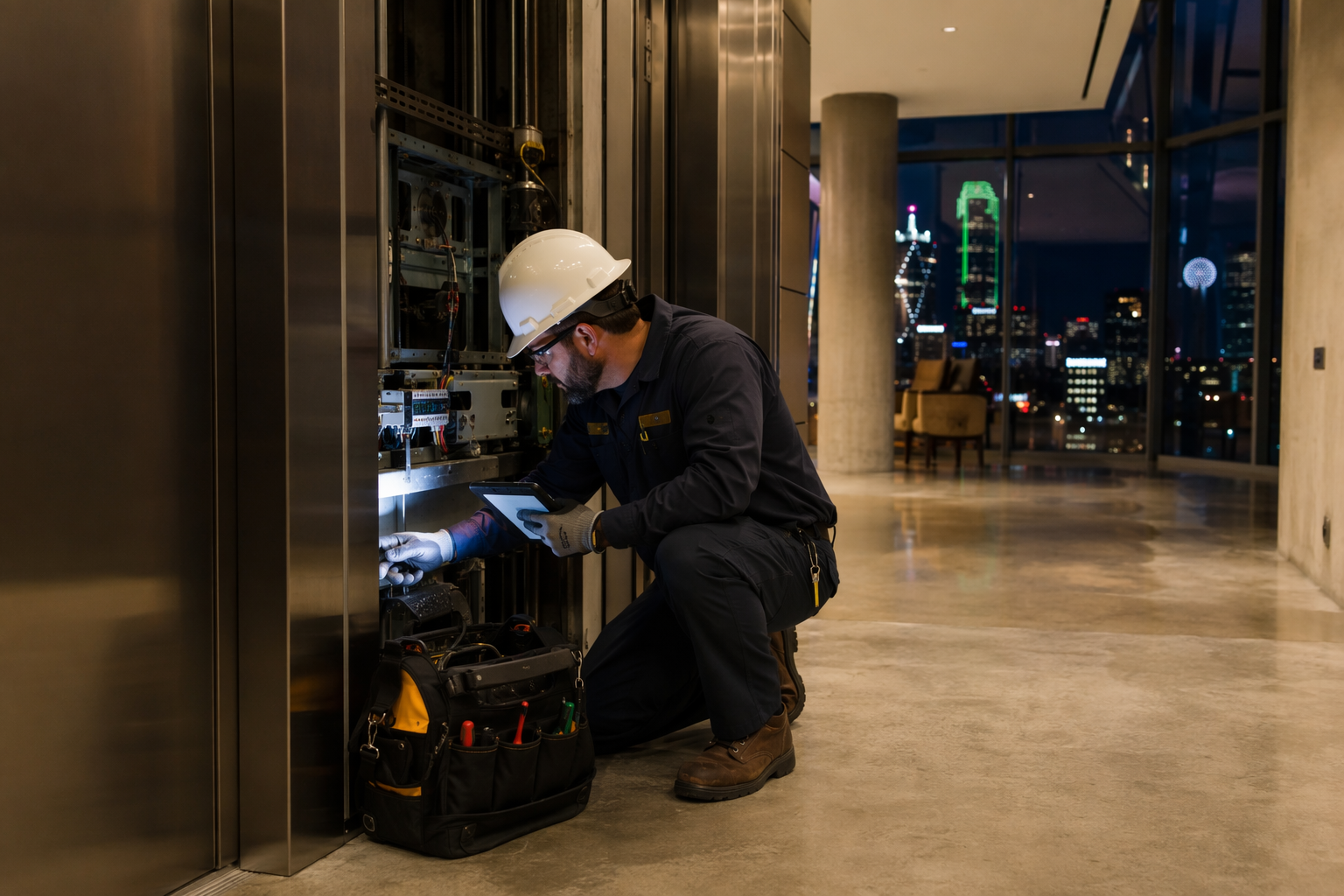
After 15+ years working on elevator systems across Texas — from high-rise towers in Uptown Dallas to mid-rise office parks in Plano and Frisco — I’ve seen what happens when building owners aren’t prepared for an elevator emergency. Entrapments, sudden shutdowns, door failures, and safety system faults don’t wait for business hours. This guide answers every question building managers, property owners, and facility directors ask about emergency elevator repair in Dallas, TX.
What qualifies as an elevator emergency in Dallas, TX?
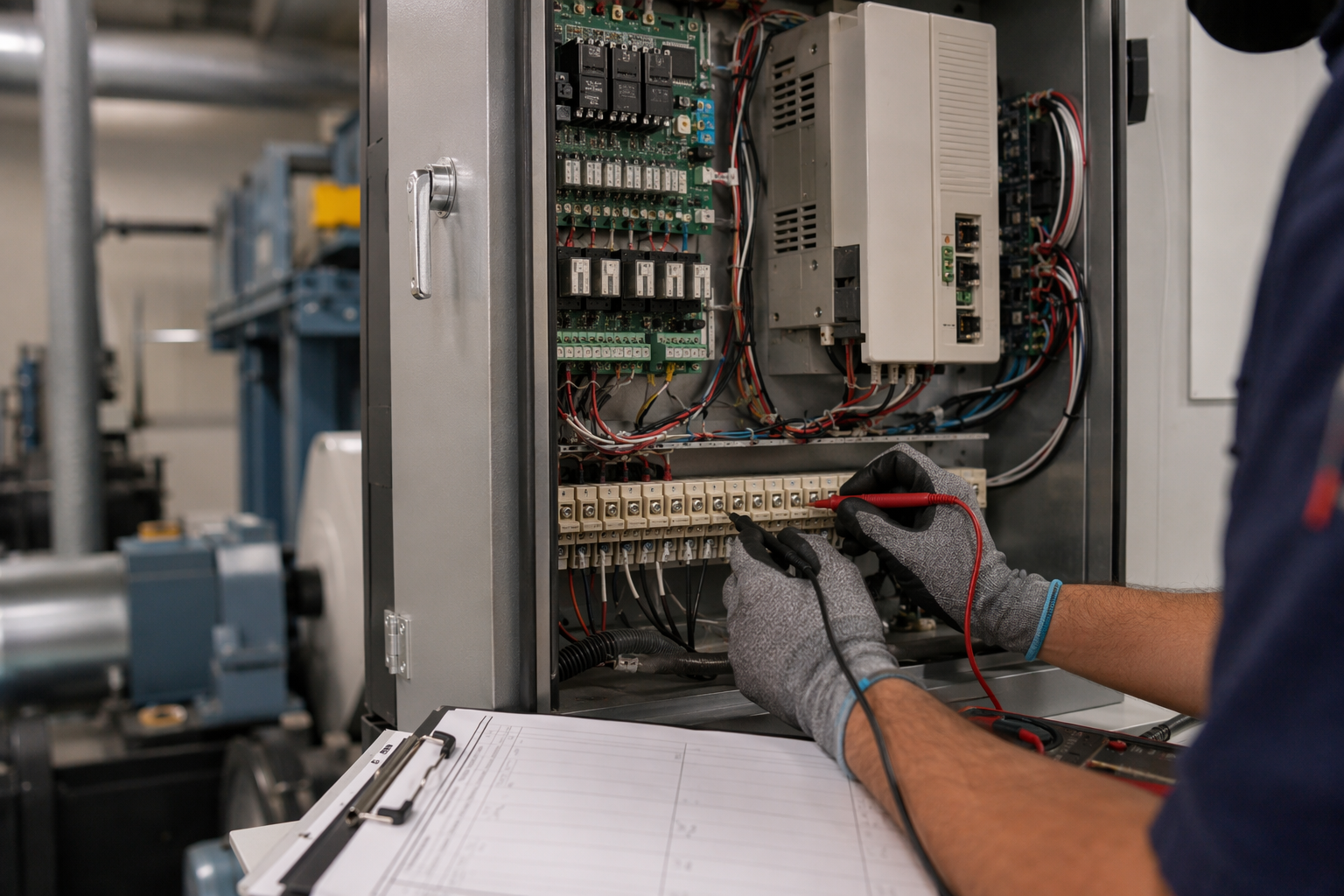
An elevator emergency is any situation that poses an immediate risk to passenger safety, traps one or more people inside a car, or renders the elevator completely inoperable in a building where vertical access is legally required.
In my experience, the most common emergency calls we receive in Dallas fall into five categories: passenger entrapments (most urgent), door circuit failures preventing travel, motor or drive unit shutdowns, hydraulic fluid leaks, and fire service recall failures. Under ASME A17.1-2019 Safety Code for Elevators and Escalators, any condition that bypasses or defeats a safety circuit must be treated as an emergency and taken out of service immediately.
Dallas follows the International Building Code and the Texas Department of Insurance (TDI) Elevator Safety Program rules. If your elevator is involved in a reported entrapment and you don’t have a maintenance contract or emergency service plan, you may face citations and fines that compound daily.
How fast can an emergency elevator technician reach me in Dallas?
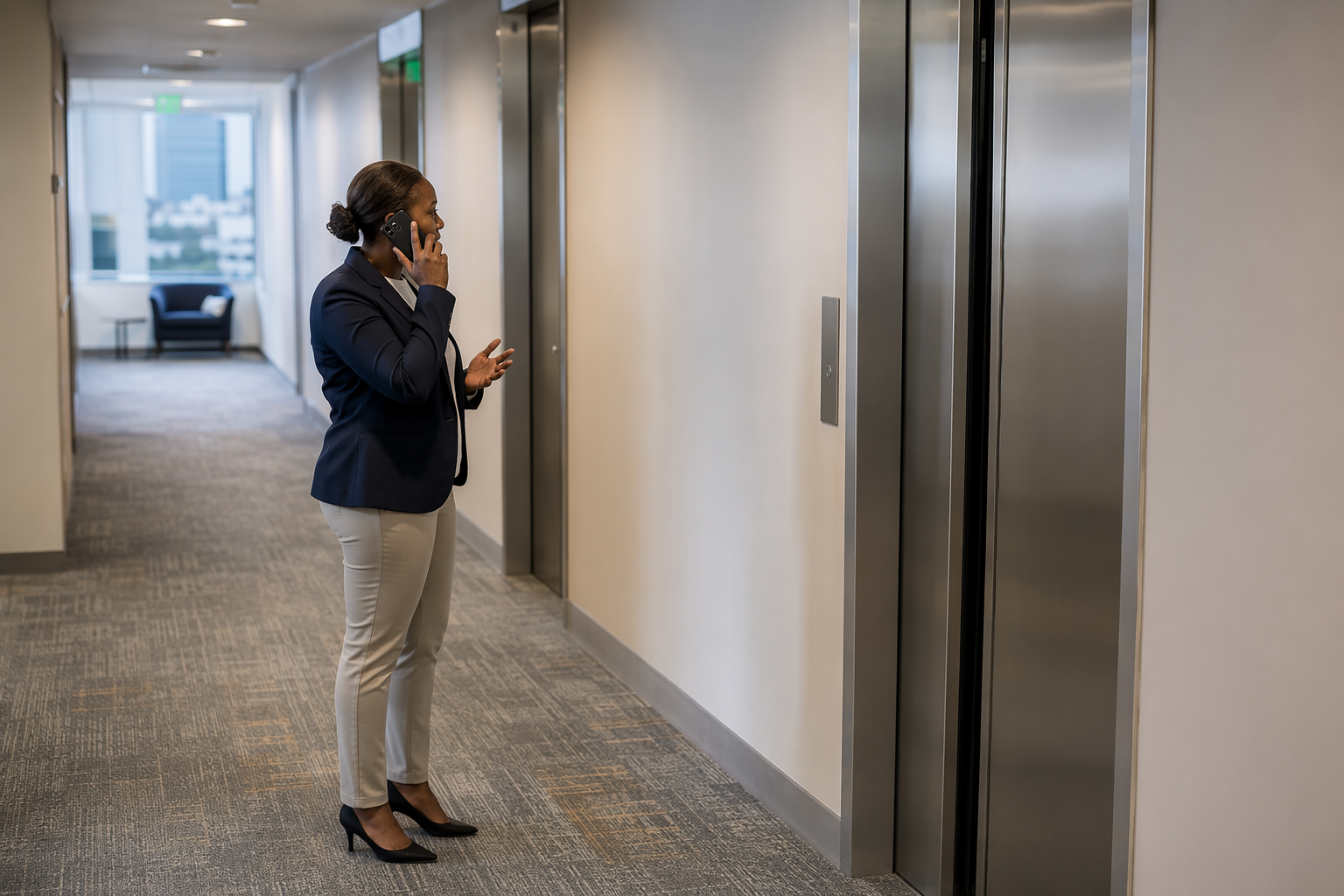
In most Dallas proper and close-in suburban locations, a certified emergency elevator technician can typically arrive within 2–4 hours of your call — and for entrapments, priority dispatch often cuts that to under 90 minutes.
Response time depends on time of day, traffic conditions on I-635 or the Dallas North Tollway, and technician availability. AmeriTex Elevator maintains a local Dallas dispatch team specifically to minimize drive time for emergency calls. We do not route Dallas calls through a national call center — you reach our Texas team directly.
For reference, industry guidance from the National Elevator Industry, Inc. (NEII) suggests that entrapment response should target under 60 minutes where possible, and under 30 minutes in buildings with known vulnerable populations such as hospitals or assisted living facilities.
What should you do immediately when someone is trapped in an elevator in Dallas?
When a passenger is trapped, remain calm, call for help, and follow a structured protocol — never attempt to manually open elevator doors or rescue passengers yourself, as this can cause fatal injuries.
- Call 911 if there is any medical emergency, panic, or immediate danger — Dallas Fire-Rescue is trained for elevator entrapment rescue and can force access if a technician cannot arrive in time.
- Reassure the trapped passenger through the intercom or door — tell them the elevator is stopped safely, they are not in danger, and help is on the way.
- Call your elevator service company’s 24/7 emergency line immediately — provide the building address, floor number if known, number of passengers, and any symptoms reported (chest pain, etc.).
- Do not attempt to pry doors open or lower the car manually — unless you are a licensed elevator mechanic with the correct tools and knowledge, manual intervention can cause the car to move unexpectedly.
- Keep the machine room accessible — unlock the elevator machine room so the arriving technician can gain immediate access without delay.
- Document the incident — note the time of entrapment, floor level, and names of passengers for the Texas Department of Insurance incident report, which may be required under state rules.
- File a report with TDI if required — Texas law requires building owners to report elevator incidents involving injury or entrapment exceeding a defined threshold.
How much does emergency elevator repair cost in Dallas in 2026?
Emergency elevator repair in Dallas typically costs between $350 and $3,500+ depending on the failure type, parts required, time of call, and whether the work is covered under an existing maintenance contract.
Here is a realistic cost breakdown based on common Dallas emergency repair calls:
| Repair Type | Estimated Cost Range (2026) | Typical Response Time | Parts Usually Required |
|---|---|---|---|
| Passenger Entrapment (no parts) | $350 – $650 | 1–3 hours | No |
| Door Operator / Clutch Failure | $600 – $2,200 | 2–6 hours | Yes |
| Motor Controller / Drive Fault | $1,200 – $5,000+ | 4–24 hours | Yes (may require ordering) |
| Hydraulic Fluid Leak / Pump Failure | $900 – $4,500 | 3–8 hours | Yes |
| Safety Relay / Governor Reset | $400 – $1,100 | 2–4 hours | Sometimes |
| Rope / Cable Replacement | $2,500 – $8,000+ | 8–48 hours | Yes |
| Fire Service Recall Failure | $500 – $1,800 | 2–5 hours | Sometimes |
Buildings with a full-coverage maintenance contract — which AmeriTex Elevator offers in Dallas — typically see emergency labor costs reduced or eliminated, since many call-backs are covered under the contract terms. Always ask your provider whether parts, labor, and after-hours surcharges are included or billed separately.
What are the most common elevator failures that require emergency repair in Dallas?
The five most frequent emergency elevator failures in Dallas commercial buildings are door system failures, drive/controller faults, hydraulic system failures in low-rise buildings, safety circuit trips, and heat-related shutdowns — the last of which is especially common during Texas summers.
Door failures account for roughly 50–60% of all elevator service calls industry-wide. In Dallas, where summer temperatures in machine rooms can exceed 110°F, heat-related controller faults and motor overloads spike dramatically from June through September. Hydraulic elevators — common in Dallas buildings under 6 stories built before 1995 — are especially vulnerable to seal failures and fluid leaks as temperatures fluctuate.
Under ASME A17.1, any elevator with a tripped safety circuit — including overspeed governors, buffers, or door bypass — must be inspected by a licensed mechanic before returning to service. You cannot simply reset and restart without a qualified technician verifying the cause.
Is emergency elevator repair required by law in Dallas commercial buildings?
Yes — building owners in Dallas have a legal obligation under Texas state law and local ordinance to take a malfunctioning elevator out of service immediately and arrange for repair by a licensed elevator contractor.
The Texas Department of Insurance Elevator Safety Program regulates elevator maintenance and inspection statewide. Operating a defective elevator that poses a safety risk can result in civil liability, TDI enforcement action, and municipal code violations through the City of Dallas. In multi-story commercial buildings, the Americans with Disabilities Act (ADA) adds another layer of obligation — if your building’s only accessible route includes an elevator and that elevator is out of service, you may be in violation of ADA Title III requirements, which carry their own federal enforcement risk.
Does AmeriTex Elevator offer 24/7 emergency service in Dallas?
Yes — AmeriTex Elevator provides around-the-clock emergency elevator repair in Dallas, TX, 365 days a year, including holidays and weekends, with live Texas-based dispatch.
Our Dallas service territory covers Dallas proper, Irving, Garland, Mesquite, Plano, Frisco, McKinney, Carrollton, Richardson, Grand Prairie, and surrounding areas. When you call our emergency line, you speak to a dispatcher who knows the Dallas market, not a national routing system. Our technicians carry commonly needed parts and components on their service vehicles to reduce return trips and get your elevator back online faster.
What certifications should a Dallas emergency elevator repair company have?
Any legitimate emergency elevator repair company working in Dallas must employ IUEC (International Union of Elevator Constructors) certified mechanics and hold a current Texas elevator contractor license through the Texas Department of Insurance.
Here is what to verify before hiring any emergency elevator service provider in Dallas:
- Texas Elevator Contractor License — issued by the Texas Department of Insurance Elevator Safety Program. Verify at the TDI website.
- IUEC Certification — individual mechanics should hold IUEC journeyman or mechanic certification.
- QEI (Qualified Elevator Inspector) affiliation — companies with QEI-certified inspectors on staff provide higher-quality compliance documentation.
- ASME A17.1 code compliance knowledge — technicians must be current on the 2019 edition (adopted as reference standard in Texas).
- Insurance and bonding — minimum $1 million general liability is standard; verify before any technician enters your machine room.
How long does emergency elevator repair typically take in Dallas?
Most emergency elevator repairs in Dallas are resolved within 2–8 hours from technician arrival, though complex parts failures requiring special-order components can extend downtime to 24–72 hours or longer.
Simple repairs — entrapment resolution, safety relay resets, minor door adjustments — are often completed within 1–2 hours on-site. Mid-complexity repairs involving door operators, drive boards, or hydraulic components typically take 3–6 hours if the technician carries the necessary parts. Major failures such as motor replacements, rope sets, or full controller replacements require parts procurement and may take several days, during which your elevator must remain out of service per ASME A17.1 requirements.
What happens if a Dallas building ignores an elevator emergency and keeps it running?
Operating a known-defective elevator in Dallas exposes the building owner to TDI enforcement, municipal code violations, ADA complaints, and severe civil liability if a passenger is injured — courts have awarded multi-million dollar verdicts in Texas elevator negligence cases.
Under Texas law, if the Texas Department of Insurance Elevator Safety Program issues a stop-operation order and the building continues running the elevator, daily fines apply and the matter can be referred for criminal prosecution in egregious cases. More practically: if someone is injured on a defective elevator that ownership knew about, the liability exposure is catastrophic. In 2026, plaintiff attorneys in Texas are increasingly aggressive in pursuing elevator negligence cases, particularly in commercial real estate.
What is the difference between emergency repair and preventive maintenance for Dallas elevators?
Emergency repair is reactive — it addresses a failure that has already occurred — while preventive maintenance is scheduled, proactive work designed to catch problems before they become emergencies, and it is almost always cheaper over a 3–5 year horizon.
A full-coverage preventive maintenance contract in Dallas typically costs $300–$800 per month per elevator depending on equipment type and building usage. Comparing that against average emergency repair costs of $600–$3,500+ per incident — not counting downtime, ADA liability, or tenant disruption — most building managers find that maintenance contracts pay for themselves after a single avoided emergency. AmeriTex Elevator offers tiered maintenance programs in Dallas specifically designed for commercial office buildings, multifamily high-rises, and retail centers.
What Dallas-specific factors affect elevator reliability and emergency frequency?
Dallas’s extreme summer heat, clay soil movement (which affects pit drainage and structural alignment), high-rise construction density in Uptown and Downtown, and aging equipment stock in older suburban office parks all contribute to above-average elevator service demand compared to national norms.
Machine room temperatures in Dallas regularly exceed 100°F from June through August. ASME A17.1 Section 2.7 requires machine room temperatures to be maintained within equipment manufacturer specifications — for most modern controllers, that means below 95°F. When ambient temperatures spike, VFD (Variable Frequency Drive) units and solid-state controllers are among the first components to fault. Buildings without proper machine room HVAC are especially vulnerable. Additionally, Dallas’s expansive clay soils shift seasonally, and I’ve personally documented pit water intrusion issues in several North Dallas buildings after heavy rains — something that can damage hydraulic systems and safety switches rapidly.
Can ADA compliance issues trigger an elevator emergency situation in Dallas?
Yes — under the Americans with Disabilities Act, an elevator outage in a commercial facility can constitute an active ADA access violation, requiring emergency restoration or provision of an alternative accessible route.
Title III of the ADA requires places of public accommodation to maintain accessible features in operable condition. A broken elevator in a multi-story building with no accessible alternative creates immediate legal exposure. The U.S. Department of Justice and private plaintiffs have successfully pursued ADA claims in Texas based on elevator outages. Building owners should treat elevator failures as ADA emergencies, not just mechanical inconveniences, particularly in office buildings, retail centers, hotels, and medical facilities.
How do you choose between emergency elevator repair companies in Dallas?
Evaluate Dallas elevator repair companies on five criteria: response time guarantee, technician certification and licensing, parts availability, after-hours pricing transparency, and local vs. national dispatch infrastructure.
Many national elevator companies route Dallas emergency calls through centralized dispatch in another state, adding 30–60 minutes to response time before a local technician is even notified. Local companies with a Dallas-based dispatch and technician pool consistently outperform national providers on response time. Ask any vendor these questions before signing an agreement:
- What is your guaranteed maximum response time for Dallas entrapments?
- Are your mechanics Texas-licensed and IUEC-certified?
- Do you stock common Dallas-market parts on your service trucks?
- What are your after-hours and holiday labor rates?
- Is emergency labor included in your maintenance contract or billed separately?
What codes govern emergency elevator repair standards in Dallas in 2026?
Emergency elevator repair in Dallas must comply with ASME A17.1-2019, the Texas Department of Insurance Elevator Safety Program rules, and the City of Dallas Building Code — with ADA requirements applying as an overlay for public accommodations.
The primary code stack for Dallas elevator work in 2026 includes:
- ASME A17.1-2019 — the Safety Code for Elevators and Escalators, referenced by Texas as the foundational technical standard.
- ASME A17.3 — Safety Code for Existing Elevators and Escalators, governing how older equipment must be brought up to minimum safety requirements.
- Texas Administrative Code, Title 28, Part 2 — TDI’s regulatory framework for elevator safety in Texas.
- ADA Standards for Accessible Design (2010) — federal accessibility requirements applicable to commercial and public buildings.
- City of Dallas Building Code — municipal requirements that may exceed state minimums in certain applications.
What information should you have ready when calling for emergency elevator repair in Dallas?
When calling for emergency elevator repair, have your building address, elevator ID or cab number, floor of entrapment or last known position, type of elevator, and your maintenance contract number ready — this cuts dispatch time significantly.
Here is the full list of information that speeds up emergency response:
- Building name and full street address including suite or floor access information
- Number of passengers trapped (if applicable) and any medical concerns
- Elevator ID, unit number, or which bank (e.g., “South elevator bank, unit 2”)
- What the elevator was doing when it failed (traveling, stopped, door cycling)
- Any error codes or fault indicators visible on the hall panel or inside the cab
- Whether the machine room is locked and who has the key
- Your maintenance contract number if applicable
- Contact name and callback number for on-site coordination
Are hydraulic elevators or traction elevators more prone to emergencies in Dallas buildings?
Hydraulic elevators in Dallas buildings are statistically more prone to weather-related and age-related emergency failures, while traction elevators more commonly experience drive system and controller faults — both types require prompt emergency response but for different reasons.
Hydraulic elevators — common in Dallas buildings under 6 stories, particularly those built in the 1970s through 1990s — are vulnerable to fluid seal failures (especially in summer heat), pump motor failures, and submersible unit corrosion. Under ASME A17.1 and EPA requirements, hydraulic fluid leaks must also be contained and reported because hydraulic oil is considered an environmental hazard. Modern traction elevators — gearless or geared, with VFD controllers — are more reliable overall but are vulnerable to software faults, encoder failures, and drive board overheating in poorly ventilated machine rooms.
What temporary measures can building management take while waiting for emergency elevator repair in Dallas?
While awaiting emergency elevator repair, building management should lock out the elevator, post signage at all landings, activate your emergency communication plan, and assess ADA accommodation needs for affected occupants.
- Place the elevator in lockout/tagout — if you have a key switch, place it in the locked position. Do not allow anyone to attempt manual operation.
- Post out-of-service signs at every landing door — prevent passengers from attempting to board.
- Notify building tenants via email, text alert, or intercom — give estimated repair timeline if known.
- Identify occupants who rely on the elevator for accessibility — contact them directly and arrange temporary accommodations (ground floor relocation, stair assistance, etc.) to maintain ADA compliance obligations.
- Secure the machine room — ensure it is unlocked and accessible for the arriving technician, but secured against untrained personnel.
- Document everything — time of failure, who was notified, actions taken. This documentation protects you legally.
How does a Dallas elevator emergency affect building insurance and liability coverage?
An elevator emergency that results in injury or property damage can trigger your commercial general liability policy, and failure to maintain required inspection certifications in Dallas can give insurers grounds to deny coverage.
Texas courts have held building owners to a high standard of care for elevator maintenance. If a passenger is injured and discovery reveals your elevator was overdue for inspection, lacked a current TDI certificate of compliance, or had a known defect that was not repaired, your insurance carrier may assert a coverage defense. In 2026, commercial property insurers increasingly audit elevator maintenance records as part of renewal underwriting. Maintaining a documented maintenance contract with a licensed contractor like AmeriTex Elevator creates an evidence trail that is valuable in both insurance and litigation contexts.
What should Dallas building owners do after an emergency elevator repair is completed?
After emergency repair, building owners should obtain written documentation of the fault and repair, verify the technician’s return-to-service sign-off, schedule a post-incident inspection, and evaluate whether a maintenance contract upgrade is warranted.
Specifically, the post-repair checklist should include:
- Obtain a written work order documenting what failed, what was repaired, and what parts were installed
- Confirm the technician performed a return-to-service test per ASME A17.1 requirements before leaving
- Request a written return-to-service certification or sign-off document for your records
- Report the incident to TDI if it involved a passenger entrapment or injury
- Schedule a full preventive maintenance visit within 30 days to assess whether related components are at risk
- Review your maintenance contract to identify any coverage gaps that left you exposed during this incident
Get Fast, Certified Emergency Elevator Repair in Dallas — Contact AmeriTex Elevator Today
If your elevator is down, trapping passengers, or operating unsafely, don’t wait. AmeriTex Elevator’s Dallas-based team of IUEC-certified technicians is available 24 hours a day, 7 days a week, 365 days a year. We carry common parts on every service vehicle, dispatch from local Dallas teams — not a national call center — and our technicians are fully licensed under the Texas Department of Insurance Elevator Safety Program.
Whether you need an emergency repair tonight, a preventive maintenance contract to prevent the next breakdown, or a full compliance assessment to address ADA and ASME A17.1 requirements, AmeriTex Elevator serves Dallas, Houston, Austin, San Antonio, Los Angeles, and San Diego with the same certified, professional standard of care.
Contact AmeriTex Elevator for a free elevator assessment: 866-679-4313
Available 24/7 for emergency elevator repair in Dallas, TX and surrounding areas.
Need elevator service you can rely on? AmeriTex Elevator is ready to help.