Elevator Entrapment Rescue Procedure: Complete Guide for Building Owners & Passengers
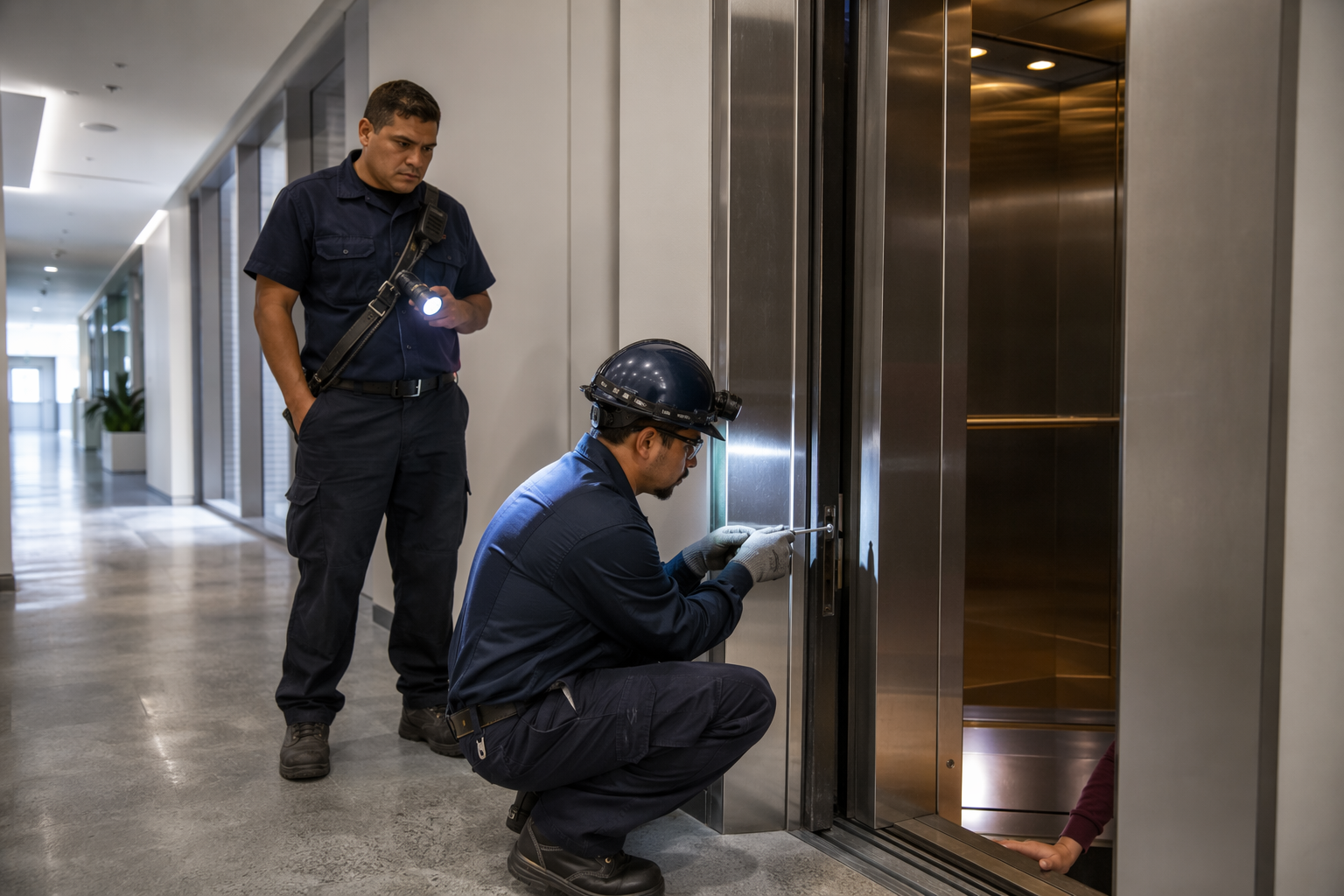
Elevator entrapments happen more often than most building owners realize. According to the U.S. Bureau of Labor Statistics and elevator industry data, approximately 10,000 elevator entrapments occur annually across the United States. Every minute a passenger is trapped matters — and so does following the correct, code-compliant rescue procedure. Whether you manage a high-rise in Houston, a mixed-use complex in Los Angeles, or a medical facility in San Antonio, understanding this process protects your tenants and limits your liability.
What Is the Standard Elevator Entrapment Rescue Procedure?
The standard elevator entrapment rescue procedure requires a certified elevator mechanic or trained first responder to safely evacuate trapped passengers by moving the elevator car to the nearest landing using mechanical or hydraulic controls, then manually releasing the doors — never by opening the hoistway doors between floors.
The full procedure follows this sequence under ASME A17.1/CSA B44 Safety Code:
- Passenger communication: Immediately contact trapped passengers via the emergency phone or intercom required by ASME A17.1 Section 2.27.1. Reassure them, confirm the number of people inside, and check for medical emergencies.
- Call certified personnel: Contact a licensed elevator mechanic. Do NOT attempt DIY rescue. In Texas, mechanics must hold a Texas Department of Insurance (TDI) elevator certificate. In California, they require a DOSH-certified license.
- Secure the machine room: The technician enters the machine room, cuts power to the car lighting and ventilation circuits while preserving the emergency lighting circuit.
- Identify the car position: Using the hoistway position indicators, the technician determines whether the car is above or below a landing.
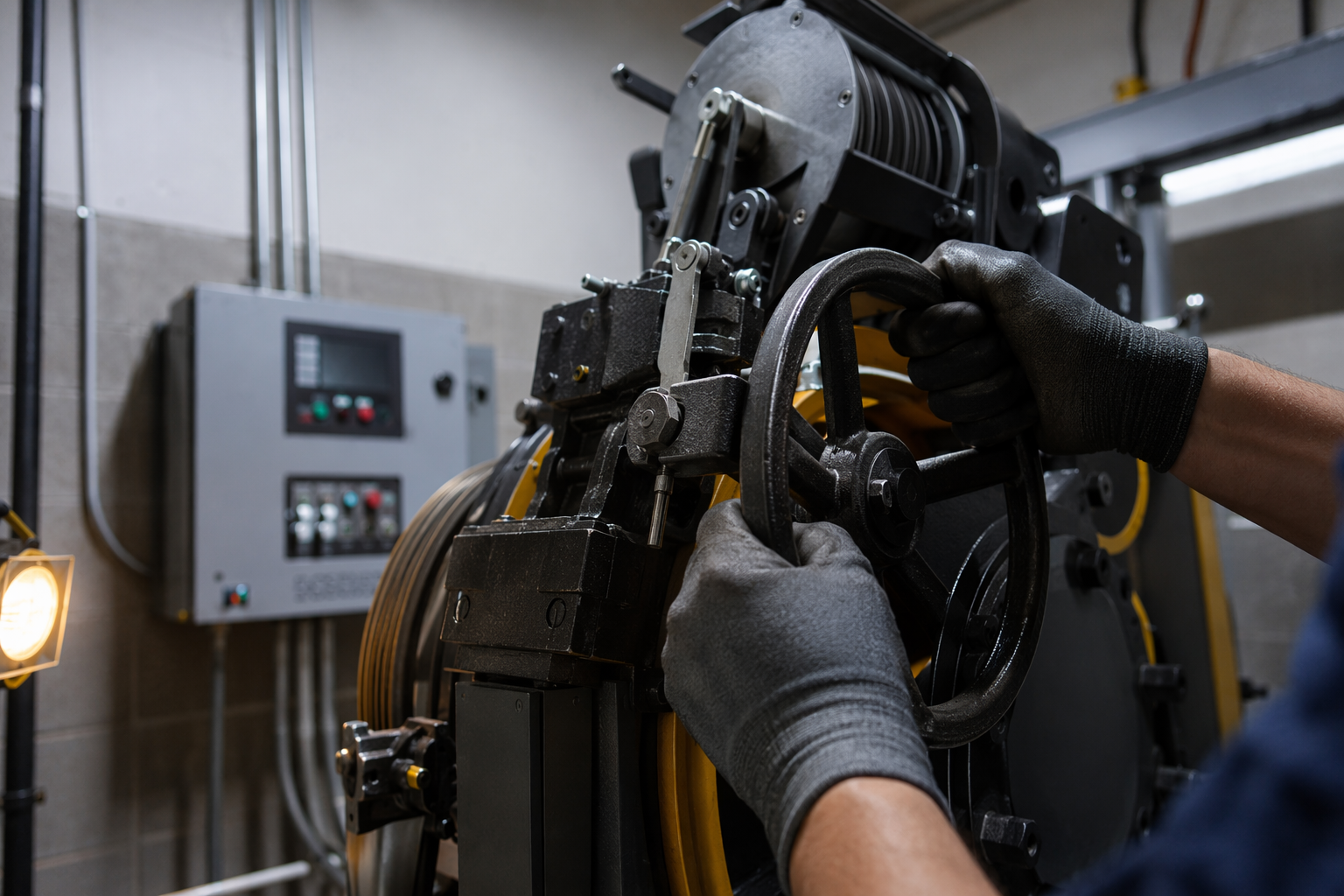
- Manual lowering or raising: For hydraulic elevators, the technician uses the manual lowering valve. For traction elevators, the hand-winding device (lowering by gravity with brake release) is used per ASME A17.1 Rule 2.26.9.
- Align with landing: The car is moved to within one inch of the landing floor sill per code requirements.
- Mechanical door release: Using the hoistway door unlocking device (drop key), the technician opens the landing door, then releases the car door from outside.
- Passenger egress: Passengers exit calmly. No passenger should step over a gap greater than 1.25 inches between car floor and landing.
- Post-rescue inspection: The elevator is tagged out of service. A full diagnostic is performed before return to service.
Who Is Legally Authorized to Perform an Elevator Rescue?
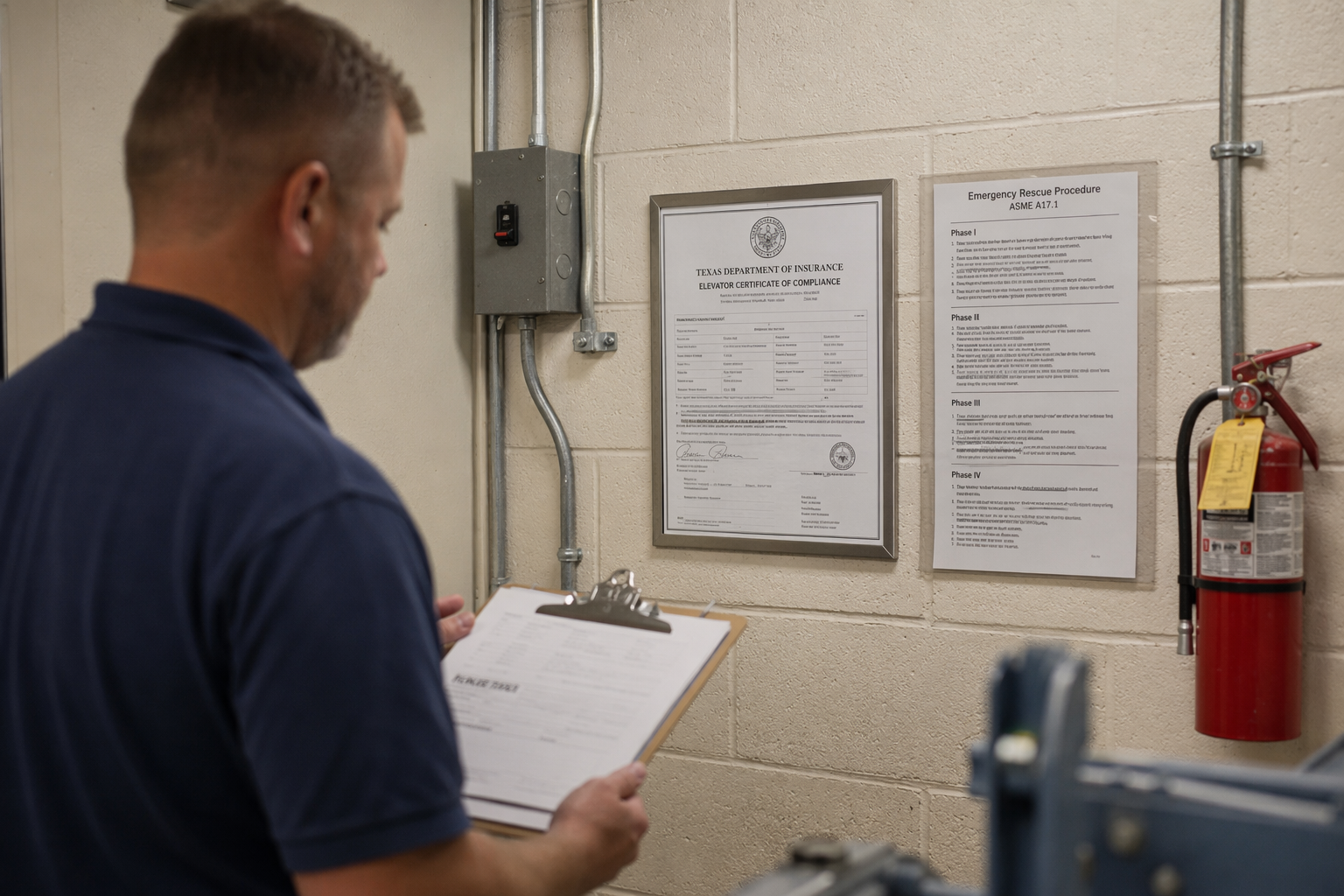
Only a licensed elevator mechanic or specifically trained fire department personnel are legally authorized to perform an elevator entrapment rescue — building maintenance staff and security guards are explicitly prohibited from conducting rescues under ASME A17.1 and most state regulations.
In Texas, the Texas Department of Insurance Elevator Safety Program mandates that all elevator mechanics hold a valid state certificate. Unauthorized rescue attempts can result in fines up to $10,000 per incident and expose building owners to significant civil liability. In California, the California Division of Occupational Safety and Health (Cal/OSHA DOSH) enforces similar requirements under Title 8 of the California Code of Regulations.
Fire departments in major cities like Houston and Los Angeles train specific rescue units in elevator extraction, but their first priority is passenger safety, not equipment operation. They will typically contact a certified mechanic for the mechanical aspects of the rescue while managing the physical evacuation of passengers.
What Are the Most Common Causes of Elevator Entrapment?
The most common causes of elevator entrapment are power outages, door sensor malfunctions, safety device trips (such as governor overspeed activation), and worn leveling components that cause the car to stop between floors.
From 15 years in the field across Texas and California markets, I’ve seen these causes break down consistently:
| Cause of Entrapment | Estimated Frequency | Preventable with Maintenance? | Average Rescue Time |
|---|---|---|---|
| Power outage / electrical failure | 32% | Partially (ARD devices help) | 15–45 minutes |
| Door sensor / operator malfunction | 28% | Yes — monthly inspection | 10–30 minutes |
| Safety device activation (governor, buffer) | 18% | Yes — annual testing required | 30–90 minutes |
| Leveling component wear | 14% | Yes — quarterly maintenance | 20–45 minutes |
| Controller/software failure | 8% | Partially — firmware updates | 20–60 minutes |
What Should Trapped Passengers Do During an Elevator Entrapment?
Trapped passengers should press the emergency call button, use the emergency phone if available, stay calm and away from the doors, and wait for certified personnel — they should never attempt to force open doors or climb out of a stalled elevator car.
Under ASME A17.1 Section 2.27.1, all elevator cars manufactured after 1997 must contain a two-way emergency communication system capable of reaching a monitored location 24 hours a day, 7 days a week. Passengers should:
- Press the alarm button and hold the emergency call button
- Use the emergency phone to speak directly with monitoring personnel
- Use a mobile phone to call 911 if the emergency phone is non-functional
- Keep away from the elevator doors — attempting to pry them open can dislodge the car from safety devices
- Sit on the floor if feeling faint — this lowers center of gravity and prevents falls
- Avoid jumping or moving excessively, which can trigger additional safety device trips
Building owners and property managers in Houston, Dallas, and Austin should post clear entrapment instructions inside every elevator cab as part of their emergency preparedness protocol.
How Long Does an Elevator Entrapment Rescue Typically Take?
An elevator entrapment rescue typically takes between 15 and 90 minutes depending on the cause of the entrapment, the elevator type, and the response time of the certified mechanic — with most straightforward rescues resolved within 30 minutes by an on-call technician.
Response time is the critical variable. A full-service maintenance contract with a company like AmeriTex Elevator typically includes 24/7 emergency dispatch with guaranteed response times — often 30–60 minutes within major metro areas like Houston, Dallas, San Antonio, Los Angeles, and San Diego. Building owners operating under third-party or spot-service contracts may face 2–4 hour response windows, significantly increasing passenger distress and liability exposure.
What Is an Automatic Rescue Device (ARD) and Does It Prevent Entrapments?
An Automatic Rescue Device (ARD) is a battery-powered backup system that automatically moves a stalled elevator car to the nearest landing during a power failure, effectively preventing entrapments caused by power outages — the single largest cause of elevator entrapments.
ARDs became a code-recommended addition under ASME A17.1 and are required in many new installations. They function by:
- Detecting loss of main power within milliseconds
- Activating battery-powered drive to move the car at reduced speed (typically 0.25–0.5 ft/sec)
- Leveling the car at the nearest floor and opening doors
- Allowing passengers to exit before the battery is depleted
ARD retrofit installations typically cost between $8,000 and $18,000 depending on elevator type and age. For buildings in Texas and California with older equipment, this investment can dramatically reduce entrapment frequency. AmeriTex Elevator’s certified technicians assess ARD compatibility during our free elevator assessments across all six markets we serve.
What Are the ASME A17.1 Code Requirements for Elevator Entrapment Prevention?
ASME A17.1/CSA B44 (2022 edition, adopted with 2026 amendments in most jurisdictions) mandates emergency lighting, two-way communication, door reopening devices, and leveling requirements specifically designed to reduce entrapment risk and facilitate safe rescue.
Key sections relevant to entrapment and rescue include:
- Section 2.27.1: Mandatory two-way emergency communication device
- Section 2.14.1.2: Car door reopening device (safety edge or light curtain) to prevent door-trap incidents
- Section 2.26.9: Hand-winding and emergency lowering provisions for rescue access
- Section 2.7.3: Car leveling — cars must level within ±0.5 inches of landing sill under all loading conditions
- Rule 8.6.5: Periodic inspections and testing of all emergency devices including emergency phones, lighting, and manual lowering systems
State adoption schedules vary. Texas generally follows the most recently adopted edition through TDI rulemaking. California enforces its own elevator safety regulations under Cal/OSHA Title 8, which mirror ASME A17.1 with additional state-specific requirements.
What ADA Requirements Apply to Elevator Entrapment Situations?
Under the ADA Standards for Accessible Design (2010), elevators serving buildings covered by the ADA must maintain accessible cab dimensions and communication systems that also accommodate users with disabilities during emergencies — including two-way communication accessible to people who are deaf or hard of hearing.
ADA Section 407.4.9 requires that the emergency communication device in the elevator car must be usable without voice communication. TTY (text telephone) capability or equivalent visual/tactile output is required to ensure passengers with hearing impairments can communicate during entrapments. Buildings in Los Angeles and San Diego face particularly rigorous ADA enforcement through California’s Department of Rehabilitation and local building departments.
How Does a Hydraulic Elevator Rescue Differ from a Traction Elevator Rescue?
Hydraulic elevator rescues use a manual lowering valve to slowly release hydraulic fluid and descend the car to the lowest landing, while traction elevator rescues use a hand-winding device or brake release to move the counterbalanced car to the nearest landing — each requiring completely different tools and procedures.
Hydraulic elevator rescue specifics:
- Car can only be lowered (not raised) under manual operation
- Technician uses manual lowering valve in the pump unit at controlled speed
- Most common in 2–6 story buildings: offices, parking structures, older Houston and San Antonio properties
- Risk: hydraulic fluid spill if seals are compromised during rescue
Traction elevator rescue specifics:
- Car can be moved up or down depending on counterweight position
- Technician uses hand-winding device on machine sheave or brake release lever
- Common in mid-rise and high-rise buildings: Dallas downtown towers, Los Angeles commercial properties
- Risk: uncontrolled movement if brake is released without proper load assessment
What Training Should Building Staff Have for Elevator Entrapments?
Building staff should receive annual entrapment response training covering passenger communication protocols, how to contact the elevator service company and 911, documenting the incident, and understanding what NOT to do — but they should never be trained to perform the mechanical rescue itself.
Recommended training components for building managers in Texas and California markets:
- Location of emergency phone panel and monitoring service phone number
- How to use the machine room key (for communication only — not rescue)
- Incident documentation for insurance and regulatory reporting
- Passenger reassurance scripts to reduce panic
- ADA-compliant communication procedures for passengers with disabilities
- When to call 911 (medical emergency inside car) versus elevator service only
AmeriTex Elevator provides complimentary building staff training sessions as part of full-service maintenance agreements across Houston, Dallas, Austin, San Antonio, Los Angeles, and San Diego.
What Equipment Does a Technician Need to Perform an Elevator Rescue?
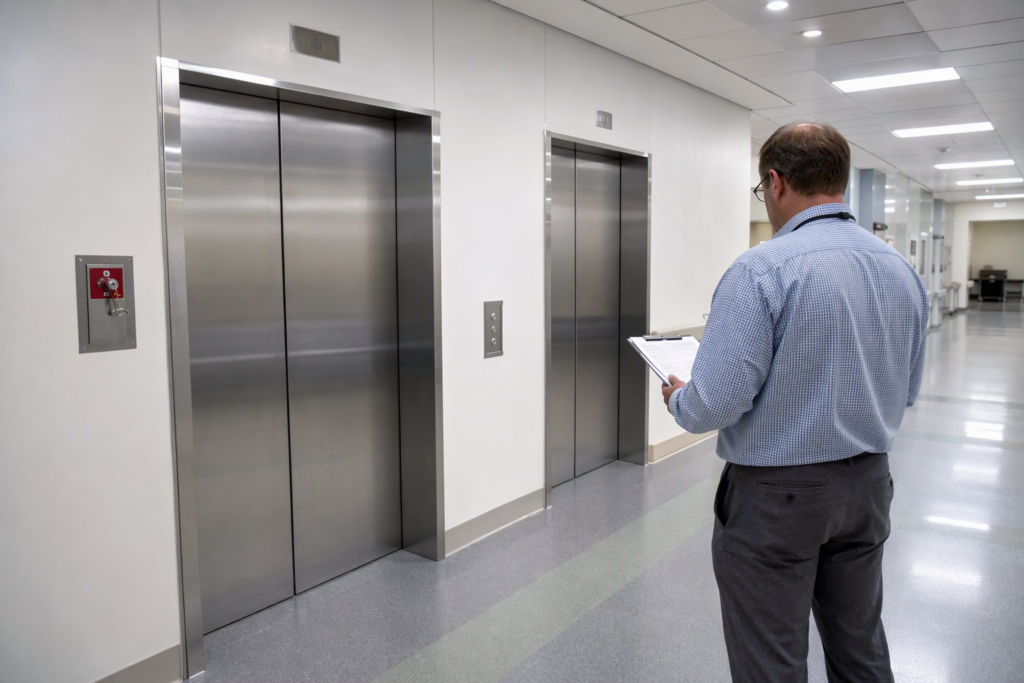
A certified elevator technician performing a rescue needs a hoistway door drop key, hand-winding device or manual lowering valve access, personal protective equipment, a calibrated leveling tool, and a two-way radio — all of which must be maintained in working order at the building per ASME A17.1.
Required rescue equipment inventory per ASME A17.1 Rule 8.1:
- Hoistway door unlocking device (drop key): Must be on-site at all times; one per building
- Machine room access key: Separate from hoistway key; controlled access required
- Emergency lighting source: Portable lighting for machine room and pit work
- Hand-winding device: For traction elevators — stored in machine room
- Manual lowering valve handle: For hydraulic units — typically integrated into pump unit
- Lock-out/tag-out (LOTO) equipment: Required by OSHA 29 CFR 1910.147 before rescue work
- Personal fall protection: For any work near open hoistway
How Much Does Emergency Elevator Rescue Service Cost?
Emergency elevator rescue service typically costs between $250 and $800 for after-hours callouts under a maintenance contract, or $500 to $1,500 as a standalone emergency service call — with additional costs for parts if the entrapment was caused by a mechanical failure requiring repair before return to service.
| Service Scenario | Estimated Cost (2026) | Response Time | Includes Repair? |
|---|---|---|---|
| Maintenance contract — emergency callout | $0–$350 (included/reduced rate) | 30–60 min | Minor repairs included |
| Time & materials — business hours | $350–$600 | 1–3 hours | Labor only |
| Time & materials — after hours/weekend | $600–$1,500 | 1–4 hours | Labor only + overtime premium |
| Rescue + major component repair | $1,500–$8,000+ | Varies | Yes — parts + labor |
| Fire department extraction (separate) | $0–$500 municipal fee | 5–15 min (response) | No mechanical repair |
What Are the Reporting Requirements After an Elevator Entrapment?
In both Texas and California, elevator entrapments that result in injury must be reported to the state regulatory authority within 24 hours — and all entrapments should be documented in the elevator logbook regardless of whether an injury occurred, as required by ASME A17.1 Rule 8.6.
Texas-specific reporting: The Texas Department of Insurance requires immediate notification for any entrapment involving injury, equipment damage, or safety device activation. The elevator must remain out of service until inspected and cleared by a licensed mechanic and, in some cases, a state inspector.
California-specific reporting: Cal/OSHA requires written reports within 8 hours for any serious injury or illness related to elevator operation under Title 8 Section 340. Failure to report can result in penalties up to $25,000 per violation in 2026.
How Often Should Elevator Rescue Equipment and Emergency Systems Be Tested?
Elevator emergency phones, emergency lighting, manual lowering devices, and hoistway door unlocking tools must be tested at least annually under ASME A17.1 Rule 8.6.5 — with some jurisdictions like California requiring semi-annual testing and a 5-year full-load safety test.
Testing schedule best practices for 2026:
- Monthly: Emergency phone operability check, door reopening device test, leveling accuracy verification
- Quarterly: Emergency lighting battery test, governor and safety device visual inspection
- Annual: Full safety device operational test, manual lowering/winding device test, drop key function test, load weighing device calibration
- 5-Year: Full-load safety test (buffers, safeties, governor) as required by ASME A17.1 Rule 8.6.5.8 and California Title 8
Can Modern Elevator Monitoring Technology Prevent Entrapments?
Yes — modern IoT-based elevator monitoring systems can detect anomalies in door operation, leveling, motor performance, and power quality in real time, allowing technicians to address developing failures before they cause entrapments, with predictive maintenance reducing entrapment incidents by up to 35% according to 2025 industry data.
Remote monitoring platforms used by leading elevator companies in 2026 can:
- Track door cycle counts and detect early sensor degradation
- Monitor vibration and acoustic signatures for rope and sheave wear
- Alert technicians to controller error codes before they cascade into failures
- Log leveling accuracy trends over time to predict component wear
- Automatically dispatch service tickets when anomaly thresholds are crossed
AmeriTex Elevator offers remote monitoring integration across all markets including Dallas high-rise portfolios and Los Angeles commercial properties — connecting your elevator’s performance data to our certified technicians around the clock.
What Happens If a Building Owner Fails to Maintain Proper Rescue Equipment On-Site?
A building owner who fails to maintain required on-site rescue equipment — including the hoistway door drop key and machine room access — faces state regulatory fines, mandatory elevator shutdown orders, and significant civil liability if a delayed rescue causes passenger injury.
In Texas, TDI elevator inspectors routinely verify drop key availability during annual inspections. Missing or non-functional rescue equipment can result in immediate out-of-service orders under Texas Administrative Code Title 28, Part 1. In California, similar enforcement occurs through Cal/OSHA elevator inspectors. Beyond regulatory penalties, civil liability cases involving entrapment injuries regularly reach six-figure settlements when building owners cannot demonstrate proper maintenance and emergency preparedness.
What Is the Difference Between an Elevator Entrapment and an Elevator Emergency?
An elevator entrapment is specifically when passengers are confined inside a stalled car, while an elevator emergency is a broader category that includes entrapments but also encompasses situations like free fall, uncontrolled movement, fire in the hoistway, flooding, or structural damage — each requiring different response protocols.
Response matrix by emergency type:
- Entrapment (car stalled, passengers confined): Certified mechanic rescue, no 911 required unless medical emergency exists
- Uncontrolled movement or free fall: Immediate 911, emergency services, building evacuation — do not attempt rescue
- Fire in or near hoistway: Full building evacuation, fire department response, elevators must NOT be used per ADA fire evacuation guidelines and NFPA 101
- Flooding of pit: Mechanic plus building facilities team, potential out-of-service order
- Passenger medical emergency inside car: 911 immediately, fire department coordinates with mechanic for rapid rescue
How Do I Choose the Right Elevator Service Company for Emergency Rescue Agreements?
Choose an elevator service company with state-licensed mechanics, documented 24/7 emergency response with guaranteed response time SLAs, familiarity with your specific elevator equipment brand, and verifiable references from building managers in your market — price alone should never be the deciding factor for life-safety services.
Key evaluation criteria for 2026:
- Licensing: Verify TDI certification (Texas) or DOSH certification (California) for all assigned mechanics
- Response time guarantee: Ask for the contractual SLA in writing — 60 minutes or less is the standard for full-service agreements
- Equipment coverage: Confirm the company stocks parts for your elevator brand (Otis, KONE, Schindler, ThyssenKrupp, etc.)
- Insurance: Minimum $2 million general liability coverage is standard; verify additional insured endorsement
- Training documentation: Request proof of IUEC apprenticeship completion and ongoing continuing education
- Local presence: A company with local mechanics in Houston, Dallas, Austin, San Antonio, Los Angeles, or San Diego will always outperform a national call center dispatching from outside the market
What Should Be in a Building’s Written Elevator Emergency Response Plan?
A building’s written elevator emergency response plan must include the elevator service company’s 24/7 emergency contact number, the 911 emergency protocol, passenger communication procedures, staff responsibility assignments, equipment locations, and post-incident documentation requirements — and it should be reviewed and updated annually.
ASME A17.1 and most state regulations do not prescribe a specific written plan format, but best practice for property managers in Texas and California in 2026 includes the following elements:
- Primary and secondary contact numbers for elevator service company (including after-hours dispatch)
- Machine room location and key access procedures
- Emergency phone monitoring service contact number
- ADA-compliant passenger communication procedures
- Medical emergency escalation protocol (when to call 911)
- Post-incident inspection and return-to-service authorization process
- Incident log template for regulatory compliance
- Annual review schedule with sign-off by property management
Get Expert Elevator Safety Support from AmeriTex Elevator
From emergency entrapment rescue to preventive maintenance programs that keep your passengers safe and your equipment code-compliant — AmeriTex Elevator serves building owners and property managers in Houston, Dallas, Austin, San Antonio, Los Angeles, and San Diego with IUEC-certified mechanics available 24/7.
Our team will assess your elevator’s emergency systems, rescue equipment readiness, and ASME A17.1 compliance at no charge.
Contact AmeriTex Elevator for a free elevator assessment: 866-679-4313
Available 24/7 for emergency rescue response across all Texas and California markets we serve.