How Fast Can an Elevator Be Repaired? Complete FAQ Guide (2026)
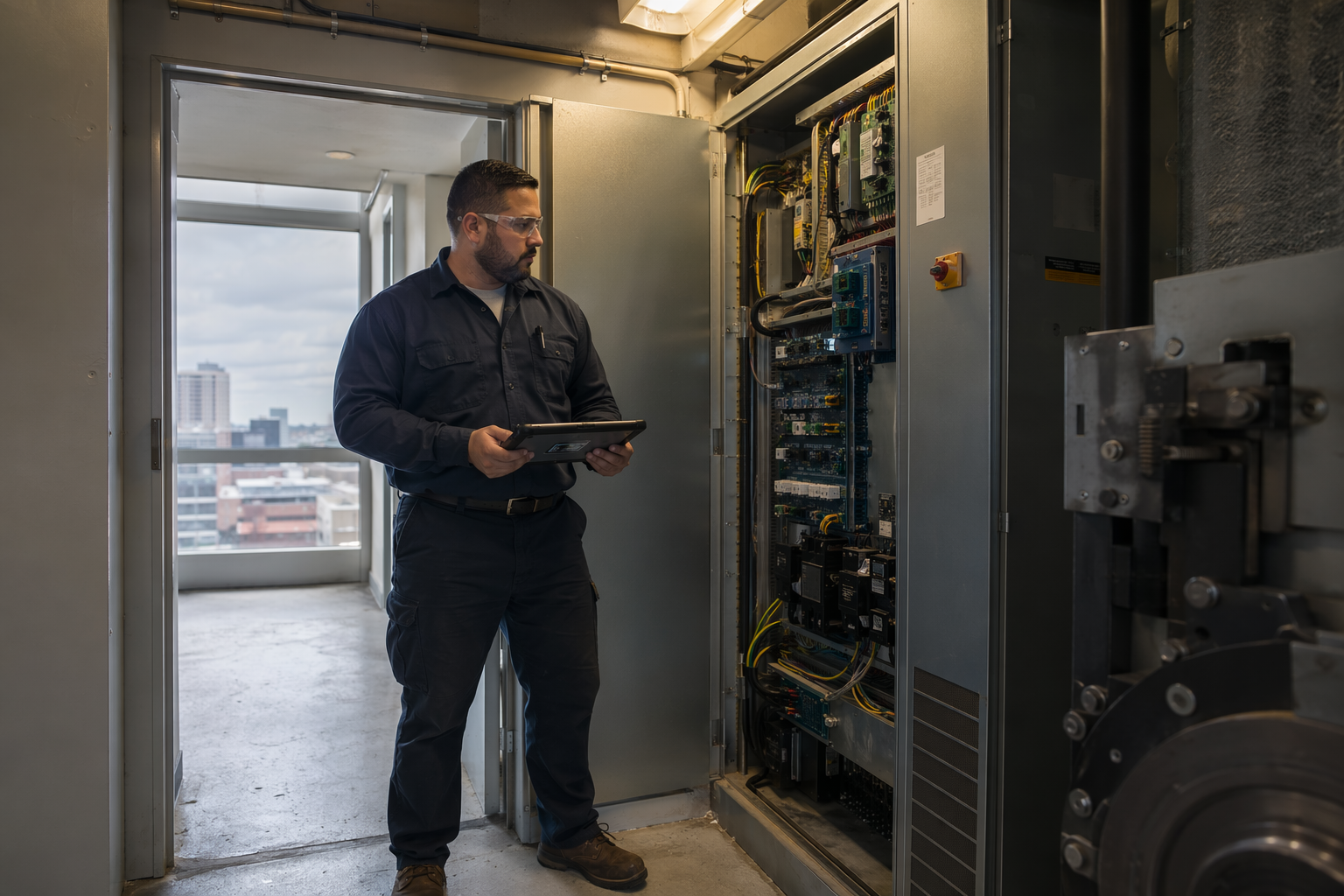
After 15-plus years working on traction, hydraulic, and MRL elevators across Texas and California, I can tell you that one question property managers ask more than any other is: how fast can my elevator be back in service? The honest answer involves more variables than most people expect. This guide breaks down realistic repair timelines, what drives them, what they cost, and how to stay compliant with ASME A17.1 and state codes throughout the process.
What Is the Average Elevator Repair Time?
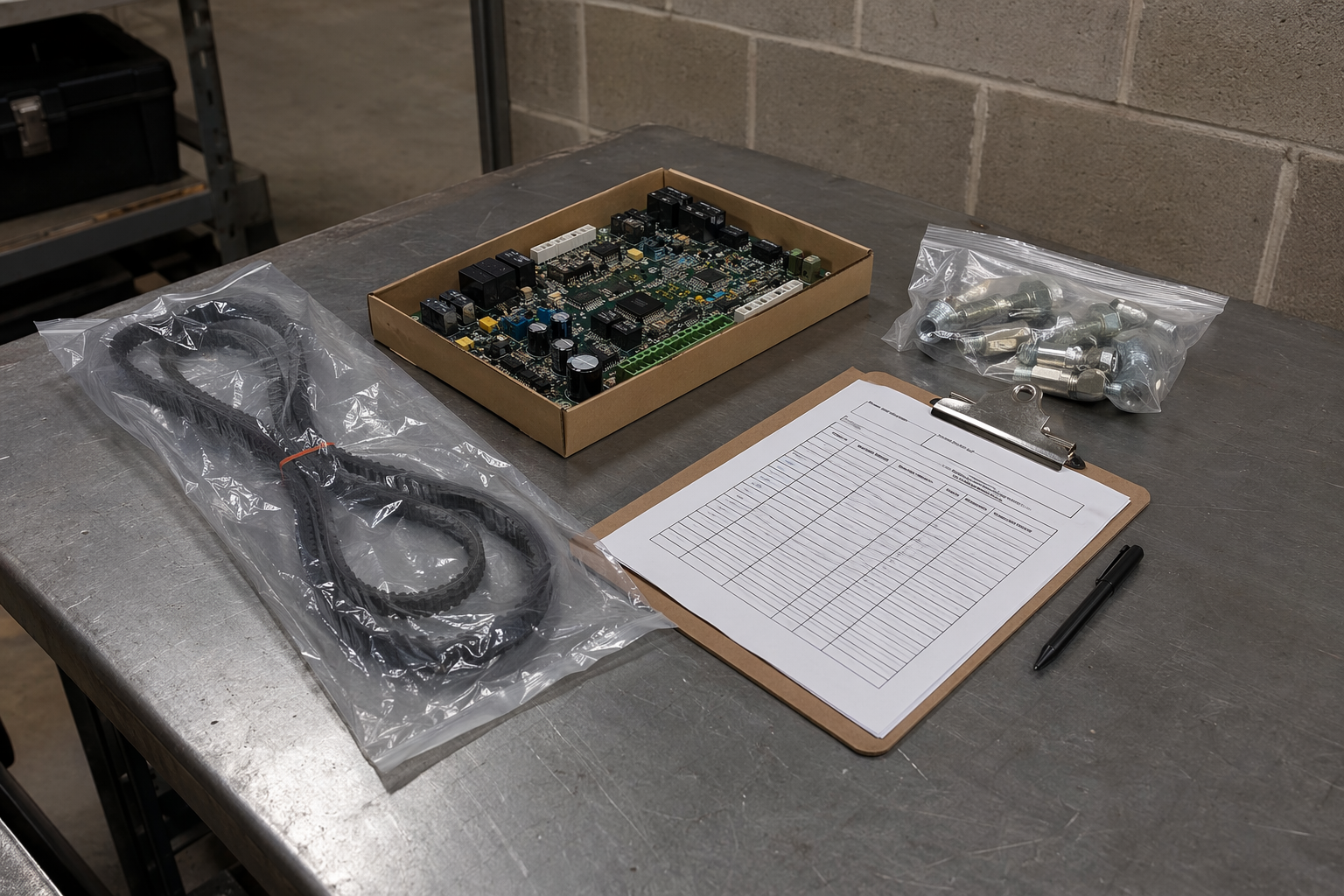
The average elevator repair takes between 4 hours and 3 business days, depending entirely on the fault type, parts availability, and technician expertise.
Minor electrical faults — a blown fuse, a tripped breaker, or a faulty door sensor — are often resolved in 2 to 4 hours by a qualified technician. Moderate failures such as a worn drive belt, damaged roller guide, or failing door operator may require 1 to 2 days when parts are in stock. Major overhauls involving hydraulic pump replacement, hoist motor failure, or control system modernization can stretch from 2 to 6 weeks. In 2026, supply chain delays continue to affect lead times on proprietary elevator components, sometimes adding 10 to 30 days beyond the repair window itself.
What Factors Determine How Quickly an Elevator Can Be Repaired?
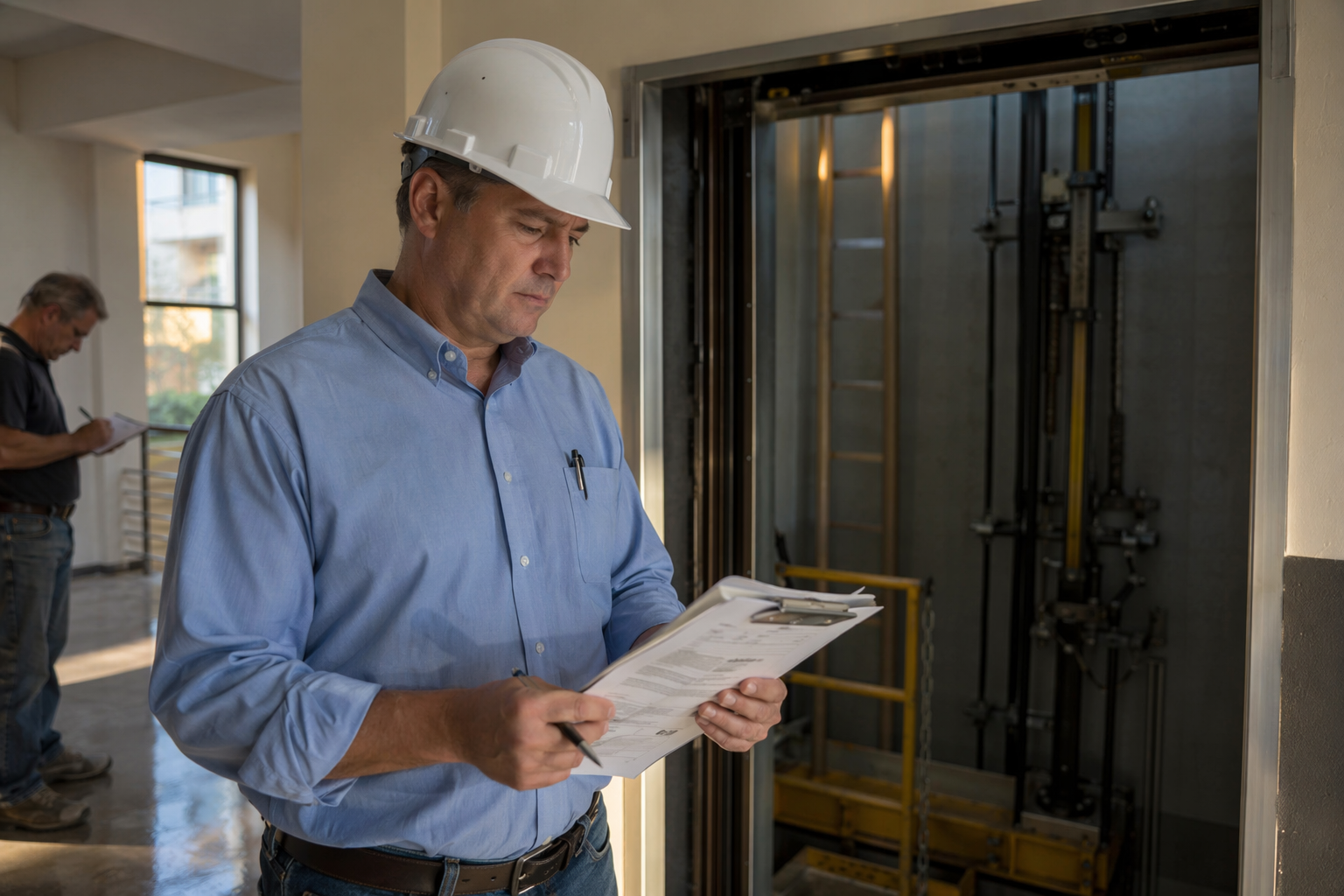
The five primary factors that determine elevator repair speed are: fault severity, parts availability, elevator age, technician certification level, and permit requirements.
Fault severity is the most obvious driver. A door that won’t close because of a misaligned cam is a 1-hour fix. A hoist machine bearing failure on a 40-year-old traction elevator can become a 3-week parts-hunt. Elevator age plays a major role — units manufactured before 1995 often have discontinued components that must be custom-fabricated or sourced from specialty suppliers, which adds days or weeks to the timeline.
Permit requirements under state elevator codes in Texas (governed by the Texas Department of Insurance, Elevator Safety Division) and California (DOSH Elevator Unit) can require inspections before an elevator is returned to service following certain repairs. Factoring in inspection scheduling — which can add 2 to 5 business days — is critical for realistic planning.
How Long Do Common Elevator Repairs Take?
Common elevator repairs range from 1 hour for simple sensor resets to 4–6 weeks for full hydraulic cylinder replacement.
| Repair Type | Typical Duration | Parts Lead Time | Permit Required? |
|---|---|---|---|
| Door sensor reset / adjustment | 1–2 hours | None | No |
| Door operator belt replacement | 2–4 hours | 0–2 days (common) | No |
| Control board / circuit board | 4–8 hours | 3–14 days | Sometimes |
| Hydraulic fluid leak repair | 4–8 hours | 0–1 day | Yes (TX, CA) |
| Hoist rope replacement | 1–2 days | 1–5 days | Yes |
| Drive sheave replacement | 2–3 days | 5–21 days | Yes |
| Hydraulic pump motor replacement | 1–2 days | 2–10 days | Yes |
| Hydraulic cylinder replacement | 3–6 weeks | 3–8 weeks | Yes |
| Control system modernization | 2–4 weeks | 2–6 weeks | Yes |
| Full cab interior renovation | 1–2 weeks | 2–4 weeks | Varies |
These timelines assume parts are either in stock or on expedited order. In Houston, Dallas, Austin, San Antonio, Los Angeles, and San Diego — all markets served by AmeriTex Elevator — local parts warehouses can cut lead times significantly compared to rural service areas.
What Is Emergency Elevator Repair Response Time?
Emergency elevator repair response time from a qualified contractor should be 1 to 4 hours for after-hours calls, with on-site arrival targeted within 2 hours in metro markets.
When a passenger is trapped, response time becomes life safety issue. ASME A17.1-2022, Section 2.27.1 requires that all elevators be equipped with a means for two-way communication and that rescue procedures be defined. Local fire departments often handle passenger extraction, but a licensed elevator technician must be called to inspect and clear the unit before it re-enters service. AmeriTex Elevator maintains 24/7 emergency dispatch across all six of its service markets, targeting under-2-hour on-site response for trapped-passenger calls.
For non-emergency outages, same-day or next-morning service is the industry benchmark. Anything beyond 24 hours without a defined repair timeline from your contractor is a red flag.
How Does Elevator Type Affect Repair Speed?
Hydraulic elevators are generally faster to repair for mechanical failures, while traction elevators have more complex electrical systems that can extend diagnostic and repair time.
Hydraulic elevators use simpler mechanics — a pump, cylinder, and fluid system — so fluid leaks or pump failures are well-understood repairs with widely available parts. However, single-bottom hydraulic cylinders that develop underground leaks can be the industry’s most time-consuming repair: excavation, cylinder pull, and replacement can take 4 to 8 weeks total.
Traction elevators (geared, gearless, or MRL) involve variable-frequency drives, encoder feedback systems, and complex safety circuits governed by ASME A17.1. Fault diagnosis on these systems requires specialized training. An IUEC-certified technician with VFD experience can diagnose a drive fault in 30 minutes; an under-qualified tech might spend 6 hours chasing the same fault.
How Long Does Elevator Repair Take After a Failed Inspection?
Following a failed inspection, elevator repairs typically take 3 to 21 days before reinspection clearance is granted, depending on the violation category and local enforcement schedules.
In Texas, the Texas Department of Insurance (TDI) Elevator Safety Division classifies violations by severity. Immediately hazardous violations result in shutdown — the elevator is red-tagged and cannot operate until the deficiency is corrected and a reinspection is passed. Non-hazardous violations may allow continued operation under a correction order with a 30 to 90-day compliance window. California’s Division of Occupational Safety and Health (Cal/OSHA) follows a similar tiered enforcement model.
The reinspection scheduling gap is often the longest part of the wait. In Houston and Los Angeles, inspection backlogs in 2026 can push reinspection out 5 to 15 business days after the repair is completed. Filing for expedited reinspection with documented repair evidence can sometimes cut that window in half.
Does Parts Availability Significantly Delay Elevator Repairs?
Yes — parts availability is frequently the single biggest delay in elevator repair, with proprietary components for older or discontinued models sometimes taking 4 to 12 weeks to source.
Manufacturers like Otis, KONE, Schindler, and ThyssenKrupp use proprietary control boards and drive components that are only available through authorized channels. Independent service providers without manufacturer authorization must source these through secondary suppliers, which adds cost and time. This is a primary reason why choosing a service provider with broad manufacturer relationships and a well-stocked local parts inventory matters so much.
Generic components — door hanger rollers, wire rope, guide rails, buffers — are widely available and rarely cause delays. The risk is concentrated in control systems, VFDs, and old hydraulic cylinders.
What Is the Cost of Elevator Repair and How Does It Relate to Timeline?
Elevator repair costs range from $200 to $500 for simple adjustments up to $50,000 or more for major component overhauls, and faster timelines often require premium expediting fees for parts and after-hours labor.
Here is a realistic 2026 cost breakdown for common repairs in the Texas and California markets:
- Door sensor / adjustment: $200–$500
- Door operator replacement: $1,500–$4,000
- Control board replacement: $3,000–$10,000
- Hydraulic pump motor: $4,000–$12,000
- Hoist rope replacement (traction): $5,000–$15,000
- Hydraulic cylinder replacement: $20,000–$60,000
- Full control system modernization: $30,000–$100,000+
Expediting parts — overnight freight, factory-direct sourcing, or premium supplier relationships — can add 15 to 30 percent to material costs but shave 1 to 3 weeks off total downtime. For a commercial building where elevator downtime costs thousands of dollars per day in tenant disruption, that premium is almost always worth it.
How Does Preventive Maintenance Reduce Elevator Repair Time?
Elevators on monthly preventive maintenance programs experience 60 to 70 percent fewer emergency breakdowns and, when issues do occur, are repaired 40 percent faster because service history and component wear data are already on file.
From my field experience, the fastest repairs happen when I already know the elevator. If I’ve been servicing a unit monthly, I know its quirks, its wear patterns, its part numbers, and its failure tendencies. Diagnosis that might take 3 hours on a cold-call service visit takes 20 minutes on a unit I maintain. ASME A17.1-2022 does not mandate specific maintenance frequencies, but it does require that maintenance be performed by competent personnel following a documented maintenance program — and most state codes interpret that to mean qualified technicians on a regular schedule.
Texas Administrative Code Title 28, Part 2 (TDI) and California Code of Regulations Title 8 both require elevators to be maintained in safe operating condition at all times, which in practice means regular serviced intervals.
What Are the ASME A17.1 Code Requirements That Affect Repair Timelines?
Under ASME A17.1-2022, certain repairs require the elevator to be taken out of service, and others require a witnessing inspection before return to service — both of which directly impact total downtime.
Key ASME A17.1 provisions affecting repair timelines include:
- Section 8.6 (Maintenance, Repair, and Replacement): Requires that all maintenance, repair, and replacement work be performed by competent, qualified personnel and documented in a maintenance control program (MCP).
- Section 8.11 (Periodic Tests): After major work such as rope replacement or safety gear replacement, witnessing tests by a qualified elevator inspector are required before return to normal service.
- Rule 2.27 (Emergency Operations): Specifies that emergency lighting, communication, and leveling operations must be functional before an elevator returns to service following any repair that interrupts these systems.
Non-compliance with these provisions can result in a failed reinspection, doubling the downtime. Working with a contractor like AmeriTex Elevator — who documents every repair per the Maintenance Control Program requirements — ensures inspections pass on the first attempt.
Are There ADA Compliance Requirements That Must Be Addressed During Repairs?
Yes — under the Americans with Disabilities Act (ADA), any alteration to an elevator that affects accessibility must bring that element into compliance with current ADA Standards for Accessible Design, which can add scope and time to a repair project.
The ADA’s 2010 Standards for Accessible Design, Sections 206 and 407, govern elevator accessibility including cab size, door timing, floor indicators, and tactile controls. If a repair involves replacing the door operator, control panel, or cab interior, the contractor must evaluate whether the change triggers a broader accessibility upgrade obligation. In practice, replacing a control board with an equivalent unit does not typically trigger ADA upgrade requirements. However, a full cab renovation or control system modernization almost certainly does.
This matters for timeline because ADA-compliant components — raised Braille buttons, voice annunciators, accessible call stations — may have longer lead times than standard components. Budget an extra 1 to 2 weeks if ADA remediation is part of the scope.
How Does Elevator Age Affect Repair Speed?
Elevators older than 20 years take on average 30 to 50 percent longer to repair than modern units due to discontinued parts, outdated wiring schemes, and reduced availability of technicians familiar with legacy systems.
I’ve worked on Westinghouse relay-logic elevators from the 1960s and Montgomery hydraulics from the 1970s. Parts are either unobtainium or must be rebuilt from scratch by specialty shops. Wiring diagrams may be incomplete or nonexistent, making fault diagnosis a slow, methodical process. Older relay-logic controllers have no fault codes — you’re tracing circuits with a meter, one contact at a time.
For buildings with elevators approaching 25 to 30 years old, the calculus often shifts from repair to modernization. A full modernization takes longer upfront — 3 to 6 weeks — but eliminates the cycle of aging-system breakdowns that individually take 1 to 3 weeks each and cost $5,000 to $20,000 per incident over time.
How Quickly Can an Elevator Be Repaired After a Major Safety Incident?
Following a major safety incident — passenger injury, free-fall event, or fire-service malfunction — an elevator typically requires 1 to 4 weeks before it can legally return to service due to mandatory investigation, insurance evaluation, and required inspections.
In Texas, any elevator accident resulting in injury must be reported to the TDI Elevator Safety Division. The unit is immediately taken out of service pending investigation. In California, Cal/OSHA must be notified of any serious injury involving an elevator, and a special inspection is required before return to service. These regulatory timelines are non-negotiable and cannot be expedited regardless of how quickly the physical repair is completed.
Documentation quality matters enormously in these situations. Contractors who maintain detailed service records, including the Maintenance Control Program required by ASME A17.1-2022 Section 8.6, can move through investigations significantly faster than those with incomplete records.
What Is the Fastest Way to Get an Elevator Repaired?
The fastest path to elevator repair is: call a 24/7 certified contractor immediately, have your elevator’s model number and maintenance history ready, and authorize parts procurement before diagnosis is complete if downtime cost exceeds parts cost.
Here is the fastest-possible repair sequence from a technician’s perspective:
- Call within minutes of the fault — every hour of delay is an hour of downtime added.
- Have your machine room accessible — locked or cluttered machine rooms add 30 to 90 minutes to every service call.
- Provide model and serial number upfront — this allows the dispatcher to pull parts inventory and service history before the tech arrives.
- Authorize parts procurement proactively — waiting for approval after diagnosis adds 24 to 72 hours in many cases.
- Use a contractor with local inventory — in Houston, Dallas, Austin, San Antonio, Los Angeles, and San Diego, AmeriTex Elevator maintains regional parts stocking to eliminate most standard parts delays.
How Long Does It Take to Get an Elevator Back Online After a Power Outage?
Most elevators can be restored within 30 minutes to 4 hours after a power outage, assuming no secondary damage occurred during the outage or restoration.
Power fluctuations — particularly voltage spikes during restoration — are a leading cause of VFD (variable frequency drive) and control board damage in traction elevators. After extended outages, a qualified technician should perform a controlled restart sequence, checking phase balance, voltage levels, and ground fault conditions before returning the elevator to service. Skipping this step and simply resetting breakers after a significant outage is a common cause of secondary failures that extend downtime from 1 hour to multiple days.
Hydraulic elevators are generally more resilient to power events, though pump motor starters can be damaged by power surges. Emergency lowering and leveling systems governed by ASME A17.1-2022 Rule 3.26 must be verified functional before return to passenger service.
What Should Building Managers Do While Waiting for Elevator Repairs?
While waiting for elevator repairs, building managers must post out-of-service signage, notify tenants, ensure ADA accommodation plans are activated, and document the outage start time for insurance and compliance purposes.
Under the ADA, building owners have an obligation to provide accessible access. If the elevator is the sole accessible means of reaching upper floors, the outage may trigger an obligation to provide alternative accommodation — temporary access solutions, service relocation, or other measures — depending on building type and tenancy. Consulting with legal counsel on extended outages in commercial settings is advisable.
From a practical standpoint, keep the machine room clear and accessible, ensure the contractor has key access, and designate a single point of contact to communicate with the repair team. Fragmented communication is one of the most common sources of unnecessary repair delays in multi-tenant buildings.
How Do Houston, Dallas, Austin, and San Antonio Regulations Affect Repair Timelines?
In Texas, the TDI Elevator Safety Division oversees all elevator permits, inspections, and reinspections — and reinspection scheduling in major metros like Houston and Dallas can add 5 to 10 business days to post-repair timelines in 2026.
Texas requires that elevator contractors hold a Certificate of Approval issued by TDI and that qualifying elevator mechanics hold an Elevator Inspector or Elevator Mechanic license. Work performed without proper licensing is illegal and voids any path to reinspection. The TDI also requires that certain categories of repair — particularly those affecting safeties, buffers, or hoisting ropes — be inspected before return to service.
Houston and Dallas are the two largest elevator markets in Texas by unit count, which creates inspection scheduling congestion. Building owners who work with established contractors maintaining good relationships with TDI inspectors — as AmeriTex Elevator does — can sometimes expedite inspection scheduling through proper documentation and pre-inspection checklist compliance.
How Do Los Angeles and San Diego Regulations Affect Elevator Repair Speed?
In California, elevator repairs are regulated by the Division of Occupational Safety and Health (Cal/OSHA) Elevator Unit, and permit issuance for major repairs can take 5 to 20 business days in the Los Angeles and San Diego markets.
California requires an Alteration Permit for work that exceeds ordinary maintenance — including control system changes, rope replacement, and hydraulic cylinder work. The permit application must include a detailed scope of work, and work cannot begin on permitted items until the permit is issued. Emergency repairs that are immediately hazardous to life safety may proceed under a verbal permit followed by written submission, but this is a limited exception.
The California Elevator Safety Construction Unit (part of Cal/OSHA) sets the regulatory framework. In Los Angeles County, a separate county authority having jurisdiction (AHJ) may also be involved for certain buildings, adding a second approval layer. San Diego operates under Cal/OSHA directly with fewer local layers, generally making permits faster by 3 to 5 days compared to LA.
How Can a Maintenance Contract Reduce Future Repair Downtime?
Buildings with full-service elevator maintenance contracts experience average repair resolution times 35 to 50 percent shorter than those relying on on-demand service calls, because service history, parts preferences, and building access are already established.
A comprehensive maintenance agreement — covering monthly inspections, lubrication, adjustment, parts-in-service monitoring, and 24/7 emergency response — is the single most effective strategy for minimizing both repair frequency and repair duration. When a contracted technician arrives at a breakdown, they are not starting from zero. They know the elevator’s configuration, they have the service records, and they often have probable-cause parts in the service vehicle based on the unit’s age and history.
Maintenance contracts also typically include priority response guarantees — 2-hour response rather than 4-hour — and parts markup structures that are pre-negotiated, eliminating approval delays. For multi-elevator buildings in Houston, Dallas, Austin, San Antonio, Los Angeles, and San Diego, the ROI on a full-service maintenance contract is well-documented in reduced downtime cost alone.
When Should an Elevator Be Modernized Instead of Repaired?
Modernization becomes more economical than repair when annual repair costs exceed 30 to 40 percent of modernization cost, when parts are consistently unavailable, or when the elevator cannot be brought into current code compliance through repairs alone.
The 2026 benchmark I use with property managers is what I call the “three-year repair test”: if your total repair expenditure over the past three years exceeds 50 percent of a full modernization quote, you are likely past the repair-first threshold. Beyond economics, ASME A17.1-2022 and state codes increasingly require safety upgrades — phase protection, emergency lighting, firefighter service Phase I and II, and door reversal systems — that older elevators may not have. In Texas and California, alterations that trigger code compliance review can require bringing these systems up to current standard, which in some cases makes full modernization the only practical path.
A qualified contractor like AmeriTex Elevator can provide a lifecycle analysis comparing 5-year repair cost projections against modernization investment, giving building owners the data they need to make the right long-term decision.
How Do I Choose the Right Elevator Repair Company for Fast Service?
Choose an elevator repair company based on: IUEC certification of technicians, 24/7 emergency availability, local parts inventory, demonstrated experience with your elevator make and model, and proper state licensing in Texas or California.
The fastest repairs come from contractors who bring all five of these capabilities together. IUEC certification ensures technicians have met the highest industry training standard. Local parts inventory eliminates the most common cause of delay. State licensing — TDI in Texas, CSLB and Cal/OSHA compliance in California — ensures the contractor can legally perform permitted work and schedule reinspections without third-party intermediaries.
When evaluating contractors, ask specifically: What is your average emergency response time in my market? Do you stock parts for my elevator brand? Can you provide references from buildings with my elevator model? What is your inspection pass rate on first reinspection? These four questions will quickly distinguish capable contractors from those who will extend your downtime through inexperience or thin resources.
Summary: Elevator Repair Timeline Quick Reference
| Scenario | Estimated Total Time to Restore Service | Key Variable |
|---|---|---|
| Minor fault, no parts needed | 1–4 hours | Technician response time |
| Moderate repair, parts in stock | 4–24 hours | Local parts availability |
| Moderate repair, parts on order | 3–10 days | Supplier lead time |
| Major repair with permit required | 1–4 weeks | Permit and inspection scheduling |
| Post-safety incident repair | 2–6 weeks | Regulatory investigation |
| Full modernization | 4–10 weeks | Parts lead time and inspection |
Need elevator service you can rely on? AmeriTex Elevator is ready to help.