24 Hour Elevator Repair Service: Everything You Need to Know
After 15 years of responding to elevator emergencies across Texas and California, I’ve seen what happens when building owners are unprepared for a midnight breakdown. Passengers get trapped. Businesses lose revenue. Liability exposure skyrockets. This guide answers every question property managers, building owners, and facility directors should know before an elevator crisis hits — including what real 24-hour service looks like, what it costs, and how to choose the right provider.
What exactly is 24 hour elevator repair service and how does it work?
24 hour elevator repair service is an emergency response program where licensed elevator technicians are available around the clock — including nights, weekends, and holidays — to diagnose, repair, and restore any elevator system that fails outside of normal business hours.
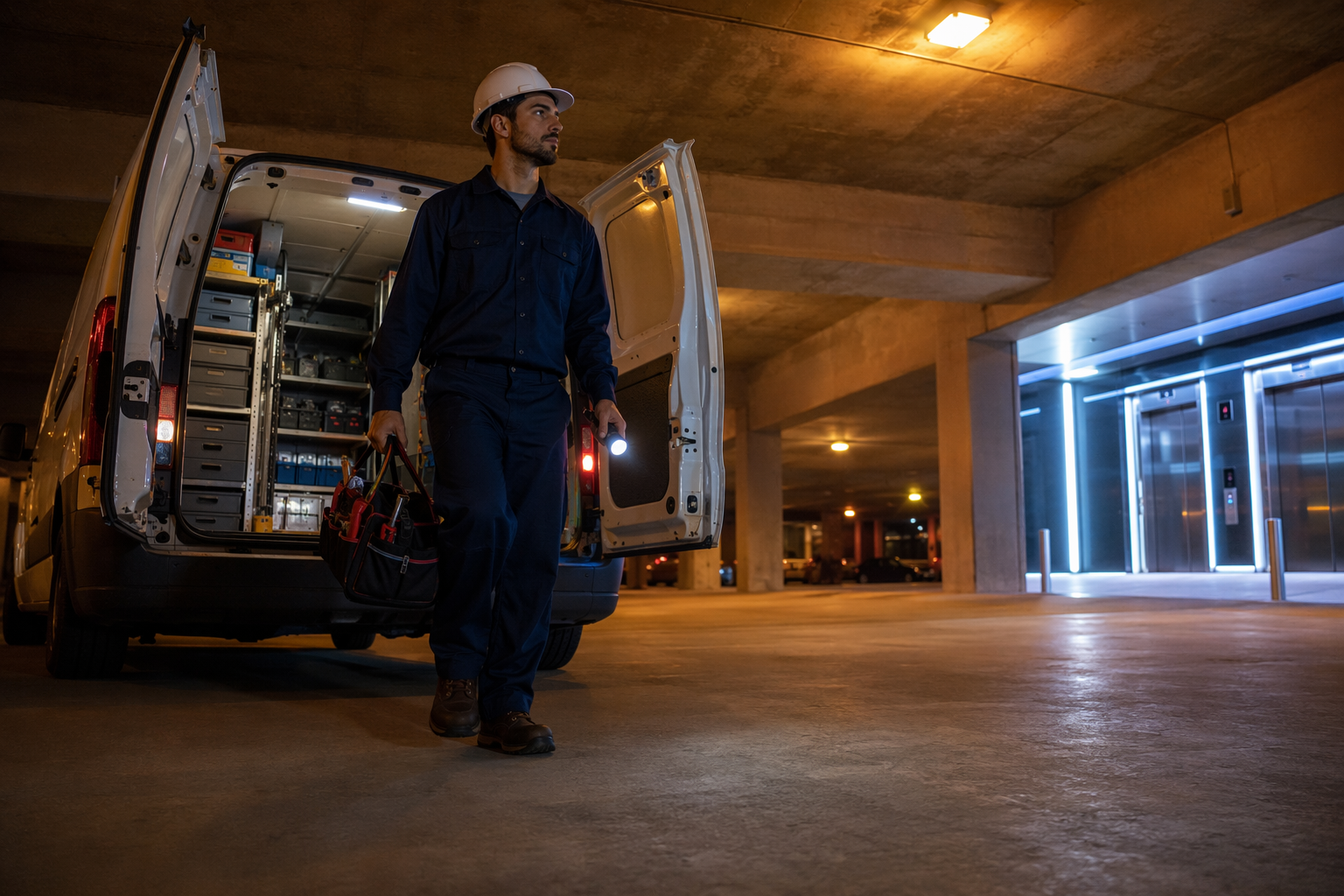
When a service call is placed, a certified technician is dispatched immediately. Most reputable providers like AmeriTex Elevator maintain on-call technician rotations across their service territories so that response times remain consistent whether it’s 2 PM on a Tuesday or 3 AM on Christmas morning. The technician arrives with a fully stocked service vehicle carrying common replacement parts — control boards, door operators, safety switches, hydraulic fittings — to maximize first-visit resolution rates.
True 24/7 service is not simply an answering service that schedules a next-day appointment. It means a licensed, tools-in-hand technician is en route within minutes of your call. Always ask a prospective vendor: “Is dispatch live 24/7, or do you take a message and call back in the morning?” The answer tells you everything.
What are the most common elevator emergencies that require immediate repair?

The most common emergency elevator situations requiring immediate 24-hour service include passenger entrapments, door malfunctions, sudden stops between floors, hydraulic fluid leaks, and control system failures.
Passenger entrapment is the scenario every building manager fears most. Under ASME A17.1-2022, elevators must be equipped with emergency lighting and two-way communication systems, but these features do not eliminate the urgency of rapid technician response. Entrapments can become medical emergencies within minutes, particularly for elderly passengers or those with health conditions.
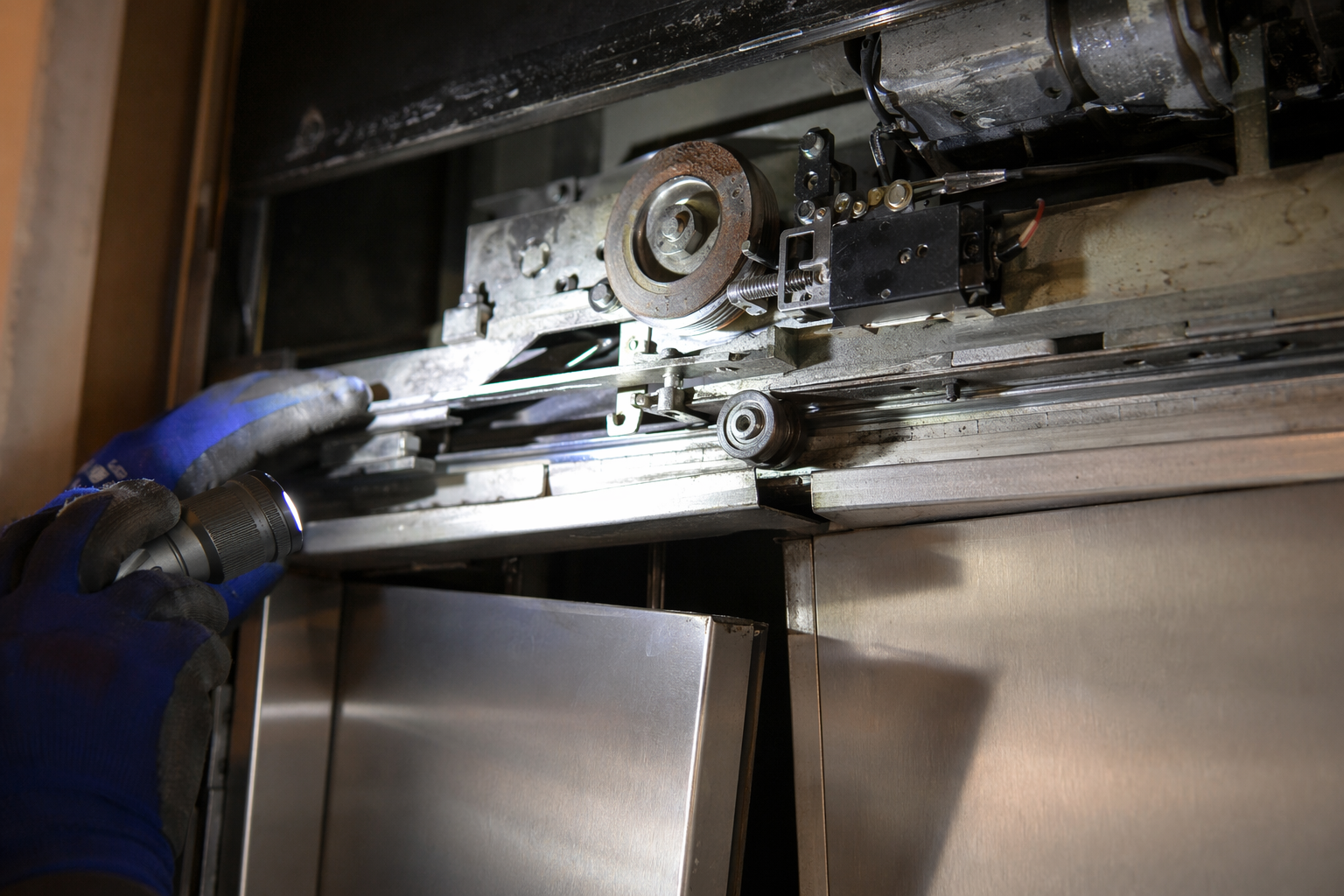
Door system failures account for roughly 60% of all emergency service calls I respond to. A door that won’t close prevents the elevator from moving; a door that won’t open traps passengers at a floor. Gate switch failures, worn door rollers, misaligned tracks, and faulty photo eyes are all culprits. Beyond entrapments, hydraulic oil leaks in traction or hydraulic elevators can create fire hazards and environmental compliance issues that demand same-night resolution.
How fast should a 24 hour elevator repair technician arrive after I call?
A legitimate 24 hour elevator repair service should dispatch a technician immediately upon your call, with typical on-site arrival times ranging from 1–4 hours depending on your location and time of day.
| Service Scenario | Expected Dispatch Time | Expected On-Site Arrival | Industry Benchmark (2026) |
|---|---|---|---|
| Passenger Entrapment (Priority 1) | Immediate — under 5 minutes | 30–90 minutes (urban markets) | < 60 min (best practice) |
| Elevator Out of Service (Priority 2) | Within 15–30 minutes | 1–3 hours | < 2 hours (best practice) |
| Partial Operation / Safety Issue (Priority 3) | Within 30–60 minutes | 2–4 hours | < 4 hours (best practice) |
| Non-Critical After-Hours Call (Priority 4) | Scheduled same night or next AM | 4–8 hours | Next business day acceptable |
In Houston, Dallas, Austin, San Antonio, Los Angeles, and San Diego — the metro markets AmeriTex Elevator serves — technician density is high enough that Priority 1 entrapment responses routinely occur within 45–60 minutes. Rural or suburban locations outside major metro cores may see longer windows. Always confirm your provider’s average response time in writing before signing a service contract.
Is 24 hour elevator repair service required by law in Texas or California?
While no law explicitly mandates that building owners purchase a 24/7 repair contract, both Texas and California codes require that inoperable elevators be taken out of service immediately and that entrapments be resolved without delay — making round-the-clock access to licensed technicians a de facto compliance necessity.
In Texas, elevator safety is governed by the Texas Department of Insurance (TDI) Elevator Safety Program, which enforces ASME A17.1 as the state’s adopted safety code. Any elevator operating in a failed or unsafe condition without a plan for immediate repair exposes the building owner to citation, fines, and civil liability. California enforces elevator safety through the California Division of Occupational Safety and Health (Cal/OSHA) Elevator, Rides and Tramways Unit, with similarly strict requirements under the California Elevator Safety Construction Code (Title 8, CCR).
For buildings subject to the Americans with Disabilities Act (ADA), a prolonged elevator outage in a multi-story building may constitute a denial of access to people with disabilities — a separate legal exposure that 24/7 repair capability directly mitigates.
What does 24 hour elevator repair service typically cost?
Emergency after-hours elevator repair typically costs $300–$800 for the service call and diagnostic, plus parts and labor, with total repair invoices commonly ranging from $500 to $5,000+ depending on the failure type and components required.
Pricing structures vary significantly across providers. Here’s what you should expect to see itemized on any legitimate invoice:
- Emergency dispatch/trip fee: $150–$350 (after-hours premium over standard rates)
- Labor rate: $120–$220 per hour (IUEC-scale labor in major markets as of 2026)
- Parts markup: 20–40% over wholesale cost is standard and acceptable
- Hydraulic fluid replacement: $200–$600 per service, depending on volume
- Control board replacement: $800–$3,500 depending on manufacturer and system age
Buildings enrolled in a comprehensive maintenance agreement often receive emergency labor at reduced or zero additional cost. This is one of the strongest financial arguments for preventive maintenance contracts — the emergency call you didn’t budget for becomes a covered service event rather than an unexpected capital expense.
What qualifications should a 24 hour elevator repair technician have?
Any technician performing emergency elevator repairs must hold a state-issued elevator mechanic license and should be a member of the International Union of Elevator Constructors (IUEC) or hold equivalent certified training credentials.
In Texas, elevator mechanics must be licensed through the Texas Department of Insurance. In California, elevator mechanics must hold a Certified Competent Conveyance Mechanic (CCCM) certification through Cal/OSHA. Unlicensed “handymen” or general maintenance personnel are legally prohibited from performing elevator repairs in both states — and any work they perform voids insurance coverage and creates enormous liability exposure for the building owner.
Beyond basic licensure, look for technicians who are factory-trained on your specific equipment brand (Otis, KONE, Schindler, ThyssenKrupp, Dover, Mitsubishi, etc.). Brand-specific training dramatically reduces diagnostic time and increases first-visit fix rates. At AmeriTex Elevator, all emergency-response technicians carry multi-brand certification and stock cross-brand parts inventories in their service vehicles.
Can a 24 hour elevator technician fix any brand or type of elevator?
Most qualified independent elevator service providers can repair all major brands and elevator types — including traction, hydraulic, MRL (machine room-less), and commercial freight elevators — though some proprietary systems from manufacturers like Otis and KONE may require additional access tools or software licenses.
The elevator industry has historically used proprietary diagnostic systems to lock buildings into manufacturer service contracts. Legislation in several states has moved to address this, but in 2026 it remains a practical consideration. A well-equipped independent service company will have third-party diagnostic interfaces (such as the GAL MOVFR tool set or equivalent), enabling full-scope repairs on most proprietary systems without manufacturer involvement.
Elevator types serviced under a comprehensive 24/7 program should include: hydraulic elevators (both conventional and LULA), geared and gearless traction elevators, MRL traction elevators, platform lifts (ASME A18.1), dumbwaiters, and escalators. Confirm the vendor’s equipment type coverage list before signing any service agreement.
What should I do while waiting for the emergency elevator repair technician to arrive?
While waiting for the technician, your immediate priorities are ensuring passenger safety, securing the elevator out of service, communicating with any trapped passengers, and documenting the failure for the service record.
If passengers are trapped: maintain verbal contact through the elevator’s two-way communication system (required by ASME A17.1 Section 2.27.1.1). Reassure them, confirm they are not injured, and advise them not to attempt to force open doors or climb out of the cab. Under no circumstances should untrained personnel attempt manual door release — improper procedures can cause falls into the hoistway.
Post “Out of Service” signage on all landings. In multi-elevator buildings, verify that remaining elevators are fully operational to maintain building access. Notify building management, security, and if a passenger is medically compromised, call 911 simultaneously with the elevator service provider. Document the time of failure, last known floor, number of passengers (if any), and any unusual sounds or movements reported before the outage.
How do I evaluate whether a company truly offers 24 hour elevator service versus marketing claims?
To verify genuine 24/7 capability, call the provider’s emergency line at 10 PM on a weeknight before signing any contract — a real 24-hour operation connects you to a live dispatcher within 3 rings, not a voicemail or answering service.
Additional verification steps include asking for the provider’s average documented response time by priority category, requesting references from current contract clients who have used emergency service, and checking online reviews specifically for after-hours response experiences. Look for Google or BBB reviews that mention weekend or overnight calls by name.
Ask these five contract-qualifying questions before signing:
- Is your dispatch center staffed by employees or a third-party answering service?
- How many on-call technicians cover my zip code at 2 AM?
- What is your documented average response time for Priority 1 entrapments in my market?
- Are after-hours labor charges included in my maintenance agreement?
- Do your emergency technicians carry parts inventory on their service vehicles?
What is the difference between emergency elevator repair and preventive maintenance?
Emergency repair is reactive — it restores a failed elevator to operation; preventive maintenance is proactive — it inspects, adjusts, and replaces wear components on a schedule to prevent failures from occurring in the first place.
Industry data consistently shows that elevators on active preventive maintenance programs experience 60–80% fewer emergency service calls than unmanaged units. ASME A17.1-2022 establishes minimum maintenance standards, but best-practice programs go well beyond the code minimums. A comprehensive maintenance program should include monthly lubrication and safety device testing, quarterly control system diagnostics, semi-annual door timing and force measurement, and annual full-system inspections aligned with the state’s certificate of operation renewal cycle.
The false economy of deferred maintenance is one of the most expensive mistakes I see building owners make. A $200/month maintenance contract routinely prevents $3,000–$8,000 emergency repair events. When you do need emergency service, having an existing maintenance relationship with a provider like AmeriTex Elevator means technicians already know your equipment’s history, making diagnosis faster and resolution more reliable.
How does a passenger entrapment rescue work under ASME A17.1 standards?
Under ASME A17.1-2022, passenger entrapment rescue must be performed by a qualified elevator mechanic using the designated manual lowering or leveling procedure specific to the elevator type — never by fire department forced entry unless a medical emergency exists.
ASME A17.1 Section 2.27 governs emergency operations and signals. Traction elevators equipped with an emergency lowering device allow a certified technician to manually lower the car to the nearest landing and release passengers within minutes of arrival. Hydraulic elevators use manual lowering valves in the machine room to achieve the same result. The technician then secures the unit out of service, performs a diagnostic assessment, and either completes the repair on-site or locks out the elevator pending parts procurement.
Fire department intervention, while available in true emergencies, often results in door damage, safety device trips, and inspection requirements before the elevator can be returned to service — adding hours and cost to the resolution. This is why rapid certified technician response is always the preferred protocol.
Are there specific elevator codes or regulations I need to know as a building owner in Texas or California?
Yes — Texas building owners must comply with ASME A17.1 as enforced by the Texas Department of Insurance, while California owners must comply with both ASME A17.1 and California Title 8 CCR as enforced by Cal/OSHA’s Elevator Unit.
Key compliance milestones for Texas building owners in 2026:
- Annual certificate of inspection required for all passenger elevators
- TDI-licensed elevator inspector must perform all inspections
- Inspection certificates must be posted in the elevator car
- Elevators found in unsafe condition must be taken out of service immediately
Key compliance milestones for California building owners in 2026:
- Annual permit to operate required through Cal/OSHA Elevator Unit
- Certified Competent Conveyance Mechanic (CCCM) required for all maintenance and repair
- California-specific seismic safety provisions apply in high-seismic-risk zones (Los Angeles, San Diego)
- Elevator safety reports must be retained for a minimum of 5 years
ADA requirements apply federally: ADA Title III requires that places of public accommodation maintain accessible routes. A broken elevator in a building where the elevator is the only accessible path to upper floors can constitute an ADA violation if not promptly repaired.
What types of buildings benefit most from a 24 hour elevator service contract?
Buildings with the highest exposure to elevator failure risk and the greatest operational dependency include multi-family residential properties, hospitals and medical facilities, hotels, high-rise commercial office buildings, and any multi-story property serving elderly or mobility-impaired populations.
For residential apartment buildings, a broken elevator directly impacts tenant quality of life, lease renewal decisions, and habitability obligations under landlord-tenant law. For hospitals and medical facilities, elevator reliability is a patient safety issue — many states classify hospital elevator outages as reportable incidents. Hotels with a single elevator serving multiple guest floors face immediate guest relations crises and potential OTA review damage that far outweighs the cost of a 24/7 contract.
Even smaller commercial buildings with just one elevator should have a 24/7 service relationship. The moment your elevator becomes the only accessible route in the building under ADA guidelines, its uptime is no longer optional — it’s legally mandated.
How long does an emergency elevator repair typically take to complete?
Most emergency elevator repairs are completed within 2–6 hours of technician arrival when common parts are available on the service vehicle; complex failures requiring sourced components may take 12–72 hours depending on part availability and system age.
First-visit completion rates are one of the most important service quality metrics to evaluate when selecting a 24/7 elevator repair provider. Based on 2026 industry benchmarks, a well-equipped independent service company should achieve first-visit resolution on approximately 75–85% of emergency calls. The remaining cases typically involve:
- Obsolete or proprietary control components requiring special ordering
- Major mechanical failures (broken sheaves, snapped ropes, hydraulic cylinder failures)
- Failures requiring regulatory inspection before return to service
When a repair cannot be completed on the first visit, the elevator must be secured out of service and a follow-up timeline communicated to the building contact. Reputable providers will offer a loaner or temporary accessibility plan if the building serves ADA-protected tenants and the outage extends beyond 24 hours.
What parts are most commonly replaced during emergency elevator repairs?
The most frequently replaced components during emergency elevator service calls are door operator components, safety switches, control relays or circuit boards, hydraulic pump units, and suspension ropes or cables showing safety wear.
Door system components — specifically door operators, door clutches, rollers, tracks, and photo eye sensors — account for the single largest category of emergency parts replacements. These components experience thousands of cycles per day in high-traffic buildings and wear on predictable timelines. A proactive maintenance program should include door timing tests at every visit to catch wear before it causes failure.
Safety device activations — safeties, buffers, governor rope switches — while less common, require mandatory inspection and testing before the elevator is returned to service. Under ASME A17.1, a safety device trip is a “shutdown condition” that cannot simply be reset; the cause must be identified and corrected by a licensed mechanic before operation resumes. This is a non-negotiable code requirement, not a recommendation.
How should I compare 24 hour elevator service providers before signing a contract?
Evaluate 24/7 elevator service providers across five dimensions: licensure and insurance verification, documented response time guarantees, parts inventory capability, contract transparency, and references from active clients in your property type.
| Evaluation Criteria | Minimum Acceptable Standard | Best-in-Class Standard |
|---|---|---|
| Technician Licensure | State-licensed elevator mechanic | IUEC-certified + brand-specific factory training |
| Liability Insurance | $1M per occurrence | $5M+ per occurrence / umbrella coverage |
| Emergency Response Time (Priority 1) | Under 4 hours guaranteed in writing | Under 90 minutes average, documented |
| Parts Availability | Common parts on vehicle | Stocked warehouse + emergency supplier network |
| Contract Transparency | Itemized labor and parts billing | Fixed-fee emergency coverage in maintenance agreement |
| Dispatch Model | Live answering service | 24/7 in-house dispatch with technician GPS tracking |
| Regulatory Compliance Support | Inspection scheduling assistance | Full compliance management and documentation |
What should be included in a 24 hour elevator service agreement contract?
A complete 24-hour elevator service agreement should explicitly define response time guarantees by priority level, labor coverage terms for emergency calls, parts and materials handling, liability limitations, insurance requirements, and the escalation process for extended outages.
The single most important clause to negotiate is the emergency labor coverage term. Many contracts advertise “24/7 availability” but bill emergency after-hours labor at double or triple standard rates. A best-practice contract includes emergency labor at no additional charge for Priority 1 and Priority 2 calls, with a clear definition of what qualifies as each priority level.
Also confirm that the contract specifies compliance support: who is responsible for scheduling the annual state inspection, maintaining the certificate of operation, and filing any required incident reports. These administrative responsibilities are often ambiguous in boilerplate contracts and can create compliance gaps if not clearly assigned. AmeriTex Elevator’s service agreements include full compliance coordination as a standard feature for all contract customers.
Does building insurance cover emergency elevator repair costs?
Standard commercial property insurance policies typically cover emergency elevator repair costs only when the failure results from a covered peril such as fire, vandalism, or severe weather — ordinary mechanical breakdown is generally excluded unless you carry elevator-specific equipment breakdown (boiler and machinery) coverage.
Equipment breakdown coverage, sometimes called “boiler and machinery” or “mechanical breakdown” coverage, is a separate endorsement or policy that many building owners do not realize they lack until they face a major repair bill. This coverage can pay for sudden and accidental mechanical failure of elevator components, including control systems, hydraulic units, and traction machinery.
The claims process for elevator repairs typically requires documentation of the failure cause, parts replaced, technician license number, and total repair cost. Your emergency service provider should be able to supply a fully itemized repair invoice suitable for insurance submission. Always notify your insurance carrier promptly after any major emergency repair event — some policies have notification windows as short as 30–60 days after the incident date.
How can building owners in Houston, Dallas, Austin, San Antonio, Los Angeles, and San Diego access emergency elevator repair?
Building owners in these six major markets can access certified 24-hour emergency elevator repair by contacting AmeriTex Elevator directly — the company maintains fully staffed service operations with licensed technicians in all six cities, providing consistent emergency response coverage across Texas and California.
Geographic coverage matters enormously in emergency response. A provider with a single dispatch hub serving multiple cities will consistently underperform on response times compared to a company with established local technician teams in each market. AmeriTex Elevator operates with locally based technician rotations in Houston, Dallas, Austin, San Antonio, Los Angeles, and San Diego — meaning your emergency call is handled by a technician who is already in your city, not driving three hours from a regional hub.
Each AmeriTex market team is staffed with IUEC-certified mechanics familiar with the specific code environments of their state — Texas TDI requirements in Houston, Dallas, Austin, and San Antonio; Cal/OSHA and Title 8 requirements in Los Angeles and San Diego. Local regulatory knowledge is not a minor advantage — it directly impacts how quickly an elevator can be legally returned to service after an emergency repair.
What technology improvements are changing 24 hour elevator repair service in 2026?
In 2026, predictive maintenance technology — including IoT-connected elevator monitoring systems, AI-driven fault detection, and remote diagnostic platforms — is significantly reducing emergency call volume by identifying failure conditions before they cause operational shutdowns.
Modern elevator monitoring systems can track door cycle counts, motor current draw, landing accuracy deviations, and dozens of other performance parameters in real time, transmitting alerts to service technicians when values drift outside normal ranges. In practical terms, this means a door motor drawing elevated current at 2 PM Tuesday triggers a scheduled maintenance visit — rather than a midnight entrapment call when the motor finally fails.
Remote diagnostic capability also accelerates emergency response: when a technician can access the elevator controller’s fault log remotely before arriving on-site, they can load the correct replacement parts onto their vehicle during the drive to your building, eliminating the most common cause of first-visit non-resolution. While no technology eliminates the need for 24/7 physical technician availability, predictive monitoring integrated with a strong emergency response infrastructure represents the most advanced service model available in 2026.
What questions should I ask before hiring a 24 hour elevator repair company?
Before hiring any 24-hour elevator repair provider, ask about their state licensing status, response time guarantees in writing, technician-to-building ratios, emergency parts inventory depth, insurance coverage limits, and whether after-hours labor is included in their maintenance contract.
Here is a complete pre-hire checklist based on 15 years of working in this industry — both as a technician and advising building owners on service contracts:
- Are all technicians licensed under Texas TDI or California Cal/OSHA for my specific state?
- Can you provide proof of current general liability insurance ($2M minimum recommended)?
- What is your guaranteed maximum response time for passenger entrapments — and is it in the contract?
- Do you have technicians physically located in my city, or do they dispatch from a regional hub?
- How many buildings do each of your on-call technicians service in my market?
- What is your first-visit resolution rate for emergency calls (target: 75% or higher)?
- Is emergency labor covered under the maintenance agreement, or billed separately?
- Can you handle my specific elevator brand and system type?
- Do you provide compliance documentation support for my annual state inspection?
- Can you provide three references from similar properties that have used your emergency service?
Need elevator service you can rely on? AmeriTex Elevator is ready to help.