Elevator Safety Code Compliance: Standards, Inspection Requirements & What Building Owners Must Know
Elevator safety code compliance is one of the most consequential — and frequently misunderstood — obligations for commercial and residential building owners across the United States. Falling out of compliance can mean fines, insurance complications, and most critically, preventable injuries. This guide covers the full landscape of elevator safety standards, inspection timelines, compliance costs, and emerging trends heading into 2025 and 2026.
The Core Statistic Every Building Owner Should Know
The ASME A17.1 Safety Code for Elevators and Escalators — the foundational U.S. standard — requires that most traction and hydraulic elevators undergo a Category 1 full-load safety test annually and a Category 5 no-load safety test every five years. These are not optional benchmarks; they are minimum legally enforceable intervals adopted by the majority of U.S. jurisdictions. Missing a required test date is, by itself, a compliance violation regardless of whether the elevator is operating normally.
| Test Category | Description | Required Frequency | Applies To |
|---|---|---|---|
| Category 1 | Full-load safety test; governor, safeties, buffers | Annual | Traction & hydraulic elevators |
| Category 3 | No-load test of safeties and governors | Every 3 years (where applicable) | Certain traction elevators |
| Category 5 | Full-load, full-speed safety test | Every 5 years | Traction elevators with oil buffers |
| Hydraulic Pressure Test | Relief valve and pressure test | Every 5 years | Hydraulic elevators |
Note: Local jurisdictions may impose more frequent inspection requirements. Always verify with your Authority Having Jurisdiction (AHJ).
What Governing Bodies Set Elevator Safety Codes?
Elevator safety in the United States operates on a layered regulatory framework:
- ASME A17.1: The primary model safety code, published by the American Society of Mechanical Engineers. Most U.S. states and municipalities adopt ASME A17.1 either in full or with local amendments. The standard is updated on a regular cycle; building owners and maintenance contractors should confirm which edition their jurisdiction has adopted.
- State & Local Authorities Having Jurisdiction (AHJs): Each state — and sometimes each municipality — has its own elevator safety division that enforces inspections, issues certificates of operation, and can order an elevator out of service. AHJ rules govern how frequently inspections occur, who is authorized to perform them, and what documentation is required.
- Americans with Disabilities Act (ADA): The ADA imposes separate accessibility requirements for elevators in public accommodations and commercial facilities, including door timing, control heights, audible signals, and Braille signage. ADA compliance overlaps with but is distinct from ASME mechanical safety compliance.
- OSHA (Occupational Safety and Health Administration): OSHA’s standards apply specifically to elevators used in construction or as part of a workplace. For building owners, OSHA requirements become relevant when elevators are used by employees or during renovation work, and OSHA references ASME standards in several of its applicable regulations.
What Does an Elevator Compliance Inspection Actually Cover?
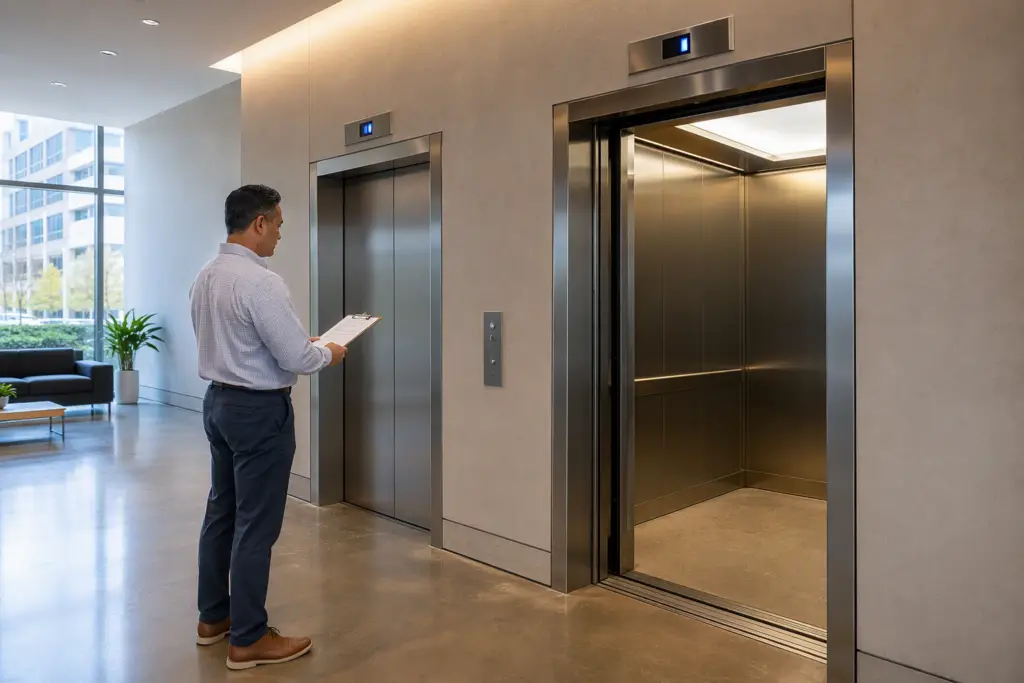
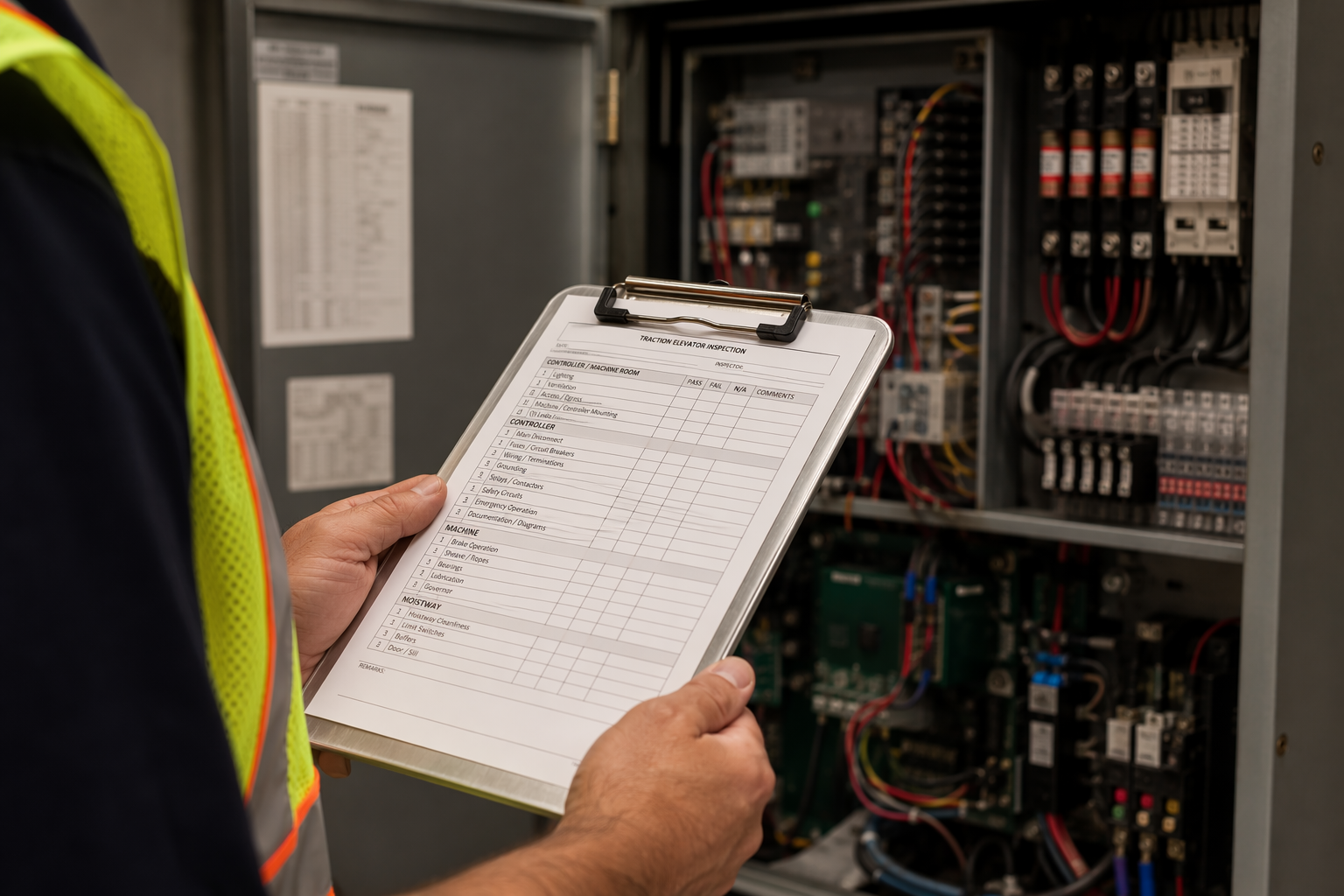
A thorough elevator compliance inspection is not a simple visual walkthrough. A qualified inspector working under the applicable AHJ requirements typically examines the following systems and components:
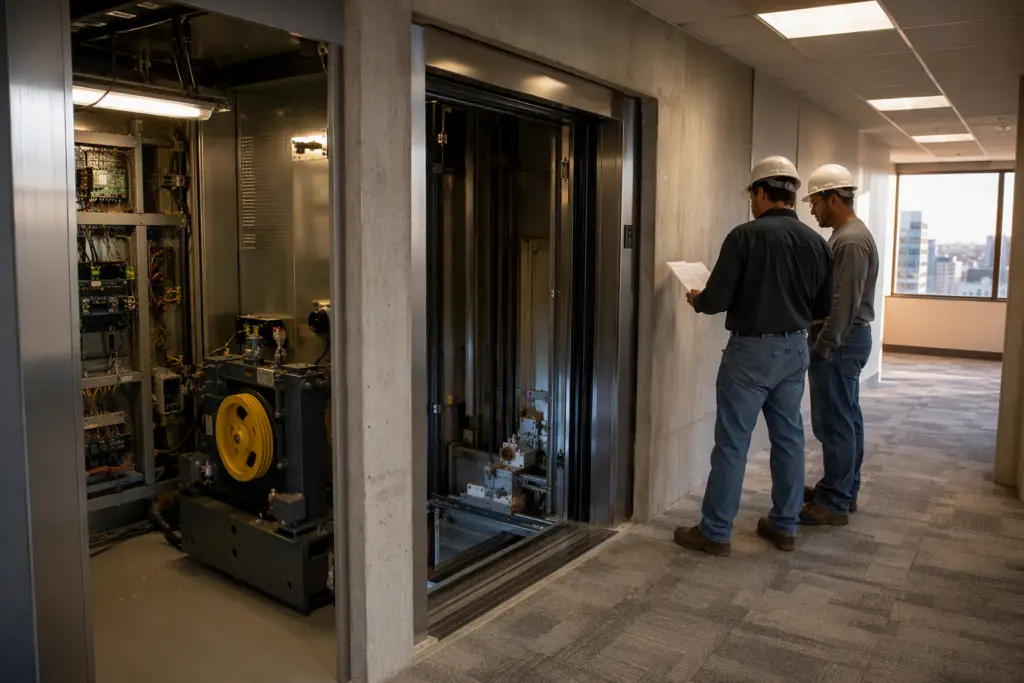
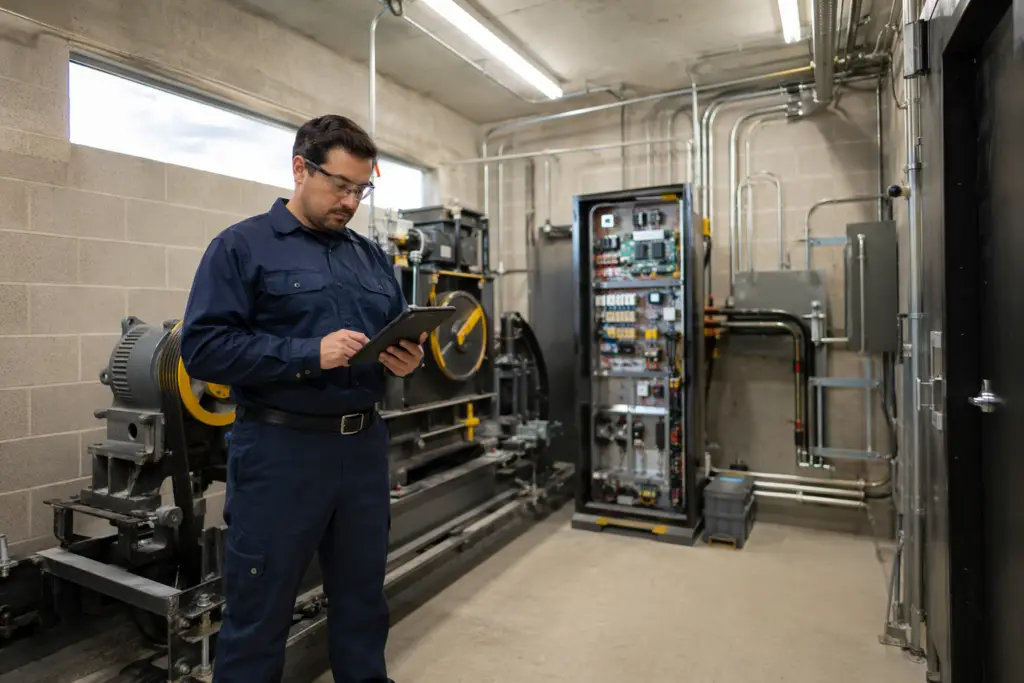
- Hoistway and machine room conditions, including lighting, clearances, and fire ratings
- Car and counterweight safeties, governor, and overspeed protection
- Electrical controls, wiring, and emergency lighting
- Door operators, interlocks, and closing force compliance
- Emergency communication systems (telephone or two-way communication)
- Capacity and load ratings posted in car
- Hydraulic fluid containment systems (for hydraulic units)
- Pit conditions, including sump pump, lighting, and stop switch
- Seismic requirements, where applicable by local code
- ADA-related accessibility features (control heights, Braille, audible indicators)
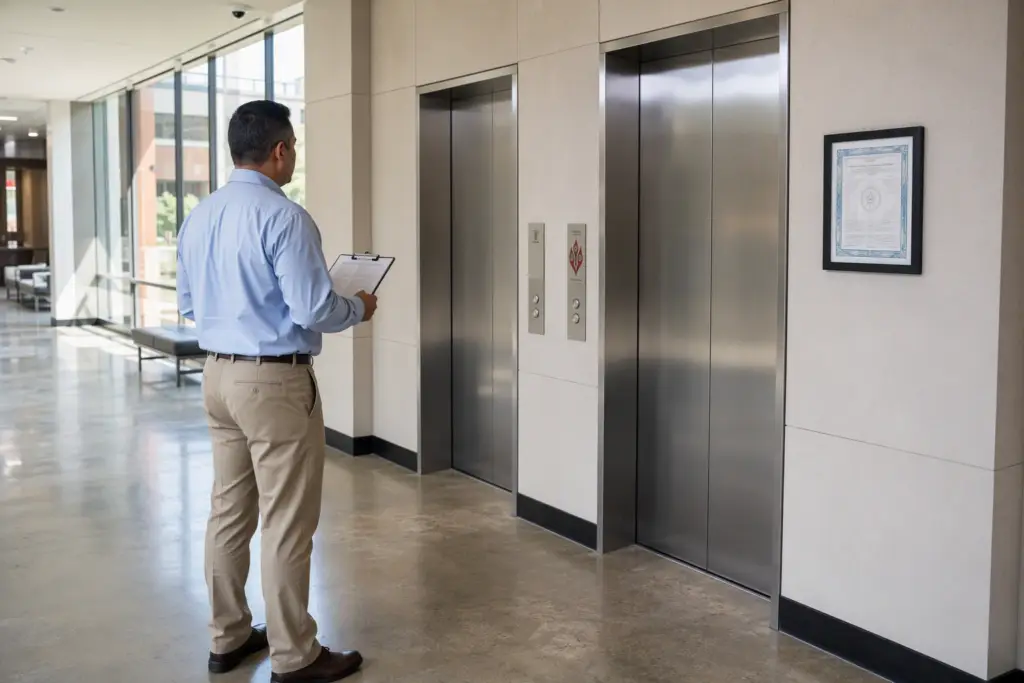
After inspection, the AHJ issues either a Certificate of Inspection (allowing continued operation) or a violation notice requiring corrective action within a defined timeframe.
How Much Does Elevator Code Compliance Cost?
Compliance costs vary widely depending on the age of the equipment, the jurisdiction’s adopted code edition, and the gap between current equipment condition and what the code requires. It is not accurate or useful to state a single national figure, because costs are driven by highly localized factors. What typically drives compliance expenditure includes:
- Age of the elevator: Older elevators (pre-1990s) are more likely to require upgrades to meet current code editions, particularly around door reopening devices, pit lighting, and emergency communication systems.
- Type of violation: A documentation deficiency (missing posted certificate) has a negligible remediation cost. A failed governor or deteriorated hydraulic cylinder represents a significant capital expenditure.
- Jurisdiction-specific mandates: Some states have enacted mandatory modernization requirements that apply when an elevator reaches a certain age or when substantial work is performed, regardless of whether a violation has been cited.
- ADA retrofit requirements: Bringing an older elevator’s controls, signage, and door timing into ADA compliance adds cost beyond the mechanical safety scope.
- Category 5 testing logistics: The five-year full-load, full-speed test for traction elevators often requires temporary shutdown and specialist equipment, making it a notable line item in a compliance budget.
Building owners are best served by obtaining a current condition assessment before budgeting for compliance work, rather than relying on national average figures that may not reflect local code editions or equipment-specific conditions.
Frequently Asked Questions: Elevator Safety Code Compliance
What is the ASME A17.1 code and why does it matter?
The ASME A17.1 Safety Code for Elevators and Escalators is the model standard that defines the minimum design, construction, installation, operation, inspection, testing, maintenance, alteration, and repair requirements for elevators and escalators in the United States and Canada. It matters because virtually every U.S. state and most municipalities adopt it as the legal baseline — meaning violations of ASME A17.1 requirements are enforceable violations of law in most jurisdictions, not merely industry recommendations.
How often must elevators be inspected by law?
Inspection frequency is set by the Authority Having Jurisdiction (AHJ), which is typically a state elevator safety bureau or a local building department. Most jurisdictions require at minimum an annual inspection aligned with ASME A17.1 Category 1 testing requirements. Some high-density jurisdictions inspect semi-annually. Building owners should request the specific schedule from their AHJ rather than assuming a universal interval applies.
What happens if an elevator fails a compliance inspection?
When an elevator fails inspection, the AHJ issues a violation notice that typically specifies the deficiency found, the applicable code section violated, and a deadline for correction. In cases involving immediate safety hazards — such as a failed door interlock or a malfunctioning overspeed governor — the AHJ has authority to order the elevator taken out of service immediately. Continued operation of a shut-down elevator exposes the building owner to significant liability and potential criminal penalties in some jurisdictions.
Does ADA compliance apply to all elevators?
The Americans with Disabilities Act requires elevator accessibility in most multi-story public accommodations and commercial facilities. Exemptions exist for buildings with fewer than three stories or fewer than 3,000 square feet per floor in certain facility types, but the exemptions are narrower than many building owners assume. Residential buildings covered by the Fair Housing Act have parallel but distinct accessibility requirements. Any elevator serving the public in a covered facility must meet ADA Standards for Accessible Design, which address door width, control placement and Braille labeling, audible floor signals, and more.
What is an Authority Having Jurisdiction (AHJ) and how does it affect compliance?
An AHJ is the governmental body — state elevator safety division, city building department, or similar agency — that has legal authority to enforce elevator codes within its territory. The AHJ determines which edition of ASME A17.1 applies locally, licenses inspectors, issues Certificates of Inspection, and enforces violations. Because AHJs operate independently, compliance requirements can differ meaningfully between cities or counties within the same state. Building owners operating in multiple jurisdictions must track requirements separately for each location.
What is a Certificate of Inspection and is it required to be posted?
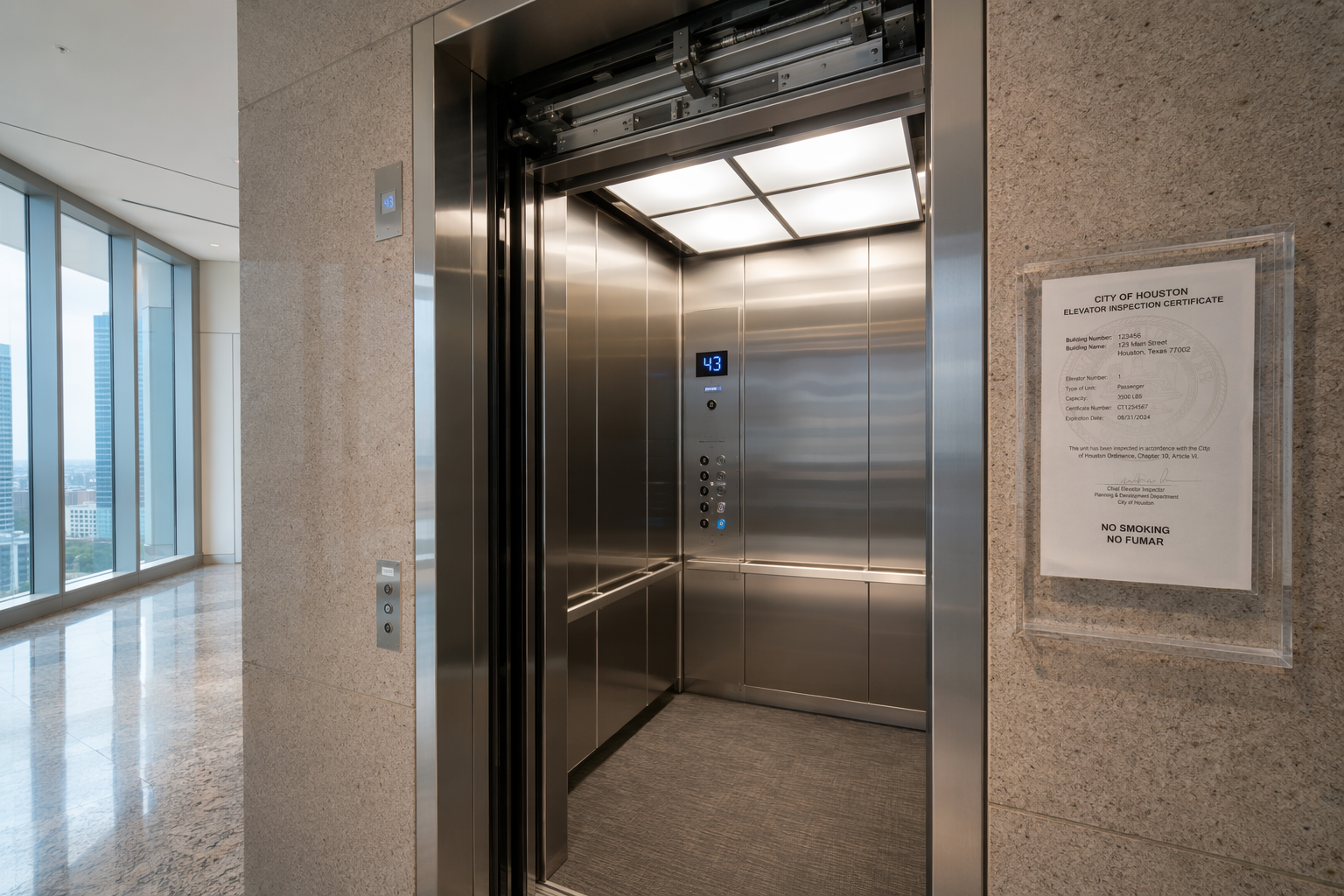
A Certificate of Inspection (sometimes called a Certificate of Operation) is the document issued by the AHJ confirming that the elevator passed its most recent required inspection. In the vast majority of U.S. jurisdictions, this certificate is required to be posted inside the elevator car and must be current. An expired or missing certificate is itself a citable violation in most states, independent of the mechanical condition of the equipment.
What are the most common elevator compliance violations?
While violation data varies by jurisdiction, the deficiencies most commonly cited across U.S. elevator safety programs fall into these categories:
- Expired or missing Certificate of Inspection
- Inoperative emergency lighting or communication system
- Door closing force or timing out of specification
- Pit lighting, stop switch, or drainage deficiencies
- Overdue Category 1 or Category 5 testing
- Missing or illegible load capacity posting
- Machine room temperature or access violations
- Non-compliant or missing firefighter service (Phase I and Phase II recall)
How do OSHA regulations relate to elevator safety compliance?
OSHA requirements intersect with elevator safety primarily in workplace and construction contexts. OSHA’s construction standards address material and personnel hoists used on job sites, and OSHA’s general industry standards reference ASME standards for certain equipment categories. For commercial building owners, OSHA becomes directly relevant when building employees operate or work adjacent to elevators, when construction or modernization work is underway, or when a workplace injury investigation involves elevator equipment. OSHA citations related to elevator conditions can compound AHJ violations in a non-compliance situation.
What is the difference between elevator maintenance and elevator compliance?
Maintenance refers to the ongoing service activities — lubrication, adjustments, parts replacement — performed to keep equipment operating reliably. Compliance refers to meeting specific code-defined standards and documentation requirements that are verified by an independent inspector. Good maintenance practices strongly support compliance outcomes, but they are not the same thing. An elevator can be well-maintained yet still be out of compliance if required tests were not performed on schedule, if documentation is incomplete, or if a code edition update introduced new requirements that the equipment has not yet been upgraded to meet.
What should a building owner do immediately after receiving a violation notice?
- Read the violation notice carefully and identify the specific code section cited and the correction deadline.
- Determine whether the AHJ has ordered the elevator out of service or allowed continued operation pending correction.
- If the elevator is ordered out of service, notify building occupants immediately and arrange accessible alternative access for individuals with disabilities in compliance with ADA obligations.
- Contact a qualified elevator maintenance contractor to assess the cited deficiency and provide a scope of corrective work.
- Obtain a written corrective action plan and timeline from the contractor to present to the AHJ if requested.
- Document all corrective work performed, including parts replaced, tests conducted, and technician records.
- Schedule and complete any required re-inspection by the AHJ before the stated deadline.
- Retain all inspection records, test results, and certificates for the minimum retention period required by your jurisdiction — typically at least five years.
Industry Trends in Elevator Safety Compliance: 2025–2026
Several meaningful shifts are reshaping the elevator compliance landscape heading into 2025 and 2026, and building owners and facility managers should be tracking them:
Remote Monitoring and Predictive Maintenance Integration: Regulatory bodies and AHJs are increasingly open to recognizing continuous remote monitoring data as a supplemental compliance tool. While monitoring does not replace required periodic inspections, it provides real-time visibility into equipment performance that can identify precursor conditions before they become violations. The 2025–2026 period is expected to see more jurisdictions formalize how remote monitoring data can be incorporated into maintenance records.
Code Edition Adoption Lag: ASME publishes updated editions of A17.1 on a regular cycle, but state and local adoption significantly lags publication. As of 2026, many jurisdictions are operating under editions that are one or two cycles behind the current published standard. Building owners planning major modernizations should verify whether their AHJ has adopted newer editions, because modernization projects frequently trigger requirements to bring the entire elevator into compliance with the currently adopted edition — not just the components being altered.
Increased Enforcement Activity: Multiple state elevator safety programs have expanded inspection staffing and digital tracking tools, resulting in more consistent enforcement of inspection deadlines and violation response timelines. Building owners who previously operated with expired certificates in low-enforcement environments are finding that tolerance is decreasing.
Sustainability and Modernization Intersection: Building owners pursuing energy efficiency upgrades are discovering that machine room-less (MRL) and variable-frequency drive (VFD) modernizations, while primarily driven by energy goals, also bring older equipment closer to current ASME A17.1 compliance standards. This convergence is making the compliance and sustainability business cases mutually reinforcing in upgrade planning.
Seismic Code Applicability Expansion: In regions with recognized seismic risk, local amendments to ASME A17.1 seismic requirements are being revisited following updated hazard mapping. Building owners in affected regions should assess whether their existing equipment meets the seismic requirements of the currently adopted local code edition.
How to Choose an Elevator Compliance Service Provider
Not all elevator service contractors approach compliance with the same rigor. When evaluating a service provider for compliance-related work, building owners should consider:
- Familiarity with the local AHJ: A provider experienced in the specific jurisdiction understands which code edition is adopted locally, how the AHJ conducts inspections, and what documentation is expected.
- Written documentation practices: A compliance-focused contractor provides detailed maintenance logs, test results, and records that satisfy AHJ documentation requirements and protect the building owner in the event of an incident.
- Scope of testing capabilities: Category 5 testing, hydraulic pressure testing, and governor testing require specific equipment and coordination. Verify that the contractor can perform all required periodic tests, not just routine maintenance visits.
- ADA compliance knowledge: Contractors who understand ADA accessibility standards alongside mechanical safety codes provide more comprehensive compliance support.
- Transparent violation response: A trustworthy provider communicates clearly when deficiencies are found rather than deferring findings to avoid difficult conversations.
AmeriTex Elevator brings a data-driven approach to elevator safety code compliance, combining thorough condition assessments with documentation practices designed to support building owners through inspection, violation response, and ongoing compliance maintenance. AmeriTex Elevator serves commercial and residential clients with the technical rigor that modern compliance enforcement demands.
Compliance Documentation: What Records to Keep and for How Long
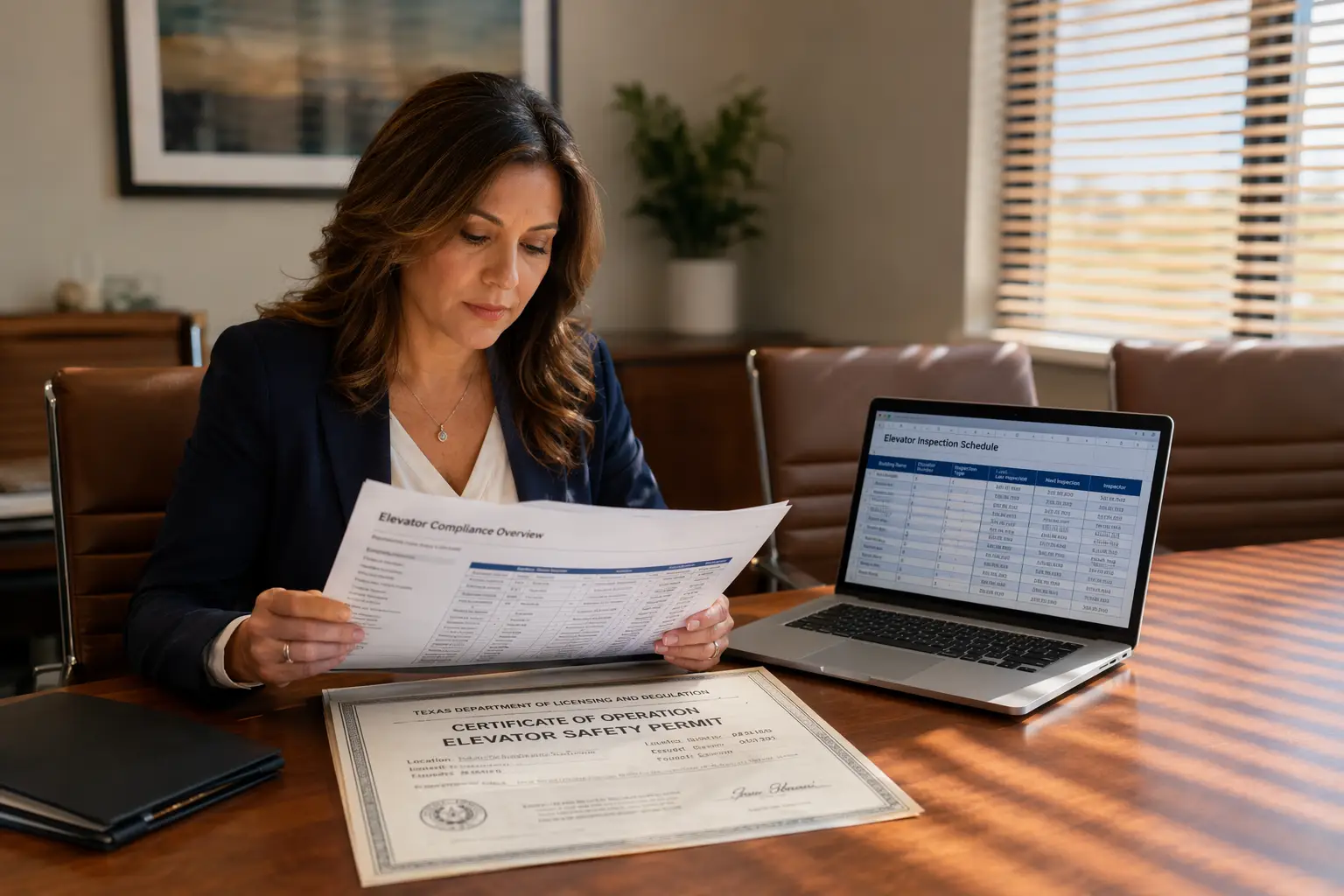
Proper recordkeeping is an underappreciated element of elevator compliance. Required documentation typically includes:
- Current Certificate of Inspection (must be posted in the car in most jurisdictions)
- Maintenance log records from the service contractor, including dates, technician identification, and work performed
- Periodic test reports for each required category (Category 1, Category 5, hydraulic tests)
- Alteration permits and inspection approvals for any modification work
- Violation notices received and corrective action records
- Emergency recall (firefighter service) test records
Retention requirements vary by jurisdiction but typically range from three to five years for maintenance records and longer for alteration permits. In the event of a personal injury claim related to an elevator, comprehensive historical records are a critical element of the building owner’s legal defense. Gaps in records are frequently cited by plaintiffs as evidence of inadequate oversight.
Summary: Elevator Safety Code Compliance Essentials
Elevator safety code compliance is a continuous obligation, not a one-time event. The ASME A17.1 Safety Code for Elevators and Escalators sets the national baseline, local AHJs enforce and may exceed it, ADA standards add accessibility requirements, and OSHA regulations apply in workplace contexts. Building owners who treat compliance proactively — through timely inspections, accurate documentation, and responsive corrective action — face substantially lower risk of liability, fines, and unplanned shutdowns than those who respond reactively.
The 2025–2026 environment is one of increasing enforcement consistency and growing complexity as newer code editions are adopted by more jurisdictions. Partnering with a service provider who understands this landscape at the local level is not optional — it is the practical foundation of a defensible compliance program.
Get a Free Elevator Compliance Assessment
Compliance requirements differ by jurisdiction, equipment type, and code edition — and the cost of non-compliance far exceeds the cost of staying current. AmeriTex Elevator provides thorough, data-driven elevator assessments to help building owners understand exactly where their equipment stands relative to current code requirements.
Contact AmeriTex Elevator for a free elevator assessment: 866-679-4313