Elevator Inspection Requirements and Permit Timelines in San Diego, California
For building owners, property managers, and facility directors in San Diego County, understanding exactly what the state requires — and when — is the foundation of legal operation and liability management. This page walks through California’s inspection mandate, the permit process, what inspectors evaluate, how timelines work in practice, and what the 2025–2026 regulatory environment means for conveyance owners in Southern California.
What Agency Governs Elevator Inspections in San Diego?
California elevator regulation is a state-level function. The California Department of Industrial Relations (DIR), through its Division of Occupational Safety and Health (DOSH) — commonly referred to as Cal/OSHA — holds jurisdiction over elevators, escalators, dumbwaiters, and other conveyances throughout the state, including all of San Diego County. Local city building departments in San Diego do not conduct elevator inspections independently; they defer to the state’s permitting and inspection framework for conveyances.
The governing federal technical standard that California adopts and enforces by reference is the ASME A17.1 Safety Code for Elevators and Escalators for new installations and the ASME A17.3 Safety Code for Existing Elevators and Escalators for units already in service. These codes set the technical benchmarks — clearances, load ratings, door timing, safety device function — that California inspectors use as their evaluation criteria.
Workplace safety obligations for elevator-related worker hazards fall additionally under OSHA federal standards, and any elevator serving the public must comply with accessibility requirements under the Americans with Disabilities Act (ADA).
How Often Are Elevators Required to Be Inspected in California?

California law requires that permitted elevators and conveyances be inspected at regular intervals by a Certified Competent Conveyance Inspector (CCCI). The inspection frequency is determined by the type and use classification of the conveyance:
- Passenger and freight elevators in commercial and residential occupancies are generally subject to periodic inspections on an annual cycle under California’s conveyance inspection program.
- Escalators and moving walks follow a similar periodic inspection schedule.
- Hydraulic elevators require inspection of hydraulic system components, including underground cylinders where applicable, on intervals specified in the adopted edition of ASME A17.1.
- Conveyances in high-occupancy or high-risk environments may be subject to more frequent oversight at the inspector’s or agency’s discretion.
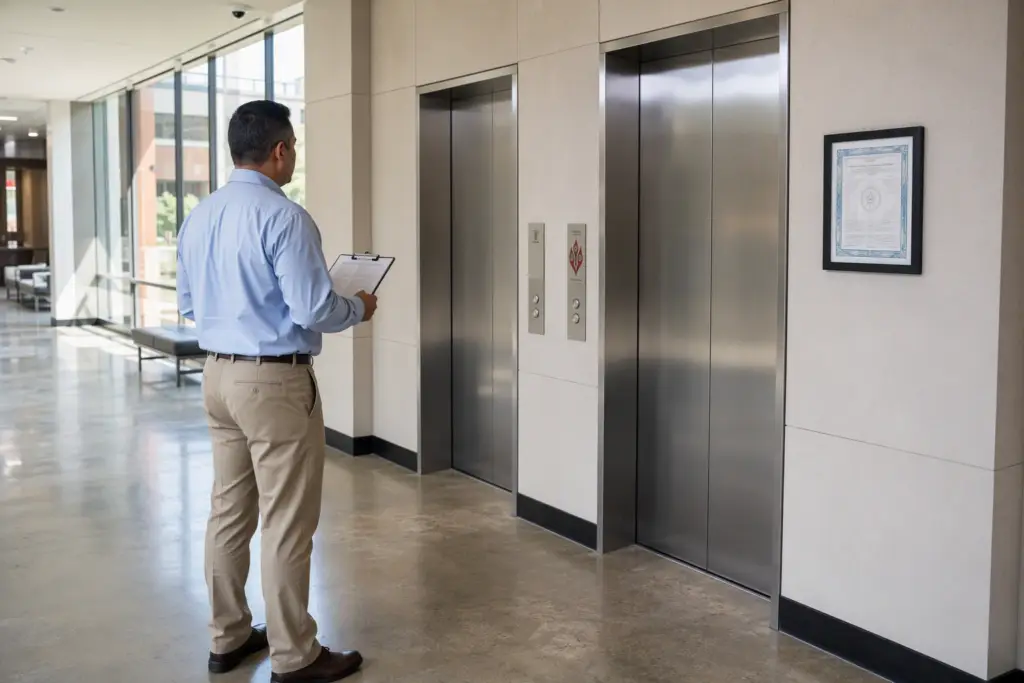
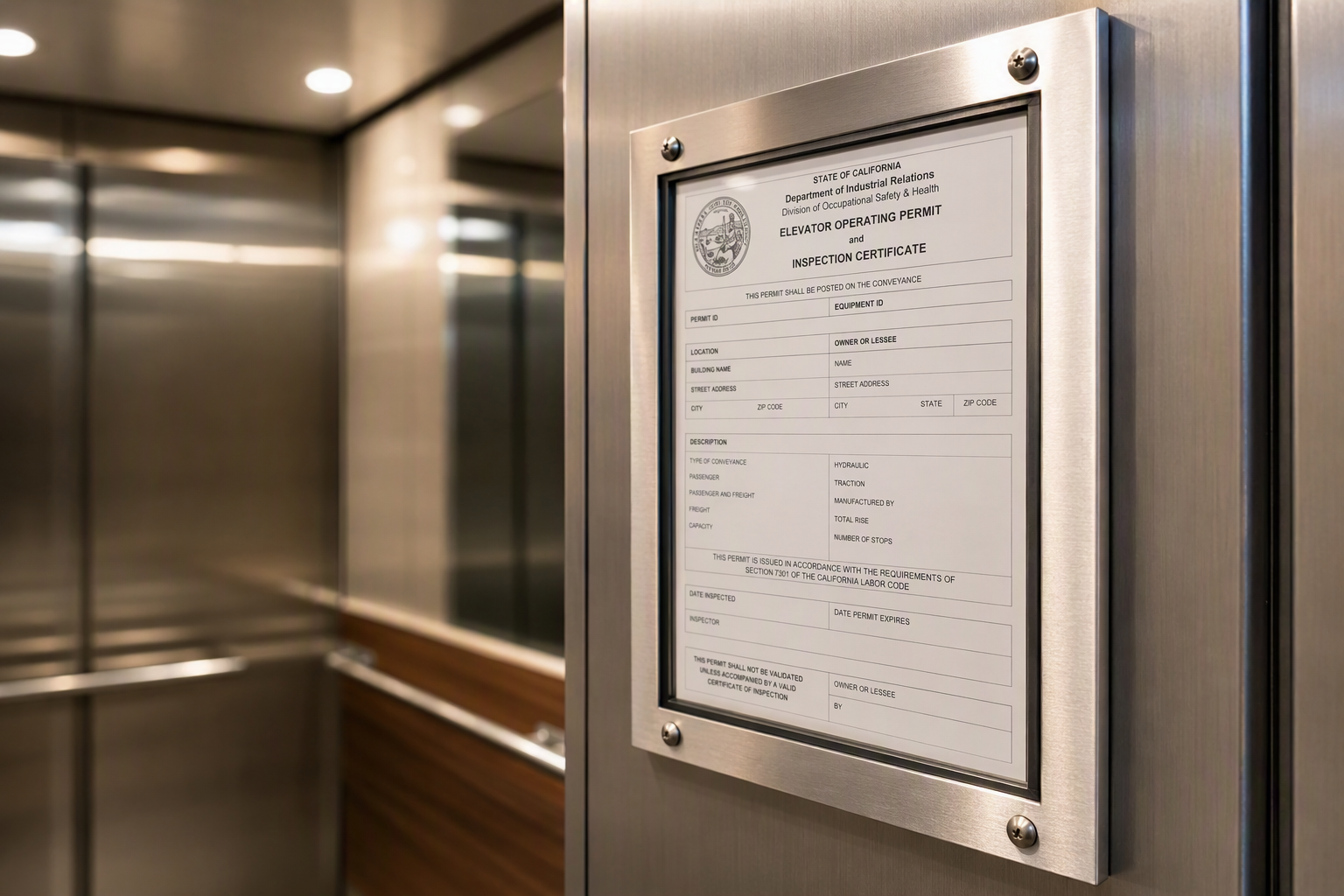
In addition to periodic inspections, acceptance inspections are required before any new elevator can be placed into service, and alteration inspections are required whenever permitted modifications are made to an existing conveyance. No elevator may legally operate in California without a current, valid permit posted in the car.
What Is the Elevator Permit Process in San Diego, California?
The California DIR conveyance permit process applies uniformly statewide, including in San Diego. The following steps describe the standard pathway for a new elevator installation or a major alteration:
- Submit permit application to the California DIR. The elevator owner or licensed elevator contractor submits a permit application — along with construction drawings, specifications, and applicable fees — to the California Department of Industrial Relations’ Elevator Unit prior to beginning any work.
- Plan review and approval. The DIR reviews submitted documents for compliance with the adopted edition of ASME A17.1 and California-specific amendments. This review period varies based on application volume and project complexity.
- Construction or installation phase. Once plans are approved, work may commence. The installing contractor must notify the DIR at defined milestones to allow for any required interim inspections.
- Acceptance inspection scheduling. Upon completion, the contractor or owner requests an acceptance inspection from a CCCI. The inspector evaluates the completed conveyance against applicable code requirements.
- Deficiency correction (if applicable). If the inspector identifies deficiencies, the contractor must correct them and a re-inspection is scheduled before the permit is issued for operation.
- Operating permit issuance. Once the elevator passes its acceptance inspection, the DIR issues an operating permit. The permit certificate must be posted inside the elevator car at all times.
- Ongoing periodic inspections. From that point forward, the elevator must pass periodic inspections on the required schedule to maintain its operating permit in good standing.
What Do California Elevator Inspectors Evaluate?
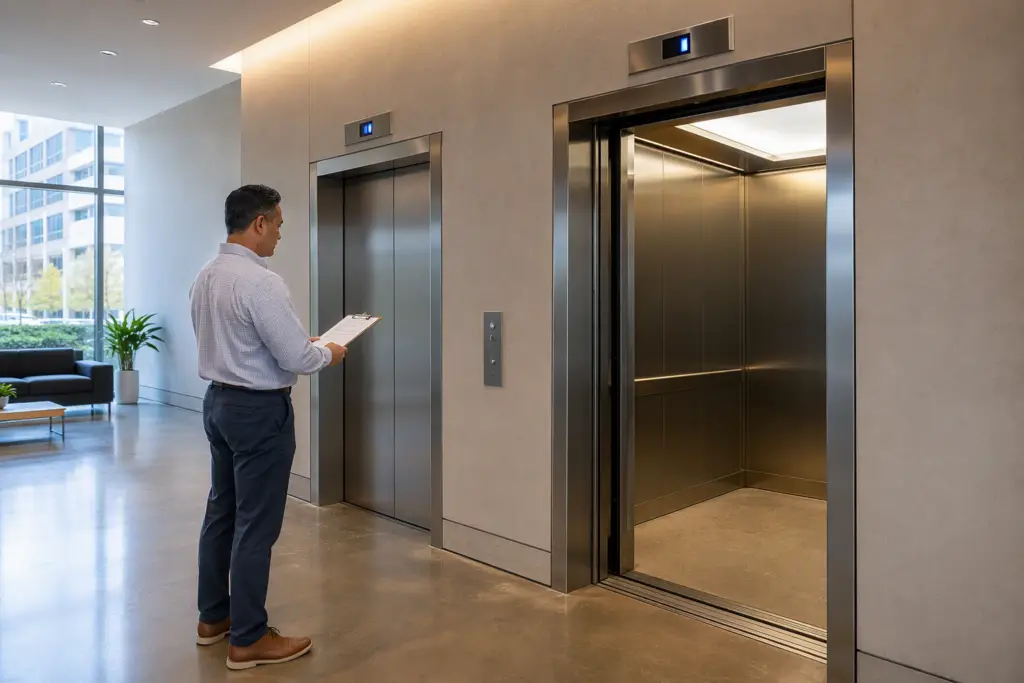
During a periodic or acceptance inspection in California, a Certified Competent Conveyance Inspector examines the conveyance against the requirements of the applicable edition of ASME A17.1 or A17.3. Key areas of evaluation typically include:
- Safety devices: Governor, safeties, buffers, and oil buffers are tested to verify proper function under load and overspeed conditions.
- Door and gate systems: Door closing force, timing, reopening devices, and interlocks are evaluated to prevent entrapment and shear hazards.
- Electrical systems: Wiring, control systems, and emergency lighting are reviewed for code compliance.
- Structural components: The car, sling, guide rails, and suspension system are checked for wear, corrosion, and structural integrity.
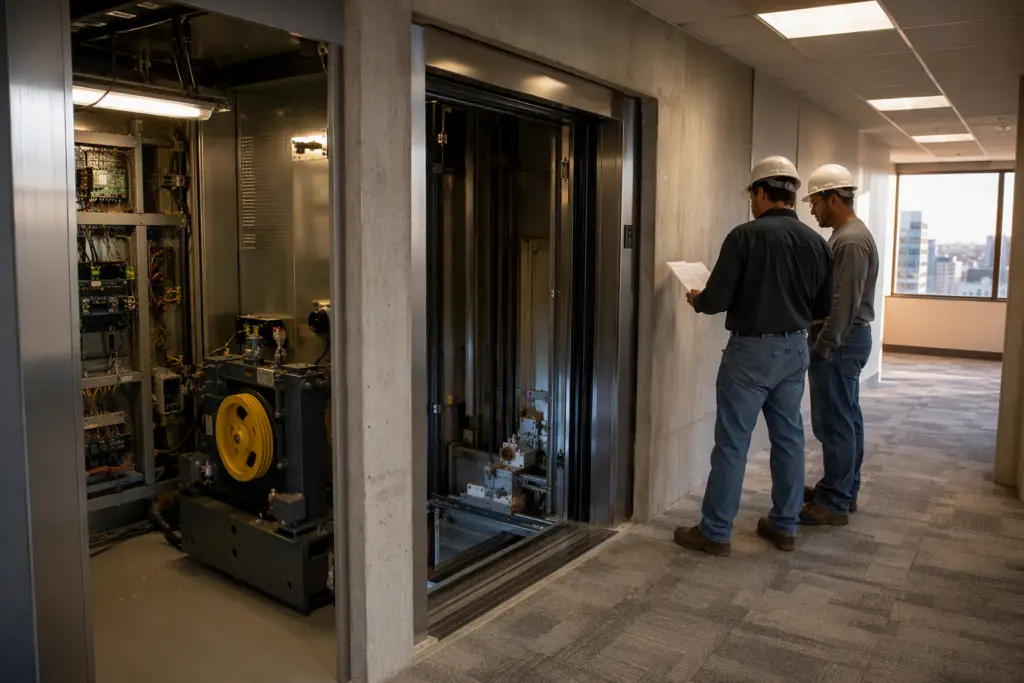
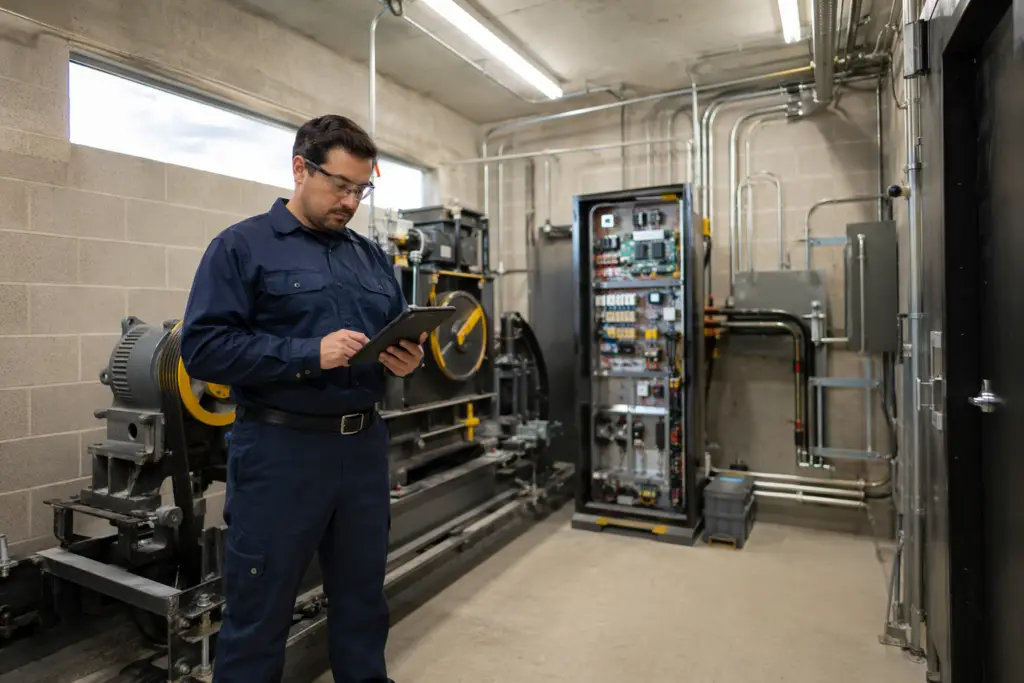
- Machine room and pit conditions: Clearances, housekeeping, lighting, ventilation, and firefighting equipment are assessed.
- Load testing: Elevators may be subject to load tests at acceptance or after major alterations.
- ADA accessibility features: Control heights, audible signals, and Braille markings are evaluated against ADA Standards for Accessible Design requirements where applicable.
- Emergency communication: Two-way communication systems are tested for operability, a requirement reinforced under both ASME standards and ADA guidance.
What Happens If an Elevator Fails Inspection in California?
When a California elevator inspection results in identified deficiencies, the response depends on the severity of the finding:
- Imminent hazard conditions trigger an immediate order to take the elevator out of service until the condition is corrected and a re-inspection is completed. The inspector has authority to prohibit operation on the spot.
- Non-imminent deficiencies are documented in a written notice, and the owner is given a defined correction period. Failure to correct deficiencies within the required timeframe can result in permit suspension.
- Permit suspension or revocation means the elevator cannot legally operate. Continued operation of a suspended conveyance exposes the building owner to significant liability under both California law and potential OSHA enforcement if workers are involved.
Building owners in San Diego who receive a deficiency notice should engage a qualified elevator contractor promptly to document a correction plan, as responsiveness to the DIR typically influences how the agency treats subsequent timelines.
How Long Does the Elevator Permit and Inspection Process Take in San Diego?
Permit and inspection timelines in California vary based on several qualitative factors that building owners should plan around:
- Plan review duration depends on the completeness and complexity of submitted documents. Applications with missing specifications or non-standard configurations take longer to review.
- Inspector availability in Southern California can affect scheduling, particularly during periods of high construction activity in San Diego County.
- Correction cycles add time when deficiencies require re-inspection. Projects with well-prepared documentation and experienced contractors tend to move through the process more efficiently.
- Alteration permits for existing elevators generally follow a shorter timeline than full new-installation permits, depending on the scope of work.
Building owners planning new installations, significant modernizations, or any work requiring a permit should factor these timelines into project schedules and avoid assuming that inspections can be scheduled on short notice.
What Records Must San Diego Building Owners Keep for Elevator Compliance?
California requires that elevator owners maintain documentation demonstrating compliance history. Standard recordkeeping expectations include:
- The current operating permit, posted inside the elevator car at all times
- The most recent inspection report or certificate of inspection
- Maintenance logs documenting service, lubrication, adjustments, and repairs
- Records of any alteration permits and associated inspection clearances
- Documentation of any deficiency notices and the corrections made in response
These records are subject to review by the California DIR and, in the event of an incident, by legal counsel, insurers, and courts. Gaps in documentation are a common source of liability exposure for building owners.
Does ADA Compliance Affect Elevator Inspections in California?
The Americans with Disabilities Act establishes accessibility requirements that apply to elevators serving the public in commercial and multi-tenant residential settings. While ADA compliance is technically separate from Cal/OSHA’s elevator inspection program, the two interact in practice:
- Any alteration to an elevator that triggers a permit may require the installation to be brought into conformance with current ADA Standards for Accessible Design.
- Features such as call button height, door hold-open time, audible floor announcements, and Braille markings are ADA requirements that a thorough inspection process will flag when out of compliance.
- California’s own accessibility standards under the California Building Code may impose requirements that are equal to or exceed federal ADA minimums.
Owners planning elevator modernizations in San Diego should evaluate ADA compliance as part of the overall scope, not as an afterthought, to avoid triggering a second round of required modifications.
What Are the Elevator Inspection and Compliance Trends for 2025–2026 in California?
The California elevator regulatory environment is evolving in ways that San Diego building owners should monitor qualitatively:
- Increased enforcement focus: California’s DIR has signaled ongoing emphasis on conveyance compliance as part of broader workplace safety initiatives, with particular attention to high-occupancy residential and mixed-use buildings.
- Modernization pressure from aging equipment: A significant portion of California’s installed elevator inventory was installed decades ago. As equipment ages, the gap between existing conditions and current ASME A17.3 retrofit requirements widens, increasing the likelihood that periodic inspections surface deficiencies.
- Digital maintenance records: The industry is moving toward digital maintenance logging and remote monitoring systems. While not yet universally mandated in California, these tools are becoming a best-practice expectation that positions owners well during inspections.
- Supply chain impacts on repair timelines: Replacement parts for older elevator models can face extended lead times, making proactive maintenance planning more important for owners who want to avoid protracted out-of-service periods following a failed inspection.
- ADA enforcement activity: Federal ADA enforcement and private litigation around elevator accessibility remain active in California, giving owners an additional compliance motivation beyond state inspection requirements alone.
What Is the Difference Between a Periodic Inspection and an Acceptance Inspection in California?
These two inspection types serve fundamentally different purposes in California’s conveyance compliance framework:
- An acceptance inspection occurs after a new elevator is installed or after a permitted alteration is completed. Its purpose is to verify that the work was performed in accordance with the approved plans and the applicable edition of ASME A17.1 before the unit is placed into service for the first time.
- A periodic inspection occurs at recurring intervals throughout the elevator’s operating life. Its purpose is to verify that the existing installation continues to meet the standards of ASME A17.3 for existing elevators and that no deterioration or unauthorized modifications have compromised safety.
Both types result in either a clearance to operate or a deficiency notice. Neither replaces the other — owners cannot use a recent acceptance inspection to defer a periodic inspection requirement.
Who Can Perform Elevator Maintenance and Repairs to Maintain California Compliance?
California requires that elevator maintenance, repair, and alteration work be performed by licensed elevator mechanics working for a licensed elevator contractor. This licensing requirement exists separately from the inspection function, which must be performed by a Certified Competent Conveyance Inspector.
Building owners who allow unlicensed individuals to perform elevator work — even minor adjustments — risk voiding their operating permit and creating significant liability exposure if an incident occurs. Maintenance contracts with qualified firms are the standard risk management approach for commercial and residential properties in San Diego.
What Are Common Causes of Elevator Inspection Failures in California?
Based on the technical requirements of ASME A17.1 and A17.3, common categories of findings during California elevator inspections include:
- Door reopening device failures or door closing force exceeding code limits
- Inadequate pit conditions — water intrusion, improper lighting, missing or damaged pit stop switches
- Safety device function failures during testing, including governor and buffer deficiencies
- Machine room conditions — improper storage, inadequate lighting, ventilation deficiencies
- Worn or improperly tensioned suspension ropes
- Non-functional or inadequate emergency lighting or communication systems
- Missing or expired permits not posted in the car
- Hydraulic system oil leaks or deteriorated hydraulic cylinder conditions
Proactive maintenance programs are the most reliable way to prevent these findings from appearing on an inspection report.
How Does AmeriTex Elevator Support San Diego Compliance Requirements?
AmeriTex Elevator serves building owners and property managers in California as a data-driven elevator service provider focused on regulatory compliance, maintenance management, and permit support. The firm’s approach emphasizes documentation discipline — maintaining the maintenance logs, deficiency response records, and permit histories that California’s DIR expects building owners to produce.
For San Diego properties navigating the California permit process, alteration inspections, or periodic inspection preparation, AmeriTex Elevator provides assessments designed to identify conditions likely to generate deficiency findings before an inspector arrives — reducing out-of-service time and permit complications. The firm’s work is grounded in the technical requirements of ASME A17.1 and A17.3, the ADA, and California’s conveyance regulatory framework.
Get a Free Elevator Compliance Assessment for Your San Diego Property
Permit timelines, inspection schedules, and deficiency correction windows move faster than most building owners expect. Don’t wait for a failed inspection to learn where your elevator stands with California’s requirements.
Contact AmeriTex Elevator for a free elevator assessment: 866-679-4313
Need elevator service you can rely on? AmeriTex Elevator is ready to help.