Elevator Inspection Requirements and Permit Timelines for Healthcare Facilities in San Antonio and Austin, Texas
Hospitals, outpatient clinics, assisted living facilities, and medical office buildings depend on reliable, code-compliant vertical transportation every hour of every day. A failed elevator in a healthcare setting is not just an inconvenience — it is a patient safety issue and a regulatory liability. Understanding exactly what inspections are required, who performs them, and how long the permit process takes in San Antonio and Austin is essential for any healthcare facility manager or compliance officer operating in Texas.
—
What Are the Core Elevator Inspection Requirements for Healthcare Facilities in Texas?

In Texas, elevator inspections are administered under the authority of the Texas Department of Insurance (TDI), which regulates elevator safety statewide through its Elevator Safety Program. All elevators in healthcare facilities — including hospital patient lifts, service elevators, and accessible vertical platform lifts — must be inspected at intervals established under Texas law and consistent with the ASME A17.1 Safety Code for Elevators and Escalators and ASME A17.3 Safety Code for Existing Elevators and Escalators.
Key requirements for healthcare facilities specifically include:
- Annual periodic inspections by a TDI-licensed elevator inspector or a qualified third-party inspection agency approved by TDI.
- Periodic testing requirements, which include full-load safety tests and hydraulic pressure tests on intervals defined under ASME A17.1.
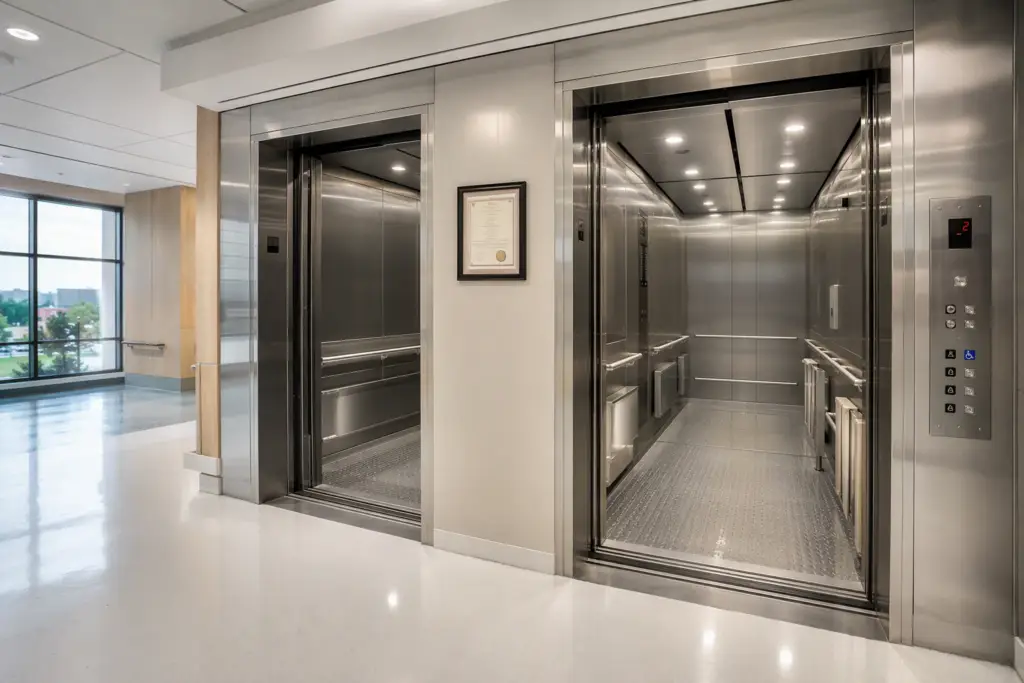
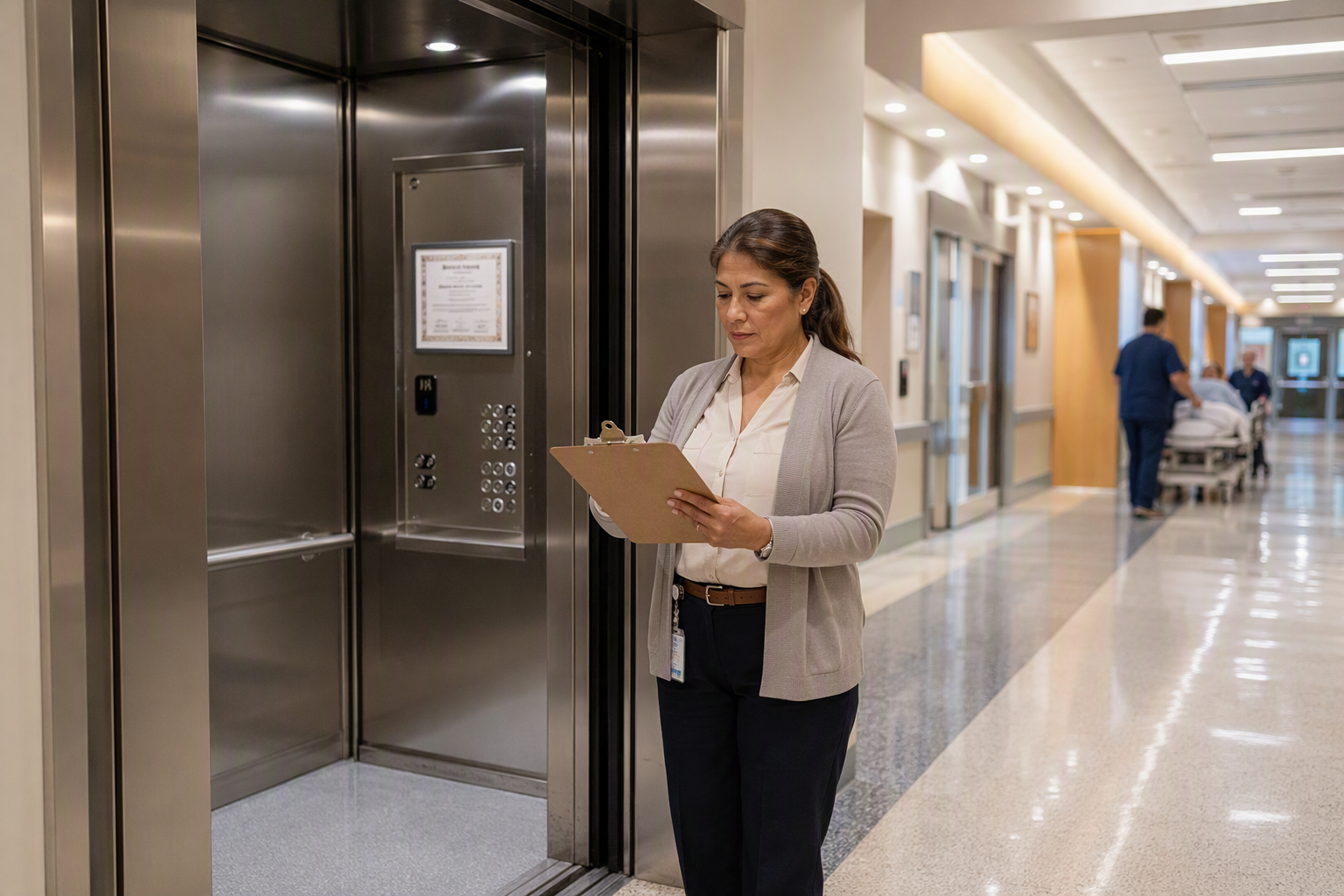
- Certificate of Compliance posting in the elevator cab — a certificate must be current and visible at all times.
- Modernization and alteration permits required any time modifications are made to elevator equipment, controls, or safety systems.
- ADA compliance for all elevators serving public or patient-accessible areas, governed by the Americans with Disabilities Act, including proper door timing, audible signals, Braille floor indicators, and minimum cab dimensions.
AmeriTex Elevator works directly with healthcare facility managers in San Antonio and Austin to ensure all inspection documentation, testing records, and certificates remain current and audit-ready.
—
What Is the Permit Timeline for Elevator Work in San Antonio, Texas?
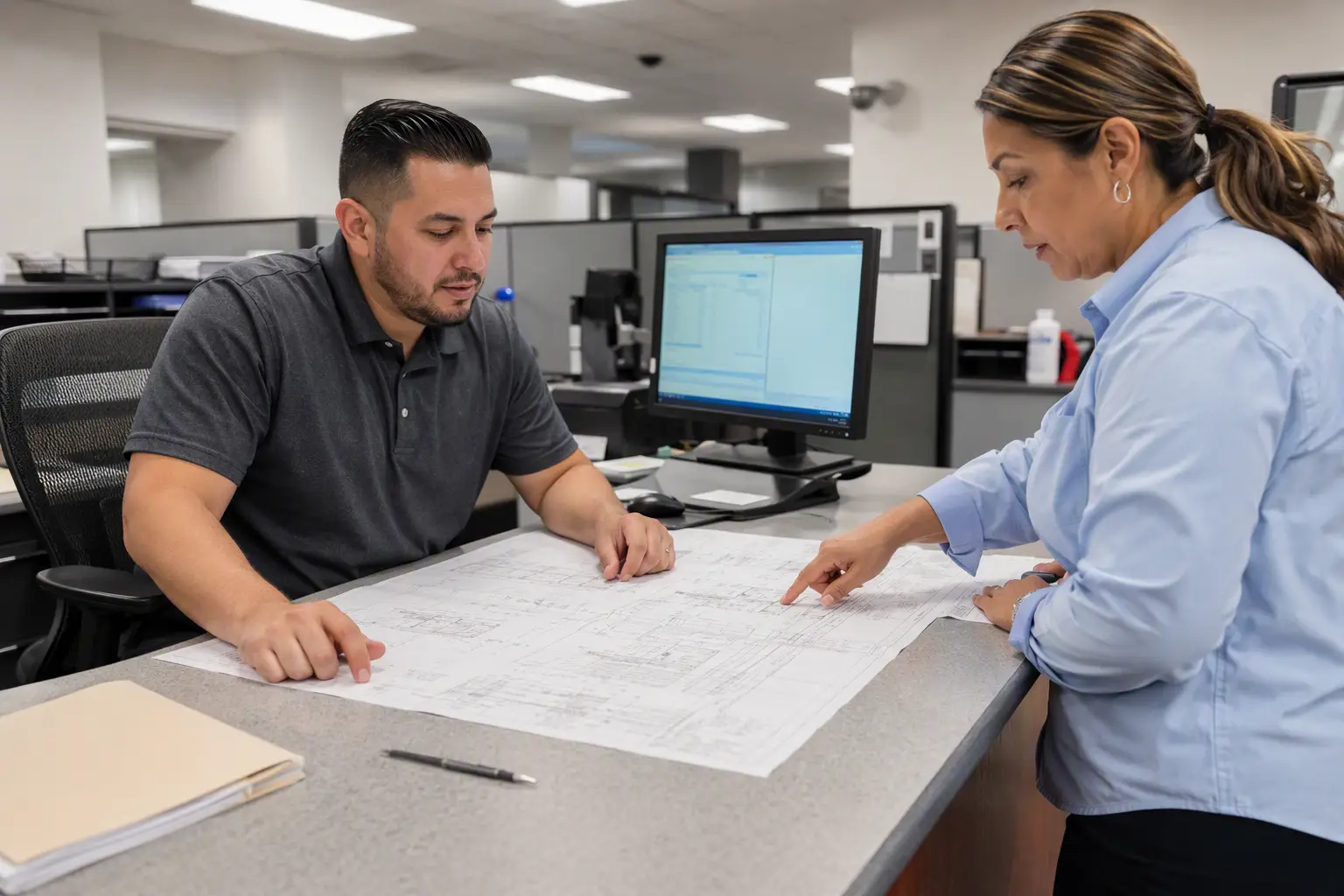
In San Antonio, elevator permits are issued through the City of San Antonio Development Services Department, which serves as the local Authority Having Jurisdiction (AHJ). The timeline for permit issuance depends on the scope of work:
- Submit permit application — including equipment specifications, contractor license information, and engineering drawings where required — to the Development Services Department.
- Plan review — standard commercial plan reviews in San Antonio typically take several business days to several weeks depending on application volume and project complexity. Healthcare projects with significant mechanical modifications may require additional review cycles.
- Permit issuance — once plans are approved, the permit is issued and work may begin.
- Inspection scheduling — upon completion of work, an inspection must be scheduled with TDI or the AHJ. In San Antonio, this typically requires advance notice of several business days.
- Certificate of Compliance issuance — following a passed inspection, the Certificate of Compliance is issued and must be posted in the elevator cab before the unit is returned to service.
Healthcare facilities undergoing new construction or major renovations should build permit and inspection timelines into project schedules well in advance to avoid operational delays.
—
What Is the Permit Timeline for Elevator Work in Austin, Texas?
In Austin, elevator permits fall under the jurisdiction of Austin Development Services Department (DSD). The process follows a similar framework to San Antonio but has its own procedural timeline:
- Create or log into an Austin Build + Connect (AB+C) account and submit a permit application with all required documentation.
- Plan review assignment — Austin DSD assigns the application to a plan reviewer. Express review options may be available for straightforward projects; complex healthcare facility projects may require standard or extended review.
- Applicant response period — if reviewers issue comments, applicants must respond and resubmit. This cycle can add time to the overall timeline.
- Permit issuance — permits are issued digitally through AB+C once all reviews are cleared.
- Final inspection request — upon project completion, request a final inspection through AB+C. Scheduling windows vary by workload and season.
- Certificate of Occupancy and Compliance — issued after a successful final inspection, allowing the elevator to return to service.
Healthcare facilities in Austin should anticipate that projects requiring structural or electrical modifications may take longer due to multi-discipline review requirements. AmeriTex Elevator assists clients in preparing complete permit packages to reduce back-and-forth with the AHJ.
—
Which ASME Codes Apply to Healthcare Elevators in Texas?
The two primary ASME codes governing elevator safety in Texas healthcare environments are:
- ASME A17.1 Safety Code for Elevators and Escalators — applies to new installations and governs design, construction, operation, inspection, testing, maintenance, alteration, and repair of elevators.
- ASME A17.3 Safety Code for Existing Elevators and Escalators — applies to elevators already in service and establishes retroactive safety requirements that facilities must meet during modernizations or when violations are identified during inspection.
Healthcare facilities operating older elevator equipment should pay particular attention to ASME A17.3, as inspectors will identify deficiencies and require remediation within specified timelines. Ignoring these findings can result in the elevator being taken out of service — a serious operational risk in a clinical environment.
—
What ADA Requirements Apply to Elevators in Hospitals and Medical Facilities?
Under the Americans with Disabilities Act, elevators in healthcare facilities serving the public or patients must meet specific accessibility standards. These include:
- Minimum cab dimensions sufficient to accommodate a wheelchair and attendant.
- Door reopening devices that respond to obstructions without contact.
- Audible and visible floor indicators inside and outside the cab.
- Raised and Braille characters on hall call buttons and within the cab.
- Leveling accuracy to ensure the cab floor is flush with the landing to within a defined tolerance — critical for patients in wheelchairs or on hospital gurneys.
- Accessible controls positioned within reach ranges specified under ADA guidelines.
Hospitals and healthcare organizations that receive federal funding or serve the public have a legal obligation to maintain ADA compliance on all elevators. Non-compliance can expose facilities to civil complaints and federal enforcement action.
—
What OSHA Requirements Are Relevant to Healthcare Elevator Maintenance?
The Occupational Safety and Health Administration (OSHA) establishes workplace safety requirements that affect elevator maintenance personnel in healthcare settings. These include lockout/tagout (LOTO) procedures when servicing elevator equipment to prevent unexpected energization. Healthcare facilities must ensure that any elevator service contractor operating on-site follows OSHA-compliant energy control procedures — a requirement that AmeriTex Elevator builds into every service visit.
—
How Often Must Healthcare Facility Elevators Be Inspected in Texas?
Texas requires periodic inspections for all elevators, with annual inspections as the standard interval for most elevator types. In addition to the annual periodic inspection, specific tests — such as safety device tests and hydraulic pressure tests — are required on intervals defined within ASME A17.1. Healthcare facilities should maintain a compliance calendar that tracks:
- Annual inspection due dates for each elevator unit.
- Periodic safety test schedules (which differ by elevator type and drive system).
- Certificate of Compliance expiration dates.
- Maintenance log requirements — a written maintenance record must be kept for each elevator.
—
What Happens If a Healthcare Elevator Fails Inspection in Texas?
- Inspector documents deficiencies in a written inspection report and notifies the building owner or facility manager.
- Elevator may be ordered out of service if safety-critical deficiencies are identified — meaning no passengers until repairs are completed.
- Facility contacts a licensed elevator contractor to perform the required repairs or corrections.
- Repairs are completed and documented, with parts and work records available for review.
- Re-inspection is requested through TDI or the AHJ to confirm all deficiencies have been corrected.
- Certificate of Compliance is reinstated following a successful re-inspection, allowing the elevator to return to service.
In a hospital or medical facility, an out-of-service elevator can disrupt patient transport, pharmacy logistics, and critical equipment movement. Proactive maintenance — not reactive repair — is the most effective strategy for avoiding this scenario.
—
What Are the Unique Elevator Compliance Considerations for Assisted Living and Long-Term Care Facilities?
Assisted living facilities and long-term care centers in Texas operate under additional oversight beyond standard commercial elevator requirements. These facilities may be subject to inspection by the Texas Health and Human Services Commission (HHSC) during licensure surveys, which can include a review of elevator maintenance records, current certificates of compliance, and evidence of timely corrective action on inspection deficiencies. Facilities should be prepared to produce complete maintenance logs and inspection history on request.
—
Questions Your Inspector Will Ask
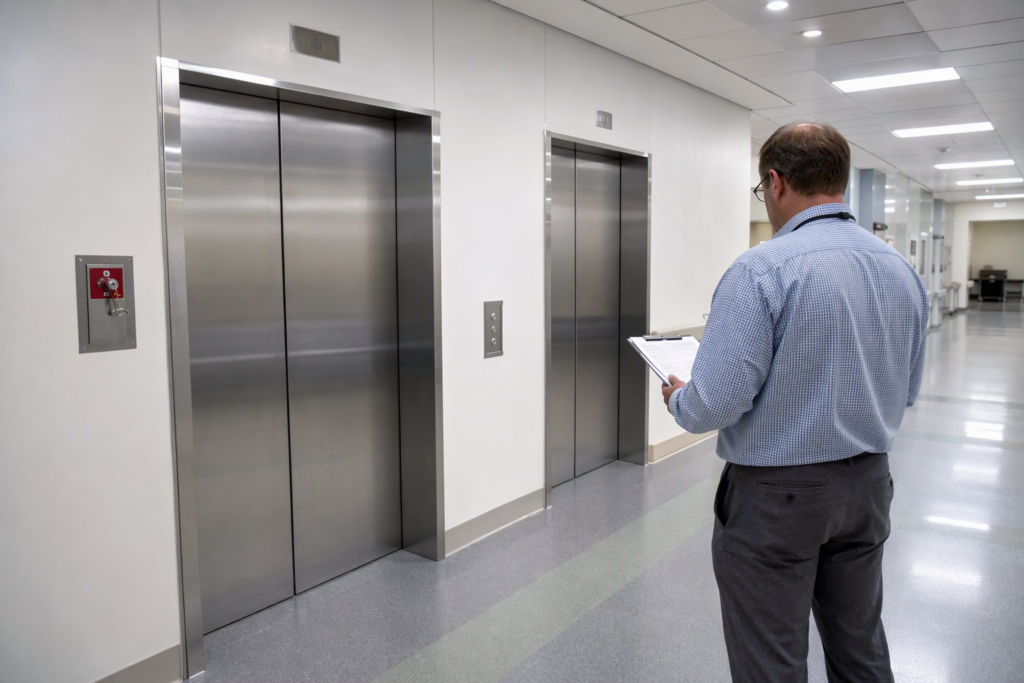
Healthcare facility managers should be prepared to answer the following during an elevator inspection or compliance audit:
- Is the Certificate of Compliance current and posted in the cab? Inspectors will check that the certificate has not expired and is displayed in the required location.
- Is there a written maintenance log for each elevator? Maintenance records must document routine lubrication, adjustments, repairs, and parts replacements with dates.
- When was the last periodic safety test performed? Inspectors will verify that required tests have been conducted on schedule and that results are documented.
- Have any alterations been made to the elevator since the last inspection? Unpermitted modifications are a common violation — all alterations require prior permit approval.
- Are door safety devices functioning correctly? Door reopening devices, edge sensors, and electronic safety edges must be operational and tested.
- Is the machine room secured and properly ventilated? Access must be restricted to authorized personnel, and the room must meet code-required temperature and lighting conditions.
- Are all required emergency features functional? This includes emergency lighting, emergency communication systems, and alarm bells — all critical in a healthcare setting where a trapped passenger may need assistance quickly.
- Is leveling accuracy within acceptable tolerances? Misleveling is a trip-and-fall hazard for ambulatory patients and a barrier for wheelchair users — inspectors measure this directly.
—
How Can a Healthcare Facility Prepare for an Elevator Inspection?
- Compile and organize all maintenance logs and service records for the preceding inspection period.
- Confirm that the Certificate of Compliance is posted, legible, and has not expired.
- Test emergency lighting, communication systems, and door safety devices in advance.
- Verify that the machine room is clean, secured, properly lit, and accessible only to authorized personnel.
- Confirm that no unpermitted modifications have been made to any elevator unit.
- Contact your elevator service provider to conduct a pre-inspection walk-through and correct any identified deficiencies before the official inspection date.
AmeriTex Elevator provides pre-inspection assessments for healthcare clients in San Antonio, Austin, Houston, and Dallas to help facilities identify and resolve potential deficiencies before a formal inspection occurs.
—
Does AmeriTex Elevator Service Healthcare Facilities in San Antonio and Austin?
Yes. AmeriTex Elevator provides elevator maintenance, inspection support, modernization, and repair services for healthcare facilities across San Antonio, Austin, Houston, and Dallas, Texas, as well as Los Angeles and San Diego, California. Healthcare clients benefit from a service partner who understands the regulatory environment — including TDI requirements, ASME code standards, ADA obligations, and the operational realities of a clinical setting where elevator downtime has direct patient care consequences.
—
Schedule a Free Elevator Assessment for Your Healthcare Facility
Keeping patients, staff, and visitors safe depends on elevators that are compliant, well-maintained, and ready for every inspection. Whether your facility is preparing for an upcoming TDI inspection, planning a modernization project, or simply needs a compliance review, our team is ready to help.
Contact AmeriTex Elevator for a free elevator assessment: 866-679-4313
Need elevator service you can rely on? AmeriTex Elevator is ready to help.