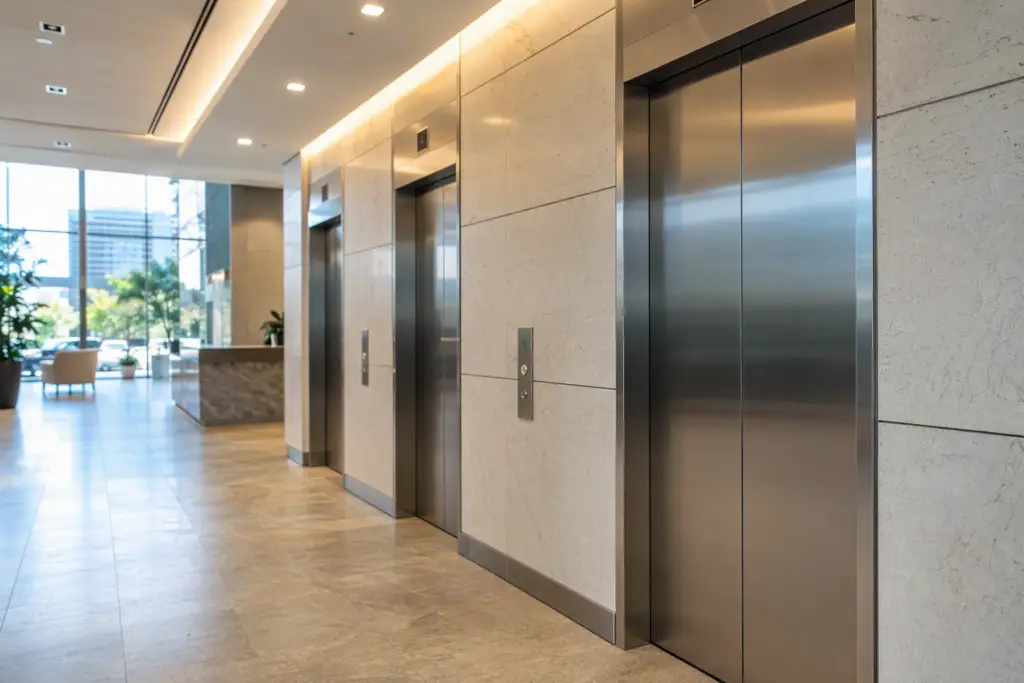
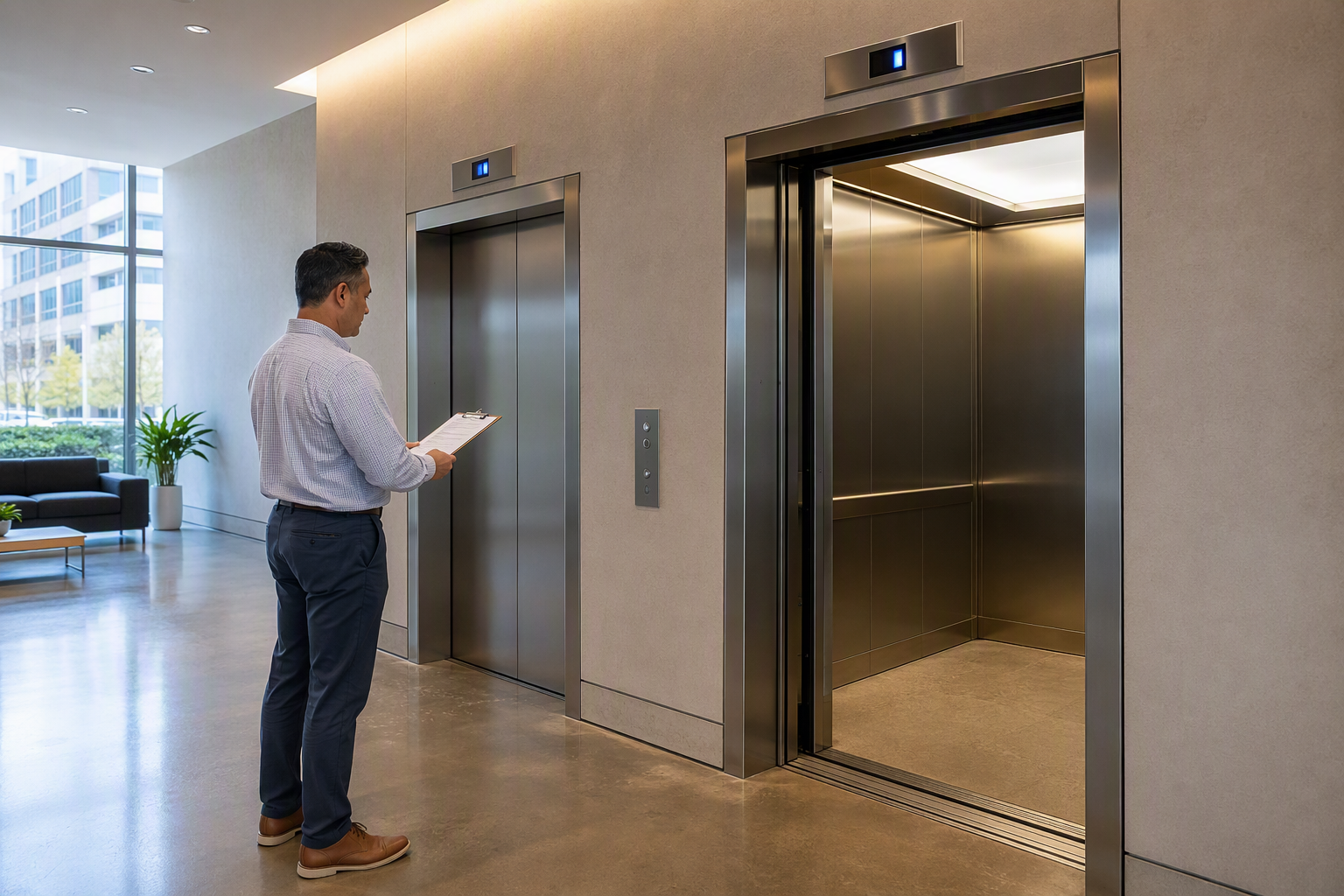
Elevator modernization in Texas and California is not simply a matter of upgrading aging equipment — it is a compliance event that activates overlapping federal accessibility standards, national safety codes, and state-level inspection requirements. Building owners, property managers, and facility directors who understand what triggers compliance obligations, what upgrades are mandatory versus optional, and how to sequence the work will avoid costly delays, failed inspections, and ADA litigation exposure.
This guide covers the full decision landscape: which codes apply, what equipment must be upgraded, how ADA requirements layer on top of safety codes, and how to evaluate vendors capable of navigating both Texas and California regulatory environments.
What Codes Govern Elevator Modernization in Texas and California?
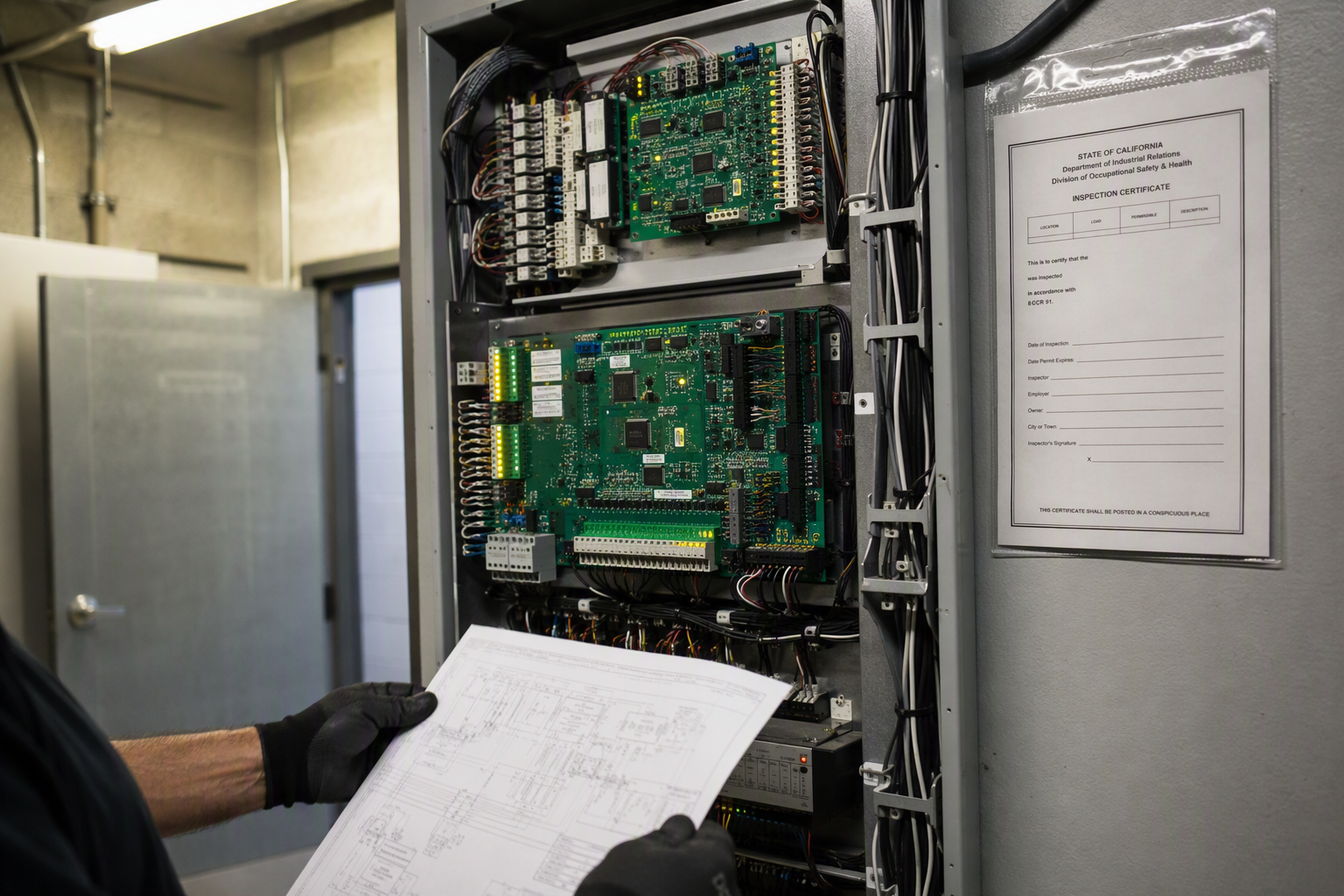
Two primary code frameworks govern elevator modernization in both states:
- ASME A17.1 Safety Code for Elevators and Escalators — The foundational installation standard. When modernization work is performed, the upgraded components must meet the edition of A17.1 adopted by the local AHJ.
- ASME A17.3 Safety Code for Existing Elevators and Escalators — Governs retroactive safety requirements for existing equipment. This is the code most directly triggered by modernization projects.
- ADA Standards for Accessible Design — Federal civil rights law administered by the U.S. Department of Justice. ADA compliance obligations apply to places of public accommodation and commercial facilities regardless of when modernization occurs, though the “path of travel” rule links renovation scope to accessibility upgrade obligations.
In Texas, the Texas Department of Insurance (TDI) administers elevator safety through its Elevator Safety Program. In California, the Division of Occupational Safety and Health (Cal/OSHA) Elevator, Ride, and Tramway Unit has jurisdiction over most elevators, while some local jurisdictions (such as the City of Los Angeles) operate their own elevator inspection programs. Building owners must identify their specific AHJ before beginning any modernization work.
What Triggers a Full Code Compliance Review During Modernization?
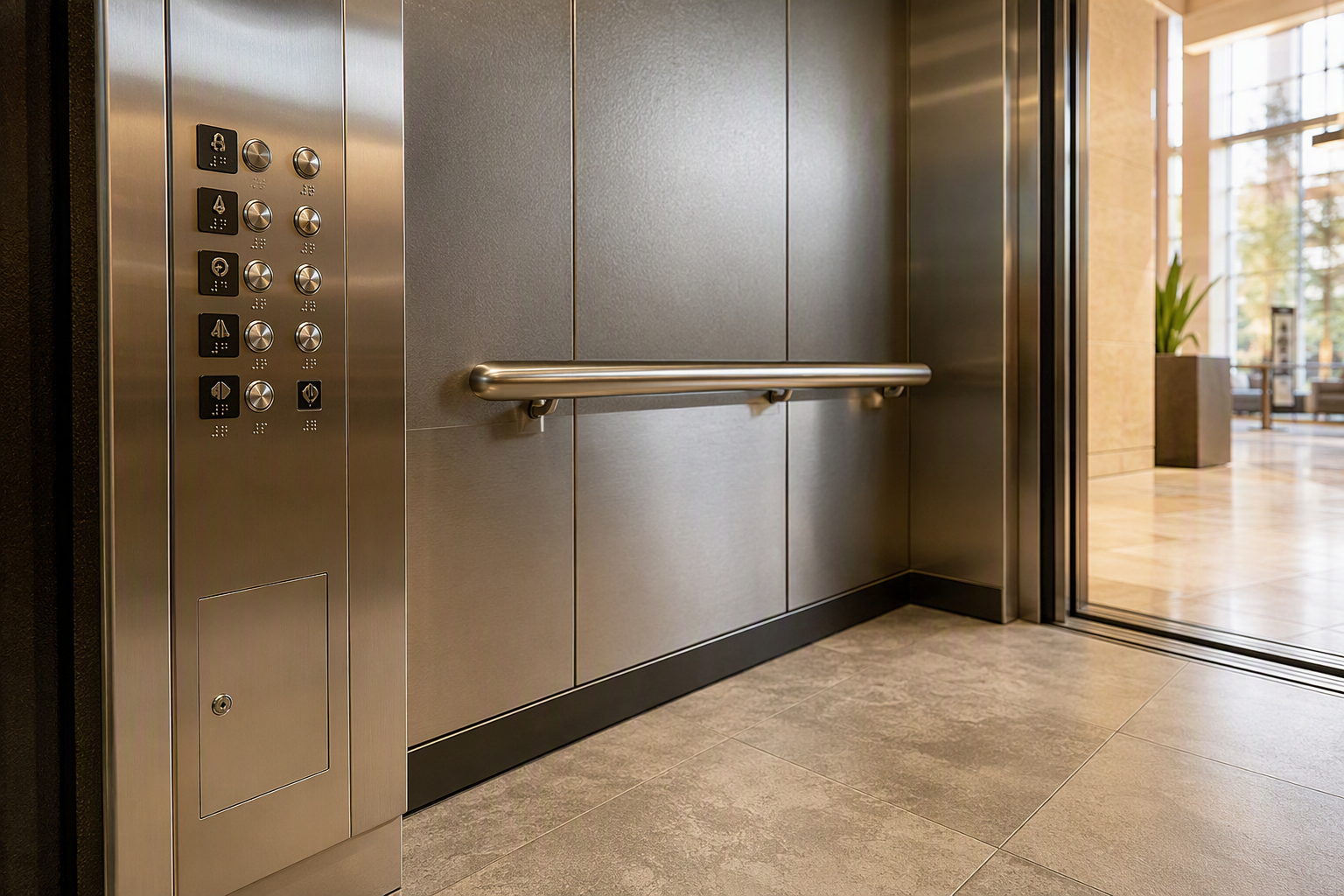
Not every repair triggers a full modernization compliance review. The scope of work determines the compliance obligations. Generally, the following events trigger a formal review under ASME A17.3 and ADA path-of-travel rules:
- Replacement of the elevator controller or drive system
- Replacement or significant alteration of the car enclosure, cab interior, or doors
- Changes to the machine room, hoistway, or pit equipment
- Alterations to safety devices, buffers, or governor systems
- Any work classified as “modernization” rather than routine maintenance by the AHJ
Under ADA guidance, when a commercial facility undergoes alterations affecting “primary function areas,” the owner must also make the path of travel — including elevator access — accessible to the extent that the cost of accessibility work does not exceed a disproportionate share of the overall project cost. Building owners should consult ADA technical guidance at ADA.gov to understand current disproportionality thresholds and obligations.
What Safety Upgrades Does ASME A17.3 Require for Existing Elevators?
ASME A17.3 establishes retroactive safety requirements — meaning existing elevators must be brought into compliance over time, not just when new equipment is installed. Common retroactive requirements that affect older elevators in Texas and California include:
- Car door reopening devices: Doors must reopen upon contact or sensing of an obstruction.
- Emergency lighting and communication: A two-way means of communication and battery-powered emergency lighting are required in the car.
- Phase I and Phase II firefighters’ emergency operation: Elevators must be equipped with fire service recall and in-car operation capability.
- Seismic requirements (California): California’s high-seismic-activity zones impose additional retroactive seismic safety requirements for elevator equipment, buffers, and guide rail brackets. These requirements are enforced through the California Building Code and Cal/OSHA elevator regulations.
- Governor and safeties: Overspeed protection and safety devices must meet applicable A17.3 performance standards.
- Pit stop switches and lighting: Pit lighting, a stop switch, and a ladder are required for safe maintenance access.
The specific edition of A17.3 enforced depends on the edition adopted by each state and local AHJ. Building owners should confirm the adopted edition with their AHJ before scoping modernization work.
What ADA Accessibility Requirements Apply to Elevator Modernization?
The ADA Standards for Accessible Design (specifically the 2010 ADA Standards) establish detailed requirements for elevator accessibility in buildings subject to Title II (state and local government) and Title III (places of public accommodation and commercial facilities). Key requirements for existing elevators undergoing modernization include:
| Requirement Area | ADA Standard Element | Common Upgrade Needed for Older Elevators |
|---|---|---|
| Car Size | Minimum clear floor space to accommodate wheelchair turning | May require hoistway or car enclosure alteration |
| Door Width | Minimum clear door opening width | Door operator and frame replacement |
| Hall Call Buttons | Raised characters, Braille, visual signals, specific mounting height | Hall station replacement |
| Car Control Panel | Raised and Braille floor designations, accessible mounting height range | Control panel replacement or overlay |
| Floor Indicators (visual) | Visual car position indicators visible from hall | Indicator lantern upgrade |
| Audible Signals | Audible signals at each floor and at car arrival | Audible indicator system installation |
| Emergency Communication | Two-way communication usable without voice | Emergency phone system upgrade |
| Leveling | Car must level within a specified tolerance | Controller or leveling system upgrade |
Older hydraulic and traction elevators installed before the ADA’s 1990 enactment frequently fail to meet these standards, particularly for control panel height, door width, and leveling accuracy. A comprehensive modernization provides an opportunity to address all accessibility deficiencies in a single project.
How Do Costs and Timelines Compare Across Modernization Scopes?
| Modernization Scope | Typical Work Included | ADA Upgrades Triggered? | ASME A17.3 Review? | Relative Project Timeline | ROI Considerations |
|---|---|---|---|---|---|
| Cosmetic / Interior Refresh | Cab interior, flooring, lighting aesthetics | Possibly (path-of-travel rule applies if primary function area affected) | Limited — if no safety systems altered | Shortest (days to weeks) | Tenant satisfaction; lower risk of triggering full compliance review |
| Partial Modernization | Controller replacement, door operators, or drive upgrade only | Yes — controller/door work activates ADA review | Yes — upgraded components must meet A17.1; retroactive A17.3 items reviewed | Moderate (weeks) | Energy savings, improved reliability, reduced service calls |
| Full Modernization | Controller, drive, doors, cab, fixtures, safety devices, roping | Yes — comprehensive ADA compliance required | Yes — full safety compliance review by AHJ | Longest (several weeks to months depending on AHJ permit timelines) | Extended equipment lifespan, lowest long-term maintenance cost, full compliance achieved |
| Seismic Retrofit (California) | Guide rail brackets, buffers, machine anchorage per CA seismic code | Depends on whether cab or door work is included | Yes — seismic requirements reviewed alongside A17.3 | Moderate to long | Risk mitigation; required for California compliance in applicable seismic zones |
Note: Specific cost figures vary by building type, elevator configuration, number of stops, local permit fees, and labor market. Building owners in Texas and California should obtain itemized proposals from qualified elevator contractors. AmeriTex Elevator provides free assessments to help owners understand scope before committing to a project.
What Is the Step-by-Step Process for Elevator Modernization Compliance in Texas or California?
- Identify your Authority Having Jurisdiction (AHJ). In Texas, contact the Texas Department of Insurance Elevator Safety Program. In California, determine whether your building falls under Cal/OSHA’s Elevator, Ride, and Tramway Unit or a local inspection authority (e.g., City of Los Angeles).
- Conduct a current condition assessment. Have a qualified elevator contractor audit the existing equipment against the currently adopted ASME A17.3 edition and the 2010 ADA Standards to identify all deficiencies.
- Define the modernization scope. Work with your contractor to determine which components will be replaced or altered, which compliance obligations are triggered, and which items can be phased.
- Obtain permits from the AHJ. Submit drawings, specifications, and permit applications before work begins. Permit timelines vary by jurisdiction and should be factored into project scheduling.
- Complete the modernization work. Licensed elevator mechanics perform installation. In Texas, work must be performed by contractors licensed under the TDI program. In California, work must be performed by appropriately licensed contractors under Cal/OSHA requirements.
- Schedule AHJ inspection and witness testing. The AHJ must inspect and witness safety tests before the elevator is returned to service. Schedule this well in advance; inspection slots can be limited.
- Obtain the Certificate of Operation or equivalent. Once the AHJ approves the installation, a new operating certificate is issued. The elevator cannot legally return to service without this certificate.
- Document ADA compliance measures. Retain documentation of ADA-compliant features installed. This supports any future ADA audit or inquiry and demonstrates good-faith compliance efforts.
How Do Texas and California Differ in Their Elevator Modernization Requirements?
| Factor | Texas | California |
|---|---|---|
| Primary State Authority | Texas Department of Insurance (TDI) — Elevator Safety Program | Cal/OSHA Elevator, Ride, and Tramway Unit (or local AHJ in select cities) |
| Seismic Requirements | Lower seismic risk in most of state; seismic upgrades generally not mandated as broadly | Significant seismic upgrade requirements apply in high-seismic-risk zones; these are among the most complex and costly California-specific compliance items |
| Inspection Frequency | Periodic inspections required; interval determined by TDI and equipment type | Annual inspections required for most elevator types; some categories have more frequent requirements |
| Local AHJ Variation | Moderate — most buildings under TDI statewide program | High — Los Angeles and some other cities operate their own programs with additional requirements |
| ADA Enforcement | Federal ADA applies statewide; Texas also has state accessibility standards (TAS) enforced by TDI for new construction and alterations | Federal ADA applies statewide; California also has the California Building Code accessibility provisions, which in some areas exceed federal ADA minimums |
| ASME Code Adoption | Adopts ASME A17.1 / A17.3; specific adopted edition confirmed through TDI | Adopts ASME A17.1 / A17.3 through California Building Code; edition and local amendments confirmed through AHJ |
Texas-specific note: Texas has its own Texas Accessibility Standards (TAS), administered by TDI, which apply to new construction and alterations in public accommodations and commercial facilities. TAS is substantially equivalent to the 2010 ADA Standards but is enforced through a state review and inspection process in addition to federal ADA obligations. Building owners in Texas should verify TAS compliance as part of any modernization project that triggers the path-of-travel rule.
Does ADA Compliance Apply to Private Residential Buildings?
The ADA’s Title III provisions apply to places of public accommodation and commercial facilities — not to purely private residential buildings. However, buildings with mixed-use occupancies, residential buildings with common areas open to the public, and federally funded housing may have accessibility obligations under the ADA, the Fair Housing Act, or Section 504 of the Rehabilitation Act. Building owners should evaluate their specific occupancy classification with qualified legal and accessibility counsel. California’s accessibility provisions under the California Building Code may also impose requirements beyond the federal ADA for certain residential occupancies.
What Are the Pros and Cons of Phased vs. Full Modernization?
| Phased Modernization | Full Modernization | |
|---|---|---|
| Pros |
|
|
| Cons |
|
|
What Happens If a Building Owner Ignores Modernization Code Requirements?
Non-compliance with ASME A17.3 safety requirements or ADA standards carries significant legal and operational risk:
- AHJ enforcement: In Texas, TDI can order an elevator out of service for safety violations. In California, Cal/OSHA has authority to issue citations and order equipment shut down. A non-operating elevator in a multi-story building creates immediate access and business continuity problems.
- ADA litigation: Title III of the ADA allows private parties to file lawsuits for accessibility violations. California has a history of active ADA-related litigation. Businesses and building owners face the risk of injunctive relief, attorney’s fees, and — under California’s Unruh Civil Rights Act — statutory damages per violation.
- Insurance implications: Elevators operating without current certificates of inspection or out of compliance with safety codes may create liability exposure that affects insurance coverage or claims outcomes.
- Permit non-compliance: Performing modernization work without AHJ permits and inspections is a violation in both Texas and California and can result in orders to undo and redo work at the owner’s expense.
How Should Building Owners Evaluate Elevator Modernization Contractors in Texas and California?
Not all elevator contractors have equal familiarity with the regulatory environments in Texas and California. When evaluating potential service providers, building owners should consider:
- Whether the contractor is licensed in the applicable state (TDI-licensed in Texas; appropriately licensed under California requirements)
- Experience navigating both ASME A17.3 compliance reviews and ADA path-of-travel assessments
- Familiarity with local AHJ permit processes in the building’s specific jurisdiction
- Ability to provide a comprehensive condition assessment before proposing scope
- Independence from a single manufacturer, which allows specification of the most appropriate equipment rather than a proprietary solution
AmeriTex Elevator is an independent, certified elevator service company operating in Texas and California. As an independent provider, AmeriTex Elevator is not tied to a single equipment manufacturer, which allows the team to recommend and install solutions based on the building’s specific compliance needs, equipment compatibility, and budget — not manufacturer incentives. AmeriTex Elevator provides free elevator assessments to help building owners understand their current compliance status before committing to a modernization scope.
What Questions Should Building Owners Ask Before Starting an Elevator Modernization Project?
- Which edition of ASME A17.1 and A17.3 has been adopted by my local AHJ?
- Does my building fall under TDI (Texas) or Cal/OSHA / local authority (California) jurisdiction?
- Will the planned scope of work trigger the ADA path-of-travel obligation?
- Are there California seismic upgrade requirements applicable to my building’s zone?
- Does my Texas project also need to meet Texas Accessibility Standards (TAS) review?
- What is the current certificate of inspection status for each elevator, and are there any outstanding violations or orders?
- Is full modernization more cost-effective than a phased approach given my building’s equipment age and condition?
- What is the realistic AHJ permit and inspection timeline in my jurisdiction, and how does that affect tenant and operations planning?
Is OSHA Involved in Elevator Modernization Compliance?
The federal Occupational Safety and Health Administration (OSHA) has jurisdiction over elevator safety as it relates to worker protection — specifically, the safety of elevator mechanics and maintenance personnel during installation, modernization, and service work. OSHA standards apply to the working conditions of the technicians performing modernization work, including lockout/tagout procedures, confined space requirements for pit work, and fall protection. Building owners should verify that any elevator contractor they engage operates in full compliance with OSHA worker safety standards.
Summary: Key Decisions for Elevator Modernization Compliance in Texas and California
- Identify your AHJ and confirm the adopted ASME code editions before scoping any work
- Evaluate whether your modernization scope triggers ADA path-of-travel obligations — and plan for full accessibility compliance in that event
- In California, account for seismic retrofit requirements specific to your seismic zone
- In Texas, verify Texas Accessibility Standards (TAS) review requirements in addition to federal ADA obligations
- Weigh phased versus full modernization based on capital availability, equipment condition, and total compliance cost
- Select an independent, state-licensed elevator contractor with demonstrated experience in both ASME A17.3 and ADA compliance work
- Never return an elevator to service after modernization work without obtaining the AHJ inspection and new certificate of operation
Get Expert Guidance for Your Texas or California Elevator Modernization
AmeriTex Elevator helps building owners in Texas and California navigate ASME A17.3 safety upgrades, ADA accessibility compliance, seismic retrofit requirements, and AHJ permit processes — from initial assessment through final inspection.
Contact AmeriTex Elevator for a free elevator assessment: 866-679-4313
Need elevator service you can rely on? AmeriTex Elevator is ready to help.