Elevator Troubleshooting Guide: What You Can Fix, What Requires Emergency Repair
Most elevator problems fall into two categories: minor operational quirks that a trained building manager can address with a structured checklist, and serious safety failures that demand a certified elevator technician immediately. Knowing which situation you are facing protects passengers, limits liability, and prevents a minor inconvenience from becoming a costly shutdown. The guidance below covers the full troubleshooting spectrum—from resetting a tripped breaker to recognizing the warning signs of a genuine emergency—based on the requirements of the ASME A17.1 Safety Code for Elevators and Escalators and applicable Texas and California regulations.
What are the most common elevator problems building managers encounter?
The most common elevator problems are door malfunctions, leveling errors, unresponsive call buttons, lighting failures, and nuisance shutdowns caused by power fluctuations—most of which have identifiable root causes that can be documented before a technician arrives.
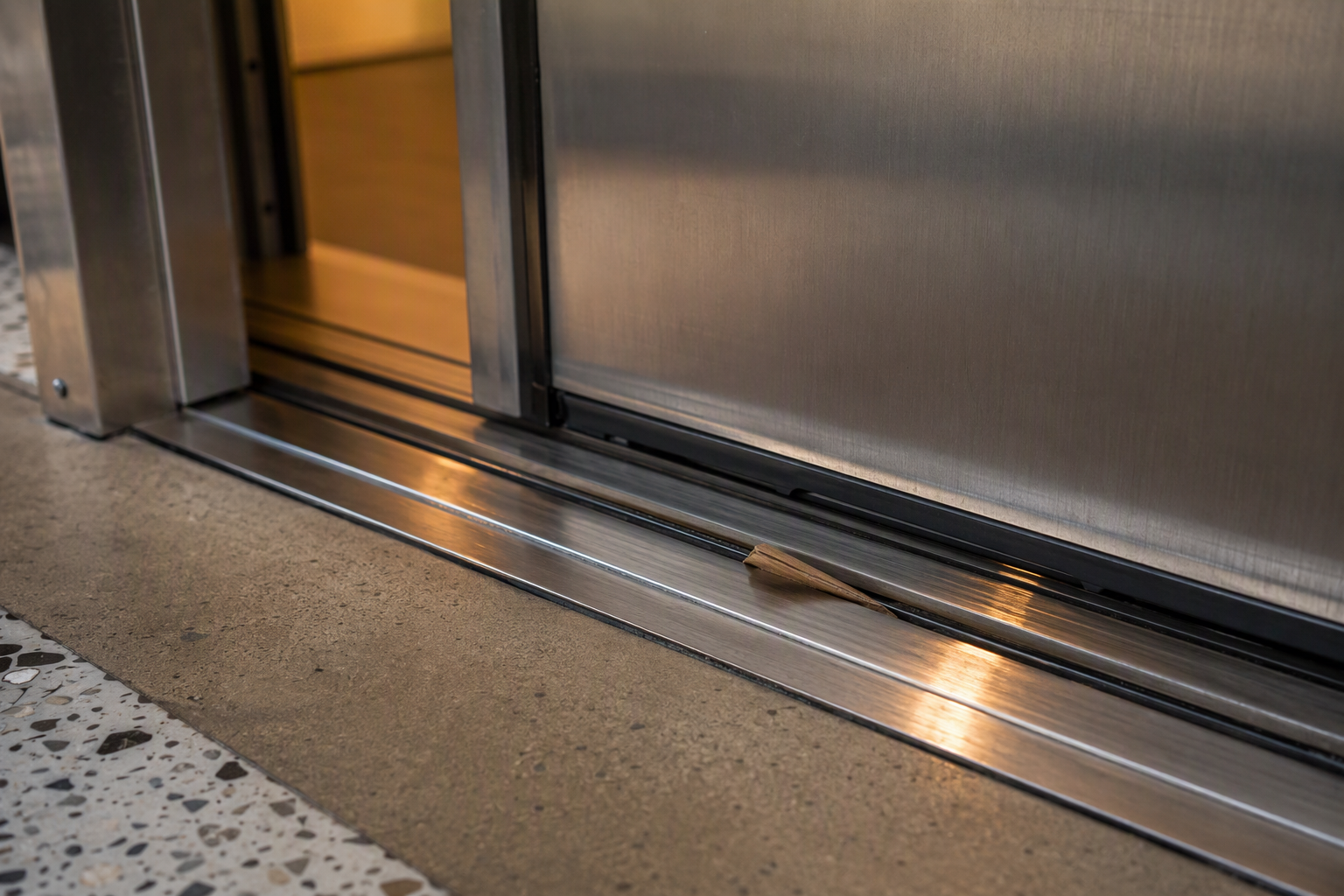
Understanding the frequency of specific failure types helps maintenance staff prioritize inspections and maintenance schedules. Door-related issues are consistently the most reported category of elevator complaints in commercial and residential buildings. Doors that hesitate, reverse unexpectedly, or refuse to close are often triggered by dirty or misaligned sensors, obstructions on the door threshold, or worn door gibs. Leveling issues—where the cab stops above or below the floor—can stem from worn brake shoes, encoder drift, or hydraulic fluid irregularities in hydraulic systems. Call buttons that appear lit but do not register a call may indicate a failing button module or a controller communication fault.
Before contacting a technician for any of these issues, building staff should document the cab number, the floor(s) affected, the time of occurrence, any error codes displayed on the controller or inside the cab, and whether the issue is intermittent or constant. This documentation shortens diagnostic time and can reduce billable service hours.
Which elevator problems are safe for building staff to address without a technician?
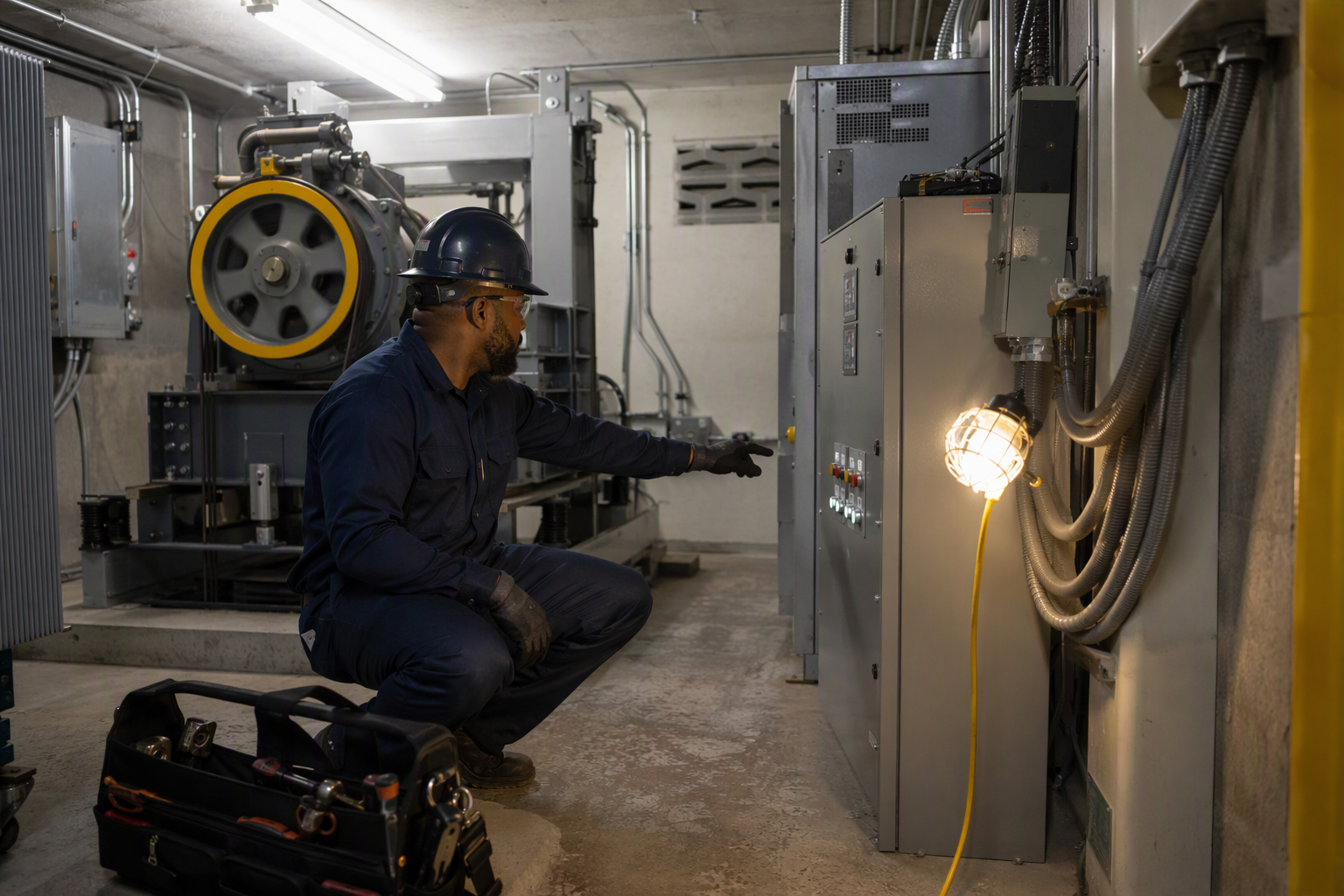
Building staff can safely address power-related resets, door obstruction clearance, and basic safety phone tests without touching any mechanical or electrical components inside the hoistway or machine room.
The following actions fall within the scope of a non-technical building operator and do not require a licensed elevator mechanic:
- Clearing visible door threshold obstructions such as debris, matting edges, or small objects preventing the door from closing fully.
- Checking the main elevator circuit breaker in the electrical room and resetting it once if it has tripped—but only if the breaker panel is safely accessible and clearly labeled.
- Testing the emergency phone by pressing the call button inside the cab to confirm a two-way connection, as required under the Americans with Disabilities Act.
- Replacing burned-out cab lighting if the fixture uses accessible, standard lamp types and no hoistway access is required.
- Logging error codes displayed on the in-cab panel or lobby status board for technician reference.
- Posting an “Out of Service” notice and barricading the lobby call station when the elevator has been taken out of service for any reason.
Building staff should never attempt to open hoistway doors manually, enter the pit, adjust brake components, or interact with any controller beyond a labeled reset button. These actions require an elevator mechanic licensed by the Texas Department of Insurance (TDI) in Texas or the California Division of Occupational Safety and Health (Cal/OSHA) Elevator, Ride & Tramway Unit in California.
How do I troubleshoot an elevator that will not move after a power outage?
After a power outage, restore building power, wait for the elevator controller to complete its self-test cycle, and check whether the unit returns to normal operation before calling a technician—but if the cab remains occupied or the unit does not restore within a few minutes, treat it as an entrapment emergency.
- Confirm that building power has been fully restored, including the dedicated elevator circuit.
- Locate the main elevator disconnect switch in the machine room (or MRL control panel) and verify it is in the “ON” position.
- Check the elevator circuit breaker in the main electrical panel; reset it once only if it has tripped.
- Allow two to three minutes for the controller to run its self-diagnostic sequence and return the cab to a landing.
- Call the cab using the lobby button; listen for motor engagement.
- If the cab does not respond, check whether any error code is displayed on the controller or the in-cab panel and record it.
- If the cab is occupied or has not returned to service after the above steps, call a licensed elevator technician immediately and activate building emergency protocols.
Many modern traction and hydraulic elevators are equipped with automatic rescue operation (ARO) or emergency lowering systems that activate on battery backup during an outage. If a building’s units lack this feature, a power interruption during a run can strand passengers between floors—making emergency technician response necessary. AmeriTex Elevator provides emergency service throughout Houston, Dallas, Austin, San Antonio, Los Angeles, and San Diego for exactly these situations.
What should I do if passengers are trapped in an elevator?
A passenger entrapment is a life-safety emergency: call 911 and the elevator service company simultaneously, communicate calmly with passengers through the emergency phone or intercom, and never attempt to open the hoistway door or extract passengers without a licensed technician present.
- Locate the trapped passengers by calling out through the door or using the intercom system.
- Reassure passengers verbally that help is on the way; advise them to stay calm and away from the door.
- Call 911 to notify emergency services.
- Immediately call your elevator service provider’s emergency line.
- Note the cab number, which floor it appears to be between, and approximately how many passengers are inside.
- Keep the lobby landing door area clear of bystanders until the technician or fire department arrives.
- Do NOT attempt to force open the hoistway door, insert tools into the door gap, or instruct passengers to pry the doors open themselves—doing so creates a fall-into-the-hoistway risk.
Under ASME A17.1, elevator cabins must be equipped with a two-way emergency communication system. If that system is non-functional at the time of entrapment, it represents both an immediate safety hazard and a code violation that must be documented and corrected.
Which elevator symptoms require emergency repair and should not wait for a scheduled visit?
Any symptom involving passenger safety—entrapment, uncontrolled movement, burning odors, smoke, severe leveling failure, or brake irregularities—requires emergency repair and the elevator must be taken out of service immediately.
| Symptom | Can Building Staff Address? | Urgency Level | Recommended Action |
|---|---|---|---|
| Door won’t close (debris on threshold) | Yes — clear obstruction | Low | Clear obstruction; test; log |
| Unresponsive call button | Partial — log and report | Low–Medium | Schedule non-emergency service call |
| Cab lighting failure | Yes — if accessible fixture | Low | Replace bulb; if wiring issue, call tech |
| Tripped circuit breaker (one-time) | Yes — reset once | Medium | Reset; if trips again, call technician |
| Leveling gap greater than ½ inch | No | High | Take out of service; call technician same day |
| Passengers trapped | No | Emergency | Call 911 + elevator service immediately |
| Unusual grinding or banging noise | No | High–Emergency | Take out of service; call technician immediately |
| Burning smell or smoke | No | Emergency | Evacuate building; call 911 |
| Cab moving with doors open | No | Emergency | Disconnect power if safe; call 911 + technician |
| Hydraulic oil leak (visible in pit) | No | High | Take out of service; call technician same day |
| Emergency phone non-functional | No | High | Take out of service; repair required before return to service per ADA |
| Excessive cab vibration | No | Medium–High | Log details; schedule prompt service call |
How do I troubleshoot elevator door problems before calling a technician?
Door problems can often be traced to sensor obstruction, threshold debris, or a door edge that has been physically bumped—all of which building staff can inspect visually before requesting a service call.
Elevator doors are governed by safety edge and sensor requirements under ASME A17.1, which mandates that doors re-open upon contact with a passenger or obstruction. Begin troubleshooting by inspecting the door threshold for gravel, matting edges, coins, or any object that could prevent the sill gibs from traveling freely. Next, visually inspect the door edges for the safety light curtain or mechanical edge—if the plastic safety edge strip appears cracked, compressed, or detached, this is a mechanical defect requiring technician attention.
If the door repeatedly reverses without an obvious obstruction, the infrared light curtain sensors may be dirty or misaligned. Building staff can gently clean the sensor strips on both door faces with a dry cloth—but must not adjust, bend, or reposition the sensors themselves. If cleaning does not resolve the issue, schedule a non-emergency service call and document how frequently the reversal occurs and at which floor.
What does elevator leveling failure mean and how serious is it?
Leveling failure—when the cab floor does not align within an acceptable tolerance with the landing floor—is a serious safety hazard that creates a trip-and-fall risk for all passengers, particularly those using wheelchairs or mobility aids.
Under the Americans with Disabilities Act, elevator landings must be accessible, which practically requires that the cab floor align closely enough with the landing that passengers using wheelchairs, walkers, or canes can board safely without a significant step. A leveling gap of more than a half-inch is generally considered a deficiency under elevator safety codes and a potential ADA compliance issue.
Leveling failures in traction elevators are commonly caused by encoder drift, worn brake shoes, or controller calibration issues. In hydraulic elevators, leveling problems are often related to fluid temperature, seal wear, or valve irregularities. Neither root cause is addressable by building staff. If a leveling gap is observed, the elevator should be taken out of service and a technician called the same business day. Do not allow continued use, as repeated boarding over a significant gap increases fall liability substantially.
What are the warning signs of a failing elevator brake?
Warning signs of a failing elevator brake include the cab drifting or rolling when stopped at a floor, longer-than-normal deceleration runs, mechanical thumping sounds during stopping, or the cab settling visibly after the doors open.
The brake system is among the most safety-critical components in any traction elevator. Under ASME A17.1, elevator brakes must hold the rated load plus an additional safety margin—meaning any sign of brake slippage or inconsistent holding represents a code-level safety failure. Building staff who observe cab drift, post-stop settling, or unusual mechanical sounds during deceleration should take the elevator out of service immediately, post out-of-order signage at all landings, and contact an elevator service company without delay. AmeriTex Elevator’s technicians service brake components across all its Texas and California markets for situations exactly like this.
How often are elevators legally required to be inspected in Texas and California?
In Texas, elevators must be inspected periodically under the oversight of the Texas Department of Insurance, which administers the state elevator safety program; in California, the Division of Occupational Safety and Health (Cal/OSHA) Elevator, Ride & Tramway Unit requires periodic inspections, with certificates of inspection required before an elevator can legally operate.
Both Texas and California require that a valid Certificate of Inspection be posted in the elevator cab and that inspections be performed by a licensed elevator inspector. The ASME A17.1 Safety Code for Elevators and Escalators and the companion existing-installations standard ASME A17.3 form the technical basis for what inspectors evaluate in both states. Buildings that cannot produce a current certificate of inspection are operating out of compliance and face potential shutdown orders from the applicable authority having jurisdiction (AHJ).
Building managers should maintain a physical binder that contains the current inspection certificate, the most recent maintenance logs, any outstanding violations or correction orders, and the elevator contractor’s emergency contact information. This documentation is the first thing an inspector will request.
What routine maintenance tasks help prevent emergency elevator failures?
Routine maintenance tasks such as lubrication of guide rails, inspection of ropes or hydraulic fluid levels, cleaning of door tracks, and testing of safety devices directly reduce the probability of unexpected breakdowns and emergency shutdowns.
Preventive maintenance (PM) programs structured around the requirements in ASME A17.1 address the mechanical systems most likely to fail between inspections. Key maintenance activities include:
- Guide rail lubrication: Reduces guide shoe wear and cab vibration in traction elevators.
- Hoist rope inspection: Technicians assess rope wear, broken wires, and proper tension; deterioration beyond code limits requires immediate replacement.
- Hydraulic fluid checks: Fluid level, condition, and the absence of leaks are fundamental to hydraulic elevator reliability and environmental compliance.
- Door operator and clutch inspection: The door operator is the single most frequently replaced major component in commercial elevators; regular adjustment extends service life.
- Safety device testing: Governor, safeties, buffers, and final limit switches must be tested at code-specified intervals.
- Emergency lighting and phone testing: The two-way emergency communication system must be verified functional at each maintenance visit.
What is the correct procedure when an elevator makes unusual noises?
When an elevator produces grinding, banging, screeching, or repetitive clicking sounds not present during normal operation, building staff should take the unit out of service immediately and contact a technician—never attempt to diagnose mechanical noises from inside the hoistway.
- Note the specific character of the sound (grinding, banging, squealing, clicking) and during which part of the run it occurs (acceleration, constant speed, deceleration, or at the landing).
- Note whether the sound is present on every run or only in certain directions (up vs. down) or at specific floors.
- Take the elevator out of service by activating the key switch or placing the unit on independent service mode if the building has a trained operator.
- Post out-of-order signage at every landing.
- Call the elevator service company and relay all documented observations.
- Do not re-enter the cab to attempt further diagnosis, and do not allow passengers to use the unit until a technician has cleared it.
Grinding sounds during travel can indicate worn guide shoes, rope-to-sheave slippage, or deteriorating roller guides. Banging sounds at the landing often point to door operator issues or buffer contact. Screeching during acceleration may signal a motor or drive issue. Each of these requires hands-on technician diagnosis.
What does it mean when an elevator displays an error code?
An error code on an elevator controller or in-cab display is the system’s self-diagnostic output indicating which subsystem has triggered a fault—recording this code accurately before calling a technician is one of the most useful things building staff can do.
Modern elevator controllers log fault codes that correspond to specific subsystem failures: door zone errors, overspeed conditions, communication faults between the car and machine room, or safety circuit openings. These codes vary significantly by manufacturer and controller generation, which means building staff cannot typically interpret them without the manufacturer’s fault code reference. However, writing down the exact alphanumeric code displayed—along with the time, cab number, and what the elevator was doing when the fault occurred—equips the technician with information that can cut diagnostic time significantly.
Some systems display fault codes on a lobby status panel visible to building staff. Others require the technician to plug in a diagnostic tool at the controller. In either case, the code should be treated as a symptom report, not a repair instruction. If the same fault code appears repeatedly after a manual reset, the elevator should be taken out of service until the underlying cause is repaired.
How do I handle an elevator that smells like burning or shows signs of smoke?
A burning smell or visible smoke from an elevator is a fire-safety emergency—evacuate the building using stairs, call 911 immediately, and do not use the elevator under any circumstances.
- Alert all building occupants to evacuate via the stairs immediately—do not use elevators during a suspected fire event.
- Call 911 and report the location, floor, and nature of the odor or smoke.
- If safely accessible, activate the fire recall function (Phase I Emergency Recall) at the main floor key switch to return all cabs to the main landing with doors open.
- Do not attempt to open the machine room door if smoke is emanating from it—this may feed oxygen to a fire.
- Meet emergency responders at the building entrance to provide elevator cab numbers and machine room location.
- After fire department clearance, contact your elevator service provider before returning any unit to passenger service.
Burning odors in an elevator can originate from motor winding breakdown, overheated brake linings, controller component failure, or an external fire event. All of these scenarios require professional assessment before the elevator is returned to service. OSHA standards for worker safety in confined and mechanical spaces reinforce that hoistway and machine room entry must be performed only by trained, authorized personnel.
What are ADA elevator requirements building managers must maintain?
Under the Americans with Disabilities Act, elevators in multi-story buildings subject to ADA must maintain operational call buttons, audible and visual floor indicators, Braille and raised-character signage, and a two-way emergency communication system accessible to people who are deaf or hard of hearing.
ADA elevator requirements are not one-time installation standards—they impose ongoing operational obligations. If a call button fails and is not repaired promptly, the building may be denying access to people with disabilities. If the audible floor announcement system fails, passengers with visual impairments lose a required wayfinding aid. If the emergency phone is non-functional, passengers with hearing disabilities may be unable to communicate during an entrapment.
Building managers should include ADA compliance verification as a standing item on monthly self-inspection checklists. This means testing every call button, verifying Braille signage is undamaged, confirming the emergency two-way communication system connects and transmits clearly, and checking that the cab floor aligns closely with landings to allow wheelchair access. Any deficiency should be addressed through a formal service work order—not deferred—because ADA non-compliance can expose building owners to federal complaints and litigation.
When should a building manager consider elevator modernization instead of continued repair?
When repair costs approach or exceed the investment required to modernize aging components, when parts availability becomes a barrier to timely repairs, or when the existing equipment cannot meet current code or ADA standards, modernization is typically more cost-effective than continued patchwork maintenance.
Elevators have long service lives, but their electrical and mechanical components age at different rates. Controllers, door operators, and relay logic panels from older generations can become difficult to service when replacement parts are discontinued by the manufacturer. In these cases, a single component failure can result in an extended outage because parts must be sourced from salvage or custom-fabricated.
The ASME A17.3 Safety Code for Existing Elevators and Escalators provides the baseline safety requirements for elevators already in service. During a code compliance review or modernization evaluation, an elevator service company will assess which existing components meet current A17.3 requirements and which require upgrade. AmeriTex Elevator performs modernization assessments for commercial and residential properties in Houston, Dallas, Austin, San Antonio, Los Angeles, and San Diego, providing building owners with a clear picture of their options before committing to a repair path.
What documentation should building managers keep for elevator compliance?
Building managers must maintain the current certificate of inspection, maintenance logs, records of any repairs or parts replaced, and documentation of safety device test results—all accessible for review by the authority having jurisdiction.
In both Texas and California, the authority having jurisdiction (AHJ) can request elevator records during a compliance inspection. A well-maintained documentation file should include:
- The current Certificate of Inspection posted in the cab and a copy on file.
- Signed maintenance records from each PM visit, including what was inspected, adjusted, lubricated, or replaced.
- Work orders for any corrective repairs, including parts replaced and technician signature.
- Records of any required five-year full-load safety tests or other periodic tests required under the applicable code cycle.
- Any violation notices from the AHJ and the corresponding correction documentation.
- The elevator service contract identifying the licensed contractor responsible for maintenance.
How can building staff safely test the emergency phone in an elevator?
Building staff can test the emergency phone by entering the elevator cab during a low-traffic period, pressing the emergency call button, confirming a live two-way connection is established within the required timeframe, and logging the test result with the date and name of the person who performed it.
- Enter the cab alone during a low-traffic period and allow the doors to close.
- Press and hold the emergency call button (typically marked with a bell icon).
- Confirm that a dial tone, ring, or immediate voice connection is audible within a short interval.
- Speak clearly and confirm that the receiving party can hear you and that you can hear them.
- If the system connects to a monitoring center, identify yourself as a building manager performing a routine test.
- Log the test result, date, time, and your name in the elevator maintenance log.
- If no connection is established, take the elevator out of service and contact your elevator service provider—a non-functional emergency phone is an ADA compliance issue and a code deficiency under ASME A17.1.
What is Phase I and Phase II emergency recall and when should building staff activate it?
Phase I Emergency Recall returns all elevator cabs to a designated main floor with doors open when activated by a key switch or smoke detector signal, while Phase II gives firefighters in-cab control—building staff should activate Phase I manually when directed by fire department personnel or building fire response protocols.
Every elevator in a building required to have firefighters’ service under ASME A17.1 must be equipped with Phase I and Phase II emergency operation. Phase I can be activated automatically by a smoke detector signal or manually by a building representative using the designated key switch, typically located at the main floor lobby. When Phase I is active, no passenger call button will summon the elevator—cabs return to the main floor and hold there with doors open. Building staff should know the location of the Phase I key switch and understand that this function is intended to prevent fire responders from encountering an elevator that opens on a fire floor.
Phase II, which gives a firefighter inside the cab manual control, is operated exclusively by fire department personnel. Building managers should never operate Phase II controls outside of a drill or fire department direction.
How does an elevator service contract protect building owners from unexpected repair costs?
A properly structured elevator service contract defines the scope of preventive maintenance, provides priority response for service calls, and—depending on the contract type—covers parts and labor for specified repairs, protecting building owners from large unplanned expenses.
Elevator service contracts generally fall into several categories: oil-and-grease agreements (covering only lubrication and basic adjustments), full-service agreements (covering parts and labor for most repairs), and comprehensive agreements (covering all components including modernization components). Building owners should review contract language carefully to understand what is excluded—particularly high-cost components such as controllers, hoist motors, or hydraulic cylinders—and what the response protocol is for emergency calls.
In markets where elevator downtime directly affects tenant satisfaction or ADA compliance obligations—such as Houston office towers, San Antonio senior living facilities, Los Angeles multi-family residential buildings, or San Diego commercial properties—an appropriate service agreement provides both financial predictability and faster response when problems arise. AmeriTex Elevator serves all of these markets with structured maintenance programs designed around the operational needs of Texas and California building owners.
What should building managers do after an elevator has been repaired to verify it is safe to return to service?
After a repair, building staff should obtain written clearance from the licensed technician who performed the work, confirm the elevator completes several unloaded test runs without incident, and verify that all safety features—doors, emergency phone, and lighting—are functioning before reopening to passenger traffic.
- Obtain a signed work order or repair report from the technician stating the repair is complete and the unit is safe for passenger use.
- If the repair involved safety-critical components (brakes, safeties, door interlocks, or hydraulic systems), confirm whether an AHJ inspection is required before return to service under applicable Texas or California regulations.
- Conduct a minimum of three unloaded test runs—one up and one down, plus a third at a different floor—observing for any abnormal sounds, vibration, or door behavior.
- Test the emergency phone to confirm two-way communication is active.
- Verify cab lighting and emergency lighting are functional.
- Remove out-of-service signage and restore access only after all of the above are confirmed satisfactory.
- Log the repair, the return-to-service test, and the date in the elevator maintenance record.
Need elevator service you can rely on? AmeriTex Elevator is ready to help.