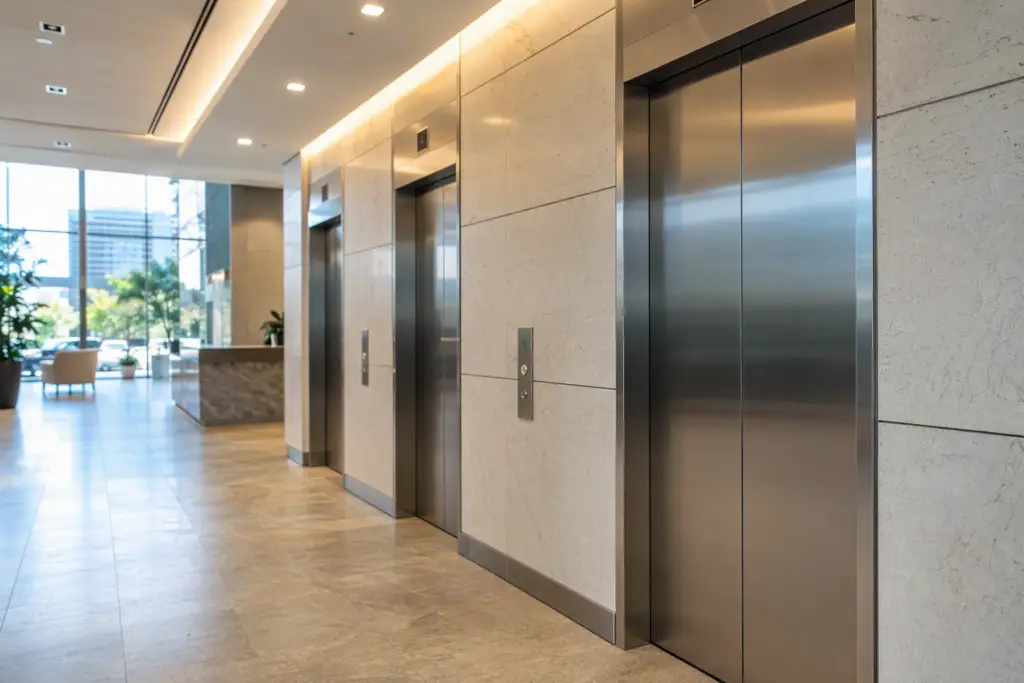
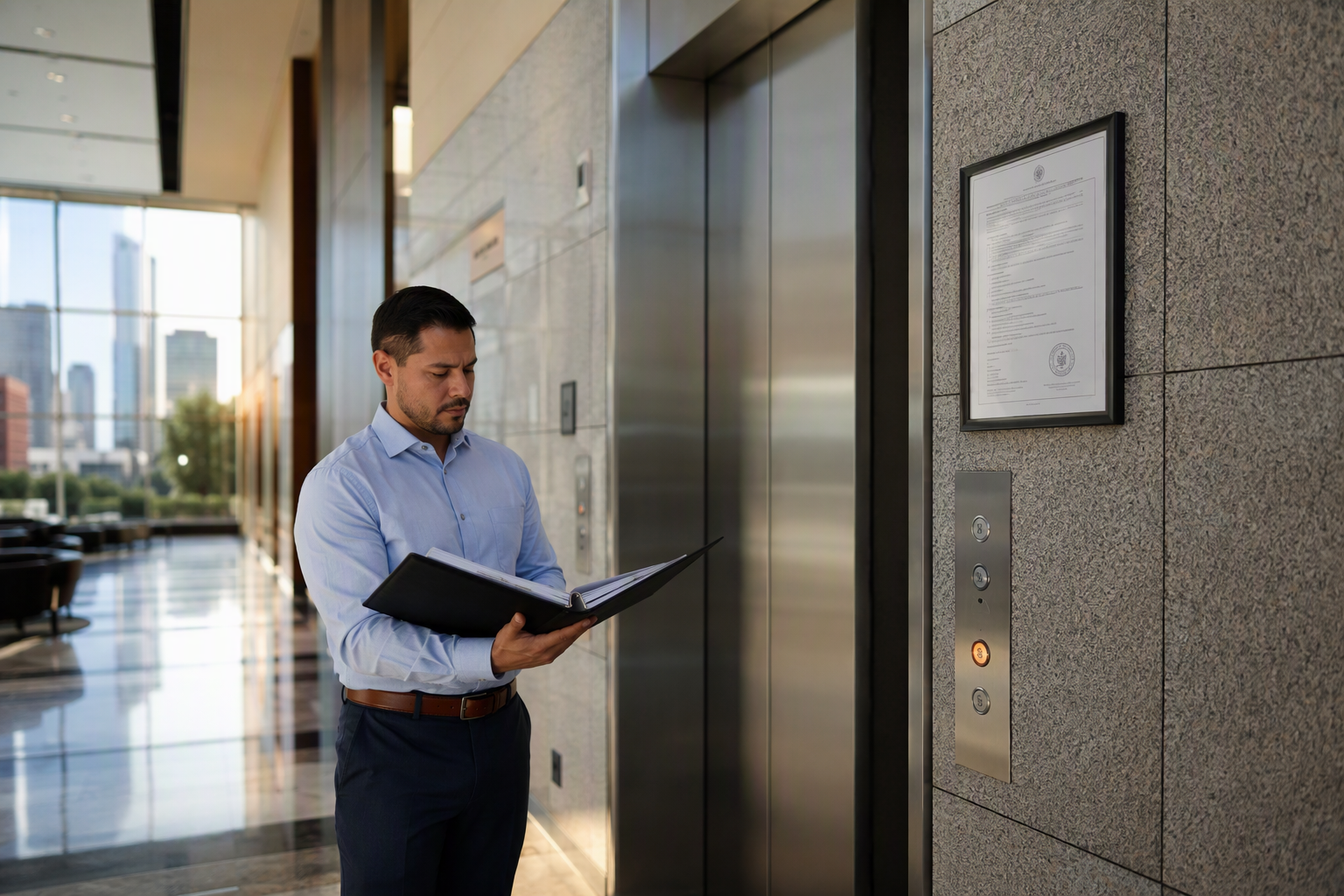
Houston building owners, property managers, and facilities directors face a clear compliance obligation: every elevator, escalator, and related conveyance in a commercial or multi-family residential building must meet Texas state inspection requirements administered through the Texas Department of Insurance (TDI) Elevator Safety Program. Failing to maintain a current Certificate of Operation can mean fines, forced shutdown, and liability exposure. This guide covers the full inspection timeline, permit process, code framework, and how to choose a qualified service provider — so building owners can make informed, confident decisions.
What State Agency Governs Elevator Inspections in Texas?
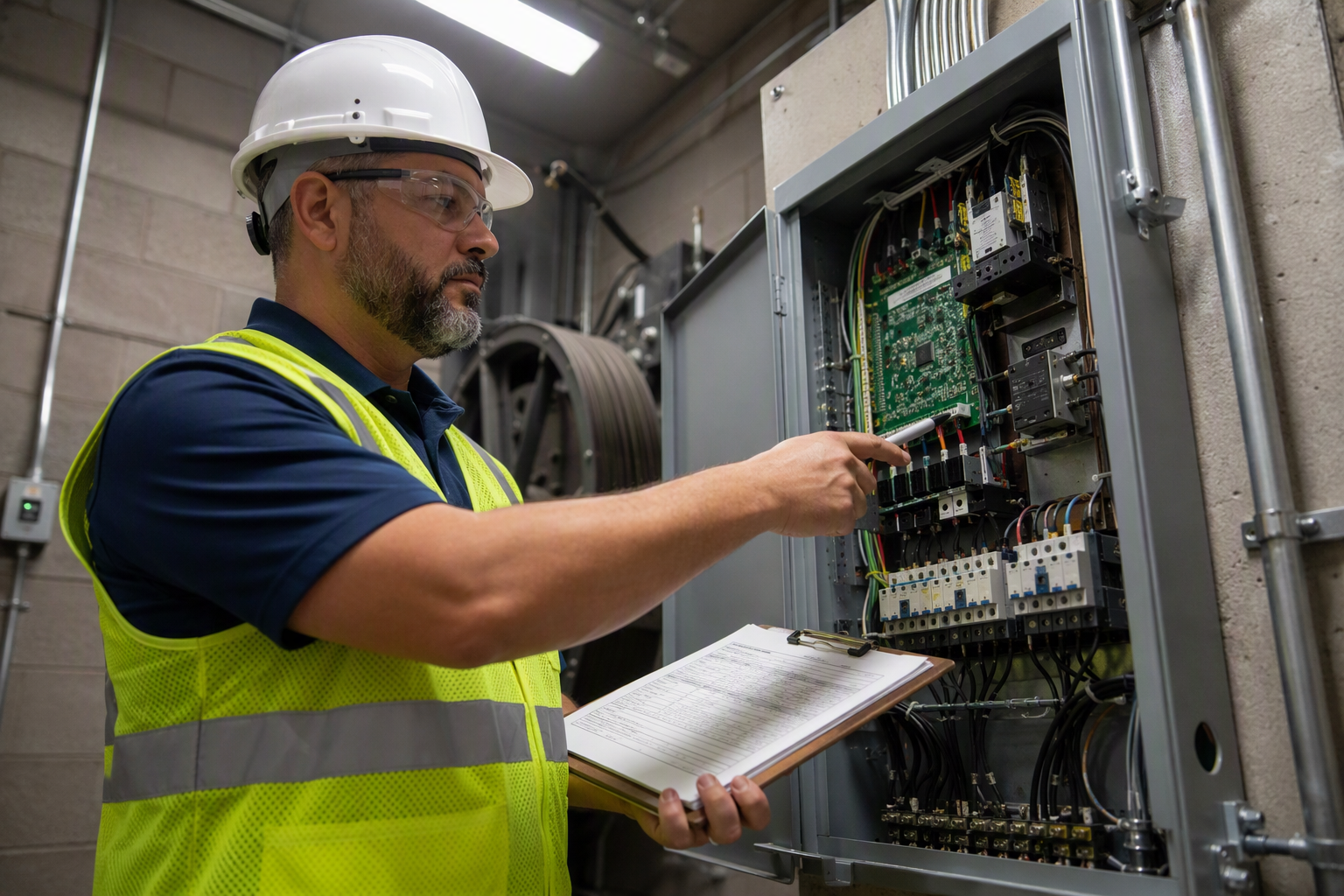
The Texas Department of Insurance (TDI) administers the Texas Elevator Safety Act and oversees the licensing of elevator inspectors and contractors statewide. TDI’s Elevator Safety Program requires that every elevator installation in Texas be inspected by a licensed elevator inspector before it is placed into service, and then re-inspected on a recurring basis to maintain the Certificate of Operation.
The City of Houston does not operate a separate, independent elevator inspection office that supersedes TDI authority. Instead, Houston building owners must comply with the state-level program administered by TDI. Third-party inspectors certified by TDI — including inspectors employed by or contracted through elevator service companies — can perform the required inspections.
The national technical standard that underpins Texas elevator safety requirements is the ASME A17.1 Safety Code for Elevators and Escalators for new installations and the ASME A17.3 Safety Code for Existing Elevators and Escalators for equipment already in service. Texas adopts these standards by reference, and TDI enforcement actions are measured against these benchmarks.
What Is the Required Inspection Timeline for Elevators in Houston?

Texas state law establishes recurring inspection intervals that every building owner must understand:
| Conveyance Type | Inspection Frequency | Certificate Required? | Key Standard |
|---|---|---|---|
| Passenger & Freight Elevators | Annual (every 12 months) | Yes — Certificate of Operation | ASME A17.1 / A17.3 |
| Escalators & Moving Walks | Annual (every 12 months) | Yes — Certificate of Operation | ASME A17.1 / A17.3 |
| Dumbwaiters | Annual (every 12 months) | Yes — Certificate of Operation | ASME A17.1 / A17.3 |
| Newly Installed Equipment | Before first use / initial acceptance inspection | Yes — Certificate of Operation prior to operation | ASME A17.1 |
| Altered Equipment | Inspection required after any alteration | Yes — renewed certificate required post-alteration | ASME A17.1 / A17.3 |
Building owners should calendar their renewal date from the date of their most recent Certificate of Operation issuance. Allowing the certificate to lapse — even by a short period — can constitute a violation and may require the unit to be taken out of service until compliance is restored.
What Permits Are Required Before Installing or Altering an Elevator in Houston?
Any new elevator installation or significant alteration to existing equipment in Texas requires a permit issued through TDI before work begins. The permit process involves submission of equipment plans and specifications for review. Only licensed elevator contractors may perform installation or alteration work in Texas.
| Work Type | Permit Required? | Inspection Trigger | Certificate Outcome |
|---|---|---|---|
| New Installation | Yes — prior to installation | Acceptance inspection before operation | Initial Certificate of Operation issued |
| Major Alteration (controller, machine, safety devices) | Yes — prior to alteration | Post-alteration inspection required | Certificate renewed/re-issued |
| Routine Maintenance & Repair | No permit required for maintenance | No additional inspection trigger | Existing certificate remains valid |
| Modernization Project | Yes — plans submitted to TDI | Inspection upon project completion | Updated Certificate of Operation |
What Does the Annual Elevator Inspection Process Look Like Step by Step?
Understanding the procedural flow helps building owners prepare and avoid delays in certificate issuance.
- Schedule a licensed inspector. Engage a TDI-licensed elevator inspector or an elevator service company that employs or has access to one. AmeriTex Elevator works with licensed inspectors and can coordinate the process for building owners in Houston.
- Prepare the equipment and documentation. Gather the previous Certificate of Operation, maintenance logs, and any repair records from the prior year. Ensure machine room access is clear and lighting is functional.
- Conduct the inspection. The licensed inspector examines the elevator against the applicable requirements under ASME A17.1 / A17.3, reviewing mechanical components, safety devices, cab condition, signage, and operating controls.
- Receive the inspection report. The inspector documents findings, noting any deficiencies that must be corrected before a certificate can be issued or renewed.
- Correct deficiencies. If violations are found, a licensed elevator contractor must complete the required repairs. AmeriTex Elevator can perform deficiency corrections as part of a comprehensive service plan.
- Obtain re-inspection if required. For units with deficiencies, a follow-up inspection may be necessary after corrections are made.
- Receive the Certificate of Operation. Once the unit passes inspection, TDI issues or renews the Certificate of Operation, which must be posted in or near the elevator.
- Post the certificate and update records. Texas requires the current certificate to be displayed. Update your facility’s compliance calendar for the next annual cycle.
What Are the ADA Accessibility Requirements That Apply to Elevators in Houston?
In addition to the TDI safety inspection program, elevators in buildings subject to federal law must comply with Americans with Disabilities Act (ADA) accessibility standards. The ADA Standards for Accessible Design govern elevator cab dimensions, door width and timing, control panel height and Braille markings, audible signals, and leveling accuracy.
ADA compliance is not enforced through the TDI inspection program — it is enforced through federal civil rights law. However, a building that fails an ADA elevator audit faces federal complaint exposure independent of whether its TDI certificate is current. Building owners should treat ADA compliance as a parallel, ongoing obligation rather than a one-time inspection item.
| Compliance Area | Governing Authority | Enforcement Mechanism | Review Frequency |
|---|---|---|---|
| Equipment Safety (mechanical, structural) | TDI / ASME A17.1 & A17.3 | Certificate of Operation | Annual |
| Accessibility (cab, controls, signals) | ADA / U.S. DOJ | Federal complaint / litigation | Ongoing / triggered by complaint |
| Worker Safety (machine room, pit) | OSHA | OSHA inspection / citation | Complaint-driven or programmed |
What Are the Consequences of Operating an Elevator Without a Valid Certificate in Houston?
Operating a conveyance without a current Certificate of Operation in Texas is a violation of the Texas Elevator Safety Act. Consequences can include:
- Administrative penalties assessed by TDI against the building owner or operator.
- Mandatory shutdown orders requiring the elevator to be taken out of service until compliance is achieved.
- Increased liability exposure in the event of an injury, since operating without a valid certificate can be used to establish negligence in civil litigation.
- Complications with property insurance, as many commercial property policies contain exclusions or conditions tied to code compliance.
Building owners who discover a lapsed certificate should immediately contact a licensed elevator contractor and inspector to initiate the renewal process — and should document all steps taken to remediate the lapse.
How Do You Choose Between an OEM Service Provider and an Independent Elevator Service Company in Houston?
| Factor | OEM / Manufacturer-Affiliated Provider | Independent Service Company (e.g., AmeriTex Elevator) |
|---|---|---|
| Equipment Brand Flexibility | Typically limited to own brand | Services multiple brands and manufacturers |
| Parts Sourcing | OEM parts only; may be premium-priced | OEM and compatible parts; competitive sourcing |
| Contract Flexibility | Often long-term, proprietary contracts | Typically more flexible contract terms |
| Local Responsiveness | Varies by regional coverage model | Locally focused; dedicated Houston/Texas market |
| Inspection Coordination | May offer in-house inspector coordination | Coordinates with licensed TDI inspectors |
| Code Compliance Expertise | Strong for own equipment lines | Broad cross-brand ASME and TDI compliance knowledge |
| Proprietary Lock-In Risk | Higher — equipment data/codes may be restricted | Lower — no proprietary lock-in |
AmeriTex Elevator is a certified independent elevator service company operating in Texas. As an independent provider, AmeriTex Elevator can service equipment from a wide range of manufacturers, coordinate TDI-required inspections, manage deficiency corrections, and support building owners through modernization projects — without the proprietary lock-in that characterizes OEM-exclusive service arrangements.
What Is the Difference Between ASME A17.1 and ASME A17.3 and Which Applies to My Elevator?
Both codes are published by the American Society of Mechanical Engineers and form the technical backbone of elevator safety regulation across the United States, including Texas.
- ASME A17.1 Safety Code for Elevators and Escalators governs the design, construction, installation, and alteration of new elevator equipment. It applies when a new unit is installed or when existing equipment undergoes a major alteration.
- ASME A17.3 Safety Code for Existing Elevators and Escalators governs elevators and escalators already in service. It establishes the minimum safety requirements that must be met during annual inspections and defines what constitutes a violation on legacy equipment.
Most Houston building owners with older elevator stock will find that TDI inspections are conducted against ASME A17.3, while any renovation or modernization work triggers review under ASME A17.1. An experienced service provider such as AmeriTex Elevator can advise on which code edition applies to a specific unit and what upgrades may be required.
What OSHA Requirements Apply to Elevator Machine Rooms and Pits in Texas?
The Occupational Safety and Health Administration (OSHA) has jurisdiction over worker safety conditions in elevator machine rooms, hoistways, and pits. Building owners and their service contractors share responsibility for maintaining safe working environments in these spaces. OSHA requirements relevant to elevator service include proper lighting, adequate ventilation, slip and trip hazard management, electrical panel safety, and confined-space protocols for pit entry.
OSHA compliance is evaluated separately from TDI elevator inspections. A building may hold a current Certificate of Operation and still face an OSHA citation if machine room conditions are unsafe. Regular maintenance visits by a qualified elevator service company help maintain both the operational integrity of the equipment and the safety of the spaces in which it is serviced.
What Should Building Owners Do If Their Elevator Fails Inspection in Houston?
- Take the unit out of service immediately if the inspector or TDI issues a shutdown order, or if the deficiency poses an immediate safety risk.
- Obtain the written deficiency report from the inspector documenting each item that must be corrected.
- Contact a licensed elevator contractor — such as AmeriTex Elevator — to review the deficiency list and provide a scope of corrective work.
- Prioritize life-safety deficiencies (door interlocks, safeties, governor) before cosmetic or secondary items.
- Complete all required repairs using licensed elevator mechanics in compliance with ASME A17.1 / A17.3 standards.
- Schedule a re-inspection with the TDI-licensed inspector once corrective work is complete.
- Obtain the renewed Certificate of Operation and post it as required by Texas law before returning the unit to passenger service.
- Document everything. Retain the inspection report, contractor invoices, and the renewed certificate in a dedicated compliance file for the property.
How Far in Advance Should Houston Building Owners Schedule Their Annual Elevator Inspection?
Scheduling an annual elevator inspection is not a same-day or last-minute process. Licensed TDI inspectors may have lead times that vary depending on the season and demand in the Houston market. Best practice is to initiate the scheduling process well before the current certificate’s expiration date. This allows time for:
- Inspector availability confirmation
- Pre-inspection maintenance service to reduce the likelihood of deficiency findings
- Any corrective work required before the inspection
- Re-inspection scheduling if deficiencies are identified
AmeriTex Elevator recommends that building owners treat annual inspection scheduling as a proactive compliance task — not a reactive one — and incorporate it into the property’s broader facilities management calendar.
Elevator Inspection Compliance: Pros and Cons of Different Service Approaches
| Approach | Pros | Cons | Best For |
|---|---|---|---|
| Full-Service Maintenance Contract (Independent) | Proactive maintenance reduces deficiency risk; single point of contact; inspection coordination included | Ongoing contract commitment required | Multi-unit buildings, active commercial properties |
| Inspection-Only Engagement | Lower immediate cost; flexible | No proactive maintenance; higher risk of undetected issues; corrective work managed separately | Low-use equipment, small buildings with tight budgets |
| OEM Exclusive Contract | Manufacturer expertise on specific equipment | Higher cost; proprietary lock-in; limited flexibility across mixed fleets | New installations under warranty |
| Independent Multi-Brand Service (e.g., AmeriTex Elevator) | Cross-brand capability; competitive pricing; local expertise; no lock-in | Must verify technician qualifications per brand | Mixed-brand portfolios; cost-conscious owners; buildings with older equipment |
Why Work With AmeriTex Elevator for Houston Elevator Compliance?
AmeriTex Elevator is a certified elevator service company serving Texas building owners across the full compliance lifecycle — from maintenance and modernization to inspection coordination and deficiency correction. As a Texas-based independent provider, AmeriTex Elevator brings:
- Deep familiarity with TDI’s Certificate of Operation process and Houston-area inspection timelines
- The ability to service elevators from multiple manufacturers without proprietary lock-in
- Expertise in ASME A17.1 and A17.3 compliance for both new and existing installations
- Support for ADA accessibility compliance assessments alongside safety inspections
- A proactive approach designed to identify and resolve issues before they become inspection failures or shutdown orders
Building owners who partner with an experienced, independent service company rather than waiting until the annual inspection deadline are better positioned to maintain continuous compliance, protect occupant safety, and avoid the operational disruption of unexpected shutdowns.
Need elevator service you can rely on? AmeriTex Elevator is ready to help.