Elevator Modernization vs. Replacement Cost: Complete Guide for Building Owners
After 15-plus years inspecting and servicing elevators across Texas and California, I’ve helped hundreds of building owners navigate one of the most consequential capital decisions they’ll face: should you modernize your existing elevator or replace it entirely? The answer depends on equipment age, condition, compliance status, and long-term building goals — and getting it wrong costs serious money. This guide walks you through every variable that matters.
What is the average cost difference between elevator modernization and full replacement in 2026?
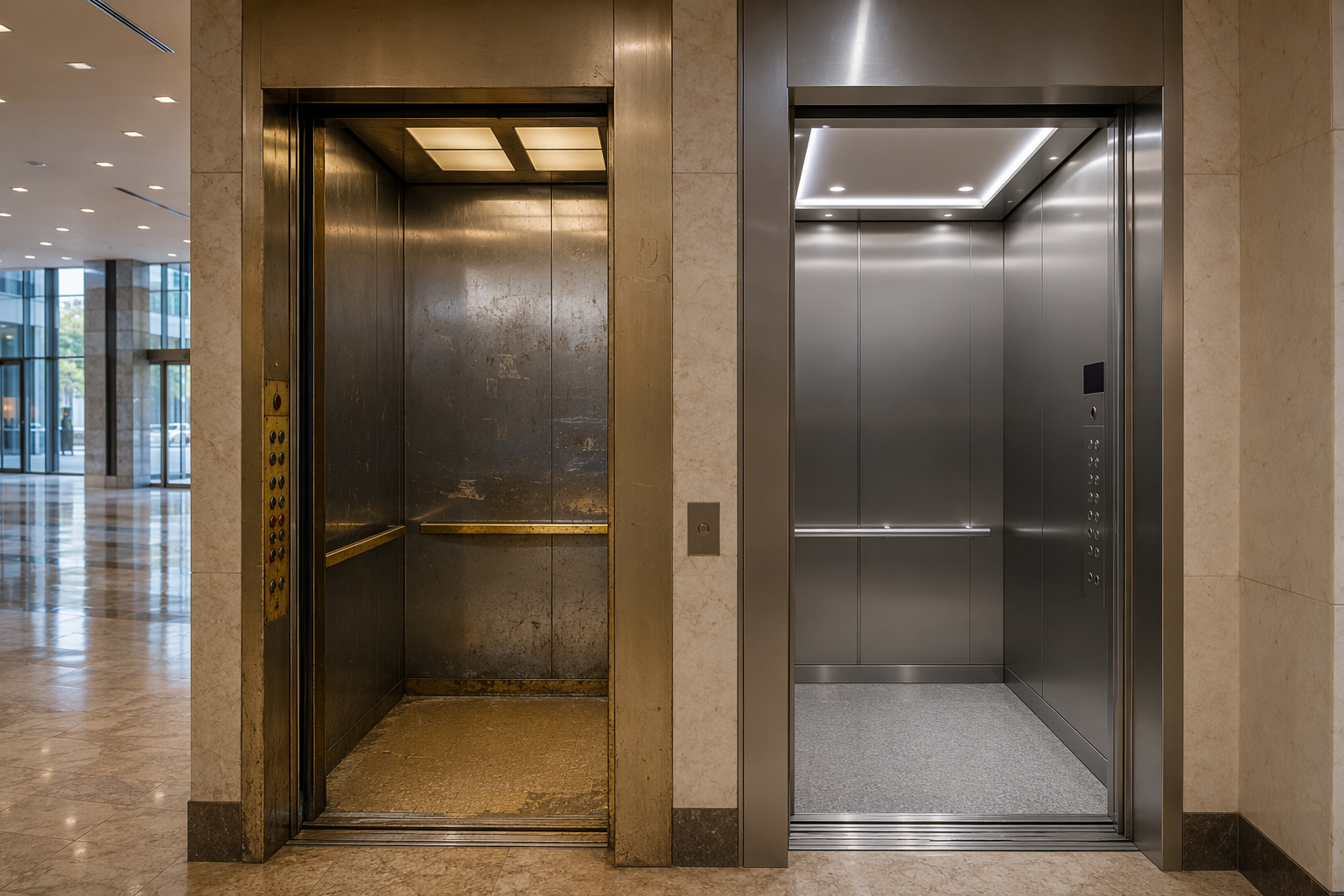
Modernization averages $50,000–$200,000 while full replacement averages $100,000–$500,000, making modernization roughly 40–60% less expensive in most commercial scenarios.
Full replacement involves removing every component — cab, hoistway equipment, machine room machinery, and all electrical systems — and installing new from scratch. Modernization replaces only the worn or non-compliant systems while retaining the structural hoistway and cab shell. For a standard 4-stop hydraulic elevator in a Houston office building, a full replacement bid typically runs $180,000–$280,000, while a comparable modernization scope lands between $75,000 and $130,000.
Labor is the dominant cost driver in both scenarios. In high-cost markets like Los Angeles and San Diego, expect labor rates 20–30% higher than Texas markets. Always collect at minimum three competitive bids and verify that each scope covers the same equipment systems.
| Scope | Typical Cost Range | Downtime | Life Extension | Best For |
|---|---|---|---|---|
| Partial Modernization (controls only) | $20,000–$60,000 | 1–2 weeks | 10–15 years | Elevators 15–20 years old with sound mechanicals |
| Full Modernization | $50,000–$200,000 | 4–8 weeks | 15–25 years | Elevators 20–35 years old with good hoistway structure |
| Full Replacement (hydraulic) | $100,000–$250,000 | 8–16 weeks | 25–30 years | Obsolete systems, failed structure, major reconfiguration |
| Full Replacement (traction/MRL) | $200,000–$500,000+ | 12–24 weeks | 25–30 years | High-rise, heavy-duty commercial, new construction |
| Controls + Drive Modernization | $30,000–$80,000 | 2–3 weeks | 12–18 years | Analog-to-digital upgrade, energy efficiency improvement |
How do I know when my elevator needs modernization versus full replacement?
If your elevator is 20–35 years old with a structurally sound cab and hoistway, modernization is almost always the right call; replacement becomes necessary when the cab structure is failing, parts are completely obsolete, or a fundamental configuration change is required.
The decision tree I use with clients starts with three questions: Is the hoistway structurally sound? Are replacement parts still manufactured for the core mechanical components? And does the current footprint meet the building’s future capacity needs? If you answer yes, yes, and yes — modernize. If any answer is no, replacement deserves serious evaluation.
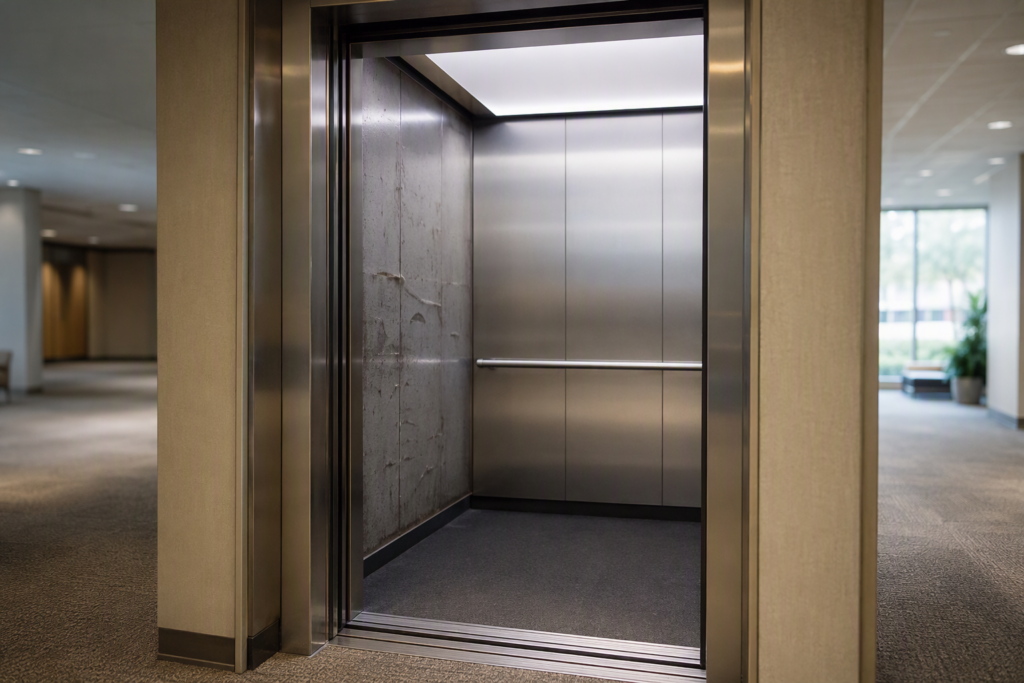
Specific red flags that point toward replacement include hydraulic cylinders with confirmed single-bottom jack construction (a known failure and environmental risk), traction machines with severely worn sheaves that cannot be re-machined, and original 1970s–1980s relay logic control panels where manufacturer support has completely ended. Modernization red flags, by contrast, are situations where the hoistway concrete or steel shows cracking, settlement, or fire damage — these structural problems make hoistway retention unwise regardless of equipment age.
What does a full elevator modernization typically include?
A complete modernization package covers the control system, drive unit, door operators, fixtures, safeties, and often the cab interior — essentially everything except the hoistway walls, pit, and cab structure.
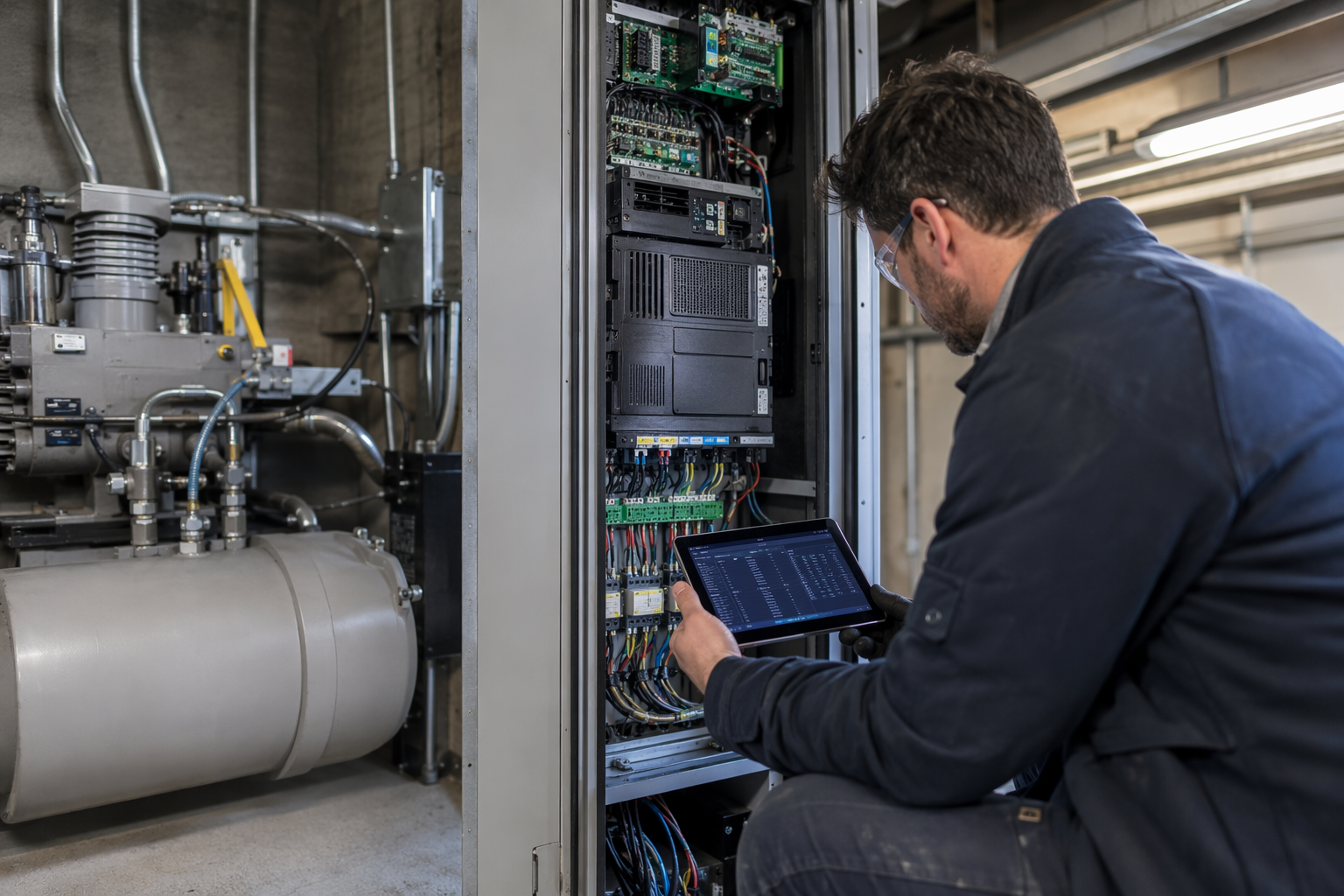
Breaking it down by subsystem helps building owners understand where their money goes. The control system (PLC-based or microprocessor) typically represents 25–35% of modernization cost. The drive unit — whether AC variable-frequency drive (VFD) for traction or new pump unit for hydraulic — accounts for another 20–30%. Door operators and entrance equipment run 15–20%, and cab interior finishes add 10–20% depending on material selections. Safety devices and electrical upgrades make up the remaining 10–15%.
Every modernization project in Texas and California must comply with ASME A17.1 Safety Code for Elevators and Escalators as adopted by the relevant state authority having jurisdiction (AHJ). Texas follows ASME A17.1-2019 under the Texas Department of Insurance (TDI) Elevator Safety program. California follows ASME A17.1-2019 under Cal/OSHA’s Elevator, Ride, and Tramway (ERT) Unit, with additional California-specific amendments.
What compliance codes apply to elevator modernization projects in Texas and California?
Both Texas and California require modernization work to bring upgraded systems into compliance with the current edition of ASME A17.1 and applicable state amendments, which can trigger additional upgrades beyond the original scope.
This is the compliance trap that catches building owners off guard. When you modernize a single system — say, just the controls — the AHJ may require that all other systems brought into the scope area meet current code. In Texas, TDI enforces this through permit review and final inspection. In California, Cal/OSHA ERT unit inspectors will flag non-compliant safeties, buffers, or door protection devices even when those items weren’t in the original modernization contract.
ADA compliance is a parallel obligation. Under ADA Title III, places of public accommodation that undertake alterations — which modernization qualifies as — must ensure the altered areas meet ADA Standards for Accessible Design to the maximum extent feasible. This means button heights, Braille markings, door timing, and audible signals may all require updating during modernization, adding $3,000–$15,000 to a typical project.
In 2026, building owners in Los Angeles and San Diego should also verify compliance with California’s seismic requirements for elevator equipment. ASCE 7 seismic design categories affect how elevator components must be anchored and braced, and modernization is an ideal time to address any seismic deficiencies.
How long does elevator modernization take compared to full replacement?
Modernization typically takes 4–8 weeks for a full scope, while complete replacement runs 12–24 weeks — a significant operational difference for buildings that cannot afford extended elevator downtime.
Timeline is often the deciding factor for occupied multi-tenant buildings, senior living facilities, and medical offices in markets like Austin and San Antonio where a single elevator may serve dozens of residents or patients daily. Modernization preserves the structural hoistway, which eliminates the most time-consuming phases of replacement: hoistway demolition, reinforcement, and rough-in inspections.
Lead times for equipment also matter. In 2026, supply chain conditions for elevator control systems from major OEMs such as Otis, Kone, Schindler, and Thyssenkrupp range from 8–20 weeks. Working with an independent certified contractor like AmeriTex Elevator gives building owners access to multiple control system manufacturers, often cutting lead times compared to single-brand OEM contracts.
What are the biggest hidden costs in elevator modernization projects?
The most common hidden costs are code-triggered upgrades, asbestos or lead abatement in older machine rooms, electrical panel upgrades, and permit fees — which can collectively add 15–35% above the initial modernization quote.
I’ve seen modernization projects in Houston and Dallas that started at $90,000 and ended at $130,000 because the building’s main electrical panel couldn’t support the new VFD drive without a service upgrade. Electrical infrastructure is almost always an overlooked line item. Ask your contractor explicitly: does the existing electrical service support the proposed drive and control system without panel upgrades?
Asbestos and lead paint abatement is another frequent surprise in buildings constructed before 1980. Machine rooms and pit areas in older Houston and Los Angeles commercial buildings commonly contain asbestos pipe insulation or lead-painted hoistway walls. Abatement costs range from $2,500 to $20,000+ depending on scope and cannot begin until a certified industrial hygienist completes an assessment.
Permit fees vary significantly by jurisdiction. In Los Angeles, elevator modernization permits through the LADBS can run $1,500–$4,000. Texas TDI permit fees are generally lower, ranging $300–$900, but third-party inspection fees add another $500–$1,500 per inspection stage.
How should building owners evaluate elevator modernization bids from contractors?
A valid modernization bid must specify the exact equipment manufacturer and model numbers, list all code compliance items included, identify permit and inspection fees, and define the warranty terms — bids missing any of these elements are not comparable to bids that include them.
The apples-to-oranges problem is rampant in elevator contracting. A $70,000 bid that excludes permit fees, third-party inspections, asbestos abatement coordination, and electrical upgrades is not cheaper than an $85,000 bid that includes them — it’s actually a hidden $95,000+ project. Always request a scope-of-work itemization, not just a total number.
Verify contractor credentials before signing anything. In Texas, elevator contractors must hold a current Texas Elevator Contractor License issued by TDI. In California, contractors must hold a C-11 Elevator Contractor License from the CSLB. Individual mechanics must hold state elevator mechanic certifications and, ideally, IUEC (International Union of Elevator Constructors) certification. AmeriTex Elevator holds all required state licenses across our Texas and California service markets, and every technician on our crews carries current state certification.
What is the ROI timeline for elevator modernization versus replacement?
Modernization typically achieves positive ROI within 3–5 years through reduced maintenance costs and energy savings, while full replacement ROI timelines run 8–15 years due to the higher initial capital outlay.
Modern VFD-controlled traction elevators consume 30–40% less energy than comparable older systems with older motor control technology. For a mid-rise building in Dallas running its elevator 14+ hours per day, that translates to $1,800–$4,500 per year in energy cost reduction — not insignificant when compounded over a 20-year equipment life. Hydraulic systems converted from single-speed to two-speed or variable-speed pump units see similar energy improvements.
Maintenance cost reduction is equally significant. An elevator running on original 1990s relay logic controls can cost $8,000–$15,000 annually in reactive service calls and parts sourcing because components are scarce. The same elevator with a modernized microprocessor control system and new door operators typically runs $2,500–$5,000 per year in maintenance — saving $5,000–$10,000 annually from day one post-modernization.
Property value and tenant retention are harder to quantify but real. Commercial real estate brokers in Houston and Austin consistently report that outdated elevator systems are a negotiating point that reduces lease rates and occupancy in Class B and C buildings. A modernized, code-compliant elevator with a clean inspection certificate removes that negative factor from lease negotiations.
Does elevator modernization require a permit and inspection in Texas and California?
Yes — all modernization work in Texas and California requires permits from the state authority having jurisdiction, and final inspections must be passed before the elevator returns to service.
In Texas, the permit is issued through TDI’s Elevator Safety Program. The contractor submits plans and equipment specifications, TDI reviews and issues the permit, work proceeds, and a licensed elevator inspector — either a TDI inspector or a TDI-approved third-party inspector — conducts the final acceptance inspection. Operating the elevator without a valid Certificate of Compliance after modernization is a violation and exposes building owners to liability.
In California, the Cal/OSHA ERT unit administers elevator permits and inspections. California’s process includes a plan check phase that can add 4–8 weeks to project timelines in busy markets like Los Angeles and San Diego. Building owners should factor this permit lead time into any project schedule planning.
What are the specific steps to start an elevator modernization project?
Follow this process to initiate a modernization project correctly and avoid costly scope changes mid-project:
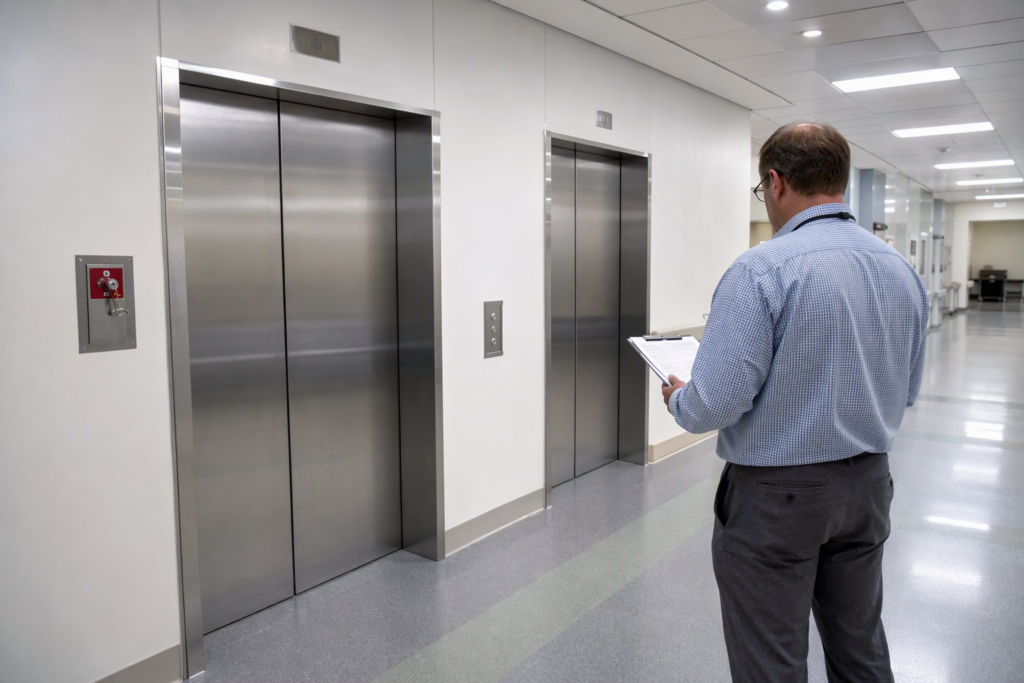
- Commission a condition assessment: Have a certified elevator technician perform a documented inspection of all systems — controls, drive, mechanical, safeties, doors, cab, pit, and machine room. This report becomes the basis for accurate bidding.
- Identify all code deficiencies: Cross-reference the inspection findings against current ASME A17.1 requirements and ADA standards. Document every item that will be required by the AHJ during permit review.
- Define the modernization scope in writing: Specify each subsystem to be replaced, the replacement equipment manufacturer and model, and all code compliance items. This written scope goes out to every bidding contractor identically.
- Solicit a minimum of three bids: Require each contractor to bid the identical written scope. Verify each bidder’s state contractor license and insurance certificates before accepting a bid for evaluation.
- Review bids for completeness: Confirm that each bid includes permit fees, inspection fees, warranty terms, equipment lead times, and a project schedule with key milestones.
- Confirm electrical infrastructure: Have a licensed electrician verify that the existing electrical panel and feeder circuits meet the new equipment’s requirements before finalizing the contract.
- Apply for permits: Your selected contractor submits the permit application with equipment submittals to TDI (Texas) or Cal/OSHA ERT (California). Do not schedule equipment delivery until permit approval is confirmed.
- Plan for downtime: Notify building occupants and tenants of the elevator outage schedule. For buildings with a single elevator serving mobility-impaired occupants, prepare a temporary accommodation plan compliant with ADA obligations.
- Monitor the installation: Request weekly progress updates from your contractor tied to the project schedule. Verify that equipment matches the approved submittals before installation begins.
- Schedule and pass final inspection: Coordinate the final inspection date with your contractor and the AHJ. Ensure the contractor has addressed all punch-list items before the inspector arrives.
When does elevator replacement make more financial sense than modernization?
Replacement makes financial sense when structural hoistway repairs alone would exceed 40–50% of replacement cost, when the building’s capacity or configuration needs fundamentally change, or when the existing system type is being converted to a different drive technology.
A common replacement-justified scenario is converting an older hydraulic elevator in a mid-rise Houston office building to a machine-room-less (MRL) traction system. This conversion recaptures the machine room square footage — which in a Houston Class A building can be worth $200–$400 per square foot — and may generate enough recovered rentable area to offset the premium replacement cost over modernization. This calculation requires a real estate advisor’s input alongside the elevator contractor’s numbers.
Single-bottom hydraulic cylinders are another clear replacement trigger. These older cylinders lack the secondary containment required by current environmental regulations and present a groundwater contamination risk. Texas Commission on Environmental Quality (TCEQ) and California’s Regional Water Quality Control Boards both have regulations that can impose significant remediation liability on building owners with leaking underground hydraulic cylinders. Replacing the entire hydraulic system eliminates this long-term environmental exposure.
How does elevator age affect the modernization vs. replacement decision?
Elevators under 20 years old are almost universally better candidates for targeted modernization, while elevators over 35 years old warrant a more rigorous structural assessment before committing to modernization over replacement.
The 20–35 year range is where the decision requires the most careful analysis. In that window, the hoistway and cab structure are typically sound, but multiple systems may be approaching end-of-life simultaneously. A thorough condition assessment from a qualified technician can identify whether a phased modernization — upgrading systems in planned stages over 3–5 years — is viable, or whether the concentration of failing systems makes a comprehensive one-time project more cost-effective.
Elevators installed before 1990 in Texas and California markets are particularly worth scrutinizing for parts availability. Several major control system manufacturers from that era — Westinghouse, Dover, and Montgomery — have been acquired or discontinued. Parts for these legacy systems are sourced through specialty suppliers at premium prices, and availability is declining year over year through 2026. This parts scarcity accelerates the economic case for modernization.
What energy efficiency gains can building owners expect from elevator modernization?
A modernized elevator with a variable-frequency drive and regenerative drive technology typically reduces elevator energy consumption by 30–50% compared to original equipment, with payback periods of 4–8 years from energy savings alone.
Regenerative drive technology — available on most modern traction elevator systems — captures the energy generated when a loaded cab descends or an empty cab ascends and feeds it back to the building’s electrical grid. In a busy commercial building in Dallas or San Diego, this can reduce net elevator energy consumption by an additional 20–30% beyond basic VFD savings. For buildings pursuing LEED certification or ENERGY STAR scores, modernized elevator systems contribute meaningfully to energy performance metrics.
LED cab lighting upgrades, which are typically included in cab interior modernization, add another 60–80% reduction in lighting energy compared to fluorescent fixtures. While the dollar savings from lighting alone are modest ($200–$600 per year), every efficiency improvement compounds in buildings with multiple elevator units.
How do elevator modernization costs differ between Houston, Dallas, Austin, San Antonio, Los Angeles, and San Diego?
Texas markets (Houston, Dallas, Austin, San Antonio) run 15–25% lower in total modernization cost than California markets (Los Angeles, San Diego) primarily due to labor rate differences, California prevailing wage requirements on public projects, and California’s more complex permitting process.
In Houston and Dallas, a full elevator modernization for a standard 4-stop commercial hydraulic elevator averages $75,000–$120,000 in 2026. The same scope in Los Angeles runs $95,000–$155,000, and San Diego falls in a similar range at $90,000–$150,000. Austin and San Antonio pricing is comparable to Houston and Dallas, though Austin’s construction market has tightened, narrowing the gap slightly with California pricing in recent years.
California’s prevailing wage requirements apply to elevator work on public buildings, schools, and government facilities — adding 20–35% to labor costs for those project types. Private commercial projects in California are not subject to prevailing wage, though the union labor market in Los Angeles still commands higher rates than Texas non-prevailing-wage projects. AmeriTex Elevator’s multi-market presence means we can provide locally calibrated pricing across all six of our service markets without the overhead of national OEM contracting structures.
What warranty should building owners expect on modernization work and new equipment?
Industry-standard warranty coverage for modernization work is 12–24 months on labor and 12 months on parts, though premium independent contractors may offer 24-month comprehensive warranties — always get warranty terms in writing before signing any contract.
Equipment manufacturer warranties vary by component. Control systems from major manufacturers typically carry 12–18 month warranties. Drive units and pump assemblies may carry 24-month warranties. Door operators commonly carry 12-month warranties with wear parts excluded. The labor warranty from your contractor covers workmanship issues that arise during the warranty period — callbacks to address installation defects should be at no additional charge.
Be cautious of “parts-only” warranties buried in low-bid contracts. A $5,000 labor call-back to address a workmanship defect in the first year of operation can wipe out the apparent savings of a low-bid contract. Ask every contractor explicitly: what is the labor warranty, and what is explicitly excluded?
How does elevator modernization affect building insurance and liability?
A modernized, currently code-compliant elevator with a valid Certificate of Compliance materially reduces a building owner’s liability exposure and can reduce elevator-related insurance premiums by 10–25% depending on the carrier and claims history.
Insurance underwriters assess elevator liability risk based on equipment age, last modernization date, current code compliance status, and maintenance history. A building with a 35-year-old elevator running on original equipment and an overdue inspection is a high-risk profile. A building with a recently modernized elevator, current Certificate of Compliance, and active maintenance contract is a materially different risk profile. Request a re-rating from your insurance broker after modernization is complete — the premium reduction may offset a meaningful portion of the project cost over the equipment’s service life.
From a liability standpoint, building owners have a duty of care to maintain elevators in a safe, code-compliant condition under both Texas and California law. An elevator accident on outdated, non-compliant equipment where the owner deferred modernization is an extremely difficult liability defense position. Modernization is not just a capital investment — it’s risk management.
What questions should I ask an elevator contractor before hiring them for modernization?
The seven most critical questions to ask before signing a modernization contract are: What is your state contractor license number? Who manufactures the control system you’re proposing? Does your bid include all permit and inspection fees? What is your project schedule including equipment lead time? What is your labor warranty period? Have you completed comparable projects in this building type? And can you provide three current references from similar modernization projects?
Beyond these baseline questions, ask specifically about the contractor’s familiarity with your AHJ. A contractor who regularly pulls permits with TDI in Texas or the Cal/OSHA ERT unit in California will navigate the review process faster and with fewer surprises than a contractor who rarely works in your jurisdiction. Local relationship and permit experience is a real project efficiency variable — not just a soft preference.
Demand proof of general liability insurance (minimum $1M per occurrence in Texas, $2M in California is strongly advisable) and workers’ compensation coverage before any technician sets foot in your machine room. Building owners can be held jointly liable for contractor workers’ compensation claims in some circumstances, making this a genuine financial risk, not just a formality.
Can elevator modernization be done in phases to spread out costs?
Yes — phased modernization is a legitimate and commonly used strategy that allows building owners to spread capital expenditure over 2–5 years while prioritizing the most critical systems first, typically controls and safeties in phase one.
A typical phased approach for a 25-year-old traction elevator might look like this: Phase 1 (Year 1) — control system and door operators, $40,000–$65,000, addressing the most common failure points and bringing the elevator into basic AHJ compliance. Phase 2 (Year 2–3) — drive unit upgrade and machine room electrical, $25,000–$45,000. Phase 3 (Year 4–5) — cab interior, fixtures, and final compliance items, $15,000–$35,000.
The risk with phased modernization is that code compliance triggers can surface in later phases that require going back to earlier systems. Work with your contractor to map out all known code compliance requirements across the entire planned scope before phasing begins, so the phasing plan is structured to avoid costly rework. AmeriTex Elevator routinely develops multi-year modernization roadmaps for building owners in Houston, Dallas, Austin, San Antonio, Los Angeles, and San Diego — it’s one of the planning services we include in our initial elevator assessments at no additional charge.
What is the typical lifespan of a modernized elevator versus a new elevator?
A fully modernized elevator has an expected service life of 15–25 years post-modernization, which is comparable to the practical service life of a newly installed elevator before its first major modernization cycle is required.
New elevators installed in 2026 will likely require their first significant modernization cycle between 2041 and 2051, primarily driven by control system obsolescence and door operator wear — the same systems that drive modernization needs today. This equivalence in forward-looking service life is the most powerful financial argument for modernization over replacement when the structural elements are sound. You are effectively buying the same remaining service life at 40–60% of the cost.
The key variable is the quality of the modernization work itself. A modernization using second-tier control systems with limited manufacturer support, or using refurbished rather than new drive components, will not achieve the full 20–25 year expectation. Specify new, currently manufactured equipment from established suppliers with confirmed parts support commitments of at least 15 years — and get that commitment in writing from the equipment manufacturer, not just the installing contractor.
How do I find a qualified elevator modernization contractor in Houston, Dallas, Austin, San Antonio, Los Angeles, or San Diego?
A qualified elevator modernization contractor in any of these markets must hold a current state elevator contractor license, employ IUEC-certified or state-certified mechanics, carry adequate liability and workers’ compensation insurance, and have a documented portfolio of comparable modernization projects in the local market.
In Texas, verify contractor licenses through the TDI Elevator Safety Contractor License lookup tool. In California, verify the C-11 Elevator Contractor License through the CSLB license check. Both verification steps take less than five minutes and should be non-negotiable before any site visit or bid request.
Beyond licensing, look for contractors who offer a documented condition assessment before the bid process — not just a walk-through with a verbal quote. A contractor willing to invest in a thorough written assessment demonstrates technical rigor and gives you a defensible basis for comparing competing bids on equal terms. AmeriTex Elevator provides complimentary condition assessments for building owners across all our service markets, delivered as a written report with photographic documentation and a code compliance checklist. It’s the starting point for every modernization project we take on, and it costs our clients nothing upfront.
Ready to Know What Your Elevator Really Needs?
After 15 years in this industry, I’ve seen too many building owners make a $250,000 replacement decision when a $90,000 modernization would have served them just as well for the next 20 years — and too many others patch a system that genuinely needed replacement, spending $40,000 on a band-aid before doing the full project anyway two years later. The difference between those outcomes is a thorough, honest condition assessment from a qualified technician who doesn’t have a financial stake in steering you toward the higher-cost option.
AmeriTex Elevator provides certified elevator condition assessments, modernization planning, full modernization and replacement services, and ongoing maintenance contracts across Houston TX, Dallas TX, Austin TX, San Antonio TX, Los Angeles CA, and San Diego CA. All work is performed by state-licensed, IUEC-certified technicians under active state contractor licenses in Texas and California.
Contact AmeriTex Elevator for a free elevator assessment. We’ll inspect your equipment, document all code compliance items, and give you a straight answer on whether modernization or replacement is the right path — with numbers to back it up.
Call us today: 866-679-4313
Need elevator service you can rely on? AmeriTex Elevator is ready to help.