State regulations in Texas and California do not leave elevator maintenance to chance. Both states mandate that only properly credentialed companies perform any work on a conveyance — including pit cleaning, lubrication, safety device testing, and all other tasks listed in the adopted maintenance code. If a provider cannot demonstrate the required registration or certification, building owners face compliance exposure that can result in equipment being removed from service, fines, and liability for accidents. The sections below answer every related question building owners, facility managers, and property managers commonly ask in 2026.
What does state law actually require from an elevator maintenance provider?
Both Texas and California require that elevator maintenance be performed exclusively by companies that hold a specific government-issued registration or certification — not simply a general contractor license.
In Texas, any person or company that installs, repairs, alters, tests, or maintains elevator equipment must be registered as a contractor with the Texas Department of Licensing and Regulation (TDLR), Elevator and Escalator Safety program, under Texas Health and Safety Code Chapter 754 and 16 Texas Administrative Code Chapter 74. That registration must be renewed annually, and the contractor must carry general liability insurance of at least $1,000,000 per occurrence for bodily injury or death and $500,000 per occurrence for property damage. Each registered Texas contractor must also designate one or two responsible parties with at least three years of elevator contractor experience.
In California, the bar is set through a two-layer system administered by the Division of Occupational Safety and Health (Cal/OSHA), Elevator Unit, California Department of Industrial Relations, under California Labor Code Sections 7300–7324.2 and the California Code of Regulations, Title 8, Elevator Safety Orders. Any company that maintains, repairs, alters, or replaces components on a conveyance must be certified by Cal/OSHA as a Certified Qualified Conveyance Company (CQCC). Individual mechanics must hold Cal/OSHA’s Certified Competent Conveyance Mechanic (CCCM) credential. Both certificates last two years and require at least eight hours of continuing education for renewal. CQCC applicants must also hold a C-11 Elevator Contractor license issued by the California Contractors State License Board (CSLB).
AmeriTex Elevator operates within these regulatory frameworks across its Texas and California markets — Houston, Dallas, Austin, San Antonio, Los Angeles, and San Diego — ensuring that every maintenance visit is performed by personnel who meet the applicable state requirements.
Does state regulation specifically require pit cleaning, or is that optional?
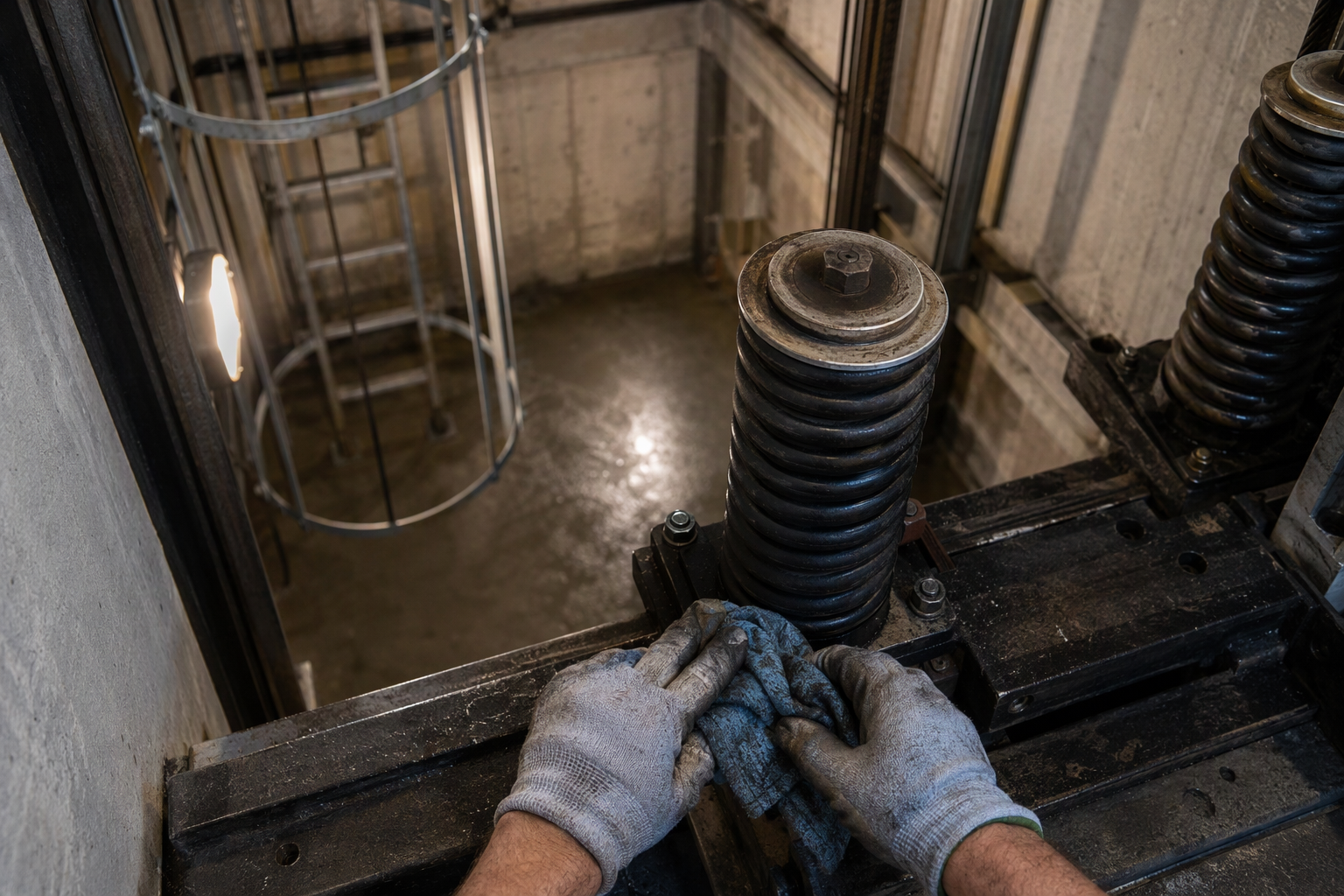
Pit cleaning is not optional — it is a maintenance obligation embedded in the ASME A17.1 Safety Code for Elevators and Escalators, which both Texas and California have adopted as their governing technical standard.
ASME A17.1 includes Rule 8.6, the Maintenance, Repair, and Replacement section, which requires that elevators and their component spaces — including the pit — be kept clean and free from accumulations of oil, grease, water, and debris. Because Texas has adopted ASME A17.1/CSA B44, 2016 edition (effective November 1, 2018), and California has adopted ASME A17.1/CSA B44, 2004 edition for equipment governed by its current Group IV Elevator Safety Orders, those pit-cleaning requirements carry the force of state law in both jurisdictions. A maintenance provider that skips pit cleaning is not simply cutting corners — they are failing to perform a task that the adopted state code mandates. If an inspector finds a contaminated pit, the building owner bears the compliance consequence, not the provider.
What specific maintenance tasks does the adopted code require a provider to perform?
The adopted ASME A17.1 standard defines a broad scope of mandatory maintenance that goes well beyond pit cleaning.
Under the ASME A17.1 Maintenance, Repair, and Replacement rules, a compliant provider must keep all equipment in a safe operating condition by performing, at the intervals specified in the standard, tasks that include:
- Pit inspection and cleaning — removing oil, water, and debris
- Lubrication of guide rails, governor components, and other moving parts
- Inspection and adjustment of door operator mechanisms, hangers, and gibs
- Testing and adjustment of safeties, buffers, and speed governors
- Inspection of wire ropes or chains for wear, corrosion, and proper tension
- Verification of lighting in the pit, machine room, and car top
- Testing of emergency lighting and alarm systems
- Inspection and testing of firefighters’ service (Phase I and Phase II)
- Verification of proper operation of door restrictors
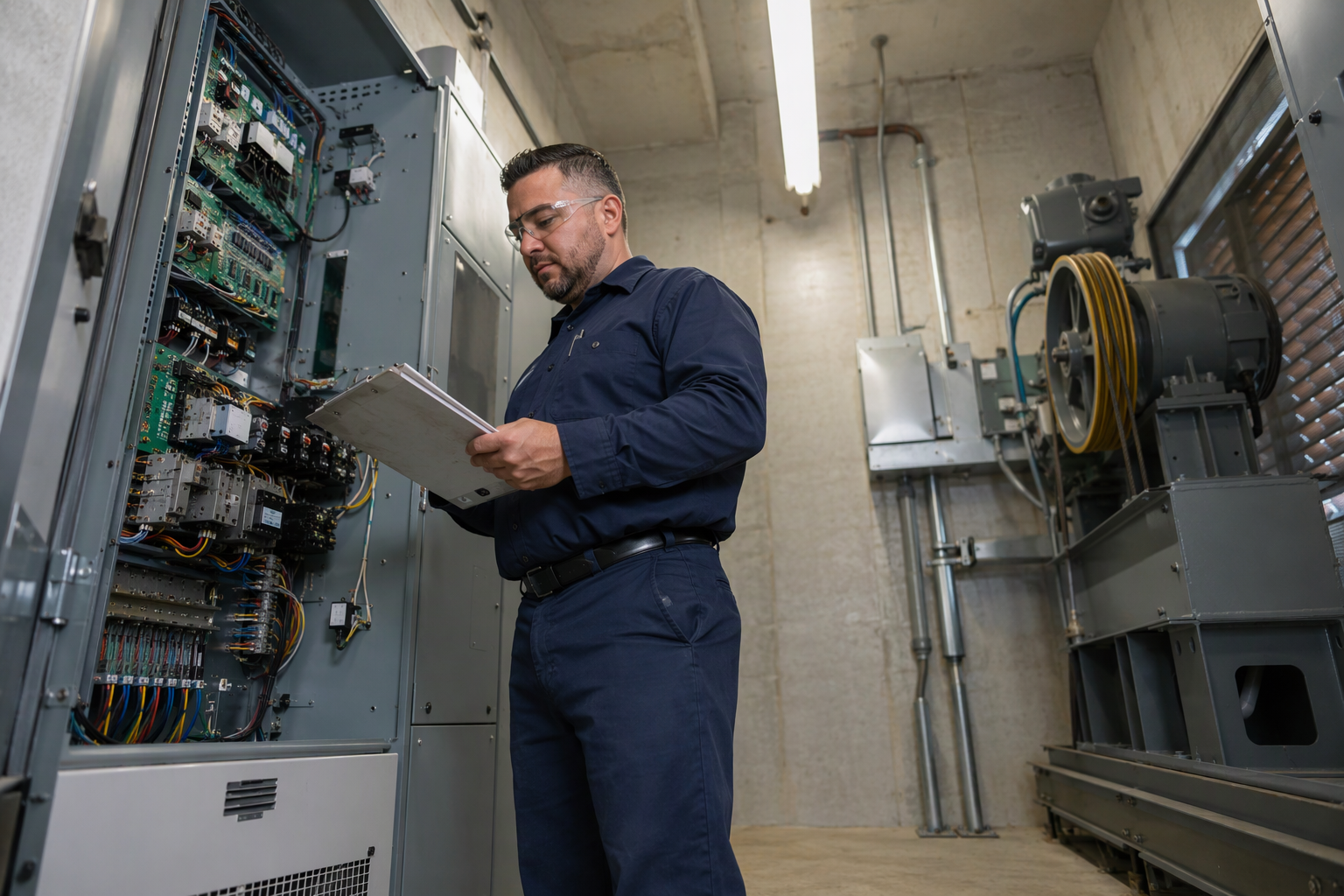
- Machine room housekeeping — keeping the space clean and free of stored materials
In Texas, the criticality of some of these items is underscored by removal-from-service mandates: a passenger elevator without working door restrictors must be taken out of service immediately, and a passenger elevator without properly functioning firefighters’ service must also be removed from service immediately under 16 Texas Administrative Code Chapter 74.
How does the inspection process differ from the maintenance provider’s obligations?
Inspections and maintenance are legally separate functions, performed by different parties under state regulation — confusing the two is a common and costly mistake for building owners.
In Texas, a TDLR-registered elevator inspector — who is not a TDLR employee and is selected by the building owner — performs the annual inspection and must deliver the inspection report to the owner within five calendar days. The inspector issues findings; the registered contractor fixes them. Texas building owners must have cited violations corrected or under contract for correction within 30 days of the inspection, or obtain a waiver or delay from TDLR. The building owner must then obtain a TDLR Certificate of Compliance for each unit and display it in a publicly visible area of the building. Note: TDLR does not regulate elevators inside Houston city limits — the City of Houston operates its own elevator program, and building owners in Houston should verify requirements directly with the city.
In California, only Cal/OSHA State safety engineers and Certified Competent Conveyance Inspectors (CCCI) may perform elevator inspections. Cal/OSHA issues a permit to operate for up to one year when an elevator is found safe; that permit must be posted conspicuously inside the elevator car. When a building is covered by a full maintenance contract with a C-11 licensed elevator company, Cal/OSHA may extend that permit to operate for up to two years. Arranging the annual reinspection is the elevator owner’s responsibility — not the maintenance provider’s. In the City of Los Angeles, the Los Angeles Department of Building and Safety (LADBS) runs its own elevator and conveyance inspection program; Los Angeles building owners should confirm current requirements directly with LADBS.
What happens if my current provider is not registered or certified as required?
An unregistered or uncertified provider is legally prohibited from touching the elevator, and any work they perform is non-compliant — exposing the building owner to serious legal and financial consequences.
If a California provider lacks CQCC certification, any maintenance performed violates California Labor Code Sections 7300–7324.2. Cal/OSHA can deny or revoke the permit to operate, effectively shutting the elevator down. In Texas, work performed by an unregistered contractor violates Texas Health and Safety Code Chapter 754, and TDLR can take enforcement action against both the contractor and, in some circumstances, the building owner for knowingly allowing non-compliant work. Beyond regulatory penalties, building owners who experience an elevator accident while using an unregistered provider face significant tort liability, because the failure to use a lawfully qualified contractor is evidence of negligence in premises liability claims.
How can a building owner verify that their current provider is properly credentialed?
Verification takes only a few minutes using the official online lookup tools maintained by the state regulators.
- In Texas, visit the TDLR Elevator and Escalator Safety program page and use the license search function to confirm the contractor’s current registration status and insurance certificate are on file.
- In California, visit the Cal/OSHA Elevator Unit page and verify the company’s CQCC certification and each mechanic’s CCCM credential. Credentials expire every two years, so check the expiration date, not just active status.
- Ask the provider for a copy of their C-11 license (California) or their TDLR registration certificate (Texas) and cross-reference the license number against the state database.
- Confirm that the provider’s general liability insurance certificate meets the Texas minimums ($1,000,000 per occurrence for bodily injury or death; $500,000 per occurrence for property damage) or California’s comparable insurance requirements for CQCC applicants.
- Request a written maintenance log from the provider demonstrating that all ASME A17.1-required tasks — including pit cleaning — have been performed at the code-specified intervals.
What is a full maintenance contract, and why does it matter for compliance?
A full maintenance contract is a formal agreement under which a certified or registered elevator company commits to performing all ASME A17.1-required maintenance tasks on a defined schedule — and in California it carries a specific regulatory benefit.
California’s elevator regulations allow Cal/OSHA to issue a permit to operate for up to two years — rather than the standard one year — for an elevator covered by a full maintenance contract with a C-11 licensed elevator company. This two-year permit is not automatic; Cal/OSHA still makes the determination based on the elevator’s condition. However, the extended permit reflects the state’s recognition that comprehensive, documented maintenance materially reduces safety risk. Building owners who rely on ad hoc or partial maintenance arrangements do not qualify for this benefit and must arrange annual reinspections every year without exception.
In Texas, while TDLR does not use the same two-year permit mechanism, a full maintenance contract still provides critical operational protection: it ensures all ASME A17.1-2016 tasks are covered, creates documentation for the building owner when TDLR inspectors find violations, and supports the 30-day correction timeline that Texas law requires.
AmeriTex Elevator provides structured maintenance agreements designed to satisfy the full maintenance contract standards recognized by both California and Texas regulators, covering all code-mandated tasks from pit cleaning to firefighters’ service testing.
How often must elevator maintenance and inspections occur under state regulations?
Both Texas and California require annual inspections at minimum, while ongoing maintenance must follow the intervals set by the adopted ASME A17.1 edition — which prescribes tasks on monthly, quarterly, semi-annual, and annual cycles.
| Requirement | Texas (TDLR / 16 TAC Ch. 74) | California (Cal/OSHA / Title 8) |
|---|---|---|
| Governing code edition | ASME A17.1/CSA B44, 2016 ed. (eff. Nov. 1, 2018) | ASME A17.1/CSA B44, 2004 ed. (Group IV, eff. May 1, 2008) |
| Minimum inspection frequency | Annually by a TDLR-registered inspector | At least once per year by a Cal/OSHA safety engineer or CCCI |
| Permit / certificate validity | TDLR Certificate of Compliance — 1 year | Permit to operate — up to 1 year (up to 2 years with full maintenance contract) |
| Category 5 full-load test | Every 5 years (electric/traction elevators) | Governed by ASME A17.1-2004 test intervals |
| Violation correction deadline | 30 days (or waiver/delay from TDLR) | As directed by Cal/OSHA on inspection report |
| Who selects the inspector | Building owner | Inspection arranged by building owner; inspector must be Cal/OSHA engineer or CCCI |
| Accident reporting | Within 24 hours to TDLR | Governed by Cal/OSHA reporting requirements |
| Who may perform maintenance | TDLR-registered contractor | CQCC-certified company / CCCM-certified mechanics only |
| Houston exception | City of Houston runs its own program; TDLR does not regulate within city limits | N/A |
| Los Angeles exception | N/A | LADBS runs its own program within Los Angeles city limits |
Does the ADA impose additional maintenance obligations on elevator owners?
Yes — the Americans with Disabilities Act (ADA) requires that elevators in covered facilities be maintained in operable condition, and an elevator that is out of service due to deferred maintenance can constitute an ADA violation.
Under the ADA, public accommodations and commercial facilities that provide elevator access as part of their accessible route must keep that elevator operational. Isolated, temporary outages for maintenance are permissible, but chronic unavailability due to neglected maintenance — including dirty or flooded pits that cause component failures — can expose building owners to ADA enforcement actions and private lawsuits. The ADA does not set elevator-specific maintenance schedules, but it creates an independent legal obligation that runs parallel to state code requirements. A building that is current on TDLR or Cal/OSHA compliance but has an elevator that is routinely out of service due to poor maintenance can still face ADA liability.
What is OSHA’s role in elevator pit safety and maintenance worker protection?
The Occupational Safety and Health Administration (OSHA) governs the working conditions of elevator mechanics performing pit cleaning and other maintenance tasks — separate from the state elevator safety codes that govern equipment condition.
OSHA regulations require that maintenance personnel entering elevator pits follow lockout/tagout (LOTO) procedures to de-energize equipment before work begins, that confined-space entry rules be followed where applicable, and that fall protection and proper lighting standards are met. These worker-safety obligations apply to the maintenance contractor’s employees. A registered or certified elevator company will have OSHA-compliant procedures for pit entry and confined-space work. Building owners should verify that any provider they engage has documented LOTO and pit-entry procedures — the absence of such procedures is a warning sign that the company may also be cutting corners on code-required maintenance tasks.
Can a building owner or in-house facilities staff perform elevator pit cleaning themselves?
No — in both Texas and California, maintenance work on a conveyance, including pit cleaning, must be performed by a qualified, credentialed elevator contractor, not by building staff.
In California, only a Certified Competent Conveyance Mechanic working for a Certified Qualified Conveyance Company may maintain, repair, alter, or replace components on a conveyance. Pit cleaning that involves contact with elevator equipment — removing oil from buffers, clearing debris from guide-rail shoes, draining water from the sump — constitutes maintenance work under the California Code of Regulations, Title 8, Elevator Safety Orders. In Texas, maintenance must be performed by a TDLR-registered contractor. While some jurisdictions permit building staff to perform very minor housekeeping in common areas, any work inside the pit that touches elevator components is regulated activity. Building owners who attempt self-service maintenance also void the documentation trail that inspectors and courts look for when evaluating compliance.
What are the consequences of skipping or delaying required maintenance tasks?
Skipping mandated maintenance tasks can trigger a cascade of regulatory, financial, and safety consequences that far exceed the cost of the maintenance itself.
From a regulatory standpoint, an inspector who finds unperformed maintenance — a contaminated pit, inadequate lubrication, non-functional safety devices — will cite violations. In Texas, those violations must be corrected or under contract within 30 days, or the building owner must obtain a waiver or delay from TDLR. Failure to meet that deadline can result in the Certificate of Compliance being withheld, which means the elevator cannot legally operate. In California, Cal/OSHA can decline to issue or can revoke a permit to operate, shutting the elevator down until deficiencies are corrected. Beyond regulatory penalties, deferred maintenance accelerates component wear, increases the likelihood of entrapment or injury, and creates documented evidence of negligence that plaintiffs can use in personal injury litigation. Texas law also requires accident reporting to TDLR within 24 hours — an accident caused by a maintenance deficiency generates an immediate regulatory and legal event.
What should a building owner do if they suspect their current provider is not meeting code requirements?
Building owners who suspect their provider is non-compliant should take immediate, documented steps to protect themselves and their occupants.
- Pull the maintenance logs: Request all service records from the current provider in writing. Logs should show the date, tasks performed, and the technician’s credential number for every visit.
- Verify credentials: Cross-check the provider’s TDLR registration (Texas) or Cal/OSHA CQCC certification (California) and confirm current status and expiration dates using the state regulator’s online database.
- Compare tasks to code: Measure the logged tasks against the ASME A17.1 maintenance requirements. Pit cleaning, lubrication, safety device testing, and machine room housekeeping should appear at their code-specified intervals.
- Commission an independent inspection: In Texas, the building owner has the sole right to select the inspector — engage a TDLR-registered inspector who is not affiliated with the current provider for an objective assessment. In California, arrange a Cal/OSHA inspection or engage a CCCI.
- Document everything: Send written notice to the current provider of any identified gaps and retain a copy. This documentation is essential for contract termination disputes and regulatory inquiries.
- Contact AmeriTex Elevator: AmeriTex Elevator serves building owners in Houston, Dallas, Austin, San Antonio, Los Angeles, and San Diego who need a credentialed second opinion or a transition to compliant maintenance.
How does switching elevator maintenance providers affect compliance status?
Switching providers does not reset or erase compliance obligations — the building owner remains responsible for the equipment’s condition at the moment of transition, which makes a thorough onboarding inspection by the new provider essential.
When a new registered or certified provider takes over a maintenance contract, best practice — and regulatory prudence — dictates performing a comprehensive condition assessment before the first routine service visit. This assessment should document the state of the pit, machine room, car, and all safety devices, so the incoming provider is not responsible for deficiencies created by the predecessor. In Texas, if violations exist at the time of the next annual inspection, the building owner has 30 days to correct them or obtain a TDLR waiver — having a documented transition assessment from the new provider supports the owner’s position that remediation is underway. In California, incoming providers should review the existing permit to operate and confirm that all conditions Cal/OSHA placed on it are being met.
Are there maintenance requirements specific to traction elevators versus hydraulic elevators?
Yes — ASME A17.1 distinguishes between elevator types and prescribes maintenance and testing tasks specific to each design, and Texas state regulations layer additional requirements on top for traction equipment.
Traction (electric) elevators require maintenance of wire ropes or belts, sheaves, braking systems, and machine room equipment including motor-generators or drives. Texas requires a Category 5 full-load test every five years on electric traction elevators — a test that must be performed by a TDLR-registered contractor and witnessed by a registered inspector. Hydraulic elevators require maintenance of the hydraulic power unit, cylinder, jack, piping, and fluid — including periodic checks for underground cylinder leakage where applicable. Pit cleaning requirements apply to both types, though the sources of contamination differ: traction systems may deposit lubricant and metal debris, while hydraulic systems present fluid leak risks that have both environmental and safety implications. Building owners should confirm that their maintenance contract specifies tasks for the actual elevator type installed, not a generic checklist.
What records should a compliant maintenance provider maintain and provide?
A compliant provider must maintain detailed service records that demonstrate code-required tasks were performed by credentialed personnel on the schedule the adopted ASME A17.1 edition specifies.
Minimum compliant documentation includes: date and time of each service visit; name and credential number of the mechanic(s) who performed the work; specific tasks completed with notation of any findings or adjustments; parts replaced, with manufacturer and part numbers; test results for any safety devices tested; and a notation for any deferred items with a planned correction date. In Texas, the building owner should retain inspection reports delivered by the TDLR-registered inspector within five calendar days of each inspection, along with the TDLR Certificate of Compliance. In California, the permit to operate must be posted in the car at all times, and the building owner should retain Cal/OSHA inspection correspondence. During a regulatory audit, enforcement action, or litigation, complete, unbroken maintenance records are the primary evidence of compliance — gaps in those records are treated as gaps in the maintenance itself.
Does California’s proposed Group V update change maintenance requirements in 2026?
Not yet — as of 2026, California’s current elevator maintenance requirements remain governed by the Group IV Elevator Safety Orders, which adopt ASME A17.1/CSA B44, 2004 edition.
California has proposed a Group V update to its Elevator Safety Orders that would incorporate ASME A17.1-2019 in part. The California Standards Board held the public hearing on June 18, 2026, and no effective date has been posted for the Group V rules. Building owners and maintenance providers in California should not treat the 2019 edition as currently enforceable — the 2004 edition remains in force for equipment covered by the Group IV orders. AmeriTex Elevator monitors regulatory developments in both Texas and California markets so that maintenance programs can be updated as soon as new requirements take effect.
What role does the machine room play in regulatory compliance, and is it included in maintenance obligations?
The machine room is a regulated space under ASME A17.1, and maintaining it in a clean, organized, and properly lit condition is as much a code obligation as pit cleaning.
ASME A17.1 requires that machine rooms be kept clean, properly ventilated, and used exclusively for elevator equipment — no storage of building supplies, tools, or other materials is permitted. Machine room lighting must meet code minimums. Fire suppression, if installed, must be functional. The machine room environment directly affects equipment longevity and safety: excessive heat from poor ventilation degrades drive electronics; contamination from stored materials can introduce foreign debris into drive systems. A maintenance provider whose scope excludes machine room housekeeping and environmental checks is not delivering a code-compliant service. During inspections in Texas and California, machine room conditions are reviewed and cited just as readily as pit conditions.
How do local programs in Houston and Los Angeles affect maintenance compliance?
Building owners in Houston and Los Angeles operate under local elevator programs that run independently from their respective state regulators, which means additional or different requirements may apply beyond what TDLR or Cal/OSHA specify.
In Houston, TDLR does not regulate elevators or escalators inside the city limits — the City of Houston operates its own program. Building owners and maintenance contractors in Houston must comply with the city’s program rather than TDLR’s statewide rules. Maintenance providers serving Houston must be familiar with the city’s requirements, and building owners should verify compliance directly with the City of Houston’s program. In Los Angeles, the Los Angeles Department of Building and Safety (LADBS) runs its own elevator and conveyance inspection program. Los Angeles building owners and their maintenance providers must work within the LADBS framework, which may differ in procedures and requirements from the Cal/OSHA statewide program. AmeriTex Elevator serves customers in both Houston and Los Angeles and maintains working knowledge of local program requirements in those markets.
What should a building owner look for when evaluating a new elevator maintenance provider?
Selecting a compliant elevator maintenance provider requires verifying credentials, reviewing contract scope, and assessing the provider’s familiarity with both state and local regulatory requirements in the specific market where the building is located.
A checklist for evaluation should include the following:
- State registration / certification: Confirmed TDLR contractor registration (Texas) or Cal/OSHA CQCC certification (California) with current expiration dates verified in the state database
- Individual mechanic credentials: In California, every mechanic performing work must hold a current Cal/OSHA CCCM certificate
- Insurance compliance: In Texas, minimum $1,000,000 per occurrence for bodily injury or death and $500,000 per occurrence for property damage; comparable documentation in California
- Contract scope: Written confirmation that all ASME A17.1-required maintenance tasks — including pit cleaning, lubrication, safety device testing, and machine room maintenance — are included, not treated as extra-cost items
- Local program knowledge: For Houston properties, familiarity with the City of Houston’s program; for Los Angeles properties, familiarity with LADBS requirements
- Recordkeeping: A defined process for delivering service reports to the building owner after every visit, with technician credential numbers on each report
- Category 5 test capability: For Texas traction elevator owners, confirmation that the provider can arrange and perform the five-year full-load test with a registered inspector present
- Responsive maintenance: A clear process for addressing safety-critical deficiencies — in Texas, door restrictors and firefighters’ service failures require immediate removal from service, so the provider must have a protocol for those events
AmeriTex Elevator serves building owners across Houston, Dallas, Austin, San Antonio, Los Angeles, and San Diego with maintenance programs designed to meet these criteria in every market the company operates in.
Contact AmeriTex Elevator for a free elevator assessment at 844-646-9660.
Need elevator service you can rely on? AmeriTex Elevator is ready to help.