Who Should I Contact for Elevator Maintenance, and What Does It Cost?
Contact a state-licensed elevator maintenance company to handle all routine servicing, code-required inspections, and repairs. Maintenance costs depend on elevator type, usage frequency, equipment age, geographic market, and contract scope. Property owners in Texas and California should work with a certified provider familiar with local authority-having-jurisdiction (AHJ) requirements and current ASME A17.1 Safety Code for Elevators and Escalators standards to avoid compliance gaps and unexpected repair costs.
Who is the right contact for elevator maintenance services?
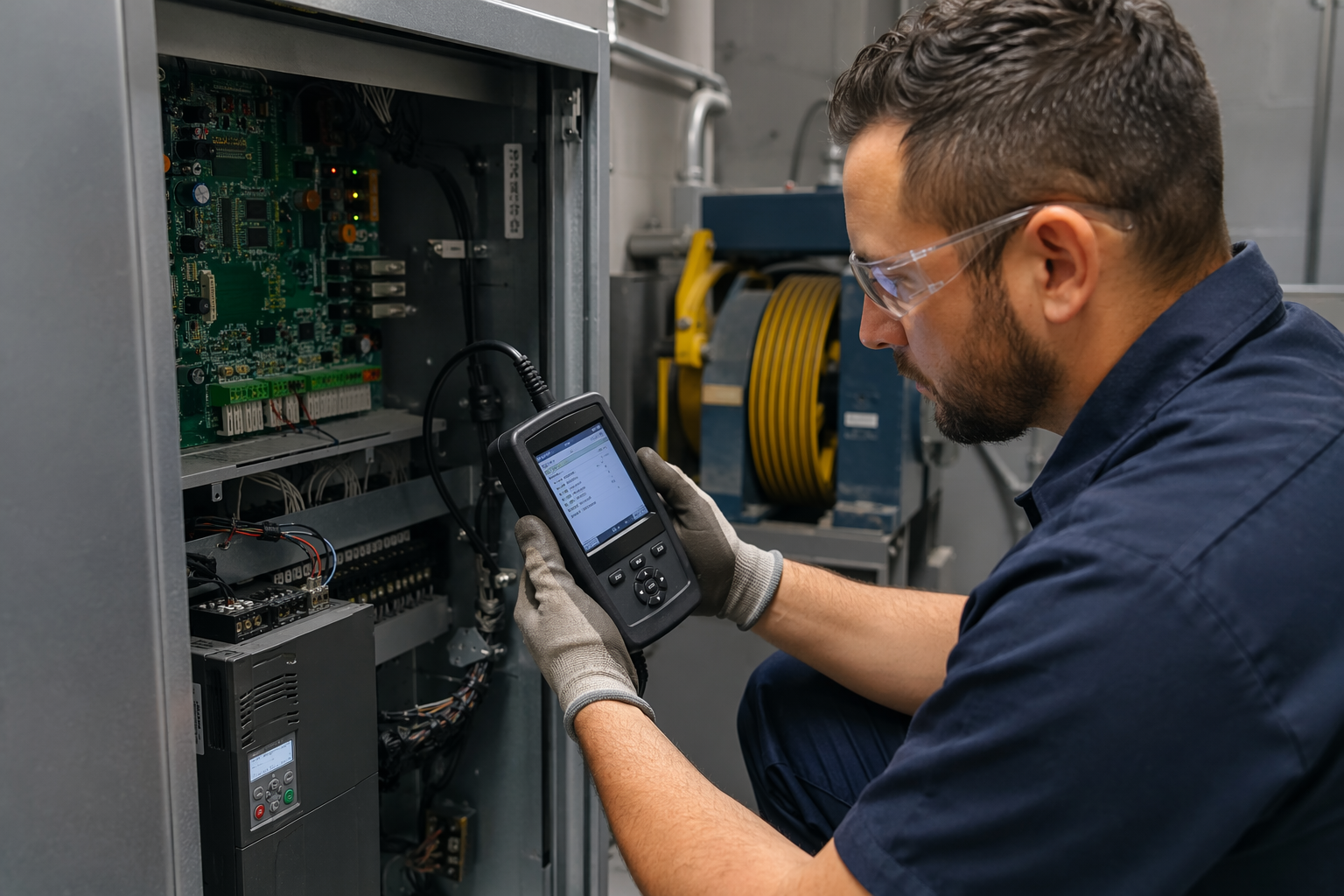
The right contact is a licensed, state-registered elevator service contractor with demonstrated familiarity with both the local authority having jurisdiction (AHJ) and current national safety codes.
Building owners, facility managers, and property management companies should not rely on general mechanical contractors or building maintenance staff for elevator work. Elevators are regulated vertical transportation systems that require technicians operating under specific licensing frameworks in Texas (administered through the Texas Department of Insurance, Elevator Safety Program) and California (administered by the Division of Occupational Safety and Health, also known as Cal/OSHA).
AmeriTex Elevator serves clients across Houston, Dallas, Austin, San Antonio, Los Angeles, and San Diego, providing full-service maintenance programs that align with each jurisdiction’s permitting and inspection protocols.
What does elevator maintenance cost?

Elevator maintenance costs vary significantly based on elevator type, number of stops, usage volume, equipment age, and the scope of the service agreement chosen.
Rather than quoting a flat industry figure — which can be misleading given the wide variance across elevator categories and contract structures — building owners should request itemized proposals from licensed providers. The table below illustrates the primary cost-influencing factors and how they affect pricing tiers qualitatively.
| Cost Factor | Lower Cost Range Indicators | Higher Cost Range Indicators |
|---|---|---|
| Elevator Type | Hydraulic, low-rise residential | Traction, high-rise commercial, MRL |
| Number of Stops | 2–3 stops | 10+ stops |
| Equipment Age | Modern, code-compliant systems | Aging systems requiring legacy parts |
| Usage Volume | Low-traffic residential or small commercial | High-traffic hospitals, airports, retail |
| Contract Scope | Lubrication and adjustment only | Full-coverage including parts and callbacks |
| Geographic Market | Suburban Texas markets | Urban California markets (LA, San Diego) |
| Compliance Status | Current on all AHJ requirements | Deferred maintenance, pending violations |
The most reliable way to understand total annual cost is to request a site assessment that accounts for equipment condition, usage patterns, and jurisdiction-specific compliance requirements. AmeriTex Elevator offers free assessments to help building owners get accurate, transparent proposals rather than working from generic estimates.
What types of elevator maintenance contracts are available?
Elevator maintenance contracts typically fall into three categories: oil-and-grease (basic), parts-and-labor, and full-coverage (comprehensive), each offering a different allocation of risk between building owner and service provider.
Oil-and-Grease / Lubrication-Only Contracts: These cover routine lubrication, adjustment, and visual inspections. Parts, repairs, and callback visits outside scheduled maintenance windows are billed separately. This contract type carries higher unpredictability for budget planning but lower base premiums.
Parts-and-Labor Contracts: These cover the cost of labor for repairs and a defined list of parts. Exclusions vary by provider, so owners must review itemized exclusion schedules carefully. Major components — such as controllers, motors, and hydraulic cylinders — may still be separately billed.
Full-Coverage / Comprehensive Contracts: These agreements cover labor, most parts, callback visits, and annual code-required inspections. They offer the most predictable budget performance and are generally recommended for high-traffic or mission-critical facilities such as hospitals, hotels, and large commercial buildings.
How often should elevators be inspected under ASME A17.1?
Under the ASME A17.1 Safety Code for Elevators and Escalators, elevators must undergo periodic inspections — typically annual for most categories — though exact intervals depend on the elevator type and the adopting jurisdiction’s specific rules.
ASME A17.1 establishes the national safety baseline, but individual states and local AHJs set enforcement schedules. In Texas, the Elevator Safety Program under the Texas Department of Insurance requires periodic inspections and maintains permitting records. In California, the Division of Occupational Safety and Health (Cal/OSHA) enforces elevator inspection requirements under California Labor Code and the California Elevator Safety Construction Code.
Building owners operating in multiple markets — such as those with properties in Houston and Los Angeles — must track inspection deadlines independently for each jurisdiction. Missing an inspection deadline can result in fines, permit revocation, or mandatory shutdown of the elevator until compliance is restored.
What are the ADA compliance requirements for elevator maintenance?
Under the Americans with Disabilities Act (ADA), elevators in public accommodations and commercial facilities must remain operational and accessible to people with disabilities, meaning deferred maintenance that results in prolonged outages can create ADA compliance exposure.
ADA Standards for Accessible Design specify requirements for call buttons, door timing, leveling accuracy, and floor indicators among other features. While ADA does not prescribe maintenance intervals, it does require that accessible features remain functional. A maintenance program that includes regular testing of door sensors, leveling mechanisms, and emergency communication systems is essential for sustained ADA compliance.
Property managers should document all maintenance activities related to accessibility features, as this documentation can demonstrate good-faith compliance efforts in the event of an ADA complaint or litigation.
What is included in a standard elevator maintenance visit?
A standard elevator maintenance visit covers a structured checklist of mechanical, electrical, and safety components designed to prevent failures and confirm code compliance.
Typical items inspected and serviced during a maintenance visit include:
- Lubrication of guide rails, sheaves, and mechanical components
- Inspection and adjustment of door operators, gibs, and clutches
- Testing of safeties, buffers, and governor systems
- Verification of leveling accuracy and stopping distance
- Inspection of hydraulic fluid levels and cylinder integrity (hydraulic elevators)
- Electrical panel inspection, including relay and controller checks
- Testing of emergency lighting and two-way communication systems
- Review of machine room cleanliness and environmental conditions
- Documentation of findings and any deferred repair recommendations
What should building owners do immediately after an elevator malfunction?
When an elevator malfunctions, building owners and facility managers should follow a structured response protocol to protect occupant safety and maintain regulatory compliance.
- Take the elevator out of service immediately if any safety system has triggered, if the cab is stuck between floors, or if unusual noises, odors, or erratic movement are reported.
- If occupants are trapped, contact emergency services (911) without delay — do not attempt to force open doors manually.
- Post clear signage at all affected landings indicating the elevator is out of service.
- Contact your licensed elevator maintenance provider to report the malfunction and request a service call.
- Document the time of malfunction, any occupant reports, and the sequence of events for your maintenance and incident records.
- Do not return the elevator to service until a qualified technician has inspected the system and cleared it for operation.
- If the malfunction triggers a reportable incident under local AHJ rules (such as a passenger entrapment), notify the relevant regulatory authority as required.
How does elevator age affect maintenance costs?
Older elevator equipment generally increases maintenance costs because aging mechanical and electrical components require more frequent intervention, proprietary or obsolete parts are harder to source, and deferred modernization needs accumulate over time.
Elevators installed before modern control and safety technologies became standard may also carry greater compliance risk as ASME A17.1 editions evolve. Jurisdictions may require retroactive upgrades to certain safety features when code is updated, and older systems are more likely to require such retrofits.
A maintenance provider conducting a thorough initial assessment of an older system can identify components approaching end-of-service life, allowing property owners to budget for replacements proactively rather than responding to emergency breakdowns at premium rates.
How does elevator usage volume affect maintenance needs?
Higher usage volume accelerates wear on mechanical components — particularly door systems, guide shoes, and cab interiors — making more frequent service intervals necessary for high-traffic installations.
A low-rise residential elevator in a two-story home experiences fundamentally different stress cycles than a commercial traction elevator serving a 20-story office tower. Maintenance intervals and component replacement schedules should be calibrated to actual usage patterns, not just calendar time. Providers offering usage-based maintenance planning rather than purely calendar-based scheduling can deliver better value and fewer unexpected breakdowns.
What is the difference between preventive and reactive elevator maintenance?
Preventive maintenance involves scheduled, proactive servicing designed to prevent failures before they occur, while reactive maintenance — also called corrective or breakdown maintenance — addresses failures only after they happen, typically at higher cost and with greater disruption.
A preventive maintenance program supported by a comprehensive contract provides more predictable operating costs and better equipment longevity. Reactive-only approaches may appear less expensive on paper but typically result in higher aggregate costs over time due to emergency call premiums, accelerated component wear, and potential regulatory fines for equipment downtime during inspection periods.
How do Texas and California elevator regulations differ?
Texas elevator regulation is administered by the Elevator Safety Program under the Texas Department of Insurance, which enforces state-adopted safety codes, licensing requirements, and inspection schedules. California elevator regulation falls under Cal/OSHA and follows the California Elevator Safety Construction Code, which incorporates ASME standards with California-specific amendments.
Both states require licensed contractors to perform elevator work, but the licensing pathways, renewal cycles, and fee structures differ. California markets — particularly Los Angeles and San Diego — may also present additional local permitting layers at the municipal level. Property owners with multi-state portfolios should ensure their maintenance provider holds appropriate credentials in each operating state. AmeriTex Elevator maintains operations aligned with regulatory requirements in all six of its served markets: Houston, Dallas, Austin, San Antonio, Los Angeles, and San Diego.
What questions should building owners ask when evaluating elevator maintenance companies?
Building owners should evaluate elevator maintenance providers using a consistent set of criteria that covers regulatory standing, service capabilities, contract transparency, and local market knowledge.
Key questions to ask prospective providers include:
- Is the company licensed in this state and jurisdiction?
- Are technicians certified and trained on the specific equipment in the building?
- What does the maintenance contract explicitly include and exclude?
- How are callback visits handled, and are they included in the contract?
- What is the process for reporting and tracking deficiencies?
- How does the provider handle code-required annual inspections — do they coordinate with the AHJ?
- Does the provider offer modernization or repair services if upgrade needs are identified?
- What documentation is provided after each maintenance visit?
How can deferred elevator maintenance lead to regulatory violations?
Deferred maintenance allows minor deficiencies to escalate into code violations that can result in failed inspections, mandatory shutdowns, and financial penalties imposed by the AHJ.
Under frameworks aligned with the ASME A17.1 Safety Code for Elevators and Escalators, elevators with identified safety deficiencies may be tagged out of service by an inspector until corrective action is completed and re-inspection is passed. For commercial properties, an elevator shutdown can disrupt tenants, trigger lease disputes, and create ADA compliance exposure. The cumulative cost of a shutdown — including lost productivity, tenant complaints, emergency repair premiums, and re-inspection fees — typically far exceeds the cost of maintaining a consistent preventive maintenance program.
What are common elevator components that require repair or replacement over time?
Several categories of elevator components have defined service lives and will require planned replacement as equipment ages, regardless of maintenance quality.
Components most commonly requiring repair or replacement include:
- Door operators and related hardware: Frequent cycling causes wear on clutches, gibs, rollers, and cam mechanisms.
- Hoist ropes and sheaves: Subject to fatigue and require periodic inspection and replacement per ASME standards.
- Controllers and logic boards: Older relay-logic controllers are increasingly difficult to source parts for and may require modernization.
- Hydraulic cylinders and seals: Subject to fluid degradation and potential environmental compliance requirements.
- Guide shoes and roller guides: Wear with usage volume and contribute to ride quality degradation when neglected.
- Safety devices and governors: Must be tested and certified at prescribed intervals per ASME A17.1.
- Emergency communication systems: Required to be functional at all times; components including intercoms and phone systems age over time.
Is elevator maintenance required by law in Texas and California?
Yes — both Texas and California require that elevators be maintained in safe operating condition under state law, with periodic inspections conducted by licensed inspectors as a legal prerequisite for continued operation.
In Texas, the Elevator Safety Program sets inspection intervals and requires that conveyances be registered and inspected. In California, OSHA-aligned standards under Cal/OSHA mandate regular inspection and maintenance to protect workers and the public. Operating an elevator without a current, valid inspection certificate is a violation that can result in fines and mandatory shutdown orders. Maintenance contracts with a qualified provider help ensure that inspection deadlines are tracked and that equipment is in certifiable condition before each inspection date.
How should building owners budget for elevator maintenance annually?
Annual elevator maintenance budgeting should account for contract fees, anticipated repair and parts costs outside contract scope, reserve funds for modernization or major component replacements, and regulatory fees such as permit renewals and inspection charges.
A lifecycle cost approach — projecting costs over a multi-year horizon rather than on a year-by-year basis — provides a more accurate picture of total elevator ownership costs. Facility managers are advised to obtain a full equipment condition assessment from a licensed provider at the start of a maintenance relationship, as this creates a documented baseline for budgeting and capital planning. Budget reserves for older equipment should be proportionally larger to account for the higher probability of unscheduled component replacements.
What is elevator modernization and when does it make more sense than ongoing maintenance?
Elevator modernization involves the partial or full replacement of aging systems — typically controls, doors, drive systems, or cab interiors — to restore code compliance, improve reliability, and extend equipment service life, and it becomes cost-justified when maintenance and repair costs are rising steeply relative to the value of the existing equipment.
Common triggers for a modernization evaluation include repeated callback incidents, inability to source replacement parts for legacy controllers, pending AHJ violation notices, and tenant or occupant complaints about reliability or ride quality. A qualified maintenance provider can help building owners assess the crossover point at which modernization delivers better long-term value than continued maintenance of an aging system. AmeriTex Elevator provides modernization assessments as part of its service offerings in all its operating markets.
How do multi-elevator buildings manage maintenance costs efficiently?
Buildings with multiple elevator units — such as hotels, hospitals, or large commercial towers — can typically negotiate consolidated maintenance contracts that cover all units under a single agreement, reducing per-unit administrative costs and often achieving better pricing through volume.
Coordinated scheduling across a multi-elevator fleet also allows maintenance to be staggered so that the building retains operational elevator capacity throughout the service period, minimizing tenant and occupant disruption. Facility managers of multi-elevator properties should request fleet-level reporting from their maintenance provider, which enables trend analysis across units and early identification of systemic issues affecting multiple cabs.
How does elevator maintenance affect property value and tenant retention?
Well-maintained elevators contribute directly to tenant satisfaction, lease renewal rates, and property valuation — particularly in multi-story commercial, residential, and mixed-use buildings where elevator reliability is integral to the occupant experience.
Frequent outages, rough rides, door malfunctions, and leveling issues are among the most common tenant complaints in multi-story properties. These issues, when unresolved, can accelerate tenant turnover, reduce lease renewal rates, and affect property ratings in commercial real estate assessments. Conversely, a documented, consistent maintenance record signals to prospective tenants and buyers that the property is professionally managed and that infrastructure risk is well-controlled.
How can I get started with a maintenance contract for my elevator?
Building owners can initiate a maintenance relationship by scheduling a site assessment with a licensed elevator service provider who will evaluate equipment condition, identify any existing deficiencies or compliance gaps, and propose a maintenance program aligned with the building’s usage profile and regulatory requirements.
The assessment process typically involves a physical inspection of the machine room, cab, hoist way, pit, and all accessible components, followed by a written report and contract proposal. AmeriTex Elevator conducts free elevator assessments for property owners and managers in Houston, Dallas, Austin, San Antonio, Los Angeles, and San Diego, providing a transparent starting point for maintenance planning without obligation.
Need elevator service you can rely on? AmeriTex Elevator is ready to help.