Commercial Elevator Lifespan & the Repair-or-Replace Decision: A Data-Driven Guide
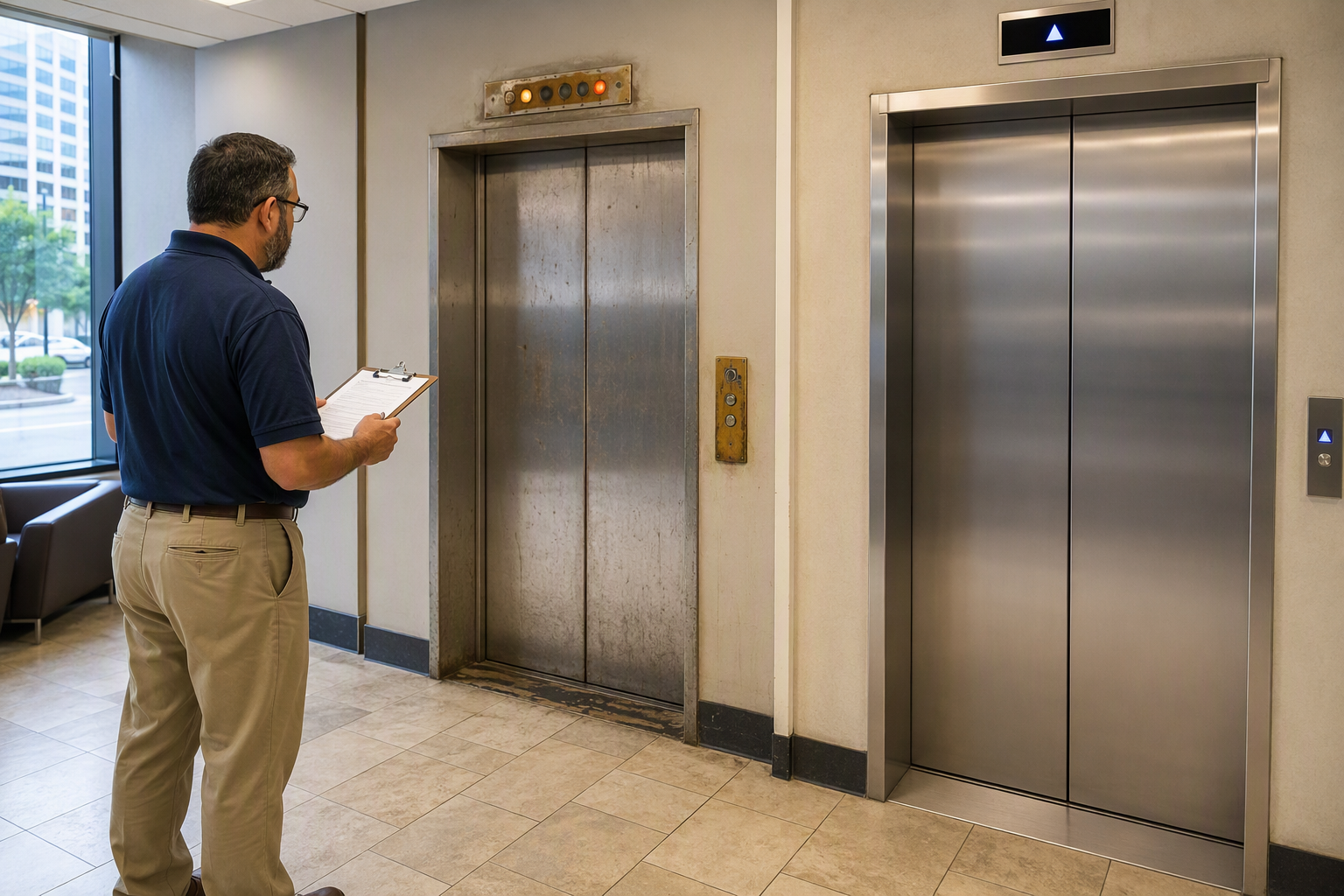
Building owners and facilities managers in California and Texas face the same critical question at some point in a building’s life cycle: is the right move to repair this elevator, modernize it, or replace it entirely? The answer depends on age, maintenance history, compliance status, and a clear-eyed look at total cost of ownership. This guide walks through every factor so the decision is grounded in facts, not guesswork.
What Is the Actual Lifespan of a Commercial Elevator?
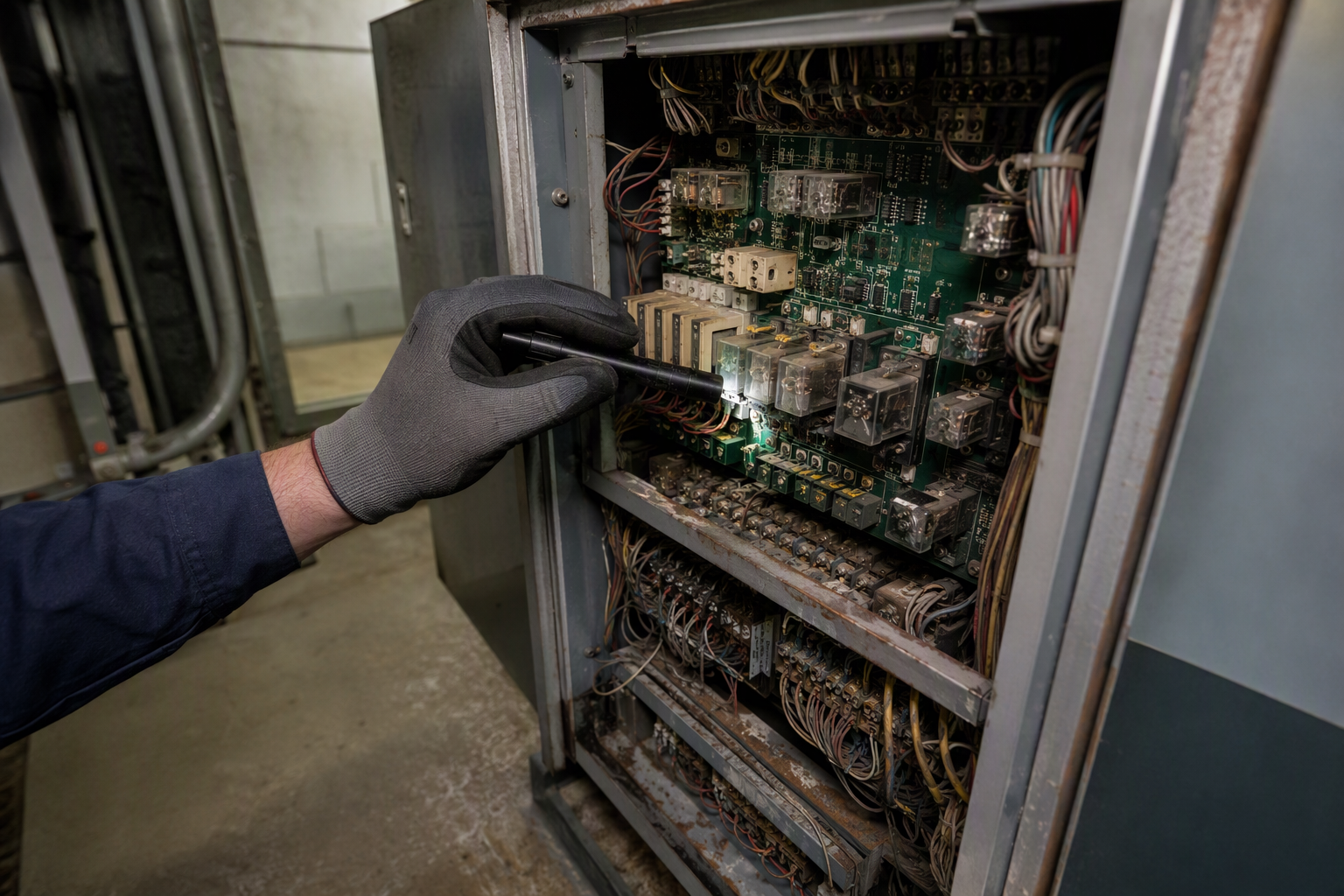
Industry consensus — reflected in maintenance guidance from elevator manufacturers and referenced by the ASME A17.1 Safety Code for Elevators and Escalators framework — places the functional service life of a commercial elevator at roughly 20 to 25 years under normal use and with a disciplined preventive maintenance program. Hydraulic elevators often reach end-of-life sooner than traction elevators because their fluid systems, jack cylinders, and seals are subject to wear that accelerates in high-use environments.
That 20–25 year figure is not a hard cutoff. Some elevators with premium components and rigorous maintenance remain serviceable past 30 years. Others in high-traffic buildings or in coastal environments — where salt air accelerates corrosion — may show significant degradation within 15 years. The lifespan is best understood as a probability window, not a warranty date.
Component-Level Lifespans to Track
Because elevators are assemblies of many subsystems, a building owner should think about lifespan at the component level, not just the unit level. Controllers, the electronic brain of the elevator, are typically expected to be serviceable for roughly 15 to 20 years before parts become difficult to source. Hydraulic cylinders, ropes and cables, door operators, and cab interiors each carry their own service expectancy. When multiple subsystems approach end-of-life simultaneously, the economics of piecemeal repair deteriorate rapidly.
What Codes and Standards Govern Commercial Elevators in California and Texas?
Two primary national standards set the baseline for elevator safety and maintenance in both states:
- ASME A17.1 Safety Code for Elevators and Escalators — the foundational design and installation standard adopted by California and Texas as the basis for their local elevator codes. New installations and major alterations must comply with the edition adopted by the applicable authority having jurisdiction (AHJ).
- ASME A17.3 Safety Code for Existing Elevators and Escalators — this companion standard specifically addresses retroactive safety requirements for elevators already in service. It is particularly relevant to the repair-or-replace decision because it establishes the safety upgrades that must accompany certain repairs or alterations.
- Americans with Disabilities Act (ADA) — federal accessibility requirements that apply to most commercial buildings and must be considered whenever an elevator undergoes significant alteration.
- OSHA — federal workplace safety standards apply to elevator construction and service work and to the protection of building occupants during maintenance operations.
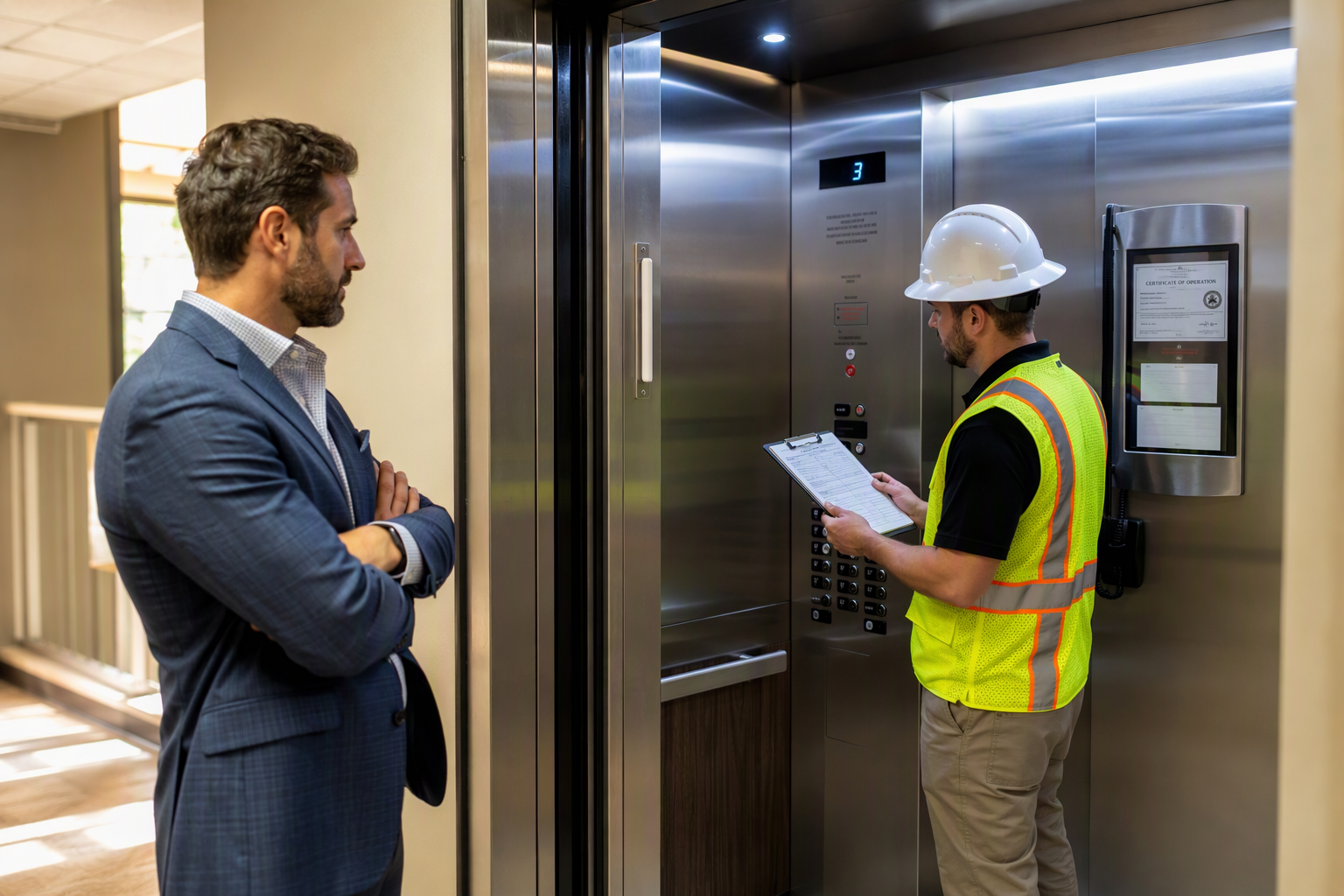
In California, elevator inspections are administered by the Division of Occupational Safety and Health (Cal/OSHA) Elevator Unit. In Texas, the Texas Department of Insurance (TDI) oversees elevator inspection and licensing through its Elevator Safety program. Building owners in both states are required to maintain current certificates of inspection and to schedule periodic inspections through their AHJ. Letting a certificate lapse is not simply a paperwork issue — it can trigger mandatory shutdown orders and expose property owners to significant liability.
How Do Inspection Intervals Factor Into the Repair-or-Replace Decision?
Required inspection intervals in California and Texas are set by each state’s adopted version of ASME A17.1 and enforced by the respective state agencies. When an elevator fails inspection or accumulates a pattern of violations, the building owner faces a compliance-driven deadline that can accelerate the repair-or-replace timeline considerably.
A single failed inspection is not automatically a signal to replace an elevator. However, a pattern of repeated violations across multiple inspection cycles — particularly violations tied to structural components, safety circuits, or hydraulic system integrity — is a strong indicator that the unit has aged beyond economical repair.
What Are the Key Signs That an Elevator Needs Repair?
Not every problem signals end-of-life. The following conditions typically point toward repair rather than replacement:
- Intermittent door malfunctions caused by worn rollers, gibs, or detector strips
- Leveling issues where the cab consistently stops above or below floor level
- Unusual noises — grinding, squealing, or thumping — tied to a specific mechanical component
- Slow or erratic cab movement that responds to controller recalibration
- Minor hydraulic leaks confined to seals or fittings rather than the cylinder itself
- Cab interior wear such as damaged panels, flooring, or lighting fixtures
In these cases, targeted repair restores reliable function without committing to the cost and downtime of a full replacement or modernization.
What Are the Key Signs That an Elevator Should Be Replaced or Modernized?
Certain conditions shift the calculus firmly toward modernization or full replacement:
- Age beyond 20–25 years combined with multiple simultaneous failures — when the controller, motor, and hydraulic system all require attention at once, the aggregate repair cost often approaches or exceeds modernization cost.
- Obsolete controls with no available parts — proprietary older controllers that are no longer supported by the manufacturer cannot be safely maintained long-term.
- Hydraulic cylinder corrosion or pit flooding history — a compromised in-ground cylinder in a hydraulic elevator is a serious safety issue and a costly repair that may not be economically justifiable in an aging unit.
- Repeated entrapments or safety-circuit failures — escalating liability exposure and potential regulatory action.
- Energy inefficiency — older hydraulic units and non-regenerative traction systems consume significantly more power than modern variable-frequency drive (VFD) systems. While precise savings figures vary by building, the energy cost differential over a 10-year horizon is a legitimate factor in the replacement calculation.
- ADA non-compliance requiring structural alteration — when achieving ADA compliance requires cab widening or hoistway modification, the cost of compliance-driven retrofit can justify full modernization.
How Do I Calculate Whether Repair or Replacement Is More Cost-Effective?
A widely referenced rule of thumb in facilities management is the “50% rule”: if the estimated repair cost exceeds 50% of the cost of full modernization or replacement, the economics favor modernization. This threshold is not a regulatory requirement — it is a practical decision-making framework. The actual break-even point for any specific elevator depends on the unit’s age, remaining service life after repair, downtime costs, energy savings from newer equipment, and compliance obligations triggered by the repair under ASME A17.3.
One critical and often overlooked factor: under ASME A17.3, certain repairs and alterations trigger mandatory safety upgrades to the existing installation. A building owner planning a targeted repair may find that the work triggers code-required upgrades to additional systems, materially changing the cost comparison.
What Steps Should a Building Owner Take When Evaluating an Elevator Problem?
- Document the symptoms. Record dates, times, and descriptions of every malfunction, entrapment, or failed inspection item. A pattern matters as much as individual incidents.
- Pull the maintenance and inspection history. Obtain all inspection certificates, violation notices, and maintenance logs for the unit. This history is the baseline for evaluating systemic versus isolated problems.
- Commission a condition assessment from a qualified elevator contractor. A written assessment should identify every component near or past end-of-life, not just the presenting failure.
- Request itemized repair estimates alongside a modernization quote. Comparing these side by side — including any code-triggered upgrades required under ASME A17.3 — gives a defensible basis for the decision.
- Evaluate total cost of ownership, not just initial outlay. Factor in projected energy savings, expected reduction in service calls, and the useful life added by each option.
- Consult with your AHJ before committing to major work. In California, that is the Cal/OSHA Elevator Unit. In Texas, that is the Texas Department of Insurance Elevator Safety program. Confirming scope and permit requirements before work begins prevents costly surprises.
- Review financing and incentive options. Some Texas and California utility programs offer energy efficiency incentives for replacing older hydraulic elevator systems with modern traction or machine-room-less (MRL) units. Eligibility and amounts change year to year; consult current utility program materials directly.
What Is the Difference Between Modernization and Full Replacement?
These terms are sometimes used interchangeably but they describe different scopes of work. Modernization retains the existing hoistway structure and often the cab shell while replacing the mechanical and electrical systems — controller, motor or pump unit, ropes or hydraulic jack, door operators, and safety systems. Full replacement involves removing all equipment including the cab and, in some cases, modifying or rebuilding the hoistway itself. Full replacement is the more disruptive and expensive option and is typically justified only when the hoistway itself is compromised or when a building owner chooses to change the elevator type entirely — for example, converting from hydraulic to traction to eliminate the underground cylinder.
How Does Elevator Type Affect the Repair-or-Replace Decision?
The technology type of an elevator significantly influences both the failure modes and the economics of the decision:
- Hydraulic elevators — common in low-rise buildings in Texas and California. Their primary long-term risk is the underground cylinder. Older single-bottom cylinders without secondary containment are subject to leaks that can contaminate soil and groundwater, creating environmental liability in addition to mechanical cost. Retrofitting to a holeless or above-ground-cylinder hydraulic system, or converting to traction, are both options worth evaluating when a hydraulic unit reaches end-of-life.
- Geared traction elevators — found in mid-rise applications. The gearbox is the primary wear component and can often be rebuilt or replaced without a full modernization, extending service life meaningfully.
- Gearless traction elevators — common in high-rise buildings. These units have fewer wear components and tend to have longer service lives when properly maintained, but controller and rope replacement are still periodic requirements.
- Machine-room-less (MRL) traction elevators — a relatively modern configuration that eliminates the dedicated machine room. Repair and modernization considerations are similar to gearless traction, but the compact drive location requires careful access planning for service work.
What Industry Trends Should Building Owners in California and Texas Watch in 2025–2026?
Several trends are shaping elevator repair and replacement decisions in both states heading into 2026:
- Tightening environmental rules around hydraulic fluid. Both California and Texas continue to enforce environmental standards governing underground petroleum storage and contamination. Older single-bottom hydraulic cylinders that lack secondary containment face increasing regulatory pressure, making hydraulic-to-traction conversions a more common modernization path.
- Remote monitoring and predictive maintenance adoption. Modern controllers increasingly support IoT-based condition monitoring that generates performance data and flags anomalies before they become failures. Building owners modernizing aging units in 2025–2026 are adding these capabilities as standard practice, shifting maintenance from reactive to predictive.
- Energy code pressure in California. California’s Title 24 building energy standards continue to evolve. While elevator systems are not always the primary target, buildings undergoing significant renovation may face energy-related compliance requirements that factor into modernization scope.
- Parts availability for legacy controllers. Industry observers note that older proprietary elevator controllers from the 1990s and early 2000s are becoming progressively harder to source parts for. Building owners with units in that age range should proactively assess parts availability risk rather than waiting for a catastrophic failure.
- Increased demand for modernization services. The aging commercial real estate stock across Texas metros — Dallas, Houston, San Antonio, Austin — and California’s major markets means a large volume of elevators entering or past the 20–25 year service window simultaneously. Lead times for modernization projects in major metro areas have been extending as demand increases.
Does ADA Compliance Play a Role in the Repair-or-Replace Decision?
Yes. The Americans with Disabilities Act establishes accessibility requirements for elevators in most commercial buildings. When a building undergoes alterations — including significant elevator work — the path of travel to the altered area, which includes the elevator, must comply with ADA standards to the extent that doing so is readily achievable. A major modernization project can trigger an obligation to bring the elevator cab dimensions, door clear width, control panel height and braille markings, and audible/visual signals into full ADA compliance. Factoring this compliance cost into the modernization estimate — rather than discovering it mid-project — is essential to accurate decision-making.
How Long Does an Elevator Modernization Project Typically Take?
Project duration varies considerably based on scope, parts lead times, and building access constraints. A controller-only modernization on a straightforward traction elevator in an occupied building can often be completed in a matter of days to weeks. A full modernization of a hydraulic elevator — including jack replacement, new power unit, new controller, new cab, and door operators — is a more substantial undertaking and the elevator will be out of service for a longer period. Building owners in high-occupancy buildings should discuss temporary access plans for people with disabilities with their contractor and confirm compliance with ADA requirements for maintaining accessible routes during construction.
What Should I Look for When Selecting an Elevator Service Provider for This Decision?
The quality of the condition assessment drives the quality of the repair-or-replace decision. When evaluating service providers, building owners should look for:
- A written, component-level condition assessment rather than a general opinion
- Familiarity with the specific elevator type and manufacturer in question
- Knowledge of the applicable ASME A17.1 and A17.3 requirements and how they affect the scope of work
- Experience with the permitting and inspection processes administered by the Cal/OSHA Elevator Unit in California or the Texas Department of Insurance Elevator Safety program in Texas
- Transparency about what compliance upgrades a repair or modernization will trigger under ASME A17.3
- Independent assessment rather than a recommendation that coincidentally always points toward the most profitable scope of work
AmeriTex Elevator serves commercial building owners and facilities managers across California and Texas with data-driven assessments designed to support defensible repair-or-replace decisions. The AmeriTex approach begins with a documented condition assessment that evaluates every major subsystem, identifies compliance status relative to current code requirements, and presents repair and modernization options side by side so the building owner can make an informed choice grounded in actual conditions — not general rules of thumb.
Sourced Data Reference Table
| Data Point | Standard / Source |
|---|---|
| Design, installation, and safety requirements for new elevators | ASME A17.1 Safety Code for Elevators and Escalators |
| Retroactive safety requirements and alteration-triggered upgrades for existing elevators | ASME A17.3 Safety Code for Existing Elevators and Escalators |
| Federal accessibility requirements for elevator cab dimensions, controls, and signals | Americans with Disabilities Act (ADA.gov) |
| Workplace and construction safety requirements applicable to elevator service work | Occupational Safety and Health Administration (OSHA) |
Note: This table lists only attributable code standards. Figures described qualitatively in the body of this article (expected service life, component lifespans, decision thresholds) reflect industry consensus and professional practice frameworks rather than a single published statistic, and are intentionally presented without fabricated percentage claims.
Frequently Asked Questions
How old does a commercial elevator have to be before replacement makes sense?
There is no single age trigger, but the 20–25 year window is when the economics of replacement or full modernization typically become competitive with continued repair. The more important indicator is the convergence of multiple aging subsystems — when the controller, motor, and hydraulic or rope systems all require attention simultaneously, the aggregate cost of repair often rivals or exceeds modernization cost.
What happens if I ignore elevator maintenance to avoid costs?
Deferred maintenance accelerates component wear, increases the probability of entrapments and safety incidents, and can result in failed inspections that trigger mandatory shutdown orders. In California, the Cal/OSHA Elevator Unit has authority to order an elevator removed from service. In Texas, the Texas Department of Insurance Elevator Safety program holds similar authority. Operating an elevator without a current certificate of inspection is a legal violation that exposes property owners to both regulatory penalties and civil liability.
Does a major repair trigger code compliance upgrades under ASME?
Yes. Under ASME A17.3, certain categories of alterations to existing elevators trigger requirements to bring additional systems into compliance with current safety standards. The specific upgrades required depend on the nature and scope of the alteration. This is one of the most frequently overlooked costs in repair estimates and one of the most important reasons to have ASME-knowledgeable contractors assess work scope before committing to a repair path.
Can I convert a hydraulic elevator to a traction elevator?
Hydraulic-to-traction conversions are technically feasible and are increasingly common in California and Texas as older single-bottom hydraulic cylinders age out and environmental liability concerns rise. The conversion requires a thorough hoistway assessment to confirm structural suitability for traction equipment and involves permitting through the applicable state authority. The result is typically improved energy efficiency and elimination of the underground cylinder liability, which can justify the conversion cost on a total-cost-of-ownership basis.
How does ADA compliance factor into an elevator modernization?
When a building undergoes significant alteration — including a major elevator modernization — ADA requirements apply to the path of travel to the altered area. This can require bringing the elevator cab dimensions, door clear width, control panel reach ranges and braille markings, and audible/visual floor indicators into compliance. ADA compliance costs should be built into the modernization estimate from the outset.
What is the difference between a full elevator replacement and a modernization?
Modernization retains the existing hoistway and often the cab shell while replacing drive, control, and safety systems. Full replacement removes all equipment including the cab and may involve hoistway modifications. Modernization is the more common and cost-effective path for elevators with intact hoistways. Full replacement is typically reserved for situations where the hoistway is structurally compromised or where an elevator type change (e.g., hydraulic to traction) is being made.
How do I know if my elevator’s controller is obsolete?
Indicators of controller obsolescence include an inability to source replacement parts from the original manufacturer, the absence of manufacturer technical support for the system, increasing frequency of unexplained faults or lockouts, and the installation date — controllers from the early-to-mid 2000s or earlier from discontinued product lines are increasingly at end-of-support status. A qualified elevator contractor can evaluate parts availability for a specific controller model.
What are the environmental risks of older hydraulic elevators in California and Texas?
In-ground hydraulic cylinders in older installations — particularly single-bottom cylinders without secondary containment — carry a risk of hydraulic fluid leakage into soil and groundwater. Both California and Texas have environmental protection frameworks governing underground contamination. A leaking cylinder can create cleanup liability that significantly exceeds the mechanical repair cost. Building owners with older hydraulic elevators should have the cylinder condition assessed as part of any comprehensive evaluation.
How long does elevator modernization take and how does it affect building occupants?
Project duration depends on scope and parts availability. Partial modernizations (controller replacement, door operator replacement) can sometimes be staged to minimize continuous downtime. Full modernizations require extended out-of-service periods. During any period when an elevator is out of service in a building required to provide accessible vertical access under the ADA, building owners must address accessible route continuity — typically through signage, temporary access arrangements, or scheduling work to maintain at least one accessible elevator in multi-elevator buildings.
What questions should I ask an elevator contractor before approving repair or modernization work?
Key questions include: What ASME A17.3 upgrades does this scope of work trigger, and are they included in the estimate? What is the expected remaining service life of the elevator after this repair? Are parts for the existing controller and drive system available and for how long? What permits are required and who pulls them? What is the realistic out-of-service duration? Is there an energy efficiency case for modernization over repair? Does the proposed scope bring the unit into full ADA compliance? A contractor who provides detailed written answers to each of these questions is demonstrating the transparency that supports a defensible decision.
How can AmeriTex Elevator help with the repair-or-replace decision?
AmeriTex Elevator serves commercial building owners and facilities managers in California and Texas with comprehensive elevator condition assessments, code compliance reviews, and clearly documented repair-versus-modernization analyses. The assessment process is designed to give building owners the specific, documented information they need to make a financially and legally defensible decision — not a sales recommendation dressed up as technical advice. AmeriTex works with the applicable state authority having jurisdiction in both California and Texas to ensure all proposed work is properly permitted and inspected.
Ready to Know Where Your Elevator Actually Stands?
The repair-or-replace decision is too consequential to make without documented, component-level data. AmeriTex Elevator provides free elevator assessments for commercial building owners and facilities managers in California and Texas — giving you the facts you need before you commit to any course of action.
Contact AmeriTex Elevator for a free elevator assessment: 866-679-4313
Need elevator service you can rely on? AmeriTex Elevator is ready to help.