Annual Elevator Inspection: Complete FAQ Guide for Texas and California Building Owners
Annual elevator inspections are mandatory for virtually every commercial, residential, and public-access elevator in Texas and California. Building owners who miss the inspection deadline risk fines, removal of the elevator from service, and significant liability exposure. This FAQ hub answers the 20 most common questions about the inspection process, applicable codes, state-specific requirements, and how to keep your elevator compliant in 2026 and beyond.
What is an annual elevator inspection?
An annual elevator inspection is a formal, code-mandated examination of an elevator’s structural, mechanical, electrical, and safety systems performed by a qualified inspector to confirm the unit meets all applicable code requirements before it may legally remain in operation.
The inspection covers the elevator car, cab interior, door operation, safeties, buffers, guide rails, machine room equipment, electrical controls, emergency communication systems, and firefighters’ service, among other components. The scope is governed at the federal level by the ASME A17.1 Safety Code for Elevators and Escalators and at the state level by the applicable regulatory authority—the Texas Department of Licensing and Regulation (TDLR) under Texas Health and Safety Code Chapter 754, or the Division of Occupational Safety and Health (Cal/OSHA) under California Labor Code Sections 7300–7324.2.
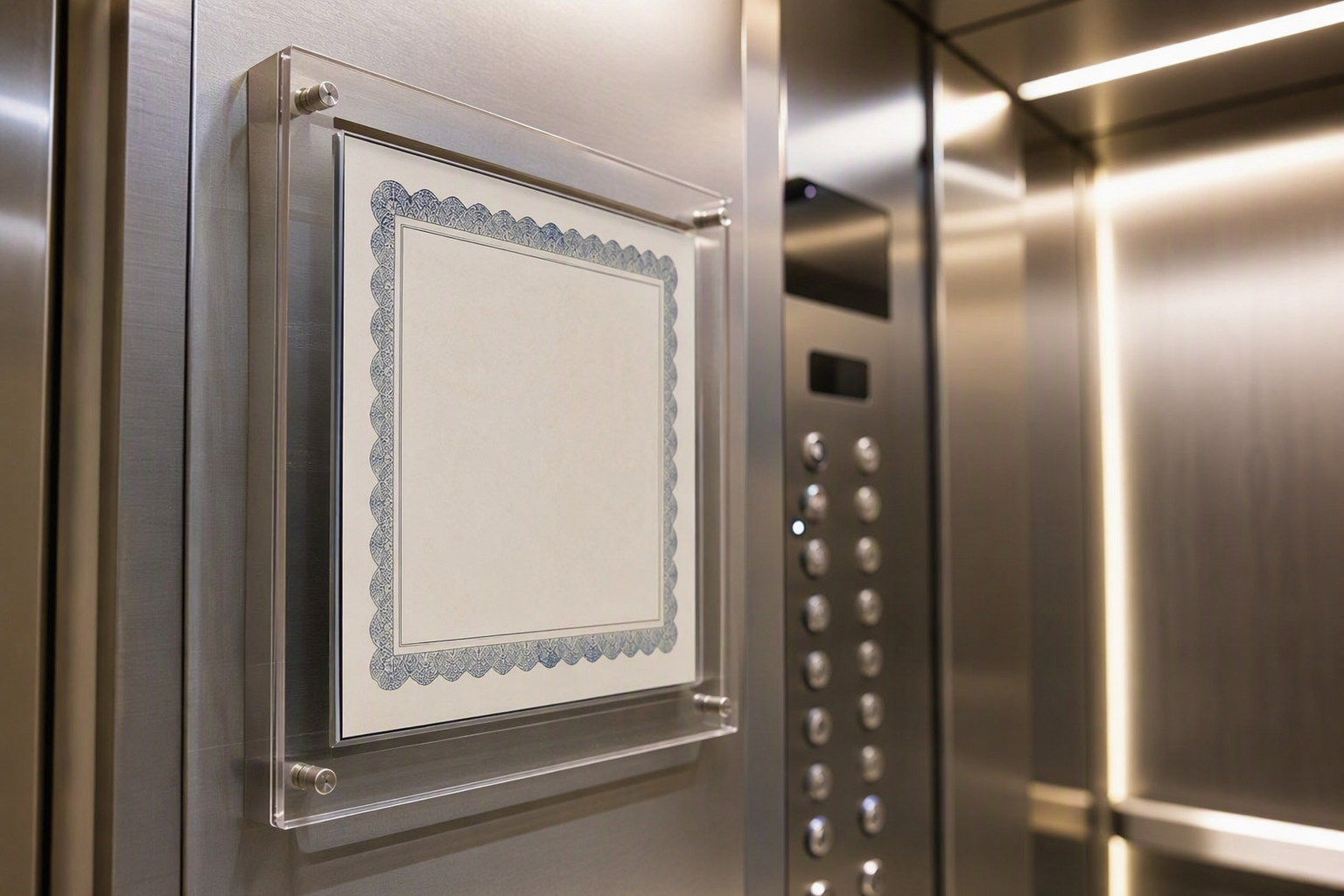
The outcome of a passing inspection is a compliance document—a Certificate of Compliance in Texas or a permit to operate in California—that must be publicly displayed. A failed inspection results in a violation list that the building owner must address within the required timeframe or risk the elevator being taken out of service.
Why is an annual elevator inspection legally required?
Annual inspections are legally required because elevators are classified as high-risk mechanical systems, and both Texas and California have enacted statutes holding building owners accountable for the ongoing safety of every person who uses their equipment.
In Texas, Texas Health and Safety Code Chapter 754 and 16 Texas Administrative Code Chapter 74 establish mandatory annual inspection and Certificate of Compliance requirements enforced by TDLR. In California, California Labor Code Sections 7300–7324.2 and the California Code of Regulations, Title 8, Elevator Safety Orders (Sections 3000–3146) enforced by Cal/OSHA prohibit operating any elevator without a current, valid permit to operate. Operating without the required compliance documentation can result in civil penalties, forced shutdown, and heightened liability in the event of an accident.
Beyond legal obligation, regular inspections help building owners identify wear, misalignment, or code deficiencies before they cause equipment failures or injuries.
How often must elevators be inspected under Texas law?
Texas law requires building owners to have elevators, escalators, and related equipment inspected annually by a TDLR-registered elevator inspector.
The Texas Department of Licensing and Regulation issues a Certificate of Compliance for each unit, and that certificate is valid for one year. Building owners must display the certificate in a publicly visible area of the building. After the inspection, the registered inspector must deliver the inspection report to the owner within five calendar days.
Additionally, Texas requires a Category 5 full-load safety test every five years on electric (traction) elevators—a test that goes beyond the scope of the standard annual inspection and must also be coordinated by the building owner. The City of Houston operates its own elevator inspection program and is not regulated by TDLR; building owners within Houston city limits should contact the City of Houston directly for jurisdiction-specific requirements.
How often must elevators be inspected under California law?
California law requires every conveyance to be inspected at least once a year, after which a conveyance found to be in safe condition receives a permit to operate valid for up to one year.
Under Cal/OSHA rules, the permit to operate must be posted conspicuously in the elevator car at all times. Arranging the annual reinspection is the elevator owner’s responsibility—Cal/OSHA does not automatically schedule it. Only State of California safety engineers and Certified Competent Conveyance Inspectors (CCCI) are authorized to perform these inspections.
California law provides one notable exception to the annual cycle: Cal/OSHA may issue a permit to operate for up to two years for an elevator in safe condition that is covered by a full maintenance contract with a company holding a C-11 Elevator Contractor license. The City of Los Angeles has its own elevator and conveyance inspection program administered through the Los Angeles Department of Building and Safety (LADBS); owners of Los Angeles properties should verify local requirements directly with LADBS.
What codes govern elevator inspections in Texas and California?
Texas has adopted the ASME A17.1/CSA B44, 2016 edition, as amended by 16 Texas Administrative Code §74.100(b), effective November 1, 2018, as the statewide standard for elevator safety in Texas.
California has adopted the ASME A17.1/CSA B44, 2004 edition under its Group IV Elevator Safety Orders, effective May 1, 2008, for installation contracts signed on or after that date. As of 2026, California has proposed a Group V update that would incorporate portions of ASME A17.1-2019; the Standards Board held a public hearing on this proposal on June 18, 2026, and no effective date has been posted. Both states’ rules operate on top of the foundational ASME A17.1 Safety Code for Elevators and Escalators, which sets the baseline for design, installation, operation, testing, and inspection intervals.
Federal accessibility requirements under the Americans with Disabilities Act (ADA) also apply to elevators in public accommodations and commercial facilities, addressing items such as cab dimensions, door timing, control panel height, and audible and visual signals. ADA compliance is often reviewed alongside—though separately from—the mechanical safety inspection.
Who is authorized to perform annual elevator inspections?
In Texas, inspections must be conducted by a TDLR-registered elevator inspector; Texas building owners have the sole right to select the inspector, and registered inspectors are not TDLR employees but independent third parties.
In California, only State of California safety engineers and Certified Competent Conveyance Inspectors (CCCI) certified by Cal/OSHA are authorized to perform elevator inspections. No one else—regardless of experience—may conduct an inspection that results in a permit to operate.
On the maintenance and repair side, any company that installs, alters, tests, maintains, repairs, or services elevators in California must be certified by Cal/OSHA as a Certified Qualified Conveyance Company (CQCC) and must employ Certified Competent Conveyance Mechanics (CCCM). In Texas, contractors must register with TDLR before performing any installation, repair, alteration, testing, or maintenance work. AmeriTex Elevator operates in compliance with the applicable licensing and certification requirements across its Texas and California service areas.
What does an inspector examine during an annual elevator inspection?
A qualified inspector systematically evaluates every major system of the elevator, from the machine room to the pit, using the applicable ASME A17.1 edition as the inspection benchmark.
Key areas examined typically include:
- Machine room: Condition of the traction machine or hydraulic power unit, oil levels, temperature controls, lighting, and fire protection.
- Hoistway: Guide rails, counterweight, safeties, buffers, and clearances.
- Cab and doors: Door operation, door restrictors, interlocks, cab lighting, emergency lighting, and interior condition.
- Control systems: Electrical wiring, overspeed governors, overload protection, and emergency stop functions.
- Firefighters’ service: Phase One and Phase Two firefighters’ operation—in Texas, a passenger elevator without working Phase One firefighters’ service must be removed from service immediately.
- Emergency communication: Two-way communication device functionality.
- Pit: Lighting, stop switch, ladder, and water intrusion.
- Load and travel tests: Door reopening devices, leveling accuracy, and emergency operation.
AmeriTex Elevator recommends that building owners schedule a pre-inspection maintenance check before the formal inspection date to address any known deficiencies that could result in violations.
What is the difference between an annual inspection and a Category 5 test?
An annual inspection verifies that an elevator’s safety systems and components comply with code on a visual and operational basis, while a Category 5 test is a full-load, full-speed safety test that physically exercises the elevator’s governor, safeties, and buffers under maximum rated conditions.
Texas requires a Category 5 full-load test every five years on electric (traction) elevators. This test must be performed with a registered contractor present, because activating the car and counterweight safeties at rated speed involves controlled risk that requires expert oversight and specialized equipment. The Category 5 test results are documented separately from the annual inspection report but are reviewed as part of the overall compliance record. Building owners who miss the five-year test interval may face violations that prevent issuance of a new Certificate of Compliance.
Hydraulic elevators have different periodic test requirements under ASME A17.1, including pressure tests and cylinder leak tests. Owners of hydraulic elevators should confirm the applicable test schedule with their service contractor.
What happens if an elevator fails an annual inspection?
If an elevator fails its annual inspection, the building owner receives a written violation report and is legally required to either correct the cited violations or have them under contract for correction within a defined period—otherwise the elevator faces forced shutdown.
In Texas, building owners must have violations corrected, or under contract to be corrected, within 30 days of the inspection, or obtain a waiver or delay from TDLR. Certain safety-critical failures trigger immediate removal from service: in Texas, a passenger elevator without working door restrictors or without functional Phase One firefighters’ service must be taken out of service immediately, with no 30-day grace period. In California, Cal/OSHA has authority to order an elevator out of service for unsafe conditions, and no permit to operate will be issued until deficiencies are resolved and the elevator passes reinspection.
Building owners should maintain a file of all inspection reports, violation notices, and correction records. AmeriTex Elevator can assist building owners in prioritizing repairs and coordinating return-to-service reinspections across Houston, Dallas, Austin, San Antonio, Los Angeles, and San Diego.
What steps should a building owner take immediately after receiving a failed inspection report?
Acting quickly and methodically after a failed inspection protects building occupants, limits liability, and keeps the elevator on a path back to compliance.
- Read the inspection report carefully and note each cited violation, its description, and any code section referenced.
- Contact a registered (Texas) or CQCC-certified (California) elevator contractor to review the violations and provide a scope of repair.
- If any violation triggers an immediate removal-from-service requirement—such as a missing door restrictor or failed Phase One firefighters’ service in Texas—post out-of-service notices on the elevator doors and do not allow use until corrected.
- Obtain a written repair agreement from the contractor so the correction is “under contract” within the required timeframe (30 days in Texas).
- Schedule and complete all repairs, obtaining documentation from the contractor for each corrected item.
- Request a reinspection from an authorized inspector and ensure all corrected items are accessible for examination.
- Retain all reports, work orders, and reinspection records in the building’s elevator compliance file.
- In Texas, report any accident involving elevator equipment to TDLR within 24 hours if one occurred as part of or related to the deficiency.
How does an annual maintenance contract affect inspection outcomes?
A full maintenance contract with a qualified elevator company significantly improves inspection outcomes by ensuring the elevator receives scheduled lubrication, adjustments, parts replacements, and safety testing throughout the year rather than only at inspection time.
In California, the benefit of a full maintenance contract extends to the compliance document itself: Cal/OSHA may issue a permit to operate for up to two years for an elevator in safe condition that is covered by a full maintenance contract with a C-11 licensed elevator company, effectively reducing the frequency of formal inspections for well-maintained equipment. In Texas, while the annual inspection cycle does not change, a maintained elevator is statistically less likely to accumulate violations, reducing correction costs and downtime. AmeriTex Elevator offers maintenance agreements designed to keep equipment in inspection-ready condition across all six of its service markets.
What are the most common violations found during annual elevator inspections?
While every elevator is different, inspectors consistently identify a cluster of recurring deficiencies that building owners and their maintenance contractors should monitor proactively.
Common violation categories include:
- Door and door operator issues: Worn door gibs, faulty closers, non-functional door restrictors, and interlock failures.
- Emergency lighting and communication: Dead batteries in emergency lights, inoperative two-way communication devices, and missing or expired emergency phone service.
- Firefighters’ service: Malfunctioning Phase One recall or Phase Two in-car operation—both are immediate removal-from-service triggers in Texas.
- Machine room conditions: Excessive heat, missing or expired fire extinguisher, unauthorized storage, or inadequate lighting.
- Pit conditions: Standing water, inoperative pit stop switch, inadequate lighting, or missing ladder.
- Governor and safety gear: Seals broken without documentation, or devices not tested at required intervals.
- Missing or expired compliance documentation: Certificate of Compliance or permit to operate not posted or expired.
A pre-inspection walkthrough with a qualified technician from a company like AmeriTex Elevator can identify and address most of these issues before the formal inspection takes place.
What are an elevator owner’s responsibilities versus the inspector’s responsibilities?
The building owner is responsible for arranging the inspection, maintaining the equipment between inspections, correcting violations, and posting compliance documents—while the inspector’s role is to objectively evaluate and document code compliance without performing repairs.
| Responsibility | Building Owner | Registered/CCCI Inspector |
|---|---|---|
| Schedule the annual inspection | Yes — owner’s sole duty (CA and TX) | No |
| Select the inspector | Yes — owner has sole right in TX; Cal/OSHA assigned in CA | No |
| Provide access to machine room and pit | Yes | No |
| Perform the inspection and document findings | No | Yes |
| Deliver inspection report to owner (TX: within 5 days) | No | Yes |
| Correct violations within required timeframe | Yes | No |
| Post Certificate of Compliance or permit to operate | Yes | No |
| Report accidents to TDLR within 24 hours (TX) | Yes | No |
| Maintain full maintenance contract to qualify for 2-yr CA permit | Yes | No |
Does the ADA require anything during an annual elevator inspection?
The Americans with Disabilities Act does not mandate a separate annual ADA inspection, but ADA compliance is an ongoing legal obligation for elevators in facilities covered by the Act, and deficiencies may surface during or alongside a code inspection.
ADA requirements for elevators include minimum cab dimensions, door clear-width minimums, door timing requirements, tactile and braille floor designations, audible floor announcement systems, control panel mounting heights, and leveling accuracy to allow wheelchair users to enter and exit safely. Inspectors reviewing elevator code compliance under ASME A17.1 will document code violations within their scope, but ADA compliance is enforced separately through the U.S. Department of Justice and, in some cases, through litigation. Building owners should review ADA accessibility requirements independently and verify that modernization or repair work does not inadvertently create new accessibility barriers.
What permits are required before installing or modifying an elevator in Texas or California?
Both Texas and California require regulatory approval before an elevator is installed, materially altered, or placed in service—and operating without the correct permit is a violation of state law in both jurisdictions.
In California, a permit from Cal/OSHA is required before a conveyance is erected, installed, or materially altered. Each new elevator must be inspected by Cal/OSHA and receive a permit to operate before it is placed in service. In Texas, a registered contractor must submit plans to TDLR and obtain approval before installing an elevator or escalator. These pre-installation requirements exist separately from the annual inspection cycle and must be completed by the contractor—not the building owner—as part of the project. AmeriTex Elevator manages the permitting coordination process on behalf of building owners undertaking new installations or modernization projects in its service markets.
How should a building owner prepare for an annual elevator inspection?
Thorough preparation reduces the likelihood of violations, accelerates the inspection process, and helps ensure a compliance document is issued without delay.
- Review the previous inspection report and confirm all prior violations have been corrected and documented.
- Confirm the machine room is clean, well-lit, at appropriate temperature, and free of unauthorized storage.
- Test emergency lighting and the two-way emergency communication device; replace batteries or service the phone if needed.
- Verify door operation on every landing—doors should open, close, and reopen on obstruction without hesitation.
- Check that Phase One firefighters’ service key switch operates correctly at the main lobby.
- Inspect the pit for standing water, verify pit lighting works, and confirm the pit stop switch is accessible and functional.
- Confirm the current Certificate of Compliance (Texas) or permit to operate (California) is posted and not expired.
- Gather maintenance logs, Category 5 test records, and any previous violation-correction documentation for the inspector to review.
- Ensure the elevator contractor has completed all scheduled maintenance items before the inspection date.
What qualifications must an elevator contractor hold to perform maintenance and repairs in California?
In California, any company performing maintenance, repair, alteration, or installation work on elevators must be certified by Cal/OSHA as a Certified Qualified Conveyance Company (CQCC), and every mechanic performing unsupervised work must be certified as a Certified Competent Conveyance Mechanic (CCCM).
To obtain CQCC certification, a company must submit a current C-11 Elevator Contractor license issued by the California Contractors State License Board (CSLB), along with certificates of workers’ compensation and liability insurance. Only a CCCM working for a CQCC may maintain, repair, alter, or replace components on a California elevator. CQCC, CCCM, and conveyance inspector certificates are valid for two years, and renewal requires at least eight hours of continuing education. These layered requirements ensure that every technician touching a California elevator has demonstrated competency and is working within a properly licensed and insured company framework.
What qualifications must an elevator contractor hold to perform work in Texas?
In Texas, a person or business may not install, repair, alter, test, or maintain elevator equipment without first registering as a contractor with the Texas Department of Licensing and Regulation.
Texas elevator contractors must carry general liability insurance of at least $1,000,000 per occurrence for bodily injury or death and $500,000 per occurrence for property damage. Each registered contractor must designate one or two responsible parties with at least three years of elevator contractor experience. Texas elevator contractor and inspector registrations expire one year after issuance and must be renewed. The City of Houston operates its own elevator program independent of TDLR; building owners in Houston should verify contractor requirements directly with the City of Houston. AmeriTex Elevator maintains the registrations and insurance required to operate as an elevator contractor in Texas.
Which types of elevators and locations are exempt from annual inspection requirements?
Both Texas and California provide limited exemptions from elevator inspection requirements, primarily for federal government property and certain private residential equipment.
In California, the elevator law exempts conveyances under federal jurisdiction and conveyances in single-unit private homes that are not accessible to the public. In Texas, the elevator law does not apply to equipment in buildings owned and operated by the federal government. Texas law also excludes elevators in single-family dwellings from ongoing TDLR regulation, although a TDLR-registered inspector must inspect a newly installed single-family dwelling elevator after installation. Building owners uncertain whether their equipment qualifies for an exemption should consult directly with Cal/OSHA or TDLR rather than assuming an exemption applies—operating an uninspected elevator without a valid exemption carries the same penalties as operating without a permit.
How can building owners stay compliant between annual inspections?
Staying compliant between inspections requires a documented maintenance program, prompt reporting of accidents or unusual events, and proactive monitoring of the elevator’s mechanical and safety systems throughout the year.
In Texas, building owners must report any accident involving elevator equipment to TDLR within 24 hours. Both Texas and California building owners should maintain a binder or digital record containing the current compliance document, the most recent inspection report, all maintenance logs, and all repair work orders. Any mid-year change to the elevator—such as a control system upgrade, cab interior alteration, or safety component replacement—may require a permit in California before the work begins. Scheduling a mid-year check with a qualified service company helps catch emerging issues before they become inspection violations. AmeriTex Elevator serves building owners across Houston, Dallas, Austin, San Antonio, Los Angeles, and San Diego with ongoing maintenance programs designed to bridge the gap between annual inspection cycles.
What should building owners look for when selecting an elevator inspection and service company?
Selecting the right elevator service company involves verifying regulatory compliance, understanding scope of services, and ensuring clear communication about inspection findings and repair timelines.
Building owners in Texas should confirm the company is registered with TDLR as an elevator contractor before allowing any work. Building owners in California should verify the company holds both a C-11 Elevator Contractor license from the CSLB and CQCC certification from Cal/OSHA. In both states, the contractor should carry the insurance minimums required by law. Practically, owners should ask whether the company can provide pre-inspection maintenance visits, assist with violation correction, coordinate Category 5 testing, and manage permitting for any planned alterations. A company that offers a documented maintenance program—rather than only reactive repairs—reduces violation risk and can support the California two-year permit eligibility. AmeriTex Elevator provides elevator inspection coordination, maintenance, and repair services for commercial, residential, and institutional properties across its Texas and California service markets.
Contact AmeriTex Elevator for a free elevator assessment at 844-646-9660.
Need elevator service you can rely on? AmeriTex Elevator is ready to help.