ADA Elevator Accessibility Requirements for Healthcare Buildings
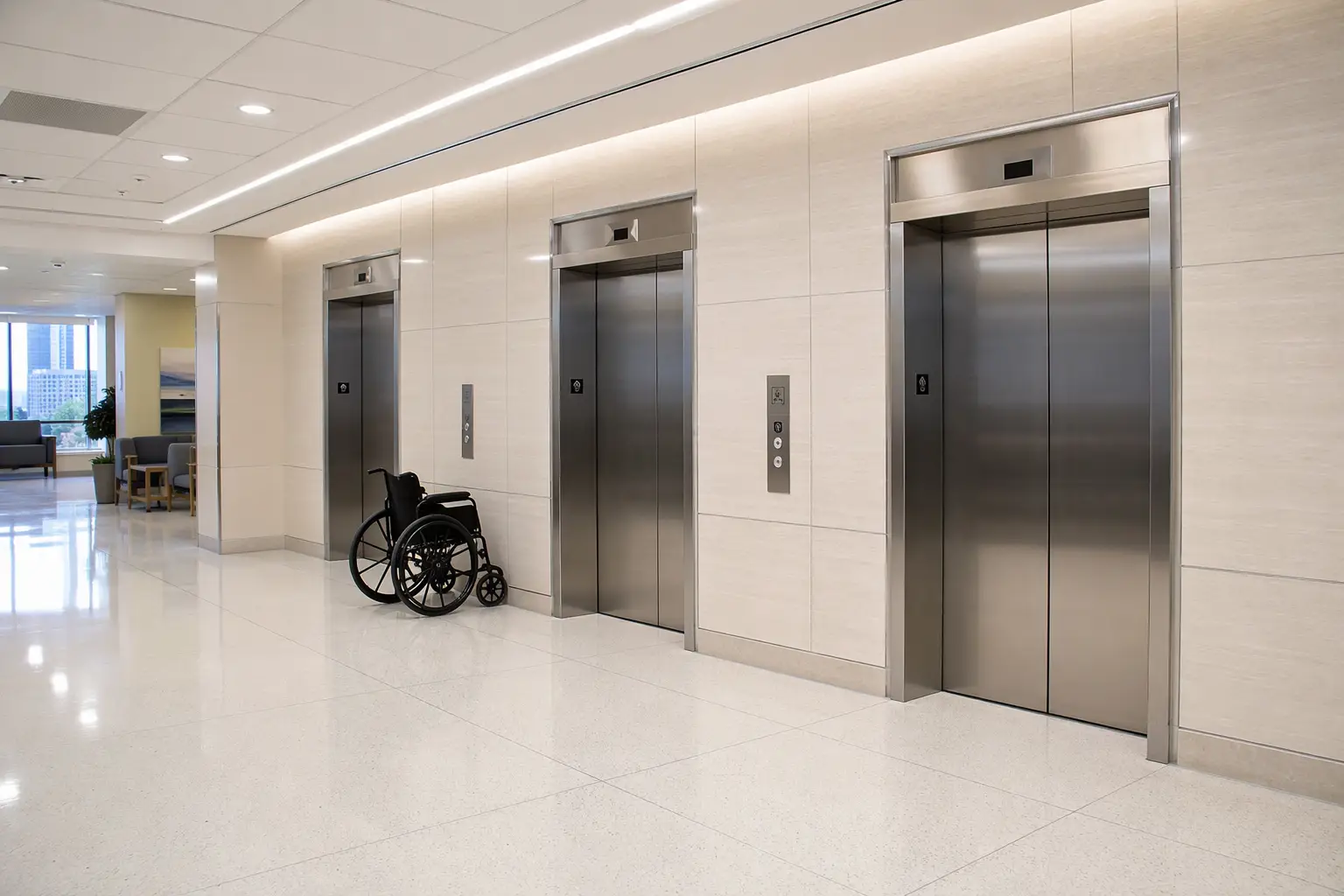
Healthcare facilities—hospitals, medical office buildings, outpatient clinics, rehabilitation centers, and long-term care campuses—serve patients and visitors who may use wheelchairs, walkers, stretchers, or other mobility aids. Meeting ADA elevator accessibility requirements is not optional for most of these buildings. This guide walks healthcare facility managers, hospital administrators, and property owners through the federal requirements, the mechanical standards that underpin them, and the state-level compliance layers that apply in Texas and California.
What Does the ADA Actually Require for Elevators in Healthcare Facilities?
The Americans with Disabilities Act and its implementing 2010 ADA Standards for Accessible Design require that an accessible route connect all floors of a multi-story facility that is open to the public or used by employees—and in healthcare settings, virtually every floor qualifies. Key federal requirements include:
- Elevator call buttons: Must be located on an accessible route, centered at a height no higher than 42 inches above the floor, with a visual and audible signal indicating car arrival and direction of travel.
- Car dimensions: The ADA Standards specify minimum cab dimensions to allow a wheelchair to enter, maneuver, and exit. For a center-opening door configuration, the clear floor space inside the car must meet the minimum depth and width thresholds outlined in the Standards.
- Door clear width: Elevator doors must provide a minimum clear opening width of 36 inches to accommodate wheelchairs and medical equipment such as IV poles and gurneys commonly used in healthcare settings.
- Floor leveling: Cars must stop and remain level within a tolerance that allows smooth, safe entry and exit for wheeled mobility devices.
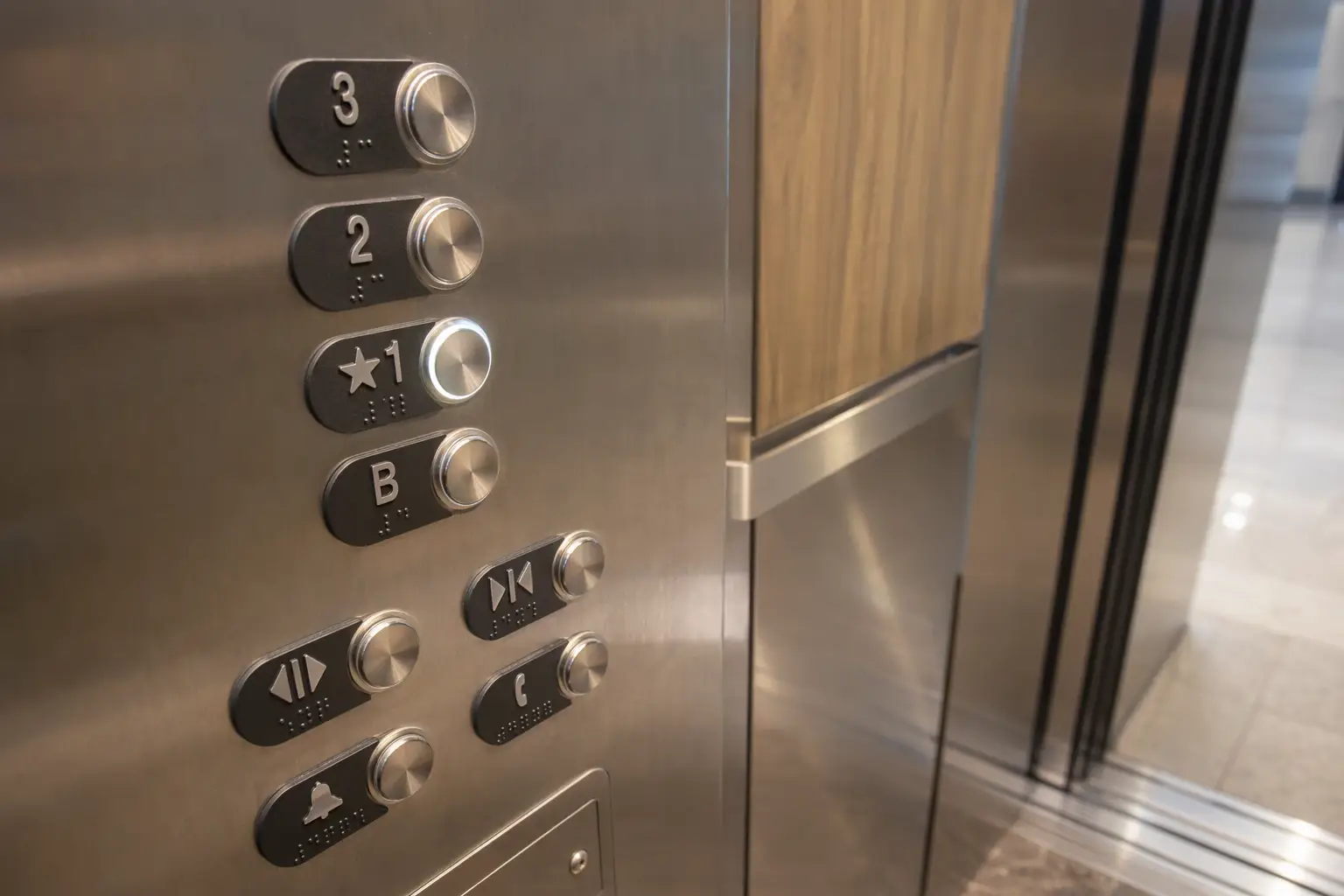
- Controls and keypads: Car controls must be operable with one hand and without tight grasping, pinching, or twisting. Buttons must have raised characters and Braille designations. The highest operable part of controls used by passengers may not exceed 48 inches above the floor.
- Emergency communication: Two-way communication is required inside every accessible car so that a person who is deaf or hard of hearing can communicate an emergency. Federal requirements mandate both audible and visual signals for this system.
- Floor designations: Raised and Braille floor designations must be posted on both jambs of the hoistway entrance at each floor.
- Illumination: A minimum illumination level is required inside the car at the platform, threshold, and landing of each hoistway entrance.
Healthcare facilities should also note that the ADA requirement applies to alterations: when a building undergoes renovation, the altered areas and their path of travel—including vertical access—must be brought into compliance to the maximum extent feasible.
How Does ASME A17.1 Relate to ADA Compliance in Healthcare?

The ASME A17.1 Safety Code for Elevators and Escalators is the foundational mechanical and safety standard for elevator construction and operation. Where the ADA sets the accessibility outcome—a person in a wheelchair must be able to use the elevator—ASME A17.1 governs how the equipment is built and maintained to achieve safe, reliable operation. In healthcare environments, ASME A17.1 requirements that intersect with ADA accessibility include:
- Door reopening devices that prevent the door from closing on a passenger
- Leveling accuracy specifications that directly support ADA floor-leveling requirements
- Emergency lighting and communication requirements inside the car
- Firefighters’ emergency operation (Phase I and Phase II), which is critical in hospitals and facilities with non-ambulatory patients
Compliance with ASME A17.1 does not automatically guarantee ADA compliance, but non-compliance with ASME A17.1 almost always creates ADA violations. Healthcare facility managers should treat the two standards as complementary, not interchangeable.
What State-Level Requirements Apply in Texas for Healthcare Elevator Accessibility?
In Texas, the elevator program is administered by the Texas Department of Licensing and Regulation (TDLR), Elevator and Escalator Safety program, under Texas Health and Safety Code Chapter 754 and 16 Texas Administrative Code Chapter 74. Texas has adopted ASME A17.1/CSA B44, 2016 edition, as amended by 16 TAC §74.100(b), effective November 1, 2018.
Healthcare building owners in Texas should be aware of these state-specific obligations:
- Annual inspections by a TDLR-registered elevator inspector are required, and the building owner holds the right to select that inspector.
- A TDLR Certificate of Compliance must be obtained for each unit and displayed in a publicly visible area of the building.
- Violations cited at inspection must be corrected or under contract to be corrected within 30 days, or a waiver or delay must be obtained from TDLR.
- Electric traction elevators—common in multi-story hospitals—require a Category 5 full-load test every five years.
- A passenger elevator without working door restrictors must be removed from service immediately, which carries serious implications for patient flow in a healthcare setting.
- Any elevator accident must be reported to TDLR within 24 hours.
Houston note: TDLR does not regulate elevators inside Houston city limits. The City of Houston operates its own elevator inspection program. Healthcare facilities in Houston should contact the City directly to confirm current inspection and permitting requirements.
What State-Level Requirements Apply in California for Healthcare Elevator Accessibility?
In California, the elevator program is administered by the Division of Occupational Safety and Health (Cal/OSHA), Elevator Unit, California Department of Industrial Relations, under California Labor Code Sections 7300–7324.2 and the California Code of Regulations, Title 8, Elevator Safety Orders (Sections 3000–3146). California has adopted ASME A17.1/CSA B44, 2004 edition, for installation contracts signed on or after May 1, 2008.
California-specific obligations for healthcare facility operators include:
- No elevator may be operated without a valid, current permit to operate issued by Cal/OSHA. That permit must be posted conspicuously inside the elevator car.
- Every conveyance must be inspected at least once a year. Arranging the annual reinspection is the elevator owner’s responsibility.
- A conveyance covered by a full maintenance contract with a C-11 licensed elevator company may qualify for a permit valid for up to two years.
- Only State of California safety engineers and Certified Competent Conveyance Inspectors (CCCI) may perform elevator inspections.
- All maintenance, repair, alteration, or replacement work on a conveyance must be performed by a Certified Competent Conveyance Mechanic (CCCM) working for a Certified Qualified Conveyance Company (CQCC).
- A new elevator must be inspected by Cal/OSHA and receive a permit to operate before it is placed in service—critical for healthcare facility expansions or new construction.
Los Angeles note: The City of Los Angeles, Department of Building and Safety (LADBS) runs its own elevator and conveyance inspection program. Healthcare facilities in Los Angeles should work with LADBS alongside Cal/OSHA requirements.
AmeriTex Elevator holds the certifications required to perform elevator work in California markets including Los Angeles and San Diego, ensuring healthcare clients receive compliant service under Cal/OSHA’s regulatory framework.
Are There Elevator Requirements Specific to Hospitals and Medical Facilities Beyond Standard ADA Rules?
Yes. Healthcare occupancies face requirements that go beyond what a standard commercial office building must meet. While the ADA establishes the accessibility floor, healthcare facility planners and compliance officers should also evaluate:
- Stretcher capacity: Many healthcare facility guidelines and local building codes require that at least one elevator in a multi-story medical facility be large enough to accommodate a stretcher or hospital bed with attendants. This often exceeds standard ADA minimum cab dimensions.
- Infection control: Elevator interiors in healthcare settings must use surfaces that can withstand the cleaning agents required by infection control protocols. This is a facility management and equipment specification issue, not strictly an ADA requirement, but it affects elevator selection and maintenance programs.
- Firefighters’ emergency operation: ASME A17.1 requires Phase I and Phase II firefighters’ service. In Texas, a passenger elevator without Phase I firefighters’ service must be removed from service immediately. Healthcare facilities must ensure this feature is fully operational during every inspection cycle.
- Emergency power: Healthcare facilities operating under life-safety requirements should confirm that elevators serving critical areas are connected to emergency power per applicable building and life-safety codes.
What Is the Process for Bringing a Non-Compliant Healthcare Elevator into ADA Compliance?
- Commission a compliance audit. Have a qualified elevator contractor document the current state of each unit against ADA Standards for Accessible Design and the applicable ASME A17.1 edition adopted by your state.
- Identify deficiencies by category. Separate issues into physical/dimensional deficiencies (cab size, door width, leveling), hardware deficiencies (controls, Braille signage, emergency communication), and operational deficiencies (door timing, leveling accuracy).
- Submit alteration plans. In Texas, a TDLR-registered contractor must submit plans to TDLR and obtain approval before beginning alterations. In California, a permit from Cal/OSHA is required before any material alteration.
- Complete the work using credentialed contractors. In California, only a CCCM working for a CQCC may perform the work. In Texas, only a TDLR-registered contractor may install, repair, alter, or maintain elevator equipment.
- Schedule post-alteration inspection. In California, Cal/OSHA must inspect any new or materially altered elevator before it is placed in service. In Texas, the building owner arranges inspection through a TDLR-registered inspector.
- Obtain updated permits and certificates. Post the new Texas Certificate of Compliance or California permit to operate as required.
- Document and retain records. Maintain inspection reports, correction records, and permits for the facility’s compliance files.
AmeriTex Elevator supports healthcare facility managers through each step of this process across its Texas and California service markets.
How Often Must Healthcare Facility Elevators Be Inspected to Maintain ADA and State Compliance?
Both Texas and California require annual inspections as the baseline. In Texas, a TDLR Certificate of Compliance is valid for one year, and building owners must arrange inspection accordingly. In California, every conveyance must be inspected at least once a year, though a unit under a full maintenance contract with a C-11 licensed company may qualify for a permit valid up to two years at Cal/OSHA’s discretion.
Beyond annual inspections, Texas requires a Category 5 full-load test every five years for electric traction elevators. Healthcare facilities with high-use elevators—such as those serving patient floors in a hospital—should also consider more frequent preventive maintenance intervals to avoid the out-of-service situations that directly affect patient care.
What Happens If a Healthcare Facility Elevator Fails an Accessibility Inspection?
The consequences of a failed elevator inspection differ by jurisdiction but carry significant operational and legal implications for healthcare facilities:
- In Texas, violations must be corrected or under contract to be corrected within 30 days, or the owner must obtain a waiver or delay from TDLR. An elevator without working door restrictors or without functioning Phase I firefighters’ service must be removed from service immediately.
- In California, Cal/OSHA may restrict or suspend the permit to operate. Operating an elevator without a valid permit is a violation of California Labor Code Sections 7300–7324.2.
- Under the ADA, persistent accessibility barriers expose healthcare facilities to civil rights complaints filed with the U.S. Department of Justice or private litigation. Hospitals and healthcare facilities that receive federal funding face additional exposure under Section 504 of the Rehabilitation Act.
What Should a Healthcare Facility Look for When Selecting an Elevator Service Company?
In California, the contractor must hold CQCC certification from Cal/OSHA and employ CCCMs for all hands-on work. The company should also hold a C-11 Elevator Contractor license issued by the California Contractors State License Board (CSLB). In Texas, the contractor must be registered with TDLR and carry general liability insurance of at least $1,000,000 per occurrence for bodily injury or death and $500,000 per occurrence for property damage.
Beyond regulatory credentials, healthcare facility managers should evaluate a contractor’s familiarity with ASME A17.1 requirements, experience coordinating with state agencies for alteration permits, and capacity to respond to equipment issues that affect patient-care operations. AmeriTex Elevator serves healthcare clients across Houston, Dallas, Austin, San Antonio, Los Angeles, and San Diego, holding the registrations and certifications required in both Texas and California.
Questions Your Inspector Will Ask
Whether the inspection is conducted by a TDLR-registered inspector in Texas, a CCCI or Cal/OSHA safety engineer in California, or a local authority inspector in Houston or Los Angeles, healthcare facility managers should be prepared to answer the following:
- Is the Certificate of Compliance (Texas) or permit to operate (California) current and posted? An expired or missing document is an immediate citation.
- When was the last Category 5 full-load test completed? Applicable to electric traction elevators in Texas; records must be available.
- Are door restrictors operational on all passenger elevators? Non-functional door restrictors require immediate removal from service in Texas.
- Is Phase I and Phase II firefighters’ emergency operation fully functional? A failure here triggers immediate removal from service in Texas and is a safety-critical deficiency everywhere.
- Are all Braille and raised-character floor designations present and correctly positioned on both hoistway jambs? Missing or damaged tactile signage is a common ADA deficiency in older healthcare facilities.
- Is the emergency two-way communication system operational and does it produce both audible and visual signals? This is a federal ADA requirement; inspectors will test it in the field.
- Do all car controls comply with height and reach range requirements? Controls added during renovations are frequently installed at non-compliant heights.
- Is car leveling within the allowable tolerance for smooth wheelchair and gurney entry? Leveling drift is a maintenance issue that creates both ADA violations and patient-safety risks.
- Are maintenance records available showing the inspection history and any prior corrections? Inspectors may ask to review the maintenance log, particularly for units with a history of violations.
Can a Healthcare Facility Claim an ADA Exemption for Elevators?
The ADA includes a limited elevator exemption for facilities that are fewer than three stories or have fewer than three thousand square feet per story, unless the building is a shopping center, shopping mall, professional office of a healthcare provider, or a transit station. The key phrase here is “professional office of a healthcare provider”—this language means that medical and dental offices, clinics, and similar healthcare provider offices do not qualify for the exemption regardless of size or number of floors. Hospitals, rehabilitation centers, and multi-tenant medical office buildings are similarly outside the exemption’s scope.
Healthcare facility owners and managers should assume the elevator accessibility requirements apply and consult with legal counsel and a qualified accessibility consultant before concluding any exemption is available.
How Can AmeriTex Elevator Help Healthcare Facilities Achieve and Maintain Compliance?
AmeriTex Elevator provides comprehensive elevator assessment, maintenance, modernization, and compliance support for healthcare facilities across Houston, Dallas, Austin, San Antonio, Los Angeles, and San Diego. The team is familiar with the intersection of ADA accessibility requirements, ASME A17.1 mechanical standards, and the state regulatory frameworks administered by TDLR in Texas and Cal/OSHA in California. Healthcare clients benefit from working with a single contractor who understands both the accessibility outcomes the ADA demands and the mechanical and documentation requirements the state agencies enforce.
For healthcare facility managers planning a renovation, responding to an inspection citation, or preparing for a scheduled annual inspection, early engagement with a credentialed elevator contractor reduces the risk of violations that interrupt patient services and trigger regulatory action.
Contact AmeriTex Elevator for a free elevator assessment at 844-646-9660.
Need elevator service you can rely on? AmeriTex Elevator is ready to help.