Elevator Maintenance & Inspection Requirements for Schools and Universities in Texas and California
Texas and California impose legally binding inspection, maintenance, and permitting obligations on every elevator in a school or university building. Because campus elevators carry students, faculty, staff, and visitors with disabilities daily, regulators treat compliance failures seriously — including immediate removal from service for critical safety deficiencies. The information below covers every layer of the compliance framework that educational facility managers must understand in 2026.
What is the core legal framework governing school elevators in Texas?
Texas elevator law is established under Texas Health and Safety Code Chapter 754 and administered by the Texas Department of Licensing and Regulation (TDLR), Elevator and Escalator Safety program. The operative technical standard is the ASME A17.1/CSA B44 Safety Code for Elevators and Escalators, 2016 edition, as amended by 16 Texas Administrative Code Chapter 74, effective November 1, 2018.
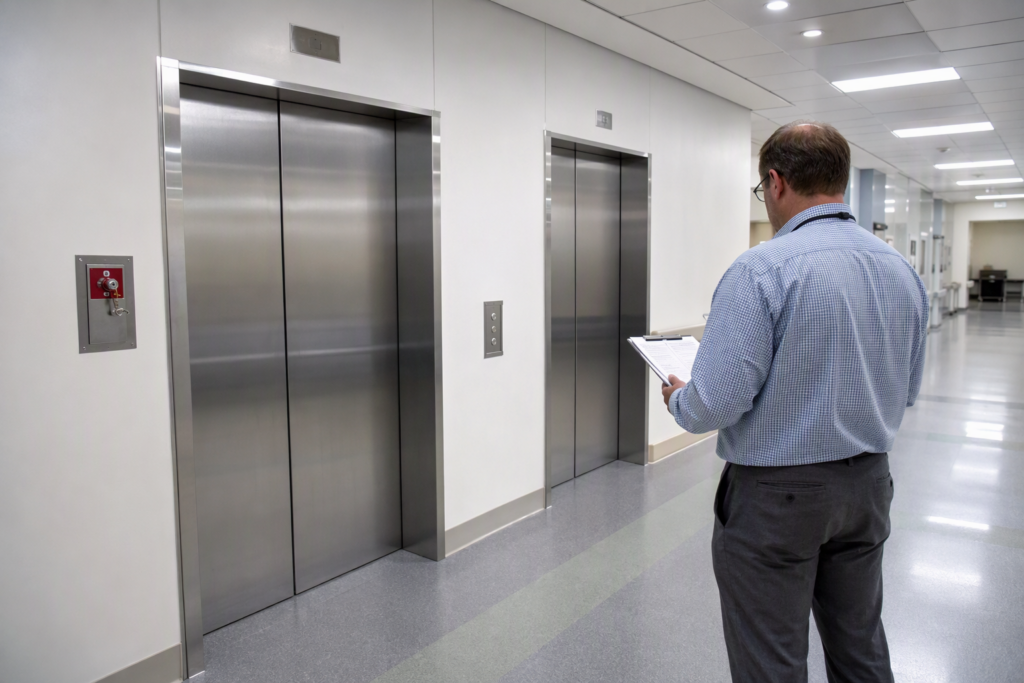
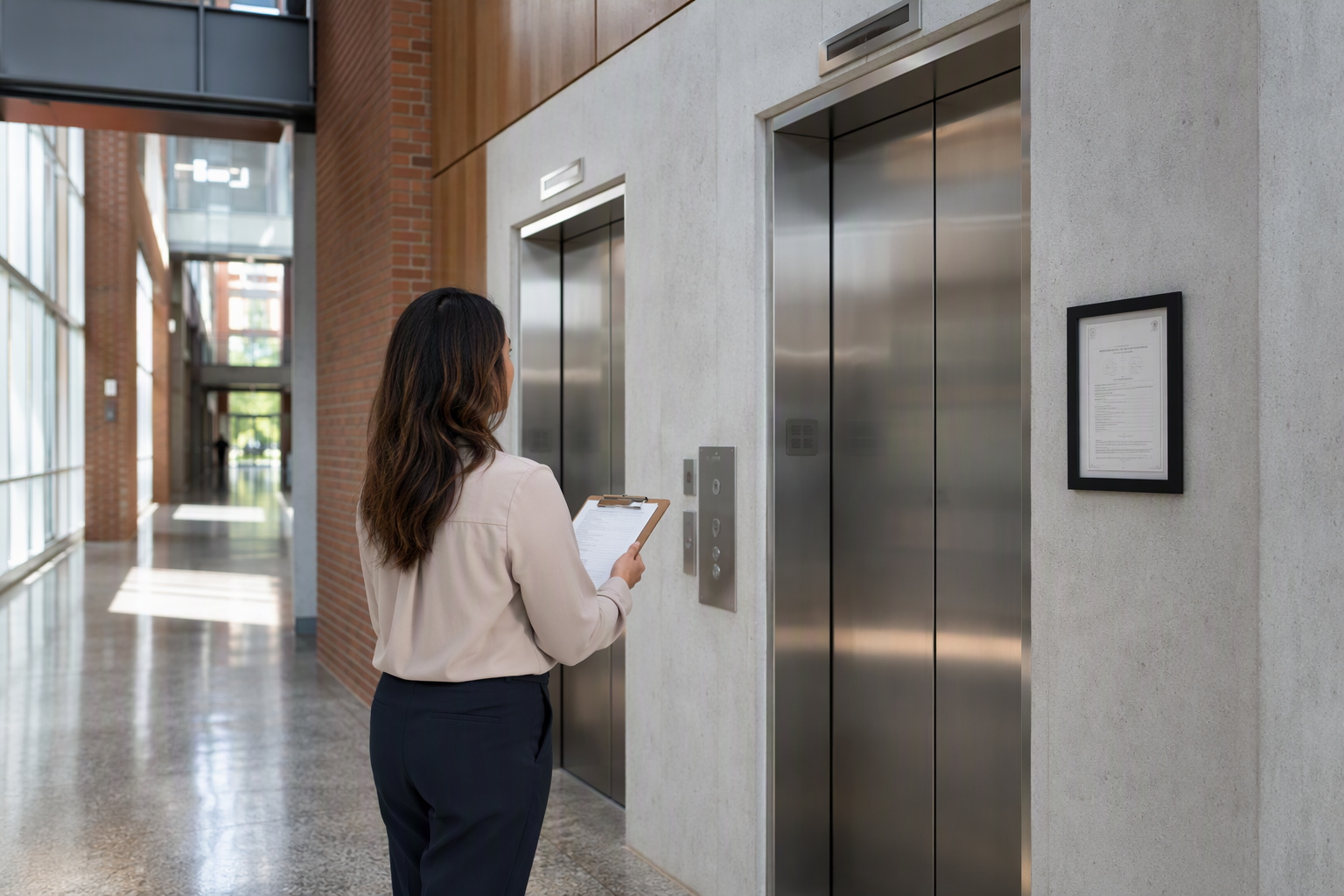
Every elevator in a Texas school or university — from a high school with a single accessible lift to a multi-tower university campus — must hold a current TDLR Certificate of Compliance. That certificate must be displayed in a publicly visible area of the building. TDLR regulations apply statewide with one important local exception: elevators inside Houston city limits are regulated by the City of Houston’s own program, not by TDLR. Facility managers at Houston-area campuses should confirm requirements directly with the City of Houston.
What is the core legal framework governing school elevators in California?
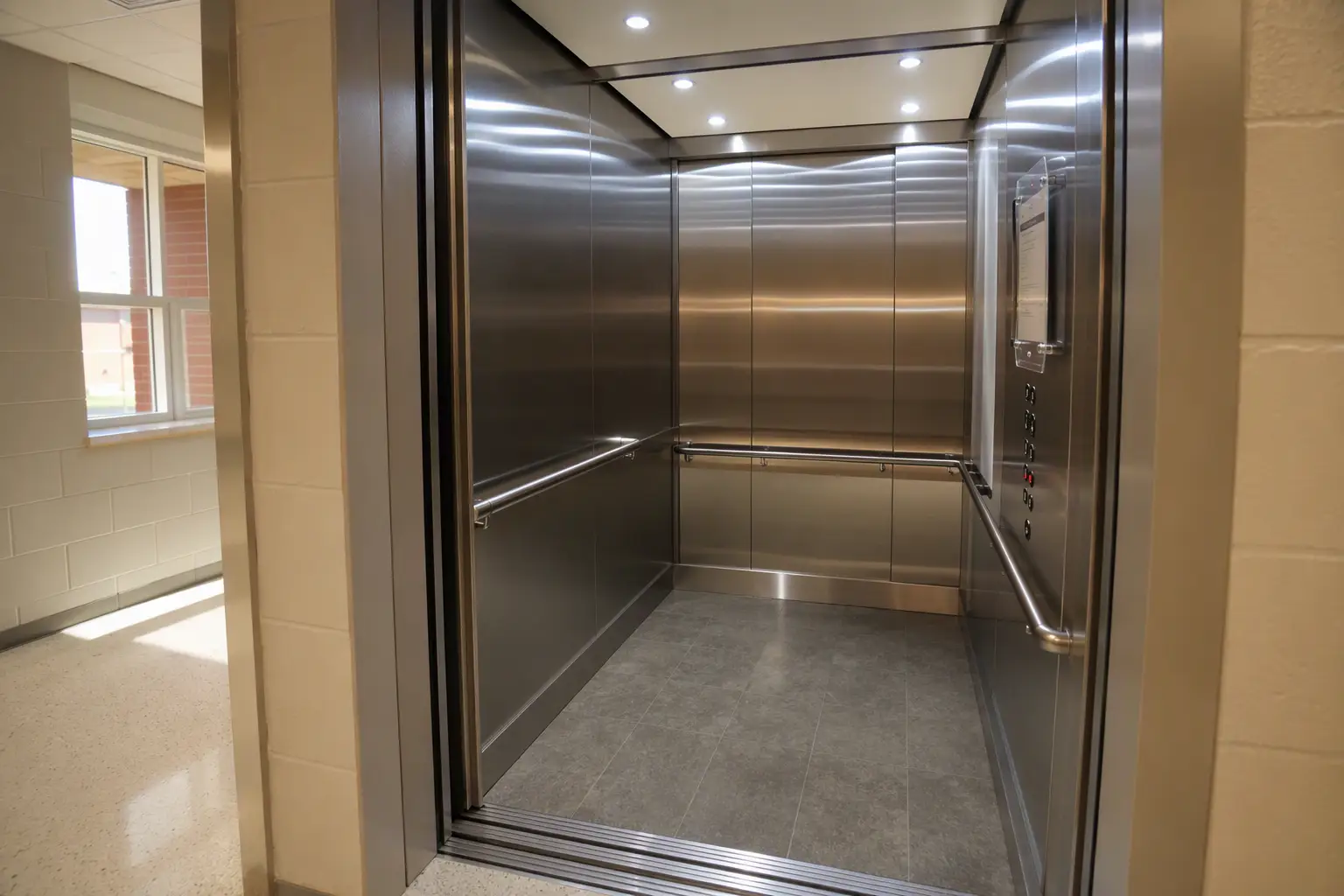
California’s elevator program is administered by the Division of Occupational Safety and Health (Cal/OSHA), Elevator Unit, California Department of Industrial Relations, under California Labor Code Sections 7300–7324.2 and the California Code of Regulations, Title 8, Elevator Safety Orders (Sections 3000–3146). The adopted technical standard is the ASME A17.1/CSA B44, 2004 edition, applicable to installation contracts signed on or after May 1, 2008.
No elevator in a California school or university may legally operate without a valid, current permit to operate issued by Cal/OSHA. That permit must be posted conspicuously inside the elevator car itself. California has proposed a Group V update to its Elevator Safety Orders that would incorporate portions of ASME A17.1-2019; the Standards Board held a public hearing on June 18, 2026, and no effective date has been posted as of this writing.
A separate local note applies to Los Angeles: the City of Los Angeles, Department of Building and Safety (LADBS) runs its own elevator and conveyance inspection program. K–12 schools and universities located within Los Angeles city limits should verify requirements with LADBS in addition to Cal/OSHA.
How often must school and university elevators be inspected in Texas?
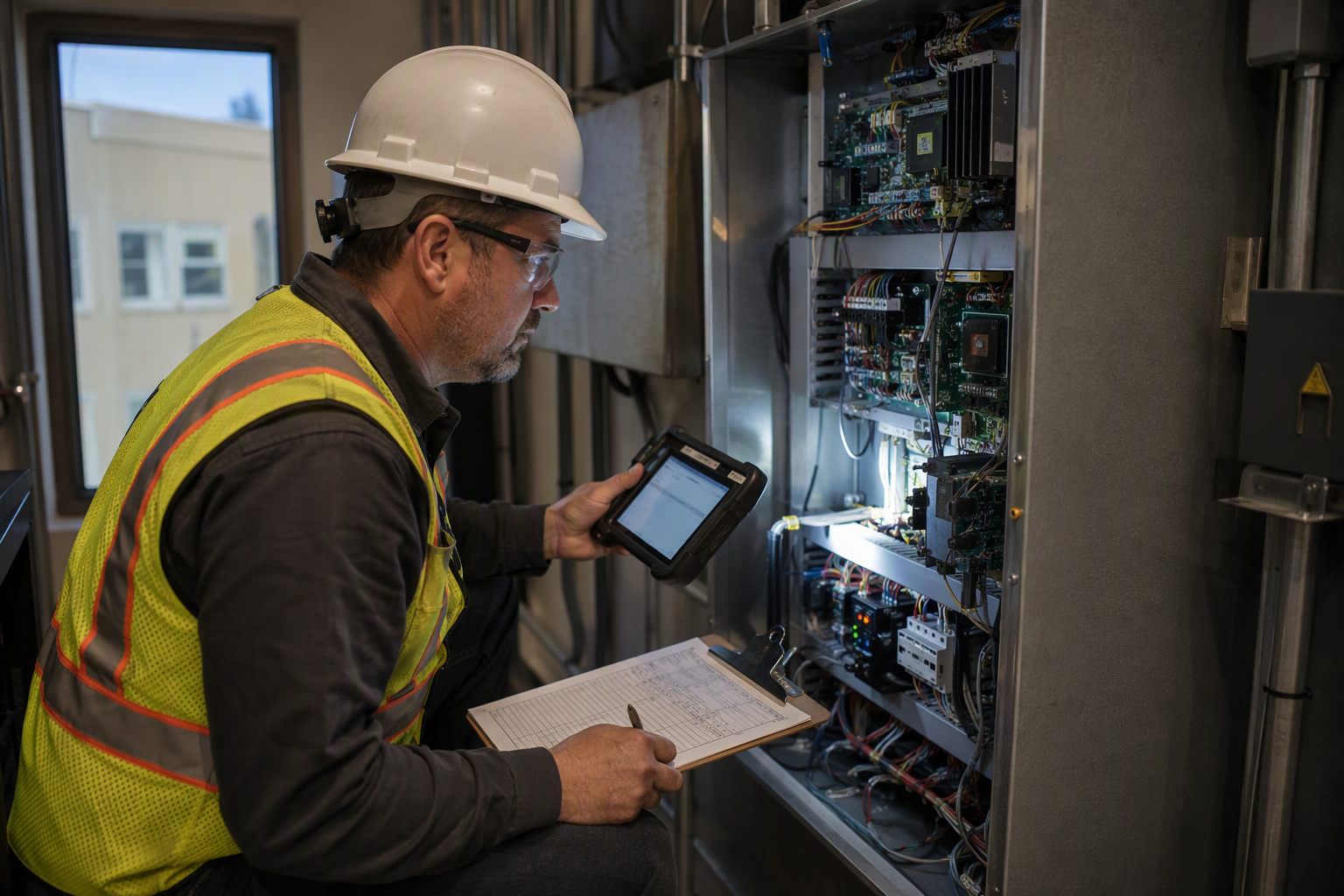
Texas building owners — including school districts and university systems — must have every elevator, escalator, and related piece of equipment inspected annually by a TDLR-registered elevator inspector. The inspector is not a TDLR employee; the building owner has the sole right to select the inspector. After the inspection, the registered inspector must provide the owner with the inspection report within five calendar days.
If violations are cited, the owner must have them corrected or under a written contract to be corrected within 30 days of the inspection, or obtain a formal waiver or delay from TDLR. Any elevator accident must be reported to TDLR within 24 hours.
Texas also requires a Category 5 full-load test every five years on electric (traction) elevators — the type most common in multi-story academic buildings. This test must be performed and documented separately from the annual inspection.
How often must school and university elevators be inspected in California?
California law requires every conveyance — including all school and university elevators — to be inspected at least once a year. Only State of California safety engineers and Certified Competent Conveyance Inspectors (CCCI) may legally perform these inspections. A conveyance found safe receives a permit to operate for up to one year.
Cal/OSHA may issue a permit to operate for up to two years for an elevator in safe condition that is covered by a full maintenance contract with a C-11 licensed elevator company — a meaningful compliance incentive for schools seeking to reduce administrative burden. Arranging the annual reinspection is the elevator owner’s responsibility; the school or university district, not the state, must initiate the process.
What qualifications must maintenance companies hold to work on school elevators?
Texas
In Texas, a person may not install, repair, alter, test, or maintain elevator equipment without first registering as a contractor with TDLR. Texas elevator contractor registrations expire one year after issuance. Each registered contractor must:
- Designate one or two responsible parties with at least three years of elevator contractor experience.
- Carry general liability insurance of at least $1,000,000 per occurrence for bodily injury or death and $500,000 per occurrence for property damage.
Before installing a new elevator or escalator in any Texas building — including a school — the registered contractor must submit plans to TDLR and obtain approval before work begins.
California
In California, any company that installs, alters, tests, maintains, repairs, or services elevators must be certified by Cal/OSHA as a Certified Qualified Conveyance Company (CQCC). Applicants must hold a current C-11 Elevator Contractor license issued by the California Contractors State License Board (CSLB) and provide certificates of workers’ compensation and liability insurance.
Individual mechanics must be certified by Cal/OSHA as a Certified Competent Conveyance Mechanic (CCCM). Only a CCCM working for a CQCC may legally maintain, repair, alter, or replace components on a school or university elevator. CQCC, CCCM, and conveyance inspector certificates last two years and require at least eight hours of continuing education for renewal.
AmeriTex Elevator operates as a data-driven service provider that helps educational facility managers track qualification requirements, inspection schedules, and documentation deadlines across both states.
What happens if a school elevator fails a critical safety check in Texas?
Texas law is unambiguous about two specific deficiencies that require immediate removal from service — meaning the elevator must be taken offline the same day the deficiency is identified:
- A passenger elevator without working door restrictors must be removed from service immediately.
- A passenger elevator without firefighters’ service, or with a non-working Phase One firefighters’ service, must be removed from service immediately.
For school and university buildings where elevator downtime directly affects ADA access for students and employees, these shutdown triggers make proactive maintenance planning essential.
What are the immediate steps a school facility manager should take after an elevator inspection reveals violations?
- Review the inspection report as soon as it is received — in Texas, the inspector must deliver it within five calendar days of the inspection.
- Classify violations by severity: identify any deficiencies that require immediate removal from service under Texas or California law versus those subject to a correction window.
- Take any elevator with an immediate-removal deficiency out of service the same day; post compliant out-of-service signage at each landing.
- Contact a TDLR-registered contractor (Texas) or CQCC-certified company (California) to schedule corrective repairs and obtain a written repair contract.
- In Texas, ensure all violations are corrected or under a written contract to be corrected within 30 days of the inspection, or apply to TDLR for a waiver or delay.
- In California, coordinate with your Cal/OSHA-authorized inspector to schedule a reinspection and restore the permit to operate before returning the elevator to service.
- Update your compliance documentation: Certificate of Compliance (Texas) or permit to operate (California), and store copies in the building’s maintenance file.
- Report any elevator accident to TDLR within 24 hours (Texas requirement).
How does ADA compliance intersect with elevator inspection requirements at schools?
The Americans with Disabilities Act (ADA) requires that elevators providing access for persons with disabilities remain operational and accessible. For schools and universities — which serve students, faculty, and visitors with a wide range of mobility needs — an out-of-service elevator may create an immediate ADA compliance risk alongside the state regulatory violation.
ADA requirements address cab dimensions, control button height and Braille labeling, door timing and reopening force, and audible and visual floor indicators, among other features. When a school elevator undergoes repair or alteration, the scope of work may trigger an obligation to bring the entire elevator into current ADA conformance, not just the altered components. Facility managers planning capital upgrades should account for this “path of travel” consideration early in the project scope.
What ASME standards apply to school elevators in Texas and California?
Both states anchor their regulations to editions of the ASME A17.1/CSA B44 Safety Code for Elevators and Escalators, though the editions differ:
| State | Adopted ASME Edition | Effective Date | Regulator |
|---|---|---|---|
| Texas | ASME A17.1/CSA B44, 2016 edition (as amended by 16 TAC §74.100(b)) | November 1, 2018 | TDLR |
| California | ASME A17.1/CSA B44, 2004 edition (Group IV Elevator Safety Orders) | May 1, 2008 (for contracts signed on or after this date) | Cal/OSHA Elevator Unit |
Source: TDLR Elevator and Escalator Safety program; Cal/OSHA Elevator Unit, California Department of Industrial Relations.
ASME A17.3, the Safety Code for Existing Elevators and Escalators, addresses retrofit and modernization standards for older equipment. Many school buildings constructed decades ago house elevators that were code-compliant at installation but may need evaluation against current ASME A17.3 benchmarks when alterations are planned. Facility managers should discuss the applicable edition with their qualified contractor before initiating any modernization project.
Are there OSHA workplace safety requirements that affect school elevator maintenance workers?
Federal OSHA standards govern the safety of workers performing maintenance and inspection tasks on elevator equipment, including lockout/tagout procedures, confined space protocols, and fall protection requirements. These obligations apply to maintenance contractors working in school and university machine rooms, elevator pits, and hoistways regardless of the state-level elevator code in effect.
School and university facility managers retain a duty to ensure that any contractor performing elevator work on campus complies with applicable OSHA standards, in addition to holding the state-required contractor registration or certification.
What maintenance documentation should schools retain between inspections?
While neither Texas nor California prescribes a universal maintenance logbook format for all situations, well-managed campuses generally retain the following records as a matter of good practice and regulatory readiness:
- Current Certificate of Compliance (Texas) or permit to operate (California), including the original issuance date and expiration.
- All inspection reports received from registered or authorized inspectors.
- Records of every repair, alteration, or component replacement, including the name of the contractor and the date of work.
- Category 5 full-load test reports for traction elevators (Texas: required every five years).
- Documentation of any corrective action taken in response to cited violations, including contracts and completion confirmations.
- Accident reports submitted to TDLR (Texas) or Cal/OSHA (California), where applicable.
Maintaining organized, date-stamped records simplifies reinspection scheduling, supports ADA compliance audits, and protects the institution in the event of a liability inquiry.
What industry trends are shaping school elevator compliance in 2025–2026?
Several qualitative trends are influencing how educational institutions approach elevator maintenance and inspection in 2025 and 2026:
Remote monitoring and predictive maintenance: More campus facility teams are integrating elevator remote monitoring systems that track door cycle counts, motor temperature, leveling accuracy, and other performance indicators between inspections. These tools allow maintenance teams to identify developing issues before they become code violations or service outages — particularly valuable in schools where an unexpected shutdown can strand wheelchair users between floors.
Code modernization pressure: California’s proposed Group V Elevator Safety Orders — which would incorporate elements of ASME A17.1-2019 — represent a significant potential shift for facilities whose elevators were installed or last modernized under older requirements. Educational institutions with aging elevator inventory should monitor the California Standards Board rulemaking process and begin assessing what modernization work a code update might require.
Increased ADA enforcement attention: Higher-education institutions in particular are facing greater scrutiny around accessibility program access, and elevator availability is frequently cited in ADA complaints. Proactive maintenance programs that minimize unplanned outages are increasingly viewed as a risk management tool, not merely a facilities obligation.
Sustainability and energy efficiency in modernization: Schools and universities pursuing sustainability goals are incorporating elevator modernization — including regenerative drives and LED cab lighting — into broader capital upgrade programs. These projects trigger plan-approval requirements (TDLR in Texas, Cal/OSHA in California) and must be executed by qualified contractors.
Workforce and scheduling complexity: Coordinating annual inspections, five-year load tests, and corrective repairs around an active academic calendar — with minimal disruption to students and staff who depend on elevator access — requires earlier scheduling than many facility managers historically practiced. The tightening pool of TDLR-registered and CQCC-certified contractors reinforces the value of establishing long-term service relationships with qualified providers.
AmeriTex Elevator helps educational institutions in Texas and California stay ahead of these trends by providing structured maintenance programs aligned with current TDLR and Cal/OSHA requirements.
Do Texas elevator regulations apply to portable or temporary lifts used at school events?
Texas Health and Safety Code Chapter 754 and 16 Texas Administrative Code Chapter 74 apply to the categories of equipment defined within those statutes and rules. Facility managers considering temporary or portable lift equipment for events should confirm with TDLR whether a specific piece of equipment falls within the regulated category before deployment. Equipment that falls outside federal government ownership and is not a single-family dwelling lift generally warrants a TDLR inquiry.
What exemptions exist under Texas and California elevator law that might apply to school buildings?
Both states include limited exemptions, but neither is likely to apply to a typical school or university:
- Texas: The elevator law does not apply to equipment in buildings owned and operated by the federal government. TDLR also does not regulate elevators in single-family dwellings, except that state law requires an inspection by a TDLR-registered inspector after installation. Standard K–12 school buildings and university facilities do not qualify for either exemption.
- California: The elevator law exempts conveyances under federal jurisdiction and conveyances in single-unit private homes not accessible to the public. Again, campus elevators accessible to students, faculty, staff, and visitors do not qualify.
How can AmeriTex Elevator support school and university compliance programs?
AmeriTex Elevator serves educational institutions across Texas and California as a data-driven maintenance and compliance partner. Campus facility teams working with AmeriTex Elevator gain structured support for:
- Coordinating annual inspections with TDLR-registered inspectors (Texas) and Cal/OSHA-authorized inspectors (California) within the academic calendar.
- Scheduling and documenting Category 5 full-load tests for traction elevators on the required five-year cycle (Texas).
- Ensuring all maintenance work is performed by TDLR-registered contractors (Texas) or CQCC-certified companies staffed by CCCM-certified mechanics (California).
- Managing corrective action timelines to meet the 30-day correction window in Texas.
- Supporting ADA accessibility compliance alongside state-code compliance.
- Monitoring the California Group V rulemaking process and advising on modernization implications.
Summary: Key Compliance Obligations for School and University Elevators
| Requirement | Texas | California |
|---|---|---|
| Inspection frequency | Annually (TDLR) | At least annually (Cal/OSHA) |
| Compliance credential to display | Certificate of Compliance (posted in publicly visible building area) | Permit to operate (posted conspicuously in elevator car) |
| Inspector qualification | TDLR-registered elevator inspector | Cal/OSHA safety engineer or Certified Competent Conveyance Inspector (CCCI) |
| Contractor qualification | TDLR-registered contractor | Certified Qualified Conveyance Company (CQCC) with C-11 license |
| Mechanic qualification | Not separately verified — confirm with TDLR | Certified Competent Conveyance Mechanic (CCCM) |
| Periodic load test | Category 5 every 5 years (traction elevators) | Per ASME A17.1-2004 requirements |
| Violation correction window | 30 days (or TDLR waiver/delay) | Reinspection required; permit restored upon compliance |
| Accident reporting | Within 24 hours to TDLR | Per Cal/OSHA reporting requirements |
| Adopted ASME standard | ASME A17.1-2016 | ASME A17.1-2004 |
| Local program exception | City of Houston (own program) | City of Los Angeles / LADBS (own program) |
Sources: TDLR Elevator and Escalator Safety; Cal/OSHA Elevator Unit; ASME A17.1/CSA B44.
Get Expert Elevator Compliance Support for Your Campus
Navigating annual inspection deadlines, Category 5 load test cycles, corrective action windows, and ADA requirements across a multi-building campus is a substantial administrative and operational challenge. AmeriTex Elevator works with school districts and university facilities teams across Texas and California to build structured, calendar-driven compliance programs tailored to the specific requirements each state imposes.
Contact AmeriTex Elevator for a free elevator assessment: 866-679-4313
Need elevator service you can rely on? AmeriTex Elevator is ready to help.